Ecuador has 65 oil and gas lease blocks, 88% of them in the Amazon, covering a quarter of the country’s total area. That’s according to a new data set from the Stockholm Environment Institute (SEI).
Many of the lease blocks overlap with several Indigenous territories, including the Cuyabeno-Imuya Intangible Zone, which is home to 11 Indigenous communities from the Secoya, Siona, Cofán, Kichwa and Shuar nations. Oil and gas leases also overlap with other Indigenous Shuar communities in Pastaza and Morona Santiago provinces, among others.

A Mongabay estimate based on the dataset found that roughly 21% of the leases overlap with protected areas and 61% overlap with Indigenous territories in Ecuador. Image by Andrés Alegría/Mongabay.
The SEI data set also shows lease blocks overlapping with protected areas, including the west side of Yasuní National Park. In a historic referendum in 2023, more than 5.2 million Ecuadorians voted to halt all current and future oil drilling in the park. Cofán-Bermejo Ecological Reserve (RECB) and Cuyabeno Wildlife Reserve, both home to a great diversity of wildlife including pink river dolphins (Inia geoffrensis) and jaguars (Panthera onca), also host active oil and gas production blocks, according to the data.
Combined, the blocks cover 7 million hectares (17 million acres), one-fourth of Ecuador’s total land area.
Alexandra Almeida, president of Ecuadorian environmental organization Acción Ecológica, told Mongabay via WhatsApp messages that the chemicals used for oil production are highly toxic to both the environment and human health. “Many of these are released into the environment without any treatment, contaminating water and soil,” she said.
Numerous studies have shown that exposure to such toxic substances is associated with a host of health problems, from respiratory issues and cardiovascular diseases to miscarriage and cancer.
According to the data set, some lease blocks lie along active seismic faults, which increases the risk of landslides and damage to pipelines and wells. In April 2020, seismic activity and landslides caused the Trans-Ecuadorian Oil Pipeline System (SOTE) to rupture. As a result, more than 15,000 barrels of oil spilled into the Coca River, impacting more than 27,000 Indigenous people.
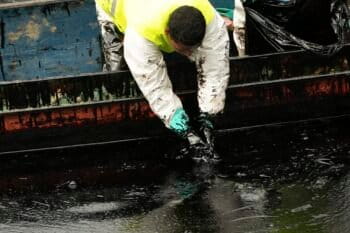
A March 2025 rupture in the SOTE released 25,000 barrels of oil that polluted three rivers, killed wildlife and affected more than 5,000 people in northwestern Esmeraldas province, one of the country’s poorest regions.
Nearly a year later, the environment and local people continue to feel the impacts, Almeida said.
“According to our monitoring, there is still contamination — the rivers can’t be used,” she said. “The fish are contaminated because the [toxic] substances enter the food chain. They bioaccumulate.”
Mongabay reached out to Ecuador’s environment ministry and energy ministry for comment, but neither had responded by the time this story was published.
Banner image: State oil company workers clean up the Viche River in Ecuador’s Esmeraldas province on March 15, 2025, after an oil spill triggered by a mudslide that fractured a pipeline. Image by AP Photo/Dolores Ochoa.


















 A Mongabay estimate found that, based on the data set, 17% of the leases in Peru, or 5.85 million hectares (14.47 million acres), overlap with protected areas and 25.6%, or 12.36 million hectares (30.54 million acres), overlap with Indigenous territories. Image by Andrés Alegría/Mongabay.