The Service Learning Elective Course (SLEC) serves as an optional class for NICE Program students, offering hands-on learning experience while giving back to the community. Students of the Fall 2025 10-Week NICE Program participated in the course, having the chance to engage in three memorable excursions: Lyon Arboretum, Kanewai Loi, and Malama Maunalua. Throughout each visit, students learned directly about the environmental and cultural histories of each site before engaging in their volunteer work.


Meet four students: Ren Miyashima, Hono Murata, Chihiro Hara, and Saita Iwasaki. Each student is a Service Learning Elective Course participant all based from Ryukoku University in Osaka, Japan. Service Learning not only stood out as an opportunity for the students to be more community-oriented, but also to practice their English speaking.
Saita reflected on his experiences being able to work with indigenous plants throughout the course. As an individual volunteer service activity, Saita had chose to research about the origins of each excursion site and the environmental issues each faces with comparison to Japan.

“I learned through service learning about original Hawaiian nature and history, and the relationship between nature and the people who live in Hawaii.”
Chihiro offered a different perspective in her Service Learning reflection. Her reasoning for electing to choose a volunteer service activity, was to not only learn about Hawaiian nature and invasive species, but learn how its significance connects to the people. Engaging with local communities allowed Chihiro to overcome shyness and gain greater confidence when speaking English in a foreign setting.
“I think it (English ability) improved because I grew to speak with more initiative, and when I speak with my host family in English, I can enjoy speaking better than I thought.”

One of the most notable Service Learning activities was the Kanewai Lo’i excursion. This service event is a recurring community workday on the first Saturday of each month. Volunteers help with planting, weeding, cleaning streams, and maintaining the quality of taro patches across the university.
Ren picked the Loʻi not only as his most memorable experience in the Service Learning Elective Course, but throughout his time collectively in Hawaii. Some notable areas that Ren highlighted was learning about the background and historical significance the Loʻi Patch has on local communities. These experiences helped Ren grow fonder of Hawaiian culture and become easier-going when communicating with locals.

“[Aloha] spirit, I like. I like the relaxed and easygoing thoughts of local people.”
As an individual activity, Ren chose to volunteer alongside other UH Mānoa students for a beach clean-up event at Ala Moana Beach Park. Having never been to Ala Moana Beach, Ren decided to use this opportunity to not only explore more of what Hawaii has to offer, but connect with community-oriented individuals.
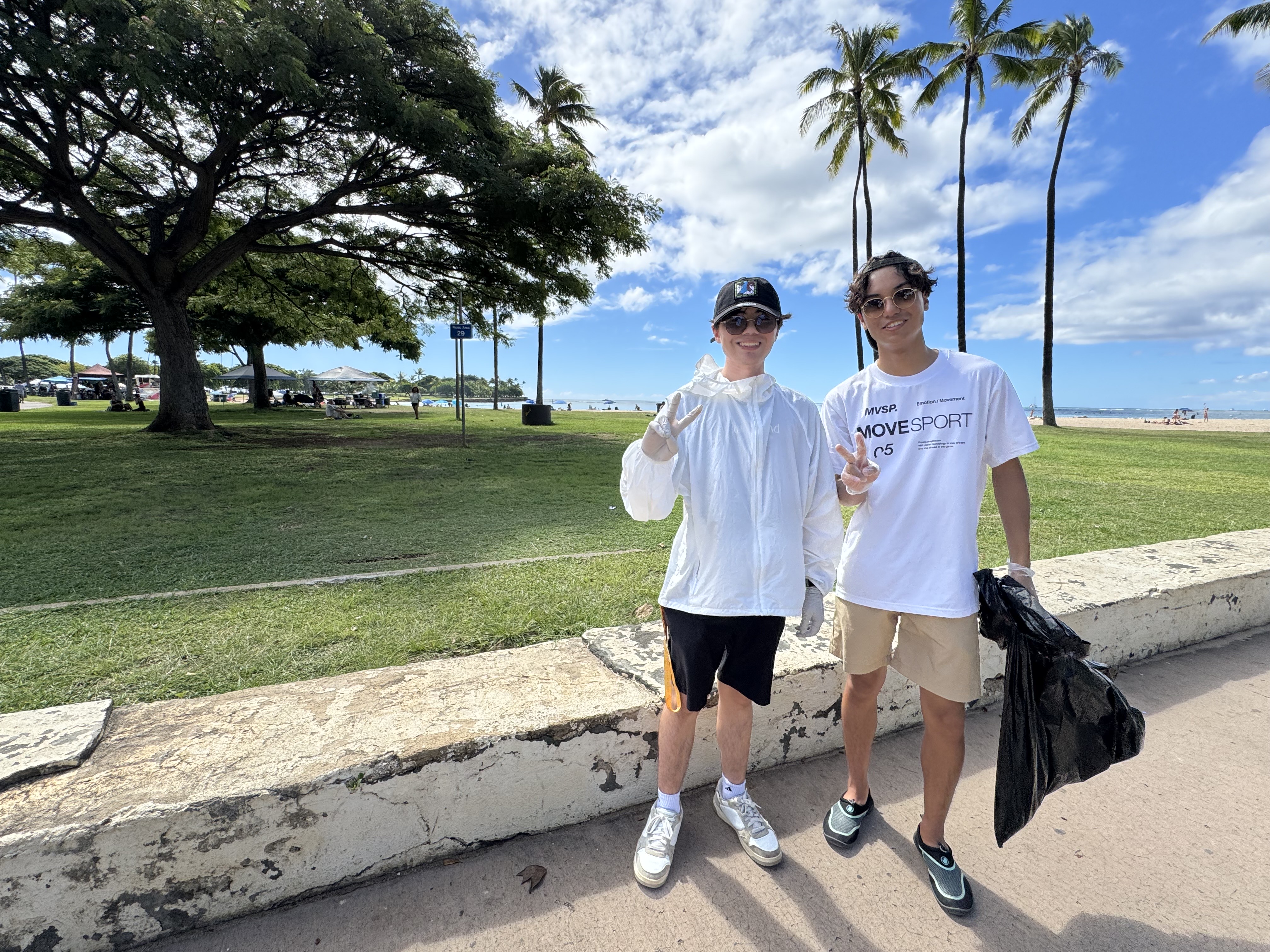

Ren Miyashima (right in both photos) at the Ala Moana Beach Park Clean-Up.
The last of our four students, Hono, took pride in contributing all her efforts to the individual activity project. Hono desired to work in an opportunity that was meaningful to her and involved close ties with her host family members based in Hawaii. She enjoyed a great deal of fun excursions with her family, along with visiting the north shore for the first time.
“It [SLEC] was interesting…communication with local people are [very] difficult, but I can improve my English skills a little bit, so [it was] fun.”

Hono chose to do her individual activity on an environmental initiative at Kuilei Cliffs Beach, located alongside Diamond Head Crater. Throughout this project, Hono identified and pulled out invasive plant species to help raise awareness for the overall and protection and thriving of native plants.
Congratulations to each of these students for the successful completion of the Fall 2025 10-Week NICE Program and we hope SLEC has had a lasting impact beyond the classroom experience.
The next Service Learning Elective Course will begin in April. For more information please contact ipinfo@hawaii.edu.




 NICE Program
