German Gas Crisis…Chancellor Merz Allegedly Bans Gas Debate Ahead of Elections!

It’s not even mid February, and Germany’s gas storage buffer is already down to 25.5% full, and faces rationing. 

LNG Supply Blocked By Sea Ice

German authorities hope to avert a supply shortage by importing gas from the Netherlands and Norway, and shipments of LNG. However, according to Blackout News, the LNG terminal on the island of Rügen is currently out of operation due to a thick layer of ice in the Prorer Wiek and the port of Mukran. Because the shipping channel is no longer safe to navigate, LNG tankers are unable to enter or leave the terminal.

The Federal Maritime and Hydrographic Agency (BSH) reports that wind is pushing the ice together, narrowing the channels. Additionally, navigation buoys have been displaced or pushed under the ice, making safe passage nearly impossible for large tankers.

Critically Low Storage Levels

In an Apollo News interview with Stefan Spiegelsberger, several critical factors are highlighted that threaten the German gas supply.

Spiegelsberger points out that gas storage levels are already very low (approx. 25.5% as of February 10) and, with a daily withdrawal rate of about 0.7% per day, they are rapidly approaching the critical limit of 20%. Below this mark, the pressure in the storage facilities drops so significantly that sufficient withdrawal becomes technically difficult, which can lead to a gas shortage, especially during cold snaps.

Consequence Of Coal, Nuclear Phaseout

Another central problem is that since the shutdown of nuclear power plants, Germany has had to use significantly more gas for electricity generation, thus diverting large amounts of gas away from the heating and industrial markets, emptying storage facilities faster than in previous years.

Germany’s energy woes were compounded by the country’s move away from coal and nuclear power as part as its transition to green energies. According to Spiegelsperger, “We have switched from nuclear and coal now mainly to gas; every day we produce an average of between 15 and 20 GW with gas-fired power plants, which naturally causes the problem that we are now in this—perhaps soon to be—gas shortage situation…”

Merz Bans Gas Debate!

According to the YouTube channel by Alexander Raue, the situation in Germany is so dismal that Chancellor Friedrich Merz has reportedly issued an official ban on debating the current gas crisis until the end of March in order to avoid negatively affecting the ongoing election campaigns.


Image

Pollen Reconstructions Show The Last Glacial’s Warming Events Were Global, 10x Greater Than Modern

“D–O signals [10-16°C warming events within decades to centuries] are not just seen in Greenland – they are registered globally.” – Liu et al., 2026

From 57,000 to 29,000 years ago, with Last Glacial atmospheric CO2 concentrations flatlining at ~200 ppm, there were 11 instances when Greenland abruptly warmed by 10-16°C within a span of just 50 to 200 years (Liu et al., 2026).

Wide-ranging pollen-based temperature and precipitation reconstructions affirm these Dansgaard-Oeschger (D-O) events did not just occur in Greenland, they were realized across the globe.

Winter warming intervals of 2-5°C and up to 5-20°C within decades (centuries) also occurred at pollen sites in Asia, Europe, South and Central America, Africa, Middle East, and Australia.

Thus, there is nothing remotely unusual or unprecedented about the rate or magnitude of modern global warming.

Image

Image Source: Liu et al., 2026

Germany’s Natural Gas Storage Level Dwindles To Just 28%… Increasingly Critical

The article from Blackout News, published on February 5, 2026, warns that the energy situation in Germany is becoming increasingly critical, with a significant rise in the risk of a gas shortage.

Image

Gas storage running out. Symbol image generated by Grok AI

Politicians, media lying about “harsh winter” being the cause of the shortage… Reality: Mismanagement is to blame…Germany was never even prepared for a WARM winter!

By late January 2026, German gas storage levels had dropped to approximately 32.75%. As of today, February 6, 2026: the storage fill levels are at only 28.1%. And things risk getting much worse.

Neighboring countries are at their limits

In an article, Blackout News highlights several factors contributing to this precarious situation. Firstly. Germany’s most important supplier via pipeline, Norway, is reaching its technical limits and Germany cannot “simply order more” because the pipelines are already operating near maximum capacity.

Secondly, the Netherlands, often viewed as a backup source, currently has even lower storage levels than Germany. In a crisis, nations prioritize their own supply, making additional exports to Germany unlikely.

US LNG won’t make a dent

Germany cannot also rely on LNG supplies from USA as severe cold snaps increase global competition for LNG, making it either unavailable or prohibitively expensive on the world market.

The situation is dire, according to Blackout News: “With constant, typical winter consumption, the remaining gas reserves in a tense scenario will only last for a maximum of about six weeks.”

Solar and wind not coming through

Another problem are the periods of low wind and solar output (known as a Dunkelflaute), which act as a “multiplier” for the crisis. During these times, gas-fired power plants must run longer to compensate for the lack of renewable energy, further depleting reserves.

Myth: Cold, harsh winter
Fact: Current winter significantly warmer

Politicians are blaming “the cold winter” for the woes. But the real reason is the country’s catastrophic energy supply mismanagement, especially the transition to green energies.

Based on recent meteorological data from the German Weather Service (DWD), the winter of 2025/26 (up to early February) has been significantly warmer than the 1961–1990 reference period, which the DWD likes to use when reporting its monthly climate reports.


Image

New Study Rebuts The Assumption That Anthropogenic CO2 Molecules Have ‘Special’ Properties

The Intergovernmental Panel on Climate Change (IPCC) has for decades advocated net-zero governmental policies to reduce anthropogenic CO2 (aCO2) emissions.

This advocacy is rooted in the non-physical assumption that aCO2 molecules are special, as they remain in the atmosphere for decades to centuries.

Proponents of the anthropogenic global warming (AGW) narrative even claim aCO2 removal can “take up to several hundreds of thousands of years.”

While AGW proponents insist that “once in the atmosphere, carbon dioxide can continue to affect climate for thousands of years,” they (and the IPCC) simultaneously acknowledge the residence time of “natural” or non-anthropogenic CO2 is only about 4 years.

In reality, a new study references the Equivalence Principle in emphasizing nature’s sinks indiscriminately and equivalently absorb both aCO2 and natural CO2 in about 4 years (Müller, 2025). There is no physical reality for IPCC claims of “specialized” absorption time for aCO2 vs. natural CO2 molecules.

The IPCC assumes exactly 50% of aCO2 emissions remain in the atmosphere for decades to millennia. It is consequently assumed net-zero policies that propose to halve aCO2 emissions will lead to the stabilization of atmospheric CO2 concentrations. Because “anthropogenic CO2 has the same [4-year] residence time of natural CO2,” this assumption is physically invalid.

Net-zero policies will literally have no detectable effect on atmospheric CO2 concentrations. In sum, “the IPCC’s assumptions and fundamentals are wrong.”

Image

Image Source: Müller, 2025

Climate Scientist Who Predicted End Of “Heavy Frost And Snow” Now Refuses Media Inquiries

Refusing to comment on his past alarmist climate predictions…

More than two decades ago, renowned climate scientist Mojib Latif of Germany’s Max Planck Instiute for Meterology, based in Hamburg, warned the climate-ambulance chasing Der Spiegel that, due to global warming, Germany would likely no longer experience harsh winters with heavy frost and snow as it had in previous decades.

Image

Spiegel reported climate scientist’s prediction of harsh winters disappearing due to man’s activities. Image cropped here

In light of the current severe winter weather in Germany, Latif’s statements are facing renewed scrutiny. An article appearing in the Berliner Zeitung here notes that Latif’s prophecy has “aged poorly” and he appears to want to have nothing to do with them.

Hiding from the media

According to the Berliner Zeitung, the former Max Planck Institute scientist has recently stopped responding to media inquiries regarding his past claims. Critics argue that such drastic predictions damage the credibility of climate science, while others point out that extreme weather events—including intense cold snaps—can still occur within the broader context of climate change.

No Easter snow as well

Latif also claimed he recalled snow in the past occurring at Easter time, implying this no longer happens today. But that too was a false claim. perhaps prof. Latif will answer phone calls in April?


Image

Polar Bear Numbers Rising And Health Improving In Areas With The Most Rapid Sea Ice Decline

“[S]ea ice loss did not lead to a reduction in BC [body condition] among adult BS [Barents Sea] bears. Rather, after around 2000…both males and females of different reproductive categories increased in body condition for the following two decades.” — Aars et al., 2026

Thick sea ice is not a necessary condition for polar bear health and survival.

As local residents regularly observe, today polar bears successfully hunt bearded seal “when sea ice is absent.”

They also routinely feed on harbour seals, walrus, and reindeer throughout the summer.

Consequently, despite the expectation that a reduction in sea ice would harm polar bear populations, not only has the body condition (BC) of Svalbard bears improved since 2000, “the population has been increasing” for the last 50 years.

Interestingly, Svalbard polar bears – especially males – in the colder northern regions with thicker sea ice are in worse body condition (shown in blue) than bears in the warmer southern regions (red).

Image

Image Source: Aars et al., 2026

One Reason Only For Germany’s Heating Gas Crisis: Its Hardcore-Dumbass Energy Policy

Germany approaching energy state of emergency…shutdown of heavy industries. The consequence: another economic body blow the country cannot afford…gross policy negligence

As Germany’s heating gas supply becomes increasingly tense and nears emergency low levels, policymakers will likely blame a “colder than normal winter.”

But that claim will not hold. The real reason: It is what the Wall Street Journal called in January, 2019, the “World’s Dumbest Energy Policy” . However, since 2019, Germany’s energy policy has gotten even worse — much worse –going from the dumbest to simply hardcore dumbass. There’s no other grade to assign here.

From dumbest to hardcore dumbest

Since 2019, Germany not only stopped producing reliable, cheap and CO2-free nuclear-powered electrcity, but has since cut off its cheap supply from big bad Russia. The consequence: the heating gas supply is now close to running out and it’s only the end of January. A crisis is looming.

According to the online “Initiative Energien Speichern (INES) site here, the natural gas storage level is currently down to a measly 32.7%. Experts warn that the critical level of 20%, a point where pressures become too low to ensure adequate supply, will be reached in as little as 3 weeks.

Image

Image cropped at INES

Gas Emergency Plan

If Germany’s gas storage fall to 20% in February, as now expected, the country will be in a serious but planned-for situation. Under current German law and the Gas Emergency Plan (Notfallplan Gas), specific protocols will be triggered to prioritize human lives and essential services.

Industry facing mandatory shutdown

Under German and EU law, private households are classified as “protected customers;” which means the state is legally required to prioritize them. As the storage levels become extremely low, the government will have to cut off gas to heavy industry, power plants, and large commercial users. This would have enormous economic repercussions.

Overall, Germany has three alert levels. If storage hit 20% and supply is deemed insufficient for the remainder of the winter, the government will have to declare the third and highest level: the Emergency Level. In this case, the Federal Network Agency (Bundesnetzagentur) becomes the “federal load distributor, and will take control of the gas market and decide who gets gas and who does not. In this case, the agency issues orders to large industrial consumers to reduce or stop their gas intake.

20% fill level means less gas flows

As already mentioned, the real risk of low storage isn’t just “running out” of gas molecules; rather it is a loss of system pressure. Gas storage facilities need a certain amount of “cushion gas” to maintain the pressure required to push gas into the pipelines. If storage falls too low, the speed at which gas can be withdrawn slows down. This is why the government has to step in early to manage demand.

Summary

Under almost any realistic scenario involving a 20% storage level, which now appears unavoidable, the government has to force industries to shut down to ensure that homes, school and emergency services continue. The main consequence of a 20% storage is a severe economic hit.

This is, in large part, the consequence of Germany’s ideologically insane adoption of the radical Energiewende: transitioning to green energy no matter what the costs are.

Maybe president Trump will step in and bail out Germany by supplying LNG.

February will be a suspenseful month!


Image

130 Years Later: The CO2 Greenhouse Effect Is Still Only An Imaginary-World Thought Experiment

Modern climate science is constructed on a foundation of belief.

Svante Arrhenius is known as the “godfather” of the CO2 greenhouse effect. Today’s climate models are still based on his 1896 thought-experiment calculations of CO2’s imagined capacity to warm Earth’s surface (71% water) out of a frozen solid state by tens of degrees.

His one-dimensional model “assumed a state of equilibrium” for all other climate factors except CO2. In other words, the model does not account for changes in albedo, insolation, cloud cover, or relative humidity (Anderson et al., 2016). Instead, these climate parameters remain perpetually constant.

“The calculations involved balancing the radiative heat budget (thereby assuming a state of equilibrium), namely solar radiation arriving at the Earth’s surface (including the effect of albedo from clouds and the Earth’s surface)…”

“He assumed constant relative humidity within the atmosphere…”

“The cloud fraction remained fixed, as did the relative contributions of land, sea, ice, and cloud to overall albedo.”

Thus, the Arrhenius conceptualization is rooted in an assumed “state of equilibrium” that does not exist in reality. An imaginary world.

Image

Image Source: Anderson et al., 2016 and Arrhenius, 1896

Even those who rigorously defend and extol Arrhenius’s work admit his model is so primitive it cannot even represent heat transfer processes.

“The simplicity of the model meant that there was no possibility of representing changes in heat transport…”

Arrhenius even claimed moon temperatures are almost equal to Earth temperatures in his 1896 paper.

“Now the temperature of the moon is nearly the same as that of the Earth.”

He also claimed doubling CO2 levels (300 to 600 ppm) warms the ocean 5-6°C, and tripling CO2 results in an 8-9°C warmer ocean surface. There is no real-world observation supporting an assertion that doubling or tripling the CO2 in the air above a body of water results in these temperature changes.

To top it off, the “godfather” of modern climate science surmised it would take 3,000 years to double the atmospheric CO2 concentration.

“Arrhenius remarked that a doubling of CO2 would occur three-thousand years hence.”

Imaginary-world models are untestable and thus unfalsifiable. The unfalsifiability of a claim necessitates it is no more than a belief.

New Study Affirms Rising CO2’s Greening Impact Across India – A Region With No Net Warming In 75 Years

Decades of satellite data confirm the globe has been substantially greening – as defined by rising Leaf Area Index (LAI) values – since the 1980s.

The CO2 fertilization effect (CFE) enhances plant productivity via improved light use efficiency and water use efficiency. In other words, with elevated CO2, photosynthesis rates are not as hampered as they would be when sunlight and water availability are limited.

A new study indicates India is the second largest contributor to global greening, and that CFE has driven a “substantial expansion of global green cover  over the last two decades.”

The authors found the CFE has “nearly doubled” the trend values in net primary production [NPP] across India relative to the trend values when the CFE is not considered.

Interestingly, despite the elevated CO2, much of India has been cooling since 2000. While the southern peninsula and parts of eastern India have been warming this century, “central and northwestern regions experienced a cooling trend.”

It should be noted that India’s annual mean non-warming trend has been ongoing since 1950 (as shown in Sanjay et al., 2020).

Image

Image Source: Das et al., 2026

Image

Image Source: Sanjay et al., 2020

Germany’s Natural Gas Crisis Escalates … One Storage Site Near Empty …Government Silent

Germany’s shift to green energy has really turned into a nightmare.

It’s the dead of winter and already the first heating gas storage facility in Germany is near empty, only 6% full!

Image


Storage facility. Symbol image generated by Grok

Germany desperately needs to pray for a warm February miracle if the country is to avoid an energy disaster and a state of emergency. 

Currently, there’s no danger to private households as their supply is guaranteed. The risks, however, are for industry. Should storage levels drop to even more dangerously low levels, then energy-intensive industry will be forced to shut down — a step that would cripple the already struggling German economy.

Bavarian gas storage levels at critical lows

No place is as critical as in the southern state of Bavaria. Apollo News describes a worrisome situation regarding Bavarian natural gas storage facilities, where fill levels are now significantly below legal requirements.

While the Federal Government mandates a fill level of 40% for Bavarian storage facilities by February 1st (due to their strategic importance for Southern Germany), the actual average in Bavaria is currently just 25%.

Only 6% full – virtually empty!

The situation is particularly dramatic at the Wolfersberg storage site, which is filled to less than 6%, making it effectively empty. Other sites like Inzenham-West (under 19%) and Bavaria’s largest facility, Breitbrunn (approx. 20%), are also far below the target.

Germany-wide levels dip below 38%

Across Germany, the situation is hardly better. Total storage levels have fallen below 38%. According to the “Natural Gas Emergency Plan,” levels below 40% are officially classified as “critical.” Yet, the German government and media continue to keep silent on the issue, which is only spawning and fueling conspiracy theories. There are reports that the government has stopped updating  storage levels.

Industrial hubs face shutdowns

Since Germany’s largest storage facilities are located in the North (Lower Saxony/North Rhine-Westphalia), the Upper Bavarian sites (representing about one-eighth of total capacity) are essential for supplying the industrial hubs of Southern Germany.

In neighboring Austria, storage levels remain significantly higher at approximately 50%.


Image

Polar Colding…Antarctica Saw Its Coldest October In 44 Years!

Record cold at the South Pole … Amundsen-Scott Station records -61.3°C … coldest October temperature in Southern Hemisphere since 1981.

The German, realist European Institute for Climate and Energy (EIKE) presents its latest video on the subject of Antarctica and contrasts the new records with mainstream media coverage of climate change.

On October 15, 2025, the Amundsen-Scott South Pole Station reported a record low temperature of -61.3 degrees Celsius, marking the coldest October temperature measured in the Southern Hemisphere since 1981.

Built on the Antarctic plateau, 2,835 metres above sea level, the station’s all-time low is -82.8°C. Since the seasons are reversed in the southern hemisphere, the Antarctic continent was already in spring in October and should have  experienced rising temperatures – at least no lower than in the deep southern winter in August.

The EIKE video criticizes German media outlets (such as “Die Zeit”) for focusing primarily on melting ice and rising sea levels while allegedly ignoring current record-low temperatures in their reporting.

Despite the record cold temperatures on land, Antarctic sea ice reached an extent of only 17.81 million km² in September 2025—the third-lowest value since satellite measurements began.

EIKE argues that no clear, short-term conclusions about global climate development can be drawn due to the contradictory nature of the data (record cold vs. low sea ice).


Image

New Study: Sea Levels Rose 20 Times The Modern Rate During The Roman Warm Period

“[D]uring the last 6 ky, repeated, meter-scale, rapid (<300 y) rises alternated with meter-scale falls…interpreted as global.” – Higgs, 2026

A new study uses excavation evidence (wall ruins, coins, pottery) to suggest sea level rise (SLR) rates reached ~4 m in ~70 yrs (60 mm/year, or 20 times the modern rate of 3 mm/year) from 430 to 500 CE across southern England.

Sea levels reached 3 m higher than today ~1500-2000 years ago, concurrent with the Roman Warm Period. Consequently, the coasts were 1.5 – 3 km farther inland versus today at this time.

Sea level falls were similarly rapid (for example, ~2 m in less than 100 years). Indeed, “dozens of authors found further evidence for Holocene SL [sea level] fluctuations of up to 5 m.”

These SLR rates were absolute or eustatic (due to water loading from melted ice sheets), and the fluctuations were likely global in scale. Similar meters-per-century SLR rates occurred in New Zealand, France, Brazil, and Florida (USA) during this period.

Image

Image Source: Higgs, 2026

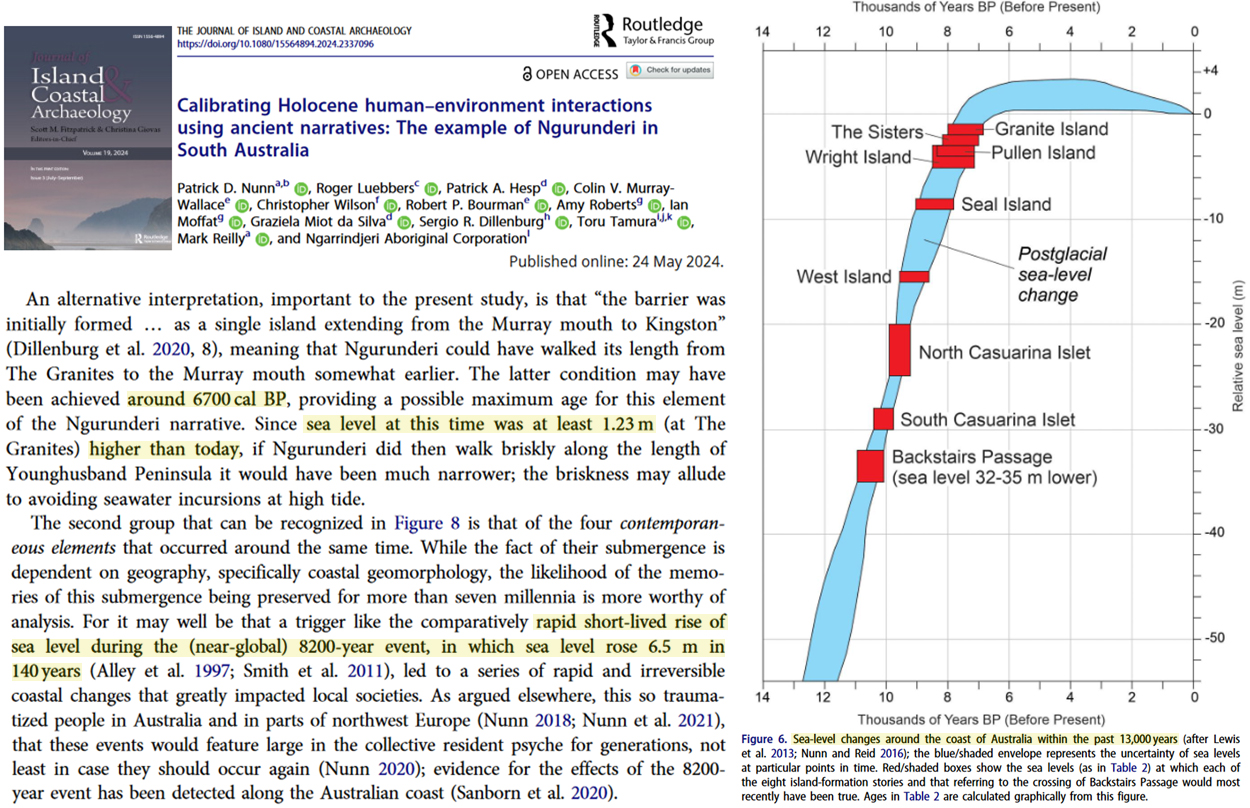
A 2024 study indicated that, 8200 years ago, near-global sea levels rose 6.5 meters in a span of just 140 years. This is 470 centimeters per century, 4.7 centimeters per year, during a period when CO2 levels were alleged to be a “safe” and stagnant 260 ppm.

Image

Image Source: Nunn et al., 2024

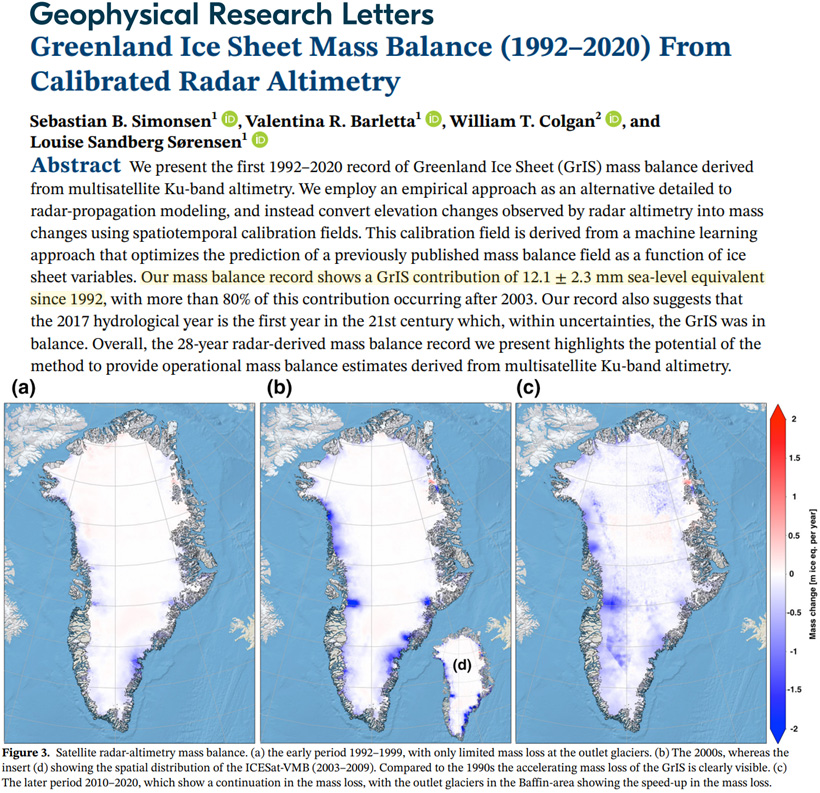
The net melt of the Greenland ice sheet (GIS) is thought to have been the largest contributor to sea level rise in recent decades. But, to put the GIS change in context, the entire ice sheet melt contribution to sea level rise was just 1.2 total centimeters from 1992-2020 (Simonsen et al., 2021).

Image

Image Source: Simonsen et al., 2021

By continuing to use the site, you agree to the use of cookies. more information

The cookie settings on this website are set to "allow cookies" to give you the best browsing experience possible. If you continue to use this website without changing your cookie settings or you click "Accept" below then you are consenting to this. More information at our Data Privacy Policy

Close