Farewell to 2019

Image

In preparing for the post, I read over my previous “farewells”. I realized my reflection on the year is largely the same as in 2018. I’m still frustrated with my creative output. I wrote no fiction at all this year, and while I’ve devoted most of my free time to artwork, I’m still not happy with my finished pieces. The house I’ve been building since 2018 still isn’t finished. Lay on that trouble sleeping and it hasn’t felt like a great year.

But, on balance, I should be more positive about my art. I picked up watercolour painting this year and fell in love with it. I took another go at the Inktober drawing exercise and that’s where I could make a real comparison to my last attempt in 2017. The ink drawings this time were much, much stronger, from broad composition down to linework. Clearly, I’ve improved a great deal, even when it’s not immediately apparent to me that this is happening.

My inability to come up with story ideas has weighed heavily on me and I’m not sure how to deal with it. I think I tied too much of my identity to writing and to creative accomplishments when my spotty publication history should have warned me that was a bad idea. Only now has the tug towards stories started again, but actually getting all of that down on the page is another struggle.

That all being said, here is my usual rundown of things I personally thought were the best things from the year.

Continue reading “Farewell to 2019”
Inktober 2019

I did Inktober this year. Noticeable improvements from the last time I did this in 2017: better use of volumes, more expressive and varied characters, more unusual and interesting compositions. Using just one sketchbook helped; my art supplies are better,my use of them more controlled.

Thumbnailing was important, as last time. Every day, I became a little more ambitious and had to try out sketch after sketch before hitting on the exact right feel. Each day, the drawing took longer to complete. I think that work shows in the final pieces.

Unlike last time, I feel have the technical skills for drawing a comic now. Maybe when the ideas start coming again.

A second pilgrimage

Image

The Scott Pilgrim series (2004 – 2010) is one of the most influential things to come out of Canadian comics. It captures the thrust of new artistic movements in the medium and storytelling modes in the first decade of the millennium. Bryan Lee O’Malley draws on video games and manga for its form – the six volumes are all made to imitate Japanese comic releases from the size to the panel formatting – while still retaining a unique look that distinguishes it from its inspirations.

Continue reading “A second pilgrimage”

Memory in the City of Women

Image

My experience with novels that have multiple authors is always coloured by wondering what part belongs to whom, and how things would have shaken out under just one pen or another. Often, the voices of the people involved dampen each other instead of sharpening their quirks and thematic obsessions, such that I come away feeling something is missing from the collaboration.

The Steel Seraglio (2012)has three authors, but I didn’t encounter any of those difficulties as I read it. Mike Carey, Linda Carey and Louise Carey seem to operate on the same wavelength, maybe helped since they’re a father-mother-daughter team. Despite its multi-narrative structure, it flows together seamlessly. Maybe this is helped by its imitative nature, trying to evoke the 1001 Nights and the 20th century fantasies that drew from that, particularly the short fiction of Borges and Lord Dunsany. A distant fairy tale voice gives the authors a stylistic goal.

The novel tracks an attempt to create a utopia in the desert, its too-brief golden age, and then its fall back into the sands. The sultan of Bessa keeps a large harem that’s exiled out of the city after he’s overthrown by an ascetic cult-leader. The members of the harem never reach their ordained destination, instead becoming an army that returns to take Bessa and make it “the city of women.”* Yet they carry with them their undoing, the last surviving heir of the sultan among their ranks who comes back to a new-forged civilization that sees no need for patriarchal structures, and certainly not for a new sultan to rule them.

Continue reading “Memory in the City of Women”

Robot philosophy

Image

1.

It’s hard to imagine the kind of circumstances and types of people that spurred on the intellectual achievements of classical Greece. While we admire Greek philosophers, the issues they discussed don’t come up all that often outside university campuses and late-night conversations. In modern life, philosophy has taken on a much smaller role in steering society, and we don’t tie together a broad range of activities like art, literature, biology, technology and the like under the same umbrella anymore.

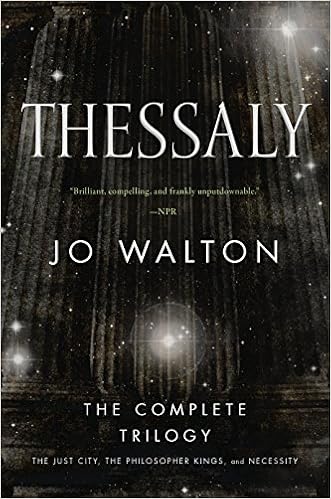
Jo Walton, however, has gone ahead and tried to imagine a place where we would do these things in the three books that make up Thessaly (2017): The Just City, The Philosopher Kings and Necessity. These are very specifically books about Greek philosophy and the making of philosophers, tackling some of the most basic existential questions such as what is goodness, what is excellence, what is our purpose – and while Walton doesn’t provide universal answers, she centres the constant asking of these questions as the root to living a satisfying life.

Continue reading “Robot philosophy”