1. Meta
You probably know the gist. Predictions and dire warnings of a future lived in an immersive virtual world had been around for decades before Neal Stephenson solidified the concept in his 1992 novel “Snow Crash”, but Stephenson called it the “metaverse”, and that was important. It was a cautionary tale. Not everyone understood that. The video game Second Life, launched in 2003, provided an early glimpse of the concept in a P.C. environment. Another piece of the puzzle, consumer-grade virtual reality, began to take shape when Oculus was founded in 2012, and shipped a developer-centric version of its virtual reality headset in 2013. The company was acquired by Facebook a year later. Oculus released a few more headsets while Facebook figured out what to do to “truly transform the way we live, work and connect with each other”.
Despite this goal, “metaverse” was not yet part of Facebook’s lingo, though it was in Oculus’ vocabulary. A 2015 internal memo from Mark Zuckerberg does not once contain the word despite describing the strategy it was developing. Even “Oculus” was barely mentioned in the company’s quarterly earnings calls around this time. But in the Q1 2018 call (PDF), Zuckerberg laid out a “10-year journey” for why Facebook bought Oculus, saying “every 10 to 15 years or so, there’s a major new computing paradigm”, and it is “very likely that the next one is going to be around virtual and augmented reality”. “One of my great regrets in how we’ve run the company so far is I feel like we didn’t get to shape the way that mobile platforms developed,” Zuckerberg said, explaining that it was important to spend vast sums of money now “in order to build some of the muscles to be competitive” later. Facebook was training for a major battle that would never materialize.
In the weeks after Meta announced it was retreating from its metaverse efforts earlier this year, I revisited this and other earnings calls, plus presentations and other documentation, as I tried to better understand what the metaverse was pitched as compared to what it ultimately became. I wanted to know how something so silly was treated by executive and media figures alike as a sincere directional shift for one of the world’s biggest companies in particular. In hindsight, it feels like a particularly narrow period of hype coinciding with — and, I think, benefitting from — the most urgent years of the COVID-19 pandemic. As enthusiasm deflated, it was almost unnoticeable despite forecasters labelling it an essential next step of the internet — a necessary next frontier.
The obsession with the metaverse seems to have solidified in Silicon Valley after Matthew Ball published an essay in January 2020 in which he forecasted that, at the very least…
…it is likely to produce trillions in value as a new computing platform or content medium. But in its full vision, the Metaverse becomes the gateway to most digital experiences, a key component of all physical ones, and the next great labor platform.
Ball admits “we don’t really know how to describe the Metaverse”, but sets seven criteria that, in general, portray it as an expansion and continuation of our blended physical and digital worlds, without the constraints of a physical space and with its own economy. Most notably, he says it will offer “unprecedented interoperability” between platforms and providers. He also lists eight things it is not, among them: it is not just a virtual world, or virtual reality, or a digital economy, or a new app store, or a new platform. It is more about a set of protocols and ideas that, yes, incorporate all these elements, but the metaverse is not itself these qualities.
Ball published this essay with darkly fortitous timing. A week earlier, Chinese health authorities had isolated a new strain of coronavirus aggressively spreading in Wuhan; a day before, they published its genetic sequence. Within a couple of months, the world had turned upside down and many of us were suddenly spending our days in a space that felt more virtual than physical. We may have only been working from home — or, at least, those of us who had the option and were not laid off — and socializing over Zoom, all while remembering the last concert we went to or the last time we ate a meal in a restaurant.
In July 2020, Forbes contributor and futurist Cathy Hackl imagined a world — one that was “for certain, it’s coming and it’s a big deal” — that connects augmented reality, neural interfaces, and a whole bunch of assumptions. In this environment, you could merely remember that you need to buy something, and then a virtual vending machine would materialize so you could order that thing. Hackl defines the metaverse as “a future iteration of the internet, made up of persistent, shared, 3D virtual spaces linked into a perceived virtual universe”.
In “The Future is a Dead Mall”, a video essay using Decentraland as a jumping-off point for a discussion of the metaverse, Dan Olson navigates several writers’ conflicting definitions before making the reasonable conclusion it is basically irrelevant:
If you comb through dozens and dozens of definitions of the metaverse you can assemble a web of broad attributes where some are generally agreed upon, while others border on being mutually exclusive. It’s a vague, largely incoherent cloud of ideas that’s malleable enough that basically anything can be called part of the metaverse, a proto-metaverse, or a semi-metaverse.
[…]
When you understand that the metaverse isn’t a distinct invention or construct, but merely a rhetorical proxy for The Future of Technology, then all of this becomes a lot easier to deal with.
I think Olson is largely correct; this is how the term is actually used. But, though not his intent, I think defining “metaverse” in vague terms is favourable to its boosters because it does not hold them to something specific. I think the explanation offered by Mark Zuckerberg in Facebook’s Q2 2021 earnings call (PDF) is actually pretty fair. This was two quarters before the company changed its name, and between prepared remarks and the question period, there were twenty total mentions of “metaverse” on this call.
So what is the metaverse? It’s a virtual environment where you can be present with people in digital spaces. You can kind of think about this as an embodied internet that you’re inside of rather than just looking at. We believe that this is going to be the successor to the mobile internet.
You’re going to be able to access the metaverse from all different devices in different levels of fidelity — from apps on phones and PCs to immersive virtual and augmented reality devices. Within the metaverse, you’re going to be able to hang out, play games with friends, work, create, and more. You’re basically going to be able to do everything that you can on the internet today as well as some things that don’t make sense on the internet today, like dancing.
So, in some ways, exactly like Olson’s definition: “different devices in different levels of fidelity” that let you socialize and do work, just like everything you currently do on the internet — plus dancing. It seems almost halfway toward being normalized in his head, though it feels as alien to read this today as it surely did then. Yet Zuckerberg is getting at something here. Virtual and augmented reality are ways of immersing us in unique environments that radically change how we interact with technology. And on the next quarter’s earnings call (PDF), Zuckerberg expanded:
[…] If you’re in the metaverse every day, then you’ll need digital clothes, digital tools, and different experiences. Our goal is to help the metaverse reach a billion people and hundreds of billions of dollars of digital commerce this decade. Strategically, helping to shape the next platform should also reduce our dependence on delivering our services through competitors.
Your avatar cannot simply be a picture of you. You will “need digital clothes” for this space. Need.
In addition to building hype among investors during these earnings calls, Facebook was pumping up its metaverse efforts in more general audience settings. In May 2021, CNet published a transcript of a thirty-minute Zoom call between Zuckerberg and Scott Stein where the former could wax lyrical about the bonafides of where Meta was at the time — “with the fidelity of experiences that are possible today, to me that just says, wow, in five years this is going to be clearly better on almost all of these fronts for a lot of the things that we do”. Casey Newton, of the Verge, was given by Facebook a copy of an internal meeting in which Zuckerberg told employees the company’s “overarching goal across all of these initiatives is to help bring the metaverse to life”. The two then recorded a soft and cuddly episode of the Vergecast that allows Zuckerberg to play visionary and rattle off the company’s metaverse talking points. “I think over the next five years or so, in this next chapter of our company,” Zuckerberg told Newton, “I think we will effectively transition from people seeing us as primarily being a social media company to being a metaverse company.” By October, Sarah E. Needleman was relaying to readers of the Wall Street Journal the words of Unity Software’s Marc Whitten the imperative for businesses to develop a “metaverse strategy”. “The metaverse is going to be the biggest revolution in computing platforms the world has seen,” said Whitten, “bigger than the mobile revolution, bigger than the web revolution”.
It is not difficult to see the deliberate strategy here. In 2019 and 2020, Facebook was not talking about the metaverse and, though a few commentators connected the just-announced Horizon social world to the concept, it was not treated yet as the inevitable future. As 2021 rolled on, Facebook’s promotional drumbeat grew stronger. Suddenly people were talking about the metaverse, and connecting it all back to Facebook. There was, it would appear, real buzz — enough, at least, for the Journal to find corroborating voices and take it seriously.
Three days after its Q3 2021 earnings call, Facebook held its Connect conference, which is centred around its augmented and virtual reality efforts. This was a big moment. This would be the keynote where the company laid out its metaverse-centric vision, and changed its name to Meta to reflect this new focus, and because it had to. “From now on,” Zuckerberg said, “we’re going to be metaverse-first, not Facebook-first”.
Rewatching this presentation in 2026 is a bizarre experience, not least of which because of how it is shot. Most scenes appear to be green screened with composited animations. Demos are virtually nonexistent, with most representations of the metaverse carrying a disclaimer that they are “not actual product images” and they are “strictly for illustrative purposes only”. Even so, Zuckerberg and other executives at Meta are all-in on hyping up an experience that, at best, only barely resembles what it ended up shipping. In many cases, it is not even close.
There is a Jon Batiste concert visualized as something that could be attended in-person by someone in Los Angeles and in the metaverse by someone in Kyoto, presumably through the glasses each person is wearing. We do not see the performance from their perspective, but the implication is that the virtual viewer would see it from the same or similar perspective to the in-person attendee. Both get invited to a virtual after-party where they can buy NFT-based digital merch and meet Batiste or, at the very least, his avatar. The reality of metaverse concerts is quite different than this concept. In 2024, Meta showed a Sabrina Carpenter performance in Horizon Worlds. The seats were great, but even in this immersive environment, it appears more like a concert film than a unbroken show viewed from a single perspective. Also, I cannot find any record of an after-party or virtual merch.
Zuckerberg touts Horizon Worlds as the place users will go to socialize, and Horizon Workrooms as the virtual environment for their job. The latter has since been completely shut down, while the former was put on ice. In gaming, Zuckerberg was particularly excited about Rockstar’s port of “Grand Theft Auto: San Andreas” which, three years later, Rockstar cancelled before it had been released. He said “remote work is here to stay for a lot of people” in this keynote, less than two years before ordering in-office work three days per week; two years after that, Instagram demanded five days per week in-office. I guess “a lot of people” does not include the people who are building the products that let a lot of other people work remotely. That is a little weird.
The wishcast-a-thon of Connect 2021 was treated by some with an entirely unearned gravitas. Dean Takahashi, of VentureBeat, called it a “historic moment” and compared it to the Manhattan Project. He thought Meta could bring about universal basic income, with Zuckerberg “paying us to use his devices so that we can make a living in his ecosystem”. In a mostly skeptical article in the New York Times, Kevin Roose raised the possibility that Meta’s focus change “could help with the company’s demographic crisis”, and advocated taking it seriously because the company “has found what may be an escape hatch” from “Facebook’s messy, troubled present”.
To mark the occasion, Zuckerberg granted interviews to four publications, all embargoed until after the Connect 2021 video was published. Dylan Byers, for Puck, was left with the understanding that Zuckerberg “doesn’t really care” about press coverage or questions about the legitimacy of this pivot — in a good way. “[I]t’s just that he’s not so bothered by the unrelenting criticism, and near-term and collateral damage,” wrote Byers, “that he’s going to check his ambitions or think twice about whether or not he’s the right person to help usher in the next phase of the internet”. Alex Heath, of the Verge, implicitly acknowledges the role Facebook’s public relations team played in creating the impression of interest in the metaverse, writing “it wasn’t thrust into the mainstream conversation until Zuckerberg started talking about it publicly earlier this year”. Heath did not break any news of note; neither did Matthew Olson, of the Information. The latter did at least contradict Zuckerberg’s protest of the “relatively high fees”, “a nod to the 30% commission” of Apple’s App Store and Google’s Play Store, by stating that while “Zuckerberg didn’t indicate what commission Facebook would charge”, “Oculus’ Quest Store currently takes 30%”.
The following day, Matthew Ball spoke with Zuckerberg in a live audio session that has since been pulled from Zuckerberg’s Facebook page, though clips remain available on YouTube. A transcript of the conversation reads like a context-free time capsule of that era, with praise for meme stocks, NFTs, and Web3 in concept more than in practice — and, of course, Ball’s writing on the metaverse. (Six months after this interview, the NFT market would well and truly collapse, with peak transactions occurring the month before Ball and Zuckerberg spoke.) Ball raises the subject of the company’s $10 billion annual spending on Reality Labs. Zuckerberg believes “the metaverse can reach a billion people, say, in the next decade, and that there can be supported hundreds of billions of dollars of commerce. And that if that’s the case, then even with relatively modest fees on the transactions that happen in our services, we think that could be a big business”. But Zuckerberg says he does not want to lose too much money, which is being treated as a “somewhat moderating force over the next period that will keep us from being able to make all of the fees maybe as low as we would want to”. The strategy is, to be clear, entirely dependent on a massive groundswell of public interest in a fundamentally new understanding of computing.
(Zuckerberg also takes time in this conversation to note his respect for intellectual property, at least for luxury brands: if “someone can just make a knock-off Gucci sweater, then I don’t think Gucci’s going to feel that good about being in that space, right, or participating in that system”. Just a few years later, Zuckerberg would allegedly approve the use of pirated ebooks for training the company’s artificial intelligence systems. The work of authors, it would seem, is not as concerning as the reaction of luxury brands.)
A few days later, Zuckerberg again eschewed traditional media outlets and sat down for an interview with Sara Dietschy; then, he chose a softer approach in spirit, if not in volume or cadence with professional talking guy Gary Vaynerchuk. Earlier that year, Vaynerchuk had launched his own NFT collection and, not long before speaking with Zuckerberg, had sold five of his paper doodles for $1.2 million at a completely real Christie’s auction, so you could say they are both on the same wavelength:
Vaynerchuk: The extremity of the NFT space is going to be even greater for what that means. It’s almost like our world is all about to become the fashion industry because we communicate so much through what we wear. The digital version of that is going to have an incredible impact on society.
Zuckerberg: Oh, totally.
Totally. Just like the fashion industry.
In 2022, Meta added support for NFTs in Facebook and Instagram, a project which it discontinued less than a year later. Digital collectibles got a shoutout in the Connect 2021 presentation, had a brief moment in the sun, and were quickly forgotten about. These things are supposed to be building blocks of the metaverse and Meta barely tried.
Meta’s annual commitment that Ball referenced, of $10 billion, represents all Reality Labs spending, including game development, some A.I. investments, and its EssilorLuxottica collaboration. Even so, despite a complete change in corporate priorities explicitly in the direction of the metaverse, Meta’s long-term interest did not match its investment. Here is a chart I made of mentions of “metaverse” in the transcripts of quarterly earnings calls from Q1 2021 — the quarter before its public relations push — through Q1 2026:
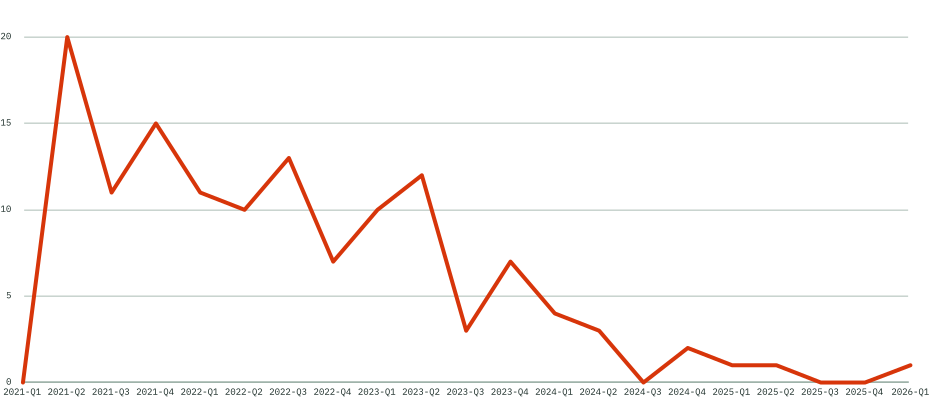
The highest point on that chart is the Q2 2021 earnings call I used earlier for the definition of “metaverse”; the second-highest is Q4 2021, the first earnings call after Connect 2021. The total count includes mentions in Meta’s prepared remarks, plus the question-and-answer period that follows. Investor conference calls are not a perfect proxy for a company’s priorities, but they are indicative. At the very least, for a company that entirely changed course with a new goal — “from now on, we’re going to be metaverse-first” — and a directly relevant name, one might imagine the company and analysts will be similarly eager to discuss how that is going. But no. In Q4 2022, mentions are half that of the year prior. By Q1 2024, neither Meta nor the analysts on the call seem to care all that much — while there were just four mentions of “metaverse”, there were ninety of “A.I.”.
This speaks volumes. It is the kind of thing that makes you wonder if this company was ever serious about this metaverse pivot at all. It seems like it had every intention, sure, but could it ever have executed on its vision? Of the four interviewers chosen for pieces related to Connect 2021, only Ben Thompson even thought to question its feasibility. (Thompson was also the only one to say he was permitted to view a copy of the presentation in advance. I do not know if this means the other three interviewers did not see it and, therefore, could not interrogate it more thoroughly, or if they did see it and simply did not bother to ask.) At the time, Facebook had no track record in building an operating system, barely had any credibility in hardware, and it only kind of created a platform on its “blue site”. (It arguably avoided creating platforms for developers with Instagram and WhatsApp.) This same company was claiming it was launching the successor to the smartphone and the next iteration of the internet. Every one of these chosen interviewers should have been all over this, but they were too distracted by the rebrand and Facebook’s sordid history to notice it was only a concept video more than it was any kind of real concept.
2. The Others
While Meta made itself the face and name of the metaverse, it was far from alone in promising the immersive computing platform of the near-future. Time basically acknowledged this by declaring one of the best inventions of 2021 was the Qualcomm Snapdragon XR2 — a foundational headset chip, rather than Meta’s attempt to build the platform.
In April 2020, Washington Post reporter Gene Park proclaimed the “next version of the Internet is often described as the Metaverse”, going on to confidently explain how it would be built. Of all the companies involved, Park wrote, “it’s Epic Games, with Fortnite, that has the most viable path forward in terms of creating the metaverse”, citing Ball’s seminal metaverse essay.
In April 2021, months before Facebook began asserting its commitment, Epic Games announced it had raised a billion dollars to “support [its] long-term vision for the metaverse” with $200 million of that coming from Sony. A year later, Epic raised another $2 billion, a billion of which again came from Sony, and the other billion from Lego. In 2023, a Lego game was added to Fortnite, which is not really the metaverse as much as it is a nifty Minecraft-like game-within-a-game.
Yet in Epic Games’ telling, it is basically delivering the metaverse already. CEO Tim Sweeney spoke at the 2023 Game Developers Conference about the company’s vision. Since there are around 600 million monthly active users of games, like Fortnite and Minecraft, set in virtual worlds, Sweeney reckoned “we can set aside the crazy hype cycle around NFTs and VR goggles. Yes, these technologies may play a role in the future, but they are not required. This revolution is happening right now.” Sweeney spoke of interconnectedness and open standards that would allow users to move between different spaces in a unified way. “What a user would really like is to be able to buy a cool-looking outfit in one place and take it everywhere they go” Sweeney claimed. (Why do they always mention digital clothes? My theory is because they do not view fashion as having much value beyond a basic assessment that how someone dresses is an expression of identity.) Sweeney describes Fortnite, Unreal Engine, and the Epic Games Store as “on-ramps to the metaverse”, and that the users of which already understand their in-game socialization can be extended to “going to a concert and dancing” in a virtual environment. Leaving aside the contradiction with definitions of the metaverse that mandate a more immersive environment, it is a big leap to think a brief animation of Eminem scratches the same itch as an actual performance.
Microsoft, as ever ahead of a trend without fully conceptualizing it, said it was doing metaverse stuff before Facebook started referencing it in public. Satya Nadella, defining the metaverse as “made up of digital twins, simulated environments, and mixed reality”, claimed a mix of Azure features, HoloLens, and Mesh would allow enterprises to get aboard. Last year, Microsoft said it was getting out of V.R. hardware and turning its mixed reality collaboration product into a glorified Snapchat filter in Teams.
Then there is Roblox. When Andreessen Horowitz announced its investment in the company, Marc Andreessen and David George wrote that “[w]hile pundits have been distracted by the readiness debates and questions over V.R. vs. A.R., the foundations of a global metaverse have been quietly built in the background… in Roblox”. This was in February 2020 — before Epic Games, before Microsoft, and well before Meta said anything in public about the metaverse. In January 2021, as part of Wired’s predictions for the coming year, Roblox CEO David Baszucki confidently predicted “the metaverse will experience widespread use, and start to become a human co-experience utility”. In March, the company went public at a $30 billion valuation. After Facebook changed its name to Meta, Baszucki saw that as validation of its strategy. That November, he made the rounds on business television networks like Bloomberg and CNBC to advocate for the company as a trailblazer.
In January 2022, Bernhard Warner of Fortune was getting excited about the possibilities of the metaverse, writing it “might be the most important trend in tech since the iPhone”, perhaps “a tectonic shift in tech that they [big tech and big investors] can’t afford to miss”. The way Roblox was “monetizing the metaverse” was a key piece of evidence, with virtual concerts and — most importantly — brands. “A parade of consumer brands […] have set up a presence on Roblox in the past year”, wrote Warner, citing Nike’s approach as being particularly exciting. A month earlier, it had acquired a company called RTFKT, which its press release extolled was a “leading brand that leverages cutting edge innovation to deliver next generation collectibles”. Guggenheim Securities, a subsidiary of Guggenheim Partners which has over $350 billion in assets under management, said it was the “‘best idea’ of 2022”, according to Warner. People are going to need virtual outfits, right? Yet, just three years later, Nike shut down RTFKT.
Gucci, another of the brands with a virtual presence in Roblox, sold virtual handbags for in-game currency for a limited time in 2021 and 2022; users realized they could effectively counterfeit and resell them. At least one of Zuckerberg’s predictions kind of came true. And, while Warner highlighted Disney as another company with in-game presence, it has not maintained a meaningful investment because, according to Variety, it feels Roblox is unsafe for children, a sentiment that was not helped when Baszucki appeared on the “Hard Fork” podcast. Roblox has settled lawsuits with the attorneys general of Nevada, Alabama, and West Virginia over accusations its platform features enabled child exploitation by other users. Roblox has denied any wrongdoing though it says it is enabling better parental controls and tighter restrictions on children’s accounts.
Through 2021 and 2022, the metaverse hype cycle was apparent across the tech industry. Max A. Cheney, reporting for Barron’s in August 2021, noted “[m]entions of the metaverse in earnings transcripts and other corporate documents are up five times this year compared with 2020, according to data from Sentieo”. This relative figure must have a hilariously low baseline, sure, but it is an indicator of how many businesses became briefly enchanted by this concept. There were serious financial analyses of real estate in the metaverse. Keep in mind that what is meant by “real estate” is much, much, much closer to domain names than it is land and deed. In July 2022, Technavio, a market research company, forecasted this market would be worth $5.37 billion by 2026. This report was picked up by Debra Kamin, of the New York Times, who published an article in the paper’s real estate section in February 2023 explaining this “new frontier for real estate builders and investors”. The primary anecdote in Kamin’s story is a just-completed mansion in Florida with a “twin” in a metaverse platform called the Sandbox. “As these technologies get more immersive”, the homebuilder said, “it’s going to make a lot more sense” to have a 3D virtual model of a house. Kamin was not breaking news on this specific story, as it was first reported by Emma Reynolds, of Forbes, over a year earlier. One would think that Kamin could therefore have asked some more probing questions or surveyed the actual market for NFTs which, by 2023, had fallen off a cliff. But no. Instead, the builder got the imprimatur of the Times describing the combined physical and digital sale in flattering terms. Ultimately, neither the listing nor many of the sale notices mentioned the sole marketing quirk of this house, suggesting that by 2023 the novelty of a digital model of a mansion was kind of over. I was curious if the NFT was a factor in the buyer’s decision, but did not receive a response to requests for comment I sent to a phone number associated with the current owner of the property.
Both the Times and Forbes articles are individual disasters in their own right. Sure, we might not expect a pinacle of journalistic integrity from Forbes and, to a lesser extent, the unabridged property ads that form the real estate section in prestigious newspapers including the Times. But to communicate this nonsense with the framing of “real estate” is treating wild speculation with unearned seriousness. This project was also co-signed by Sotheby’s. The whole thing is an embarrassing validation of a market that, predictably, would prove to have no substance. This was obvious by the time the metaverse mansion was being peddled. Eric Ravenscraft, in Wired in December 2021, reported that the attempts at artificial scarcity “more closely resembles early-access video games and common pump-and-dump schemes” than a real estate market. Indeed, a Coingecko analysis found metaverse “land” was worth 34% less in 2024 compared to the year prior, and 72% less than at its peak in 2022. This was an average across several platforms, and the biggest decline was in the Sandbox, the digital home of that mansion’s 3D model twin. According to a CoinDesk report published last year, the Sandbox laid off half its employees and its token has dropped in value from its peak by 90%. As of March 2026, user rights to space in Sandbox and Decentraland — another metaverse platform — that had originally sold for hundreds-of-thousands to millions of dollars were not a market totalling $5.37 billion as forecasted by Technavio. They had become basically worthless.
3. Fever Dream
Officially, Meta is still all-in on the concept around which it pivoted the entire company in 2021. It still has a whole marketing page proclaiming its belief “in the future of connection in the metaverse”. You can go shop its lineup of Quest headsets which Meta says represent the best and most immersive metaverse experience, though its flagship model is now two-and-a-half years old. It has awkwardly promoted its Ray-Bans as “A.I. glasses” despite them becoming the company’s most successful line of mixed reality products, and it is desperately trying to connect its newest muse of A.I. with its last one. The single mention of “metaverse” on its Q1 2026 earnings call (PDF) is when Zuckerberg claimed to be “excited for more of our metaverse efforts to be powered by the A.I. models we’re training as well”. If you want to be unfairly generous in your interpretation of Zuckerberg’s brief remark, you could point to a December 2020 Andreessen Horowitz piece, in which general partner Jonathan Lai refers to this shape as a “pyramid”, and says that “fully A.I.-created content” is directly correlated with “spontaneous social at metaverse scale”. Obviously. I am not feeling generous.
It is readily apparent that Meta’s metaverse momentum simply no longer exists. The company, in recent months, has made budget and personnel cuts to the team responsible for these products and, as mentioned, has discontinued Horizon Workrooms and will soon discontinue Horizon Worlds in V.R.. It also ended its third-party headset partnerships. If Meta wanted to wind down its commitment to the metaverse, these are the kinds of moves it would make.
Others in the space have not fared much better. Roblox has not mentioned the word “metaverse” in its quarterly or annual reports since Q1 2022 (PDF). Epic Games scarcely mentions it in recent news releases, either: since January last year, just one announcement contains the word “metaverse”, while seven are dedicated to the lawsuits Epic has been fighting against Apple and Google. Far from the inevitable next chapter of the internet, the metaverse, supposedly the future of how we live, work, and play online, is a non-event.
Near the end of the Connect 2021 presentation, Nick Clegg, then Meta’s global affairs chief, said “the metaverse isn’t something we’re building, so much as it’s something we’re building for”. Olson, in his video, wryly notes that, in the eyes of its promoters, “the metaverse cannot fail; you can only fail to make the metaverse”. The metaverse is so inevitable that “you might even already be in it”, according to Barron’s. But the metaverse is not predestined; it never has been. It is a construction of tech companies that saw in the pandemic their future — not ours.
A slightly charitable interpretation of what I think the pandemic demonstrated to Facebook executives, for example, was how invaluable technology companies were in maintaining connections even when most people could not do so in-person. They recognized how much time people were spending in front of screens already, even in years prior, and assumed that could be a more social experience.
But a more cynical view is no less fair. With the pandemic undoubtably came a realization of how much money Facebook stood to make, if only it had a platform. In 2019, there were two publicly traded companies worth over a trillion U.S. dollars; by the end of 2021, there were five, with Apple and Microsoft now worth over two trillion dollars each. This pandemic was not going to last forever — but it did not need to. Our world was permanently changed, or so it would have seemed, and we would surely want to virtually attend concerts and buy PNG files of band t-shirts with real money. And these companies would take their cut.
One thing I have mentioned but did not emphasize is just how often Zuckerberg and Sweeney mention Apple and Google platform fees as a primary justification for building the metaverse. Sweeney spent several years fighting lawsuits against both companies, mostly winning the one against Google and mostly losing the one against Apple. His efforts have, nevertheless, shined a spotlight on these grotesque practices. But it would be a mistake to assume this is an objection on ideological grounds. These guys just want to take those commissions for themselves. Sweeney spent his GDC 2023 presentation comparing the need for open standards in the metaverse to the openness of the web, but unlike the web, the Epic Games store takes a 12% commission. Meta beat that, though; it even beat Apple and Google. By the time the individual fees are added together, transactions made through Horizon Worlds could be levied a commission of up to 47.5%. The money thing is not even a secret; it was often the very first thing people like Zuckerberg and Sweeney discussed in interviews about their metaverse plans. This was a financial decision before it was a product or service people might actually want to use.
It would not be fair to characterize Meta’s endeavour as an impulsive flash in the pan. Zuckerberg laid out his vision in a 2015 internal memo in which he explained how the company “would like a stronger strategic position in the next wave of computing”. Then, in January 2017, the Chan Zuckerberg Initiative acquired a company called Meta, I think mostly for the name; a year later, Zuckerberg floated the idea of a rebrand. The 2015 memo that effectively set this whole thing into motion gives the impression of a surprisingly cogent document if you set aside the wildly optimistic timelines — “VR/AR will be the next major computing platform after mobile in about 10 years” — and the idea that virtual and augmented reality are so compelling it will supersede the desire for phones and televisions. If anything, the unearned confidence in this memo should have been alarming at the time. As Zuckerberg himself writes, the “core social networking work is no longer new, Internet.org is extending something rather than inventing it, and A.I. is not yet tangible”. This is not a company known for doing new, and it is now stuck with a name reflecting a bungled attempt to change that. Staff are not happy after years of mass layoffs, court losses, role reassignments, and internal surveillance to feed the company’s A.I. projects. Do not get me wrong — Meta’s business of collecting vast amounts of information about its users and selling relevant ad slots is as strong as it has ever been. But Meta the ad company is not Meta the platform innovator.
And this feels like the why of it all. If tech companies can channel a meaningful sliver of our entire lived experience into a world of their creation, one where they collect a portion of revenue, it would make them inescapable. Ball, Sweeney, and Zuckerberg may have all written or spoken about the importance of interoperability and open standards, but these platforms want to exercise a degree of control more similar to native software than to the open web. The steps for migrating from Horizon Workrooms to a competitor’s product, for instance, are not what one would expect if openness were a priority.
For a brief couple of years, it seemed like there could be enough enthusiasm from reporters in the space, venture capitalists, and executives to make the metaverse happen. Then ChatGPT launched in November 2022, and the pandemic ended in the U.S. in May 2023, and any interest anyone may have had for spending more time with people in a virtual setting largely evaporated. It turns out we are okay with having meetings and playing games online, but we actually like seeing live music in-person and travelling to real places. The problems each of these things may have — high costs, environmental impact, and so on — are notable and real, but are not ones with metaverse-based solutions.
The pandemic did not make the metaverse. There was sufficient interest in developing it well before then, and it is possible all of these companies would have announced all these products and services on the same timeline. But in a world without a pandemic, I cannot imagine anyone would have treated these metaverse announcements with anything like the seriousness they did. The pandemic officially ended in the U.S. just six months after the first release of ChatGPT, so it is impossible to disentangle the influence of either. But it is notable to me that the nosedive in mentions of “metaverse” on Meta’s investor calls occurred in Q3 2023 — the quarter immediately following the declared end of the pandemic.
As for the futurists like Hackl, who confidently proclaimed the metaverse was “for certain”, they have found an out thanks to its flexible definition. Jeff Barrett, of the Shorty Awards’ “It’s No Fluke” podcast, published a glowing profile of “the Godmother of the Metaverse” earlier this year under the headline “Why Cathy Hackl Keeps Getting the Future Right”. “When enthusiasm cooled and narratives collapsed, many distanced themselves from the space”, writes Barrett, noting with seeming approval that “Hackl did the opposite. She reframed it”. Many people — perhaps everyone, come to think of it — could predict the future if they got to retcon their predictions to fit reality.
There are many open questions about the metaverse; most glaringly among them, whether it could actually become a thing for normal people. That depends a little bit on what definition we use. If it simply means the slow erosion of the boundary between our physical and digital environments, that is probably something that will continue to happen. For most people, though, that does not look like Meta’s Connect 2021 concept animations. Whatever that ends up being will probably be the result of people finding something useful and intriguing about doing something different. It will not be the product of big companies redirecting the money hose of platform fees onto themselves.
With thanks to Marquette University for granting me access to the Zuckerberg Files. A frustrating number of Zuckerberg’s post-Meta interviews are video-based, so the transcripts produced by this effort were invaluable. Where possible, I have checked these copies against the originals.