I'm so inspired by HBO's new show Westworld. Of the many themes of science fiction, artificial intelligence intrigues me most and it makes me the most uncomfortable, for reasons I don't fully understand. While cloning is not really the same thing as AI, the artificially created characters in Westworld seem very much like clones.
Kazuo Ishiguro wrote one of my favorite treatments of the ethical tension implicit in cloning, in his novel Never Let Me Go.
The clones in Never Let Me Go serve a very highly prized function in the world of the novel. Their organs are harvested for human use, and they are nurses for the dying and elderly. The tension for the reader (presumably not a clone) occurs with the tragic ability of the clones to love, and their desire to escape their fate.
Westworld, an update on a 70s sci-fi film, also has a human-serving cast of (computer-controlled) clones who serve as the "hosts" of a curated theme park where guests can interact with them with no legal limits or physical danger. They are not clones, not born and then developed as humanoid. The androids of Westworld are sculpted in labs, and implanted with an interactive interface, constituting their "personhood" in the park.
The hosts are never to lay an unwanted finger on a guest. They have a name, story, and background, seemingly as controllable as a video game character. They exist to serve the desires of the guests, however unsavory. They are lifelike to the extreme, able to mimic even the slightest of human gestures that signify intelligence.
The clones "act" in scores of complicated narratives that occur simultaneously in the park, and some have been updated and modified for decades. Their storylines have changed over the years. While the status quo has been to deny the hosts access to their past storylines, the main creator, Ford, has written a new gesture code that allows for some access in order to make the hosts appear as if they are remembering something in a subconscious way. Not direct access to the memory, but an unconscious awareness. Remembering, without thinking.
When a host with several character lifetimes accidentally accesses an old storyline, their behavior becomes erratic, and unpredictable. When a host seems to remember another time, another place, usually a trauma, they override their systems and behave outside of their code. These improvisations are so far outside their programming that they feel eerie and terrifying.
The androids are not a human having an experience., but they are a reflection of a human experiencing their humanity.
The similitude that shimmers between human reproduction and Westworld's system of android creation is a complicated web of desire, nostalgia, and as the show describes, "drives," emotional and instinctual impulses that give us a sense of purpose.
Already, in Westworld, as in Never Let Me Go, love is the most complicated drive of all. The father character of a young, beautiful "white woman on the frontier" character becomes inoperable after he sees a modern photograph of a woman. He doesn't recognize the woman, or the time and place in which she's photographed, and when he accesses his memory (files) he taps into an old horror storyline in which he was a cult leader, and quoted Shakespeare. The juxtaposition of Shakespeare's timeless queries into human nature are chilling transposed over the pseudo-crimes occurring in Westworld, and what could be described as a magic mirror of humanity in the form of the androids and their meddlesome memories which conflict with their current drives.
Westworld's Delores, the aforementioned woman android, is being questioned by a technician/creator, and she asks, representing every woman trying to play an acceptable role in a patriarchal world, "have I done something wrong?," to which the creator answers no, but as it becomes clear he wants their conversation stricken from the record, she asks him a far more intelligent question, "have you done something wrong?" The innocence of the android is only as certain as the quality of the original from whence it came.
The needs of the guests seem barbaric, lustful, and gratuitously mindless. However, the needs of the creators are not altogether different. Their lusts and drives are also reflected in their work.
The final aspect of the show that intrigues me is the acting itself. Actors, acting like androids, acting human, but also at times acting robotic or anomalously. There are some scenes which seem to be altered with CGI, but others are simply outrageous performances in which real actors are showing us what it looks like when our thinking processes are interrupted by existential crises. In fact, it is a performance of metal illness, maybe a stroke crossed with a dissociative episode. A "glitch" in our human continuum.
The end of the second episode shows Delores, who after being asked if she would ever harm a living thing answered that she would never "harm a fly," is shown swatting and smashing a fly that has landed on her neck. She has begun a process of evolution which looks like it includes self-defense.
These characters and their frightening unexpected autonomy! Since Frankenstein's monster I've been fascinated with the pursuit of replication, as an aside or alternative to reproduction. We shall see, if the inhabitants of Westworld come crashing through reality with the same violence.
Wednesday, October 12, 2016

Tuesday, September 23, 2014
A Brief History of Roller Derby in Long Beach
A couple of weeks ago the LB POST published an article about Roller Derby in Long Beach, showcasing Shayna "Pigeon" Mikle, current owner of the roller skate shop on Retro Row, formerly and I think currently known as Moxi. The article attempted to coherently weave together the past and current state of roller derby in Long Beach, but, understandably, it was confusing as hell.
I would like to put something together about the past and present incarnations of roller derby in Long Beach. It's not an easy task.
To my knowledge, roller derby arrived on the scene in Long Beach with the league Long Beach Roller Derby. There were at one point, several teams, as well as a Jr. Roller Derby league. This league skated to the beat of its own drummer, that is, it did not skate according to current official flat or bank track rules. Hence, this league didn't play any other league's teams. LBRD was mostly the brainchild of Michelle "Estro Jen" Steinlin, and Lindsay "Diesel" Karnopp, who experienced both wild success as well as abysmal failure, as the League experienced smash hit status, and then a crash and burn death. Why? The consensus is mismanagement. And, some claim that funds went missing. There were a lot of hurt feelings as the league had lot of members and no real reason to end so suddenly. Many eager fingers point to Karnopp as the wrecking ball, but no one has evidence or proof. Just a lot of hearsay and hard feelings.
The second official incarnation of roller derby in Long Beach rose up in Long Beach All-Stars, a little group that formed to keep rolling the girls who cut teeth on LBRD and still wanted to skate. Headed by L.A. Derby Dolls veteran Natasha "Cannon Doll-X" Vineyard, this was a mash up fitness/derby group, sans teams, that practiced at Wardlow Park.
In the meantime, Pigeon formed Beach Cities Roller Derby, based in the South Bay. No association with Long Beach.
A year or so after LBRD dissolved, Steinlin and a team of her old skate-mates formed a new league, sans Karnopp, named Long Beach Derby Gals, hoping to revive the success and fame of the first incarnation. Partnered with Sean Ellis, owner of a production company who would provide the necessary sound and lighting needed to re-create the look and feel of LBRD, the new league promised all of the success of the former league, without all of the drama associated with Karnopp, which had by this point reached totally blown-out proportions. Teams were formed, with the majority of players skaters who had played for LBRD, along with a large group of new skaters beginning to learn the game. This time, the league would play by official WFTDA rules, hoping to play other teams as they gained recognition. But the plan was to kick out a season and make a ton of cash in order to get rolling. This didn't happen. Ticket sales were down, and costs were up. It appears that while Karnopp might have caused damage, she also was a crucial part of the first league's success. When it appeared that LBDG wasn't going to be the raging success that LBRD was, Stienlin and the rest of her team broke ties with Ellis, to whom they were in debt, and walked away from LBDG.
But LBDG didn't end there. Natalie "Buster Chassis" MacPherson, owner of Long Beach Skate, stepped up to continue Long Beach Derby Gals with Ellis, provided that league ownership be established on the basis of transparency and democracy. Ellis was interested in at least getting square on his original investment with LBDG. Practice continued, but now at the multi-use space Crafted in San Pedro, not Long Beach. Soon after, the practice space and grand schemes of LBDG became too expensive to fulfill for the fledgling league, and Long Beach Derby Gals cut ties with Ellis, and Crafted.
Out of the twice-burned remains of Long Beach Derby Gals arose Badfish, the current Long Beach roller derby league, based in Long Beach at MacPherson's shop, with scrimmages held at Bayshore Hockey Rink.
Recently, Beach Cities Roller Derby has added a team with Long Beach in the name, and Mikle acquired the skate shop previously solely owned by Stienlin. Still, Mikle doesn't operate a roller derby league associated with, or practicing in, or scrimmaging in, Long Beach.
There you have it. LBRD, then LBAS, then LBDG, and now Badfish, and never BCRD.
The main reason I wanted to set this straight is there are many, many ladies upon whose backs roller derby succeeds or fails. "Estro Jen" and "Diesel" had superstar quality as skaters and athletes, and charisma up the wazoo. But there are dozens of skaters who paid dues and then watched their hard work, dues, and derby dreams go down the drain as owners walked away, time and again.
When "Pigeon" was touted as a mother hen who was overcoming the bad blood amongst skaters in Long Beach, gathering them up like lost souls, I was offended, because other than taking the reins at the skate shop on 4th, she hasn't done anything to support roller derby in Long Beach, aside from occasionally supporting the Long Beach Junior Roller Derby league, the only roller derby league to survive out of them all. In fact, during one of the meetings held by Long Beach Derby Gals, discussing the future of the league, Mikle was asked if she would take on Long Beach Derby Gals as a division of Beach Cites. She replied quickly with a no, she was not interested. She did, however, use the final practice of Long Beach Derby Gals as recruitment night for BCRD. She benefited the most from the demise of Long Beach Derby Gals, and her recruitment of Long Beach skaters undermined the continuation of roller derby in Long Beach. It was only upon the action of MacPherson that adult Roller Derby has continued in Long Beach, period.
It is understandable that Mikle would not have wanted the debt attached to Long Beach Derby Gals, and Beach Cities has enjoyed the continued success and longevity that Long Beach has been unable to sustain. It is true that old hurts are disappearing, and Mikle seems to be the only leader left standing in Long Beach, however, her league operates outside of the city. If there is one thing that roller derby in Long Beach lacks, it's loyalty, to the skater, to the city, and to the fans.
If you are interested in roller derby in Long Beach, contact Natalie MacPherson aka Buster Chassis, and find Badfish on Facebook.
I would like to put something together about the past and present incarnations of roller derby in Long Beach. It's not an easy task.
To my knowledge, roller derby arrived on the scene in Long Beach with the league Long Beach Roller Derby. There were at one point, several teams, as well as a Jr. Roller Derby league. This league skated to the beat of its own drummer, that is, it did not skate according to current official flat or bank track rules. Hence, this league didn't play any other league's teams. LBRD was mostly the brainchild of Michelle "Estro Jen" Steinlin, and Lindsay "Diesel" Karnopp, who experienced both wild success as well as abysmal failure, as the League experienced smash hit status, and then a crash and burn death. Why? The consensus is mismanagement. And, some claim that funds went missing. There were a lot of hurt feelings as the league had lot of members and no real reason to end so suddenly. Many eager fingers point to Karnopp as the wrecking ball, but no one has evidence or proof. Just a lot of hearsay and hard feelings.
The second official incarnation of roller derby in Long Beach rose up in Long Beach All-Stars, a little group that formed to keep rolling the girls who cut teeth on LBRD and still wanted to skate. Headed by L.A. Derby Dolls veteran Natasha "Cannon Doll-X" Vineyard, this was a mash up fitness/derby group, sans teams, that practiced at Wardlow Park.
In the meantime, Pigeon formed Beach Cities Roller Derby, based in the South Bay. No association with Long Beach.
A year or so after LBRD dissolved, Steinlin and a team of her old skate-mates formed a new league, sans Karnopp, named Long Beach Derby Gals, hoping to revive the success and fame of the first incarnation. Partnered with Sean Ellis, owner of a production company who would provide the necessary sound and lighting needed to re-create the look and feel of LBRD, the new league promised all of the success of the former league, without all of the drama associated with Karnopp, which had by this point reached totally blown-out proportions. Teams were formed, with the majority of players skaters who had played for LBRD, along with a large group of new skaters beginning to learn the game. This time, the league would play by official WFTDA rules, hoping to play other teams as they gained recognition. But the plan was to kick out a season and make a ton of cash in order to get rolling. This didn't happen. Ticket sales were down, and costs were up. It appears that while Karnopp might have caused damage, she also was a crucial part of the first league's success. When it appeared that LBDG wasn't going to be the raging success that LBRD was, Stienlin and the rest of her team broke ties with Ellis, to whom they were in debt, and walked away from LBDG.
But LBDG didn't end there. Natalie "Buster Chassis" MacPherson, owner of Long Beach Skate, stepped up to continue Long Beach Derby Gals with Ellis, provided that league ownership be established on the basis of transparency and democracy. Ellis was interested in at least getting square on his original investment with LBDG. Practice continued, but now at the multi-use space Crafted in San Pedro, not Long Beach. Soon after, the practice space and grand schemes of LBDG became too expensive to fulfill for the fledgling league, and Long Beach Derby Gals cut ties with Ellis, and Crafted.
Out of the twice-burned remains of Long Beach Derby Gals arose Badfish, the current Long Beach roller derby league, based in Long Beach at MacPherson's shop, with scrimmages held at Bayshore Hockey Rink.
Recently, Beach Cities Roller Derby has added a team with Long Beach in the name, and Mikle acquired the skate shop previously solely owned by Stienlin. Still, Mikle doesn't operate a roller derby league associated with, or practicing in, or scrimmaging in, Long Beach.
There you have it. LBRD, then LBAS, then LBDG, and now Badfish, and never BCRD.
The main reason I wanted to set this straight is there are many, many ladies upon whose backs roller derby succeeds or fails. "Estro Jen" and "Diesel" had superstar quality as skaters and athletes, and charisma up the wazoo. But there are dozens of skaters who paid dues and then watched their hard work, dues, and derby dreams go down the drain as owners walked away, time and again.
When "Pigeon" was touted as a mother hen who was overcoming the bad blood amongst skaters in Long Beach, gathering them up like lost souls, I was offended, because other than taking the reins at the skate shop on 4th, she hasn't done anything to support roller derby in Long Beach, aside from occasionally supporting the Long Beach Junior Roller Derby league, the only roller derby league to survive out of them all. In fact, during one of the meetings held by Long Beach Derby Gals, discussing the future of the league, Mikle was asked if she would take on Long Beach Derby Gals as a division of Beach Cites. She replied quickly with a no, she was not interested. She did, however, use the final practice of Long Beach Derby Gals as recruitment night for BCRD. She benefited the most from the demise of Long Beach Derby Gals, and her recruitment of Long Beach skaters undermined the continuation of roller derby in Long Beach. It was only upon the action of MacPherson that adult Roller Derby has continued in Long Beach, period.
It is understandable that Mikle would not have wanted the debt attached to Long Beach Derby Gals, and Beach Cities has enjoyed the continued success and longevity that Long Beach has been unable to sustain. It is true that old hurts are disappearing, and Mikle seems to be the only leader left standing in Long Beach, however, her league operates outside of the city. If there is one thing that roller derby in Long Beach lacks, it's loyalty, to the skater, to the city, and to the fans.
If you are interested in roller derby in Long Beach, contact Natalie MacPherson aka Buster Chassis, and find Badfish on Facebook.
Friday, January 18, 2013
Hello Again to A Farewell to Arms
I've read a good deal of Hemingway. I rest on my opinion of him as a genius, and an American dreamboat writer. However, I can tire of him. I tire of his unapologetic chauvinism, the way that he and his characters opine without self-doubt. And yet, I love him. I'm drawn to his characters and their lack of judgement.
This time, I'm really enjoying A Farewell to Arms. I like the youthful, yet manly quality of Henry, the main American character. I like the romance of the Italian people, with their joking and their friendly kissing. I love Henry's way of never feeling the experience that is in front of him, but only liking it from a distance. Henry's insistence at being at the front lines to assist the wounded contrasts his almost total inability to feel the emotions in the moment. I like how his character is in love whether he likes it or not, or whether he choses to or not. For now, I just like it. And I just love Hemingway again.
Hemingway reminds me that the sensory experience of everyday life is magical in prose. His story also reminds me that you can enjoy being part of a diverse group in times of great stress without imagining that everything is about you, even though you are having the experience.
There is a great deal about Hemingway's version of masculinity that I admire, even as I am jealous of it, as it is quite hard to enact in reality. Perhaps that is why Hemingway once wrote something to the effect that if a man lived by a lie he should die by it. His versions of masculinity are so often unrealistic, and remind me more of sociopathic behavior patterns. His masculine emotions are often transformed into heroic selfless actions or patient inertia, with tragedy and emotional breakdown between the lines, in the avoidance instead of the confrontation. I'm envious of these male (and sometimes female) characters who show stoicism and fairness in the face of heartbreak. Sometimes I like a little more meltdown, as I'm reminded that I tend to turn things up to eleven in the emotions department.
I'll write more as I finish the novel.
This time, I'm really enjoying A Farewell to Arms. I like the youthful, yet manly quality of Henry, the main American character. I like the romance of the Italian people, with their joking and their friendly kissing. I love Henry's way of never feeling the experience that is in front of him, but only liking it from a distance. Henry's insistence at being at the front lines to assist the wounded contrasts his almost total inability to feel the emotions in the moment. I like how his character is in love whether he likes it or not, or whether he choses to or not. For now, I just like it. And I just love Hemingway again.
Hemingway reminds me that the sensory experience of everyday life is magical in prose. His story also reminds me that you can enjoy being part of a diverse group in times of great stress without imagining that everything is about you, even though you are having the experience.
There is a great deal about Hemingway's version of masculinity that I admire, even as I am jealous of it, as it is quite hard to enact in reality. Perhaps that is why Hemingway once wrote something to the effect that if a man lived by a lie he should die by it. His versions of masculinity are so often unrealistic, and remind me more of sociopathic behavior patterns. His masculine emotions are often transformed into heroic selfless actions or patient inertia, with tragedy and emotional breakdown between the lines, in the avoidance instead of the confrontation. I'm envious of these male (and sometimes female) characters who show stoicism and fairness in the face of heartbreak. Sometimes I like a little more meltdown, as I'm reminded that I tend to turn things up to eleven in the emotions department.
I'll write more as I finish the novel.
Friday, December 9, 2011
Book Store: These are all for me.
Thought I'd share with you my book store purchases today, and my thoughts, hopes, and dreams for each read.
#1 Republic, by Plato

What can I say about a book that was written in the fourth century, B.C.? It looks like a long conversation, which should at the least be readable for me as a format. I love asking myself questions and then answering my own question with a question. I also love stumping myself. Honestly, I get a spaghetti brain when it comes to politics and government, and it gets especially mushy when it comes to philosophy about such things. But there is hope, as I just flipped to a random page and the sentence read, "such a question is ridiculous." Hm, might be right up my alley.
To tell the vulgar truth I'm mostly reading this book to say that I've read it, but I have a lot of hope that I will be better for the reading. If it's too smart my head will explode, but that might not be so bad. There are worse things than a romantic woman reading Greek philosophy.
Like a romantic woman reading American science fiction.
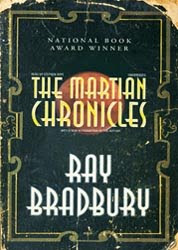
#2 The Martian Chronicles, by Ray Bradbury
Ray Bradbury lived in Long Beach, or something. Okay, what I actually do know is that he came to the final day or days of Long Beach's long-suffering used book store Acres of Books.
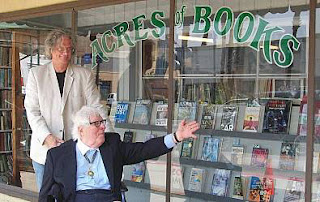
I have never read Fahrenheit 451, or Something Wicked This Way Comes, but I have been interested in Ray Bradbury, and have a growing interest in science fiction. It might sound silly, actually, it's going to sound silly, but recently I watched a few Twillight Zones in a row, and I thought, you know what, I'm into this. I know what you're thinking, but Brooke, your story of interest in science fiction is so original and riveting, how could you even think of fighting your curiosity? I couldn't my friends, I couldn't. I especially love the idea that humans came to Earth from somewhere else. I suppose there is an echo of that idea in the story of humans who go to Mars. Either way, I needed an intro to this Long Beach loving, Acres of Books loving, Mars loving white dude.
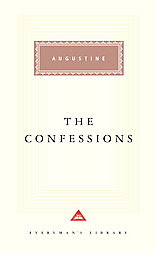
#3 Confessions, by Saint Augustine
I have been reading the work of a few saints lately, like the works of St. John of the Cross, and St. Theresa of Avila. St. Augustine seems like a logical choice. What is very intriguing to me is St. Augustine's interpretation of the Genesis of the Hebrew Bible. I used to shy away from anything Saint-related, mostly because I get a very serious dread of religious war mongering, whether against a nation, people, or individual. The persecutions of the Inquisition haunt my dreams, and I think of Goya and his etchings, or Dante's inferno, and how so many so-called holy members of the Catholic church were very okay with torturing and such. But then I discovered works by Saints that were about faith, and about the personal search for the divine. I like those ones. I like personal struggle.
#4 The Big Red Book, by Rumi
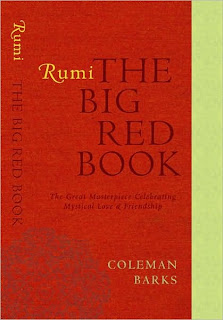
I love Rumi because he loves the divine within. Reading his poetry is like taking off a heavy pack and laughing like a child. Each time that I ache for a lost love, or an old friend, I remember Rumi, and how his poetry teaches that this is yearning for the divine within. And how loves and friends can embody divine love. I love that his poetry is simple, and easy, and reads like it's plucked from the air, and descends in words that fall like swirls of ether.
#5 Monthly Notebook Diary/Planner 2012, by MOLESKINE
 I need to know where my stuff is and when it is. But, I tend to like looking at a month in advance, so this little soft-sided book is perfect. I love MOLESKINE, of course, what English major doesn't. This one is good, and comes with tabs.
As I was leaving the bookstore, this cute little blond girl with freckles and a cute kid beanie and ugg boots and pigtails says, I go to such-and-such school and I am yadda-yadda-yadda, would you like your books wrapped? I smiled a big old smile and said thank you very much, but these are all for me.
#1 Republic, by Plato

What can I say about a book that was written in the fourth century, B.C.? It looks like a long conversation, which should at the least be readable for me as a format. I love asking myself questions and then answering my own question with a question. I also love stumping myself. Honestly, I get a spaghetti brain when it comes to politics and government, and it gets especially mushy when it comes to philosophy about such things. But there is hope, as I just flipped to a random page and the sentence read, "such a question is ridiculous." Hm, might be right up my alley.
To tell the vulgar truth I'm mostly reading this book to say that I've read it, but I have a lot of hope that I will be better for the reading. If it's too smart my head will explode, but that might not be so bad. There are worse things than a romantic woman reading Greek philosophy.
Like a romantic woman reading American science fiction.
#2 The Martian Chronicles, by Ray Bradbury

Ray Bradbury lived in Long Beach, or something. Okay, what I actually do know is that he came to the final day or days of Long Beach's long-suffering used book store Acres of Books.

I have never read Fahrenheit 451, or Something Wicked This Way Comes, but I have been interested in Ray Bradbury, and have a growing interest in science fiction. It might sound silly, actually, it's going to sound silly, but recently I watched a few Twillight Zones in a row, and I thought, you know what, I'm into this. I know what you're thinking, but Brooke, your story of interest in science fiction is so original and riveting, how could you even think of fighting your curiosity? I couldn't my friends, I couldn't. I especially love the idea that humans came to Earth from somewhere else. I suppose there is an echo of that idea in the story of humans who go to Mars. Either way, I needed an intro to this Long Beach loving, Acres of Books loving, Mars loving white dude.
#3 Confessions, by Saint Augustine

I have been reading the work of a few saints lately, like the works of St. John of the Cross, and St. Theresa of Avila. St. Augustine seems like a logical choice. What is very intriguing to me is St. Augustine's interpretation of the Genesis of the Hebrew Bible. I used to shy away from anything Saint-related, mostly because I get a very serious dread of religious war mongering, whether against a nation, people, or individual. The persecutions of the Inquisition haunt my dreams, and I think of Goya and his etchings, or Dante's inferno, and how so many so-called holy members of the Catholic church were very okay with torturing and such. But then I discovered works by Saints that were about faith, and about the personal search for the divine. I like those ones. I like personal struggle.
#4 The Big Red Book, by Rumi

I love Rumi because he loves the divine within. Reading his poetry is like taking off a heavy pack and laughing like a child. Each time that I ache for a lost love, or an old friend, I remember Rumi, and how his poetry teaches that this is yearning for the divine within. And how loves and friends can embody divine love. I love that his poetry is simple, and easy, and reads like it's plucked from the air, and descends in words that fall like swirls of ether.
#5 Monthly Notebook Diary/Planner 2012, by MOLESKINE
 I need to know where my stuff is and when it is. But, I tend to like looking at a month in advance, so this little soft-sided book is perfect. I love MOLESKINE, of course, what English major doesn't. This one is good, and comes with tabs.
As I was leaving the bookstore, this cute little blond girl with freckles and a cute kid beanie and ugg boots and pigtails says, I go to such-and-such school and I am yadda-yadda-yadda, would you like your books wrapped? I smiled a big old smile and said thank you very much, but these are all for me.
Tuesday, December 6, 2011
Smells Like My Heart Feels
Scents are magical. Due to the olfactory senses that we possess with our three-dimensional body, we attach scent to memory, emotion, and idea. I can recognize the scent of my best friend in her clothes, the scent of my grandmother's house in a tablecloth; indeed, a memory tied to a scent can almost paralyze me if caught arbitrarily.
But scent doesn't have to work with memory in a strict, directly experiential sense. I have two people in my life whose signature or favorite perfumes always represent them, even if I didn't often smell them on their skin, or in intimate situations. The association is still strong.
I have never been one to have a signature scent, although for several years I wore Theirry Mugeler's Angel perfume. I wore it out, I think. Over time I just couldn't smell it the way I wanted to anymore. Several people tell me that that scent reminds them of me, but I can't smell it anymore. I wonder if certain perfumes change their recipe, or can't get the same ingredients over time, or something else scientific I can't imagine. My tastes might have simply changed. It is a bit sweet for me nowadays.
For the past few years true commitment to a single scent has eluded me. I want to smell something so incredible that I pledge allegiance to it forever, but it is difficult to find that one fragrance. I would love it even more if that scent was already classic and respected, like Chanel No. 5 or Eau de Joy. But these perfumes are too strong for me, and they remind me that there might have been a time when bodies were not as bleached as they are today; you know, like perhaps there were more organic smells to compete with when the perfume was originally invented. I don't really know. I will smell something that I think I enjoy, then I wear it and get a headache, or get nauseous after a few minutes.
A perfumer that I have grown attached to is Jo Malone. Out of London, Jo Malone's line boasts several single-note fragrances that can be layered and interchanged to make new scents. While most perfumes must have bottom, heart, and top notes all in one bottle, Jo Malone's line lets you create these layers from a variety of notes. My problem is that I often only like lighter notes. I am in love with Nectarine Blossom, and Orange Blossom. Recently I have expanded to Mint and Jasmine Blossom, which I like because it smells almost exactly like a gin and tonic with lime. They also recently came out with a line that smelled of various teas, and I was smitten.

Aren't they lovely?
Recently I stocked up on my usual assortment of Jo Malone, and Neiman Marcus gave me a lovely little rose bag filled with samples of new perfumes, from all different lines and designers. Out of the ten or so sampled I really liked this one, ORIENS, by Van Cleef and Arpel

It's a bit spicy for me, but I think I might have found my grown up perfume. It smells like a romantic hug, or a hug with an open heart, ready to experience anything. It smells like the way my heart feels at the symphony, or the way my heart feels when I read something magical. I suppose it could just be enough to say that it smells like how my heart feels when it is open and vulnerable and filled with light.
And that kind of statement underscores the reason why I think scent is magical. Our bodies that are so marvelous, these vehicles that get us there, and house this energy and ether, need scent to explain other experiences. I hope my time with ORIENS is magical, as I take it with me today to the coffee house and read and write.
Afterward:
I failed to mention that in some cases the desire to smell a certain way is influenced by the whims of a lover. So, I will also be testing out L'ESSANCE Balenciaga Paris.
But scent doesn't have to work with memory in a strict, directly experiential sense. I have two people in my life whose signature or favorite perfumes always represent them, even if I didn't often smell them on their skin, or in intimate situations. The association is still strong.
I have never been one to have a signature scent, although for several years I wore Theirry Mugeler's Angel perfume. I wore it out, I think. Over time I just couldn't smell it the way I wanted to anymore. Several people tell me that that scent reminds them of me, but I can't smell it anymore. I wonder if certain perfumes change their recipe, or can't get the same ingredients over time, or something else scientific I can't imagine. My tastes might have simply changed. It is a bit sweet for me nowadays.
For the past few years true commitment to a single scent has eluded me. I want to smell something so incredible that I pledge allegiance to it forever, but it is difficult to find that one fragrance. I would love it even more if that scent was already classic and respected, like Chanel No. 5 or Eau de Joy. But these perfumes are too strong for me, and they remind me that there might have been a time when bodies were not as bleached as they are today; you know, like perhaps there were more organic smells to compete with when the perfume was originally invented. I don't really know. I will smell something that I think I enjoy, then I wear it and get a headache, or get nauseous after a few minutes.
A perfumer that I have grown attached to is Jo Malone. Out of London, Jo Malone's line boasts several single-note fragrances that can be layered and interchanged to make new scents. While most perfumes must have bottom, heart, and top notes all in one bottle, Jo Malone's line lets you create these layers from a variety of notes. My problem is that I often only like lighter notes. I am in love with Nectarine Blossom, and Orange Blossom. Recently I have expanded to Mint and Jasmine Blossom, which I like because it smells almost exactly like a gin and tonic with lime. They also recently came out with a line that smelled of various teas, and I was smitten.

Aren't they lovely?
Recently I stocked up on my usual assortment of Jo Malone, and Neiman Marcus gave me a lovely little rose bag filled with samples of new perfumes, from all different lines and designers. Out of the ten or so sampled I really liked this one, ORIENS, by Van Cleef and Arpel

It's a bit spicy for me, but I think I might have found my grown up perfume. It smells like a romantic hug, or a hug with an open heart, ready to experience anything. It smells like the way my heart feels at the symphony, or the way my heart feels when I read something magical. I suppose it could just be enough to say that it smells like how my heart feels when it is open and vulnerable and filled with light.
And that kind of statement underscores the reason why I think scent is magical. Our bodies that are so marvelous, these vehicles that get us there, and house this energy and ether, need scent to explain other experiences. I hope my time with ORIENS is magical, as I take it with me today to the coffee house and read and write.
Afterward:
I failed to mention that in some cases the desire to smell a certain way is influenced by the whims of a lover. So, I will also be testing out L'ESSANCE Balenciaga Paris.
Those Who Can't Do or Teach, Read
I find myself puzzled that after so many years of what felt like slaving away at college I am not wildly chomping at the bit to go to graduate school. At first, I was tired and overwhelmed at the thought of four to six more years. Now, I look at the cost, realize that I'm not in it for the career (although I may not mind a career in writing or teaching someday) and the cost is sufficient to waylay my desire for more education. I have to admit that for the most part I am in this for the learning, and not for the preparing for a job. However, should it become apparent someday that I need to have a career and need to amass an income, having such a background in literature and education would qualify me for a number of different things.
The thing is, I want to travel more than anything. So, there the money I can possibly save goes, to travel.
Still, can you imagine me, sitting around, growing stale, rotten? I still have a noodle hungry for words and ideas. I've set myself up rather nicely for pure, original idea making. That is, I have limited access to mind numbing television, have deactivated my Facebook account, and don't eat meat anymore. I have set the scene for reading. I have a great new coffee house which sits a refreshing two blocks away. It is time for some serious reading and writing. The kind I would do in graduate school -- well, maybe not the writing part. In graduate school I would have to write so many papers, and research ones at that. But I have faith that I might write a paper or two. Its early in this new reader stage of things. I have early, new venture hope.
My generous, beloved instructors have given me a reading list to satisfy the basics in literary theory and philosophy. Since I have already started Madwoman in the Attic, I will continue with it, as if it is required reading. After, I will move on to Focault. I have read a little teensy bit of Discipline and Punish, but I will buy and read the whole thing. I am actually very excited. To read and to write! These are my dreams.
Meanwhile, to continue reading and rereading Moby-Dick is enough literature for me.
Also, since I am off Facebook, I would like to add tabs to the top of my blog to share with you other lovely things that I love and am interested in, like travel, shopping, art, films, etc.
And, of course, I love you.
The thing is, I want to travel more than anything. So, there the money I can possibly save goes, to travel.
Still, can you imagine me, sitting around, growing stale, rotten? I still have a noodle hungry for words and ideas. I've set myself up rather nicely for pure, original idea making. That is, I have limited access to mind numbing television, have deactivated my Facebook account, and don't eat meat anymore. I have set the scene for reading. I have a great new coffee house which sits a refreshing two blocks away. It is time for some serious reading and writing. The kind I would do in graduate school -- well, maybe not the writing part. In graduate school I would have to write so many papers, and research ones at that. But I have faith that I might write a paper or two. Its early in this new reader stage of things. I have early, new venture hope.
My generous, beloved instructors have given me a reading list to satisfy the basics in literary theory and philosophy. Since I have already started Madwoman in the Attic, I will continue with it, as if it is required reading. After, I will move on to Focault. I have read a little teensy bit of Discipline and Punish, but I will buy and read the whole thing. I am actually very excited. To read and to write! These are my dreams.
Meanwhile, to continue reading and rereading Moby-Dick is enough literature for me.
Also, since I am off Facebook, I would like to add tabs to the top of my blog to share with you other lovely things that I love and am interested in, like travel, shopping, art, films, etc.
And, of course, I love you.
Tuesday, November 15, 2011
Half-Read Books: Whole Lessons
Recently I leant the book Teachers as Cultural Workers: Letters to Those Who Dare Teach, by Paulo Freire, to a friend who either currently or in the past taught elementary school. When I found out she was a teacher, I quickly remembered this book, one that I had been required to read in my senior year of college, for an education class I reluctantly took to fill a credit requirement. I had found it thrilling, heart pounding, and comforting. She returned it to me recently, delicately sealed in a plastic baggie, and commented that she didn't read the whole thing, but found it intellectual, stimulating, and effective in bringing up memories from her past experiences with her students, teaching them poetry, etc.
I smiled with some understanding and sadness that she didn't finish it, and that she found it intellectual. It is true that Freire's work is not easy to understand. There are also cultural differences between his teaching experiences with children and illiterate young adults and adults in South America, and teaching mostly American and Mexican-American children in Southern California. However, Freire always speaks in generalities, using terms and references that indicate his letters are meant for the world, meant for humankind in various states of government and organization. Even still, this book is a work of theory; this work is information meant to challenge and argue, to draw out ideas and examine them, even to mercilessly scrutinize ideas until new perspectives are identified. I realize that I smiled with sadness because I wanted to see a spark in her eyes, a light of new hope, or some intense, childlike energy. I wanted to share my love of this work with someone, especially a teacher.
She did enjoy what she had read. I suppose I was disappointed at the idea that she felt the intellectual nature of the book was too much for her. Yet, I understood. How many times did I read theory in college and feel like crying (fine, maybe I did cry a few times), feeling that I would never understand such concepts. I still feel this way when I read theory. I begin to sense an energy, a rush of anticipation at devouring new information or new ideas, and then it comes, the fear. The fear that I don't understand everything. The fear that I'm outside of the intellectual circle, and that even if I wasn't, what I have to offer the circle isn't good enough.
These fears used to be very real to me, but now, a couple of years after college, I am not so intimidated nor so afraid of ideas. However, I am still afraid of not being good enough for academia. I see how I am saddened by my friend's fear, by the ease with which she explained that she didn't read the whole book, because I see my own fears, the ease with which I say that I'm not planning on going to graduate school, that I haven't written anything on Moby-Dick in over a year, that I haven't read any theory in just as long.
Freire has a chapter in his book entitled "Don't Let the Fear of What is Difficult Paralyze You." Freire states, simply, and reassuringly, that
He goes on to exhort his readers to never "stop at the at the level of emotions, of intuitions," when reading a text. I feel my heart blossom in the freedom of his exhortation. Does this mean that I am free? Free to love books, not because they are great, or classics, or literature, or funny, or important, but because I love words and stories? I am consistently afraid that I am not allowed to love literature. I am tired of being paralyzed by fear. I am tired of being panicked that my love of literature makes any of my scientific observations more vulnerable to attack and dismissal. I am tired of thinking that my love of literature could be taken from me as it is inevitably revealed that my ideas are not important, relevant, or high enough for others to enjoy.
All of this insecurity has troubled me since the day I walked into my first English class, in Fullerton, at 23. I carry a terrible shame about going to college with an eighth grade education. I battled this shame with bravado, superior attitudes, insistence that my reading list outranked most college graduates in terms of greatness and literature. I hid this gnawing rat of shame that my intelligence is and always will be linked to those dark years of "teenage wasteland." It loomed constantly over my experiences in college, when every B was a travesty, when I would have miscommunications and struggles with instructors or texts. And even as I was walking in procession during my university commencement, I couldn't be happy with any of the recognition without telling myself, yes, I suppose it's pretty good for the girl who left school at 13.
I have been given the opportunity to see, through the sad and dismissive eyes of my friend, who sealed this book of generous encouragement in sanitary plastic, my own abandonment of education, largely due to the shame I willingly carry about my upbringing and childhood experience. This is what hit home for me. Usually, I would judge her as not courageous enough to finish the work, or lazy, but now, with a clear mind I see myself. I see how I have mostly given up on graduate school.
But maybe all is not lost. Before putting the book away, back with its comrades in theory, in my own personal theory section in my library, I quickly read the introduction, which moved me to tears, and inspired me to write this post. Written by Joe L. Kincheloe, esteemed professor, author, and rigorous critic of pedagogue, the introduction speaks about an experience Kincheloe had as an undergraduate in which a professor claimed that a beloved researched paper Kincheloe has slaved over was not original work, and without any proof stated it must be plagiarized. The professor blasted him with: "I know that someone like you is not capable of such work." Kincheloe explains, "In retrospect I think he was referring to my Appalachian markers: the Tennessee mountain accent, cheap clothes, the nontraditional scholarly persona." And yet, what Kincheloe did next hit me right in the heart. He tells, "I walked over to the library and returned to the works...the ideas soothed my agitated mind like an opiate." Returning to the work has always been a saving grace for me. Even fighting myself, fighting my own voice that would oppress me and have believe the lie that there is no place for a 32 year-old female adult-child with an eighth-grade education in university academia, I have always returned to the work. I return to Melville, to Faulkner, to Jonathan Culler, to Derrida, to Freud, to Kirkengard, to Gilbert and Gubar.
Perhaps it's time to get the thirteen year-old dropout alcoholic off my back, and return to the work.
I smiled with some understanding and sadness that she didn't finish it, and that she found it intellectual. It is true that Freire's work is not easy to understand. There are also cultural differences between his teaching experiences with children and illiterate young adults and adults in South America, and teaching mostly American and Mexican-American children in Southern California. However, Freire always speaks in generalities, using terms and references that indicate his letters are meant for the world, meant for humankind in various states of government and organization. Even still, this book is a work of theory; this work is information meant to challenge and argue, to draw out ideas and examine them, even to mercilessly scrutinize ideas until new perspectives are identified. I realize that I smiled with sadness because I wanted to see a spark in her eyes, a light of new hope, or some intense, childlike energy. I wanted to share my love of this work with someone, especially a teacher.
She did enjoy what she had read. I suppose I was disappointed at the idea that she felt the intellectual nature of the book was too much for her. Yet, I understood. How many times did I read theory in college and feel like crying (fine, maybe I did cry a few times), feeling that I would never understand such concepts. I still feel this way when I read theory. I begin to sense an energy, a rush of anticipation at devouring new information or new ideas, and then it comes, the fear. The fear that I don't understand everything. The fear that I'm outside of the intellectual circle, and that even if I wasn't, what I have to offer the circle isn't good enough.
These fears used to be very real to me, but now, a couple of years after college, I am not so intimidated nor so afraid of ideas. However, I am still afraid of not being good enough for academia. I see how I am saddened by my friend's fear, by the ease with which she explained that she didn't read the whole book, because I see my own fears, the ease with which I say that I'm not planning on going to graduate school, that I haven't written anything on Moby-Dick in over a year, that I haven't read any theory in just as long.
Freire has a chapter in his book entitled "Don't Let the Fear of What is Difficult Paralyze You." Freire states, simply, and reassuringly, that
"[s]tudying is a demanding occupation, in the process of which we will encounter pain, pleasure, victory, defeat, doubt, and happiness. For this reason, studying require the development of rigorous discipline, which we must consciously forge in ourselves. No one can bestow or impose such discipline on someone else; the attempt implies a total lack of knowledge about the educator's role in the development of discipline. In any case, either we are the agents of this discipline, or it becomes a mere appendage to ourselves. Either we adhere to study with delight or accept it as necessity and pleasure, or it becomes a mere burden and, as such, will be abandoned at the first crossroads.
The more we accept this discipline, this more we strengthen our ability to overcome threats to it and thus to our ability to study effectively."
He goes on to exhort his readers to never "stop at the at the level of emotions, of intuitions," when reading a text. I feel my heart blossom in the freedom of his exhortation. Does this mean that I am free? Free to love books, not because they are great, or classics, or literature, or funny, or important, but because I love words and stories? I am consistently afraid that I am not allowed to love literature. I am tired of being paralyzed by fear. I am tired of being panicked that my love of literature makes any of my scientific observations more vulnerable to attack and dismissal. I am tired of thinking that my love of literature could be taken from me as it is inevitably revealed that my ideas are not important, relevant, or high enough for others to enjoy.
All of this insecurity has troubled me since the day I walked into my first English class, in Fullerton, at 23. I carry a terrible shame about going to college with an eighth grade education. I battled this shame with bravado, superior attitudes, insistence that my reading list outranked most college graduates in terms of greatness and literature. I hid this gnawing rat of shame that my intelligence is and always will be linked to those dark years of "teenage wasteland." It loomed constantly over my experiences in college, when every B was a travesty, when I would have miscommunications and struggles with instructors or texts. And even as I was walking in procession during my university commencement, I couldn't be happy with any of the recognition without telling myself, yes, I suppose it's pretty good for the girl who left school at 13.
I have been given the opportunity to see, through the sad and dismissive eyes of my friend, who sealed this book of generous encouragement in sanitary plastic, my own abandonment of education, largely due to the shame I willingly carry about my upbringing and childhood experience. This is what hit home for me. Usually, I would judge her as not courageous enough to finish the work, or lazy, but now, with a clear mind I see myself. I see how I have mostly given up on graduate school.
But maybe all is not lost. Before putting the book away, back with its comrades in theory, in my own personal theory section in my library, I quickly read the introduction, which moved me to tears, and inspired me to write this post. Written by Joe L. Kincheloe, esteemed professor, author, and rigorous critic of pedagogue, the introduction speaks about an experience Kincheloe had as an undergraduate in which a professor claimed that a beloved researched paper Kincheloe has slaved over was not original work, and without any proof stated it must be plagiarized. The professor blasted him with: "I know that someone like you is not capable of such work." Kincheloe explains, "In retrospect I think he was referring to my Appalachian markers: the Tennessee mountain accent, cheap clothes, the nontraditional scholarly persona." And yet, what Kincheloe did next hit me right in the heart. He tells, "I walked over to the library and returned to the works...the ideas soothed my agitated mind like an opiate." Returning to the work has always been a saving grace for me. Even fighting myself, fighting my own voice that would oppress me and have believe the lie that there is no place for a 32 year-old female adult-child with an eighth-grade education in university academia, I have always returned to the work. I return to Melville, to Faulkner, to Jonathan Culler, to Derrida, to Freud, to Kirkengard, to Gilbert and Gubar.
Perhaps it's time to get the thirteen year-old dropout alcoholic off my back, and return to the work.
Subscribe to:
Comments (Atom)
