
Customers who viewed this item also viewed
Buy new:
-39% $12.90$12.90
FREE delivery Sunday, February 8 on orders shipped by Amazon over $35
Advertisement
Ships from: Amazon.com Sold by: Amazon.com
Save with Used - Very Good
$6.65$6.65
FREE delivery February 11 - 13
Advertisement
Ships from: ThriftBooks-Baltimore Sold by: ThriftBooks-Baltimore
Sorry, there was a problem.
There was an error retrieving your Wish Lists. Please try again.Sorry, there was a problem.
List unavailable.
Download the free Kindle app and start reading Kindle books instantly on your smartphone, tablet, or computer - no Kindle device required.
Read instantly on your browser with Kindle for Web.
Using your mobile phone camera - scan the code below and download the Kindle app.
Image Unavailable
Color:
-
-
-
- To view this video download Flash Player
-
-
-
6 VIDEOS -
Follow the authors
OK
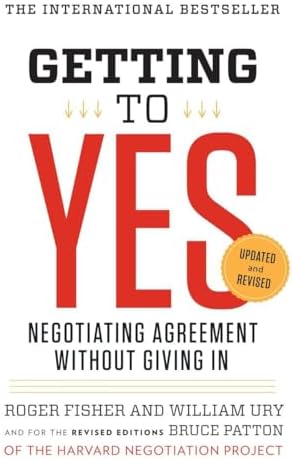
Getting to Yes: Negotiating Agreement Without Giving In Paperback – May 3, 2011
Purchase options and add-ons
“The authors have packed a lot of commonsensical observation and advice into a concise, clearly written little book.”—Bloomberg Businessweek
One of the key business texts of the modern era, Getting to Yes has helped millions of people learn a better way to negotiate. Based on the work of the Harvard Negotiation Project, a group that deals with all levels of negotiation and conflict resolution, it offers readers a straightforward, universally applicable method for reaching mutually satisfying agreements—at home, in business, and with people in any situation. Read Getting to Yes to learn, step-by-step, how to
• disentangle the people from the problem
• focus on interests, not positions
• work together to find creative and fair options
• negotiate successfully with anybody at any level
- Print length240 pages
- LanguageEnglish
- PublisherPenguin Books
- Publication dateMay 3, 2011
- Dimensions5.09 x 0.63 x 7.73 inches
- ISBN-101844131467
- ISBN-13978-0143118756
Discover the latest buzz-worthy books, from mysteries and romance to humor and nonfiction. Explore more
Frequently bought together

More items to explore
Bargaining for Advantage: Negotiation Strategies for Reasonable PeoplePaperbackFREE Shipping on orders over $35 shipped by AmazonGet it as soon as Sunday, Feb 8
Murder Is Bad MannersPaperbackFREE Shipping on orders over $35 shipped by AmazonGet it as soon as Sunday, Feb 8
Getting Past No: Negotiating in Difficult SituationsPaperbackFREE Shipping on orders over $35 shipped by AmazonGet it as soon as Sunday, Feb 8
Difficult Conversations: How to Discuss What Matters MostPaperbackGet it as soon as Thursday, Feb 19
Customers also bought or read
- Bargaining for Advantage: Negotiation Strategies for Reasonable People
Paperback$10.69$10.69Delivery Sun, Feb 8 - Negotiation Genius: How to Overcome Obstacles and Achieve Brilliant Results at the Bargaining Table and Beyond
Paperback$10.93$10.93Delivery Sun, Feb 8 - Difficult Conversations: How to Discuss What Matters Most#1 Best SellerManagement Science
Paperback$9.99$9.99Delivery Feb 19 - 23 - Beyond Winning: Negotiating to Create Value in Deals and Disputes
Paperback$20.83$20.83Delivery Sun, Feb 8 - The Mediation Process: Practical Strategies for Resolving Conflict
Paperback$43.37$43.37FREE delivery Sun, Feb 8 - The Bartering Mindset: A Mostly Forgotten Framework for Mastering Your Next Negotiation
Paperback$21.94$21.94Delivery Feb 14 - 19 - Negotiation: Theory and Strategy (Aspen Casebook Series)
Hardcover$124.00$124.00FREE delivery Feb 9 - 11 - How to Negotiate like a Pro: How to Resolve Anything, Anytime, Anywhere
Paperback$13.10$13.10Delivery Sun, Feb 8 - Getting to Yes with Yourself: How to Get What You Truly Want
Paperback$13.53$13.53Delivery Feb 15 - 23 - Negotiating Globally: How to Negotiate Deals, Resolve Disputes, and Make Decisions Across Cultural Boundaries (Jossey-bass Business & Management)
Hardcover$38.89$38.89FREE delivery Feb 10 - 12 - 3-d Negotiation: Powerful Tools to Change the Game in Your Most Important Deals
Hardcover$17.85$17.85Delivery Feb 16 - 22 - Collywobbles: How to Negotiate When Negotiating Makes You Nervous
Paperback$24.99$24.99Delivery Sun, Feb 8 - Negotiation Theory and Strategy: [Connected Ebook] (Aspen Casebook) (Aspen Casebook Series)
Hardcover$257.50$257.50FREE delivery Sun, Feb 8 - Transformative Negotiation: Strategies for Everyday Change and Equitable Futures
Paperback$27.48$27.48Delivery Sun, Feb 8 - The Art of Negotiation: How to Improvise Agreement in a Chaotic World (A Creative Guide to Negotiating)
Hardcover$14.60$14.60Delivery Sun, Feb 8 - The Fundamentals of Family Mediation (Transpersonal Humanist Psychol)
Paperback$34.47$34.47Delivery Sun, Feb 8 - The Practice of Mediation: A Video-Integrated Text [Connected eBook] (Aspen Coursebook)
Paperback$142.50$142.50FREE delivery Feb 9 - 11 - Alternatives to Litigation Mediation, Arbitration, and the Art of Dispute Resolution: Third Edition (NITA)
Paperback$95.69$95.69FREE delivery Feb 11 - 17
From the Publisher
Editorial Reviews
Review
—John Kenneth Galbraith
“The authors have packed a lot of commonsensical observation and advice into a concise, clearly written little book.”
—Businessweek
“A coherent brief for ‘win-win’ negotiations.”
—Newsweek
“Getting to Yes has an unrivaled place in the literature of dispute resolution. No other book in the field comes close to its impact on the way practitioners, teachers, researchers, and the public approach negotiation.”
—National Institute for Dispute Resolution Forum
“Getting to Yes is a highly readable and practical primer on the fundamentals of negotiation. All of us, as negotiators dealing with personal, community, and business problems need to improve our skills in conflict resolution and agreement making. This concise volume is the best place to begin.”
—John T. Dunlop
“This splendid book will help turn adversarial battling into hardheaded problem solving.”
—Averell Harriman
“Getting to Yes is a highly readable, uncomplicated guide to resolving conflicts of every imaginable dimension. It teaches you how to win without compromising friendships. I wish I had written it!”
—Ann Landers
“Getting to Yes is powerful, incisive, persuasive. Not a bag of tricks but an overall approach. Perhaps the most useful book you will ever read!”
—Elliot Richardson
“Simple but powerful ideas that have already made a contribution at the international level are here made available to all. Excellent advice on how to approach a negotiating problem.”
—Cyrus Vance
About the Author
William Ury cofounded the Harvard Negotiation Project and is the award-winning author of several books on negotiation.
Bruce Patton is cofounder and Distinguished Fellow of the Harvard Negotiation Project and the author of Difficult Conversations, a New York Times bestseller.
Excerpt. © Reprinted by permission. All rights reserved.
The case of Israel and Egypt negotiating over who should keep how much of the Sinai Peninsula illustrates both a major problem in negotiation and a key opportunity.
the pie that leaves both parties satisfied. Often you are negotiating along a single dimension, such as the amount of territory, the price of a car, the length of a lease on an apartment, or the size of a commission on a sale. At other times you face what appears to be an either/or choice that is either markedly favorable to you or to the other side. In a divorce settlement, who gets the house? Who gets custody of the children? You may see the choice as one between winning and losing- and neither side will agree to lose. Even if you do win and get the car for $12,000, the lease for five years, or the house and kids, you have a sinking feeling that they will not let you forget it. Whatever the situation, your choices seem limited.
option like a demilitarized Sinai can often make the difference between deadlock and agreement. One lawyer we know attributes his success directly to his ability to invent solutions advantageous to both his client and the other side. He expands the pie before dividing it. Skill at inventing options is one of the most useful assets a negotiator can have.
Yet all too often negotiators end up like the proverbial children who quarreled over an orange. After they finally agreed to divide the orange in half, the first child took one half, ate the fruit, and threw away the peel, while the other threw away. the fruit and used the peel from the second half in baking a cake. All too often negotiators "leave money on the table" - they fail to reach agreement when they might have, or the agreement they do reach could have been better for each side. Too many negotiations end up with half an orange for each side instead of the whole fruit for one and the whole peel for the other. Why?
DIAGNOSIS
As valuable as it is to have many options, people involved in a negotiation rarely sense a need for them. In a dispute, people usually believe that they know the right answer - their view should prevail. In a contract negotiation they are equally likely to believe that their offer is reasonable and should be adopted, perhaps with some adjustment in the price. All available answers appear to lie along a straight line between their position and yours. Often the only creative thinking shown is to suggest splitting the difference.
inventing of an abundance of options: (1) premature judgment; (2) searching for the single answer; (3) the assumption of a fixed pie; and (4) thinking that "solving their problem is their problem." In order to overcome these constraints, you need to understand them.
Premature judgment
Inventing options does not come naturally. Not inventing is the normal state of affairs, even when you are outside a stressful negotiation. If you were asked to name the one person in the world most deserving of the Nobel Peace Prize, any answer you might start to propose would immediately encounter your reservations and doubts. How could you be sure that that person was the most deserving? Your mind might well go blank, or you might throw out a few answers that would reflect conventional thinking: "Well, maybe the Pope, or the President."
pounce on the drawbacks of any new idea. Judgment hinders imagination.
sense is likely to be sharper. Practical negotiation appears to call for practical thinking, not wild ideas.
on the other side. Suppose you are negotiating with your boss over your salary for the coming year. You have asked for a $4,000 raise; your boss has offered you $1,500, a figure that you have indicated is unsatisfactory. In a tense situation like this you are not likely to start inventing imaginative solutions. You may fear that if you suggest some bright half-baked idea like taking half the increase in a raise and half in additional benefits, you might look foolish. Your boss might say, "Be serious. You know better than that. It would upset company policy. I am surprised. that you even suggested it." If on the spur of the moment you invent a possible option of spreading out the raise over time, he may take it as an offer: "I'm prepared to start negotiating on that basis." Since he may take whatever you say as a commitment, you will think twice before saying anything.
piece of information that will jeopardize your bargaining position. If you should suggest, for example, that the company help finance the house you are about to buy, your boss may conclude that you intend to stay and that you will in the end accept any raise in salary he is prepared to offer.
Searching for the single answer
In most people's minds, inventing simply is not part of the negotiating process. People see their job as narrowing the gap between positions, not broadening the options available. They tend to think, "We're having a hard enough time agreeing as it is. The last thing we need is a bunch of different ideas." Since the end product of negotiation is a single decision, they fear that freefloating discussion will only delay and confuse the process.
the second is premature closure. By looking from the outset for the single best answer, you are likely to short-circuit a wiser decision-making process in which you select from a large number of possible answers.
The assumption of a fixed pie
A third explanation for why there may be so few good options on the table is that each side sees the situation as essentially either/or - either I get what is in dispute or you do. A negotiation often appears to be a "fixed-sum" game; $100 more for you on the price of a car means $100 less for me. Why bother to invent if all the options are obvious and I can satisfy you only at my own expense?
Thinking that "solving their problem Is their problem"
A final obstacle to inventing realistic options lies in each side's concern with only its own immediate interests. For a negotiator to reach an agreement that meets his own self-interest he needs to develop a solution which also appeals to the self-interest of the other. Yet emotional involvement on one side of an issue makes it difficult to achieve the detachment necessary to think up wise ways of meeting the interests of both sides: "We've got enough problems of our own; they can look after theirs." There also frequently exists a psychological reluctance to accord any legitimacy to the views of the other side; it seems disloyal to think up ways to satisfy them. Shortsighted self- concern thus leads a negotiator to develop only partisan positions, partisan arguments, and one-sided solutions....
Product details
- ASIN : 0143118757
- Publisher : Penguin Books
- Publication date : May 3, 2011
- Edition : 3rd Revised ed.
- Language : English
- Print length : 240 pages
- ISBN-10 : 1844131467
- ISBN-13 : 978-0143118756
- Item Weight : 2.31 pounds
- Dimensions : 5.09 x 0.63 x 7.73 inches
- Best Sellers Rank: #763 in Books (See Top 100 in Books)
- Customer Reviews:
About the authors

Discover more of the author’s books, see similar authors, read book recommendations and more.

William Ury is the co--founder of Harvard's Program on Negotiation, where he directs the Project on Preventing War. One of the world's leading negotiation specialists, his past clients include dozens of Fortune 500 companies as well as the White House and Pentagon. Ury received his B.A. from Yale and a Ph.D. in Anthropology from Harvard. His books Getting to YES and Getting Past No have sold more than five million copies worldwide.

Roger Fisher teaches negotiation at Harvard Law School. He frequently appears on television as a negotiations expert and is the director of the Harvard Negotiation Project.
Related products with free delivery on eligible orders
Customer reviews
Customer Reviews, including Product Star Ratings help customers to learn more about the product and decide whether it is the right product for them.
To calculate the overall star rating and percentage breakdown by star, we don’t use a simple average. Instead, our system considers things like how recent a review is and if the reviewer bought the item on Amazon. It also analyzed reviews to verify trustworthiness.
Learn more how customers reviews work on AmazonCustomers say
Generated from the text of customer reviewsSelect to learn more
Reviews with images
Now I know
Top reviews from the United States
There was a problem filtering reviews. Please reload the page.
- Reviewed in the United States on December 27, 2025Format: PaperbackVerified PurchaseLike the title says: a great read, and a good intro to the key concepts behind managing differences.
- Reviewed in the United States on October 10, 2025Format: PaperbackVerified PurchaseGetting to Yes is one of those rare business books that manages to be both practical and genuinely easy to read. I picked it up hoping for guidance on professional negotiation, but I quickly realized its lessons extend well beyond the boardroom. The principles, focusing on interests rather than positions, separating people from the problem, and striving for win-win solutions, apply just as naturally to everyday life, from family discussions to planning group projects.
What makes it stand out is the clarity of the writing. Complex concepts are broken down into digestible examples without feeling oversimplified. Each chapter offers actionable strategies, yet it never feels like a dense textbook. The authors’ approach encourages thoughtful problem-solving rather than pushing hard bargaining tactics, which makes the advice feel both ethical and practical.
Overall, it’s one of those books you keep within reach, not just for work but for navigating daily interactions more smoothly. Definitely worth picking up!!!
- Reviewed in the United States on January 6, 2026Format: PaperbackVerified PurchaseI picked this up for a summer class I was taking on negotiations. Often, business books are full of fluff and theory that doesn't work in the real world, but this one is different. The techniques here are genuinely actionable. The highlight for me was putting the theory into practice. During the course, we traveled to Croatia and actually used the frameworks from this book to negotiate with other students there. It was impressive to see how the concepts held up even in a cross-cultural setting. It helped me approach disagreements not as a battle of wills, but as a problem to be solved together.
I am giving it 4 stars instead of 5 purely because of the writing style. It can be quite dry and academic at times. It is definitely a book you read to learn, not necessarily to be entertained. You might find yourself having to re-read paragraphs to fully grasp the concepts if your mind starts to wander.
If you are in business, law, or just want to be better at conflict resolution, this is a must-read standard. Just brew a strong cup of coffee before you sit down with it.
- Reviewed in the United States on August 19, 2007Format: HardcoverVerified PurchaseReviewing a book 15 years after its publication might seem a bit pointless. But that depends on the book. In this case, we're talking about a book that has near cult status in the business community.
Over the past 15 years, this book has been referred to and revered in thousands--if not millions--of articles, seminars, college course, and training programs. In fact, as of the date of this review over 100 published books cite Getting to Yes.
If you're in business and haven't read this book, you are operating with less than full power. But the book has value well beyond the business world. If you've ever had a disagreement end in a way that left you or the other party feeling cheated or manipulated, that ending probably came about because you were either bargaining about position or confusing the people with the problem. Either strategy guarantees at least one loser. Unfortunately, most disagreements follow one or both of these losing strategies.
With discipline and practice, you can apply the knowledge in this book so that you:
* Preserve relationships without giving in (go along to get along).
* Can satisfy the interests of both parties.
* Ensure both parties are motivated to uphold their end of the bargain.
* Feel good about the agreement reached and the people who reached it.
The strategies have nothing to do with tricking other people or playing games. The strategies have everything to do with respecting other people and refusing to play games.
In the publishing world, "thud factor" is a major consideration. Many readers expect filler, in the form of anecdotes and stories (as if they want the author to assume they are too daft to understand assertions made directly in plain English). Getting to Yes is 200 pages long, with the last 50 pages or so being basically a review and a "Cliff Notes" of the first 150. So, you have the book followed by a summary of the book. What you don't have is 150 pages stretched to 300 pages with stories that a busy executive would rather skip.
The concise writing is a huge plus to many people, but some reviewers see it as a minus. So, you may also read reviews saying that other books are "better" because they are thicker.
I have two proposed solutions to that:
1. Read the first 150 pages of Getting to Yes twice. This will equal 300 pages.
2. Read the book, then practice it. Take 150 pages of notes regarding your experiences. You now have the stories and filler you wanted.
The authors wrote this book not to entertain, but to educate. It gets to the point. There is no obfuscation, meandering, or distraction. That same communication style is required in a negotiation. The occasional anecdote may be helpful, but to lead a negotiation to a successful conclusion you must focus on the real issues. That is what this book does. And that's why it's a classic in the classroom and in the boardroom, and in executive suites and staterooms throughout the world.
Be sure to read Getting Past No and The Power of a Positive No, as well.
Top reviews from other countries
-
AgostinoReviewed in Italy on May 9, 20255.0 out of 5 stars Da leggere per vendere meglio e negoziare con efficacia
Un libro interessante, chiaro e ricco di spunti pratici. Perfetto per chi desidera migliorare le proprie competenze nella vendita e nella negoziazione, sia in ambito professionale che nella vita di tutti i giorni.
9447914010301202202112022021030104197449Reviewed in Japan on March 31, 20165.0 out of 5 stars I often have crestfallen eyes after negotiation
This book may change the way I negotiate. Most of what the authors say in the book could fall under the category of “common wisdom”. The good thing about this book is that it organizes such common wisdom in a way that a negotiator can use it to his benefit.
One of the classic books on negotiation worth reading.
Thushan HettiarachchiReviewed in the United Arab Emirates on September 16, 20245.0 out of 5 stars very well detailed
very well structured to the point and all practical advice
Marcelo BurattoReviewed in Brazil on April 15, 20235.0 out of 5 stars One of the best books about negotiation.
Format: PaperbackVerified PurchaseIt is a really amazing book about negotiation. The authors are experts on this subjects and they give many useful tactics on how to succeed in every negotiation. This book is enjoyable and I really apreciate every page of it.
It is a really amazing book about negotiation. The authors are experts on this subjects and they give many useful tactics on how to succeed in every negotiation. This book is enjoyable and I really apreciate every page of it.5.0 out of 5 stars
Marcelo BurattoOne of the best books about negotiation.
Reviewed in Brazil on April 15, 2023
Images in this review
JeromeReviewed in Singapore on November 3, 20255.0 out of 5 stars Understanding Yes
Format: PaperbackVerified PurchaseGetting to Yes completely enriched how I approach negotiation. It focuses on finding common grounds through understanding of interests, rather than about winning or giving in. The examples provided felt real and practical, and the ideas provided me additional perspectives in the world of negotiation.


![Wills, Trusts, and Estates, Eleventh Edition: [Connected eBook with Study Center] (Aspen Casebook) (Aspen Casebook Series)](https://images-na.ssl-images-amazon.com/images/I/71qQLEqup6L._AC_UL165_SR165,165_.jpg)




![Book cover The Mind and Heart of the Negotiator [Global Edition]](https://m.media-amazon.com/images/I/41gEzstsEBL._UX300undefined_.jpg)