One can certainly concede that desire is radically conditioned without claiming that it is radically determined, and that there are structures that make possible desire without claiming that those structures are impervious to a reiterative and transformative articulation. The latter is hardly a return to “the ego” or classical liberal notions of freedom, but it does insist that the norm has a temporality that opens it to a subversion from within and to a future that cannot be fully anticipated.
Antigone’s Claim departs from popular readings of Sophocles’ Antigone that have posited the play as exploring a conflict between human-made law and natural law, or – more subtly – between the norms of (private) kinship (expressed by Antigone) and the impersonal imperatives of an evolving State-form (expressed by Creon).
Taking Hegel and Lacan’s readings of the play as a counterpoint, Butler argues that Antigone displaces and unsettles accepted notions of kinship, and in doing so, foreshadows (or prefigures?) other, non-normative forms. Butler does so by taking the prohibition of incest as foundational, and noting how, in the descent from Oedipus, the family structures involving Oedipus, Antigone, Ismene, and Haemon are displaced from the heterosexual family norm; thus, Antigone’s determination to bury her “brother” is not simply an articulation of a kin-based love between brother and sister, as Oedipus himself is both “father” and “brother”, which makes Haemon simultaneously “brother” and “nephew.”
Using this, and though a close reading of the play, Butler makes the point that “if kinship is the precondition of the human, then Antigone is the occasion for a new field of the human, achieved through political catachresis, the one that happens when the less than human speaks as human, when gender is displaced, and kinship founders on its own founding laws.” This “new field of the human”, thus, is articulated through the idea of “radical kinship.”
Butler correctly notes that Antigone – of course – does not provide a blueprint for what this might look like; the role of the play is limited to unsettling the normative forms. In a certain sense, it does the work of deconstruction, which – in turn – creates the possibilities for making a new path by walking.
My own reading experience of this book was a mixed one. I have no training in the grammar and language of psycho-analytics, and no familiarity with the work of Lacan. So, there were sections of the book where my eyes glazed over, and where I felt that I simply lacked the analytical tools to make sense of the argument. Despite that, however, I felt that I was able to grasp the book’s core argument (noted above), and in many ways it felt a more persuasive – and exciting – reading of Antigone than the ones that I had previously come across.
“The melancholy of the antique world seems to me more profound than that of the moderns, all of whom more or less imply that beyond the dark void lies immortality. But for the ancients that “black hole” was infinity itself; their dreams loom and vanish against a background of immutable ebony. No crying out, no convulsions—nothing but the fixity of a pensive gaze. Just when the gods had ceased to be and the Christ had not yet come, there was a unique moment in history, between Cicero and Marcus Aurelius, when man stood alone. Nowhere else do I find that particular grandeur.”
– Gustave Flaubert, quoted in the epigraph to Robert Harris’ The Dictator
In Hisham Matar’s The Return, we are told of a character who was sad, but whose sadness had nothing noble in it. We all suffer, and we all strive mightily to convince ourselves that our suffering has the quality of nobility to it, a grandeur that gives it meaning, and elevates our suffering from the mundane to the tragic. And yet, also within our minds, there is a tiny, Puckish imp of doubt that whispers to us that we are fooling ourselves, that all told our suffering is just … ordinary. The voice gnaws away at us, threatening to burst through the seams of the carefully constructed narrative of our lives, and to tear meaning apart.
Departure(s) – Julian Barnes’ last novel (or so he tells us) – is that Puckish voice set down in spare, unsparing prose. Departure(s) takes two of the most enduring subjects of tragedy – love and death – and makes them unbearably ordinary. A young man and a young woman are introduced to each other by the author (Barnes), while all three of them are at Oxford. The two of them (seemingly) fall in love, but instead of marrying, they split up. Forty years later, the man approaches Barnes, and asks him to play matchmaker a second time. He does, to great success: the man and the woman, now in their sixties, become “rekindlers,” and this time they do marry. But this story does not culminate either in an indeterminate happiness, or in the tragedy of separation by death. Instead, the relationship breaks apart a second time, with a whimper, because “his tragedy is that he can love, but that his love cannot be accepted. Her tragedy is that she cannot love, but what she does offer is accepted as love.” But isn’t heartbreak itself a form of tragedy? No, because “then I remembered again that we live in post-tragic times. And I was falling into the temptation of the literary trope.” It is nothing more than a petering-out.
This story is interspersed by Barnes’ own cancer diagnosis, and a slowly dawning realisation that he is approaching the end of his days. And as his time comes, he resists each attempt of his mind (or his heart) to frame his life and death as a tragedy, because the Puckish voice tells him that it would be dishonest to do so. The first of Barnes’ group to pass – Christopher Hitchens – attempted to find solace in noting that “life was ‘thin stuff’, compared to literature.” Barnes’ response is wry disagreement, mixed with the rueful acknowledgment that “maybe this makes dying slightly easier.” Departure(s) makes a choice: to suffer without illusions rather than to suffer with illusions, where the suffering comes from the effort in maintaining the illusion, and the awareness that it is an illusion.
What, then, is one to do? How, indeed, is one to come back from this devastating assessment that Barnes offers up at the beginning of the book, and which the rest of the book is, in some ways, dedicated to demonstrating:
In any case the Tragic Age is long past: we are not grand enough to justify such words. We still use them, to be sure … maybe we haven’t yet found the right words to fit the lesser nature of the post-tragic life.
To some who – in the words of Ghassan Kanafani – cup the world with their hands to make it smaller so that they can be happy – this absence of grandeur suits well enough; but it does not suit Barnes, it does not suit his protagonists (one of whom – the woman – memorably says that “happiness doesn’t make me happy”), and it probably doesn’t suit his readers, at least those who persist until the end. What, then, rescues this work – and this life – from utter nihilism? Towards the end, Barnes gives us a clue, when he muses upon what he would like to do when he dies:
And, just as I shall be rereading great novels for probably the last time, I’d like to make farewell trips to see great art: to Madrid for Las Meninas, Brussels for Bruegel’s Fall of Icarus, Rome for Bernini’s Apollo and Daphne, Ghent for the Van Eyck altarpiece, Palermo for Antonello’s Annunciated Madonna, and so on.
When Barnes speaks of “great art” and “great novels”, I suspect that he understands artistic greatness as something that goes beyond the particular, and rises to the level of the universal. And so, in a strange, meandering, way we come back to tragedy: tragedy whose fundamental characteristic – if we are reading Simone Weil or Nicole Loraux – is universalism, something that “grasps and defines human beings not as citizens of a political community but as mortal men and women” (Loraux). And so, perhaps, we come to this partial and unsatisfactory answer, but an answer nonetheless: we may live in a post-tragic age, and we may have not yet found the words for it, but we can still access that sense of universalism, mediated by the art that we have in our world, and to live in and through it. And it is this that makes Barnes’ parting words, where he paints the image of the writer and reader – the last few words that he will give to us in written form – their tender, moving quality:
Instead, I prefer an image of writer and reader on a café pavement in some unidentified town in some unidentified country. Warm weather and a cool drink in front of us. Side by side, we look out at the many and varied expressions of life that pass in front of us. We watch and muse… so, I’ll just rest my hand briefly on your forearm – no, don’t stop looking – and then slip away. No, don’t stop looking.
In 1980s Chile, a young boy grows up in a Santiago suburb, the son of a carefully apolitical pair of parents. One day, his neighbour Raul’s niece – Claudia – recruits him to perform a mysterious task: to watch her uncle, note who visits him, track his movements, and report back to her on his activities. The boy carries out the task faithfully, until one day he sees a young woman visit Raul, and whom he then follows halfway across the city. He reports back to Claudia, but suddenly things seem to have changed: she is no longer interested, and – eventually – tells him that he no longer needs to watch her uncle. That is the last time he sees her.
Years pass. The boy is now a writer, living in downtown Santiago, working on a new novel while slowly – and tentatively – getting back together with his ex-partner, Eme. His novel-in-progress is a thinly fictionalised account of his own childhood – the account that, the reader belatedly learns, was what they were reading in the first section of the book. Or is it? Fiction and reality blur, as one moment Claudia seems to be a character in the narrator’s novel, and the next she steps out of the pages and into his world, returning from a self-imposed exile in the United States upon her father’s death, to kindle a brief, nostalgic, and doomed relationship with the writer. In the course of this reunion, we learn that Raul was not Claudia’s uncle but her father, an anti-Pinochet activist who was forced to assume the identity of his brother in order to escape detection, as he carried out clandestine work for the party – until, at last, the opposition was legalised, he could resume his own identity, and the boy’s services were no longer needed.
But did any of this really happen? Are Raul and Claudia and their family real people, or are they figments of the writer’s imagination, as he seeks to populate his childhood with something that might give it meaning? Does the difference even matter? In 139 taut pages, Alejandro Zambra poses these questions and answers none of them, leaving the readers to seek and find their own closure.
“Sometimes fiction wants to supplant reality,” writes Antonio Munoz Molina in Like a Fading Shadow, “[and] sometimes it settles for adding certain secondary details.” As with Molina’s novel, Ways of Going Home is about our human need to impose coherence, pattern, meaning upon the tattered patchwork that is the sum total of the disaggregated moments of our lives. The writer’s past and present with Claudia can be read at two levels: how life under dictatorship strips and hollows out individual lives, with after-effects that last even once the dictatorship is over; and as an attempt to retrospectively find meaning in a life by weaving it into – to quote Molina gain – a story with “a clear beginning and end, leaving no residues, like cigarettes that leave no cancer.” As the second part of Molina’s quote indicates, however, clean stories, stories without residue, are about as impossible as cigarettes that leave no cancer. Stories, whether real or imagined, will always be messy.
And it is in the act of writing – the effort of imposing meaning – that something vital is lost. This is not quite the same as the familiar argument that language is imprecise, always groping towards a reality that it can never quite capture, and therefore a pale shadow of that reality. This is something slightly different: the idea that designing a pattern will always cast out something that doesn’t fit, or – in Ortega y Gasset’s words – “to define is to exclude and to negate.” To express that sentiment, we have these memorable lines:
… when we write, we wash everything clean, as if by doing so we could advance toward something. We ought to simply describe those sounds, those stains on memory. That arbitrary selection, nothing more. That’s why we lie so much, in the end. That’s why a book is always the opposite of another immense and strange book. An illegible and genuine book that we translate treacherously, that we betray with our habit of passable prose. (p. 125)
So it is that the writer’s relationship with Claudia is a mutual writing of a story that retrofits their childhoods into their present. As the writer notes:
We discover coincidences that bring us back to real life, to our youth, to childhood. Because we can’t, we don’t know how to talk about a movie or a book anymore; the moment has come when movies and novels don’t matter, only the time when we saw them, read them: where we were, what we were doing, who we were then. (p. 83)
But the curious part about this story is that its creators do not see themselves as protagonists – but rather, as secondary characters who simply need to be in a story. This perhaps speaks to a narrowing of horizons under the suffocating atmosphere of a long-lasting, normalised dictatorship: under Pinochet, there are no heroes, only secondary characters who grope their way forwards, engaging – like Raul – in marginal acts of resistance (although even this is revealed to be significantly more noble and courageous than the writer’s own parents, who keep their heads down and do nothing at all). And so the effect of the dictatorship is not only the deaths and the disappearances and the repression, but an imprisonment of the mind, where even the imagination is caged. As the writer notes wryly – in echoes of Walter Benjamin’s lament for the detritus of history:
We are united by a desire to regain the scenes of secondary characters. Unnecessary scenes that were reasonably discarded, and which nonetheless we collect obsessively. (p. 99)
Thus, even what you can retrieve from the wreckage left by the dictatorship are stories of containment. And this is the sense that we are left with, at the end ofthe novel: a haunting sense of foreclosed possibilities and frustrated horizons, where all that’s left is the narrow ways of going home.
If you’d give me a gap year with no responsibilities, money to go with it, and tell me that I could use it to study anything I want, I’d enrol in a classics programme. Throughout my life, I’ve had tantalising access to flavours from this bouquet: in college I read English translations of the Greek plays; in various cities in the world I’ve gotten to watch performances (including one in ancient Greek) of some of the more famous representatives of the canon, such as Antigone; I spent a year while at Oxford auditing various courses on Greek and Roman literature; I’ve come at them obliquely through other writers (such as Ismail Kadare), and so on. I’ve just never been able to study the classics systematically.
Much like my previous forays, I came to Nicole Loraux’s The Mourning Voice without planning: I came across the book through Alberto Toscano, whom people probably know better as a scholar of fascism. But as always, I loved what I did find. In The Mourning Voice, Loraux essentially argues that – contrary to the prevailing views at the time that she wrote – tragedy in classical Athens performed what she calls an “anti-political” function: that is, it was a vehicle to express sentiments, emotions, and ideas that were contrary to the dominant ideology of the city-state, and which could not be expressed in political life. Loraux demonstrates this in a fascinating way: by focusing closely on a unique feature of Greek theatre, the chorus, on the lyrical nature of the plays (as opposed to the content of what is being said), and on the non-verbal as opposed to the verbal. She argues that without paying close attention to these essential features of Greek tragedy, you cannot fully understand what it is doing, who it is speaking to, and what it is speaking for.
In the process, Loraux reads afresh – and reads against the grain – some of the classics that I thought I knew somewhat well – Antigone, Elektra, Trojan Women etc – and completely reorients our understanding of these plays, and the context in which they were performed. The close reading is an absolute delight to follow (even though the sheer granular detail sometimes makes it hard), and in the process you understand not only the plays themselves, but also the world in which they were performed.
The book reminded me of two of my favourite works: Adam Parry’s essay, “The Two Voices of Virgil’s Aeneid,” which argues that The Aeneid has both a “public” voice – the familiar celebration of Rome’s greatness – but also, in an undercurrent, a private voice, which is more uncertain, more elegiac, and questions some of the normative frames that the public voice celebrates. And the second is Lila Abu-Lughod’s Veiled Sentiments, which shows how Bedouin women use poetry to express the subversive and anti-patriarchal sentiments that they cannot express in more regular, “prose” conversation in the public sphere. As with those two books, The Mourning Voice brings to us the unique joy of immersing ourselves in the delightful open-textured character of literature, and the beauty of discovering all that literature can do and be, in creating, shaping, and nurturing an expansive life.
I have long been fascinated by the life and work of Victor Serge. Ever since I read the stunning Unforgiving Years many decades ago, I have tried to read everything I can by – and about – him (a project facilitated by NYRB republishing a lot of his novels). As an artist, as an anarchist, and as a person, my view of him is – I think – a view shared by many others: deep respect, tinged with admiration, primarily for a man with moral integrity, who refused to compromise on it, and who paid a staggering price for his refusal.
I came across Unruly Revolutionary through a Boston Review interview with the author, Mitchell Abidor. As the title – Turncoat Radical – suggested, the interview promised to upend this widely held view about Serge. After reading it, I came across the book itself at the World Book Fair. I bought it with some trepidation: I was expecting revelations that would create the kind of jarring dissonance I felt when I read Patti Smith casually talking about playing a “harmony” concert in Tel Aviv in the 1990s. Never meet your heroes – and never find out too much about them either.
This impression is fortified when you read the book’s introduction, where Abidor is almost apologetic about what follows. And yet, the book itself is not quite near the character deconstruction that the interview suggests. To start with, let me note that it is an excellent biography: rigorous, detailed, excellently written, and – as biographies of such figures should do – crystallises the era in the person, and the person in the era.
Now, as for Serge himself: the book does not so much deconstruct him as much as it humanises him. Abidor does an excellent work of setting the context through which a lot of Serge’s writing and actions – which might otherwise seem inconsistent – make sense. What emerges is – in anarchism’s classic formulation – “neither a god nor a master,” but a human being with all his human flaws – flaws that are accentuated and amplified because of the nature of the times in which Serge lived. Thus, we do not excuse – for example – his support of the bloody suppression by the Soviet Union of the Kronstadt Rebellion, but we can understand it – an understanding that is informed by his subsequent and public change of a view, a change that he paid a high price for.
The most serious charge that Abidor claims to lay against Serge is that towards the end of his life, he became not just anti-Stalinist but anti-communist, to the point where – akin to George Orwell – he was involved in making lists and reflexively supporting the US. Unlike Orwell, however, Serge died in 1947 (an early death, hastened by privation and exile). At the time he died, institutional and governmental communism was Stalinism: other variants had been stamped out. From the vantage point of 2025, we can distinguish the two, but in 1945, that would have been a much more difficult task. At the time, even McCarthyism had not yet entered the picture. One thing about Serge that this book brings out very clearly is his ability to change his mind as the reality around him changed. With that quality, there is no reason to believe that, confronted with reality of the Cold War, and of the militant decolonisation movements that swept the world in the 1950s and 1960s, Serge would not have changed his mind again – I rather believe he would have.
We will never know, but perhaps Abidor here is a victim of his own success: the portrait he paints of Serge is so nuanced and – despite everything – sympathetic, that both at his best and at his worst, he is a figure that we can continue to admire as quintessentially human, and bearing the best of human courage as well as (on occasion) the worst of human short-sightedness – but never human evil.
For that alone, and for everything else, this is a book worth reading.
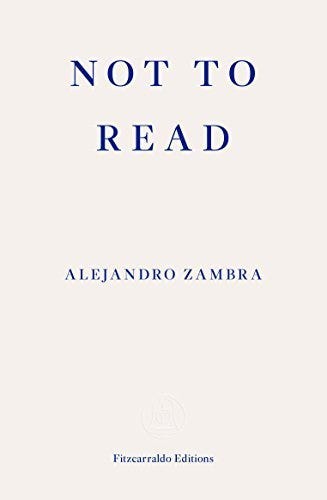
Alejandro Zambra’s Not to Read is, on first glance, a disparate collection of critical work: reviews, essays, and reflections on writing. Taken by themselves, the individual pieces are deeply enjoyable: the style is reminiscent of some of the fragmentary, episodic writings of Eduardo Galeano, there is a dry, biting, and sometimes caustic – but never ungenerous – wit, and you get to learn about an entire set of Latin American writers that the “Boom” does not normally consider. Zambra has no time for literary canons, and that is something that makes this book unique.
More than that, however, as you read, certain themes emerge. Zambra is deeply skeptical of literary establishments, and of literature as a profession. Manuel Puig, he writes, has created “a literature outside of literature, of an oeuvre that is simultaneously legible and inscrutable, one that calls the nature of the literary into question.” In one of the most memorable essays in the collection – on Pedro Lembel – he writes: “his work was forged in the night, in the barrio, in life and not in literature.” There are traces here of Joseph Andras. Still later, he writes: “Ribeyro writes to live, not to demonstrate that he has lived.” And perhaps, towards the end, the kicker:
Books say no to literature. Some. Others, the majority, say yes. They obey the market or the holy spirit of governments. Or the placid idea of a generation. Or the even more placid idea of a tradition. I prefer books that say no. Sometimes, even, I prefer the books that don’t know what they are saying.
Reading this, you get the sense that for Zambra, the phrase “full-time writer” would be a contradiction in terms: you cannot write without the stuff of life, and that comes from living.
The mirror of this is another theme that shines through the essays: for all his humour and wit, Zambra takes writing – and the practice of writing – very seriously. Early on, he writes of a compatriot: “I want us to have writers like him again: forthright, committed, beautiful, forever young, cultured, generous, loud-mouthed.” The word choice – especially the words that I have italicised – seems significant. Again, on Pedro Lembel, he notes that Lembel “reminds us that literature is not offensive, that it’s not mere decoration, that it does something to society. To give him the [Nobel] prize would be to honour that. It would be, I think, a collective prize.”
This is not a call, of course, for didacticism; Zambra is, again, careful with his words, and “does something to society” is not prescriptive about what that “something” should be. But that is not to say, either, that this is an amoral practice. Zambra’s “philosophy” of writing – or perhaps it would be better to say that the meaning he seeks in and through writing – is – echoing Vaclav Havel – to:
… find oneself with the weight of words, to reconquer their necessity, search incessantly, even when they – the words – have become ever more transitory, more perishable, more erasable than ever.
So you can read this book at multiple levels: as an insight into the craft of reviewing and of criticism; as a guide to a collection of Latin American writers that you might not instantly find displayed in a bookshop; but above all else, I think, a reflection on how even within “th[is] pile of debris … [that] grows skyward,” writing remains necessary.
I ended 2025 with Alba de Cespedes’ Her Side of the Story. After my mid-year journey through Elsa Morante’s Lies and Sorcery, this was my second tragic bildungsroman novel set in mid-20th century Italy, focusing intensely on women’s lives, their rich interiority, their friendships, and confrontations with patriarchy in the context of a violently changing world. Both Lies and Sorcery and Her Side of the Story presage themes that you can later find in Elena Ferrante, and it’s of little surprise that Ferrante herself acknowledges her debt to these two writers.
In fact, some of the early parts of Her Side of the Story – set in a tenement complex in Rome – reminded me of the brilliant HBO TV adaptation of Ferrante, in how it communicated the suffocating atmosphere in these tenements, and of the patriarchal violence that lurks just underneath the facade of forced marital and familial civility:
In the apartment above ours, the one next to it, the modern white buildings rising up beside ours – in all the buildings in Rome, all the buildings in the world, I saw women awake in the dark, behind the unscalable walls of men’s shoulders.
Early on in the novel, the protagonist’s mother – caught between an unhappy marriage she cannot escape from, and a love affair that she cannot escape into, dies by suicide; this event shapes the protagonist’s own life, her relationship with her father, and the emptiness of her own marriage. Meanwhile, Italy has entered World War II, the protagonist’s husband is a part of the resistance and is imprisoned, driving her to join the resistance as well – in the hope that through militant action, she will come to understand her husband better.
Her Side of the Story is a novel of permanent deferral: the novel’s women protagonists confront and struggle against patriarchy and violence in the hope that the barrier immediately before them (whether a loveless marriage or fascism) is the last barrier that they have to overcome before they can find something resembling happiness. But that happiness appears to be permanently deferred, always beyond the next barrier, and the next, and the next.
At times, this results in what appears to be a frustrating lack of agency on part of the characters (for example, the protagonist’s natural curiosity, love for reading, and ability to put herself in danger are at odds with the passivity with which she approaches decisions that have to do with her marriage, including her decision to join the resistance) – but perhaps that is the entire point:
In other words, you had to accept that you couldn’t be a hero or play a leading role. And I would have to accept my marriage, the loneliness it brought with it, its decline, the end of the romantic plan through which we had invented ourselves.
At the same time, however, I did not read Her Side of the Story as a novel about defeatism – far from it. Throughout the story, there are cracks in the edifice that let the light in – even though the form of that light is as much wont to illuminate as it is to blind.
It is fascinating to read Lies and Sorcery, Her Side of the Story, and The Neapolitan Quartet together. Between them, these books chronologically cover most of 20th-century Italy, and thinking of them together lets you see both the incremental, crawlingly slow progress in women’s agency through the course of the century, but also – and at the same time – the constraints, traps, and nightmares that persist generation upon generation. In each of these books you find the violent clash between the richness and complexity of these women’s interior landscape, and the structures of a world that have been designed to snuff it out – with varying outcomes.
It is probably the spectacular success of Ferrante’s Neapolitan Quartet that has brought Morante and Cespedes’ work back into the public eye, and into the consciousness of readers (like me) who’d otherwise have been unlikely to come across them. For that – as for so much else – we have a lot to thank Elena Ferrante for.
Welcome to the annual year-in-books post. I’ve changed the format a bit: I’ve felt for a while that the genre/ratings approach I used to take in previous years had run its course. In this post, I’ve taken a more fluid, thematic approach, and dispensed with the ratings system. It also means that I’ve not covered every book I read this year; for that, I now have a regular Substack newsletter, where I talk fortnightly about what I’m reading (you can subscribe here). The Substack also has a version of this post, if that’s the format you prefer. Some of these books I’ve reviewed separately on this blog, and I’ve linked to those reviews below.
I began 2025 with two books at the intersection of poetry, history, politics, and revolution. Samuel Hodgkin’s Persianate Verse and the Poetics of Eastern Internationalism told the story of how Persian poetry constituted a glue that bound together a number of decolonisation projects in the mid-20th Century, in central and South Asia. From Iran to India to the USSR to the central Asian republics, Persian poetry provided a cultural vocabulary and a grammar that diverse peoples could use to talk to each other – a grammar that was eclipsed as the USSR eventually turned it into a top-down, State-led project. Eric Calderwood’s On Earth or in Poems: the Many Lives of al-Andalus movingly chronicled how, centuries after the fall of the Kingdom of Granada, al-Andalus has lived on in history, memory, legend, and as an anchor for radical political projects, including in Palestine. Al-Andalus has fascinated me ever since I came across it as a teenager in a fantasy novel by Guy Gavriel Kay, and I loved reading this book. In summer, I would re-read the book wandering through Andalusia, in the squares of Granada, in a tea-house in Cordoba, and by the corniche in Cadiz.
In July, I read Michael Craig Hillman’s part-biography, part-literary analysis in A Lonely Woman: Forough Forroukhzad and her Poetry. I had previously read Forroukhzad’s poems in a scattered way, but this book did a wonderful job not only of setting them in context, but also in illuminating Forroukhzad’s own poetic and personal development through these poems, in the context of mid-20th century Iran under the rule of the Shah. The book is a window into what rebellion through poetry might mean in a society where other modes of rebellion are closed off, and it forever altered my reading of the beautiful – and unsettling – Conquest of the Garden.
On a similar theme, the month after, I read Whitney Chadwick’s The Militant Muse: Love, War and the Women of Surrealism, my annual find at Budapest’s matchless National Gallery Bookshop. This book chronicles the intense relationships between women surrealist artists in the mid-20th century, who confronted both the travails of World War II as well as the patriarchal art world. I discovered new things about the lives and loves of artists like Frida Kahlo, and I discovered new artists entirely, such as Claude Cahun (“True poetry, the kind that keeps its secret … is like the paving stone … that can be used by the revolutionaries rather than the police.”) The fictional complement to this book was Lucy Steeds’ The Artist, which is one of the best novels I read this year: the story of a young woman in early-20th-century Provence, who dreams of being an impressionist artist, and struggles against the strictures imposed by her reclusive uncle, whom she lives with, and who actually is a famous artist. Rarely have I come across a novel with as narratively perfect an ending as this one.
On the topic of art and the novel, and hopping from France to Italy: the dazzlingly unpredictable Laurent Binet’s latest novel, Perspectives, is set in renaissance Italy with Michelangelo as a character, and is a historical-detective novel that moves through the world of renaissance art. Binet is as virtuoso as ever as a novelist, with shades of The Name of the Rose in this novel (long-time Binet readers will be unsurprised, given that Umberto Eco himself is a character in The Seventh Function of Language). I was told by someone with impeccable taste that they found the ending a let-down; I’m not so sure!
Still on the same theme, and back to non-fiction, in February, at the World Book Fair in Delhi, I chanced upon Jacopo Galimberti’s Images of Class: Operaismo, Autonomia, and the Visual Arts – a dense, complex, and ultimately rewarding book about how the the post-war, militant left-wing political movements in Italy gave rise to an entire genre of art, from the visual to the aural to the architectural, and how these artists struggled to craft a vision of what it means to be – and to make – radical art within the constraints of a capitalist world. Set in the same era, Luigi Pintor’s Memories from the Twentieth Century: A Kind of Trilogy is a set of political montages and reflections of radical movements and their limits. These books fortified my view that Italy from the end of the War to the conclusion of the Years of Lead is one of the most fascinating places to read about, if you’re interested in radical politics and art.
Ah, the Italians! More than a decade ago, I read Elena Ferrante’s Neapolitan Quartet, and it changed my life. It turns out that Ferrante was just the tip of the iceberg when it comes to Italian women writers writing the most intense, the most visceral, and most unforgiving bildungsroman novels about womanhood, revolt, and patriarchal and political tyranny. In summer, I read Elsa Morante’s 800-page, three-generations-spanning Lies and Sorcery, which left me raw. Barely had the wounds closed when I decided to finish the year with Alba de Cespedes’ Her Side of the Story, set in the years before and during World War II, with the protagonist a blend of a Ferrante and a Morante character, whose travails in the resistance and in a love-starved marriage leave you with alternating feelings of rage and helplessness, until a late sting in the tail leaves you not knowing what to think at all; I’m still navigating my feelings about this book.
My one day in Barcelona in summer, half of which was spent in an anarchist walking tour, finally drove me to start reading the Spanish Civil War and Spanish anarchist history books that I have long been procrastinating on. Danny Evans’ Revolution and the State: Anarchism in the Spanish Civil War is a fascinating account of the anarchist perspective in the revolution, of the anarchist movement’s valiant – and ultimately doomed – attempts to avoid co-option in the effort of republican State reconstruction that was ongoing even as Franco’s fascists were at the gates of Barcelona. This is a detailed and granular history. Meanwhile, Mark Bray’s The Anarchist Inquisition: Assassins, Activists, and Martyrs in Spain and France takes the longer view, starting with the “propaganda of the deed” that began in the late-19th century, and going on to discuss the anarchist movements in the early 20th century, culminating with Barcelona’s “tragic week” in 1909. The book starts with an immortal line about terrorism and human rights being the two fractious siblings born out of the 20th century, and only gets better from there. In between these two I read Serge Pay’s little gem, Treasures of the Spanish Civil War, a set of interconnected reflections and anecdotes about the revolution, the war, and the aftermath, set in spare and haunting prose.
Still on the theme of anarchism, but moving away from Spain, Kavitha Rao’s Spies, Lies, and Allies: the Extraordinary Lives of Chatto and Roy is a fantastic account of a certain moment in Indian revolutionary history, and which really should be a lot better known, and read by a lot more Indians, than it currently is. I also discovered at the book fair Ngo Van’s In the Crossfire: Adventures of a Vietnamese Revolutionary, which tells the little-known story of the radical Vietnamese revolutionaries who were persecuted both by the colonial powers and by Ho Chi Minh’s party, because of their anarchist views – a necessary corrective to the otherwise brilliant (and seductive) works such as Joseph Andras’ Faraway the Southern Sky, which I had read last year. It once again convinced me that the revolutionary movements of early and mid-20th century east and south-east Asia (Japan, Korea, Vietnam, Indonesia) are some of the most fascinating to have ever been – and their almost total erasure a tragedy. On the subject of Vietnam, I read Salar Mohendesi’s brilliant Red Internationalism, which chronicles the rise of the anti-war Vietnam movement, the global solidarities that it created, and how – ultimately and ironically – the victory of the Vietnam led to its fracture and ultimate co-optation of the language of anti-imperialism by the language of human rights, actively promoted by the United States as a legitimation strategy. After reading this book, you’ll never quite be able to look at the concept of human rights the same way.
Another revolutionary movement that has long fascinated me has been the Ethiopian students’ movement that overthrew emperor Haile Selassie – but was then co-opted and ultimately destroyed by the military regime of the Derg. This summer, I read two excellent book about that history. Baalu Girma’s Oromay – only recently translated – is a haunting novel about the political repression that followed after the victory of the Derg. Elleni Centime Zeleke’s Ethiopia in Theory: Revolution and Knowledge Production, 1964-2016 interrogates the radicalism of the students’ movement – and its long legacy, for good and for ill, that still informs contemporary Ethiopia. This is one of the best books of critical non-fiction that I read this year.
Patti Smith is a writer I’ve always wanted to read more of, ever since I read her beautiful eulogy for Sam Shepard; this year I finally did so, reading her memoirs Just Kids(about her life as a young artist and musician in the New York of the 1960s and her love story with Robert Mapplethorpe) and Bread of Angels (about her childhood, her life with her husband Fred Smith, and her rebuilding of her music career after Smith’s death). I found Bread of Angels – especially the bits about domestic life – a little patchy, but Just Kids – whew! Patti Smith has an ear for the rhythm and the music of words – and for the movement of the sentence – that is simply extraordinary.
As always, I read a lot of science fiction this year, with mixed results. Alastair Reynolds’ Century Rain – doubling up as an alt-world SF novel and a love letter to Paris – was my stand-out read, the best Reynolds I’ve read (and that’s saying something, as he’s my favourite SF writer active today). I was not overly impressed by the Clarke Award shortlist, with Kaliane Bradley’s The Ministry of Time perhaps being my favourite in the shortlist. I bookended my year with two two Adrian Tchaikovsky novels – Alien Clay and Bee Keeper – that had all kinds of weird and unsettling biological speculation, in the classic Tchaikovsky mold. I enjoyed Stew Hotson’s Indian-influenced space opera, Project Hanuman, which also came out this year. And one of my favourite genre reads was a book that’s not been published yet, but is forthcoming in 2026: I was asked to write a blurb for Mahmud El Sayed’s The Republic of Memory, a book that brings together two of my favourite themes that I never thought I’d see crossed over: a generation spaceship, and the 2011 Egyptian Revolution! Watch out for this one when it’s released in the Fall.
Among the unclassifiable books that I read this year: Sonallah Ibrahim’s Ice, a novel about an Arab student’s time in the Soviet Union in that most consequential of all years, 1973; Venus Ghata-Khoury’s The Last Days of Mandelstam and Dominique Noguez’s The Three Rimbauds: one imagines Osip Mandelstam’s final days, and the other imagines a world in which Rimbaud did not die, but became a member of the French literary establishment; Julie Lekstrom Hime’s Mikhail and Margarita which, sticking to the Soviet theme, (fictionally) reconstructs Bulgakov writing his novel in the climate of censorship and disappearances (Mandelstam plays a part here too); Kaouther Adimi’s A Bookshop in Algiers, a novel about how an Algiers bookshop played a part in the war for Independence, before falling into disuse, disrepair and – ultimately – destruction; Dubravka Ugresic’s A Muzzle for Witches, an absolutely wonderful memoir – written towards the end of her life – of the relationship between nationalism, literature, and women’s writing; on a similar theme, and also a last memoir, Eduardo Galeano’s The Hunter of Stories; Alejandro Zambra’s delicious, ironic, and bitingly witty collection of essays on literary criticism and the Latin American novel, Not to Read (come for the Neruda barbs, stay for discovering writers you didn’t know you needed to read); Julio Llamazares’ The Yellow Rain, a Pedro Paramo-esque novel where an atmosphere of loneliness and death creeps up on you so quietly that you don’t even notice it until the moment that it thoroughly disorients you; Han Kang’s We Do Not Part (probably the most famous novel in this list!) which I really don’t have much to say about that hasn’t been said already, other than that I loved it; and finally, one of my favourite novels of the year, John Williams’ Stoner, which has the finest and most moving treatment of death that I’ve ever read in fiction.
These are not all the novels I read this year, but they form a significant portion of them. Reviews of the ones I read most recently will be forthcoming in the first January 2026 issue of the newsletter. I hope that some of these books pique your interest, and that you find them to be the compelling and magical companions that I did this year.
To the writers who read this newsletter, I wish you a 2026 where words are kind to you; and to the readers, I hope 2026 brings you many more books that – as Kafka said – can be “an axe for the frozen sea” within us.
‘Even if he does become a communist, I want him to be a happy communist,’ said his mother. Her marriage to a communist, which had lasted for some years, and her interaction with her husband’s comrades had led her to the conclusion that communists were always gloomy and pensive and never had a good time. So throughout that difficult era, the entire Japanese occupation and the revolutionary war, she let Kliwon live in an endless hoorah.
‘Have you become a communist?’ asked his mother, almost in despair. ‘Only a communist would be so gloomy.’
‘I’m in love’, said Kliwon to his mother. ‘That’s even worse!’
Eka Kurniawan, Beauty is a Wound
“What do communists do?” Maddalena whispered.
“I don’t know,” Aida replied. “I really don’t know. They’re not happy. Antonio was never happy. Friends often came to see him and they seemed unhappy too. They were never lighthearted like other young men his age. I’d open the door and every time it seemed like they’d just had bad news. They came to Antonio and read … it’s odd, but thinking back, I remember that when it got dark and I went to Antonio’s room to close the shutters, they would look up from their books, their eyes full of sadness. God! What sad expressions they had!”
“If poetry comes not as naturally as the leaves to a tree, it had better not come at all.”
John Keats, Letters
“… poets trip over tongues, language comes to them the way it does to a stutterer, as a problem.”
Alejandro Zambra, Not to Read
“I close parentheses to return to Clarice Lispector, though only to recall the moment when, in the middle of a chronicle, she stops and breathes and says: ‘I am writing with a great deal of ease and fluidity. One must distrust that.’”
Alejandro Zambra, Not to Read
“The book is the sum of our highest potential. Writers, alas, are the rough drafts.”
Sandra Cisneros, Introduction to Eduardo Galeano’s Days and Nights of Love and War
“As many critics have noted, in the end Macedonio was a draft of Borges. And sometimes – every other year – we like drafts more than the clean version.”




 anenduringromantic
