In December 2021, Everton Downey stabbed his girlfriend Melissa Blimkie 15 times in a stairwell at a shopping mall in Burnaby. She died. Downey was convicted of second-degree murder. In February, the British Columbia Supreme Court sentenced him to life in prison, the minimum sentence set out in the Criminal Code. The Crown sought no chance for parole for at least 15 years. But Associate Chief Justice Heather Holmes decided on 12 years instead, in part because of “mitigating circumstances of his background,” as described in his Impact of Race and Culture Assessment (IRCA). The time to parole was reduced because of Downey’s experience of being Black.
Race-based sentencing has become commonplace in Canada. The sentence doesn’t fit the crime but the identity of the criminal. “Racialized” offenders, especially Indigenous and Black, may have their sentences reduced because of “overt and systemic discrimination.” So the Supreme Court of Canada said last July. The Criminal Code directs judges to consider “the circumstances of Aboriginal offenders” in setting sentences. The Supreme Court has suggested that “inquiring into social context” of other racial groups can provide guidance “to understand the particular experience of an offender and their moral culpability.” It doesn’t matter if you’re black or white, Michael Jackson sang. He wasn’t referring to Canadian courts.
It’s not just criminal sentencing. From employment opportunities, government programs and subsidies, seats in university programs, and myriad other ways, Canadian laws and institutions treat different races, sexes, and genders differently. They provide more favourable or lenient criteria to “historically disadvantaged groups.” Which are all of them. Except straight white men, of course.
How can this be? Doesn’t the law prohibit discrimination? In Canada, the answer is no. Americans have a constitutional right to equal protection of the law. Canadians don’t.
The text of the Canadian Charter of Rights and Freedoms suggests that they do. Section 15(1) says that every individual “is equal before and under the law and has the right to the equal protection and equal benefit of the law without discrimination.” The Charter was adopted in 1982, but section 15 did not come into force until April 1985. The Supreme Court of Canada did not decide its first case under section 15 until 1989. In the interim, another development would have a significant impact on the path of equality law in Canada.
In 1984, the federal government established the “Royal Commission on Equality in Employment,” also known as the Abella Commission after its commissioner Rosalie Abella, later a judge of the Supreme Court (now retired). The commission’s mandate was to enquire into employment discrimination in Canada, particularly against women and visible minorities. Its report , released in 1985, recommended employment equity policies in the federal government and in federally regulated companies. Those recommendations led to the passage of the federal Employment Equity Act in 1986. It required federal employers to “ensure that persons in designated groups achieve a degree of representation in each occupational group in the employer’s workforce” that reflected their representation in the Canadian workforce. In other words, it directed federally regulated employers to adopt affirmative action programs that gave preference to candidates from some groups over others. It mandated unequal treatment, or equity.
As a mere statute, not part of the Constitution, the Employment Equity Act did not bind the Supreme Court’s interpretation of the Charter’s equality provision. But the Act was newly in place when the Supreme Court heard its first case under section 15. The Court decided that section 15(1) required “substantive equality.” Which means equal or comparative benefits and burdens. Which means equal or comparable outcomes between groups. Which may require different rules for different groups. Which means equity.
Section 15 also includes an exception. Section 15(2) allows for laws and programs that aim to ameliorate “conditions of disadvantaged individuals or groups.” The Supreme Court of Canada has since made the exception into the general rule. Sections 15(1) and (2), it declared in 2008, “work together to confirm s. 15’s purpose of furthering substantive equality.” Which means equity.
Race-based criminal sentencing is not an automatic discount. It’s not a coupon or a “get-out-of-jail-free” card. The court takes the background and circumstances of “racialized” individuals into account. But that is exactly the problem. Defenders of the practice would say that the court is merely ascertaining culpability of the individual accused. But if that were so, the same considerations and potential reductions would be available to the accused of any racial group. White guys don’t get Gladue Reports or Impact of Race and Culture Assessments.
In Canada, legal equality now means equity. Equity means unequal treatment. The same laws and standards do not apply to everyone. Instead, laws and institutions can treat different identity groups differently. In criminal sentencing, as in applications for jobs, schools, and programs, some Canadians are more equal than others. Canada’s justice system is broken. To fix it, equity must go.
Bruce Pardy is executive director of Rights Probe and professor of law at Queen’s University.
Trump is just Beth Dutton with a better real estate portfolio.
Some people see Trump as a villain. Others see him as a hero- they all see him as a politician.
I see him as a corporate raider and that distinction matters more than you think. If- like the media and most critics- you’re trying to understand what he’s doing through a political lens you’re always going to be confused. He’s not governing. He’s executing an acquisition strategy. Once you see it that way everything that looks chaotic suddenly looks very deliberate.
Most people are watching the tariffs, Canada, Venezuela, Cuba, Greenland, and Iran like they’re separate news stories. They’re not. They’re all part of a single structured strategy. But if you don’t see the whole board you’re going to miss the play and never understand the next move.
The media calling him unpredictable just tells you they never read his book.
THE TARIFFS WERE NEVER ABOUT TRADE.
Trump hit 180 countries simultaneously. You don’t negotiate with 180 countries at once – that’s not negotiation, that’s a stress test. You apply pressure across every node at the same time and the vulnerabilities reveal themselves. Who breaks. Who bends. Who was already quietly on someone else’s books.
Here’s the backstory most people missed. For decades the World Economic Forum, the United Nations, and a network of non-governmental organizations worked to build what was essentially a global corporate structure – a framework to manage global trade, global policy and global power. They built the boardroom the institutional architecture and the internal infrastructure. All the while, China was watching. Not just watching – planning. Because what the West was constructing was exactly the vehicle China needed for a Chinese-led new world order. They didn’t need to build anything. They just needed to wait until it was finished and then buy up the real-estate, which is exactly what they did. Belt and Road locked in the supply chains across the developing world. Proxy states and compromised politicians secured the choke points. Sanctioned oil kept the operation funded at a discount when they had acquired enough of the pieces, Xi Jinping walked into Davos and pretty much declared his takeover. It was a hostile takeover of the global order. Announced publicly. In front of everyone but barely anyone reacted.
Xi walked into Davos and declared he would steer the global order the same week Trump took office.
Trump walked into the White House already knowing exactly what needed to be done.
The tariffs are the beginning of the counter-move. They make China’s acquisition strategy expensive. They expose every asset China has already captured. And they force every player on the board to declare which side of the ledger they’re on.
WHY VENEZUELA?
Venezuela sat on the largest proven oil reserves on the planet making it one of the most valuable acquisitions on the board. Under Maduro it had been completely absorbed – a Chinese and Russian forward operating base with a UN seat attached. China owned the oil infrastructure. Russia provided the security. Cuba ran the intelligence layer that neither of them wanted fingerprints on and supplied the military regiments that protected Maduro from his own people. That’s not a failed state. That’s a fully occupied asset being operated by a hostile ownership group right in the middle of Trump’s hemisphere.
The Monroe Doctrine – the 200 year old principle that says no foreign power operates militarily or politically in this hemisphere – gave Trump the framework. But what he executed wasn’t a political declaration. It was a hostile reclamation. Border corridors China was using to infiltrate and destabilize, closed. Ports in Panama used by China to move product -held for decades through a Hong Kong conglomerate with deep CCP ties – were forced into divestiture under US pressure. Military posture on every strategic choke point of value to China, was established. Maduro was removed (notably while Chinese officials were on Venezuelan soil – a timing that was not coincidental).
Venezuela was a critical forward operating base and a private oil supply line that China was buying at bottom of the barrel prices – cheap energy that kept Chinese industry running and freed up capital that fed directly back into funding their global acquisition strategy. Not anymore.
DONT FORGET ABOUT GREENLAND.
Greenland isn’t a real estate play. It’s a strategic acquisition of the highest order. Whoever controls the Arctic controls the next century- the shipping lanes, the rare earth supply chains, the northern military positioning that makes everything else possible. China and Russia have both been aggressively moving on Arctic access for years (China was even training their military for Arctic strategy on Canadian soil, under the Liberal government). Greenland sitting under Danish sovereignty with NATO’s northern flank exposed was a liability Trump identified a long time ago.
While most people were busy debating whether Trump was serious about buying Greenland he was already moving in. There was talk of deploying military hospital ships to the region – which raised eyebrows because nobody was sick and nobody had asked for help. A US submarine surfaced off Greenland. The 11th Airborne Division – the US Army’s Arctic specialized unit – was put on standby. F-35s and F-16s were deployed to Pituffik Space Base. And $25 million in airfield upgrades were quietly initiated. None of these things happen casually or accidentally. Nobody talked much about that either. Why? Because they were too busy laughing at the real estate comment. But that’s exactly how you establish a forward operating position – you don’t announce it, you don’t ask permission, you just move assets in while everyone is looking the other way; by the time anyone figures out what you’re actually doing you’re already there and you’re already dug in. Thats exactly what he did. While the diplomatic theatre played out above the surface something else was happening quietly underneath it. The US Export-Import Bank moved $120 million toward funding the Tanbreez rare earth mine – potentially the largest rare earth deposit in the world – after the US had already moved to block a China-linked company from acquiring it. Chinese access to Greenland’s most valuable deposits is legally frozen. American access is being financed into existence.
That’s not annexation. That’s a corporate raider move. You don’t need to own the company to control the board. You just need the right seats, the right financing relationships, and your competitor locked out of the building.
You secure critical infrastructure before your competitor does. He didn’t need permission.
IRAN – You Are Here Now
In 1980 a young Donald Trump sat down for an interview and made his feelings about the Iranian revolution and the hostage crisis very clear. He was disgusted. Not just by Iran – by the American weakness that allowed it to happen. 40 years later he hadn’t forgotten.
During his first term Trump made it very clear he wasn’t going to operate the way previous presidents had. In April 2017 he authorized Tomahawk strikes on a Syrian air base while Xi Jinping was sitting across from him at dinner at Mar-a-Lago. He told Xi about it over dessert. That moment told the world everything it needed to know about how Trump was going to operate. And then in January 2020 he took out Qasem Soleimani – the head of Iran’s Revolutionary Guard and the architect of their entire proxy network. Trump wasn’t dragged into the Iran fight during his second term. He was there before his second term even started.
Iran is China’s most important proxy. China buys sanctioned Iranian oil at a discount, keeps the regime solvent, and Iran deploys that capital through Hamas, Hezbollah, and the Houthis – three instruments designed to keep the Middle East ungovernable, keep Israel on defense, and keep American assets perpetually tied down and exhausted. It’s an elegant arrangement – someone else’s problem, funded by someone else’s oil, managed at arm’s length.
Maximum Pressure on Iran isn’t about Iran. It’s about defunding the instrument. Every dollar that stops flowing to Tehran is a dollar that doesn’t reach a proxy designed to keep the region in permanent chaos.
People assume, and are being led to believe, Israel pulled Trump into this fight. That’s backwards. Trump spent four years out of power building a parallel intelligence relationship with Mossad – completely outside the American institutional apparatus he already knew had been compromised – and implementing covert structures right under Iran’s nose; because he knew the history of iran and its value to china, which he’s spoken about on numerous occasions long before becoming president. Israel had what he needed to complete what he started. He didn’t inherit a Middle East strategy. He pre-built one. The Abraham Accords weren’t a peace deal. They were infrastructure – a Sunni Arab-Israeli alliance framework, pre-positioned and ready. Trump didn’t follow Israel into this fight. He used the relationship as the anchor point for a regional architecture that Iran would never survive.
AND THEN THERE’S CANADA…
Venezuela. Iran. Mexico. Canada wasn’t told about any of it. Not briefed. Not in the room. Not trusted. While some Canadians will shrug and say that’s fine because they didn’t agree with what Trump was doing anyway – that’s not the point. The point is our closest allies made a deliberate decision to cut us out of major international security discussions; and when you understand why, it stops being embarrassing and starts being alarming.
Because this isn’t new behaviour for the Liberal Party. These are people with a long, well documented history of getting cozy with China’s assets and allies. The Trudeau family’s relationship with Castro wasn’t complicated – it was warm, personal and generational. They’ve maintained cozy relationships with the Iranian regime- Iranian state leaders and known IRGC-connected individuals have been allowed to operate freely inside Canada – protected, not prosecuted or deported. Just now Mark Carney signed MOUs that include China in Canadian national security structures. If your entire objective is dismantling China’s global position, why would you hand your playbook to a board that’s been getting cozy with the opposition for decades. Cuba. Iran. China. This isn’t naivety. This is a pattern.
That’s why Canada isn’t in the room. And it’s going to get worse before it gets better.
Mark Carney isn’t a politician who wandered into power. He is the deliberate installation of a very specific kind of operator. WEF trained. Goldman Sachs veteran. As Governor of the Bank of England he opened the UK financial system to Chinese currency – the first Western central bank to do it. He built Brookfield’s presence in China through a partner with direct ties to CCP advisory structures. When his Shanghai assets ran into trouble the Bank of China stepped in. He spent years building the architecture behind the scenes as Trudeau’s advisor and when the Liberal Party needed a clean face he was installed as Prime Minister – not elected, installed to leader of the party -and then bought his majority on the backs of floor-crossers. Chinese state media didn’t just report his rise, they supported it. Actively. That’s not a coincidence. That’s a signal.
In corporate terms a board was captured, a CEO was installed by the acquiring company, and the shareholders were never consulted.
And now that he’s secured his position? He’s on vacation – visiting his true home in London while Canada burns.
Here’s what makes Canada so valuable to China – and it’s not our military or our resources. It’s our weakness. Weak counter-intelligence. Open institutions. A G7 seat and a Five Eyes membership that gives access to the most sensitive intelligence sharing network in the world. The longest undefended border on the planet sitting right against the United States. Chinese telecom infrastructure already embedded inside our networks. BC ports already documented as active fentanyl transit corridors. Chinese interference confirmed at every level of government. We are not a sovereign nation being pressured by an aggressive neighbour. We are a captured subsidiary with a compromised board being used as a backdoor into the entire Western system. And Carney is the one holding it open.
Which is why Trump’s pressure isn’t about the 51st state. It’s about closing the backdoor. Canada under this Liberal government is China’s cleanest entry point into the Western order – with $2 trillion in pension capital that Carney is actively positioning Brookfield to manage and deploy globally. That’s not Canada’s money serving Canadians. That’s Canadian capital being weaponized to out-compete American interests while our Prime Minister waves a flag and calls it patriotism.
Carney knows the clock is ticking. Which is why he’s moving fast on something most Canadians haven’t noticed. He is desperate to control what Canadians can see and desperate enough to push through bill after bill giving Ottawa control over speech, internet access and the information flowing through it. He watched what happened in Iran. When the regime locked down internet access Starlink kept the information flowing anyway and there was nothing they could do about it. He is not going to let that happen here. Which is why he is fast tracking Telesat’s government-backed satellite network – to make sure it’s operational before Starlink nodes proliferate across Canada and he loses control of the information pipeline entirely. This isn’t telecommunications policy. It’s asset protection. It’s making sure that when Canadians start asking the wrong questions he already controls the answers they can reach.
AND THEN THERE’S ALBERTA AND THE WEST – Mark Carneys leverage.
Around the time of the election Danielle Smith went to Mar-a-Lago and, not so coincidentally, when she returned she introduced legislation that lowered the separation referendum threshold AND retroactively nullified the court rulings that had been blocking the separation movement from having a legitimate petition for a referendum. The Alberta Prosperity Project met with Trump’s State Department three times in secured facilities. The US Treasury Secretary called Alberta “a natural partner.”
This is not a regional squabble about equalization payments.
This is where Canadians need to stop and think about the 51st state comment. Because most Canadians heard that and got so offended they stopped listening. Which is exactly what happened with the Greenland real estate comment. Trump doesn’t want Canada. He doesn’t need Canada. What he needs is to close the backdoor that China has been operating through Canadian institutions for decades. The most efficient way to do that isn’t annexation – it’s separation. Pull Alberta out from under Carney’s control and the whole architecture falls apart on its own.
Carney’s entire pitch to the world – to the WEF, to the Gulf states, to every sovereign wealth fund he’s courting with Canadian pension capital – is built on one thing. Controlling Alberta oil and redirecting it through the green transition narrative he designed. That’s his credibility. That’s his product. That’s what he’s selling to every boardroom he walks into with Canadian state access in his pocket.
Alberta is the crown jewel asset that makes the entire acquisition viable. Without it the offer collapses. The pension collateral disappears. Canada stops being a stable G7 node worth controlling. But more importantly – and this is what nobody is talking about – it pulls China’s last clean institutional foothold out of the Western order entirely. China doesn’t just lose an oil supply. They lose their most sophisticated entry point into the Five Eyes intelligence network. They lose their seat at the G7 table through a proxy government. They lose the $2 trillion pension capital deployment vehicle that Carney built specifically to out-compete American capital globally. They lose the backdoor they spent decades and billions quietly constructing. Alberta leaving doesn’t just embarrass Carney. It dismantles the entire Chinese institutional position in the Western world in one move.
Trump isn’t fighting Canada. He’s surgically removing China’s most valuable Western asset. Alberta is the incision point.
By now the picture is getting pretty clear…
The West built a global corporate structure. China acquired it – not through a single transaction anyone could point to, but through decades of quiet deals, strategic partnerships, leveraged investments and relationships built with people nobody was paying attention to. By the time anyone noticed how much China had accumulated it was already too late to stop the announcement. Xi walked into Davos the same week Trump took office and declared his intent to take over operations of what had been quietly acquired piece by piece over thirty years.
Trump looked at that acquisition and did what corporate raiders do. He identified every choke point. Every leveraged position. Every compromised asset. Every vulnerability in the structure. And then he moved on all of them simultaneously.
The tariffs were the due diligence – stress testing every node to expose what China already owned. Venezuela was a hostile reclamation of a seized asset. Greenland was a strategic acquisition of critical infrastructure before the competition locked it down. Iran was the defunding of the operational network that kept the acquired structure protected. The Abraham Accords were the pre-built counter-alliance – the new board assembled before the old one even knew it was being replaced. Canada and Alberta are the forced divestiture of China’s most sophisticated Western holding. Defunding the UN is the boardroom purge – clearing out the captured institutional structure and rebuilding it under new ownership.
This is not chaos. This is not politics. This is a hostile takeover executed by someone who has been doing this his entire career. He ran it by the book. His book.
The West built the boardroom. China quietly acquired it. Trump is taking it back.
Whether you like him or not – understand what you’re watching. This is bigger than one election. And it is moving fast because the people executing it know exactly what they’re looking at.
Our leaders chose the wrong side of that equation. And now Canadians are paying for it – stranded in war zones they weren’t warned about, locked out of intelligence briefings, watching our pension capital get deployed for someone else’s agenda. While Canadians lose their homes and struggle to feed their families our Prime Minister flies to India to close deals that make him billions and support the Chinese and globalist order putting Canada in Trump’s crosshairs.
He explains why Canada’s laws don’t treat everyone the same. He says we’re moving toward a system where your identity matters more than your individual rights. So what’s really going on?
This isn’t left vs. right. It’s about fairness. It’s about freedom. And it’s about whether the same rules still apply to everyone.
“Canada has created different classes of citizens” says law professor Bruce Pardy.
He explains why Canada’s laws don’t treat everyone the same. He says we’re moving toward a system where your identity matters more than your individual rights. So what’s really going on?
This isn’t left vs. right. It’s about fairness. It’s about freedom. And it’s about whether the same rules still apply to everyone.
SWIFT CURRENT — The Federal Crown has stayed all charges against two Calgary residents who were arrested last year after nearly 8 kilograms — roughly 17.5 pounds — of fentanyl were found hidden in their vehicle during a traffic stop on the Trans-Canada Highway in Saskatchewan.
Swati Narula, 27, and Kunwardeep Singh, 29, each faced one count of trafficking a controlled substance and one count of possession for the purpose of trafficking. The Public Prosecution Service of Canada entered written stays of proceedings against Narula on February 24 and against Singh on February 27, Swift Current Online reported Monday.
There was no explanation for why the narco-suspects walked free, beyond the standard policy language the prosecution service has cited in a number of similar cases documented by The Bureau — that prosecutors must continually assess “a reasonable prospect of conviction and whether the public interest supports continuing the prosecution.”
On January 28, 2025, officers from the Saskatchewan Highway Patrol were conducting proactive patrols along the Trans-Canada when they stopped a vehicle with two adults near Swift Current, a prairie city of roughly 17,000 people that serves as the regional hub of southwestern Saskatchewan, positioned at the junction of the Trans-Canada less than 160 kilometers from the American border. A search of the vehicle uncovered the fentanyl hidden under the spare tire. Investigators noted the pair said they were travelling to Regina.
RCMP Superintendent Grant St. Germaine, officer in charge of Saskatchewan RCMP Traffic Services, called it a significant seizure. “Keep in mind that only a few grains of fentanyl is enough to potentially cause a fatal overdose,” he said in a statement the following day. “We have prevented potentially millions of doses of this dangerous drug from entering our communities. I hope this is a message to others who choose to transport illicit goods in our province. Our officers are watching out for you.”
The two appeared in Swift Current Provincial Court on January 29, 2025. Singh was granted bail on February 20 on a $25,000 bond. Narula was granted bail on March 4 on a $10,000 cash bond, with conditions that included surrendering her passports to immigration authorities, observing a nightly curfew, and remaining within 100 kilometers of her sister’s Calgary residence. At a subsequent hearing, Singh’s bail conditions were loosened at his lawyer’s request to allow him to resume work as a truck driver in the Calgary area.
The case moved through a series of adjournments across 2025. The final delay came at Singh’s lawyer’s request after a defense witness was unavailable for the preliminary inquiry, pushing the next court date to March 2, 2026. It never reached that hearing.
The Calgary-to-Saskatchewan fentanyl corridor evident in the case bears resemblance to a separate interprovincial network dismantled by Ontario Provincial Police last week.
In that investigation, dubbed Project Ollie, the OPP’s Border Drug Interdiction Task Force identified an alleged network trafficking fentanyl between the Greater Toronto Area and Calgary, the OPP reported. A search warrant executed February 10 at a Brampton residence yielded 18 kilograms of suspected fentanyl — equivalent, police said, to roughly 180,000 potentially lethal doses. Three individuals were arrested: Navjot Singh, 20, of Brampton; Attarvir Singh, 23, of Calgary, arrested in Winnipeg on a Canada-wide warrant; and Balwinder Singh, 21, of Calgary. A fourth suspect, Manpreet Singh, 21, of Calgary, remains at large on a Canada-wide warrant.
As The Bureau has previously reported, the pattern of federal charges being stayed in major fentanyl and narcotics cases is not new. In a British Columbia case, federal prosecutors stayed 12 counts of possession for the purpose of trafficking against a Richmond fentanyl network defendant on the fourth day of trial in B.C. Supreme Court — after a “comprehensive and exhaustive investigation” by the Organized Crime Unit, three overdose victims, and kilograms of fentanyl-laced heroin. The prosecution service offered a statement then that is word-for-word identical to the one it issued in the Swift Current case: the standard for prosecution, it said, had ceased to be met. No further explanation was provided in either case.
The Bureau has also reported on two marquee cases — Project Brisa in Ontario and Project Cobra in Alberta — where record-breaking seizures and triumphant press conferences collapsed in court.
In Brisa, Toronto Police described the investigation as the largest drug seizure in the service’s history, centered on tractor-trailers with sophisticated hydraulic traps moving cocaine and methamphetamine from Mexico through California into Canada. Crown prosecutors stayed all 182 charges by 2023, offering little public explanation.
In Cobra, federal Crown prosecutors terminated the prosecution of five alleged leaders of a cross-border methamphetamine trafficking operation for Mexican cartels — Alberta’s largest drug case at the time, involving the seizure of nearly one metric tonne of methamphetamine — one day before defence lawyers were set to argue for dismissal. Four co-accused also had their cases stayed.
The Bureau, drawing on interviews with Canadian and American law enforcement and national security experts conducted over three years, has reported that investigators believe Indo-Canadian organized crime networks — which have gained significant control of Canada’s long-haul trucking industry — have become a major factor in both cross-border and interprovincial narcotics trafficking in Canada.
The Bureau is a reader-supported publication. To receive new posts and support my work, consider becoming a free or paid subscriber.
WASHINGTON / OTTAWA — Even as kinetic strikes against Iran’s nuclear and military infrastructure have devastated the Islamic Republic’s conventional capabilities, a more shadowy threat remains intact and potentially primed for reactivation: a web of Iran-backed sleeper cells, proxy militias, and criminal mercenary networks already embedded inside North America — networks that have demonstrated the operational capacity to commit murder on American and Canadian soil.
That warning, from David Luna, a former senior U.S. government intelligence official, is not academic. It sits at the intersection of live court cases, active federal indictments, and documented threats against senior politicians and community leaders from Montreal to Brooklyn and beyond — including President Donald Trump himself — and most recently, a missing mathematician in suburban Vancouver.
Writing publicly this week, Luna said it remains unclear “to what extent these armed Iranian-backed proxies and terrorist sleeper cells have been neutralized in North America — Canada, Mexico, the United States — and the rest of the Western Hemisphere and Europe, and related threats and capabilities downgraded.”
He warned that Hezbollah sleeper cells or other proxy terrorist affiliates could be ordered to attack American and Western interests beyond the Middle East, noting that Iran has directed proxy groups including Hezbollah and Islamic Jihad to embed sleeper cells in the United States for activation in support of potential terror activity. Luna called on the Federal Bureau of Investigation, U.S. law enforcement, and Northern Command to prioritize the identification and disruption of Iranian intelligence and military operations — “especially now,” he wrote, that Supreme Leader Ayatollah Ali Hosseini Khamenei has been killed.
Luna spent 22 years inside the U.S. national security apparatus, including as a senior director at the State Department’s Bureau of International Narcotics and Law Enforcement Affairs.
His recent study through the International Coalition Against Illicit Economies found that Canada has become what he calls “an integrated ecosystem of criminality and corruption” — nearly 700 organized crime groups, networked across 48 countries, potentially laundering hundreds of billions of dollars annually. Iranian crime networks, his research found, are embedded within that ecosystem alongside Chinese Triads, Mexican cartels, and the Hells Angels, sharing logistics, financial corridors, and enforcement infrastructure. Canada, Luna concluded, is “a safe zone for the world’s most notorious crime groups” — and Washington is producing a more reliable intelligence picture of that criminal economy than Ottawa itself.
The federal prosecutions already on record make the threats Luna points to a court-tested reality.
In January 2024, the U.S. Department of Justice unsealed an indictment charging Iranian narcotics trafficker Naji Sharifi Zindashti — a contract killer operating under the direct orders of Iran’s Ministry of Intelligence and Security, according to the U.S. Treasury — with recruiting Canadian Hells Angels associates to assassinate Iranian dissidents in Maryland.
Damion Ryan, a full-patch Hells Angel from British Columbia facing separate drug trafficking charges linking Colombia, Mexico, Canada, and Greece, was allegedly promised $350,000 for the murders and paid $20,000 in expenses. His co-conspirator, Adam Richard Pearson, allegedly told Ryan the target should be hit “in the head a lot, make example.”
The plot was disrupted. Zindashti’s network, Treasury found, had carried out murders and kidnappings across at least five countries. It was, by the Justice Department’s own count, at least the third Iran-directed assassination conspiracy prosecuted in the United States since 2022 — and it ran through Canada.
The Iranian regime’s assassination campaign reached its most documented intensity in its pursuit of Masih Alinejad, the Iranian-American journalist, women’s rights activist, and Voice of America contributor based in Brooklyn. Over three years, Iran subjected her to at least three separate murder plots, deploying a senior Islamic Revolutionary Guard Corps general, Russian organized crime figures, and Afghan operatives.
A federal prosecutor described the campaign as “a spree of plots here and around the world.” In March 2025, a Manhattan federal jury convicted two Azerbaijani members of the Thieves-in-Law criminal gang in connection with a 2022 murder-for-hire plot against Alinejad, backed by a $500,000 Iranian government bounty.
The same network had also been tasked by the Islamic Revolutionary Guard Corps with arranging the assassination of then-candidate Trump before the 2024 election. “The same Islamic Revolutionary Guard Corps that ordered a massacre in Iran gave money to the assassins here to buy AK-47s to end my life,” Alinejad said outside the Manhattan courthouse after the verdicts.
In October 2024, Alinejad traveled to Ottawa to speak at a transnational repression conference. Simultaneously, the Royal Canadian Mounted Police were moving to protect Irwin Cotler — former Canadian justice minister, founder of the Raoul Wallenberg Centre for Human Rights, and architect of Canada’s Islamic Revolutionary Guard Corps terrorist designation — after foiling what the force described as an imminent assassination plot against him. Cotler, 84, was warned the attack was planned within 48 hours. Two suspects were reportedly apprehended.
The most recent Canadian case is unresolved.
Masood Masjoody, 45, a mathematician and Iranian dissident who had publicly called for the overthrow of the Tehran regime, disappeared from Burnaby, British Columbia, on February 2.
The Integrated Homicide Investigation Team has taken over the investigation, describing the disappearance as a potential targeted attack and ruling out local extortion. “The search still continues,” Integrated Homicide Investigation Team spokesperson Sgt. Freda Fong said, declining to confirm a foreign threat link for fear of jeopardizing the investigation.
In January 2024, Masjoody had shared The Bureau’s reporting on Iranian intelligence using British Columbia narcotics networks in dissident assassination plots, adding commentary in Persian calling for investigations into “the regime’s agents and Islamic Revolutionary Guard Corps in Canada.” The last post on his social media account was made the afternoon he vanished.
Nazanin Afshin-Jam MacKay, a prominent Iranian-Canadian human rights activist and wife of former Minister of Justice and Attorney General Peter MacKay, wrote on X that Masjoody “had been under threat for months” and “was trying to expose Islamic Revolutionary Guard Corps affiliates in Canada.”
The logic of deniability connecting these cases is apparent.
Rather than deploying agents of Iranian descent — which invites rapid attribution — Tehran has contracted its operations to insulated criminal intermediaries: Russian organized crime, Azerbaijani gangsters, Afghan fixers, Canadian outlaw bikers.
Canadian Security Intelligence Service Director Dan Rogers, in his first major speech as Canada’s new intelligence chief last year, warned that “the nexus between criminal groups and state actors challenges traditional definitions and complicates our efforts to respond.” Rogers said his agency had “reprioritized our operations” to counter Iranian intelligence proxies involved in “disrupting potentially lethal threats” against people in Canada, noting that transnational repression operations disproportionately target journalists, activists, dissidents, and community leaders.
FBI Assistant Director Suzanne Turner, in the context of the Ryan indictment, stated that the charges “show a pattern of Iranian groups trying to murder U.S. residents on U.S. soil.”
Luna, mapping that same pattern from Washington, warned this week that the full extent of Iran’s embedded networks in the West remains unknown — and that the FBI, Northern Command, and allied services must treat their identification and disruption as an urgent priority. Last year, Rogers, from Ottawa, was essentially saying the same thing.
The Bureau is a reader-supported publication. To receive new posts and support my work, consider becoming a free or paid subscriber.
Arwen~ Dr. Jordan Peterson warned about this back in 2016 concerning BillC-16 which is compelled speech and where the passing of BilC-16 would lead us. He fiercely fought this and spoke against BillC-16. He was right. The fact that the Conservative party overall supported this was mind boggling and reflected either a party that was ill informed to the ramifications of this bill or cowardly and kow towed so as not to be labeled. Neither is acceptable.
Barry Neufeld, a former school trustee fined $750,000 for questioning gender identity.
First Reading is a Canadian politics newsletter curated by the National Post’s own Tristin Hopper. To get an early version sent directly to your inbox, sign up here.
TOP STORY
Twice this month, a Canadian has been financially punished by a human rights tribunal for violating the Canadian legal mandate that gender is self-identified.
In a decision dated Feb. 5, the Quebec Human Rights Tribunal ordered a Montreal salon named Station10 to pay $500 to a non-binary activist who had objected to its menu offering men’s and women’s haircuts.
“Station10’s online booking system imposes a distinction based on gender identity, and this distinction excludes non-binary people,” said the French-language decision that was published Thursday.
That same day, the B.C. Human Rights Tribunal handed down a much more onerous penalty on a former school trustee, Barry Neufeld, who had publicly campaigned against the idea that gender was a “social construct.”
This was deemed to be “dehumanizing,” “delegitimizing” and “extremely serious and damaging,” and Neufeld was ordered to pay $750,000.
Both cases are part of a growing archipelago of decisions in which businesses or private individuals have been hammered with fines for alleged violations of the notion that an individual’s gender is whatever they say it is.
Last year, a private individual was fined $10,000 by the B.C. Human Rights Tribunal for expressing concerns to a friend about their upcoming double-mastectomy. As the surgery was intended to affirm the friend’s trans identity, the tribunal ruled the comments discriminatory.
“Statements … suggesting that gender-affirming surgery is unnecessary or inherently harmful, reinforce stigma against transgender people,” it reads .
Just last month, the B.C. Human Rights Tribunal sided with a complainant described as a non-binary individual who presents “as a trans masculine butch woman.” The complainant alleged that while working a senior position at the BC Ferry & Marine Workers’ Union, a colleague used “she/her” pronouns instead of “they/them” pronouns.
Canada’s various human rights codes represent the first instances of Canadian laws being amended to the notion that an individual’s self-identified gender should be subject to mandatory affirmation and accommodation.
In 2012, “gender identity” and “gender expression” were first entrenched as protected categories in the Ontario Human Rights Code.
Within five years, Ontario’s example would be followed by all other provincial human rights codes, and at the federal level.
In 2016, the House of Commons, with substantial Conservative support , voted to add “gender identity” and “gender expression” as protected categories in both the Canadian Human Rights Act and the Criminal Code.
The result of all of this, according to the tribunals enforcing these amendments, is that Canadians now face civil penalties for any deviation from the idea that “gender expression” is an immutable characteristic like race or ethnicity.
This ranges from failing to affirm the chosen pronouns of a client or employee, to merely stating that gender is a binary between male and female.
This would be stated plainly in Monday’s ruling against Neufeld.
The tribunal wrote that the former school trustee’s mistake was two-fold. First, he had stated that “separating gender identity from assigned biological sex is a fiction and an ‘ideology’ to be opposed.” And second, he had advocated the view that “teaching children about sexual orientation and gender identity, and/or affirming their LGBTQ identities, harms them and primes them for abuse.”
Both of these were defined by the tribunal as the “denial of trans identities” and “trans erasure.”
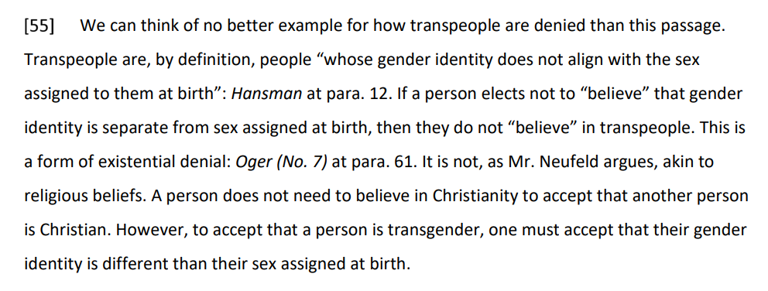
An excerpt from the decision stating plainly the tribunal’s view that it is unlawful not to accommodate the concept of self-selected gender identity.
The 143-page decision singled out a comment of Neufeld’s in which he had called for “educators to stop affirming the gender identities of students.” This was in reference to a mandatory B.C. policy of affirming the trans identities of students, regardless of age, and concealing that information from parents upon request.
The B.C. Human Rights Tribunal described Neufeld’s view as “advocating” the “erasure” of trans people, and would characterize his rhetoric as a campaign of saying their “very existence was a threat to children, families, and social order.”
In the case of Station10, the non-binary complainant testified that seeing men’s and women’s haircuts precipitated a mental breakdown resulting in missed work.
Although the Quebec Human Rights Tribunal rejected a request for $12,500 in damages, they did conclude that Station10 was the party at fault.
“The fragility of a party’s position and the weakness of its evidence do not necessarily equate to recklessness constituting abuse,” the ruling read.
Crime groups are endangering the health of Canadian citizens, imperiling national security and global peace.
Arwen~Remember Canadians in 2016 when Trudeau went against the highest of warnings from all national security agencies not to drop visa requirements for Mexico ,he did it anyway. I remember that very clearly. It is either Trudeau was inept or he was told to do so by outside powers, I go with the latter.
Feb 13, 2026
WASHINGTON — A former senior U.S. intelligence official has concluded that an “unprecedented crime convergence” is underway across Canada, involving nearly 700 organized crime groups operating in strategic cooperation and networked into 48 countries—amid virtually no coordinated national response from Ottawa—resulting in potentially hundreds of billions of dollars laundered in the country each year.
Beyond this groundbreaking assessment of the scale of drug money laundering through Canada, the Washington-based expert finds that these expanding criminal operations were accelerated and empowered by the Liberal government’s 2016 decision to drop visa requirements for Mexico.
The hard-hitting study, produced by David M. Luna through the International Coalition Against Illicit Economies, asserts that U.S. government assessments on Canada’s growing role as a transnational hub of poly-narcotics production, trafficking, and—more importantly—money laundering are more detailed and plausible than Ottawa’s own data releases.
The consequence has been the rapid formation of what Luna describes as “an integrated ecosystem of criminality and corruption” operating within Canadian borders and Indigenous First Nation territories, involving key transnational networks—most importantly Chinese Triads and the Sinaloa and Jalisco New Generation Mexican cartels.
Critically, the findings illuminate the structural role of domestic figures like former Olympian Ryan Wedding: powerful Canada-based biker networks, including the Hells Angels, have become key enforcers and intermediaries between Chinese, Mexican, and Iranian transnational crime networks and Canadian street-level drug dealers.
“Canada has become a safe zone for the world’s most notorious crime groups and threat networks. It is not merely a consumer of illicit goods and contraband, but increasingly serves as a hub of illicit trade, production, and distribution of illicit goods, an exporter of such contraband, and a money laundering safe haven for a potpourri of sinister malign networks,” Luna writes.
“These illicit activities have a disrupting and destabilizing impact on Canadian political, governance, security, and business structures,” his report finds. “In fact, across Canada, criminal networks continue to profit handsomely from an array of illicit activities that are endangering the health and safety of its citizens, and are imperiling the country’s national security and threatening global peace.”
The report affirms much of The Bureau’s recent investigative reporting on the convergence of organized crime and foreign interference in Canada, while delivering a conclusion that reframes the crisis: the fentanyl epidemic devastating Canadian communities, and the border vulnerabilities that enable it, are critical—but they are symptoms.
The deeper threat, Luna argues, is Canada’s role as a money laundering platform for these transnational networks.
In this analysis, drug trafficking revenue is not merely a commodity to be cleaned and banked by international crime groups. It is the capital—or liquidity, as financial analysts might say—that provides fuel for multiple sectors of both the legal and illegal economy. In this new light, drug trafficking and money laundering aren’t ends to themselves. They are the operating system.
Luna’s new study, an ongoing series through ICAIE’s Illicit Shadows project, represents one of the most comprehensive public mappings yet attempted of Canada’s criminal infrastructure—and by a figure with direct experience inside the U.S. intelligence and law enforcement architecture.
Luna, who served 22 years in U.S. government including as Assistant Counsel to the President and in multiple senior directorships at the State Department’s Bureau of International Narcotics and Law Enforcement Affairs, identifies a criminal ecosystem in which the most powerful transnational organizations on earth—Chinese triads and CCP-linked money laundering syndicates, Mexican cartels, Iranian crime networks, Punjabi gangs, the Hells Angels, Eurasian mafias, and Aboriginal criminal groups—are not competing, but rather collaborating. At scale. Across every province and territory.
“Taken together, available estimates by both governments in Canada and the United States, it is fair to state that Canada is awash with tens of billions of dirty monies from an array of criminal activities and corruptive influence operations that are laundered and reinvested every year across its formal sectors and industries,” Luna writes.
“The biggest cross-border criminal security threats to Canada and the US are the staggering amounts of dirty money that is laundered in both countries by Mexican cartels, Chinese money laundering syndicates, and other transnational criminal organizations that finance greater insecurity and instability.”
Luna traces the acceleration of cartel infiltration to a specific policy decision. The 2016 lifting of the Mexican visa requirement under Prime Minister Justin Trudeau, his assessment finds, enabled hundreds of cartel members to enter Canada and establish operations freely. The Sinaloa Cartel and Jalisco New Generation Cartel — which Luna designates the “most dangerous” transnational criminal organizations in North America — have since expanded from supply into direct production, establishing fentanyl synthesis labs on Canadian soil and building distribution networks in partnership with domestic criminal organizations including the Hells Angels.
But the cartels operate below an upstream force.
Chinese transnational crime syndicates play what Luna calls “a central role in financing and laundering the proceeds of the drug trade in Canada,” managing networks that disguise cartel profits through casinos, real estate transactions, underground banking systems, and cryptocurrency exchanges. Vancouver and Toronto are identified as the primary hubs for these operations, with laundered proceeds moving undetected across international financial systems. Luna positions these CCP-adjacent networks not as one player among several but as the predominant upstream factor — the financial oxygen without which the ecosystem cannot function.
Iranian crime organizations, less visible but strategically significant, have established control over fentanyl trafficking’s financial and cybercrime sectors, facilitating cross-border laundering through sophisticated transaction schemes. Iranian financial elements are also linked to the trafficking of precursor chemicals used in fentanyl production. Punjabi gangs have emerged as major players in a billion-dollar supply network trafficking heroin and methamphetamine from India through Canada to North America and Europe.
The Hells Angels serve as the critical domestic intermediary — handling local distribution and enforcement across urban and rural markets, ensuring that product supplied by international networks reaches Canadian street dealers.
One of Luna’s most pointed findings concerns trust.
In building ICAIE’s Canada Illicit Economies Project, Luna found that U.S. government assessments of illicit markets inside Canada were consistently more credible and more granular than anything produced by Ottawa. Canadian authorities, he reports, could provide seizure data — and almost nothing else.
“There was the dearth of quality data provided by the Government of Canada,” Luna states. “I was disappointed that besides seizures, we could not get any official data points on estimates for the overall size and scales of today’s illicit markets in Canada and their specific dollar amounts.”
“What is alarming,” he continues, “is that seizures only show a minuscule level of criminality and strategic corruption in Canada, and in fact the scales of illicit markets in Canada are closer to various USG estimates.”
The Canadian Security and Intelligence Service has publicly estimated that $36 billion to $91 billion is laundered and integrated into Canada’s economy annually. But that figure comes with no breakdown by predicate crime, no specificity by illicit market, and no accounting for embezzled funds reinvested in the country.
ICAIE’s own projection, drawing on U.S. government intelligence and open-source analysis, is that the real figure could be several times the CSIS estimate — potentially reaching into the hundreds of billions of dollars annually. A 2022 U.S. State Department report assessed that tens of billions are laundered in Canada every year from drug trafficking, fraud, corruption, counterfeiting, piracy, and tobacco smuggling. The TD Bank scandal — in which the institution admitted its lax controls allowed fentanyl traffickers to launder at least $670 million — represents just one bank and one pipeline among many.
For a Five Eyes partner, the implication is damaging: Washington is producing a more reliable intelligence picture of Canada’s domestic criminal economy than Canada itself, in Luna’s telling.
Western Hemisphere Trafficking Runs Through Great Lakes Crossings
The scope of the infrastructure Luna documents is continental.
His assessment, produced jointly with the Council of the Great Lakes Region, maps drug flows, smuggling methods, border vulnerabilities, and laundering channels across the full U.S.–Canada corridor.
His boiled-down assessment presents a narrative of what has emerged, and what is foreshadowed, if Ottawa doesn’t meaningfully act.
“Local distribution is dominated by outlaw motorcycle gangs, with the Hells Angels being the most influential. They act as a critical intermediary, handling local distribution and enforcement within Canada, ensuring the product moves through urban and rural markets,” Luna writes. “This ecosystem demonstrates that organized crime is adopting corporate-style models. They are using alliances to expand their illicit operations, forming a sophisticated North American criminal ecosystem. They have the product and the power. Now, they need a place to wash the billions of dollars soaked in blood.”
The place for the Western world has now become Canada, is Luna’s unsparing conclusion.
Among the findings:
Drug flows into Canada originate primarily from two sources. Mexican cartels supply cocaine, heroin, and methamphetamine across the U.S. border. China supplies fentanyl precursors and pill presses — both to Mexico and directly to Canadian labs. Luna found based on available data that the vast majority of fentanyl has flowed from Mexico into the United States, rather than from Canada’s northern border, although other U.S. experts say they believe fentanyl shipments moving from Vancouver’s port into western U.S. ports represent a growing and largely unreported trafficking route.
Drug flows out of Canada mark a critical shift. Canada-produced fentanyl is largely for domestic consumption, but significant quantities are now trafficked to Australia, parts of Asia, and New Zealand. Synthetic opioid shipments leave via air cargo, postal services, and maritime routes. Domestic fentanyl and nitazene production is increasing, driven by Mexican cartel expansion onto Canadian soil. Canada has graduated from consumer to exporter.
The Great Lakes region is the geographic epicenter. Spanning eight U.S. states, two Canadian provinces, and Indigenous Nations, it has a combined GDP of nearly $6.87 trillion and handles more than 50% of U.S.–Canada cross-border trade. In 2024, 86% of illegal crossings from Canada into the U.S. occurred in this region. The Swanton Sector accounted for 82% of those crossings — primarily through Roxham Road, the International Railway Bridge, and Akwesasne First Nations territory. Detroit, Buffalo, Toronto, Montreal, and Chicago are primary trafficking points. Vancouver, Calgary, Toronto, and Montreal serve as cartel-controlled distribution hubs.
The smuggling methods are industrial. Hidden vehicle compartments in commercial trucks. Cargo containers with narcotics mislabeled as legitimate goods. Drug mules at airports. Small parcels flooding USPS, FedEx, UPS, and DHL to avoid bulk seizures. Human smuggling operations across land borders. E-commerce platforms, postal services, and air cargo exploited with increasing sophistication.
The laundering architecture runs through six channels: real estate fraud — particularly high-value property purchases in Toronto, Vancouver, and Montreal; casino-based laundering in British Columbia and Ontario, where illicit cash is exchanged for chips and cashed out as “winnings”; trade-based laundering through over- and under-invoicing of legitimate goods; Chinese underground banking systems and cryptocurrency exchanges; shell companies enabling cross-border transfers; and e-commerce and postal platforms used to move small, high-value shipments and launder profits under legitimate cover.
The human cost is staggering. Between 2016 and 2024, there were 49,105 opioid-related deaths in Canada, with 84% of 2024 fatalities in British Columbia, Alberta, and Ontario. Fentanyl seizures surged 775% in 2024. Cocaine seizures increased 168%. Luna frames this not as a public health crisis with criminal dimensions, but as a criminal enterprise with catastrophic public health consequences.
That distinction arguably determines whether the response is treated as a medical challenge—or a national security imperative.
The Bureau is a reader-supported publication. To receive new posts and support my work, consider becoming a free or paid subscriber.
TORONTO/WASHINGTON – Tony Luk took private jet flights to China with three Canadian prime ministers. He has been photographed alongside premiers, immigration judges, and former U.S. presidents Bill Clinton and George W. Bush.
Years before Luk unsuccessfully ran to become Toronto’s mayor in 2022—the first Chinese Canadian to seek the office in Canada’s largest city—a member of the Ontario legislature stood in the provincial chamber to honor him by name, citing his leadership across a constellation of organizations including the Canada-China Overseas Exchange Association, the Canada–China Trade Promotion Association, and the Canada Guangdong Overseas Friendship Association.
Every one of those organizations, according to a landmark new study by the Jamestown Foundation, a Washington-based research institute, bears the hallmarks of Beijing’s “united front” influence system—a sprawling global apparatus designed to extend the Chinese Communist Party’s reach into foreign governments, economies, and diaspora communities.
And Luk, the research suggests, exemplifies a rare level of access sought by Beijing.
“United front organizations share many characteristics, but they also differ in important ways,” writes author Cheryl Yu in her groundbreaking report, which identified 2,294 Beijing-linked organizations across the United States, Canada, the United Kingdom, and Germany—with Canada emerging as an extreme outlier, hosting nearly five times the per capita penetration rate of the U.S.
“Depending on the extent to which they are established within foreign societies, they may vary in their perceived value to the Party,” Yu states. “For example, some organizations and individuals may be able to directly influence national leaders. This was the case for Tony Luk, who took private jet flights to the PRC with three Canadian prime ministers.”
Luk’s ambitions within Canadian politics extended beyond rubbing elbows with prime ministers on trips to China.
On May 2, 2022, he became the first candidate to file for Toronto’s mayoral race. A press conference he held at the Diaoyutai State Banquet hall reportedly drew nearly 100 community representatives and 50 media outlets. The guest list read like a directory of the Canada-based United Front networks catalogued in the Jamestown research: attendees included the Executive Chairman of the Shenzhen Federation of Associations, the Secretary General of the All-Canada Chinese Federation, and the Co-Chairman of the China Business Alliance.
Luk’s engagement with Canadian political processes has also intersected with contentious policy debates.
On June 24, 2023, he attended a Parliament Hill rally alongside Canadian Senators Victor Oh and Yuen Pau Woo. The rally, ostensibly held to commemorate the 100th anniversary of the Chinese Exclusion Act, was repeatedly linked in its marketing materials with e-Petition 4395, which urged the Canadian government to reconsider implementing a foreign agent registry—a transparency measure designed to identify individuals acting on behalf of foreign governments.
And Luk’s political meetings reach far beyond Toronto and Ottawa.
According to Chinese-language media reports reviewed by The Bureau, Luk met on June 13, 2024, with two Hong Kong officials sanctioned by the United States government: Chief Executive John Lee Ka-chiu and Zheng Yanxiong, Director of the Hong Kong Liaison Office. Both were sanctioned on August 7, 2020, for undermining Hong Kong’s autonomy and restricting citizens’ freedom of expression and assembly.
Luk has not yet responded to requests for comment on the Jamestown report’s findings regarding his alleged United Front connections.
The meeting was hosted by the Friends of Hong Kong Association commemorating the 75th anniversary of Chinese Communist Party rule, featuring addresses from Zou Jiayi, Deputy Secretary-General of the Chinese People’s Political Consultative Conference, and Wang Ping, Secretary General of the Chinese Overseas Friendship Association—both elite organs central to the Jamestown Foundation’s methodology for linking Canada-based groups and their leaders to the CCP’s united front influence apparatus.
Additionally, posts on the WeChat channel “The Luk Family” document his appointment as an Overseas Representative of the Chinese People’s Political Consultative Conference at five different governmental levels since 2013: the national CPPCC in 2013, Guangdong provincial CPPCC in 2015, Beijing municipal CPPCC in 2015, Foshan municipal CPPCC in 2017, and Zhanjiang municipal CPPCC in 2019.
An October 2023 WeChat post noted that Luk had attended the People’s Republic of China National Day reception in Beijing for 23 consecutive years, with the 2023 event co-hosted by the National CPPCC Committee, the United Front Work Department, the Overseas Chinese Affairs Office, and the All-China Federation of Returned Overseas Chinese—all of them key organs in the Jamestown Foundation’s research into Beijing’s overseas influence operations.
These connections take on added significance in the context of Canada’s 2025 federal election.
On December 24, 2024, Hong Kong’s National Security Department issued a warrant for the arrest of Joe Tay—a former Hong Kong actor, democracy advocate, and Conservative candidate in Canada’s federal election—with a bounty of HK$1 million. The charge: “inciting secession” and “colluding with foreign forces” through his work with HongKonger Station, a Canada-based media platform he co-founded.
The network of Hong Kong officials who oversaw the enforcement action against Tay—including Chief Executive John Lee—was the same network Luk had engaged with months earlier during the anniversary celebration in Hong Kong.
The case detonated inside the federal campaign when Paul Chiang, the Liberal incumbent in Markham-Unionville and a former York Regional Police sergeant who had led the force’s Diversity and Cultural Resources Unit, was revealed to have told a Chinese-language media conference in January that attendees could collect the bounty by delivering Tay to the Chinese consulate in Toronto. After initially defending Chiang as a “person of integrity,” Liberal Leader Mark Carney accepted his resignation from the race on April 1.
Meanwhile, Canada’s Security and Intelligence Threats to Elections Task Force identified a coordinated online operation against Tay’s candidacy, involving the synchronized amplification of wanted-poster imagery and disparaging content across WeChat, Facebook, TikTok, RedNote, and Douyin.
In testimony before the House affairs committee following the election, Tay described a pattern of physical intimidation that accompanied the digital campaign: a venue owner who had hosted a private event he attended was summoned twice by the Chinese consulate; volunteers and Tay himself were followed, photographed, and had their homes surveilled by unidentified vehicles; and elderly Chinese-Canadian voters received warnings that if they voted for Tay, the consulate would know, and they would lose their visas to visit China.
Canada as Extreme Outlier
The Jamestown Foundation’s research places Luk’s documented relationships in a far broader context. With 575 documented organizations planted within a population of only 40 million people, Canada hosts 14.38 united front groups per million residents—nearly five times the U.S. rate of 2.89 per million, more than double the United Kingdom’s density, and over three times Germany’s penetration rate.
Canada leads not only in overall density but also in specific high-impact categories: it hosts 109 business associations linked to the united front system—the most of any country surveyed—and 76 cultural promotion centers, again the highest number among the four democracies studied.
Cultural promotion centers and friendship organizations serve as instruments of the PRC’s campaigns, establishing pathways for elite capture and political influence. As former CCP General Secretary Jiang Zemin told representatives of overseas Chinese organizations in 1999, these groups constitute “an important driving force for the development of international people-to-people friendship.”
When the China Cultural Center in Vancouver opened in 2016, then-CEO Ye Hongtao stated the center would “tell Chinese stories well, show the charm of Chinese culture, spread Chinese culture well, and strive to make it a platform for cultural exchanges and cooperation between China and Canada.” The language—”tell Chinese stories well”—directly echoes directives from CCP leadership, which has repeatedly emphasized the strategic importance of narrative control in overseas influence work.
Open-source research conducted by The Bureau has established troubling connections between Vancouver’s Chinese cultural infrastructure and individuals linked to organized crime and intelligence networks.
One Vancouver Chinese cultural club established by Ye Hongtao hosted an event attended by Paul King Jin, a figure whom Canadian federal police sources have tied to the notorious Sam Gor transnational organized crime syndicate—described by law enforcement as one of Asia’s most powerful drug trafficking organizations. According to records reviewed by The Bureau, Jin is associated with Shandong United Front groups operating in Canada, positioning him at the intersection of Beijing’s influence apparatus and criminal networks.
Also present at the cultural club meeting were former Richmond, B.C. Liberal MP Joe Peschisolido, along with a number of local politicians and Jin’s known associates.
These included a former People’s Liberation Army officer who has been implicated in RCMP money laundering investigations, as well as Chinese milk tycoon Niu Gengsheng—the founder of Mengniu Dairy who has maintained close ties to the Chinese Communist Party throughout his business career. Significantly, all of these individuals have been documented at meetings with former Liberal Prime Minister Justin Trudeau.
Alongside Paul King Jin, a figure linked in open-source reporting and expert analysis to organized-crime and money-laundering concerns, was the leader of the Canadian Alliance of Chinese Associations—an umbrella organization for numerous smaller Vancouver-based groups that Jamestown and other researchers describe as united front-linked.
Economic Engagement as Political Leverage
Jamestown’s research underscores that business associations constitute a critical pillar of the Chinese Communist Party’s overseas united front system. “The focus of these groups is to promote economic connections with and bring foreign resources back to the PRC,” the report states. “They organize visits to the PRC to build relationships and work with local governments and companies.”
The Canada Shandong Chinese Business Association, established in 2015, exemplifies this model. In 2016, it organized the Vancouver, Canada–Weihai, China Seminar on Investment & Trade—an event that culminated in the Weihai Municipal Bureau of Commerce and the City of Burnaby signing a memorandum of cooperation on economics and trade, effectively giving a Chinese municipal government a direct institutional relationship with a Canadian city.
The association’s influence extends further through the Canadian Alliance of Chinese Associations, an umbrella network that, according to Jamestown’s report, participates in events hosted by the Overseas Chinese Affairs Office and the All-China Federation of Returned Overseas Chinese. The alliance also organizes delegations to the PRC to promote economic and trade exchanges with Canada—creating ongoing channels through which Beijing can shape perceptions, cultivate dependencies on Chinese markets, and leverage economic relationships for political ends.
The Jamestown research decodes a patient playbook for institutional capture that unfolds with methodical precision, transforming independent community organizations into instruments of state power while preserving the appearance of grassroots legitimacy.
“The Party’s process for co-opting overseas organizations into the overseas united front system typically starts with identification by the United Front Work Department,” writes Yu. “Once an organization is identified as a target, officials within the united front system initiate contact, set up meetings, and invite the organization’s leadership to visit the PRC.”
Critically, many of these organizations did not begin as instruments of CCP influence. The report notes that “although many of these groups began as ordinary community, cultural, or professional associations—sustained engagement by the Party’s united front system has gradually encouraged them to align with Beijing’s narratives and priorities.” This process of co-optation, which can unfold over years or even decades, makes the network particularly insidious and difficult to counter.
“While not all members of these organizations are aware of their role as part of the united front’s broader ecosystem, the cumulative effect is a significant extension of the Party’s influence into democratic societies,” the report states.
Organizations are classified as united front-linked if they have connections to the system’s key organs: the Chinese People’s Political Consultative Conference (CPPCC), the Overseas Chinese Affairs Office (OCAO), the United Front Work Department (UFWD), the Chinese Overseas Exchange Association (COEA), the China Overseas Friendship Association (COFA), or the All-China Federation of Returned Overseas Chinese (ACFROC).





 Now or Never
