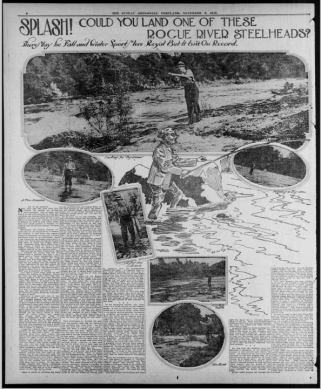
Rogue River Steelhead, 1913

The Oregon Digital Newspaper Project is a treasure trove of history. A search for the word “steelhead” landed this one. Click on the image below to launch the ODNP page and read the article.  Enjoy!

image: screenshot of Oregonina article about steelhead fishing on Rogue River, Oregon


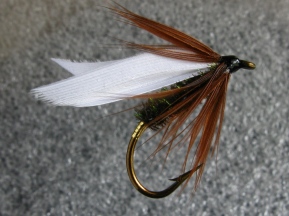
Here are flies similar to those mentioned in the article, as tied by the brilliant Don Bastian:

Image: Royal Coachman wet flies tied by Don Bastian

Royal Coachman (Wet Flies)

image: Coachman wet fly

COACHMAN Tip: Gold tinsel if desired Tail: None Ribbing: None Body: Peacock herl Hackle: Dark red brown or brown Wing: White

image: Gray Hackle Yellow fly

GRAY HACKLE YELLOW Hook: Standard wet fly hook, size #8 to #16 Thread: Danville Flymaster 6/0 white for body; black for head Tag: Flat gold tinsel Ribbing: Flat gold tinsel Body: Yellow floss Hackle: Grizzly hen

Your Maine Hunting Shoes Rebuilt

I have a pair of LL Bean Lounger boots from the 1980s that are a favorite for yardwork, camping,rainy day errands, sloshing around parking lots in ski country, and so on. They were always on the small side and my feet have changed in the intervening years. The treads were also quite worn down. Luckily, Bean’s still offers a rebuilding service, so off they went for new bottoms in a larger and wider size. I asked for the “Maine Hunting Shoe”  rather than the “Bean Boot” version. The MHS is softer and quieter.

I’m very happy with the results. The shoes came back a week earlier than expected, complete with a new set of insoles. They’re a great fit with two pairs of midweight socks, or a thinner liner plus a heavy sock.

Before

image: LL Bean Lounger Boots


After

Image

Image

This cost about $45 plus shipping. Higher than 1938 (see below), but still not bad, especially if they provide another 20+ years of service.

Image

Deschutes Sunset

…I fish because I love the environs where trout are found, which are invariably beautiful…

– Robert Traver 1964, (Judge John Voelker 1903-1993)

image: sunset over Deschutes River, Central Oregon, USA


Deschutes River, Oregon, Summer 2010. Upstream from the Trout Creek BLM campground.


Black Flying Ant

image: black flying ant (artificial trout fly)

Hook: dry fly, size 14 – 18 (fly in photo is tied on a #14 Gamakatsu P10 "Traditional Dry Fly")
Thread: black or brown
Abdomen: fat ball of black dubbing
Thorax: Thread with a few turns of black hackle
WIngs: blue dun hackle tips
Head: another fat ball of black dubbing

The world is full of ants, and I’ve caught fish whenever I remember to fish ant patterns, with or without wings. Here is an easy one that will work either wet or dry. Be sure to keep the thorax section nice and skinny.

Bike N’ Fish

It was a beautiful Willamette Valley afternoon, and I had a tough decision between fly-fishing and a nice long bike ride. The obvious answer was to do both.

image: touring bicycle with fishing gear

This is a Miyata 215ST touring bike. Waders and boots are in the panniers, and my vest is in the saddlebag.

In less than 40 minutes I was on the McKenzie River at Armitage Park:
image: McKenzie River, Oregon near Armitage Park

I caught one native cutthroat trout and missed a few others. The action was on a soft hackle wet fly with brown hackle and brown dubbed body ribbed with hackle stem, size 12:

Image

Watch for more Bike N’ Fish reports in the near future.

Quail and Olive (soft-hackle)

Quail & Olive Soft-Hackle

Hook: wet fly hook (this is a size 12 Dai-Riki #730)
Tail: California Quail neck feather fibers
Rib: fine gold oval tinsel
Body: mixed olive & natural beaver
Hackle: California Quail flank feathers, palmered through front 1/3 of body

We have friends with a ranch west of Eugene; the quail feathers are from a young female that was left behind by a coyote or bobcat.

Coho Salmon return to N Fork Nehalem River

This is fun to watch:


from IEODFW:
Coho salmon entering an ODFW live-cycle monitoring fish trap on the North fork of the Nehalem River, October, 2009.

North Umpqua River, Oregon

North Umpqua River at Steamboat Inn

North Umpqua River at Steamboat Inn

Earlier this fall I took a trip to Oregon’s beautiful  North Umpqua River for a couple days of steelhead flyfishing.  This is a tough fishery and I’ve learned through the years that to have a successful trip, it is important to keep your hopes high and expectations low.  In other words, fish every cast with care, as though a steelhead will take your fly at any point, but don’t be surprised or disappointed when it doesn’t happen.

This year, my low expectations were met, at least in terms of not catching any steelhead. I did catch a beautiful sea-run cutthroat trout and several nice rainbows.  The cutthroat took this size 8 Silver Brown, a classic Northwest pattern originated by Roderick Haig-Brown to imitate coho salmon fry. I tied it on because there are a lot of October Caddis on the N Umpqua at this time of year, and this fly offers the October Caddis colors with a bit of extra flash from the silver hook.

Image

Here is the pattern.

A few other words of advice:

– This is a famous river with a long, distinguished flyfishing heritage. Take some time to read about it, appreciate the history, and learn its traditions and protocols.

North Umpqua River: Zane Grey's fishing camp

– Wading in the North Umpqua is tough and can be dangerous. You will read in every guidebook and magazine article about the North Umpqua that studded wading shoes are essential, and it is true.  I’ve done well with Patagonia Beefy wading boots with carbide studs and, more recently, Simms Headwaters Vibram with hex head screw-in cleats. These perform very well on wet rock (slimy and regular versions), dry rock, and on the trail.

– Carry a wading staff to help keep your balance in the water and while scrambling up and down the banks. I use a section of vine maple sapling, tethered to my vest with braided parachute cord and a mini-carabiner. I’ve used it for years and it works very well.

wadingstaff_LL

Bass in a beautiful Maine lake

photo by Beth B, 2009

photo by Beth B, 2009

Earlier this month (July 2009), we traveled back east for vacation. Part of our trip included a stay at a cabin on Great Pond, Belgrade Lakes, Maine. My New Hampshire-based brother-in-law is also a fly fisherman, so this gave us the chance to paddle around our arm of the lake in an old canoe, casting to the rocky shoreline and/or trolling. We caught a mixed bag that included smallmouth, largemouth, rock bass, and one small pike. Flies that worked well included one of my homemade wine-cork poppers, Bakke’s Dragonfly (steelhead dry), and traditional Muddler Minnows. The best fish were caught trolling Muddlers in approx size 4.

The solar-powered house we rented (“The Rink”) is owned by Ben and Emily Swan, who direct Pine Island Camp. It is a great location and the lake is beautiful. Ben and Emily gave us a very enjoyable tour of the camp, and lunch with the campers.

All in all, it was a wonderful, classic NE summer experience

smallmouth bass

smallmouth bass

largemouth bass

largemouth bass

still life from an old New Hampshire fishing vest

still life from an old New Hampshire fishing vest

Yours Truly, Multitasking. Photo by Kate (kateflaim.com)

Yours Truly, Multitasking. Photo by Kate (kateflaim.com)

Old English Iron Blue Dun

Image

From Trey Combs, Steelhead Fly Fishing and Flies (Frank Amato, 1976):

Tail: Golden pheasant red breast feather fibers
Body: Blue-gray dubbing (muskrat) ribbed with oval silver tinsel
Hackle: Natural black or dark gray
Wing: Gray goose or gray squirrel tail

This was Peter Schwab’s favorite steelhead pattern. he called it, “the most universally successful fly I have ever seen.” For Schwab it was best a clear water summer-run dressing, and he fished it at the exclusion of many patterns he had designed and made nationally famous. (p.95)

note: my example in the photo uses natural gray sheep’s wool rather than muskrat.

Design a site like this with WordPress.com
Get started