Bloomsbury Academic is announcing the launch of a new book series: Intelligence: AI and Humanity. I’m humbled, delighted, and honestly amazed to say that I will be the series editor.
Intelligence is a venue for writers from a wide array of fields and areas of expertise to reflect on artificial intelligence as a mirror to society and culture. Books in thisseries will not be technical — not about artificial intelligence as technology. Instead, they will examine AI’s meaning to our lives and collective humanity. AI’s entrance into public discourse as a literate machine challenges us to reexamine our views of intelligence, creativity, language, learning, authority, humanity. The intended audience is broad, both academic and trade: anyone with an interest in AI and its profound implications for us all.
The first three books and authors we’re announcing represent the range of perspectives we wish to offer.
Dr. Rumman Chowdhury, CEO and cofounder of Humane Intelligence and a pioneer in the field of applied algorithmic ethics, asks the first and fundamental question raised by AI: What is intelligence?
Dr. Charlton McIlwain, Vice Provost and Professor of Media, Culture, and Communication at NYU and author of Black Software, will examine whether and how Black Americans could use the opportunity of AI to overcome years of white technological oppression.
Dr. Matthew Kirschenbaum, the Commonwealth Professor of Artificial Intelligence and English at the University of Virginia, warns of the coming Textpocalypse, altering our relationship with text forever.
I hope to see authors proposing books to reflect on fundamental questions raised by AI and to explore how AI in turn reflects on society, for AI replays to us the collective notions, misapprehensions, clichés, and biases of those who have had the power and privilege to publish in the past. I want to see books that challenge presumptions about AI and power, creativity, education, democracy, sustainability, religion, history, artistry, collaboration, and countless topics I’ve yet to imagine.
Featuring scholars, public intellectuals, journalists, and professionals, books in Intelligence will be written by authors from many fields — history, psychology, anthropology, sociology, philosophy, communication, community studies, linguistics, literature, religion, classics, economics, law, government, and the arts — and from diverse and global perspectives.
Almost seven decades ago, Sputnik overthrew the humanities in favor of science, technology, and mathematics in American education, policy, and culture. But now that the machine can speak our languages, the CEOs of some AI companies say schools should stop training computer scientists in favor of developing domain expertise. Could this, then, be the revenge of the liberal arts major?
The humanities and social sciences have been largely left out of deliberation about technology and its impact on society. Intelligence will provide them their place at the table, to bring their perspective, expertise, and inquiry to critical discussion of this technology and the opportunities, perils, and questions it presents.
Print required capital to control. Electronics required expertise to operate. AI is different in that its tools are designed for anyone to use. All one needs is human language and a phone or a keyboard or geeky eyeglasses to seek, organize, and query information or to command a computer to create text, image, sound, or code.
That potential for broad and fast adoption of these tools is why Bloomsbury Academic and I believe this series is needed, providing space for writers to stand apart, to observe, to ask key questions, and most of all to challenge readers to understand and undertake their roles in the future of these technologies and society.
The series it the brainchild of Haaris Naqvi, Director of Scholarly and Student Publishing for Bloomsbury US and Global Editorial Director of Bloomsbury Academic. Haaris has been the wise, supportive, and patient editor and publisher of three of my own books. One day, Haaris called and asked whether I thought a book series on AI was a good idea — and whether I would like to edit it. Well, of course. We compared our hopes and plans for the series and found ourselves in quick kismet.
So now here we are. We plan to publish three to five books a year, each an independent work through which we hope readers will be led to more books in the series. Prospective authors may submit proposals— emailing intelligencebloomsbury@gmail.com — to be reviewed by us, outside reviewers, and the Bloomsbury board. The decisions will not be mine alone. I will be eager to hear suggestions for both subjects and authors.
We also plan to hold a series of events featuring writers and ideas covered in the series. Watch this space and listen to the AI podcasts I cohost — Intelligent Machines and AI Inside — for announcements and updates.
Jürgen Habermas has died. In memory of the great philosophical provocateur, is a section of my book, The Gutenberg Parenthesis, grappling with his idea of the public sphere and the coffeehouse.
Writing and conversation came together in a new institution built for the purpose: the coffeehouse. There, in the seventeenth and eighteenth centuries, especially in England, varied constituencies and classes gathered to drink the exciting, imported brew as they discussed what they read in newspapers, newsletters, and books. Jürgen Habermas theorized that the coffeehouses of England and salons of France were the birthplace of the bourgeois public sphere — in his definition as an inclusive society gathered to share private opinions publicly and to hold rational and critical debate over issues of common concern in the newly available commodity of news. Thus, he said, they established themselves as a public distinct from the state.
Habermas’ thesis was challenged by, among others, a five-year academic collaboration called the Making Publics Project, organized by McGill University Shakespeare scholar Paul Yachnin. The project’s academics focused not on a singular public sphere. Instead, they examined the creation of plural publics, “forms of association built on the shared interests, tastes, and desires of individuals, most of them ordinary ‘private’ people. The project argued that public making was enabled by new media and new cultural forms and was nested in an emerging market in cultural goods.” They concluded that publics formed not only in coffeehouses and around news. Publics formed around books and pamphlets — as when Luther chose to publish in vernacular German, addressing and forming a public with his ideas. Publics formed in the Globe Theatre as an audience watched Hamlet, with Shakespeare “seemingly able to unite them as a group invited to think through a problem and to form a judgment along with the protagonist,” said Yachnin. Publics would form around portraiture and maps, as people of a given location and culture could understand their place in the world. Publics formed around printed ballads and sermons. Publics formed around languages, around laws, around ideas — making, in the words of Benedict Anderson “imagined communities.” Richard Helgerson, a guiding light of the Making Publics Project, was inspired to write his book Forms of Nationhood by this single sentence in a letter by Edmund Spenser in 1580: “For why a God’s name may not we, as else the Greeks, have a kingdom of our own language?” Or a kingdom of our own culture or religion or gender or worldview, a community or kingdom of our definition and making?
“To live together in the world,” wrote Hannah Arendt, “means essentially that a world of things is between those who have it in common, as a table is located between those who sit around it.” Publics and communities are often thought of in terms of space: a boundary around a town, a state, a nation. Arendt’s metaphor of the table appeals as it brings to mind the discourse of those seated around — and makes us ask who is and is not given a place there. “A public sphere comprises an indefinite number of more or less overlapping publics,” said Craig Calhoun, “some ephemeral, some enduring, and some shaped by struggle against the dominant organization of others.” Michael Warner developed his theory of counterpublics around the notion that some publics “are defined by their tension with a larger public.” Nancy Fraser made the concept concrete: Alongside the bourgeois public “there arose a host of competing counterpublics, including nationalist publics, popular peasant publics, elite women’s publics, and working-class publics. Thus there were competing publics from the start, not just in the late nineteenth and twentieth centuries, as Habermas implies.”
Habermas called the Early Modern public of the coffeehouse inclusive, for it allowed people who otherwise would not have met in conversation to sit at the same table — in fact, they were required to, as the historian of the venue, Markman Ellis, recounted: “Arriving in the coffee-house, customers were expected to take the next available seat, placing themselves next to whoever else has come before them. No seat could be reserved, no man might refuse your company. This seating policy impresses on all that in the coffee-house all are equal. Though the matter of seating may appear inconsequential, the principle of equality this policy introduced had remarkable ramifications in the decades to come. From the arrangement of its chairs, the coffee-house allowed men who did not know each other to sit together amicably and expected them to converse.” New norms were required in increasingly urbanized England. “In the anonymous context of the city, in which most people are unknown to each other, this sociable habit was astonishing. Furthermore, the principle of equality established by the seating arrangements recommended equality and openness as the principle of conversation.” Even in the midst of civil upheaval, royalists sat with Puritans (who preferred the temperance of coffee, tea, and chocolate over taverns’ beer). Early on, coffeehouses were inhabited by a “virtuoso culture” that emphasized “civility, curiosity, cosmopolitanism, and learned discourse,” said Brian Cowan in The Social Life of Coffee.
London’s most celebrated coffeehouse was Will’s, where England’s first poet laureate, John Dryden, would hold court. There a twelve-year-old Alexander Pope was brought to hear him. There, too, diarist Samuel Pepys would come to catch news and gossip. “Under no roof was a greater variety of figures to be seen,” wrote Thomas Babington Macaulay. “There were earls in stars and garters, clergymen in cassocks and bands, pert Templars, sheepish lads from universities, translators and index-makers in ragged coats of frieze. The greatest press was to get near the chair where John Dryden sat.”
As coffeehouses spread in London after the first opened there in 1652, subcultures emerged within and among the houses. Some had a single table for all, and others had multiple tables or booths where people of like interest could congregate. In the Chapter Coffeehouse, one booth was occupied by the Wet Paper Club, so-called because they would wait to receive the day’s newspaper wet (not hot) off the press. Macaulay listed one coffeehouse for medical men; another for Puritans “where no oath was heard”; another where Jews, “dark eyed money-changers from Venice and Amsterdam greeted each other”; another for papists where“as good Protestants believed, Jesuits planned over their cups another great fire, and cast silver bullets to shoot the King.” Coffeehouses became known as penny universities because, for the price of drink, one could listen to learned men — Dryden, Christopher Wren, Robert Hooke, Edmund Halley, Robert Boyle, Daniel Defoe, David Hume, Voltaire, Jonathan Swift (who complained, “the worst conversation I ever remember to have heard in my life was that at Will’s Coffeehouse”). Patrons signed up for lessons in languages, dancing, or fencing, or to hear lectures in poetry, mathematics, or astronomy. The change in social norms brought by the coffeehouse was significant, shifting social interaction away from the expectation of arranging formal visits in homes to suddenly being able to drop by a place where everybody knows your name.
It sounds idyllic, the coffeehouse of the period, filled with a diversity of souls able to mix and converse and discern and learn. That image and that standard of discourse is enough to shame us for the quality of conversation we have in our coffeehouse online, where rancor rules. Ah, but it was at Will’s where Pope was assaulted outside “by a gang of ruffians who had not taken kindly to his latest poetic satires.” Coffeehouses were blamed for the ruin of English intellectual life: “‘the decay of study, and consequently of learning,’ was due to ‘coffy houses, to which most scholars retire and spend much of the day in hearing and speaking of news [and] in speaking vily of their superior,’” complained Oxford’s Anthony Wood. Oxford and Cambridge each issued rules forbidding students from frequenting coffeehouses without protection of their tutors. “More than once, the coffeehouse was compared to Noah’s ark, receiving ‘Animals of every sort’ or both ‘the clean and the unclean,’” wrote Lawrence Klein, quoting The Character of a Coffee House from 1673.
In Habermas’ rather kumbaya view, the coffeehouse, “far from presupposing the equality of status, disregarded status altogether” and therefore created “a more inclusive public of all private people, persons who — insofar as they were propertied and educated — as readers, listeners, and spectators could avail themselves via the market of the objects that were subject to discussion.” His “insofar” is immensely limiting, including the propertied and educated but excluding women, “people of mean fortune,” and untold undesirables. Women of the time protested, presenting The Women’s Petition Against Coffee, representing to public consideration the grand inconvenience accruing to their sex from the excessive use of the drying and enfeebling Liquor. Nancy Fraser made a compelling feminist argument against Habermas’ presumption of a public sphere there: “We can no longer assume that the bourgeois conception of the public sphere was simply an unrealized utopian ideal; it was also a masculinist ideological notion that functioned to legitimate an emergent form of class rule. . . . In short, is the idea of the public sphere an instrument of domination or a utopian ideal?”
Habermas idealized not only the composition of coffeehouse clientele but their discussion, building his thesis on the belief that their debate was rational and critical. Cowan alleged that Habermas engaged in a tautology of sorts, accepting descriptions of the culture in British coffeehouses from Joseph Addison and Richard Steele’s publications, which themselves tried to mold that culture. Their journals were read in coffeehouses, their content was debated there, and these conversations were in turn reported and critiqued in their pages. “In the Tatler, the Spectator, and the Guardian, the public held up a mirror to itself,” Habermas wrote.
Habermas’ mirror was gilded, said Cowan, for “it was difficult to find this ideal public sphere in the real coffeehouses of London. Herein, then, lay much of the import and the urgency of Addison’s claim that his Mr. Spectator desired to be known as the one who ‘brought philosophy out of closets and libraries, schools and colleges, to dwell in clubs and assemblies, at tea-tables and in coffee-houses.’ In other words, he wanted to make the coffeehouses safe for philosophy and to do so required that they be purged of the vice, disorder, and folly that Mr. Spectator so often observed within them.” Cowan said the ideal public sphere painted by the Spectator “was a carefully policed forum for urban but not risqué conversation, for moral reflection rather than obsession with the news of the day, or the latest fashions, and for temperate argument on affairs of state rather than heated political debate. In other words, it was not envisioned as an open forum for competitive debate between ideologies and interests, but rather as a medium whereby a stable sociopolitical consensus could be enforced through making partisan political debate appear socially acceptable in public spaces such as coffeehouses or in media like periodical newspapers.” The public sphere of the coffeehouse was aspirational more than documented.
If coffeehouses were such paragons of politeness and civility, there’d have been no need for proprietors to post rules such as these in a 1674 broadside reproduced in Aytoun Ellis’ The Penny Universities: A History of the Coffee Houses. It would not be such a bad set of rules for Facebook and Twitter.
First, Gentry, Tradesmen, all are welcome hither, And may without Affront sit down Together: Pre-eminence of Place, none here should Mind, But take the next fit Seat he can find: Nor need any, if Finer Persons come, Rise up for to assign to them his Room; To limit men’s Expence we think not fair, But let him forfeit Twelve-pence that shall Swear; He that shall any Quarrel here begin, Shall give each Man a Dish t’ Atone the Sin; And so shall He, whose Complements extend So far to drink in COFFEE to his Friend; Let Noise of loud Disputes be quite forborn, No Maudlin Lovers here in Corners mourn, But all be Brisk, and Talk, but not too much. On Sacred things, Let none presume to touch, Nor Profane Scriptures, nor sauciley wrong Affairs of State with an Irreverent Tongue: Let Mirth be Innocent, and each Man see That all his Jests without Reflection be; To keep the House more Quiet and from Blame, We Banish hence Cards, Dice and every Game: |Nor can Allow of Wagers that Exceed Five Shillings, which oft-time much Trouble Breed Let all that’s lost, or forfeited, be spent In such Good Liquor as the House doth vent And Customers endeavour to their Powers, For to observe still seasonable Howers. Lastly, let each Man what he calls for Pay, And so you’re welcome to come every Day.
My quarrel with Habermas’ idealized public sphere is that he set a standard impossible for modern conversation to attain. A fall from conversational grace is a useful device by which to fault mass media, capitalism, and the welfare state for the shortcomings of democratic society. But what if the public conversation was never so lofty? What if it has not fallen? Cowan said that “the pretense of coffeehouse civility might easily dissolve into mob violence. These fears of civil society gone awry continued to haunt understandings of the role of the coffeehouse in English society from its inception well into the eighteenth century. They were well-founded fears. The coffeehouses were indeed a primary venue for the distribution of false rumors, seditious libels, and political organizing.” Mark Pendergrast reported that English coffeehouses were often “chaotic, smelly, wildly energetic, and capitalistic.” That is precisely what appeals to me about the real coffeehouse (versus Habermas’) as a metaphor for the public conversation online today: It is inclusive but imperfectly. It aspires to be intelligent and informed yet so often fails, turning nasty and occasionally violent. The net is all that: chaotic, smelly, wildly energetic, and capitalistic and sometimes also intelligent and convivial and warm. The net, like the coffeehouse, is merely human. In 2022, Habermas himself commented at last on the advent of the internet, calling it “a caesura in the development of media in human history comparable to the introduction of printing.” He acknowledged that “at first, the new media seemed to herald at last the fulfillment of the egalitarian- universalist claim of the bourgeois public sphere to include all citizens equally.” At first, at least.
In each of these two eras — Early Modern coffeehouse and present-day net — a new institution threw people together who were not accustomed to interacting and did not yet have the mutual understanding as well as the norms and rules to govern their intercourse. Lawrence Klein explained that in its day, the aristocracy had set the rules for polite culture. But the opening of the first coffeehouse in Oxford in 1650 (by a Jewish entrepreneur named Jacob, just as Jews were allowed to resettle in England) came amid revolution, as King Charles I had been beheaded only the year before. Puritans were now in government but challenged by royalists, Catholics, Presbyterians, Quakers, and Anglicans. Without the monarchy to set standards and with much turmoil in the wind, other institutions — publishing, universities, the arts, and even coffeehouses — entered to fill the normative void.
Today we, too, are leaving a time when venerable institutions — media, the arts, schools, government, religion, the family — had established rules of interaction, but now fail to inform the circumstances of our new means to connect. It’s not just that the old rules may not apply in new environments. It’s also that old rules were imposed by the powerful — white, male, and privileged — upon other sectors of society — among them in America, Black, Latino, LGBTQ+, disabled, immigrant, poor — who did not have seats at the table where standards were set for all. Now the formerly disenfranchised have an opportunity to seek new rules — and those who set the old rules resent their intrusion; when their old ways are criticized, they cry that they have been “canceled.”
In a perceptive Twitter thread, Regina Rini, a Canadian philosophy professor, identified two forces at work in the debate about debating we are having today.In one corner are those she labeled the Movement for Marginal Protection, who wish to add to the list of exceptions to what is allowed in polite conversation. For example, I’m old enough to remember when calling a grown woman a “girl” was tolerated, albeit through gritted teeth, and then at last that was added to the list of exceptions. Today, we are debating new exceptions about, for example, gendered pronouns or immigration. In the other corner are those who do not wish to expand the list of exceptions and do not like being called out and criticized for failing to follow someone else’s new rule. Those Rini labels the Status Quo Warriors. This process of forging societal norms has gone on forever, only now there are more people taking part in the negotiation. In the age of the coffeehouse, there were rules pasted on the walls, countless manuals for appropriate behavior and conversation, and a place to leave your sword at the door. Online, we are struggling to discern our new rules as the incumbent institutions — media, government, education — blame technology companies for ruining society without addressing their own need to adapt. The technology companies, in turn, are fearful of making rulesthat will be unpopular or hard and expensive to enforce at scale. Into that void lunge trolls and conspiracy theorists who will reign until polite society finally agrees what is acceptable behavior and begins enforcing its norms, shunning the miscreants.
Inthe coffeehouse, we see the origins of a media industry and its relationship with its public and with authorities. We see, too. the birth of social media of a sort and its relationship with news. Print had been around for two centuries by the time coffeehouses arrived, but newspapers were new and were too expensive to be bought by commoners. Coffeehouses changed that: “The coffeehouse was the place to read broadsides, pamphlets, and periodicals,” said Klein. “As a specifically discursive institution, the coffeehouse should be viewed in the context of the history of discourse and communicative practices in society.” The web of coffeehouses was a mechanism for the distribution not only of drink but of news and information, and for the public conversation around it. “A correspondent to the Spectator noted in 1712 how an untruthful remark made in one morning would fly through the coffeehouses of the city throughout the course of the day,” said Cowan. “The numerous coffeehouses of the metropolis were greater than the sum of their parts; they formed an interactive system in which information was socialized and made sense of by the various constituencies of the city.”
“Nothing resembling the modern newspaper existed,” noted Macaulay. “In such circumstances, the coffee-houses were the chief organs through which the public opinion of the metropolis vented itself.” Macaulay, who was credited in 1828 with naming the press in the gallery of Parliament “the Fourth Estate of the realm,” said coffeehouse orators deserved the title first. Early Modern England and Europe struggled to find mechanisms to assure credibility while authorities attempted to control the flow of bad information or of information entirely. “Although the coffeehouse carried an air of distinct gentility that set it apart from other common victuallers and public-house keepers,” said Cowan, “the trade also faced a unique image problem as a result of its association with the dissemination of seditious rumors or ‘false news’ among the general populace.” Cowan quoted English lawyer Roger North fretting that “not only sedition and treason, but atheism, heresy, and blasphemy are publicly taught in diverse of the celebrated coffee-houses.”
It is a testament to the importance of the coffeehouse in English society that even as an institution Puritanical in nature — it was a temperance house with rules of behavior — it survived the Restoration of the monarchy in 1660 and multiple subsequent attempts to shut it down. “They were certainly viewed with grave suspicion by authority which, at times, was apprehensive but was forced to recognize them and respect them as the vox populi,” wrote Aytoun Ellis. “It became increasingly difficult to assert the authority of traditional institutions in this discursive and cultural environment,” said Klein.
Charles II viewed the coffeehouses as a place to brew sedition alongside coffee. He had his high chancellor propose to the Privy Council the use of spies to snoop on the conversationsthere and to consider a royal proclamation to close them down. The secretary of state rejected the proposal, cautioning that the crown needed revenue from the lucrative excise tax on coffee, and that prohibition would, in Cowan’s words, stir up resentment against the recently reinstalled monarchy. Charles issued proclamations in 1672 against harmful content and rumor-mongering, ordering that “great and heavy Penalties are Inflicted upon all such as shall be found to be spreaders of false News, or promoters of any Malicious Slanders and Calumnies in their ordinary and common Discourses.” In 1673 the government issued a statement through Parliament: “As for coffee, tea, and chocolate, I know no good they do.” In 1675, Charles finally issued a Proclamation for the Suppression of Coffee-Houses:
Whereas it is most apparent that the Multitude of Coffee-houses of late years set up and kept within this Kingdom . . . have produced very evil and dangerous effects; as well as for the Tradesmen and others do therein misspend much of their time, which might and probably would otherwise be employed in and about their Lawful Callings and Affairs; but also, for that in such Houses, and by occasion of the meetings of such persons therein, divers False, Malicious and Scandalous Reports are devised and spread abroad, to the defamation of His Majesties Government, and to the Disturbance of Peace and Quiet of the Realm, his Majesty hath thought it fit and necessary, That the said Coffee-houses be (for the future) Put down and Suppressed.
“As soon as the Proclamation was made known there was a great public outcry and men of all parties protested in the most vigorous fashion,” Aytoun Ellis said. The proclamation was withdrawn within ten days and the coffeehouses were allowed to stay open so long as they cooperated in “barring entry to the spies and mischief makers” and would not allow “scandalous papers, books or libels.” Intrigue continued as a spy named Dangerfield set out to hire agents to infiltrate the coffeehouses and spread disinformation about Presbyterian plots. The idea of regulating the coffeehouses did eventually become more popular, Cowan said, “when it was phrased as an assault on the dissemination of ‘false news,’ nearly everyone could rally round the cause of regulating the coffeehouses. The difficulties arose when it came to determining which news was false and what was true, especially in an intense climate of fear of popish and/or nonconformist plots. . . . Insofar as coffeehouses figured in this debate, they appeared as dangerous vectors through which the seditious principles and the false news of one’s political opponents were propagated. At best, they were a necessary evil through which the views of one’s opponents must be countered.” Unbridled talk, fake news, spies, scandals, sedition — fear of Facebook, Twitter, and the net has its precedent in the coffeehouses.
Coffeehouses were distinctly businesses. They partnered with booksellers to offer books. They, like early American newspapers, sold patent medicines from quacks. They were involved in the slave trade as a place to leave messages regarding the sale or capture of enslaved people. When the coffeehouse came to England, the office as workplace still did not exist, so business was often done over tables in the coffeehouse, “which satisfied the functions of mailroom, boardroom, desk space, and, of course, cafeteria.” Lloyd’s Coffeehouse played host to ship auctions and to insurance merchants, soon charging them ten guineas a year for the privilege of working there, eventually becoming the insurance marketplace Lloyd’s of London. Its proprietor, Edward Lloyd, also started publishing a newspaper, Lloyd’s News, covering primarily mercantile matters but also the affairs of Parliament, which led to official displeasure and the end of the publication in 1697. It was replaced in 1734 with Lloyd’s List, a maritime intelligence publication, in addition to Lloyd’s Register, started in 1760; both still operate online.
Publishers and coffeehouses coexisted in a not-always-happy symbiotic relationship. The first English newspaper arrived fifteen years after the first coffeehouse, with the founding of The Gazette, an official newspaper, in 1665. They then grew together. Coffeehouse patrons expected to read and discuss newspapers (licensed or otherwise), newsletters, and journals, such as Tatler and the Spectator, with the price of their coffee. This was an expense the coffeehouse proprietors came to resent. So they ganged together and planned to publish their own sheet, the coffeehouse Gazette. In the pamphlet The Case of the Coffee Men Against the Newswriters, the proprietors complained of “an intolerable grievance that newspapers were choked with advertisements, and filled with foolish stories picked up at all places of public entertainment, including the ale-houses; and ‘persons are employed — one or two for each paper — at so much a week to haunt coffee houses, and thrust themselves into companies where they are not known . . . in order to pick up matter for the papers.’” So reported Edward Forbes Robinson in his 1893 The Early History of Coffee Houses in England.
Coffeehouses were indeed sources of publishers’ news. In Button’s Coffee House, Addison and Steele installed a lion’s head with a large, open mouth, designed by William Hogarth, as a repository for letters, reports, limericks, and whatever customers wished to submit for their periodicals. In competition, the coffeehouse cartel proposed to provide its own slates and pencils “to be filled by gentlemen frequenters of the house with such articles as each may be able to afford. . . . Such is the somewhat primitive proposal by which the public are to write their own newspapers.” Cheekily, the proprietors even called for “a joint understanding between the English nation and the Coffee House Masters” for “the sole right of intelligence” — that is, a monopoly over news. The plan came to naught.
The network of coffeehouses depended on publishers for what we would call content. The publishers depended on the coffeehouse for what we would think of as distribution. The jealous relationship between them was that of “frenemies,” as publishers and platforms gratingly say today. All the while, government stood uneasily by, unable to control what authorities saw as the unfettered flow of false news as well as opinion and complaint. Habermas’ public sphere was not invented in the coffeehouses. Neither was the conversation there as civil as he imagined. But conversation found a home there, just as it finds its new home online, with all the tensions and joys we should expect.
“Republics require conversation, often cacophonous conversation, for they should be noisy places.” So said the late Columbia Professor James Carey, a scholar of communication as culture. Carey understood, better than anyone I have read, the primacy of conversation in our conception of the public and of the role of the press in it. He informs my thinking about what kind of conversation we should strive for in this time of the universal press….
Here is an excellent paper that clearly explains the philosophy that guides Yann LeCun’s research in AI and his new company, AMI Labs. It also perfectly expresses my complaints about the trope of artificial general intelligence — AGI, or BS for short.
LeCun et al reject the idée fixe that obsesses the Promethean dreams of too many of the AI boys: that they have the power, nearly there, to surpass human intelligence in every way: thus, it is general. The paper argues instead that human intelligence itself is not general: Each of us is good at some things, incompetent at others.
To set the goal for AI development in anthropomorphic and ultimately hubristic terms is a mistake. Instead, how much better it will be to build systems that are specialized (as humans are) to concentrate scarce resources on efficiently advancing toward one skill or another, not all. “Given finite energy, an approach that directs available energy towards learning a finite set of tasks will reasonably outperform an approach that distributed the finite energy over an infinite amount of tasks.” Or in its pithy conceit quoted here: “The AI that folds our proteins should not be the AI that folds our clothes!”
LeCun also believes that embracing specialization will enable a system’s creators to limit its function, thus its power, and ensure its safety. The other AI boys think they will create the God machine whose fury even they cannot contain. LeCun has the more mature view that machines, even intelligent ones, are still machines with plugs to pull.
The paper indirectly illuminates LeCun’s devotion to world models over large-language-models’ text prediction. Or as the company’s homepage puts it: “We share one belief: real intelligence does not start in language. It starts in the world.” LeCun himself pioneered thinking that helped lead to LLMs, but he believes text can take the technology only so far. He aims to build systems that can adapt to reality because they are trained on reality, not on text as tokens or pixels next to pixels, but as machines able to train themselves to understand the laws of nature that toddlers and cats discern, without language.
The paper is written by LeCun, Judah Goldfeder, Philippe Wyder, and Ravid Shwartz-Ziv.
I’m back. Here’s where I’ve been. Most of you should not care, but for those wanting a medical update, here’s the tale.
Two weeks ago, on Sunday, Jan. 11, I lost a test of strength with bedding on laundry day. As I’ve already recounted, My feet flew out from under me; I flew up and fell hard on my back. That Thursday, I went to urgent care (yes, should have gone sooner), where a CT scan revealed a compression fracture to my L3 vertebrae.
I was in pain but felt it was in control, so I (stupidly) refused pain meds. After all, I”d driven myself to my teeth cleaning and to a board meeting; I got around.
But the next day, the pain got worse, drastically, unbearably worse. I started feeling crappy overall and lost my appetite. That Saturday, I simply could not get out of bed. I couldn’t even move myself away from its edge. In the dark, I fell out of bed with another thud.
Sunday morning, as snow fell, EMTs lugged me downstairs to the ambulance and Morristown Hospital. Because the drastic increase in back pain and the fever were coincident, the first hypothesis was that I had a spinal infection. The spinal specialist said he’d never seen such a thing. An MRI, a CT scan, and an X-ray backed him up.
Meanwhile, the infectious disease doctor ordered a huge battery of tests and a blood culture. He put me on aggressive, IV antibiotics, dripping from my personal Festivus pole. Two mornings later, the doctor came into my room, excitedly announcing, “It’s growing! It’s growing!” Strep bacteria were growing in the cultures. He knew what to treat.
Then, out of nowhere, my recurrent atrial fibrillation emerged with tachycardia — a very rapid heart beat at 133 — and low blood pressure (90/50 vs my usual 120/70). My oxygen was consequently low. After pumping me full of more fluids, that resolved.
An echo-cardiogram thankfully revealed no growth of the bacteria in my heart, but to be sure I’ll undergo another — a TEE or transesophageal echocardiogram, its wand stuck down my throat — for a closer examination later this week.
It’s likely, the doctors believe, that I got the blood infection from my dental cleaning. Happens. Years ago, folks like me with tricky heart valves had to take antibiotics before the procedure, but that standard was changed long ago. I’ll take them now.
It appears that the fall and the infection have nothing to do with each other, though we’re still baffled at how the latter coincided with much worse pain in the former. In any case, as serendipity, fate, or grace would have it, my fall — painful as it is — likely brought me to the hospital much sooner than my fever and appetite would have. I was a short walk away from sepsis: the infection spreading to organs, shutting them down in turn. The infection was treated sooner and more decisively because my back pain brought me in.
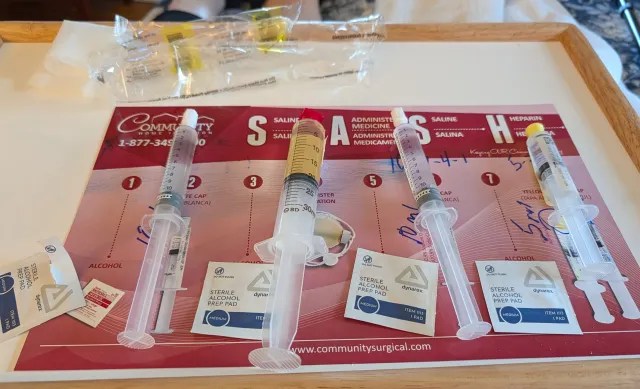
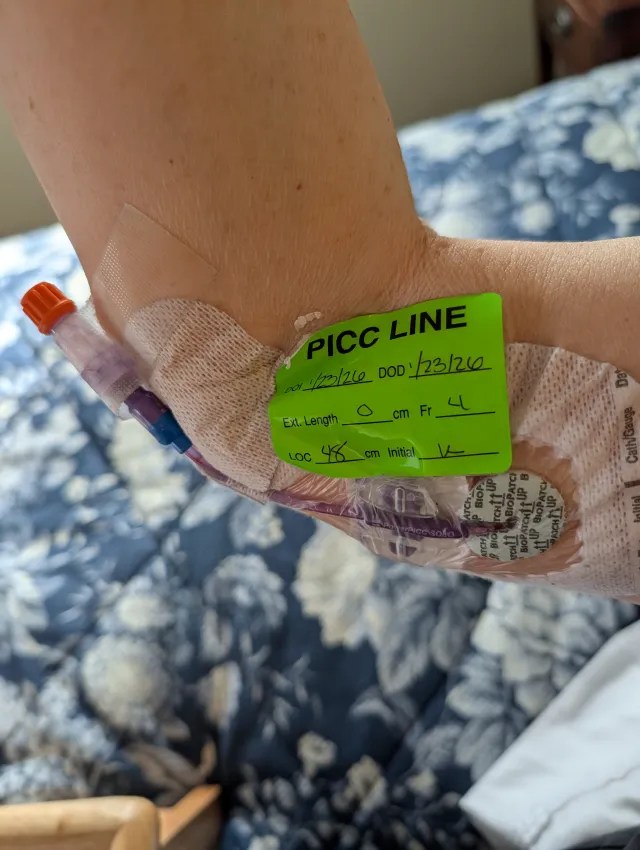
I’m trying to get back to work. The proofreading of my book is due now. I’m headquartered on a pile of pillows on the bed, forcing myself up with a cane, in a back brace. Every day, I now infuse IV antibiotics through a PICC-line, a 19-inch hose now installed from my right arm up to under my collar bone. I’ll do that for five weeks, with a kind nurse visiting to change the dressing and take blood draws once a week.
Before I left the hospital, a phlebotomist came to start another blood culture, pouring my precious humours into two little bottles that, to me, looked like hot sauce. He said most folks think they look like tiny booze bottles. Right. On second thought, this was a personal bloody Mary: Bloody Jeff.
Moments ago, my wife looked up the latest lab results and the great news is that now germs are *not* growing in my blood cocktail. Science and medicine are working.
I’m so grateful to the doctors, nurses, and staff at Morristown. To hell with you and the ignorance you stand for, RFK Jr.
And I could not be more grateful to my wife, who already does everything and now is caring for my every pathetic need, with our daughter’s help. (Our son is way up in New Hampshire.)
All this has meant canceling my scheduled cataract surgeries. Next I’ll have cardiac ablation to try to rid me of AFib. Age.
In this terrible time, what disappoints and angers me so about my own field of journalism — to which I have devoted 50 years of my life — is its refusal to recognize fascism, to even use the word so as to explain it, and to judge Trump and the Trumpists for their crimes against decency, democracy, and humanity.
But I realize that by focusing on the failures of journalistic rhetoric I, too, miss the point of the bayonet held against our throats. I complain often about the #BrokenTimes and the very #BrokenPost — about their prevaricating headlines (“magnified questions”) and perverse euphemisms (“exerts control”) and their framing of extremism as one side of bothsidesed “politicization” and polarization. To them, we are perpetually “teetering” near an edge that is ever still ahead, out of sight.
This is so much worse than words. The nation has fallen over that edge. Our country is lost.
The other night, I listened to the latest episode of the Reading Hannah Arendt podcast in which Bard College’s Roger Berkowitz explains War and Revolution. In it, Arendt, as the great historian, philosopher, and educator of totalitarianism, explores violence and crime and “founding a new polity amidst the breakdown of traditions and authority.”
I finally came to the realization that the revolution we are enduring is over. Some ask whether we will enter civil war, but in truth, that war did not end. The South — now merely metaphorical, as its border extends into every state — rose again. It won.
I come to realize that the far-right’s fetishism over the Second Amendment was likely never about rising up in opposition to some feared socialist, gunnapping American regime. It was about recruiting and arming a disordered militia in support of the autocracy of the right — to fight not against government but as internal ally to the Project 2025 vision of the “unitary executive” (read: dictatorship), alongside the Army, National Guard, and ICE-Gestapo, who are given license to evade the rule of law (receipt: January 6) by the Justice Department and Supreme Court, now also under their control. Without the rule of law, the courts, and Congress, there is no check to their power. Then there is no Constitution. There is no democracy.
So we dissent. But where?
Not in media. That, too, is lost. I have lately been shouting fire! about Ellison père et fils, Larry and David, the miniMurdochs, taking control of Paramount and CBS and next Warner Bros. Discovery — and with it CNN. I appeared on CNN to raise that alarm.
Jarvis: I hate to say this to my friends here at CNN, mass media is dying, so they're taking the last of these vestiges of institutions that matter and they're trying to turn them into propaganda organs under threat from the head of the FCC
Liberal media? It is time to burn that trope. Yes, there are liberals left in media, but the conglomerating corporations that employ them are either owned by the extremists or running scared from them, acceding to Trump’s every vindictive demand, blackmail, and bribe. Stop calling it MSM (it never was “mainstream” anyway). It is all MAGAmedia now. There’s no comfort to be had in the fact that Trump’s allies are taking control of the empty husk of the former Fourth Estate, for mass media are dead and dying. Propaganda isn’t a business, it’s a weapon.
If not in media, then can we not dissent in social media as our modern, online alternative: the press of the people? No. Twitter is the house organ of the extremists. Zuckerberg and his Facebook, Instagram, and Threads have gone full Quisling. Our one haven for dissent might have been TikTok. But the Ellisons — and now their models, the Murdochs — alongside venomous VC Mark Andreessen are subsuming that, too.
Then perhaps we might find sanctuary in the academy. Cough. The most fundamental tenet and tactic of the fascist revolution has been to destroy education from bottom to top. Over the years, without notice, the right wing took over local school boards (just as they took over local TV and radio stations). Too many universities are proving to be ineffective and irresponsible stewards of enlightenment and academic freedom: surrender monkeys in the face of serious challenge.
God then? Ha! He is their coopted coconspirator in this unholy Crusade, wearing one red hat or another.
/media/bd9d6e0e879b5eaa066db5645eeae183
Cardinal Timothy Dolan on Fox & Friends on Charlie Kirk: "This guy is a modern day St Paul. He was a missionary, he's an evangelist, he's a hero. He's one I think that knows what Jesus meant when he said 'the truth will set you free.'"
Then to the ballot box! Well, sure, but as the extremists lie and cry that elections are rigged, they’re projecting while gerrymandering and ending voting rights and exploiting the advantages given their slave-holding forebears in the Senate and Electoral College.
In The Guardian, Timothy Garton Ash warned that Americans have but 400 days and counting (394 as I write this) to perhaps save a last shred of hope by winning back the House. But our putative Democratic leadership can’t summon the spine to endorse the most exciting leader we have seen in a generation in New York, too busy as they are crawling out from under the used campaign bus they keep driving over each other.
So then let us take to the streets! OK. But see where I began: They are in power. We are not. They are organized. We are not. They are masked. We are not. They are armed. We are not.
At the end of a despairing post such as this, you’d expect me to offer my solution, saving the nation if only we would…. But I cannot. This is my worse fear: I do not know where this ends. I look often to German history and to Arendt’s lessons from it. The nation that gave rise to the most odious regime in modern memory was able to rebuild only from the ashes of its complete destruction. What might it take to cauterize the wounds to our democracy?
People like me — old, white men, going back generations — did not exercise our privilege to win the fight for all of us. Justice teetered and we sat silent, complacent for too long. Now we are silenced.
Oh, I will still speak up. I will dissent here. I will vote. I will march. But to what end when so much is lost? Is there any way that we, the democratic majority, can claw our way back to save any vestige of democracy? I do not know.
I have vented my fears, frustrations, and fatalism these last days on podcasts, which is what they apparently exist — here with friend Pete Dominick, here with Daniel Fürg, and below on American Friction. These conversations inspired this mood and post.
After writing this, I read a column by my former CUNY colleague, M. Gessen, about the recognition that one’s country is lost. They have experienced this loss twice.