It’s been a while, right! Having been swamped producing last year’s Royal Canadian Air Force: 100 Years of Service, I and Hugh Halliday, immediately had to swing into Vol.2 mode. It’s been a real grind, especially having to spend time selling Vol.1 in hope of financing Vol.2. So go the small, independent, Canadian aviation publisher’s so-called life and woes. Happily, Vol.1 has been famously received by the last of our loyal old readers (some date back to 1981), also by many new fans. We’ve received heaps of praise, this (below) being typical. With such support, we’re encouraged to keep going up this ever-steep hill known as “Book Publishing in Canada”:
Sorry that these comments took so long to get to you, Larry, but I’m just finishing the book and wanted to take my time to fully appreciate the work you and Hugh Halliday put into it. Hopefully my comments will include something that you have not already heard. I liked the way you humanize the airmen who were killed by stating their age, hometown and when and where they died. You also did the extra effort to include Canadians who served in RAF squadrons literally in all theatres. I also appreciated the aircraft tail numbers and the obvious related logbook details. You and Hugh Halliday must have been working with an uncountable number of individual details! I also liked the way you referenced other books for further details, not only your own. Then there are the asides, e.g. lack of moral fiber, aircraft production in Canada, women in the RCAF.
If you don’t yet have “100 Years of Service”, it’s easy to get your personal, autographed copy at $100 all-in for Canada and USA. If overseas, due to Mafia postal rates in effect, your price is CAD$145.00 all-in. Buyers can use PayPal or Interac tolarry@canavbooks.com Otherwise, cheque or money order to CANAV Books, 51 Balsam Ave., Toronto, ON M4E3B6
“Aviation in Canada” Series For this offer only, our revered series is on at 50% off the sticker prices. Contact Larry at larry@canavbooks.com for your total for what titles you might like + shipping/tax. These are beautiful aviation history books for the serious reader.Note to our really readers. Colin McKeeman’s spectacular history of the Piasecki H-21 series now is in print. A mammoth history ever so meticulously done over years of research. Not to be missed. Contact Colin to order your copy downrange@eircom.net
Canadian Aviation Historical Society Ancient History
The recently formed (1963) Canadian Aviation Historical Society held its June 1966 convention in Ottawa. Some sharp member organized this “class photo” at Rockcliffe of those attending (bet it was Ken Molson). I missed this convention, probably being stuck in those days taking summer courses in Toronto. I see such early members in the front row as Hugh Halliday (far left), Boris Zissoff (3rd from left), Al Martin (5th ), Clint Toms (7th ). Under the Lysander’s prop are Terry Judge and Bill Wheeler. Few remain with us today. If you can confirm any other names, please drop me a note larry@canavbooks.com You still can join the CAHS and so you absolutely should. Go to cahs.ca for the details. This is one small decision you’ll never regret.
Chatham Fly-in 2025 … Summer Wanderings
Earlier, you read on our blog about last year’s visits to the Tillsonburg and Guelph fly-ins. This season, I had little time for outings, but could not resist the “Legends of Flight” warbirds open house at Chatham-Kent airport. I also made it back to Guelph. Please enjoy these few photos.
A spectacular open house was held at Chatham-Kent Airport, Ontario, on June 21, 2025. This was hosted by the Timmermans family who were keen to show their magnificent new collection of WW2 warbirds. Ken Swartz, Gary Vincent and I drove down the evening before to take it all in. En route we stopped by Woodstock airport, had a fantastic tour of the International Test Pilots School at London, then visited St. Thomas airport, where we saw a Dash 8 graveyard and renovation operation. Early next morning we were on the ramp at Chatham under a gloomy sky, but hopeful for better weather. What we saw all around us was spectacular, including Spitfire XVIII TP280 (only 300 of this mark were built). Delivered to the RAF around war’s end, in 1947, TP280 went to the Indian Air Force. Thirty years later, Ormond and Wensley Hayden Bailey (Ormand flew Starfighters in the CAF) recovered its hulk. Shipped to the USA for the great Rudy Frasca in Illinois, it was restored to airworthy condition at Rudy’s and in the UK. As N280TP, it flew at Rudy’s for years. It recently had been added otto the Timmermans collection. The Mk.XVIII has a 2050- hp Rolls-Royce Griffon engine.Mustang “Double Trouble Two” joined the USAF in 1944 44-63507, but in 1947 flew north for the RCAF. In one case, it flew with Vancouver’s 442 Squadron. Struck off RCAF charge in 1960, it had a long career in the USA including air racing at Reno. It became a 2-seater in the early 1990s. Many adventures followed including a sojourn in Switzerland. Check the web where there is much history for this famous warbird. In 2925, “Double Trouble Two” is registered C-FPWT.Goodyear-built Corsair NX194G’s first tour began in May 1945 at NAS San Diego from where it flew aboard ship in the South Pacific. In 1946, it moved to NAS Seattle, then had later tours from NAS Jacksonville to NAS Grosse Ile finishing at NAS Seattle in May 1954. By then with 1491.7 flying hours, it became a ground training aid until struck off in September 1954. It moved into the civil world in 1960 as N6604C, then became N194G. It raced at Reno in 1967, 1970 and 1972 where (1972) it reached its best speed at 367.5 mph. In the 2020s it was restored to original US Navy configuration.NX8280K was the first Mitsubishi A6M Zero warbird I’d ever seen. Built in 1941, it came to the USA in 1999, then became a highlight at US airshows.This ex-Royal Navy Hawker Sea Fury at Chatham as C-FPSF. In 1958, it was gone to the Iraqi military. In 1979 it arrived in Florida, was restored and became a popular sight as N56SF. Various owners ensued. In 2001, it crashed at Sarnia, Ontario, was rebuilt and in 2010 was exported to France. As F-AZXJ, it received its present paint job. It was acquired by Legends of Flight in 2022.Built by Fleet Aircraft Co. of Fort Erie, Cornell C- FNOR was a fine sight in its wartime Royal Norwegian Air Force colours. The RNoAF operated in exile during the war at Toronto Island Airport and Gravenhurst, Ontario.Stearman C-FAPG flew in wearing US Navy colours.Other wartime trainers attended the Chatham display including C-FNAH/ex-RCAF 2918 Harvard II in postwar 411 Squadron (Downsview) markings.These matching Aeronca L-16s flew in from a nearby farm. This useful wartime type did important liaison work in WW2 and Korea.Ex-RCAF Beech Expeditor C-FTLU also flew in.Two local 1946 beauties: Fleet Canuck CF- DYP in Regina Flying Club colours and Globe Swift CF-IQW. No really serious aviation hound could possibly resist shooting these, even if it really takes an F-35 or B-52 to get him fully “cranked up” (I know, it’s pitiful).CANAV’s tables at the show. Sold a few books to cover the gas … actual smart people still love their actual books!Chris Timmermans greets the RCMP.Ken Swartz interviews Tom Walsh about his great aviation career with everything from running major airshows to writing recent histories of Americans in the RCAF during WW2 … President Whozit, of course, wouldn’t have a clue).Lots else to see and do at this ace of an aviation event. Many thanks to the Legends of Flight!
CAE Update
CAE book cover.
Since we published the history of CAE (Aviation in Canada: The CAE Story) in 2013, the company has steadily grown and still leads the world in its product lines. In one case, in July 2025, Porter Airlines Embraer E195-E2 pilots began using CAE’s new Montreal- based Embraer CAE Training Services full-flight simulator. In October, CAE commissioned an Airbus A350 flight sim operation at Amsterdam Schiphol Airport mainly to serve KLM which has at least 50 A350s on order. KLM begins A350 service next year. Besides such progress, many vintage CAE full-flight simulators remain in service. You can search on the blog for the story of Canada’s first Boeing 737 “sim”. Built in 1976, today it’s with Nolinor of St, Hubert awaiting restoration at age 49! See the full story here. Just search for “Ancient CAE 737-200”. For all the current CAE details, see cae.com
One of KLM’s new CAE A350 full-flight simulators. (CAE Photo)Highly detailed visuals typify CAE’s flight sims in the 2020s. (CAE Photo)Many CAE flight simulator designs have had very long, useful lives. CAE’s involvement with the Lockheed C-5 Galaxy dates to 1983 when it won a contract to build six full-flight simulators and four cockpit procedures trainers. Worth $56 million, this was the company’s biggest ever sale. That’s the way Canada- USA cross-border business is supposed to work. Over the decades, this equipment received several upgrades, so these sims are up to the latest standards for today’s fully modernized C-5M Galaxys (as shown). Then, one of the C-5A FFS in about 1991 (Paul Bigelow, Ed Birmingham) CANAV blog readers can order their beautiful, autographed copies of Aviation in Canada: The CAE Story (regular price CAD$65.00++) for CAD$55.00 all-in for Canada and USA, CAD$130.00 all-in for international orders.
Guelph Revisited
Being familiar with the annual Guelph fly-in from our 2024 item (scroll back for a look), you’re sure to enjoy this colourful bit covering Guelph’s September 20, 2025 event.
No afterburners and not too much noise and smoke at Guelph this year. Here are a couple of old friends that I photographed more than 60 years ago at Oshawa – Bob Chisholm’s Corben Baby Ace CF-RAC and Walter Huron’s Tiger Moth CF-CTN.Always a treat to see is one of Fleet of Fort Erie’s 1946 Fleet 80 Canucks. The 65th Canuck, CF-DQM has had many owners over the generations and today is beautifully restored.A Guelph perennial for ages has been Thruxton Jackaroo C-FPHZ, a modded 4-seat Tiger Moth. Only 19 were made in the UK in 1957-59, but some later were re-converted to Tiger Moths. Few other than “PHZ” remain in the skies.General scene on a cool, pleasant Guelph Airport day.“Hurricane” C-GWPN was the closest thing to a “fighter” at Guelph. Built in 1982 by Harry Lasachuk, this 5/8 th scale homebuilt had an inauspicious first flight on September 19, 1982. Harry had his pal, Toronto’s renowned DHC pilot, George Neal, do the honours. Goerge had made many such flights since the late 1930s, but this one finished badly. Flying from Toronto Island Airport, he ended by making an unexpected splashdown in Toronto bay with engine failure due to fuel exhaustion.C-GSLE — a very fine-looking Skybolt homebuilt photographed by Ken Swartz.Thorpe T-18 Tiger C-GABY flew in from Goderich. It was started in 1980 by G. Begin of Lac Etchemin, Quebec, but he died before he could finish his project. Eventually, it was taken over and finished by another pilot. Here, it looks as if it was straight out of the shop! Specs on “ABY” include empty weight 934 lb, max weight 1504, engine 150-hp Lycoming.Very flashy homebuilts: Whitman Tailwind W-10 C- FRIS, then, Van’s RV-4 C-GOMB both in from Brantford. Finally, the Thorpe.First of this type that I’ve ever seen. It’s a designed-in-India Raj Hamsa microlight based in Tillsonburg.Another microlight … Guelph-based Challenger II C- IKAM.Cam Harrod’s famous Guelph-based Fleet 16R Finch ex-RCAF 4494. Having been taken on strength in June 1940, it was struck off in October 1943, by which time Tiger Moths and Cornells were doing most of the elementary training in the BCATP. In 1944, it was exported to Mexico, later was in the southern US, then returned to Canada in 1991. 2001 to ’04 it again was in the US, then was brought home by Cam to fly on as C-FDAF.
A Few Special Items on Sale
If you are interested in any of these, please email larry@canavbooks.com to make arrangements. Any of these will make a wonderful gift for any of your special aviation pals, etc. Payment in Canadian dollars by PayPal or Interac.
Der rote Kampfflieger Manfred Frh. Von Richthofen Original 1917 ed’n. Small pocketbook, original ed’n 188 pages. German language. Very nice copy for its 100+ years. The great Baron von Richtofen’s own story from 1917. CAD$400 all-in anywhere (on the web at least $100 more)Experimental Light Aircraft and Midget Racers Seminal history of this category, covers 300+ types. 8×11 softcover by Underwood and Caler. Aero Publishers series Nice copy $25.00 all-in Canada/USA (overseas $50.00 all-in)Insignia and Lineages of the Canadian Forces Volume 2, Part 1 Extant Commissioned Ships Canada National Defence 2001 publ’n. Each ship’s insignia in colour, then the relevant details. 124 pages, softcover 8 x 10 format. Very nice copy. $32.00 all-in Canada/USA (overseas $50.00 all-in)German Military Award Documents 1939-1945 by Emile C. Stewart (1991) One of 1500 copies. As it says. 320 pages, softcover, 9×12 format. Very nice copy $125.00 all-in Canada/USA (overseas $160.00 all-in)Fleet Air Arm: The Admiralty Account of Naval Air Operations HM Stationary Office Nice old copy. As it says. All the aircraft types, the blokes, the battles to that point in WWII. Some wear but any collector will revel in this one. $15.00 all-in Canada/USA (overseas $25.00 all-in)Flight Comment 50 different copies 1970s to 1990s of this revered CanForces flight safety journal. Most issues examine at least one RCAF/CAF aircraft accident along with flight safety tips, letters, photos, etc. Typically 30 to 40 pages. Serious collectibles by the 2020s, rare source of little-known RCAF/CAF history. All in good condition. Collection only, hefty, 16- kg collection $130.00 all-in Canada/USA (overseas $300.00 all-in)Canadian Aviation Magazine June 1958 incl. one of the early Avro Arrow feature updates. Arrow RL-201 on the cover. Collector item, nice copy $25.00 all-in Canada/USA (overseas $40.00)The Record of No.7 A.O.S. R.C.A.F. Portage la Prairie, Man. 1941-45 Absolutely beautiful original copy covering 7 Air Observer School and all its great work in the BCATP through WWII. Lovely copy, you’d never know it was 80+ years old. Packed with photos and detailed info. 8×11 format, 80pages. RCAF collector item. $100.00 all-in Canada/USA (overseas $120.00)[ ] Canadian Aviation magazine: August Lovely original copy, 26 pages full of Canadian and overseas news. Gorgeous fine collector item. $50.00 all in Canada/USA (overseas $65.00)[ ] Canada’s First International Antique Airplane Fly-IN, Mountain View Airport, Ontario, June 25, 26, 27 1971 As it says. Rare item 42 pages 8×11 with photos. $20.00 all-in Canada/USA (overseas $35.00
More Old Adverts …Since You’ve Loved Our Earlier Coverage of This Topic
If you search on our blog or just scroll back, you’ll see earlier blog items featuring glorious, old aviation adverts. Here are a few more from the 1950s that you’ll love.
The CANAV Books Art Collection
The CANAV Books Art Collection now is being sold one beautiful original painting at a time. I had hoped to keep these 60 or so originals together, but no aviation museum or archive had the least interest as soon as they heard that the collection was not free, not a giveaway. These are the paintings commissioned 30-40 years ago for our earlier books. Those books elevated Canadian aviation book publishing with their pages and fold-outs of original art, gave a boost to several struggling aviation artists, and encouraged one or two other book publishers to commission a few pieces. Most of the CANAV paintings are in acrylic and water colours, are in the 24×36 inch size range on art board, and are priced at CAD$3500. A few that are cover art (dust jackets) are more. Any serious aviation fan would love one of these, but I already can hear the pitiful cries of poverty, etc. Well, in case you win the Lotto, keep one of these gems in mind. Meanwhile, see what an original Keith Ferris, Robert Taylor or Frank Wooten will cost you. How about starting around US$25,000? As lovely pieces, I argue, these CANAV paintings are as pleasing and impressive but at a pittance, by comparison. But I’ll never convince a retired airline captain of that. Those fellows come into my house, drool over the paintings, then ask, “Fantastic, Larry. Would you take 50 bucks?” It’s a laugh a minute!
These four are on offer here — all were painted by the late Robert Finlayson of Hamilton. Having been a professional photographer, Bob also had painted from his boyhood. He proved ideal for CANAV, being (first of all) such a decent, friendly, honest fellow. Then … he was fanatical about his research 1) into whichever airplane 2) into whichever geographic settling, time of year, etc. and 3) into his colours, shades, and foreground and background. Robert painted his RCAF Goose in a West Coast setting. It’s in the markings of 13 (OT) Squadron from RCAF Station Patricia Bay 1940-42. Sadly, “917” was lost in the Alaskan mountains in July 1942. Robert’s stunning painting of Spartan Air Services P-38 CF- HDI is set over Whitehorse, from where it operated during at least one contract in the early 1950s. “HDI” came to a sad ending when it crashed near Uplands/Ottawa on May 2, 1955. This wonderful piece always was one of my personal favourites of the 25 originals in our 1997 book Air Transport in Canada. Next is Bob’s quite romantic painting of glorious TCA Lockheed Super Constellation CF-TEU over Scottish lake country coming or going at Prestwick in the late 1950s. Another of my favourites. Finally, one of the paintings most commented about – Robert’s great Northern scene featuring one of the great Don McVicar’s World Wide Airways C-46s CF-IQQ in a lively scene that includes such usual details (in that era in the Quebec northland) as a common stake truck, a Bombardier snow machine, even an RCAF Expeditor. One could just see this all at such a strip as Menihek or Schefferville. CF-IQQ had served earlier in China, was under the WWA umbrella 1956-62, then roamed around in Latin America. As HK-1856 in Colombia, on January 30, 1994, it crashed on landing (without injuries) at Puerto Inirira. Few C-46s had made it that far still being airworthy. Do get in touch if you are keen about purchasing one of these larry@canavbooks.com (PS …don’t bother if all you want to do is complain about the rivet count or such. These art works of art, not photographs … something that not everyone gets, sad to say.)
Royal Canadian Air Force” 100 Years of Service, Vol.2
As you know, CANAV Books has been the RCAF’s best friend since we began in 1981. The air force always showed its gratitude, even if it hardly ever bought a single book. Regardless, our RCAF books by now are in innumerable homes, libraries, archives, etc. across Canada and around the world, so the RCAF’s great heritage has been spread far and wide. Every book from The AvroCF-100 to Sixty Years to Canada’s Air Forces on Exchange has been gloriously reviewed. Each reflects positively and authoritatively on the RCAF, as intended. All along, this has been done (except in one case) at CANAV’s sole expense, so it’s been a very rough go some years.
It’s been an a great help to have been supported by the air force as far as base visits and travel have gone over the decades. Sadly, it’s not so wonderful these days. In recent times, bureaucrats at DND and a few in the RCAF have established new little empires in Ottawa to make publishing RCAF history more of an ordeal than a joy and a worthy mission in life. Suddenly it’s no longer fun to produce beautiful books for the chief purpose of honouring the RCAF – there’s never been any other CANAV Books agenda even if painful financial losses have resulted. These new-type bureaucrats go to work to see how they can (for example) control what Canadian authors can or cannot publish.
We’ve always assumed that free speech reigns in Canada and that the history of our great nation belonged first and foremost to the citizen/taxpayers. “We the people” own Canada’s history, so what is DND thinking by now having price tags on RCAF history, in this or that circumstance? Yes, DND has RCAF history actually for sale to Canadians under the guise of “royalties”! This is pure mickey mouse if anything ever was. And we used to think that DND was there to defend us from things like Communism or Bear bombers and attack submarines. Well, things change, je suppose. According to Ottawa with its draconian copyright and privacy empires, any manuscript covering RCAF history now must first be “approved” by government flunkies, few if even one of whom has ever read a single book about RCAF history. Seems that our home and native land is not all that free after all in the 2020s. One wonders … are these new DND/RCAF paper-pushing overlords taking North Korea as a their “free speech” role model? Regardless, you can expect RCAF 100th Vol.2 “some time” in 2026. It’ll be the standard CANAV Books sort of production. It will be beautiful, authoritative and do nothing but honour the RCAF and all who ever served. Let’s see what the flunkies decide to do about it.
Many of you are familiar with our 1982 The Canadair North Star and 1986 The Canadair Sabre. You can search here on the blog to see earlier items/reviews about them. Today, we’re giving you a heads-up — both are on final sale at AvWorld in Toronto each at CDN$9.95++. AvWorld will deliver in spite of the Canada Post strike! You’ll never get a better deal on a lovely new copy of one, the other or both. FYI, here’s a typical review from back in the day — The Canadair Sabre gloriously reviewed by the revered and authoritative Aviation News.
For your copies and ordering details contact andy@avworld.ca
Cheers … Larry Milberry (author)
Esprit de Corps’ Scott Taylor … Thoughts about Canada and the US
Last week I attended the 93rd annual Conference of Defence Associations (CDA) at the landmark Chateau Laurier Hotel in Ottawa. Having personally attended three dozen of these events, they are predictably a well-worn routine of senior military brass, politicians and military academics convincing each other of the importance of national defence in Canada.
Those allied military delegations that attend are like-minded and the agreed upon mutual threats are Russia, China and Islamic extremists in a rotating order. There is always a presentation from a senior ranking US general, following which their Canadian counter-parts heap praise upon our “closest ally”.
During his first term US President Donald Trump verbally denounced NATO member states that failed to spend two per cent of their Gross Domestic Product on defence. Trump repeatedly singled out Canada as being a ‘laggard’ in this regard and he controversially stated that he would not bring America’s military might to defend a NATO member that was not spending their fair share.
As offensive as those remarks may seem, the average attendee at the CDA annual conferences welcomed Trump’s threats believing it would help to force Canadian politicians to spend more on the military. That was then.
Things have changed rapidly and dramatically since Trump won re-election last November. For starters, Trump began his drumbeat rhetoric about annexing Canada into becoming the 51st US State, and repeatedly referred to Prime Minster Justin Trudeau as the ‘governor’. Trump explained that unlike the Panama Canal, which he intends to seize through military force, he would bring about the annexation of Canada through ‘economic measures’.
In early February, just days after his inauguration, President Trump levied 25 per cent tariffs on all Canadian and Mexican imports. He promptly lifted them then re-imposed them in early March, only to suspend them again until April 2. While it is off to a topsy-turvy start, the trade war has begun. Then on Friday, Feb. 28, Trump hosted Ukraine’s President Volodymyr Zelenskyy at the White House. It was supposed to be a pre-arranged deal to exchange US access to Ukraine’s rare earth minerals, for a US security guarantee to protect Ukraine. However the photo-op devolved into a public berating of Zelenskyy and his abrupt expulsion from the Oval Office.
Trump subsequently cancelled all US military aid to Ukraine, stopped the provision of military intelligence to Ukraine and called upon the UK to do the same. On Sunday, March 2, Trudeau joined European leaders and Zelenskyy at a hastily convened meeting in the UK to try and find a way to keep Ukraine in the fight against Russia, without the aid of the US. It was against this backdrop of uncertain allegiance among the key NATO allies that the stage was set for some emotional fireworks at this year’s CDA conference. None were forthcoming. In a room packed with self-professed warriors, the collective agreement was seemingly to avoid mentioning the elephant in the room.
Even when US General Gregory Guillot, the Commander of NORAD and North Command took to the CDA stage, the gloves remained in place. General Guillot is the very individual who would lead any armed annexation of Canada, and he was politely spared any question which might prove mildly discomforting. No mention was made of the logistics of such an annexation and the subsequent absorption of our military forces into the US defence apparatus. Instead the conference’s threat focus remained that of Russia and China operating in the Arctic.
Even as the CDA conference was still in session, Trump once again publicly cast doubt on his willingness to defend Washington’s NATO allies, saying that he would not do so if they are not paying enough for their own defence. “It’s common sense, right,” Trump told reporters in the Oval Office. “If they don’t pay, I’m not going to defend them. No, I’m not going to defend them.” This time however, Trump also cast baseless aspersions on NATO’s reliability as an alliance.
“You know the biggest problem I have with NATO? I really, I mean, I know the guys very well. They’re friends of mine. But if the United States was in trouble, and we called them, we said, ‘We got a problem, France. We got a problem, couple of others I won’t mention. Do you think they’re going to come and protect us?’ They’re supposed to. I’m not so sure.”
For the record, this is not a hypothetical question. The USA was attacked on 9-11, 2001 and NATO did collectively come to the defence of our American ally. Canada may not spend two per cent of GDP on defence but for more than a decade, we punched above our weight in the war in Afghanistan, which was a direct response to the 9-11 terror attack.
For Trump to question Canada’s resolve, or any other NATO member’s resolve is an insult to the sacrifices which were made supporting the US. To threaten to annex us out of existence as a country is unconscionable.
SOS … UKRAINE, well worth a look!
Best commentary I’ve heard lately about Ukraine, but who would know better about Russia than the PM of Finland, right!
Google this (March 4, 2024)
Preview YouTube video Finland President Alexander Stubb on Ukraine, Donald Trump, European Security, Peace Deal
It’s sure been a while since we last were in touch, but I’ve finally had time to collect some decent blog reading and photos to keep you going for a bit. Since most of you are good, serious “book people”, I’ll begin by tempting you with three special books, starting with CANAV’s own incomparable RCAF centennial tribute, The Royal Canadian Air Force: 100 Years of Service. Any fan of the RCAF’s great heritage will love this one. It’s the successor to our 1984 60th Anniversary blockbuster, Sixty Years: The RCAF and CF Air Command 1924-1984. Here’s the basic info and how to order.
Next for your edification is an irresistible offer from Dan Dempsey for the 2nd edition of his world-class history of Canada’s great flight demo teams over the decades: A Tradition of Excellence – Canada’s Airshow Team Heritage. In the world of aviation book publishing, there are few (if any) books comparable in beauty, thoroughness and shear size (768 pages, 1800 photos, etc.). Having flown the CF-104, been CO of the Snowbirds and piloted F-86 Sabre “Hawk One” through Canada’s Centennial Year of Flight (2009), Dan has a serious offer here for Tradition of Excellence: Sale price including shipping and tax anywhere in Canada? $132.00. To the USA, including shipping? $115.00 USD. E-payments to afteams@gmail.com Contact Dan there for any other info.Another spectacular book on sale is the massively detailed, astoundingly impressive The Bell 47 Helicopter Story: Birth of the Commercial and Military Helicopter Industry by Bob Petite and Jeff Evans. Another book to be ordered just for being so lovingly done. Bob tells me, “There will never be a book on the Bell 47 helicopter with as much detail, new data and never-before-seen photographs.” I believe it! Order your copy for $89.95 all-in using PayPal to Bob at bpetite@telusplanet.net or mail him a cheque made out to 1640313 Alberta Ltd. at 122 Maisonneuve Village, Leduc, AB T9E 6T1 You do not need to be a CF-104 or Bell 47 person to want these books, just a solid fan and supporter of Canada’s aviation heritage and those who are dedicated to doing such books. Ya, ya, we all know that there are those in aviation who would slash their wrists before spending a penny for an aviation book, and who wish we would all go away and die. Forget them … I’m talking to you genuine aviation people. So do yourself a favour. Order 1, 2 or all 3 of these beauties for your home library or for any one of a dozen good gift-giving reasons. ‘Tis the season coming up, right, so seriously … make an impression! PS … these three spectacular Canadian books weigh in together at 8.675 kg (19.125 lb). Big enough for you? They’ve been researched, written, published and paid for by individual little Canadians having a common mission – preserve Canada’s aviation heritage and do it in high style.
Canada’s Top Aviation Booklist
Lest you still be craving your aviation book fix, here’s CANAV’s updated list of misc. new and used titles. There’s nothing comparable in Canada, so dig in. Nice discount if ordering 12 or more items.
Ex-RCAF Vampire 17031 was donated to the Comox Valley Air Force Museum by former RCAF pilot, Bill Lamberton. This is the same little beauty that I got to shoot air-to-air photos of from the ramp of 442 Sqn Buffalo No.456 on April 18, 1991. Later, one of my shots got to be on a beautiful Canadian commemorative postage stamp. Now, the museum at Comox is fundraising to build a special housing for their Vampire. See if maybe you can spare a penny or two towards this important Canadian aviation history project. The poster gives you the info. Finally, here’s 17031 at Comox on that exciting day more than 30 years ago, then during our photo session. Cheers … Larry
Remembrance Day 2024
Remembrance Day 2024 included this typical scene: the crowd at Kew Gardens on Queen Street. E. in Toronto
Ottawa Citizen Honours the RCAF on Remembrance Day with this important Bomber Command episode “We Are The Dead: Flying Officer Arthur Reid Died on a Secret Mission to Occupied France”
Seven planes took off on a blustery night in 1944. Only five made it back. This is the story of one that didn’t. Authors of the article: Andrew Duffy & Blair Crawford. Ottawa Citizen Nov 11, 2024
F/O Arthur Edward Reid died Feb. 8, 1944. Photo by Veterans Affairs Canada/Postmedia
Late on the evening of Feb. 7, 1944, Flying Officer Arthur Reid was on board one of seven Halifax bombers that took to the sky above RAF Tempsford bound for occupied France on a secret mission. The seven airplanes were attached to the Royal Air Force’s 138 Squadron, a special duties squadron that flew clandestine missions over Nazi-occupied Europe. On this night, they were bound for southeast France, on a mission to drop supplies and an important agent to aid the French resistance.
The weather was grim: windy and cold with low cloud. Two of the seven Halifax bombers would be lost during the mission. Another three would be forced into emergency landings at other air bases in England. Reid’s plane crashed in the French Alps, not far from the town of Grenoble, near the Swiss border. Members of the French resistance heard the plane struggling to maintain altitude, then shortly afterward, “a dull thump.” There was a blizzard at the time, and the resistance fighters had to wait for it to subside before climbing to the crash site. They would eventually retrieve seven bodies, including that of the navigator, Flying Officer Reid. Reid, a grocery clerk from Windsor, Ont., was buried alongside his fellow crewmen in the small, mountain village of Autrans, France. He was 22.
A photo from 1946 of the downed Halifax bomber on which F/O Arthur E Reid died in February 1944. Photo by Archive Photo/Postmedia
In an interview Monday, Reid’s nephew, Bill Matalik, 60, of Windsor, said the story of his Uncle Art’s sacrifice has been kept alive in the family. He has passed on those memories to his children and grandchildren. “We would always talk of it every Remembrance Day,” Matalik said. “My children love history and I try to tell them the stories as I remember then so that they can carry them on.”
On Remembrance Day, Arthur Reid’s name was issued by @WeAretheDead, an account on the social media site X. Former Ottawa Citizen reporter Glen McGregor established the @WeAretheDead account 13 years ago to honour Canada’s war dead. It publishes one name at 11 minutes past each hour from the list of more than 119,000 Canadians who have lost their lives in uniform. Each year, the Citizen has taken the name randomly published at 11:11 a.m. on Remembrance Day and launched a one-day reporting effort — conducted with the help of readers and researchers online — to tell the story of that fallen soldier. This year, it was Reid.
F.O. Arthur E. Reid, front row second from left, and the rest of the crew of a Halifax bomber of RAF 138 Squadron, which went down on Feb. 8, 1944. Photo by Archive Photo/Postmedia
Arthur Edward Reid was born on July 17, 1921 in Debert, N.S. One of 11 siblings, Reid moved with his family to Windsor while still a boy. His father, Robert, worked as a plant supervisor in the city’s Chrysler car factory. Reid went to Roseland Public School and Windsor-Walkerville Technical School, where he studied commerce while competing in hockey, baseball, and track and field. He liked to play the guitar and to read. After graduating from high school in 1938, he worked as a clerk in a hardware and grocery store before the Second World War interrupted his life.
In August 1940, with Nazi Germany occupying most of continental Europe, Reid enlisted in the army. He spent a year training in the tank corps before having a change of heart and enlisting in the Royal Canadian Air Force. Like many young men, Reid yearned to be an RCAF pilot. His attestation papers describe him as standing five feet six inches tall with brown eyes, fair hair and bad teeth. The medical officer who examined him found Reid to be “mild and modest in manner,” of “average intelligence and stability,” and with few mechanical interests. He was deemed to be suited for an RCAF career as a wireless operator, air gunner or navigator. Reid was sent to No. 7 Air Observer School near Portage la Prairie, Man., where his chief instructor reported that he was pleasant, popular and commanded respect. “He has proved that he can keep his head and do good navigation in an emergency,” the instructor said. “He works very hard and does everything thoroughly.” He went through more training in Trenton, Toronto and Halifax before being sent overseas in February 1943. After more operational training in England, Reid was assigned to 138 Squadron in Britain’s Royal Air Force in mid-December 1943.
An RAF webpage describes the squadron’s secretive missions: “For more than three and a half years, the squadron ranged Europe from Norway in the north to Yugoslavia in the south and at times far into Poland. First with Whitleys and Lysanders, then with Halifaxes and later with Stirlings, it flew out from Newmarket, Stradishall and Tempsford with, agents, arms, explosives, radio sets and all the other equipment of the saboteur, parachuting them down at rendezvous points where reception committees of local underground members waited.”
The gravesite of Arthur Edward Reid, a flying officer who died in 1944. Photo by Archive Photo/Postmedia
As navigator, Reid was responsible for keeping his aircraft on course, reaching its target, and guiding it home. He had flown precious few operational missions when he was assigned to join the night flight to occupied France. The Handley Page Halifax bombers flown by 138 Squadron were specially modified for their clandestine missions. The engine exhaust was shrouded to hide their telltale flames from enemy fighters, while the gun turret in the plane’s belly was removed and folding doors installed over a “Joe hole” — the hatch from which agents could parachute. The nose gun was also removed, giving the bomb aimer a clearer view of the landing zone, often a field dimly lit by Resistance fighters waiting to receive the drop. It’s believed that Reid’s aircraft was delivering supplies to the resistance as well as dropping canisters of propaganda leaflets that fateful night of Feb. 7.
Another plane among the seven that lifted off from RAF Tempsford carried a British agent, Francis Cammaerts, of the famed Special Operations Executive. SOE agents were highly trained irregular soldiers, some of them commandos, some of them women, who worked with underground resistance units waging guerrilla warfare and sabotage attacks in enemy territory. In the words of British Prime Minister Winston Churchill, it was the SOE’s job “to set Europe ablaze.” SOE operatives wore civilian clothing and, if captured, were subject to torture and execution. Their average life expectancy was just six weeks, according to Britain’s National Army Museum.
On the night of Feb. 7-8, the Halifax carrying Cammaerts iced up as it flew over France, and lost an engine, but continued to the target. The plane made it to the drop site, delivered its human cargo, and crash landed. (The crew all survived and managed to avoid capture.) Reid’s plane may have been similarly victimized by the weather, or damaged by a German nightfighter, the scourge of all Allied bomber pilots. Reid was reported missing after his plane failed to return on Feb. 8, 1944, and “presumed dead” by December.
In June 1945, Reid’s parents received a letter from the RCAF’s casualty officer, confirming that he had died in the February 1944 crash. They later received a letter from the mayor of Autrans, Henri Barnier, who told them the crash happened on a cold night, during a “raging snowstorm.” A group of resistance fighters, hiding in a forest hut, saw the plane issue distress signals and then heard “the dull sound” of a crash, he said. When the storm finished, they searched the forest and found the plane crumpled among some fir trees. The bodies were removed in April, Barnier said, and buried in the Autrans Communal Cemetery. “In the grief of this cruel loss, be at least in peace, madame, as to the last sleep of your son and his young comrades,” he told Reid’s mother. In November 1946, RCAF Wing Commander W.A. Dicks sent Reid’s parents their son’s operational wings. “I realize there is little which may be said or done to lessen your sorrow,” he wrote, “but it is my hope that these wings, indicative of operations against the enemy, will be a treasured memento of a young life offered on the altar of freedom.”
Matalik said his mother, Jean, told him his grandmother could not handle news of her son’s death. “She got very ill and was bedridden for months,” he said. “And my mother, basically at 10 years old, was trying to run the household. She had to take care of the younger ones. It took my grandmother probably three or four months to get out of bed.” For years, Reid’s parents would remember their lost son on the anniversary of his death by publishing a memorial notice in the newspaper. On the first anniversary of his death, in 1945, they wrote: “We think of you often as we sit alone, hoping and praying that yet you will come home.”
N.B. F/O Reid’s 138 Sqn Halifax was LL114 with code letters NF-P. Also lost when LL114 crashed was RCAF F/Sgt James Alvin Taylor (age 19 from Hamilton, Ontario) and RAF members F/O G.D. Carroll (skipper), Sgt P.T. Thompson, Sgt R.D. Clement, Sgt G.S Woodrow, Sgt K.W. Radford. Lost on the same operation was 138 Sqn Halifax LW275/NF-O which included RCAF F/O R.L. Beattie. All of this crew safely evaded after parachuting due to icing and an engine fire.
Noorduyn Norseman Book Sale
Noorduyn Norseman Vols. 1 and 2. In case you do not have ourin-depth coverage of this great Canadian aviation story, here’s a chance to save a penny or two. Usually $115 + shipping and tax, until the end of 2024 you can order a set for $85.00 all-in (Canada only, international please enquire to larry@canavbooks.com) This magnificent duo totals 536 pages, large format, hardcover with more than 1000 photos. Rarely has there been such a wide-ranging bushplane history, let alone for this iconic all-Canadian plane. Another ace of a Christmas gift item for any aviation pal! Pay to larry@canavbooks.com
Alaska Aviation 10-minute Video:
Enjoy this excellent new 10-minute look at Alaska bush and mountain aviation. Spot for Norsemans as it goes along:
New video reveals the thrill of flying in Alaska
“The kind of flying we’re doing here isn’t something you learn in books. Each flight brings new challenges and it gets a little less scary every time, so it quickly becomes addictive to keep pushing that edge,” says Andrew Esola.
How Did Your Summer of ’24 Go?
Here at CANAV Books? Our summer of ‘24 was busy and mostly enjoyable. The main event was publishing The Royal Canadian Air Force: 100 Years of Service, one of Canada’s loveliest books this century – you name the subject. Having begun this project in 2018, things sailed along, then got to be touch-and-go towards the end. First, so much material was available to Hugh Halliday and me that (as tends to happen with CANAV projects) “100 Years” morphed in 2023 into two volumes. Then the cash ran out, so further mortgaging of “CANAV Books World HQ” was needed. Great fun, then came some time wasting, really stupid hassles with the Department of National Defence and RCAF (more to follow in the Preface of Vol.2). We were very lucky to keep things on track and get our best-in-class RCAF Centennial book into print. Gads … Ottawa people sure have weird and twisted views of the universe. Nothing is simple and beautiful for them, someone will always be there at the taxpayers’ expense to found a new and demented empire and turn your dream into a trainwreck. Meanwhile, I had some good fun on the side even though I didn’t have the time or energy to take in the Centennial airshows. On June 1, I attended the Canadian Harvard Aircraft Association open house at Tillsonburg. I’ve been taking in such events since my first Oshawa Flying Club breakfast fly-in. I still have my notes from that one of June 19, 1960 listing aircraft spotted and photographed. These ranged from tiny homebuilts Jodel D.9 CF- RAM and Corben Baby Ace CF-RAO to vintage Tiger Moths CF- DCG, ‘DFZ and ‘FEN to Chipmunk CF-FHI, Auster CF-KPM and resident Kenting Canso CF-DFB. I hitchhiked the 30 miles east to Oshawa that morning down old Hwy 2 from my home in east Toronto. At day’s end, I hitchhiked back in Cessna 175 CF-KRK. However, ‘KRK dropped me off at Malton Airport, this time 30 miles west of home, so I had to put my thumb back to work! No sweat … for keen school kids chasing airplanes 60+ years ago, it all was the best of fun! For 2024, the CHAA put on a super day, even if the morning weather discouraged the fly-in crowd. Here are a few photos:
Tillsonburg is all about the Harvard, so on many a fine day you’ll spot one in the circuit. For open house, many visitors happily pay for the back-seat to enjoy the thrill of flying in this famous RCAF trainer. Here are C-FWPK (postwar RCAF Harvard IV 20242) and C-FRWN (wartime RCAF Harvard II 3830). Then, ‘RWN gets airborne with a happy camper in the back seat. Both Harvards wear the RCAF Centennial logo on the tail.Ex-RCAF Tiger Moth 5884 (now C- FCTN) taxis in from Guelph, then gasses up. Having joined the RCAF in November 1941, it had served the RCAF at Hamilton Mount Hope and Toronto Malton elementary flying training schools. At war’s end, it was donated to the Royal Canadian Flying Clubs Association. In the 1950s, it was in the Montreal area, then Walter Huron of Whitby acquired it to do a meticulous restoration. Eventually, it joined Tom Dietrich and the famous Tiger Boys at Guelph. Here also is a b/w of ‘CTN that I shot with my trusty Minolta “2 1/4” Autocord on a fine summer’s day at Oshawa 63 years ago.Such local fly-ins always are wide-open events where aviators, local families and tail spotters/photogs all enjoy a day together. The atmosphere is relaxed, BBQs are smokin’, fun stuff is for sale or to trade for, etc. Something for everyone!Avid photogs Bill Sawchuk of New Hamburg and Gus Corujo of Toronto covered all the action. Such dedicated types have been recording Canadian civil and military aviation for eons. Then, goings on in the hangar with Jeanette at the CANAV Books display.Stearman PT-17 C-FBBS taxis in. Built in 1941, it began as US Army 41-38229. In British Commonwealth Air Training Plan times, the RAF briefly had operated Stearmans in western Canada.Beech 18 C-FTLU operates in the summer fly-in circuit. Otherwise, Tillsonburg this day was a feast of lovely, photographable planes from handsome Piper PA-22 Tripacer C-FKTF to Cub replica C-FJVH, Van’s RV-9A C -FGXA, Murphy Moose C-FXLR, Piper PA-28 Arrow C-GSIZ and Ikarus C42E. Keep Tillsonburg in mind for a spring outing in 2025!
Rail and Air Extravaganzas!
Two other top events for me this summer took place on September 20/21. First, I set off for Guelph Air Park and the Tiger Boys annual open house. Heading west down the mighty “401”, I took the Campbellville exit, then drove north for Guelph. After a few klicks, I noticed a sign for the Halton Co. Radial Railway, a major Ontario transportation museum that I hadn’t visited for ages. Nearing the entrance, there was extra traffic. Turning in, I found that this was the museum’s 70 th anniversary and big things were happening. I didn’t have much time, but this was something I couldn’t resist. I had a busy, well-spent hour taking it all in. Mostly, this was a grand “photo op” with so many vintage street rail units, including some that over the past 60+ years I had photographed in Toronto. Have a look:
Entrance scene including the museum centrepiece – the historic Grand Trunk Railway station from the nearby town of Rockwood. Waiting in front to make another passenger trip is Toronto Transit Commission 1922 “Small Witt” No.2894 (a simplified Peter Witt car). It’s still in the TTC paint job in which it retired in 1963. As kids, we often rode Peter Witts in the 50s-60s.TTC car No.327 about to make a run. Built in 1893, it served into 1915 when running boards were banned from TTC operations. For Toronto’s centennial in 1934, No.327 was restored and today is still kept “like new”.Part of the day’s celebrations included a wonderful band. Nearest beyond is the TTC’s S-37 — a 1920 snow sweeper that served into 1973. On our blog item “A Few More TTC Scenes” (check it out), you can see several photos that I took of vintage TTC work cars, including of S-41 — a twin to S- My caption reads: “TTC snow sweeper S-41 at the car barns at Queen and Roncesvalles on February 9, 1969. Twelve such cars were acquired in the 1940s. Note that these had a sweeper at each end. They also had double-ended controls. Any such car always caught the keen photographer’s eye, especially on such a bright winter’s day. What a sight so late in the game was such a ‘prehistoric beast’. The last I saw one of these at work was in the Sixties as it was sweeping the loop at Queen and Coxwell one night. Two such cars survive: S-36 in the Shore Line Trolley Museum in Connecticut, and S-37 in the Halton County Railway Museum in west of Toronto.”Another TTC work car at Halton is rail grinder W-28 built in 1917. Starting in the early 1960s, I took every chance to shoot these fantastic, still working relics. Here’s my October 1974 shot of W-28 westbound on Queen St. West at University Ave.The band again with TTC car 4178 as backdrop. One thing always leads to another if some nerd has been jotting down streetcar (or airplane) “tail numbers”. I wondered if I ever had photographed 4178. Guess what … yes! On December 11, 2018, I had caught it eastbound on Queen St. East just passing Waverley Road. Notice the powerfully (fanatically?) worded grand motif. Since when was the TTC so crazily political! Well, back then probably not at all. This likely was just a good chance to make some quick adverting revenue, but you won’t likely be seeing such a rolling TTC billboard again in Toronto. Anyway, here’s ol’ 4178 in two colourful sets of clothes! Great that 4178 somehow evaded the scrapyard.Befittingly, the museum has its TTC “PCC” cars (Presidents Conference Committee). No.4000 was the first PCC anywhere in Canada when the TTC acquired it in 1938. At one point, the TTC had 745 PCCs. I remember shooting some that recently had been retired and were being loaded aboard ship in Toronto Harbor bound for service in Alexandria, Egypt. Also at Halton is PCC 4600 (when rebuilt in 1986, it changed from 4505 to 4600). The last TTC PCCs left service in December 1995. Finally … a Halton PCC that’s not exactly a priority restoration project!There also are several ex-TTC CLRV cars at the museum. No.4039 was built in 1979 by Hawker Siddeley in Thunder Bay, then joined the museum on retiring in 2019. Next chance you get, be sure to visit this important museum. Look it up on the web for directions, etc.Beautifully restored L&PS car No.8 comes back in after a passenger run. Built in Ohio in 1915, it was rebuilt by CCF in Montreal in 1926 after a fire, served London into 1957, was a work car into 1963, then joined the museum in 1971. The museum guidebook points out that few such cars survive. How so? They were so solidly built that they proved “worth their weight in gold” as scrap metal.
Tiger Boys 2024 Annual Open House
Next stop on the 20 th was Guelph Air Park. Since settling in there decades ago, the Tiger Boys (led by Tom Dietrich, who had owned a hobby shop for decades in Guelph) revelled in acquiring vintage airplanes, no matter their condition. Most gradually were restored to flying condition. Over time, the club house itself became a fascinating sort of museum filled with stripped-down airplanes, models, photographs, books and magazines, airplane parts galore, etc. Here’s a sampling of photos that tell a bit of the story at Guelph on September 20/21, 2024:
Cam Harrod taxis his lovingly restored and flown ex-RCAF Fleet Finch trainer. Then, Tiger Moth CF-CTN yet again. Long since part of the Tiger Boys collection, it’s flown here by Tim Eckenviller. Guelph’s runway was busy all day with endless such action.Another of Guelph’s beloved residents is Thruxton Jackaroo C-FPHZ, which came to Canada in 1971. First flown in the UK in 1957, the Jackaroo is a 4-seat version of the Tiger Moth. Only 19 were built, so ‘PHZ is a rare one.Yet another showcase of a Guelph “oldie” is Bruce Paylor’s Bucker Jungmann C-FEBU in flashy Spanish air force colours. Then … some Cornells: C-FCVT (ex-RCAF FV720) is in ersatz RCAF/BCATP wartime markings. My old notes show that I first spotted ‘CVT at Toronto Island on September 26, Then I saw it at the island on August 17, 1960 in this spiffy scheme, but didn’t make note of which colours. In the second b/w shot, ‘CVT was at the Oshawa Flying Club breakfast fly-in on June 17, 1963 wearing new yellow paint with shark teeth!Several Pietenpol homebuilts call Guelph home and others often visit. Here C-FPET draws a crowd on the flightline this September 20. Recently, Guelph added Canada’s most historic “Piet” in the form of CF-BAA, built in 1937 by teenage Bob Wong with his brother Tom and most of the others in the big Wong family chipping in at their downtown Vancouver home. When Bob and Tom joined the RCAF early in the war, Bob sold ‘BAA and it disappeared east of the Rockies. With the brothers recently nominated for membership in Canada’s Aviation Hall of Fame (inducted this year) there was interest in finding ‘BAA. Fat chance anyone would say, since most such planes had disappeared generations ago. Even so, after a 2-year search, ‘BAA recently was found by Hamilton’s Don McVicar. Having slowly been rotting away in a container in Saskatoon, it’s now with Cam Harrod for restoration. Here it is in Cam’s hangar. Bob’s daughter Evelyn recently published the history of all this wonderful Canadian aviation book. See WIKI for a good history of the Pietenpol.Of huge interest to me this weekend were some other old Canadian homebuilts. I was excited to see Jodel D.9 C-IRAM, the same little beauty I photographed at Oshawa 60+ years ago, when it was CF-RAM. Here, ‘it scorches by the crowd powered by its 40-hp VW car engine with owner Paul Dyson at the controls. Here also is my shot of ‘RAM from way back — 1960. Benny Keillor of Hamilton had built it in the late 1950s, making it one of Canada’s first post-WWII homebuilts. The Department of Transport gave homebuilders back then a block of “R” registrations, “R” for “Restricted”, which these little buggies were, due to their experimental nature. Next, I with ’RAM in a shot taken by Jeanette. There are endless stories about this Jodel, one being: circa 2008 Air Canada wanted to register one of its new Boeing 777s in honour of company CEO Robert A. Milton. But … C- FRAM already was flying on the tail of a certain wee Jodel. However, Canadian plane owners are allowed to sell their registrations, so the then owner of ‘RAM allegedly fared nicely on selling “RAM” to Air Canada for its 777-333 serial number 35250. Consequently, the Jodel was re-registered C-IRAM. From Wikimedia Commons, here’s a dramatic scene by ZoonViewer showing Air Canada’s C-FRAM leaping into the air at Toronto “YYZ” (see File:Air Canada Boeing 777-300ER C-FRAM.jpg).Another little cutie at Guelph was the Tiger Boys’ Corben Baby Ace CF-RAC “Bits ‘n Pieces”. Built in the late 1950s at Goderich by Gus Chisholm and pals (including homebuilding pioneer Keith “Hoppy” Hopkinson) ‘RAC also flies on after all its decades. Here it taxies in with owner Paul Dyson. Then, ‘RAC as I shot it at Oshawa in the summer of 1960.On November 25, 2007, I was at Guelph to meet Gus Chisholm and shoot some winter photos of ‘RAC. Here’s Gus with his famous piece of handiwork; then in the hangar with Tom Dietrich and (seated) Len Ariss, founder of Guelph Air Park in the 1950s. Finally, ‘RAC getting airborne that day.Kaz Nawrot built Corben Baby Ace “C” CF-RCP about 1960. Typically, it passed through a list of owners including Robert Grose of Lakefield, Ontario, who flew it for years. In 2000, Dave Robinson of St. Marys, Ontario, acquired ‘RCP, which by then had flown about 600 hours with its 65-hp Continental. Eventually, ‘RCP needed new wings, so Dave ordered a set of Corben “D” plans (assumedly, he finished the wings). Here’s an ancient photo of ‘RCP at Oshawa c.1960, then at Guelph flown by owner Steve Robson.Another ancient plane at Guelph was Taylor E-2 Cub CF-ANT. According to the Canadian Aviation Historical Society civil aircraft register, ‘ANT came to Canada from the US in 1935, then was around London, Kitchener, Guelph and Toronto ‘til early after WWII. Then Andy McKimmon of Guelph got it flying in 1946 as CF-ANT-X (he changed the engine from a Lycoming to a Continental, so ‘ANT became “Experimental” according to DOT regulations). I remember Jack McNulty telling me back in the 60s that with its “X” category, in a way, ‘ANT could be called Canada’s first post-WWII “homebuilt”. When ANT went into storage for a long time, its registration went to St. Catharines furnace manufacturer Anthes-Imperial’s Beech Super 18. Now it’s back where it started. Finally, a dusty old photo of ‘ANT from the 1930s.WACO UPF-7 CF-CGC spent the weekend hopping passengers at Guelph. Good flights (for 2) were a bargain at $220! Passengers sit in CGC’s front cockpit, the pilot behind. Here pilot Gary Schroeder leans out the make sure he’s still on the taxiway heading for the runway! The UPF-7 is a rarity in Canada. I only saw two over the decades until ‘CWC appeared. The first I photographed was CF-JAU towing gliders at Brantford. Here’s my shot of it there on July 16, 1960. Plowing through my notebooks from those years, I find that I saw it again on July 23, 1961 at Hamilton Mount Hope, but it was in pieces following a crash at Brantford. What became of ‘JAU? Scrapped? Anyone know?
Canada’s Aviation Hall of Fame 2024 Induction Gala
Another key event for me in 2024 was the annual CAHF induction dinner in Toronto on September 14. Inductees were the great Canadian astronaut Ken Money (who trained in our first cadre of astronauts but never got to fly in space); Neil Armstrong, founder of the STARS helicopter medevac system in Western Canada; Aerospace entrepreneur and innovator John Binder; legendary RCAF Aurora pilot, Mary Cameron-Kelly; and the famous kingpins at Central Airways on Toronto Island airport, Bob and Tom Wong (see CF-BAA above). For all this year’s CAHF details, please go to cahf.ca
This year’s CAHF event was a full house at Toronto’s airport strip Sheraton. Great to see such support for our aviation heritage. Next … the old boy himself with Evelyn and Roberta Wong. We were trading books!Matt and Simon Milberry with RCAF Major Mary Cameron-Kelly. Some 38 years ago while I was visiting CFB Greenwood, I met Mary who then was “Corporal Cameron-Kelly” instructing with 404 Squadron. She mentioned how she was dreaming of being an Aurora pilot. Here is the photo I took of her that day. Now it’s 2024 and Mary is the high time Aurora pilot at some 8500 flying hours! Simon was smart enough to bring along his copy of CANAV’s 1987 Canada’s Air Force Today to get her to sign it!Jolly CAHF members (or their reps) at this year’s CAHF induction ceremonies. There are 231 CAHF members but most “have flown West”. Thanks to Jeanette, Matt and Simon for these pix.
More from the Rails: TTC Hillcrest Open House
Even more great fun began on Saturday morning, September 28 when I headed off to the TTC Hillcrest barns on Bathurst Street north of Bloor St. between Davenport and Dupont. Hillcrest was celebrating its 100 th anniversary, so there was plenty to do and see. Back in the 60s, I sometimes would check out Hillcrest to photograph the PCCs either stored there for disposal or awaiting repairs and mods. If the coast was clear, I’d sneak in and grab some shots. Today, it was wide open. All the equipment was on show, there were Peter Witt rides and wonderful tours of the facilities, the vast Harvey shops included, where streetcars and busses are repaired and overhauled. Here are a few of my pix:
Famous Hillcrest Barns: the welcoming sign and open house entrance tent. Once inside we were greeted by the sight of PCC 4549 and CLRV 4001 — both operable. Here they are plus a view of 4549’s “cockpit”.I quickly grabbed a ride on Peter Witt 2766. That sure brought back childhood memories of riding them on such TTC routes as Queen St., King St. and Kingston Road.Lots of TTC equipment and processes were on show, rail bending included.Wheels waiting for overhaul, then on the line in the Harvey shops.Happy campers touring the Harvey shops are reflected in a convex mirror.TTC busses 3472 and 3264 on the repair and overhaul lines. Many busses get damaged on the streets, so need repairs.Harvey’s busy upholstery shop.A streetcar in the paint shop, then a freshly painted bus awaiting final detailing.Before saying goodbye to Hillcrest, here’s an ancient TTC photo that I copied. Track refurbishment is shown at Queen, King and Roncesvalles on April 19, 1923. I photographed the same complicated intersection with the same thing going on April 24, 2021 nearly a century later. To set the scene a bit better, here’s an aerial photo I took of this always-busy and ever-so historic neighbourhood on September 8, 1971. You can see Queen running left-to-right (east-west), King coming in at the bottom right and “Roncy” heading northward diagonally. The main east-west mainline rail tracks and Gardiner Expressway are below. The most prominent single landmark, of course, is the TTC Roncesvalles Barns crowded with PCCs. Just where the main 3 streets “collide” is the Grey Coach bus terminal and infamous Edgewater Hotel. On the northeast corner is an ancient Imperial Bank. Now you’re oriented ref. what the corner looks like today.
CH-47 Segue: TTC “Roncy” Aerial Photo Explained
On September 6, 1971, I was doing some flying with a US Army crew from Fort Campbell, Kentucky in their newly-delivered Boeing Vertol CH-47C Chinook tail number 70-15017. The shiny big chopper was taking part in Toronto’s annual airshow. This likely was a demo/promo, since Boeing Vertol was promoting the Chinook to the Canadian Armed Forces (sale completed, first CAF Chinook delivered in 1974). Seen first is the Chinook with a US Army Hughes OH-6 at CFB Downsview from where we operated. Then, the big bird a short hop south at Toronto Island Airport, from where it flew during the airshow. A US Army Kiowa is beyond and farther back is the Central Airways hangar and island airport terminal building. Finally, myself (left) with other passengers and crew at Downsview. I forget who the other pax were, but they were movie types. I assume that a third fellow had me hold his big 16mm Bolex movie camera while he took this shot with my camera. Anyway, 60+ years later it’s fun to reminisce. Re. this very Chinook, what a “life” it later had. Completely rebuilt as a CH-47D in 1984, it became 84-24155. Then, brought up to CH-47F standards in 2008, it became 08-08044, then was shipped to Afghanistan. Before dawn on July 25, 2011, it was shot down by the Taliban near Nangalam Air Base in Kunar Province. The bad guys hit ‘044 with an RPG that set fire to the John Deere Gator it had been delivering to the boonies. All 13 aboard the Chinook survived but getting “RPG’d” must have been a terrifying few minutes for them. For me it all goes back to 1971 and the great chance to fly in CH-47C ‘15017. Good for now on the CANAV blog, catch you next time. Keep up with your books and stay in touch. Larry larry@canavbooks.com
One of my first photos of the Martin Mars shows CF-LYL “Hawaii Mars” at anchor on Sproat Lake in 1974. Fifty Years later, ‘LYL made its final flight to Victoria International Airport (CYYJ) to join the BC Aviation Museum.Rick Radell caught “Hawaii Mars” moments before it landed at “YYJ” on August 11, 2024.
August 11, 2024 was a Canadian aviation milestone when Martin Mars C-FLYL “Hawaii Mars” was delivered from its historic base at Sproat Lake on Vancouver Island to the British Columbia Aviation Museum at Victoria International Airport (CYYJ). After flying its farewell tour between Campbell River and Victoria with several communities between, it landed on schedule at about 1800. The weather was fine, the Snowbirds provided a spectacular escort, and the crowds along the route were mightily impressed!
I first had visited the Mars on August 5, 1974 while on a cross-Canada driving tour with my nephew, Larry. The Mars sure was our highlight, for no sooner had we pulled into the Forest Industries Flying Tankers (FIFT) base at Sproat Lake than one of the staff insisted on taking us out in a boat for a tour of “Hawaii Mars”. The great flying boat has been in BC for some 64 years. Congratulations to all who have kept it and Philippe Mars” working planes for so long.
Mars CF-LYK “Philippine Mars” and CF-LYM “Caroline Mars” at Victoria in 1960 … these beautiful set-up shots are published here for the first time! Aviation photographer and Canadian Aviation Historical Society pioneer member Al Martin took these not long after the Mars had been saved from a California scrap yard and were awaiting conversion. From this period into modern times when the Coulson company took over, the Mars were owned by the BC forestry consortium Forest Industries Flying Tankers. ‘LYK remains at Sproat Lake but is destined for the Pima Museum in Arizona. ‘LYM was wrecked by Typhoon Freda at Victoria on October 12, 1962. Thereafter, it became a parts goldmine for the FIFT fleet. CF-LYJ “Marianas Mars” was lost while firefighting in the mountains on June 23, 1961.“Philippine Mars” (nearest) and “Hawaii Mars” in an idyllic August 5, 1974 Sproat Lake scene. On April 9, 1992, I again was at Sproat Lake. The ramp was extra crowded with two Goose, Canadian Air-Crane (ex-German army) S-64 C-GJZK, and FIFT Bell 206L C-GWFH. The “Philippine Mars” flight deck during my 1992 visit. Simple looking, but most of the instrumentation and “switchology” was behind the pilots at the flight engineer’s station. Then, some propeller maintenance in the shop. Of this scene, Peter Killin notes: “Dave Porter (left) and Tom Irving (FIFT General Manager) chat in the hangar. Dave overhauled the propellors for our ferry flight.”Before I left Sproat Lake on April 9, 1992, company pilot P. Greenwood took me up and around in Jet Ranger C-GWFH for some aerial shooting. First, a nice view of ‘LYL looking towards base; then a wider view of the main ramp. All Mars maintenance over the decades was done right here in the open air.On August 9, 1995 I caught this view of “Hawaii Mars” at the Abbotsford airshow.On March 13, 2002 I was on a base visit to Comox. Included was a “family flight” with 442 Squadron in Labrador 11307. When the captain asked what I’d like to see, I suggested Sproat Lake about 25 miles to the south. Here are two of the quickie Fujichrome’s that I snapped off as we rotored overheadBack to August 11, 2024 … another of Rick Radell’s lovely photos. In 9-plane, line abreast formation, the Snowbirds fly their final salute of the day as “Hawaii Mars” taxis in. Much has been written about the Martin Mars. A good starting place is the Mars Wiki site. There also is this superb journal by Steve Ginter. Another such is “The Mighty Mars” published in 2010 by Wayne Coulson in conjunction with Steve. Also recommended is Ron Edwards’ article in this Challenge Aviation 1989 special. It includes some lovely air-to-air photos by Mike O’Leary. At the time, Mike told me that he had shot something like 3000 Kodachrome’s that week in and around Sproat Lake! Used copies of these treasures sometimes can be found on the web.
Many Mars news videos have been available since August 11. This from the CBC is worth a look:
I originally wrote about the Mars in my first book Aviation in Canada, published in 1979 by McGraw Hill-Ryerson. Here’s the gist of it including one of my other August 5, 1974 Sproat Lake Kodachromes. Then … a BC Forest Service paper covering the wide history in BC of forest fire fighting, the Mars included.
The Royal Canadian Air Force: 100 Years of Service, Volume 1
After years of grinding research and writing, Hugh Halliday and I finally have finished Vol.1 of our spectacular history honouring the RCAF in its Centennial Year.
Here’s a bit of background … 40 years ago CANAV introduced Sixty Years: The RCAF and CF Air Command 1924-1984. This by-now beloved title has become the No.1general source in a single volume of wide-ranging, fact-based RCAF history. A special feature is Sixty Years’ wonderful gallery of RCAF art commissioned by CANAV and subsequently donated to the air force by me. This year the collection was on public display for the first time in 40 years at the Royal Aviation Museum of Western Canada. So … Sixty Years itself has quite the heritage of its own.
Now comes “100 Years”, Vol.1, which you’ll be pleased to see on your RCAF bookshelf beside Sixty Years. “100 Years” also is massive, beautiful and authoritative. At 384 pages, this is our 5th largest (of 39) books since 1979. Text and captions exceed 300,000 words and there are more than 800 photos (expect the same in about 8 months for Vol.2 RCAF 1945-2024). No other Canadian book publisher would dare publish such a book. Firstly, there’s little interest, since Canadian publishing houses rarely can make the numbers work for such a book. Luckily, numbers never deter CANAV, where it’s primarily about the book, no matter the cost.
In a nutshell, “100 Years” Vol.1 covers the RCAF to the end of 1945. The opening chapters provide the preliminaries leading to the birth of the RCAF in 1924, including some dramatic chapters about Canada’s part in the air war 1915-18. Typically, we have found much new material for this era (CANAV shies away from re-ploughing all the usual old furrows no matter the theme/era). Then, we describe the RCAF through the interwar years, emphasizing how it achieved so much with so little in funding, men and aircraft. Finally, just before WWII erupts, the RCAF gets the green light to modernize and expand.
Then come all the main WWII themes — BCATP, Home War Establishment, the U-boat War, early fighter action (Battle of Britain, etc.). Then we get into Bomber Command, Day and Night Fighters (a special history of 412 Sqn + Canadians on the Whirlwind), Coastal Command, the Desert War, “The Med” and the Far East. All the basics are there supported by new perspectives and personal profiles. You’ll find nothing like this in word and photograph in any recent RCAF history book.
Finally, victory is achieved, the war ends and the RCAF largely stands down. Most of its members are sent home — they’re happy to get back into their civvie clothes and jobs. Meanwhile, nearly all RCAF equipment is disposed of as cheap war surplus matériel. But there also are hints of things to come. The first RCAF jets are taken on strength amid faint rumblings from Russia and China with new threats to free society. Suddenly, the RCAF again is in re-building mode! So ends Vol.1 and that’s where Vol.2 begins (watch for it in about 8 months).
Any true fan of the RCAF’s magnificent heritage will revel in having a copy of “100 Years”. The price is $75. For any Canadian order there’s a package price (“all-in”) of $100. This gets you your book including shipping and tax no matter where you are (2 copies of Vol.1 all-in for $175). USA readers? Pay US$100 for a copy to any destination. Overseas? Pay CAD$155 to any destination. International orders go by surface mail (you can pay extra for air, let me know if that’s what you prefer).
It’s easy to order your copy of “100 Years”. Pay using Interac or PayPal to larry@canavbooks.com or post your cheque or money order to CANAV Books, 51 Balsam Ave., Toronto, Ontario, Canada M4E 3B6. Please mention if you’d like me to autograph your copy.
In today’s General Aviation News (May 24, 2024), Frederick Johnsen’s item about dusty old photographs really strikes a nostalgic nerve. Over the decades, I’ve acquired 100s of such photos, one’s that really get anyone thinking, since their origin too often is lost in the shadows of times. Enjoy Frederick’s item. It sure will interest anyone (all you airplane modellers out there, for sure) following the beloved subject of aircraft nose art!
The B-24 nicknamed Guardian Angel carried the written caption “Old Faithful” written appreciatively on the back of the print.
It was a casual Sunday drive through towns like Santa Paula and Fillmore, California, probably 20 years ago. The kind of easygoing ramble that included visits to a few antique shops.
At one store, among aging postcards and photos of somebody’s distant ancestors posing stoically, my eye caught sight of deckle-edged snapshots of B-24 Liberator nose art. And a B-17. And GI tourist views of the Leaning Tower of Pisa. The pictures had captions on the backs, written in a black ink cursive that gave some illumination to the collection.
But not enough — who took these photos? Who handed his camera to a buddy and had him take a snapshot long before the days of selfies? And how did this personal history, some of it obviously peeled from the pages of a photo album, come to rest in a stack of pictures for sale in the back of an antique store in a small town nestled among California orange groves?
I was compelled to buy the photos. They have resided quietly in my collection. I thumbed through them recently, and decided these pictures and captions stand as their own historical project, a marker to an unknown veteran. Chronologically first, one snapshot, presumably recording the veteran who wrote the captions, says “R.T.U. at Walla Walla…”
On the east side of Walla Walla, Washington, the air base trained replacement B-24 Liberator bomber crews when this snapshot was made. Our unknown airman posing by the gate probably trained as a B-24 waist gunner in 1944-1945. (Unknown source, from author’s collection)
Beginning in the spring of 1944, Walla Walla Army Air Base in southeastern Washington was a Replacement Training Unit (RTU) airfield, coalescing new B-24 Liberator bomber crews to fill slots in existing combat groups overseas. In the picture we see an enlisted man standing in front of the air base gate sign.
A couple of photos show what looks to be our veteran with the waist gun of a B-24, probably signifying his crew position. Looks like he sent one shot home and signed it “Love, Mel,” perhaps giving us a clue to his identity.
From the loose stack of World War II snapshots, it looks like this is the unknown airman who is represented at Walla Walla and beyond. He peers from an opened waist window on a B-24 Liberator. It appears he signed the back of this print “Love, Mel.”
Then, photos recognizable as 15th Air Force B-24s in Italy depict nose art. The snapshots range from the caveman comic strip character Alley Oop to pin-up paintings named Guardian Angel and Jolly Molly.
B-24 Liberator graced with the cartoon caveman Alley Oop flew from Italy over the Alps to strike German targets.The flat-sided B-24 fuselage lent itself to artwork in the field, like Jolly Molly.
A slightly out-of-focus candid shot has a black puppy putting one white paw forward toward the photographer. Its detailed caption says the dog is Tilly, and credits her with flying 10 missions with the photographer’s crew aboard their B-24.
According to the caption on the back of the photo, Tilly “had her own oxygen system and heated suit” to protect her against the rigors of high-altitude flight, as did the human crewmen. As fantastic as that sounds, there are several documented cases of bomber crews rigging oxygen masks and heated flight gear for dogs who went aloft. Tilly’s caption takes a sad twist with the notation: “Died of a flak hit over Moosbierbaum, Austria” during a mission targeting a German ball bearing plant.
Written caption on back: “‘Tilly’ — flew 10 missions with us — Had her own oxygen system and heated suit. Died of a flak hit over Moosebierbaum, Austria (Ball bearing plants).”
Our anonymous hero was in Italy on V-E Day, and made plans to fly home across the Atlantic with a bunch of other servicemen shoehorned into a returning B-17 in the summer of 1945.
Three snapshots show their homeward-bound Fortress, serial 44-6681, parked on turf in Italy. Destination: Florida. The caption for that flight tells quite a tale: “B-17 we flew from Chergnola [Cerignola], Italy, to U.S. across Atlantic. Lost 2 engines beyond point of ‘No Return’…we all had to throw out our personal gear (including German Mauser sniper rifle). Made it to coast of Florida at 25’ above water.” So, within ground effect, the loaded B-17G on two engines brought the men home…with at least one roll of film surviving the ordeal.
According to our veteran’s handwritten caption, this B-17G — carrying a heavy load of GI passengers eager to reach the United States — made it on two engines cruising in ground effect over the Atlantic Ocean.
A records check of that B-17’s serial number shows it at Morrison Field near Palm Beach, Florida, on Sept. 19, 1945. Three months later this combat-tested bomber was unceremoniously sold for scrap at the huge aircraft boneyard in Walnut Ridge, Arkansas.
I like to think of our anonymous veteran as B-24 waist gunner Mel. His trip to Italy with the 15th Air Force was likely his biggest life adventure up to that time, when most Americans did not travel far unless Uncle Sam sent them off to war. When he came home, did he settle in that rich California orange-grove country? Did the GI Bill give him a deserved nudge toward a good life?
More than 16 million Americans served in World War II. Perhaps fewer than 119,000 still live, based on extrapolated figures from the National World War II Museum. I look at these snapshots from that war and I wonder how their owner’s life went in peacetime. Did he pass me on the street, unseen, unrecognized? Did he ever get thanks for his efforts in the war?
I’d like to thank him now, as I look at his nearly 80 years old snapshots
Fred Johnsen is a product of the historical aviation scene in the Pacific Northwest. The author of numerous historical aviation books and articles, Fred was an Air Force historian and curator. Now he devotes his energies to coverage for GAN as well as the Airailimages YouTube Channel. You can reach him at Fred@GeneralAviationNews.com. *For more about vintage airplane photos, you can spend ages scrawling back right here on our blog. You won’t consider it time wasted!
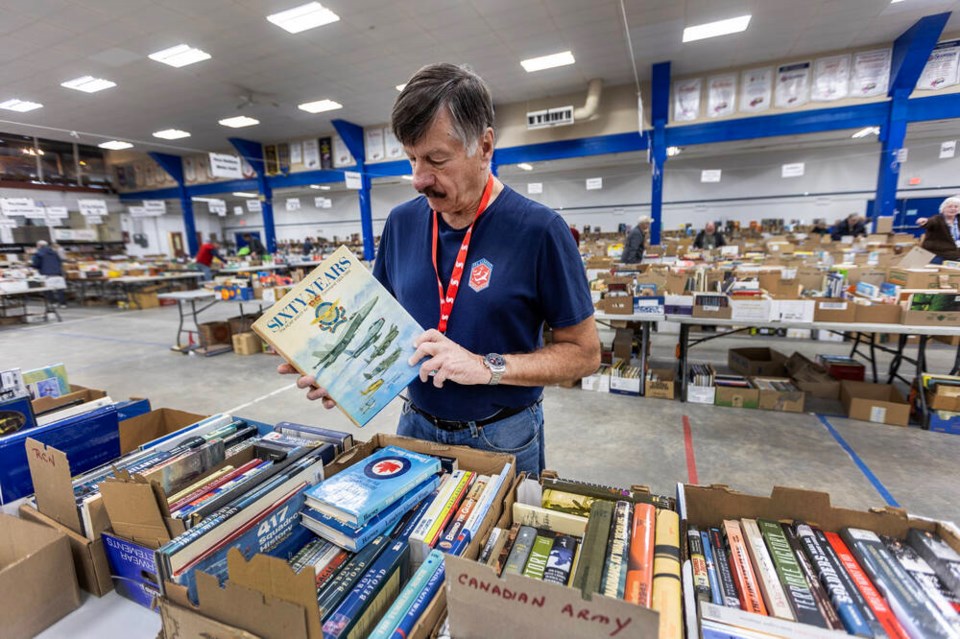
Former Snowbird Dan Dempsey works in the military section getting things ready for the Times Colonist book sale, taking place at the Victoria Curling Club on May 4 and 5. DARREN STONE, TIMES COLONIST
Dan Dempsey used to command and lead the Canadian Forces Snowbirds in airshows across North America. He also flew airshows in the F-86 “Golden Hawk” Sabre from 2009-2012 to celebrate the 100th anniversary of powered flight in Canada. His teammates included fellow jet jockeys — and astronauts — Chris Hadfield and Jeremy Hansen. In all, Dempsey spent 46 years flying jets, first for the Air Force, then as a Cathay Pacific pilot out of Hong Kong and New York, then with defence contractor Top Aces out of Victoria.
This week, though, found Dempsey toiling with a ground crew of sorts, tackling the mountain of donations to the Times Colonist book drive, just as his wife Ruth used to do. “The reason I’m here is because of Ruth,” he said, pausing amid the massive book-sorting effort in the Victoria Curling Club. “This was the highlight of her year.” Ruth Dempsey passed away in 2019, one day after her 63rd birthday. She had been dealing with cancer for six years, but refused to let the disease stop her from volunteering for the annual charity sale, something she had been doing since 2005. Those who worked beside her at the book drive miss her a lot. “This would have been 20 years for Ruth,” Dan says. He’s happy to serve in her place, one of the bustling mob of volunteers who have spent the past week sorting the hundreds of thousands of volumes donated to next weekend’s sale.
Dan and ex-Mountie Dennis Flewelling curate the book sale’s military section, arranging the titles into dozens of subsections: all of the world’s conflicts, military hardware, peacekeeping… A couple of times over the past few years, Dan has come across a copy of A Tradition of Excellence – Canada’s Airshow Team Heritage, his own 768-page history of Canada’s airshow teams.
Ruth’s brother, Ralph Sommerfeld, has also been volunteering at the book drive for many years. The Dempseys’ daughter and grandson joined in on Saturday. Such people are the backbone of the book sale, which funds literacy efforts on Vancouver Island. The Times Colonist’s name might be on the event but its success depends on the hundreds of volunteers who have no direct connection to the newspaper. Each has his own story, her own motivation. Most are book-lovers, word nerds. Many are retirees. Some just like each other’s company, treating each spring’s sale like a family reunion.
Their backgrounds are diverse. Dennis Seymour, retired after 30 years in the army, spent the week doing grunt work, horsing stacks of books around with a pallet jack. Wayne Aitken, the co-author of Blisters and Bliss (essential reading for anyone tackling the West Coast Trail) wielded a boxcutter, day after day. Victoria city council’s Chris Coleman spent last weekend lifting boxes and bags out of donors’ cars at the drive-through book drop-off.
Saanich Coun. Karen Harper, a one-time school teacher and librarian, sorted books during the week. So did UBC creative writing student Ciel Lenz, back home in Victoria for a break between semesters. So did Bou van Oort who, after spending his early years in a Second World War concentration camp in the Dutch East Indies, went on to become a Rhodes scholar. Margaret Horsfield, the author of three books about the west coast of Vancouver Island, shuttled titles from the sorting stations to the sale’s 470 trestle tables.
Many devote their time to multiple causes. Typical is Anne O’Leary who, after 27 years at the reference desk at a public library, now volunteers as a gardener at Government House and a hike leader with Victoria Outdoor Club. She also pitched in at the downtown Salvation Army thrift shop until it closed. The book drive allows her to flex her library-research skills.
Many have volunteered at the sale for 10, 20 years. A handful, such as Marsha Birney, the queen of the cookbooks, go back to the very first sale in 1998. Mary-Ethel Audley, who in 1975 became one of the first female patrol cops in B.C. (in an A-line uniform skirt and two-inch heels, no less) was at that 1998 event, too. So was the Times Colonist’s Keith Ellender, who puts paid work on the back burner in favour of volunteering in the weeks leading up to the sale. “I always book my holidays around this,” he says.
Others volunteers do that, too. Angela Leung, who works for the Victoria school district, showed up for the first time on Wednesday, her day off, and was immediately impressed by the collegiality she found. She plans to take vacation so that she can help out again next week. Why do they do it, devoting their free time to standing on the cold, concrete floor of a cavernous curling rink, working for free, subsisting on nothing but coffee, dust mites and the occasional Timbit? Because they’re thoroughly decent human beings, that’s why.
LatestMartin Mars “Gen” from General Aviation News … 13 May 2024
In June 1972, Philippine Mars, in high-visibility red and white paint, floated on Sproat Lake as the Grumman Goose used as a bird dog on fire missions landed behind it. (Photo by Frederick A. Johnsen)
Story by Frederick Johnson … Fred is a product of the historical aviation scene in the Pacific Northwest. The author of numerous historical aviation books and articles, he was an Air Force historian and curator. Now he contributes to General Aviation News and the Airailimages YouTube Channel. Catch Fred at Fred@GeneralAviationNews.com
One was lost fighting fires, one was considered irreparably damaged in a 1962 storm, and the last two of the named JRMs, Hawaii Mars and Philippine Mars, served as giant firefighters from the mid-1960s well into the 21st Century. They were based on Sproat Lake at Port Alberni located in the southern third of Vancouver Island. Hawaii Mars was last on fire call in 2015; Philippine Mars ended service a few years earlier, and has been stored at the company’s flying boat base. Hawaii Mars is set to make a fly-by tour of Vancouver Island on delivery to the museum.
“Vancouver Islanders are in for an amazing aerial treat because the Mars arrival is going to be like a big blockbuster movie weekend as everyone from Nanaimo to Victoria will get to watch the massive, majestic Hawaii fly low and slow overhead with its immense 200-foot wingspan and wonderfully loud radial engines,” said Richard Mosdell, who led the team securing Hawaii Mars for the Canadian museum.
The delivery flight will end with the Hawaii Mars landing in the saltwater at Patricia Bay beside the Victoria International Airport (CYYJ). The red-and-white water bomber will be pulled up onto the Coast Guard base near the World War II hangars where it was originally converted into a water bomber. A slow overland move to the museum will follow.
How the Philippine Mars will make the journey to the Pima Air and Space Museum’s desert home remains unknown at this time. Will it be disassembled for shipment to Arizona? Philippine Mars retired in 2012; Coulson officials are not saying whether it can be made ready for a ferry flight which, at best, could place the huge flying boat on a body of water in Arizona, much closer to Tucson, with some disassembly and overland travel still required to finish the delivery.
An article by Darron Kloster in the Times Colonist newspaper on Vancouver Island said mechanical work and permitting are being accomplished on both Mars aircraft, suggesting a final flight is in store for Philippine Mars. A Coulson spokesperson said her company and the museums are not answering media questions about the Mars project, including how Philippine Mars will make it to Arizona, referring queries to published news releases.
It is ironic that after a decade of Navy service, most people expected the anachronistic Mars flying boats to fade away. But FIFT’s vision gave these mammoth machines five times the life they had as naval aircraft. As scoopers, the Mars seaplanes used a trick their terrestrial counterparts could not — filling their firefighting tanks on the fly. To maintain proper level in the water, FIFT crews could takeoff from a standing start at an aircraft weight of 148,500 pounds. On a high-speed pass skimming the surface, the Mars could scoop enough water to finish loading the tanks and attaining a weight of 162,000 pounds. Of that weight, Mars could heft 6,000 Imperial gallons of water, equaling more than 7,200 U.S. gallons.
To subscribe to GAN? Contact Ben at ben@generalaviationnews.com
Hawaii Mars releases thousands of gallons of water over a Canadian forest sometime in the first decade of its service. This flying boat will remain on Vancouver Island as a centerpiece in the British Columbia Aviation Museum. (Photo courtesy Forest Industries Flying Tankers)
ConfedCollege Hits 50!
November 17 – 19, 2023 was a grand weekend to be in Thunder Bay. How so? It was the 50 th anniversary of Confederation College, one of Canada’s most renowned aviation training centers. Since its inception, “Confed” has graduated commercial pilots and air engineers who since 1973 have helped keep Canada’s aviation industry in peak form. Hundreds of graduates turned up for this wonderful event, many a bit shattered to realize how those 50 years had sped by and how the aging process is no joke! Regardless, it was a fantastic weekend of reminiscing and seeing how the college goes along so well in the 2020s.
My own involvement began on boarding Porter PD2631 an 0915 departure from YTZ Toronto Billy Bishop Airport for the 2:08-hour flight to YQT Thunder Bay. It was clear sailing all the way in the usual first-class Porter style. On arrival, sidekicks John Hill, Mark Dinna and others met me for the first part of my visit – a YQT airside tour guided by Ryan Brading, Manager YQT Airport Services. This was a fascinating, all-in couple of hours reminiscent of several other such I’d had beginning with my own “self- guided” tour back in 1961. Here are a few photos highlighting our tour and some of the fun that ensued. At the end are some reminders of previous CANAV Blog item featuring the Lakehead. Enjoy!
YQT Terminal with Porter Q400 C-GKQH Flight PD2631 just arrived from Toronto.Some Confederation College ’83 graduates now in their dotage as airline captains: Dave Ewing (787 WestJet)), Mark Dinan (777 Air Canada) and Dan Keogh (A380 Emirates ret’d, now 767 Cargojet) with our tour guide, YQT’s Ryan Brading (3 rd from left)).Since 1973, Confederation College has taught flying with the classic Cessna Ce.172. In the early 2020s, it started replacing its vintage fleet with the latest Ce.172S equipped with Garmin G1000 avionics. Seen is 2002 vintage C-FNYX, then “G1000” C-FZLW acquired in 2022. Although seemingly pricey at about US$400K, the new 172s will give decades of top service. For a rare history of the beloved Ce.172 in Canada, search on our blog for “Cessna 172 Archaeology”, an item you’ll really enjoy.An early stop on our YQT airside tour was the Government of Ontario Ornge Air medevac helicopter base. Here is the base Leonardo AW129. Then, our group with the duty pilots and a look at the AW129 “front office”. A 2011 model, “NYZ” spent to 2016 with Alaska- based ERA before joining Ornge.Next, we were welcomed at the Ontario Provincial Police base for a close look at Pilatus PC-12 C-FOPD (with which your scribe is shown). Acquired new from Pilatus in Switzerland via Levaero of Thunder Bay in 2013, “OPD” serves many uses from surveillance to prisoner transfers.Also on the YQT ramp for the eager photographer this morning were Wasaya Dash 8 C-GOKN and Calmair ATR-42 C-GRFU. 37-passenger “OKN” is one of those first gen Dash 8-100 survivors, having started its career with American West Airlines in 1989 as N807AW. In 1995 it moved to Allegheny as N831EX, returned to Canada in 2004 as C-GAII for a taste of the north with Air Inuit, then migrated to Mexico in 2012 for TATSA as XA-UQY. Finally, it returned again to Canada for Wasaya in Built in 1995 for Bangkok Airways, ATR-42-200 series C-GRFU served such carriers as Precision Air in Tanzania. In 2009 it was converted to a freighter and since then wandered from India to Texas to (presently) YQT. As a freighter it can carry a 5500-lb payload. In this period ‘RFU was based at YQT doing a nightly courier run to Winnipeg.Air Tindi’s STOL Dash 7 C-FPBJ turned heads on arriving with some Confed College grads from Yellowknife. Dash 7 No.9, it originally (1978) had served Emirates Air Services as A6-ALM. In 1994 it moved from the desert to the icecap for historic Dash 7 operator, Air Greenland. In 2011, it was purchased by Trans Capital Air, the famous Toronto Island Airport operator using Dash 7s on United Nations contracts in Africa. Ten years later, it migrated to Yellowknife, where its good services are well appreciated throughout the NWT.Since my first visit to YQT in 1961 I’ve been fascinated by what sits there “in the weeds”. One type in 1961 was Consolidated BT-13 WWII trainer CF-HJB once used by Superior Airways to haul fresh fish from the bush, but by then abandoned (find my photo of it by searching here for CF-HJB). This time around I was keen to find some HS-748s and other types parked “out of the way” and waiting for the scrapman to show up. Seen first withdrawn from service is Wasaya 748 C-GANA. Delivered new in 1978 from Hawker Siddeley in the UK as 9Y-TFX to Trinidad and Tobago Air Services, it labored in the Caribbean until sold in 1987 to Ottawa- based Bradley Air Services (later FirstAir) where it became C-GFNW. By the early 2000s, FirstAir was disposing for its beloved 748s which had been serving the Arctic for decades. Most went for scrap, by C-GFNW was picked up by Air North of Whitehorse, another dedicated 748 operator (to be Canada’s last such). Air North gave “FNW” a new color scheme and new registration, C-GANA. In January 2021, Air North retired the 748, selling C-GANA and C-FCSE to Wasaya (google “Air North Retires Hawker Siddeley 748 by Chris Loh”).Wasaya’s 747 C-FFFS sat beside ‘ANA this day. Originally with Philippine Airlines, HS748 c/n 1663 had gone new in May 1969 on a short lease to Transair of Winnipeg as CF-TAZ. It then spent 1979-89 with Dan-Air London after which it had a long career from Winnipeg with Air Manitoba. In 1996, it joined Wasaya. Then, another old 748 “in the weeds” at YQT, C-FCSE, also ex-Air North. In 1970 it had gone new to Chevron Standard Oil of Calgary, a company long supportive of corporate aviation (1959-67 Chevron had operated Boeing 247 CF-JRQ, now with the Canada Aviation and Space Museum). C-FCSE’s future once retired by Chevron in 1993 was first with West Wind Aviation of Saskatoon, then Air North, where it served the Arctic for some 25 years. On going to Wasaya in 2021 its only use was for spare parts. Some years ago, I had teamed with FirstAir president Bob Davis to offer a 748 to the CASM in Ottawa. FirstAir was ready to clean up one of its 748s, fly it in to the CASM at Rockcliffe and hand over the keys. Sad to say but the CASM really had no interest in a 748. Besides, it was strapped for space, so the 748 flew instead to Trois-Rivières, Quebec to be scrapped.The only active 748 at YQT in this period was C-GLTC, a tanker for hauling fuel to North Ontario’s remote Indian reservations. But ‘LTC was not looking very active when I photographed it. It had spent its career since new in 1969 with the Germany government until sold in 1984. It showed up in Canada in 1986 for Intercity Aircraft of Oshawa. But Intercity was short-lived and ‘LTC joined Bradley in 1987. It later served Air Inuit and Kelner Airways until going to Wasaya (a company formed under the oversight of Kelner) in 1992.Also in the weeds at YQT in November was Mitsubishi Mu-2 “Rice Rocket” C-FZQG of local charter and medevac company Thunder Air. It last operated April 15, 2024 when it flew Thunder Bay – Muskrat Dam – Thunder Bay – Sioux Lookout – Poplar Hill – Thunder Bay. ‘ZQG had been N70KC with the US Keller Co. from 1986 until sold in Canada in 2018. Sometimes a plane like this gets back into service. Time will tell re. ‘ZQG. The Mu-2 became a popular medevac plane in Canada’s North due to its roomy cabin for a stretcher case and attendants, good speed (280 knots) and ready and cheap availability for conversion to air ambulance configuration.The YQT tiedowns are spread around but always are interesting to check out.Today’s modern Confederation College began humbly in 1973. Here, graduates Ewing, Keogh and Dinan ham it up in front of the original building.We also toured YQT’s fire hall and heavy equipment operations. Here’s one of the airport fire trucks and a heavy snow blowing machine.On the afternoon of the 17 th , Air Tindi flew several loads of “Confed” graduates around the Lakehead in their impressive Dash 7. In the aerial view, the famous “Sleeping Giant” looms in the distance.A tour of the college included much interesting history in the tech trades hangar including piston and jet engine training aids. In recent times the college ceased training students on heavier piston engines like this P&W R-985, a type that still powers the Beaver and Beech 18.Confed aircraft training aids included ex-Huisson Helicopters 1971 Bell 206B Jet Ranger C-FWGN, ex- CANForces Bell CH-136 Kiowa 136214 and a really vintage Bell 47.Later in the afternoon there was a mandatory visit to one of the Confed students’ favorite old watering holes from the 70s/80s, The Wayland. That was an experience!The weekend also involved a solid display by the inveterate people from the Northwestern Ontario Aviation Heritage Centre. Join up wherever you are to get the NWOAHC newsletter, etc. See their website, you won’t be disappointed! The RCAF also turned up with a recruiting set-up. Of course, any such college is top recruiting turf for the forces. Invariably, some Confed grads go this route and successfully so.Scenes from Saturday evening at the Confed reunion. Staff and students current and over-the-hill all mingled and enjoyed every moment!A couple of zillionaire aviation book publishers who had a super weekend at the reunion: 1991 Confed grad Rich Hulina with CANAV’s Larry Milberry. Having gotten the bush flying bug with Ignace Airways when he was a kid, Rich went on to operate Slate Falls Airways in Sioux Lookout for many years. Today he flies his own glorious Beech 18 for pure fun + to service his outpost camps.Come Sunday morning and it was time for CANAV’s CEO to get back to work, so I boarded Porter PD2630 for the 2-hour flight back to YTZ. Here we are getting de-iced at YQT before departure, then in the circuit at YTZ low over Toronto’s famous spit, on final passing Ontario Place, then the skyline as we taxy in. Bravo to Confederation College, everyone who turned up and Porter who got me up and back in very fine form aboard their magnificent Q400s. What a fantastic weekend! You can search on the CANAV blog for more about YQT by using such terms in the search box as YQT, CF-HJB, CanCar, Helldiver, Bearskin, Wasaya, Fort William or Thunder Bay. Any fan will love it all. To review some of our other Lakehead items search for these: 1) Return to Northwestern Ontario 2017 Part I “YQT” Thunder Bay 2) Thunder Bay to Sioux Lookout 2017 3) Visiting Lakehead Airport 1961 — 2012 Update 4) Canadian Car and Foundry and the Curtiss SBW Helldiver
Not Their Very Best Day at the Office
Google this little bit to see how a Lufthansa 747-8 crew did not exactly make their finest landing!
Lufthansa Boeing 747-8i’s Dramatic Touch and Go at LAX | Airline Videos Live Capture
The State of Book Publishing in Canada
Over the decades you’ve read CANAV’s many “editorials” about the reality of book publishing in Canada. The industry essentially includes in no particular order such time-immemorial trades as researchers, writers, editors, proof readers, printers, publishers and booksellers. It’s always a tenuous effort. As a matter of fact, anyone interested in Canada’s book publishing state-of-affairs, go on the web right now and find a copy of Roy MacSkimming’s landmark book The Perilous Trade: Book Publishing in Canada 1946-2006. It will inform and amuse you but maybe leave you slightly despondent about the perilousness of it all in the end. I and a small cadre in Canadian society know all too well about this biz where things should be peachy, not perilous. How can books, of all civilizing things since Gutenberg, end up, for example, being infiltrated by Mafia-like people who pull the strings of all the above partners in civilization and make sure they enjoy nothing much more than penury? I’m not making this up, believe me.
Away down at the level of being “in the weeds”, it’s not just those Mafia henchmen, as it is those who every day tell we little people “in books” how dearly they (supposedly) love books. These “fair weather friends” could help by buying a book. Instead? They slap us on the back and tell us what a great job we’re doing. Then? Well, zilch, because most of them would slash their wrists before they ever bought a book. They’re more likely to hint that they’d love a complimentary copy of this or that, or ask if I might have a special rate for poor retired government mandarins, airline captains, etc. barely surviving on their 3 or 4 pensions.
In Canada, the book business mainly is driven by government grants against which I’ve ranted for decades. I made the point years ago how if the Canada Council for the Arts in Ottawa and the equivalent outfits at the provincial and urban levels ever went away for just a few days, book publishing in Canada would collapse. Happily, to date, CANAV Books after 40+ years never has taken a penny of such money and only last year did we accept a small grant from the Air Force Heritage Fund (against my best wishes, but the fund was getting insistent that I apply). Well, good on such outfits, they do decent work, but my grant would have gone a lot farther say funding some Air Cadet to get his/her flying or mechanic’s licence.
I’m getting a bit tired of ranting about such stuff (the “Queen Street” item below included), but in that case, who will hold City Hall’s feet to the fire as we watch the way they piss away our tax dollars? What happens if we good Canadians give up in despondency and let “the enemy at the gates” completely take over? Renowned Canadian publisher, Ken Whyte of Sutherland House nicely encapsulates many aspects of book publishing in Canada in his own rant this week. If you want the low-down about it all, take a read. Meanwhile, live dangerously and maybe let me know if you’d like a copy of CANAV’s latest aviation booklist. Right … go nuts, maybe even order a book! I’m right here … larry@canavbooks.com
Here’s Ken Whyte’s fantastic item. Sign up for his free newsletter (see below)
Andrea Fleck-Nisbet (above) is CEO of the Independent Book Publishers Association, a massive trade organization representing 4,100 small-to-medium-sized publishers in the US. She recently told Publisher’s Weekly that the industry is “at an inflection point.”
I read the whole of her comments and came back to that phrase. In general usage, “inflection point” means a time of significant change, or a turning point. Is the change for the good? Or a turn to the bad? It doesn’t say. The phrase is qualitatively indifferent. I’m not saying Fleck-Nisbet was wrong to use it, but I’m not sure it captured her full meaning. To my ears, she was describing an industry in crisis.
There are two key components to the traditional publishing business model.
One is that the publisher assumes the costs and risks of a book project: this involves compensating the author for his or her manuscript (usually in the form of an advance against royalties), and paying as well to have the manuscript edited, designed, printed, and marketed, while hoping to recoup those costs through book sales.
Fleck-Nisbet says this component seems still to work for corporate publishers (the Big Five, who have their own trade association), but it is “broken for everybody else.” The costs and risks are too high: “we know that eight out of ten books are not actually profitable—that model can’t sustain a small business.”
Her answer is to evolve the business model: “What we have to look at is legitimizing different types of models like hybrid publishing.” In the world of hybrid publishing, authors share in some of the up-front costs and/or risks of producing a book.
She mentioned the new publishing house Authors Equity, led by former Penguin Random House CEO Madeline Macintosh, which is eschewing advances and giving its writers instead a greater share of net proceeds. There’s no sharing of costs at Authors Equity, but there is certainly a sharing of risk when most books will have no net proceeds to share.
Fleck-Nisbet also mentioned Forefront Books, a Nashville-based house run by former Simon & Schuster executive Jonathan Merkh. It’s been one of the fastest growing publishers in the US in recent years. It asks its authors to cover its costs, charging big upfront fees (mid-five-figures) to edit, design, produce, and distribute books, in return for 100 percent of net proceeds from sales.
There are many other examples at hand, including many US independents supplementing their traditional publishing lines with hybrid lines, running both out of one company, sharing costs.
Fleck-Nisbet acknowledges that hybrids “are still a long way from legitimacy in the marketplace,” but thinks that needs to change.
I suspect that her experience as head of IBPA has contributed to these views. I attended the organization’s big annual gathering last spring (I was going to go again this week but managed to contract what must be Canada’s last case of COVID). I was struck by the high-proportion of self-published authors and hybrid publishers in attendance. They appear to be contributing the lion’s share of new IBPA members, and they provided much of the energy at the conference.
In any event, this is an astonishing development. It was only six years ago that that the IBPA held its nose and let hybrids join the organization; now IBPA appears to see hybrids and self-publishers as the future, or at least a crucial component of it.
Tangent: The Canadian experience is somewhat different in this regard. We have a healthy number of hybrid publishers and hordes of self-published authors, but institutional barriers keep them separate from traditional publishing.As discussed on many prior occasions, Canadian book publishing, like a lot of Canadian arts activity, is to an unusual extent a grant-farming exercise. Very few US publishers have access to grants; the vast majority of our publishers would be out of business without them. Our leading granting agencies—the Canada Book Fund and the Canada Council for the Arts—don’t support self-published authors or hybrid publishers.
It follows that the IBPA’s Canadian counterpart, the Association of Canadian Publishers (ACP), has membership criteria that effectively rule out both hybrids and self-publishers. It also follows that the ACP has 115 members, 2.8 percent of the IBPA’s total. By its own numbers, ACP member revenue is down markedly over the last fifteen years or so, despite the grants. We discussed the pros and cons of grant-supported publishing in SHuSH 194, “The two solitudes of Canadian and US publishing.” One of the cons is that grants come with strict terms that lock you into a particular business model and discourage experimentation with new and perhaps more viable alternatives. When business gets challenging in Canada, the first response tends to be to request more public money. Grants are both lifeline and noose.
Second tangent: While Fleck-Nisbet is probably right that the conventional model is working at the moment for the multinationals, the growth of hybrid and self-publishing will inevitably cause huge problems for them, too. They’ve already seen an implosion of their once-reliable genre fiction business—romance, fantasy, etc.— as the action has shifted to self-publishing.
The other key component of the traditional publishing model is that the publisher accesses the book market through third-party sales-and-distribution agents. These firms warehouse the publisher’s books, pitch them to retailers, fulfil orders to interested retailers, receive the proceeds from in-store sales, remit those proceeds to the publisher (after taking a cut), and accept returns of (and give full refunds for) unsold inventory.
Fleck-Nisbet says that distribution services have become too expensive: “We have to find ways to fix the supply chain so that indie publishers aren’t always so reliant on a distributor who’s taking a large percentage of their net income per sale.”
Let’s be blunt: this is the Ingram problem. Ingram Content Group is a Tennessee-based behemoth that represents more than 37,000 publishers around the world, including the majority of Canadian and American independents.
Sutherland House is represented by Ingram in the US market. We signed with them mostly for the security of being with the largest and most stable distribution company available. When distributors go down, they tend to take publishers with them—the publisher’s inventory and cash are all tied up in the distributor. Jack Stoddart’s General Distribution Services filed for bankruptcy in 2002 and claimed or threatened the lives of a whole raft of publishing houses including Key Porter, House of Anansi, ECW, and Douglas & McIntyre. Just two weeks ago, Small Press Distribution, which distributed several hundred US literary presses and magazines, closed its doors. One expert quoted by the New York Times expects that 85 to 90 percent of those presses and magazines may now go under.
Ingram offers stability, but in return it sucks all the value out of the publishing supply chain. It is every bit as predacious as Amazon. It imposes an endless array of fees and charges on top of its basic commissions, and it negotiates horrendous Ingram-wide deals with Amazon and Barnes & Noble that give those retailers, respectively, 59 and 55 percent of the proceeds of each book sale. A normal retail discount is 45 to 50 percent. That may not look dire, but a 10 percent increase in the retailer’s share of each book sale can wipe out a publisher’s margin. I hear from more publishers all the time that it’s impossible to profitably sell a front-list book through Ingram. After you’ve covered its retail discounts, its commissions, all those fees, and paid your production costs and your author’s royalty, there’s nothing left.
Ingram is also a terrible sales agent. One firm, no matter how many divisions it has, cannot adequately represent each of 37,000 individual publishers. There are a lot of smart, capable, likeable people selling books on behalf of Ingram, but they are tiny cogs in a massive logistics machine. They are all representing hundreds of publishers and thousands of books at a time. Most books represented by Ingram aren’t sold into retailers so much as made available to retailers in a huge and cumbersome database.
Fleck-Nisbet says that it’s unreasonable to expect the big distributors to change their business models. She’s undoubtedly correct, but what’s the alternative?
“I know there’s been conversation in various quarters,” she says, “about some kind of cooperative that could be created among independent publishers who share a similar vision and have similar types of programs, where it’s not about generating revenue from distribution, but rather about helping to solve these problems of getting the books into the market…. I do think there are opportunities for independent publishers to potentially come together and create a solution through economies of scale.”
I’m not thrilled at the prospect of cooperatives. They’d likely be less expert at logistics and less financially stable than a monolith like Ingram. The upside is that they’d probably do a better job at sales and be affordable enough that a publisher could expect to earn a margin. At the end of the day, having a margin wins out. What good is stability in the absence of profit?
I don’t really know Andrea Fleck-Nisbet. I’ve met her once and I’ve seen her in action. She’s intelligent, well-spoken, understated, and cautious in the familiar way of leaders of non-profit trade organizations. I would think it took a lot to bring her to the point of declaring that independent publishing is at an “inflection point.”
I’m still puzzled by the phrase. Is she employing it as a euphemism for crisis? Or does she view these changes indifferently, having already made peace with the passing of the traditional publishing model?
To subscribe (free or paid) Ken Whyte’s essential newsletter, go to SHuSH, by Kenneth Whyteshush@substack.com
Toronto the Beautiful … NOT!
When I was a young fellow in the 50s working through high school after hours at Oakley’s Meat Market at Kingston Road and Main in Toronto, one of my daily jobs was to sweep and hose down the front sidewalk. Every shopkeeper did the same. Toronto was a much nicer place as far as simple “appearances” went.
All our mothers had taught us well about such no-brainer, simple things. These days sad to say it’s a disgrace from one end of “Toronto the Great” to the other. There’s barely a shop keeper who could care less, wouldn’t have a clue about what we’re talking about here … really depressing.
What do parents teach their children these days about such basics? And … the school system? Forget it, eh. Mustn’t actually teach the poor little darlings anything useful about daily life. Here’s a typical scene today (April 22) on Queen St. E. At every public garbage unit for miles, you pretty well see this as “normal”. Thank you so much Yahoo dog people who make every decent “dog person” look bad. Can you imagine being such a bozo who actually picks up their doggy-do then drops it in front of the waste container day after day after day! What a bunch of pitiful zeroes you are but you’re too plain stupid to get it. You morons don’t deserve a place in civilized society. Let’s see … did I miss any good descriptive nouns in getting my message across about these despicable nincompoops?
Meanwhile, Toronto-the-not-so- beautiful people down at city hall are not much better. This refuse container is one of the few in the city that doesn’t have a door hanging open obstructing the sidewalk. But city hall’s got way more important things to do than ensure we have a beautiful city, right.More of Toronto-the-Hardly-Beautiful. Since City Hall started finding endless supposed social programs to blow the people’s money on, naturally the basics of civilized urban life have gone down the drain. Toronto’s roads are the worst you’ll find anywhere. When I was travelling to places like Mogadishu and Djibouti ages ago, I used to tell my little kids about the dreadful state of city basics in such places. They couldn’t believe me even when I showed them the photos of the roads, etc. Now what? Maybe by now Mogadishu has better roads than Toronto! Here’s a typical case — Hazel Ave. in my neighborhood. It hasn’t been serviced for decades. Once a year a pitiful effort is made shoveling asphalt into the worst of the potholes. Of course (since the City no longer seems to know how to make simple asphalt that sticks) within a few weeks all that had disappeared and the potholes are worse than ever. Money well spent, right by our brilliant downtown “leaders”.
Have you noticed Toronto’s new air- and noise-polluting little gizmos driving around picking up a few butts and trash? On average, our previous City broom-and-bag lady did a way better job. Funny how City Hall loves its polluting devices. A citizen doesn’t have a chance complaining to City Hall about its industrial strength leaf blowers when City Hall itself maybe has the biggest inventory of them in Ontario.Looks like Canada Post also has lost interest in the fundamentals of decent appearance. Here’s a beauty of a letterbox at Beaufort and Southwood also in my area of Toronto. Seems like it’s just governmental de rigeur these days to have everything possible looking like crap. Of course, they’ll all have an endless list of pitiful excuses.
Hello to all our great CANAV Books blog fans. Apologies … I know you haven’t noticed anything new for months. Why? I’ve been swamped working on CANAV’s centennial history of the RCAF. That’s been taking up every working hour, 7 days a week for the last 5 years. Crazy, eh! But that’s the aviation history and book biz for you — if your plan is to get out the best such book possible. By sticking at it, I’ll be publishing the book later in the fall. Not a huge deal when you consider that our monumental RCAF 60th anniversary book (Sixty Years: The RCAF and CF Air Command 1924-1984) didn’t get out until August 1984 (the actual RCAF anniversary is in April). Sixty Years still is in print with a few nice new copies from our 5th printing still available.
The RCAF is celebrating its Centennial all through 2024 with mess dinners, air shows and local events happening across the country. Take in what you can. The airshows will be especially fantastic since so many military demo teams will be taking part along with the Snowbirds. Even lowly little CANAV Books is taking part in quite a noteworthy way.
If you’re in Winnipeg over the next few weeks (to June 30), drop by the Royal Aviation Museum of Western Canada. There you’ll enjoy the many beautifully restored RCAF aircraft, but also walk through a spacious gallery to see more than 100 original paintings of RCAF aircraft, the very glorious paintings that adorn Sixty Years. I donated these to the air force back in 1985 and this is the first time they’ve been on public show (over the decades they’ve been on the walls of air force HQ in Winnipeg, so out of public sight). This wonderful aviation art show opened in gala style on March 20. The turnout was impressive, Air Cadets and veteran included. The crowd really was into it from what I’ve seen of the photos sent to me by 17 Wing historian Gordon Crossley and Robert Arnold, one of the museum’s “original’s” and still volunteering there.
Here are a few of Robert’s and RCAF Sgt Doug Carpenter’s photos to enjoy of the opening. If you’re in Manitoba or are passing through be sure to drop into the museum for an extra great aviation history experience any time by June 30. Here also is CityNews Winnipeg’s item covering the museum art gallery opening: celebrations in Winnipeg can be viewed at this link here. Funny, but CANAV Books itself — the force that saw all these paintings created in the first place — wasn’t invited to the gale opening. I wonder if there’s a name for that weird syndrome? All the best as ever and be sure to keep in touch … Larry
Welcome one and all to the CANAV Books Blog for Fall 2023. It’s another fascinating offering of solid reading and amazing photos for serious aviation history fans.
Pratt & Whitney Canada
Here’s an important bit of Canadian history, a landmark 60th anniversary. On December 23, 1963, P&WC of Longueuil, Quebec shipped its first production PT6 to Beech Aircraft in Wichita. Beech and P&WC already had flown the PT6 on an experimental Beech NU-8F Queen Air in the previous May. Now, Beech (on a huge gamble) was starting production of its new King Air series using the PT6 (first flight January 20, 1964). Here on the verge of 2024, more than 3100 King Airs have been delivered and the type remains in production. As for the PT6 — “that little Canadian turbine engine that could” — more than 64,000 have been built in a wide range for well over a hundred fixed wing and rotary aircraft types.
The history of the PT6 is best told in Power: The Pratt & Whitney Canada Story (1989) by Kenneth H. Sullivan and me. This is one of Canada’s and the world’s most important, authoritative and beautifully-produced aerospace histories. If you’d like a copy (it’s long-since out of print), you usually can find one at biblio.com, bookfinder.com, abebooks.com etc. You’ll pat yourself on the back once you add Power to your aviation bookshelf. Meanwhile, if you’d like a copy of CANAV’s latest booklist, drop me a note at larry@canavbooks.com Cheers … Larry Milberry
New History of the RCAF
The first of several books to celebrate the RCAF’s 2024 Centennial is available from CANAV. Pathway to the Stars is a 264-page, large-format, hardcover rich in text and photos produced by the RCAF Foundation. If your interest is RCAF history, you’ll definitely want this major production, especially if you already have our 1984 Sixty Years and Canada’s Air Force at War and Peace series. Order from CANAV Books by sending CAD$52.00 (Canadian orders) to larry@canabooks.com or mail your cheque to CANAV Books, 51 Balsam Ave., Toronto ON M4E3B6. Get in on the ground floor! USA and overseas orders CAD$72.00 all-in, surface mail.
Meanwhile, here at CANAV we’re still beavering away at our own RCAF Centennial book which is due off the press for the RCAF Centennial in April 2024. If you have our Sixty Years from 40 years ago (and about 20,000 do), you’ll know what to expect with this spectacular production. What you’ll get is the very best — no other book will come close with the wide sweep of topics and depth of treatment. CANAV’s will be authoritative and beautifully produced – our two chief hallmarks. That said, real fans will want all the forthcoming RCAF 1924 – 2024 titles on your bookshelf. Each will shed new light on this huge story, which no single book can cover 100%.
S.O.S. …What a Fantastic Story from the Inimitable “SKIES” Magazine. Google “Chinook rescues stranded Canadair CL-215 ‘duck’ from northern lake”
Canadair/Bombardier Challenger at 45
The world-famous Challenger series built in Montreal has hit age 45. We covered this story in Canadair: The First 50 Years, but that was away back in 1995. Now, Pierre Gillard has done a beautiful 45-year retrospective about the Challenger, including photos of the original production aircraft. Take a look and you will not be disappointed — too good to miss, what world-class aerospace success story!
The Great War Flying Museum’s inimitable Jerry Fotheringham flies his favourite of the museum’s WWI replicas, the Nieuport 28. I took this nifty photo on September 25, 1999 from the museum’s Starduster C-GCUG piloted by another revered GWFM aviator, the late John Waldie. Jerry was one of the museum’s founding members and staunchest supporters. See our tribute below.Byron as a young man at CAE in 1973. He became the longest serving president of CAE Electronics Ltd. (CAE News)
Recent melancholic events include the passing in Kingston, Ontario of one of Canada’s true “Kings of Aerospace”, Byron Cavadias, long-time president of CAE Electronics Inc. in Montreal. It was my great good fortune to meet Byron in 2011 and have him as chief motivator, advisor, critic and proof reader for the manuscript that became Aviation in Canada: The CAE Story, arguably (some insist) the finest book we ever have published. Below is Byron’s obituary – it’s astounding what one fine citizen can accomplish! Byron is well recognized including with membership in Canada’s Aviation Hall of Fame.
Byron in one of the great flight simulators developed under his eye at CAE. His guest here is Quebec premier Robert Bourassa. (CAE News)Byron and his wife Juliet with the great R.D. Richmond at the 2012 Canada’s Aviation Hall of Fame induction dinner in Montreal. You can scroll back to see our earlier tribute to Dick, who passed at 100+. (Larry Milberry)
Use CTRL + MOUSE WHEEL to zoom in and out of the obituary above.
You’ll enjoy the episode in The CAE Story of how Byron collected customer flags for display at CAE. It was someone’s brilliant idea on Byron’s retirement for CAE to present him with his own flag! Since we published our book, CAE’s board room has been named in honour of company founder Ken Patrick and a local street now bears his name. It’s tough getting big companies to take time for heritage matters, so good on CAE for showing such interest.Byron and I at CAE’s “Prestige Club” dinner in Montreal on May 26, 2016. (Reminder … order your autographed copy of The CAE Story for $60 delivered anywhere in Canada all-in (usually a good $90.00) Easy to order via PayPal or Interac to larry@canavbooks.com This is one book you really will treasure!
GWFM Honours the Great Jerry Fotheringham
In August 1996 Jerry Fotheringham and a crowd of fans attended the inauguration at the entrance to the old Constellation Hotel near YYZ of a beautiful Lockheed Super Constellation. That’s where I met Jerry and got his photo in the Super Connie cockpit. Later, in November 1997, the fun continued for those who braved a winter storm to attend our Air Transport in Canada book launching at the Constellation. Not surprisingly, Jerry turned up with a crowd of pals who had flown and maintained the “propliners” of the 40s and 50s and once again sit in a Super Connie cockpit.
Here’s that little spread on p.326 of the book. You can see how I had Jerry autograph his photo in my personal copy that night. This grand Super Connie now is part of the Museum of Flight in Seattle. This is the same plane I suggested to the GTAA ages ago that it should get hold of, restore to its TCA glory and hang from the rafters of the then-under-construction YYZ Terminal 1. I’m still waiting to hear back from the GTAA. Meanwhile, an enthusiastic American group led by retired Boeing tech rep, Bob Bogash, got hold of the plane. Thanks to them, today you can see it in its glorious TCA colours, but far from YYZ. Thank goodness for American ingenuity, right! Otherwise the old Super Connie long ago would have gone for pots ‘n pans. Read all about this on our earlier blog “Super Connie Field Trip”. (Let me know if you still don’t have a set of “ATC”. A few remain and still are on sale (Canada only) at $65 per set (sticker price is $155, so what a deal). Drop me a note at larry@canavbooks.comAt the Great War Flying Museum 2016 open house: myself, Jerry, Murray Kot and Wally Homersham.
On September 16, I attended Jerry’s celebration of life at the GWFM. The museum, of course, is dedicated to promoting the history of the war in the air 1914 to 1918. It keeps several wonderful WWI replica fighters in flying condition in its Brampton, Ontario hangar plus has a wonderful adjacent museum building. Here are a few photos from Jerry’s event – some hangar scenes, some of the Wardair retirees attending (Jerry was a legendary Wardair captain), then a couple of “flightline” scenes. Finally, four museum planes flying by in Jerry’s honour. The Nieuport flown by Earl Smith is just pulling up to make this the “missing man” formation.
Scroll back for further in-depth coverage of the GWFM. Or … enter GWFM in the blog search box.
Central Airways, The Wong Brothers and Apache “KFX”
Earlier on our blog we covered the story of Central Airways, the renowned training and charter operation at Toronto Island Airport which so many Canadians still revere. Attached is an update about Bobby and Tommy Wong and the tiny Pietenpol parasol that they built as boys in pre-WWII Vancouver. This very Pietenpol has been found after some 80 years and soon will be under restoration. Take a look!
Meanwhile, here’s a photo I took of Central’s famous Piper Apache CF-KFX sitting at the island airport around 1960. It’s now preserved in Hamilton. On September 25, 1960 I had an “accidental flight” in “KFX” from Hamilton’s Mount Hope Airport back to Toronto Island. This happened by chance. That day I had been flying with Ron Hayashi in his Stinson SR-9 Reliant CF-IBR. We were returning to the island from Brantford around dusk when there was a sudden pop and some banging “up top”. I zipped back the roof upholstery to see the sky! The roof fabric suddenly had torn from the windshield and was wrapped around the DF antenna behind the cabin. We suddenly were hoping that the tearing was done – we didn’t want all that fabric wrapped around IBR’s tail! Gingerly, Ron descended and we landed at Mount Hope. Extra lucky that “KFX” happened to be there and we were offered a flight back to the island.
Have a look here for further in-depth history of Central Airways
Lancaster FM104 in 1999
Now being restored at the British Columbia Aviation Museum at Victoria airport, Lancaster FM104 had a famous career since first flying in 1944. Here it is as I photographed it at Downsview near Toronto in April 1964 when the Lancaster was being honoured and retired from RCAF service. Not long afterwards, FM104 became a lovely public display atop a pylon on the Toronto waterfront near the Island Airport. Sadly, like most such displays, it gradually deteriorated, then came the time when Toronto city council was (being by nature so anti-military) happy to have the Toronto Aerospace Museum take FM104 away for restoration at its Downsview hangar.
The BC Aviation Museum was one of several museums vying to acquire the beautiful Lancaster. That’s where I gave my support, writing letters to the Toronto decision-making historical bureaucracies with my reasoning. Happily, FM104 went west and that’s where you can see it today under restoration. For more info, enter FM104 in the search box. Meanwhile, here are some photos I took of it in September 1999 as Toronto Aerospace Museum volunteers dismantled it for transportation to their site. All this panned out and much good work was done on FM104 until the TAM folded and the lovely old Lancaster eventually found its present home.
AvWorld in New Digs
You can see what we wrote ages ago about Canada’s top aviation store, Aviation World (search for our item of August 30, 2010). Today you’ll find this “Mecca” for aviation fans relocated a stone’s throw from the old place. Inside? There’s much more space and the same fantastic range of products you know from years gone by. Here are views of the bookshelves and of the shop itself. Put AvWorld on your list of aviation “destinations”!
Trip to the Top of the World
This summer I had the chance to visit CFS Alert, the most northerly permanent human habitation. This famous outpost dates to the 1950s and eventually became an important Cold War “listening station”, pulling in “intel” from around the world, especially from our Cold War enemies. Some of that still goes on at Alert, but there are other activities ranging from meteorological and wildlife research. On Alert’s well-stocked magazine rack I spotted a current copy of that world class aviation journal – “The Aeroplane”. My escort took this photo, I sent it on to the UK and in a recent edition the editor found a corner for my little report.
Fun With Ancient Photos
Having begun photographing planes back in the 1950s, I still have all my ancient black-and-white negatives. But the years have not been kind to them. When I scan one, scratches, dust, specks, water damage — all sorts of imperfections – show up as you can see with the basic scan of RCAF C-119 Flying Boxcar 22131 which I shot at Trenton on July 1, 1961. What a mess, no, but what fantastic RCAF content!
Happily, these days we have photoshop to make amends, but the art of photoshopping is so time consuming. Lately, my friend Pierre Gillard of the Quebec Aviation Museum has been featuring a few of my old b/w photos on his magnificent blog http://www.pierregillard.com/blog/index.html
Be sure to visit this unique site and enjoy Pierre’s wonderful aviation content.
Here are scans of some of my old negs from 1959-61 that Pierre has completely re-vitalized, starting with 22131. I caught RCAF C-119 22104 at Toronto’s Malton airport on May 22, 1960, and 22120 at Ottawa Uplands on April 5, 1961.I shot Dakota KG414 from a USAF Albatross during the CNE airshow on September 19, 1960, Expeditor 2282 landing over Wilson Heights Blvd. at Downsview on September 3, 1962, and HB142 there on September 10, 1959. Thanks to Pierre these old 2 ¼-inch square b/w negatives now are wonderfully presentable. I think I’ll have to use some of these in our forthcoming RCAF Centennial book! (PS … if the C-119 is a favourite, search for our earlier C-119 blog article “The Travels of Nick and Larry — Chasing the Fairchild C-119”.)
Modellers Bring Aviation History to Life
Some write aviation history articles and books, others build models, some do both. Two key processes in discovering history and getting it “out there” for the public, right! Here’s a recent example. In September I heard from Neil Ralston, who builds models and covers (in depth) the modern history of the commuter airline industry in North America. Much earlier Neil had asked what I might know about Austin Airways services in NW Ontario and even (briefly) across the border in that region. I shared what little help I had. Meanwhile, he decided to model a couple of Austin airliners that would have been involved. Neil wrote: “Good morning, hope all is well. I just put the finishing touches on an Austin Airways HS-748 model to display along with a DC-3. Thought I would share a photo as the base should look familiar to you!” Thanks to all the modellers who do such vital research, discovered so much new history and produce the wonderful models!
Little Norway
One of the great Canadian aviation stories of WWII is how the Norwegian Air Force made Canada its temporary home for training aircrew. Hundreds of young Norwegians (and a few such others as Danes and Swedes) learned to fly at “Little Norway” at Toronto Island Airport and in Muskoka. Mainly, they flew the Cornell basic trainer but also the more advanced Curtiss fighters and Northrop patrol planes. All this is ever so beautifully related in Andrea Baston’s magnificent book Exile Air: World War II’s Little Norway in Toronto and Muskoka. Here are the details from our booklist: From Germany’s 1940 invasion of Norway, how Norway and the UK struggle. RNoAF 1920s Fokkers and RAF Gladiators put up a stout defence. Then, a Norwegian training plan (“Little Norway”) is established at Toronto Island Airport. Growing pains involve training, housing, contracts, administration, accidents, sports, social life. Little Norway expands to Muskoka, where pilots fly Cornells. Graduates soon man RAF squadrons flying Spitfires, Catalinas, etc. Many personal profiles. 240pp, lf sc, photos, maps, notes, biblio, index. One of Canada’s finest aviation histories in recent years, a model for this sort of book! Highly recommended $48.00 all-in. Truly a book that you will treasure!
Calgary Mosquito Society
One of Canada’s outstanding small aviation organizations is the Calgary Mosquito Society. Already having restored a Canadian-made Hawker Hurricane to flying condition, the CAS is working diligently on a De Havilland Mosquito. For all the details and to become a member look here … you’ll be impressed and keen to join! https://calgarymosquitosociety.com/membership.htm
450 Squadron CH-147F Chinook 147213 on the ramp at CFB Petawawa on June 7, 2023. Then your always keen-to-fly publisher during one of our landings in the field that day to train medical personnel on Chinook operations. Finally, here I am firing a C-6 machine gun in the 450 Squadron simulation centre operated by CAE Inc.
RCAF Centennial Book on the Go
Welcome back to the CANAV Books blog. Too bad how it’s been dormant for so many weeks, but I’ve been swamped getting our grand RCAF Centennial book researched, written, edited and (now) into layout. As with earlier CANAV projects, this one has entailed lots of field work, so the book will be a solid picture of today’s RCAF. I thought I was smart to begin the project nearly four years ago. Now it’s crunch time and I sure wish I had another year to play with! Well, not to worry, the book is well on its way for 2024 roll-out. Along the way today I’m dropping in a few photos that we’ve taken lately while visiting RCAF bases (some of ye old book publisher – yes he’s actually still “out there”).
Impressive subject matter on the 442 Squadron ramp at Comox on May 11, 2023. First, one of 442’s Cormorant SAR workhorses, then one of the new Kingfishers that’s in the SAR evaluation stage but delayed entering service until unexpected snags and operational issues are cleared. In the meantime, 442 has added two C-130Hs to cover SAR ops.
All you hardcore RCAF history fans remember our 1984 Sixty Years bookcelebrating the RCAF 60th. At times that one seemed impossible to finish, but from concept to books rolling off the bindery took something like 16 months. It’s hard to imagine, but Sixty Years got to the finish line, then had launches in Toronto, Ottawa and Winnipeg (a big deal for a small publisher back then). At 480 pages Sixty Years turned out a real beauty having something like 800 photos, many wonderful original paintings, a vast chronology and index, etc. Few aviation books ever received such glowing reviews. At the time a huge thing for CANAV was being interviewed about Sixty Years by the legendary Peter Gzowski on his beloved CBC radio show This Country in the Morning. In short, Sixty Years turned out to be a wonderful book that since 1984 has become the single-volume source for authoritative RCAF history. More than 20,000 copies came off the line at The Bryant Press in five printings.
Also at Comox in May … 407 Squadron’s historic Aurora 140001.
If by some oversight you still don’t have your copy of Sixty Years (if you’re a real RCAF believer you need this book) check such sites as bookfinder.com or biblio.com for a good used copy or contact me for a shiny new autographed one ($67.50 all-in for Canada, larry@canavbook.com).
Our RCAF Centennial book also will knock you out, especially since the content largely is new. Of course, the basic RCAF story is there from “Day 1”, but we’ve been working steadily to find new material. This is something that CANAV readers expect from us. So it shall be with masses of new reading and photos. Well, if you’re a CANAV reader, you know what to expect and won’t be disappointed. Meanwhile, there will be several other important RCAF Centennial books. This wasn’t the case in 1984 when the only “killer” book was Sixty Years. You’ll be able to order all the other RCAF Centennial books from CANAV.
The Snowbirds practicing over Comox in May. Then, a few old pals having a beer at the local casino: Yves Tessier (former Hornet demo pilot), Bob Granley (warbird pilot, retired Canadian Navy, now BC Ferries captain), CANAV’s Milberry and former Snowbirds CO Dan Dempsey. You definitely need Dan’s magnificent book A Tradition of Excellence, the most magnificent-ever RCAF history book. Look it up and order a signed copy from Dan at dvdf104@gmail.com Whatever you pay, it would be cheap at twice the price!One of Canada’s magnificent RCAF museums is here at Comox. Be sure to visit if you ever get a chance. An important local RCAF hero featured here is the great J.F. “Stocky” Edwards. Here are his medals at the museum starting with Stocky’s Order of Canada, DFC and Bar, and DFM. We’re in awe, Stocky!
As to my field work so far, I’ve visited such bases as Alert, Borden, Comox, Petawawa, Trenton and Winnipeg to do interviews and photography. On Vancouver Island 443 Sqn took me on a busy search and rescue exercise in the Cyclone, 450 Sqn at Petawawa flew me on a mission training in-flight medical personnel, and 437 Sqn at Trenton took me along on an air refueling exercise so I could do CF-18 air-to-air photography. Talk about living the RCAF history dream for a little ol’ writer/publisher, eh! Kudos to the RCAF for supporting CANAV and giving me an inside track in understanding today’s airforce. Well, the clock is ticking and it’s time to get the chapters laid out in those beautiful page spreads that you love to flip through in any CANAV book. In the next few months, I’ll keep you informed. Meanwhile, keep visiting the blog and surfing back to see the hundreds of aviation history items and amazing historic photos of planes, people and places. Here are a few more recent photos.
ASW Cyclone 148804 with crew and CANAV’s publisher on the 443 Squadron ramp at Victoria on May 8, 2023. Then, 804’s combat crew from the back end doubling in the SAR role. They’re recovering their training dummy after having dumped him out onto a rough, very confined mountaintop.C-17s of 429 “Buffalo” Squadron ready for their next missions at 8 Wing Trenton on July 31, 2023.It’s always about the best day for an aviation weeny photog to get on a tanker exercise to shoot some Hornet air-to-airs. Here Hornet 188791 from Bagotville takes on fuel from 437 Squadron Polaris tanker 150004 on July 31 this year. No.781 waits its turn in the distance.Welcome to Alert (this year in June). Then, the weekly 436 Squadron C-130J Hercules sustainment flight from Trenton lands on Alert’s 5000-foot gravel runway.Remains at Alert of a dreadful long ago Lancaster crash, then the well-tended graves of the nine men killed. Beyond is the monument to another bad day at Alert – the crash of Hercules 130322.
It’s Plain Sad
Sheldon Benner (middle) with old CAHS pals from the 1960s the late Jeff Burch and Boris Zisoff. Typical Sheldon! Then Sheldon with Al Bieck, retired chief pilot for the Ontario government. This was at the great Fred Hotson’s wake in July 2012.
Over the years we’ve covered the passing of many key figures on the Canadian aviation scene. Sad to say but it’s my sad job to report that Sheldon Benner died yesterday, August 5, 2023. He had been gradually fading in recent years, not that that kept him down. Happily, Toronto chapter member Ken Swartz had been keeping a helpful eye on Sheldon in recent weeks and getting him some important care he’d never have bothered with otherwise. You know … that “Stubborn Old Batchelor” syndrome.
Sheldon and I in Oshawa for Pete Mossman’s funeral on March 8, 2020
Into his 80s, Sheldon (born in 1935) was one of Canada’s really remarkable aviation fans. Having followed the scene first around his native Fort Erie (Fleet Aircraft, etc.), he worked for years at De Havilland of Canada and was an early member of the Canadian Aviation Historical Society. With the CAHS he served doggedly at the Toronto chapter and national levels, holding several executive positions. He was a bear for doing thing the right way, abiding by “The Rules of Hoyle”. No matter how often some less concerned members tried to block Sheldon’s insistence about this, he plugged away at his insistence. Sheldon rarely missed a CAHS chapter meeting or annual convention since the 1960s, always turned up at the airshows and fly-ins, and always was up for a flight whether with Millardair in a DC-3 or BA in the Concord when it visited for the annual airshow. He looked up endless little details for me, came to every CANAV book launch and loyally attended funerals from chapter members to aviation luminaries. His annual airplane spotting/photography road trips with his old Brit pal Peter Keating of BOAC/BA became legend, as they indulged their passion for De Havilland of Canada bushplanes. Few remain from the early days of the CAHS, so losing Sheldon is a blow. He was a genuine “solid citizen”, a generous fellow dedicated to Canadian aviation history and always ready to help from answering your specific query to helping organize a CAHS convention. Cheers, Sheldon … you were tops! Larry
Sheldon with his great pal Parr Yonemoto during the spectacular De Havilland open house of June 11, 2022. Then he and Ken Swartz at the same event. Notice how Sheldon by this time had given up on his big clunky SLRs and taken up the art of the simple point- and-shoot digital camera.
Here also is CAHS Member Ken Swartz’s obituary for Sheldon. Lots of extra details about this most interesting Canadian, so do take the time:
With great sadness, the Toronto Chapter of the Canadian Aviation Historical Society (CAHS) announces the loss of its longtime President and volunteer Sheldon Dean Benner on the morning of Friday, August 4, 2023. Sheldon had recently been ailing and passed at Toronto General Hospital after a brief stay. Sheldon was predeceased by siblings Kenneth, Marion, Oliver and Alma. Although he never married or had a family of his own, Sheldon leaves behind an extended family, primarily in Fort Erie, Ontario. He will be greatly missed and will always be remembered by colleagues and friends for his stalwart contributions and dedication to the Toronto Chapter and National CAHS. Shedon will be laid to rest along side his parents with a private family graveside service, at St. John’s Anglican Ridgemount Cemetery, Fort Erie ON. Benner Funeral Services entrusted with arrangements.Sheldon was CAHS member number 67. He joined the Society in its formative years when there was a growing interest in documenting and preserving Canadian aviation history before it was lost.
Over the past six decades, Sheldon held many leadership and administrative roles within the CAHS, including serving as a National Director from 1965 and the National Vice President – Membership for many decades. He was well respected for his outstanding leadership as President of the Toronto Chapter.
Sheldon Dean Benner was born in Fort Erie, Ontario on July 11, 1935 and developed an interest in aviation at an early age. Fleet Aircraft of Canada had an aircraft factory in Fort Erie and Curtiss and Bell had aircraft factories across the Niagara River in Buffalo and Niagara Falls, New York.
Some of Sheldon’s sisters and brothers worked at Fleet Aircraft building Fleet Finches and Fairchild Cornells during the Second World War and his brother Kenneth was a long-time employee of what became Fleet Industries. Sheldon left Fort Erie for Toronto in the late 1950s and received a BASc degree from the University of Toronto in 1960 and a MASc degree from the U of T’s Institute of Aerophysics in 1964. He later obtained his Professional Engineer (P. Eng.) status in 1975.
Sheldon worked in the Engineering Dept. at the de Havilland Aircraft Company, Downsview, ON (1962-1969). While at DHC, he was part of a small group of employees such as Terry Waddington who actively documented the history of the company and its current and historic aircraft production with their notebooks and cameras.
Sheldon started photographing aircraft in black and white film in the early 1960s and on Kodachrome colour slides in about 1963. He was especially interested in de Havilland Canada products and in the 1970s-1980s made many road trips to northern Ontario, Quebec, Alberta and British Columbia, to photograph bush planes with renowned British aviation photographer Peter Keating and others. He also enjoyed a flight on a British Airways Aerospatiale/BAC Concorde, G-BOAF, from Toronto to London on September 5, 1982 – the ultimate experience for an aviation fan.
In 1970, Sheldon became Research Director for Consolidated Industrial Dynamics where he specialized in environmental noise measurements through 1974. Then he was employed by the Air Approvals Branch (Noise Section), of the Ontario Ministry of the Environment from 1974 until he retired in 2000.
Sheldon was also an active member of the “Friends of the CNE” from 2000 to 2013 and a member of the CNEA’s Archives Committee for several years.
Sheldon provided unwavering leadership for the CAHS Toronto Chapter, as well as processing recent membership requests, meticulously proofreading Flypast newsletters and more recently contacting the Canadian Forces Staff College as to when the CAHS could resume in-person meetings at their facility at Armour Heights.
Early Flights by Sheldon D. Benner
Sheldon always kept a diary and documented his numerous aircraft flights.
For example, his very first aircraft flight was on July 11, 1947 in Piper Cub J3-65C, CF-EFL with its owner and pilot Earl V. Detenbeck. The flight took off and landed on his (Detenbeck’s) private grass strip in Ridgeway, Ontario and included sightseeing over his dad’s farm and brother’s house on Sunset Drive in Fort Erie and then past Sheldon’s home on Sunset Drive. The ride was a birthday present from Earl’s sister Evelyn (Detenbeck) Grover whose birthday was the same day as Sheldon’s. The flight was prior to an air show that Earl hosted the following two days at his farm. This aircraft was manufactured by the Piper Aircraft Corp. in Lock Haven, PA in 1946.
Less than a month later, Sheldon had a flight in Cessna T-50 Crane, CF-DGF (formerly 7946) on August 3, 1947 during an air show at Fleet Aircraft. He liked to reminisce that we “Flew to Crystal Beach and circled the Buffalo/Crystal Beach and the cruise ship “Canadiana” as it was approaching the dock at Crystal Beach. I sat on my brother’s lap and I wasn’t fastened in with a seat belt; I was 12 years old and my brother was 16 years old. This was my first flight in a twin-engine aircraft.”
Then when Sheldon was 13, he had a flight in a Luscombe Silvaire 8A, N2033B, north of Buffalo N.Y on November 21, 1948. The aircraft was owned by Shawnee Flying Service. Reminiscing again, “I was given a free ride in response to my request to obtain literature on the new private planes being constructed. I operated the flight controls.”
More than 13 years would pass before Sheldon would fly again after already embarking on a career in aeronautical engineering. His next flight was on June 14, 1962 in a Nordair Douglas DC-3C, CF-HGD, from Toronto to Montreal via Kingston on the Seaway Route. “The HP Dart Herald was u/s to-day. My first scheduled flight in a DC-3 as an airliner,” also noting his “Concerns about the long T/O at Kingston as we had a full planeload of people and I was on my way to Montreal to attend a hearing on the crash of a TCA DC-8 at St. Therese, QC.”
How Goes Canada’s Book Publishing in 2023?
Over the decades many of you have followed my pro and con (mostly con) rants about Canada’s book publishing and book selling sectors. For book publishing, you’re familiar with my stand regarding government grants. In general, my opinion pretty well stands. Having begun in 1981 with The Avro CF-100 ( five printings, around 6500 copies), CANAV Books never so much as applied for a publisher’s grant. Finally, in 2023 I did so (at the urgining of the granter) and have received a cheque that definitely will help towards the publication of CANAV’s massive 2024 history of the RCAF in its Centennial year.
I’ll follow up later with some thoughts about “the granting games”. For now, you should read this summary by Charlotte Gray in the Globe and Mail reviewing Canadian book publishing and the role of grants. If you get a chance, tell me what you think of it all. Meanwhile, if you get curious about Canadian book publishing, let me recommend the best history of it that I’ve yet read, Roy MacSkimming’s The Perilous Trade: Book Publishing in Canada 1946 – 2006. And perilous it definitely is. You’ll likely find a nice cheap copy at biblio.com or bookfinder.com Cheers … Larry
Canadian writers can’t afford to write non-fiction anymore – and that’s a problem for all of us
Charlotte Gray is a Canadian author and historian. Her newest book, Passionate Mothers, Powerful Sons: The Lives of Jennie Jerome Churchill and Sara Delano Roosevelt, will be published in September.
When I arrived in Canada more than 40 years ago, I was clueless about this country’s past, so I turned to Discover Canada: The Rights and Responsibilities of Citizenship, in order to pass the citizenship test. This brief and cheery document had a section on history that focused on European explorers and Anglo-Canadian and Franco-Canadian political leaders, plus sidebars on soldiers, hockey players and inventors. The citizenship guide has been updated a few times since then, but the version currently on the Government of Canada website sticks to this basic narrative, much of which would make many of us cringe today.
Still, there were plenty of other ways to pursue an interest in Canadian history. Back then, there was a thriving Canadian publishing industry, releasing a steady stream of bestsellers by both academic and non-academic historians – Pierre Berton, Michael Bliss, Farley Mowat, Donald Creighton, Peter Newman.
Like the citizenship guide, those books were Whiggish and smug, confident in the wisdom of the Fathers of Confederation and optimistic about this country’s future. The writers usually ignored people who had lived here for eons, before the settlers from Europe and elsewhere arrived.
But at least those books were being written and read, allowing Canadian citizens and newcomers to learn a version of how this country evolved. Moreover, they were reviewed in newspapers, discussed on CBC Radio and sometimes adapted for television documentaries. Some of them sold well over 50,000 copies – more than 200,000 in the case of Berton’s chest-thumping tomes about the War of 1812, the building of a transnational railway or the Klondike Gold Rush. A non-fiction writer could cover research costs and make a decent living from a combination of publishers’ advances, grants from federal and local arts councils and spinoff articles.
Today, in the words of author and lawyer Mark Bourrie, “it’s horrible out there.” Bourrie has written several well-received books on Canadian history, including the Charles Taylor Prize winner Bush Runner: The Adventures of Pierre-Esprit Radisson, which required months of intense research in libraries and archives plus travel to significant sites. He would like to write more. “But I can only support myself because I practise law.” Bush Runner outsold most books of Canadian history published in the past few years, yet total sales were about 25,000 – a fraction of Berton’s.
History is just one category within the larger genre of deeply researched non-fiction that struggles to survive in Canada today. Other types of non-fiction by Canadian writers that require several years of research, including popular science, climatology, biography, business writing and essays, are slowly disappearing from bookstores. These days, our publishers’ non-fiction lists are dominated by personal memoirs – books that may be well-written and illuminating, but rarely involve archives, research trips or fact-checking.
Why is this happening?
Part of the reason is the precipitous decline of our publishing industry. In the 1980s, there was a healthy publishing ecosystem, with several sturdy Canadian publishers plus a readership eager to buy its products. A promising young writer with a good idea could hope for an advance of $50,000 to $80,000 from such publishers as McClelland & Stewart, Key Porter or Stoddart/General. Strong sales justified the advances.
Today, most of those Canadian publishers have either closed or been swallowed by the multinational publisher Random House (now Penguin Random House.) There are still several independent Canadian publishers, including Douglas & McIntyre/Harbour, Greystone Books, ECW, House of Anansi or Dundurn, but most are very small and kept afloat by government grants. And their market is dwindling. In 2000, one in five of the books sold in Canada were published in this country. Today, it’s fewer than one in 20. When Canadians shop for books, they buy American.
STORY CONTINUES BELOW ADVERTISEMENT
So there is much less money around to cover the costs of writing in-depth, non-subjective non-fiction. The average advance from the more established independent publishers to reliable authors, according to one agent, is $5,000 to $7,500; “unknowns” are looking at a pittance. That is not going to keep a writer alive, let alone cover the costs of research and travel needed for a book on climate change or Indigenous archeology, or the biography of an IT pioneer.
The multinationals (we’re down to three – Penguin Random House, Simon & Schuster, HarperCollins) can pay much bigger advances, especially for celebrity authors such as Chris Hadfield, Elliot Page or Peter Mansbridge. But multinationals are minimally committed to Canadian writers or literature because the Canadian government has not given to its writers the protections from foreign competitors that, for example, our dairy farmers enjoy, and because the multinationals make their profits on U.S. or U.K. titles. Most first-time Canadian non-fiction authors who are lucky enough to get a contract from one of the big three will be offered $20,000 to $30,000. Again – not enough to cover extensive research costs.
Canadian non-fiction has a tough challenge even getting noticed. At Chapters Indigo, which dominates the bricks-and-mortar book trade, you have to fight through baby toys, blankets and candles to find any printed material. Readers today like to shop online, so can’t browse new releases so easily or chat with helpful staff eager to promote good Canadian books in neighbourhood bookstores. Crime and fiction titles have muscled out researched non-fiction in the dwindling number of newspaper review pages. What’s left? Literary awards and book clubs, and it’s hard to build a career on their serendipitous choices.
Like many writers of heavily researched books, I used to turn to the Canada Council for financial help. I received a grant of $10,000 for my second book, Sisters in the Wilderness (1999); for my ninth book, The Massey Murder (2013) I was eligible for an “established writer” grant of $25,000. However, since then the Canada Council has skewed its grant system toward personal memoir and away from those who don’t write about their own experiences. Grant applications from writers like me are rejected. I am lucky to have a partner with a steady income, which allows me to spend three to five years on each book.
Ken Whyte, the publisher at Sutherland House, which publishes only non-fiction, writes a must-read weekly newsletter on his industry called SHuSH and calls the Canada Council’s pivot away from fact-based non-fiction “bonkers. … We need investigative journalism, history, biography, politics, current affairs, science and health books if we’re going to understand ourselves and our times.”
A few Canadian non-fiction authors writing about Canada rather than themselves can buck these discouraging trends, particularly if they can sell in the U.S. Books about mental health, hockey or celebrities find their audiences. So do well-written popular-science books. Vancouver writer John Vaillant’s most recent book, Fire Weather: The Making of a Beast, about the 2016 Fort McMurray, Alta., wildfire, was described by Publishers Weekly as “an engrossing disaster tale with a potent message” and is selling very well. This fall, quantum physicist Shohini Ghose will publish Her Space, Her Time: How Trailblazing Women Scientists Decoded the Hidden Universe, a collection of essays on high-achieving but underrecognized women scientists, including some Canadians. However, Vaillant already has a glittering track record of bestsellers and awards, and Ghose has a day job as a professor of physics at Wilfrid Laurier University.
Dan Wells of Biblioasis, a bookstore and publishing company in Windsor, Ont., says that, as a bookseller, it would be easier “to build a section of Australian or East Indian history … than it is for me to build a Canadian history section” from the catalogues of multinationals. “There are more new books available to me on the U.S. Civil War or American neocon political posturing than Canadian equivalents.” Only the far smaller, undercapitalized Canadian publishers can take on Canada’s past.
So the supply of deeply researched Canadian non-fiction has been severely squeezed. Is demand down too?
There is no simple answer to that question, but it is particularly critical for those of us who write about Canadian history, which has no traction beyond our borders. Only Canadians are likely to pick up a volume about Louis Riel, Canada’s role in 20th-century wars or our postwar embrace of immigrants – books that help explain why Canada is unique as a country and how it became this way.
Established writers of popular history have found themselves cold-shouldered by publishers who have done well with their previous books. Ted Barris, the author of 20 books, insists that, judging by the number of talks he is invited to give, public interest in military history – his forte – is growing. “Yet when I gave HarperCollins a solid proposal for my next book, there was little interest,” he said. “Yet my last three books were bestsellers for them.” So he turned to Whyte’s Sutherland House, which meant a much smaller advance but, he hopes, more support. Barris rails against a publishing ecosystem that contributes to a “historically illiterate population” and an education system where Canadian history is not even a core subject in most provinces. “If we don’t know about our own past, we’re a lesser community and are more likely to make bad decisions about the future.”
Sean Livingstone, an Oakville, Ont., high-school teacher, discovered a healthy appetite for naval history when he published a book in 2014 with an independent Canadian publisher. When he took a solid proposal to the same publisher last year, however, he was asked if he would cover most of the costs of publication and buy a certain number of copies in advance. “I was shocked,” he said. “I’m not interested in going the self-publishing route. I’ve got a good story that deserves to be told, and I deserve to be paid for all the hours of research and writing.”
Some topics still appeal to publishers if told in the right way. Andrew Stobo Sniderman, a lawyer and former Rhodes scholar, spent five years on the archival research, interviews and crafting of his first book, Valley of the Birdtail, which describes 150 years of racism dividing a First Nation reserve and a town of Ukrainian immigrants in Manitoba, and the communities’ recent efforts at reconciliation.
After two applications for a Canada Council grant were rejected, Sniderman spent all his savings pursuing his ambition to describe “with accuracy and respect the stories of both communities, which explain how Canadian society became so unequal.”
Initially, he was the sole author, but he quickly realized that he needed an Indigenous co-author. He invited Douglas Sanderson, a member of the Opaskwayak Cree Nation who teaches at the University of Toronto Faculty of Law, to join him. The two authors received a contract and a five-figure advance from HarperCollins, and when the book came out last year it was shortlisted for or won several awards. But Sniderman reports that he has been on a “non-stop hustle” to promote the 10,000 copies sold so far, with little support from his publisher. “There is no way to make economic sense of the process,” he said.
One writer in her 30s has a different take on the problem. After Melissa Gismondi received a doctorate in history from the University of Virginia, she hoped to write a researched non-fiction book but failed to find a publisher. Today she supports herself with jobs in radio, but this leaves her little time or energy for research, and she has begun to wonder whether the slump in interest in Canadian history isn’t just the old cliché – “it’s boring” – but rather our inability to tell diverse stories in compelling ways. Gismondi suggests that perhaps the sense of a cohesive Canada that Berton and his generation tried to promote was always an illusion.
“The complexity and nuance of Canada was never addressed in those old narratives.”
The old narratives no longer appeal to literary festival audiences either, especially if they never learned much history in school. Sean Wilson, who runs the writers festival in Ottawa, notes little interest in “the First or Second World wars, brave heroes, Canadian prime ministers or books that the status quo is okay. … Given the dumpster fire that reality has become, the past doesn’t intrigue me unless it is seen through a lens that questions our assumptions.” He says his audiences look for books like a new graphic novel about the FLQ in Quebec or the recent bestseller The Dawn of Everything: A New History of Humanity by David Graeber and David Windrow that challenges received wisdom about the origins of human civilization. “The next generation doesn’t care at all about the triumphalist history that I was raised on. That’s a 1-per-centre world view.”
Meanwhile, a handful of authors such as Stephen R. Bowen doggedly continue to pursue an interest in Canadian history; Bowen’s new book, Dominion, to be published in October, tells the story of the CPR and includes the Indigenous experience.
But there is no enthusiastic new generation of writers tackling deeply researched non-fiction, particularly a more inclusive Canadian history. John Pearce, an agent with Westwood Creative Artists, suggests that, “for the most part, today’s academics aren’t looking for popular audiences, and aspiring non-academic historians may have turned away from a subject where there is so much conflict.”
So today’s immigrants are offered an out-of-date guide to citizenship that takes the history of this country no further than 1999 and devotes only a brief paragraph to Indigenous history. (A new version of the guide has been promised for several years but has been dogged by controversy.) Canadian citizens who enjoy learning about the past can find few original treatments of ancient or recent historical events or vigorous investigations into the historical and political controversies that have consumed this country in the past or the present.
What can halt this gradual slide into homegrown ignorance about Canadian politics, scientific achievements and history? Granting councils can reconsider the damage to non-fiction writers who want to explore this country’s culture in depth. (Sutherland House was recently turned down for Canada Council and Ontario Arts Council grants.) The federal government can offer more protections, through subsidies and regulations, for Canadian independent publishers. Provincial education departments can kindle an interest in this country by building more time for Canadian content into their curricula. Without such interventions, argues Bourrie, “we’ll soon be culturally integrated with the United States, and we’ll have lost our own history.”
YYZ Surprise … Greater Toronto Airport Authority History Room For an exotic little piece of air transport history, find this item via the search box. You won’t be disappointed. I haven’t been to YYZ T1 for a long time. Is this important display still open?
Wild ‘n Crazy Stunt Flying … have a look at this Cub landing on a sky-high, 27-meter helipad. Come on, once in a while you can be frivilous! #bullseye#redbull#givesyouwiiings
February 23, 2023 … Flight of the Silver Dart Anniversary
Today marks the 114th anniversary since the first flight in Canada and the British Commonwealth of a powered, heavier-than-air, airplane. Yes, on this day in 1909 (not long after the Wright brothers of 1903 fame) J.A.D. McCurdy flew into history by taking his design, the “Silver Dart”, into the air from Bras d’Or Lake near Baddeck, Cape Breton Island, Nova Scotia. Let’s hear it for daring, self confidence and innovation, right! For more info visit the Alexander Graham Bell Museum website, or check out such books as our own Aviation in Canada: The Pioneer Decades.
“General Aviation News” Reports Today about a New Mission for an Old Research Plane
NASA Glenn’s DHC-6 Twin Otter returns after a 2019 mission to Cleveland-Hopkins International Airport. (Photo by NASA)
As NASA aims to solve the mysteries of our home planet and revolutionize air travel, it deploys a fleet of aircraft — from Gulfstreams to helicopters to the Super Guppy — each with its specific purpose in achieving the agency’s mission.
NASA Glenn Research Center’s Flight Operations Office in Cleveland provides airborne science and research capabilities using a small fleet of aircraft that until recently included a DHC-6 Twin Otter. One of the original aircraft of its type, the Twin Otter served NASA for nearly 40 years by flying experiments and technologies designed to address an array of aviation and environmental challenges, according to NASA officials.
But now the Twin Otter has a new home at Middle Tennessee State University (MTSU), home to one of the nation’s top aerospace schools, where it’s helping address a national problem: A shortage of Airframe and Powerplant-certified (A&P) technicians.
The disassembled DHC-6 Twin Otter departs NASA’s Glenn Research Center on its way to MTSU in Tennessee. (Photo by NASA)
“We logged a lot of hours on the Otter, and it provided many valuable research insights over the years, but it was just not mechanically or financially practical to continue flying,” said Phil Beck, who spent 15 years as crew chief for Glenn’s recently retired Twin Otter. “While we’re sad to see it go, sending our retired aircraft to aviation schools as training aids is something we — through the General Services Administration (GSA) — have successfully done in the past, and we’re glad to see the Twin Otter’s workhorse legacy live on.”
Professor Bill Allen and his colleagues at MTSU train aerospace students across multiple degree paths from commercial pilot to unmanned aerial systems to air traffic control. The university’s maintenance management degree, accredited by the FAA, provides students with hundreds of hours of classroom and practical training to attain their A&P certificates before graduation.
While MTSU owns many aircraft to help train pilots, it needs retired airplanes to get maintenance students out of the classroom and into the hangar with real parts and problems. When Allen searched GSA’s website for suitable aircraft, he came across Glenn’s Twin Otter.
“The Twin Otter is perfect for us because it has Pratt & Whitney PT-6 engines, the most common turboprop engines in use today. Our students will work on those, perform airframe repairs, work on flight controls, and conduct other system-level inspections,” said Allen. “Getting their hands dirty is the best way to learn, and this level of mechanical aptitude is essential for graduation and when they get to the real world.”
NASA’s former DHC-6 Twin Otter Research Aircraft sits at the City of Murfreesboro Airport amongst some of MTSU’s other aircraft. (Photo courtesy Middle Tennessee State University)
NASA’s Beck understands how crucial hands-on experience is in building a student’s confidence to pass the written and practical tests and begin working on multi-million-dollar aircraft right out of school.
“It’s everything. What you hope to achieve in training is that you learn not only how the book says to do it, but also how the guy who has been teaching you does it,” said Beck. “So, by the time you sit for the test and the practical portion, you have seen or done whatever they assign you enough times that it’s just like any other day in the shop.”
After 40-plus years of service to the country, the Twin Otter’s most important mission begins now — sharpening the next generation’s technical proficiency before they head off to address America’s shortage of skilled aircraft technicians working at the airlines, private operators, and other maintenance and repair facilities, NASA officials concluded.
CAE and Icelandair Team in a Major Training Operation
Today (Feb.8, 2022) AeroTime News reports on a major CAE/Icelandair joint venture training operation. Have a look at how such major companies are teaming up to provide world-class training using the most advanced in simulation. If this gets you fired up about CAE, you’ll absolutely love a copy of Aviation in Canada: The CAE Story. Widely acclaimed as the best ever aerospace “biography”, The CAE Story will quickly earn a place as one of your favourite aviation books! A bargain at $65.00+ shipping + tax, but with this ALL-IN offer: CAD$55 anywhere in Canada, US$55 anywhere in the USA, CAD$100 international (surface mail). Pay by PayPal to larry@canavbooks.com
Behind the scenes at Icelandair’s safety training center
If you ask any airline, there’s one thing that comes before anything else and is non-negotiable, and that’s safety.
This is why every airline must have access to a facility to train its crews in the sorts of training procedures and protocols that could one day save your life and that of fellow passengers. Many airlines operate their own training center and one of those is Icelandair.
The Icelandic flag carrier opened the doors of its training and safety center to a bunch of aviation reporters that were in Reykjavik for the biannual Icelandair Mid-Atlantic Tradeshow, a major Icelandic tourism industry event co-organized by the airline.
This is how we are able to offer our audience a rather exclusive behind-the-scenes look at a side of the aviation industry that, despite being essential, is little known outside professional circles.
Little did we know what Icelandair had in store! Instead of a simple tour, we were given the chance to experience, hands-on, some of the procedures that crews must engage in and learn to master in order to obtain their professional qualifications.
Icelandair’s training center is located in Hafnafjordur, on the outskirts of Reykjavik, on the way to Keflavik International Airport (KEF), where the airline has its hub.
It is housed in a modern purpose-built building where the majority of the company’s training activities are concentrated. These include flight simulators and pilot training, maintenance and MRO training for technical crews and theoretical and practical training, including safety procedures for cabin crew.
A large section of the facility is taken up by the flight simulators, which cover the whole Icelandair fleet, which consists of Boeing 737 MAX, Boeing 757 and Boeing 767.
The simulator center is run together with Canadian simulator maker CAE, which has a 33% stake in the flight training venture. Icelandair pilots may find themselves in the minority here, since the center is open to external customers that come to Hafnafjordur from all over the world in order to fine-tune their piloting skills or get their type ratings.
Inside the training center
The section of the center that we are going to focus our attention on in this piece is devoted to safety training.
This part is run entirely by Icelandair, mostly to train their own crews (although they may get guests to use the facilities too) in the most realistic conditions possible.
It consists of a large factory-like hall, with very high ceilings, where several aircraft mock-ups have been affixed at different levels in order to serve as real size practice settings.
Miquel Ros/Allplane.tv
Those aircraft mock-ups are, in some cases, fuselage sections of real out-of-service aircraft preserved for this purpose (one of them, we were told, a former Monarch Boeing 757!)
The program has both a theoretical part, which takes place in a classroom, as well as a practical one. This is what the aircraft mock-ups are for.
Crews train here, in the confined space of a real aircraft fuselage, for all sorts of potential situations, from inflight service and the delivery of routine announcements to crowd control, disruptive passenger handling and evacuation training, including in heavy smoke conditions.
We were given a taster of the latter. An enclosed section of fuselage was filled with (fake) smoke and those conducting the training had to go in and try to find their way, torch in hand, to make sure no one was left behind. This is a task that is way more challenging than it sounds, even in the controlled conditions of this test site.
The mock-ups that are on an elevated level overlooking the training ground are used for training with the evacuation slides, several of which could be seen scattered around during our visit. Did you know that those inflatable slides can be turned into a raft once they are deployed in the water?
Pilots and cabin crew members are trained to be able to locate each piece of emergency equipment on the aircraft types and subtypes operated by the airline. This is why the facility is full of visual displays with every single item onboard.
These include things like handcuffs, in case crew members have to restrain violent passengers, and hazmat suits, which are carried on every aircraft (an item that, sadly, took on a special relevance during the latest pandemic).
Water training is also part of the program, although this doesn’t take place in this facility. Icelandair has an agreement with a local Olympic-sized swimming pool, which it regularly rents for “wet drill” training.
And from water to fire, because just outside the building is a prefabricated structure that serves as a fire training facility. Here different types of fire are simulated, and students must fight them with a fire extinguisher.
The techniques vary depending on the origin and location of the fire, whether it is, for example, the kitchen galley or something burning in one of the overhead bins. The extinguishing technique would be slightly different in each case, for example, if smoke comes out of the overhead bin, you should not open it, but dose the fire through a small gap.
The training program and methodology
Initial training for pilots and cabin crew ranges from four to eight weeks. Those that have already qualified return to the facility at least twice a year for hands-on training.
This recurrent training takes place every semester, either in spring or fall (there is a conscious effort to schedule the training sessions in periods outside the peak summer season when all hands are needed on deck)
Crew members receive re-training in all matters related to safety. They must learn by heart topics such as crew resource management, aircraft systems and other mandatory subjects such as ETOPS, All Weather Operations etc.
The size of the groups in training? It varies, ranging from individual training with an instructor up to classes of 24 people at a time.
At the end of the course there are also exams, of course. Some mandatory evaluations can only have a binary pass/fail result, but Icelandair’s training team uses other means to measure the knowledge and participation of the crew members too. It all depends on the task at hand.
For flight crews, Icelandair has adopted Evidence Based Training (EBT) which is a competence-based evaluation program endorsed by EASA, the European Aviation Safety Agency.
“We highly emphasize Threat and Error Management in all aspects of our training: What would be a common error in this situation and how could we mitigate that?” explained Guðmundur Tómas Sigurðsson, Head of Training at Icelandair.
There was not going to be an exam for us, the reporters, but with the Icelandair MidAtlantic Tradeshow and the airline CEO, Bogi Nils Bogason, was waiting for us to talk about the airline’s current and future plans, it was time to head for the exit. Fortunately, not the emergency one this time!
General Aviation News Brings the Aeronca and Globe Swift Histories up to Date
Here are two famous light plane stories brought up to date. What sport aviator wouldn’t love to have one of these little beauties! Google these headings: General Aviation News — Because flying is cool and Paying homage to the sleek Swift – General Aviation News
Dick Richmond Tribute and Obituary
Many are saddened to hear that the great R.D. “Dick” Richmond has passed. Dick holds a high place on my list of true ” Kings of Canadian Aviation”. I first interviewed him for my North Star book in 1981, when he was 2 i/c at Canadair and embroiled in the struggle to save the Canadair Challenger. I was lucky to get a half-hour of his time.
On North Star book launch day on Toronto’s airport strip Nov. 4, 1982, we had a big crowd out on a really stormy night. As things were picking up, the doors opened and in came a somber-looking crowd of Canadair old timers led by Dick. He had corralled them all into the company Learjet and flown up to YYZ regardless of the weather. They had had a very bumpy trip. That was a typical Dick Richmond skit, you could count on him to come through. You can see this event covered on my blog www.canavbooks.wordpress.com Just go there and put “North Star Nostalgia” into the search box. You’ll see Dick in some of the photos.
In another case, just before Dick retired from Bombardier, he ensured that the history of Canadair, a project I long had been pestering him about, finally would get written and published. Dick got the necessary approval “from on high”. The research and writing would be done by famed Canadair PR man, Ron Pickler, DFC, and me, with CANAV to publish. Catherine Chase of Bombardier’s PR department became project overseer. We all got down to the job and the book was launched on July 4, 1995 at a gala event at Marché Bonsecours in Old Montreal. Another Dick Richmond success! Here’s Dick’s obituary:
RICHMOND, Dr. Robert Dick(ie), Order of Canada CM, Honorary Doctorate (Carleton), B.S.E (Michigan) January 13, 1919, Winnipeg, MB – December 26, 2022, Toronto, ON
After a brief illness, Dick died peacefully, just after his 103rd Christmas. Predeceased by his wife Nan (nee Gilchrist – 2005), his daughter and son-in-law Robin and Patrick Mars, and his sister Marjorie Douglas. Dick leaves behind his son George (Heather) Richmond. Known as ‘Babs’ to his grandchildren, he was a special grandfather to Anthea and Euan Mars, Diana (Sean), Ian (Deanna), and John (Anastasia) Richmond; great-grandfather to Henry, Poppy, Griffin, Beckett, Annika, Cate, George, Harold, and Patrick.
Dick spent his childhood in Winnipeg, Manitoba before moving to Toronto in the early 1930s. He attended the University of Michigan, earning his Bachelor’s Degree in Aeronautical Engineering in 1942, before returning to Canada to begin a pioneering career that spanned more than 50 years in the Canadian Aerospace industry. Dick began his career as a Junior Research Engineer with the National Research Council of Canada before moving to Fairchild Aircraft Ltd. in the private sector. Throughout his career Dick held a number of positions as a senior executive with Canadair Ltd. (Chief of Aerodynamics 1947), Canadian Pratt & Whitney Ltd. (Board of Directors and Executive President 1963), McDonnell Douglas Canada (President 1970), Spar Aerospace Ltd. (President, Chief Operating Officer 1974), and Bombardier (Staff Executive Vice President, 1986).
Dick was a leading industrialist, successfully helping guide Canadian Aerospace through the development and future of a global industry; working on projects of such prominence as the CT-11 Tudor Jet flown by the Snowbirds, the Challenger (Bombardier), the Regional Jet (Canadair) and the Canadarm 1 (Spar Aerospace), as well as many other great Canadian Aerospace accomplishments. More details on Dick’s many accomplishments can be read in his autobiography, ‘A Life in Canadian Aerospace, 1942-1992’ (CANAV Books, 2014).
Dick was a Fellow, founding Member and Past President of the Canadian Aeronautics and Space Institute, and a recipient of their C.D. Howe award for leadership in Aerospace. He was an Associate Fellow of the American Institute of Aerospace Sciences, a Member of the Professional Engineers of Ontario, a Past Chairman of the Canadian Delegation to NATO Industrial Advisory Group, and a Past Chairman and Honorary Life Member of the Aerospace Industries Association of Canada. He was awarded an Honorary Doctorate in Engineering from Carleton University in Ottawa in 1998. Dick was inducted into the Canadian Aviation Hall of Fame in 1995 and was awarded the Order of Canada in 2019.
Dick cherished time spent with his family and summers on Lake Bernard, in Sundridge, Ontario. His vintage cedar strip Peterborough boat, the ‘Queen Mary’, was his pride and joy. He did many tours of Lake Bernard with family and friends aboard. He loved the great outdoors and was a keen skier, golfer and fisherman.
Dick’s sharp sense of humour, worldly experience and wise counsel were highly valued by many, particularly his grandchildren, who drew on his sage advice many times over the years. He loved nothing more than an afternoon in the sun on the deck of his cottage, with the Queen Mary in view and visitors of all ages passing by for a chat. He will be greatly missed by many. The family will receive friends at the Humphrey Funeral Home A.W. Miles – Newbigging Chapel, 1403 Bayview Avenue (south of Davisville) for a service in the Chapel on Friday, January 20 at 1:00 p.m. In lieu of flowers, donations can be made to the Canadian National Institute for the Blind. Condolences may be forwarded through www.humphreymiles.com.Humphrey Funeral Home A.W. Miles – Newbigging Chapel
Dick Richmond (right) with another “King of Canadian Aviation”, Fred Moore, whose story is told in detail in Aviation in Canada: The CAE Story. They were at the 2012 Canada’s Aviation Hall of Fame induction dinner in Montreal when I snapped them together.The Canadair Regional Jet evolved from the Challenger series. I call Dick Richmond the “Father” of these two world famous Canadian aircraft series.Dick at the 2012 induction dinner with former CAE Electronics president Byron Cavadias and his wife Juliette.In the background is Bob Deluce of Porter Airlines.Dick with the great Catherine Chase, a long-time Canadair public affairs leader. After Bombardier took over Canadair and just before he retired from the company, Dick ensured that my plan to publish the history of Canadair happened. Catherine had the job of handling all the necessary negotiations, etc. The book was published in July 1995 and was an instant best sellerDick with the renowned Canadair/Bombardiier test pilot, Doug Atkins, at the Bombardier Global Express rollout in 1996.Dick as a young man circa 1950 at an early meeting of the CAI.
CANAV’s 441 Squadron History … A Bit More Praise + A Very Good Deal!
There still are a few copies left our much-beloved Fighter Squadron: 441 Squadron from Hurricanes to Hornets. 320 pages, large format, hardcover, 700+ photos, etc., this lovely production often is touted as the standard for any book detailing a modern fighter squadron. Noted “Combat Aircraft” when the book first appeared (the reviewer was commenting about the squadron history book genre): “They are intrinsically difficult to write … [Fighter Squadron] has achieved the elusive balance … Everything about this volume has the feeling of authority and authenticity.” Lately I found yet another comment. Brief though its comment is, “Aéro-Journal” of Oct/Nov 2004 notes: “The history of 441 RCAF Squadron … is a vast panorama of a typical such Canadian fighter unit. A lovely book, beautifully illustrated. CANAV Books.” Normally CAD$75.00, Fighter Squadron presently is at a huge bargain: anywhere in Canada CAD$40 all-in, USA $45 all-in, Int’l $70 all-in (surface mail). Don’t miss out, the price soon will be back closer to normal, as our stock dwindles. Order directly from CANAV Books by sending your payment via Interac or PayPal to larry@canavbooks.com
CANAV Books Blog Oldies to Check Out … Trans-Canada Air Lines Super Constellation
If you are a fan of the classic era of the great propliners and would love some TCA Super Constellation history, put The Bogash-Lacey tour group with CF-TGE in the blog search box. Then you’ll be a happy camper!
De Havilland Exec and Commuter Planes in Canada in the 1950s
“DH Dove and Heron in Canada” … scroll back or look in the search box for this rare bit of Canadian history. Expand your aviation heritage horizons while enjoying the process!
Miles Gemini … Another Rare Canadian Story
Here’s a fascinating and authoritative peak into yet another obscure corner of Canada’s aviation history and heritage. Just type Gemini into the search box.
Trenton to Krasnoyarsk with 437 Squadron: Matthew Fisher Tribute
For some reason, many CANAV blog fans have been looking recently at our 2019 story “Mission to Krasnoyarsk” covering Canada’s humanitarian operation that delivered several CAF 437 Squadron 707 loads of medical aid to Krasnoyarsk, Siberia, where there was a special need following the collapse of Soviet Communism in the early 1990s. Please take a look at this real eye-opener about Canada’s military/humanitarian air operations. I was fortunate to accompany one of these trips with a small media group that included Canada’s revered international reporter, Matthew Fisher. You’ll get a lot from Matt’s tribute in the April 11, 2021 National Post:
Matthew Fisher, a fearless Canadian journalist and war correspondent, dead at age 66. Fisher was a globetrotting solo reporter of no fixed address who witnessed the greatest news events of the last half century
Matthew Fisher on assignment in Marseille, France on Tuesday, Dec. 14 2015. Photo by Postmedia News archives
Matthew Fisher, who has died aged 66, was a Canadian war correspondent from a bygone era, a globetrotting solo reporter of no fixed address who witnessed the greatest and most dire news events of the last half century, from the fall of communism through the campaigns against al-Qaeda and ISIS. He died of liver failure after a short illness in Ottawa on Saturday, according to his brother, Tobias Fisher. He had a knack, something between coincidence and luck, for being in the right place at the right time, from a journalist’s perspective. He was on vacation in Los Angeles in 1989 when freeways collapsed in an earthquake, and on vacation in India in 1984 when Indira Gandhi was assassinated. He was in Washington, in a hotel near the Pentagon, when it was hit by a plane in the 9/11 terror attack. He covered his first war by accident as a teenager when fighting erupted in Mozambique’s war of independence in 1973, while he was nearby writing about safaris. “The coincidences are almost too much, but he had this knack for being where the action was,” Tobias said.
Laureen and I are saddened to learn of the passing of Canadian journalist Matthew Fisher. A great writer with a passion for covering complex international issues, his voice will be missed. Our prayers are with his family and loved ones during this difficult time.— Stephen Harper (@stephenharper) April 11, 2021 He was also a professional, experienced not just in getting there, but in being first and well-prepared, as when he was in Rwanda after the 1994 genocide. “Matt wanted to be where the action was. But he wasn’t foolhardy. He was very careful and very calculating about where he went, how he went,” Tobias said.
He joined the Globe and Mail in 1984, and was posted to Moscow in time to cover the fall of Eastern European Communism. He reported on the election of Nelson Mandela in South Africa, and the funeral of Yasser Arafat. In the 2003 Iraq War, he embedded with American Marines, was surrounded by Iraqi forces and saved by a massive aerial defence, before reporting from inside the ruined lair of Saddam Hussein’s secret police. He covered Princess Diana’s funeral in London in 1997, and a week later was in Calcutta for Mother Teresa’s funeral. Fisher worked for the National Post, the Postmedia newspapers, the predecessor Canwest News Service, Sun Media, and others. He had lately joined the Canadian Global Affairs Institute, and was looking forward to contesting the nomination process for Conservative Party of Canada candidate in Kanata-Carleton.
Matthew Fisher (right), inside Iraq in March 2003, with Lance Corporal Mark Cattabay and Lance Corporal Beaut Mattiota in the turret of the Black Six, a Canadian-built light armoured vehicle. Photo by courtesy of Matthew Fisher
Fisher was famous for living out of a suitcase, staying in whichever hotel, motel, warship or army camp was closest to the action. He would plan his years ahead based on where the Canadian Forces were deployed, often showing up at major international news events as if by some strategic foreknowledge. The Canadian Forces tweeted at the news of his death: “He went everywhere to tell the story.” Other prominient voices also took to social media to express their condolences. Bob Rae called him a “fearless journalist” on Twitter, and former prime minister Stephen Harper tweeted “Laureen and I are saddened to learn of the passing of Canadian journalist Matthew Fisher. A great writer with a passion for covering complex international issues, his voice will be missed.” Matthew Fisher: The Last War Correspondenthttps://t.co/eu3FgXom2K— Geoffrey P. Johnston😎🇨🇦 (@GeoffyPJohnston) April 11, 2021
Olympics were also a focus of his reporting, especially the far flung ones, which are covered by Canadian newspapers much as wars are, often by the same people, who regarded Fisher as a legendary exemplar. An appreciation by journalist Geoffrey P. Johnston called him “the Last War Correspondent.” Fisher reported from 170 countries (there are fewer than 200 in all) and 20 major conflicts. His final report in the National Post in 2017, was about violence in the Philippines, sent from from Iligan City, then under martial law. He observed that “there has long been a sense of dread that the savage urban war might at any moment spill over into a broader conflict.” One day he was here, the next day he was there, always in his notably mismatched casual attire, often with a Montreal Canadiens cap, or a fur hat, unless circumstances required a helmet. Retired CBC correspondent Terry Milewski called Fisher “the man who’d been everywhere.”
Fisher’s stories would arrive in the various newsrooms he served at strange hours, on some other time zone. This created an allure among homebound reporters and editors, many of whom never met Fisher face to face, but knew his copy well, with those impossibly remote datelines, newsroom lingo for the place where a story is reported, stamped at the top. Exotic ones are a point of professional pride, and few reporters collected more. Fisher had filed from aboard the USS Abraham Lincoln and the HMCS Montreal, from Al Udeid and Kuwait City, Leeds and Karachi, Jerusalem and Ramallah, Jakarta and the North Pole. He once interviewed a kidnapper on a park bench in Caracas. His brother Tobias said he asked a few weeks ago what was Matthew’s scariest moment? “Being shot at, many times, many places,” was the answer. Matthew and Tobias are two of five brothers. Their parents were veterans, which contributed to Fisher’s pride and affection for the Canadian Forces.
Douglas and son Matthew Fisher in 2005. Photo by courtesy of Matthew Fisher
His father was the late Doug Fisher, MP for Port Arthur in the late 1950s and 60s, a librarian famous for defeating the Liberal “Minister of Everything” C.D. Howe, and later a political columnist with the Toronto Telegram and Toronto Sun, known as the dean of the parliamentary press gallery. His late mother Barbara joined the Navy and served overseas in London as a coder/decoder for the convoys that crossed the Atlantic during World War II. In Canada, she worked as a librarian and English language teacher, and was involved in her husband’s political work.
He never married and had no children, but had some long-term relationships and remained especially close to all his family, Tobias said. He described Matthew’s life as lonely almost by professional necessity. “He saw more horror than most soldiers, most paramedics, and I can’t say it didn’t affect him, but he didn’t let on that it affected him,” Tobias said. Illness cut short Fisher’s political ambitions. “I want to join Erin O’Toole’s team to take down Justin Trudeau’s corrupt, entitled and incompetent government,” Fisher said in a press release last year for his campaign. “Like all of you, I am fed up with the scandals and embarrassments that constantly surround and engulf the prime minister.” His campaign boasted the endorsement of retired Vice-Admiral Mark Norman, who was removed as vice chief of defence staff of Canada in 2017 over a breach of trust charge that was later dropped, and Norman fully exonerated and compensated, in an embarrassment for the Trudeau government. Tobias was unable to confirm the truth of a National Post legend about Fisher being called up on vacation and sent urgently to Israel for an audience with Prime Minister Benjamin Netanyahu, but he only had beach attire with him, so his last-minute solution was to have a suit made, rather than show up in shorts. But Tobias said it sounds about right. His brother was a problem solver. “Virtually any story you tell about Matthew is going to be true,” he said. “He was extraordinary.” See a lot more about our “Mission to Krasnoyasrk” right here on the CANAV Blog.
One of history’s all time great airplanes is the Cessna Ce.172. First flown on June 12, 1955, into 2022 more than 45,000 have been produced. One of the claims about this very pretty, lovely-to-fly 4-seater is that it is the most successful airplane in world history. Confederation College at the Lakehead recently re-equipped with 5 new “172s”.
In 1955 the fly-away price for a new Ce.172 from the factory in Wichita (initial 1955-56 production run totalled 1178) was $8750. Here’s a photo of Canada’s very first Ce.172, CF-ILE. Imported in November 1955 by Laurentide Aviation of Montreal, it went initially to the Montreal Flying Club. By 1961 it had migrated to owners in Vancouver. It met some misadventure on May 7 that year, then disappeared from the Canadian Civil Aircraft Register.
In December 1961 CF-ILE was followed by Ce.172s CF-IIK (No.32 for West Coast Air Services of Vancouver), CF-IKB (No.93 for Central Airways of Toronto Island Airport) and CF-IND (No.42 for C.M. Logan of Edmonton). Hundreds subsequently flowed into Canada. My first plane ride was in 1956 when I belonged to 172 Air Cadet Squadron in Toronto. One blustery Sunday morning a bunch of us cadets assembled down at Toronto Island Airport, where an officer cadet named Piatrovsky gave us all a short flight (3 at a time) in Central Airways’ lovely new “172” CF-IKB. Our photo above of CF-ILE (via Ian Macdonald) was taken by the late Hamilton, Ontario aviation photo hobbyist, Douglas Broadribb. The photo below of “IKB” was taken at Toronto Island Airport by the great Toronto aviation fan, Al Martin. CF-IKB has been owned for more than 35 years by Jim Bray of Paris, Ontario, who still flies it from Brantford. Jim learned from Cessna that “IKB” came off the line on October 28, 1955, then left on its delivery flight to Canada on November 3. To 2022 “IKB” has flown more than 6000 hours.Today, the fly-away price from a Ce.172 from Wichita is about US$400,000 vs that $8750 in 1955 (which today equals about US$97,300). Your best source for general Cessna history are these two fine books: Cessna: The Master’s Expression (1985) and Wings of Cessna: Model 120 to the Citation III (1986) by Edward H. Phillips. These belong on any serious aviation fan’s bookshelves. You should be able to find copies via www.bookfinder.com Now … scroll back a bit to some of our other aviation history postings. You’ll enjoy this for sure and learn more solid aviation history here than by fritzing around with video games! For more about Canada’s postwar Cessnas see our blog item “Al Martin’s Photographic Handiwork”.Two of Confederation College’s 2022 Ce.172s on November 12 this year with a crowd of students, staff and ferry pilots Anna Pangrazzi and Chris Pulley.
Canadair Sabre Reminder
Still time to get your first copy (or a spare) of our famous best seller, The Canadair Sabre. The book is incomparable & the price is irresistible. Enter CANAV Anniversary Highlight in the search box for the details.
Ancient CAE 737-200 Flight Sim: Latest News from Nolinor
Nolinor’s B.737-200 FFS in Miami. It was manufactured decades ago by Rediffusion in the UK and still is training pilots. (Nolinor Photo)Two excellent views of Nolinor B.737-200s taken by Pierre Gillard.
We now have more news about the famous CAE Boeing 737-200 full flight sim (FFS) that we’ve been reporting on since publishing the CAE book in 2015. On December 30, 2022 Marco Prud’Homme, president of Mirabel-based Nolinor Aviation, wrote to me: “Good day, Larry. We received your information request via Pan Am since we are the owner of the 200 FFS in Miami. It’s under Pan AM operations. We are also the owner of the sim previously owned by Air Canada. It’s not in service at this time since the project to put it back online in YMX was put on hold during the pandemic. To our knowledge (and we did search for months), we currently own the last two sims for the 200. Our goal is to keep them running for many years to come since we still have at least 25 years of life remaining on our fleet of 737-200 (the biggest fleet as per Boeing). If you have any specific photo you need, we will try to get it for you.” In history, it’s always nice to tie up the last basic detail which for now Marco has done. We’ll keep an eye in the coming years and eventually try to do a feature item about Nolinor.
Canada Post Kudos? Not Really!
On November 7, 2022 I mailed a Norseman book to a new CANAV reader in France. Such an order always involves explaining in advance how long “cheapest” Canada Post takes (6 to 8 weeks to the EU is ballpark). At long last, on December 30 my reader let me know, “Hello, Good receipt of a very nice book. Many thanks”
Over the decades CANAV has mailed thousands of books internationally. Sadly, each transaction is always such a delivery ordeal. Even if a reader decides to pay for (supposed) airmail, it can be a nightmare. In 2021 I mailed a set of Norseman books to a reader in Slovenia. Against my advice, he picked the airmail service at $140 (for two books, not a goldbrick) with delivery promised within one week. Delivery in reality? Two months. Personally, I was happy that this was so quick at a mere two months. (Naturally, it’s not just Canada Post that’s involved. There can be delays caused by other agencies. However, it all starts here, where Canada Post hold-ups are legendary, including long period of “storing” the overseas mail.)
Since the trans-Atlantic mail was far quicker in steamship days, Canada Post really owes its hard-pressed customers an explanation for its disgraceful and horrendously expensive service in the 21st Century. Sadly, Ottawa bureaucrats like the CEO of Canada Post, who is paid more than $500,000 a year, have zero interest. The age of public service is but a blurry memory for our Ottawa mandarins and potentates.
This is the note I sent to my patient new reader in France: “Very good news, Francois. Also, very typical at 6 to 8 weeks. It’s always a relief to hear that the trans-Atlantic mail continues to get the job done, even if it still takes as long as the great Samuel Champlain crossing from France to Quebec in his leaky little wind-powered boat 400+ years ago! Thanks, I hope you enjoy your Norseman book, and all the very best for 2023 … Larry”
PS … As to the outrageous cost of using Canada Post in the 21st Century, I’ve taken to calling this former government service “Mafia Post”. Feel free to pick up on this.
Dash 8 Reminder
For some top DHC-8/Dash 8 coverage, drop “Magnificent Dash 8” into the search box. You’ll enjoy this wee item!
Norseman Update: Antti Hyvarinen Reports from Arlanda, Sweden
Recently, aviation historian Antti Hyvarinen submitted some excellent Norseman photos taken at the aviation museum in Arlanda near Stockholm. The museum’s Norseman is SE-CPB, ex-RCAF 3538. Postwar, it was gifted to the RNoAF, where it was R-AT. Once the RNoAF re-equipped with Otters, in 1957 “R-AY” was sold to Norwegian operator A/S Flyservice Alesund. In 1960 it moved to Swedish operators Nordiska Vag Bolaget and Norrlandsflyg, where it flew as SE-CPB. From Antti’s photos it’s clear that SE-CPB is in very good condition. Unfortunately, the Arlanda museum recently had to close for financial reasons, leaving the fate of its outstanding collection up in the air (see much about this great museum on the web). Thanks to Antti, a Finnair pilot whose hobbies include collecting historic flight simulators.Below are three photos of SE-CPB during its RCAF days, first doing an air drop (DND photo) during Ex. Eskimo in 1945, then on floats and skis in photos taken by Herb Smale.
Final 747 Leaves the Line
If you go back to our February 2021 Boeing item (look for “747 Retrospective” in the search box) you’ll find a note about the impending end of the 747 line. Also to be enjoyed there are many lovely old 747 photos with a Canadian emphasis – Air Canada, CPA, Wardair, etc. Be sure to take a look.
Today comes news that the last of the 747 breed came off the line at Boeing in Renton, Washington on December 6, bringing production after 54 years to 1574. Above (Boeing Photo) is this historic “Queen of the Skies”, a 747-800 Freighter for Atlas Air of Golden, Colorado. Atlas took the last four 747s (all “F” Models) for its global cargo business.
For your enjoyment, here are a last few 747 pix from my files. Lots more back at “747 Retrospective”, if you’re a fan!Air Canada’s first 747 was CF-TOA fleet number 301. Delivered in February 1971, it was sold in 1984 to Guinness Peat Aviation, then had various leases to National Airlines, Malaysian Airlines, People Express and Flying Tiger, finally ending as N620FE with FedEx. “TOA” was scrapped in Arizona in 1995. Toronto aviation fan Bill Haines photographed “TOA” at Toronto’s Pearson International “YYZ” on June 25, 1974. His vantage point was the famous parking lot rooftop of Toronto’s “T1” Aeroquay.Air Canada’s CF-TOE lands at YYZ in June 1983. For the airplane photo nerd it’s always fun to snap off a close-up like this as one of the giants of air whistles by on short final. Delivered in May 1974,”TOE” went to Evergreen International in 1998, then was scrapped the same year.Leslie Corness caught Wardair 747 C-FDJC with a company DC-10 at Gatwick in August 1985. See the interesting details for “DJC” back in the blog at “747 Retrospective”.Leslie shot TWA’s N93104 at London on August 10, 1980. It went for pots ‘n pans at Marana, Arizona early in 1998.How many times have you looked up over the decades to marvel at a 747 slicing through the sky more than 30,000 feet above! I caught this one heading southeasterly over Yellowknife in June 1993. Happily, we’ll be marvelling at this sight for decades to come.
This week I came across a review in the great UK journal “Aviation News and Global Aerospace” (January 2010 ed’n) of our classic book Aviation in Canada: The Formative Years. As far as the early years of Canadian civil aviation go, Formative Years will inform, entertain and impress any keen reader for decades to come. Here’s a special blog offer if you don’t have your copy: Formative Years delivered anywhere in Canada (“Mafia Post” and tax included) CAD$60.00, USA US$60.00, Overseas (surface post) CAD$120. To order simply pay directly by PayPal to larry@canavbooks.c
CAE Update … CAE Stakes Early Claim as eVTOL Training Provider
Nothing in aerospace is static, every day there seem to be new technologies. In 2015 CANAV published the history of Canada’s iconic CAE Inc. Aviation in Canada: The CAE Story remains the very best book ever produced covering any of the aerospace giants. If it’s a really beautiful aviation book that you’re looking for, look no farther than this one! Here are the book specs + a special deal:
Aviation in Canada: The CAE Story By Larry Milberry. One of the world’s grandest aerospace corporate histories. Founded in 1947, CAE begins with CF-100, Argus & CF-104 “flight sims”. It was a rollercoaster … CAE tackles everything else from consumer products to radar stations, overhauls C-119s, F-84s, T-33s & Viscounts, and manufactures L-1011 & C-135 components. It profits in forestry, owns an airline, flops with bushplanes, makes auto parts, designs control systems for power stations & naval vessels, and disastrously buys Link. CAE designs the robotic hand controller for the Canadarm orbiting today on the ISS. This spectacular book brings you to the present with CAE owing the lion’s share of the commercial flight sim market, produces visual and motion systems, and runs schools & flight sim centres that ease the global pilot shortage. The CAE Story honours the great CAE pioneers & generations of employees. Retired CAE CEO Douglas Reekie comments, “You deserve a great deal of credit for undertaking this task and for doing it so well. There should be a medal for you for perseverance.” Former Commander of Canada’s air force (AIRCOM), General W.K. Carr, DFC, puts it in his famously succinct way: “The book is fantastic”! More atwww.canavbooks.wordpress.com. Treat yourself to this spectacular book, you’ll be delighted!392 pages, hc, lf, 100s of photos, gloss, biblio, index. A bargain at $65.00+ shipping + tax, but with these ALL-IN offers: CAD$55 anywhere in Canada, US$60 anywhere in the USA, CAD$100 international (surface mail only). Pay by PayPal to larry@canavbooks.com
Here is some current news about CAE getting into eVTOL — electronic vertical takeoff and landing. The history of this amazing Canadian company CAE’s viability as an eVTOL training provider is being established through its relationship with legacy airlines, including Virgin Atlantic – partnered with Vertical Aerospace, Atkins, Skyports, NATS, Connected Places Catapult, Cranfield University and WMG, University of Warwick. | Source: Virgin Atlantic December 6, 2022 Marty Kauchak
CAE’s many expanding competencies now include its leadership position in the evolving eVTOL training market. Chris Courtney, Director of Advanced Air Mobility for Civil Aviation at the company, said CAE has five training partnerships with eVTOL OEMs to include Joby, Jaunt, Vertical Aerospace, Volocopter and Beta. “These are not ‘paper partnerships,’” the former career military helicopter pilot emphasized and revealed that for one company, CAE is manufacturing simulators, for several, it is developing courseware and curriculum. “For another company we’re their exclusive training provider globally. That company, Vertical Aerospace, is a traditional OEM, making and selling aircraft. We’re going to be providing simulators and delivering training out of our training centers and assisting with their customers where they are going to be selling to.” For Volocopter, CAE is delivering global training for the OEM outside Europe. “We are making a new flight simulator for them, the CAE 700MXR and we’re working with Volocopter and with EASA to get the device qualified and get as many pilot training credits as we can get on this particular device.”
At this embryonic stage, CAE has an internal team with numerous capabilities, including a regulatory affairs specialist, engineers and others, to advance its eVTOL training portfolio. As eVTOL community members accelerate the pace of first flights, pursue aircraft certification and other early life-cycle activities, CAE has hit a “sweet spot” of sorts in the timing of its eVTOL training focus. Courtney observed that training is not a pursuit once you certify an aircraft and explained, “This is something you do three years in advance of entering service – the time we traditionally start working on training with a traditional airplane or helicopter maker.” While Courtney notes CAE has the reputation of a “credible training provider for more than 75 years,” it is also an early preferred simulation and training provider due to its global training center network. The existence of brick-and-mortar training centers dispels some of the early expectations that eVTOL training would be provided in large doses through distributed learning and like-instructional designs. “To be an ATO, there is an awful lot of rigor and scrutiny to be an authorized training provider,” the executive pointed out and added, “the infrastructure is part of it, the instructors are another, and then there are the flight training devices and curriculum that all have to come together.” And while Courtney acknowledged there will be some opportunities to conduct satellite-based or other distance-enabled learning, “you still have to follow the same process that applies for current ATOs.”
CAE notes its viability and attractiveness as an eVTOL training provider is also being established through its role as a training provider to legacy airlines beginning to acquire eVTOLs. “Almost 80 percent of those sales are already CAE existing customers,” the CAE executive said. “Whether it is Virgin, American, Gol, or others, “these airlines and operators are saying, ‘As you provide the Boeing 737 or whatever, we expect you to be there for us in the eVTOL space because it is different. We want to leverage your new and innovative ways to train pilots and train the individuals who are going to operate the eVTOLs that are going to be part of our brand.”