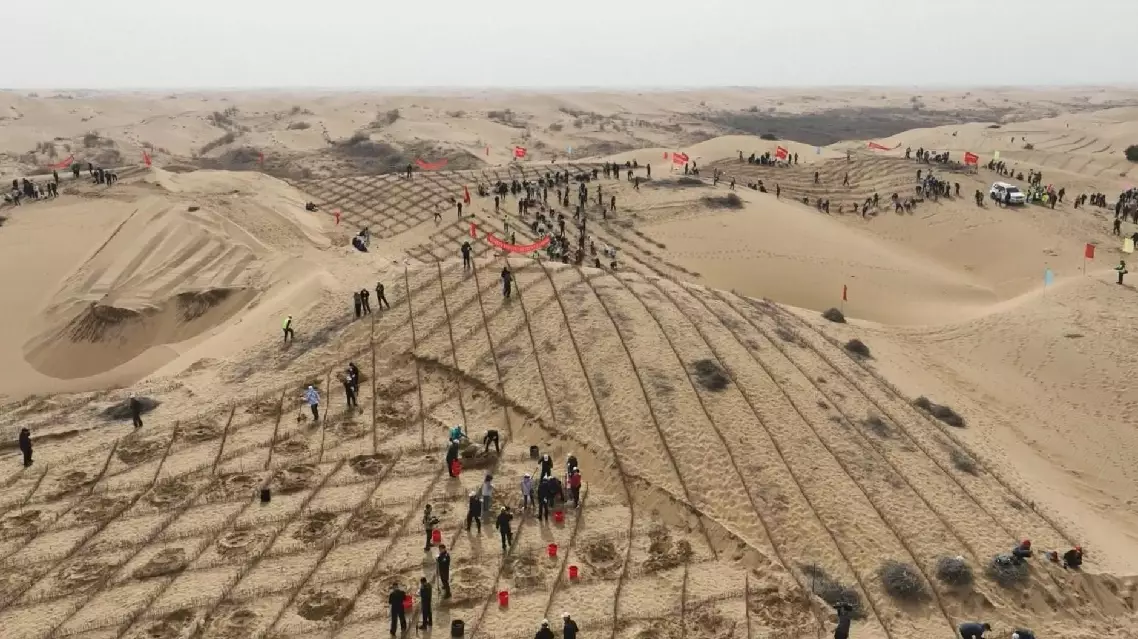
China was mocked when farmers began burying tons of straw in the Gobi Desert, but years later satellite images revealed that this simple technique was transforming shifting sand dunes into fertile land again.

Written by Bruno Teles

Published07/03/2026 às 22:19

The Gobi Desert shows how China used straw to stabilize sand dunes and slow desertification with a simple technique validated by satellites.
  • Reaction
  • Reaction
  • Reaction
  • Reaction
  • Reaction
  • Reaction

95 people reacted to this.

React with Like41Liked

React with I Loved It11Amei

React with Haha1Haha

React with Wow17Uau

React with Sad15Sad

React with Grr10grr

ouça este conteúdoreadme

In the Gobi Desert, China replaced unsuitable trees with thatched roofs, hardy shrubs, solar panels, and precision planting, reducing wind force, trapping dew and rain, stabilizing shifting dunes, and creating an ecological recovery that went from sounding like propaganda to becoming a fertile, concrete landscape once again.

No Gobi DesertThe crisis ceased to be merely a hostile landscape and transformed, over decades, into a direct threat to agriculture, transportation, water, and human habitation. In the 1970s and 1980s, desertification advanced more than 3.000 km² per year, burying villages, blocking railways, destroying crops, and pushing millions of people into a state of environmental displacement within China itself.

It was in this context that a seemingly ridiculous idea began to take shape. Instead of focusing solely on large trees or expensive construction projects, workers started burying dry straw in the sand in geometric shapes. What seemed like improvisation turned into ecological engineering.…and what seemed like waste became a base for retaining moisture, blocking the wind, and… restore stability the dunes that previously moved uncontrollably.

When sand ceased to be a local problem.

Green wall or greenwash? Analyst flags risks in Karnataka’s desertification plan

Counterview

News Blog

Image

By A Representative

A proposal by the Karnataka State Policy and Planning Commission (KSPPC) to construct a 350-kilometre-long ‘green wall’ across five districts in North Karnataka has drawn sharp criticism from a senior power and climate policy analyst, who has urged the state government to prioritise protection of existing natural forests over launching what he termed a “grandiose and uncertain” afforestation initiative.

The planning panel recently recommended building a green corridor from Belagavi to Bidar to check desertification in the arid and semi-arid regions of North Karnataka. The proposal envisions a continuous stretch of plantations cutting across five districts as a climate adaptation measure.

In a detailed representation dated February 25 and addressed to the Deputy Chairperson and Chairperson of the Commission—who also serves as Chief Minister—Shankar Sharma, a Karnataka-based Power and Climate Policy Analyst, questioned both the ecological rationale and implementation feasibility of the project.

While acknowledging that the proposal may increase green cover in some districts, Sharma argued that large-scale “green wall” models have had limited proven success globally and within India. He expressed concern that such projects often rely on monoculture plantations, suffer from low sapling survival rates beyond 10–15 years, and face weak long-term protection mechanisms. He also cited what he described as the state’s poor track record in forest conservation and compensatory afforestation, suggesting that authorities have struggled to safeguard even existing forest lands.

Instead of a linear plantation belt, Sharma recommended strengthening decentralised social forestry initiatives across taluks, towns and cities, with an emphasis on drought-resistant, native species that require minimal water and support biodiversity.

A major thrust of the representation focuses on forest diversion in the ecologically sensitive Western Ghats, a UNESCO World Heritage region and the origin of many of Karnataka’s rivers. Sharma argued that with nearly 70% of Karnataka officially classified as arid or semi-arid and over half marked as drought-prone, preserving natural forests in the Ghats should be the state’s top ecological priority.

He noted that Karnataka’s total forest and tree cover currently stands at about 23%, well below the 33% target set under the National Forest Policy. According to him, the figure has not exceeded 26–28% for decades, even as successive governments have permitted diversion of forest lands for infrastructure and energy projects. Sharma claimed that project proposals under various stages of approval in the Western Ghats could result in the felling of over 20 lakh trees.

In his letter, Sharma highlighted several major projects that allegedly involve diversion of forest land, including the proposed 2,000 MW Sharavati Pumped Storage Project in the river valley, which he said could affect around 400 acres of tropical rainforest; a 1,500 MW pumped storage project in the Varahi river valley involving forest land within wildlife sanctuaries; a 1,500 MW project in the Malaprabha river catchment area reportedly requiring felling of over 50,000 trees; the Mekedatu balancing reservoir project involving more than 10,000 acres of forest land, including significant portions within a wildlife sanctuary; and diversion of forest land in the Kali region for a 400 kV power transmission line.

Sharma contended that many such projects are either non-essential or have feasible alternatives that would require little or no forest diversion. He specifically advocated consideration of Battery Energy Storage Systems (BESS) as an alternative to large pumped storage projects in ecologically sensitive zones.

Linking the debate to climate change, Sharma argued that loss of natural forest cover is often the first step toward desertification. He warned that if deforestation continues unchecked, even parts of the Western Ghats could face long-term ecological degradation. He called for a holistic review of the green wall proposal in light of projected climate risks and the state’s rising electricity demand. Rather than investing thousands of crores in what he described as a vague project, he urged the government to prevent diversion of existing high-value forests and apply rigorous cost-benefit analysis to all major infrastructure proposals.

As a more sustainable strategy, Sharma recommended a time-bound plan to raise Karnataka’s overall forest and tree cover to 33% within the next 8–10 years through district-level afforestation programmes tailored to local ecological conditions. He also requested that the Commission convene discussion sessions involving civil society groups, environmental experts and energy planners to deliberate on biodiversity protection, freshwater management and the state’s future energy pathway. Two discussion papers have reportedly been submitted to support informed deliberations.

There was no immediate response from the Commission or the state government to the concerns raised. The green wall proposal is expected to figure in upcoming policy and budget discussions, even as environmental groups signal that the debate over balancing development, energy security and ecological preservation in Karnataka is likely to intensify in the weeks ahead.

Minister vows to implement canal excavation programme

https://www.observerbd.com/news/568910

Published : Sunday, 8 March, 2026 at 7:30 PM  Count : 254

Upazila Representative

Image
Image
Image
Image

Water Resources Minister Md Shahid Uddin Chowdhury Anee has stated that the government will protect country from the threat of desertification by implementing a nationwide canal excavation program and ensuring proper water conservation.

He made the remarks while speaking to journalists during a visit to inspect the Balrampur Sahapara canal in Dinajpur’s Kaharol upazila on Sunday afternoon.

The minister said that under the canal excavation program, rivers, canals and water bodies covering about 20,000 square kilometres across the country will be re-excavated. The initiative aims to conserve water resources and improve irrigation facilities for agriculture.

He also informed that the official inauguration of the canal excavation program will be held on March 16, 2026, and will be inaugurated by Prime Minister Tarique Rahman. The program will be launched simultaneously across the country.

According to the minister, the re-excavation of the Balrampur canal in Kaharol will bring around 6,000 acres of agricultural land under cultivation, benefiting local farmers and strengthening agricultural production in the area.

China’s bold drive to counter desertification | CNA Correspondent

Once seen as unstoppable, northern China’s deserts are now being reclaimed by forests, sprawling solar farms and even tropical fruit plantations. While officials hail it as a triumph, how durable is this green transformation? Genevieve Woo sits down with correspondent Tan Si Hui to discuss the scale of China’s long-running anti-desertification drive, the people on the front lines and the trade-offs involved. Highlights: 00:56 What is anti-desertification? 02:25 People living in China’s deserts 07:00 Why some are leaving – and some are willing to stay 08:55 Growing fruit in the middle of a desert 11:09 It’s not just about planting trees. It’s about livelihoods. 15:06 Why climate change could derail everything 16:39 Will they be on track to meet their 2050 goal?

China Is Doing More Than Just Turning Deserts Into Fertile Soil

https://www.bgr.com/2115106/china-turns-desert-soil-fertile-with-cyanobacteria/

By Joshua Hawkins – March 8, 2026 9:17 am EST

Calvin Chan Wai Meng/Getty Images
Over the past 60 years, scientists in China have been working on a project that could change how we approach the ongoing risks of desertification throughout the world. The idea is to take sandy, desert areas and then transform them into places where fertile soil can finally exist again. The benefit is two-fold. Not only would it create more fertile soil in those areas, but it would also increase the strength of the soil against erosion.

When you think about deserts, the first thing to spring to mind is likely the most iconic sandy place on our planet, the Sahara Desert. While humanity may have actually helped slow the desertification of the Sahara and places like it, it’s clear that the problem hasn’t been solved, as arid areas continue to erode and become drier. That’s why the Chinese are taking action, particularly in the Tengger and Kubuqi Deserts in the north of the country.

Finding ways to improve soil quality and slow erosion has been a key goal for Chinese scientists over the past several decades. In fact, a study published in the journal Soil Biology and Biochemistry in 2020 actually looked at a process that scientists have been using for over 60 years now. That process relies heavily on what researchers refer to as induced biological soil crusts (IBSCs), which basically act as barriers to protect soil and slow erosion, not only by trapping nutrients within, but also by holding everything together even in some of the harshest of winds.

Cyanobacteria, an ancient glue

Ray Hugo Tang/Shutterstock
There are three primary types of IBSCs used by scientists, lichen, moss, and cyanobacteria. And in this particular study, researchers have been using cyanobacteria alongside the other IBSCs to try to understand how the process can work, and how effective it is at slowing or even stopping desertification and erosion. The key to the process is what they call a soil “seed” which helps to form an artificial crust over the sand. Not only does this lay the groundwork for plants to actually grow in the sandy regions, it also helps to hold the sand together, by effectively gluing it down.

Cyanobacteria is estimated to be at least 3.5 billion years old, and may have once been responsible for turning Earth’s oceans green. However, what makes this bacteria so important to the researchers is its ability to provide much-needed resources like nitrogen to the soil around it. This allows the soil to soak up important resources it wouldn’t otherwise have ready access to naturally.

Beyond providing the soil with the needed resources to be considered “fertile,” the cyanobacteria has provided a good stopping point for erosion by dampening the effect of wind storms in the areas in which the process has been utilized. The glue-like layer that the cyanobacteria form helps to keep sand in place long enough for the roots of the plants to take hold, which in turn helps to hold the sand and surrounding dirt in place even better.

How cyanobacteria helps stop erosion

Dynamoland/Getty Images
However, desertification goes much further than just these deserts, especially as the fight against climate change continues. And with more desert-like areas spreading, scientists have been looking for ways to not only give plants in those affected areas a new lease on life, but also a way to stop the continued erosion of those areas entirely.

By turning the soil into something more fertile, the researchers also helps to stop the sand from being picked up by dust storms. This not only protects the plants from the harsh effects of those storms but also helps to limit further erosion in the areas where the cyanobacteria have been spread. It’s a joint effort by the plants and the bacteria, which seems to be working.

Over time, the crust that the researchers placed has gradually evolved, changing from a simple cover of microbes and bacteria to one that is made up of lichens and patches of moss. This provides a stronger surface against dust storms. What is also extraordinary, is that the researchers found when comparing areas where cyanobacteria had been added to the microbial layers, the crust growth was expedited by years. A process that used to take decades to properly take hold could now be achieved in a matter of just two to three years.

UNCCD Press ReleaseUN summit to focus on healthy land for resilience, stability and prosperity

Arabic | Chinese | French | Russian | Spanish

Mongolia and UNCCD unveil thematic days five months ahead of COP17 in Ulaanbaatar 

Ulaanbaatar/Bonn, 17 March 2026 —  Five months ahead of the seventeenth session of the Conference of the Parties (COP17), Mongolia and the United Nations Convention to Combat Desertification (UNCCD) today unveiled the thematic days and action agenda for the conference, to be held in Ulaanbaatar from 17–28 August 2026 under the theme ‘Restoring Land, Restoring Hope.’ 

Delegates from UNCCD’s 197 Parties will join scientists, businesses and land stewards in Ulaanbaatar for COP17 to advance action for healthy land as a cornerstone of global resilience, stability and prosperity. 

Scaled-up finance for land restoration and drought resilience, alongside the future of the world’s rangelands and pastoralists, will shape the COP17 agenda, with the conference aimed at translating global commitments into measurable progress on the ground. As the first of the three Rio Conventions COPs—on land, biodiversity and climate—meeting this year, UNCCD COP17 will set the pace for the rest of 2026 and beyond. 

UNCCD Executive Secretary Yasmine Fouad said: “Over the past decade, countries have committed to restoring one billion hectares of degraded land by 2030 and more than 70 now have national drought plans. COP17 is our opportunity to turn these commitments into real change on the ground. That means mobilizing finance at scale for land restoration and drought resilience, investing in preparedness rather than costly crisis response and recognizing rangelands as vital assets for economies, cultures and climate. The thematic days and action agenda for COP17 reflect a simple truth: healthy land underpins food security, water availability, economic resilience and stability everywhere —and the time to act is now.” 

Mongolia’s Minister of Environment and Climate Change, Batbaatar Bat, stated: “For the Government of Mongolia, the Riyadh–Ulaanbaatar Action Agenda is a strategic, participatory framework to mobilize citizens, businesses, cities and all stakeholders to restore critical ecosystems, including rangelands and agricultural lands. It drives investment in the land–water nexus and strengthens drought resilience. We call on leaders from all sectors to join us at COP17 to accelerate solutions for resilient economies and societies.” 

To help focus discussions and mobilize action, COP17 will feature thematic days dedicated to key priorities on the global land and drought agenda. These will bridge political decisions with real-world solutions, making everyone part of a powerful Action Agenda to advance land restoration and drought resilience. The four thematic days planed for COP17 are:

  • Finance (24 August): Restoring land at scale requires around one billion US dollars per day, but current funding falls far short. Finance Day will bring together ministers of finance, development banks and the private sector to help close this gap and unlock large-scale investment. 
  • Water (25 August): By 2050, three out of four people worldwide are projected to face drought. Water Day will advance proactive drought risk management and strengthen cooperation on the integrated management of water resources. 
  • Land and People (26 August): Rangelands support the livelihoods of some 500 million people but remain among the most undervalued ecosystems globally. Land and People Day will place the voices of land stewards at the heart of discussions, highlighting the perspectives of Indigenous Peoples, local communities, pastoralists, youth, women and civil society organizations. 
  • Food Systems and Soil Health (27 August): By 2050, the world will need to produce at least 50 per cent more food, even as food systems remain the leading driver of land degradation globally. Food Systems and Soil Health Day will connect soil restoration to food security, agricultural productivity and the livelihoods of farming communities. 

“The thematic days of COP17 are designed to focus global attention where it matters most — on the solutions and partnerships needed to restore land, strengthen drought resilience and support the people who take care of our ecosystems. By bringing together governments, scientists, businesses, local and pastoralist communities as well as Indigenous Peoples around shared priorities, we aim to move from commitments to implementation and help ensure that healthy land continues to sustain communities, economies and ecosystems for generations to come,” added Executive Secretary Fouad.  

For media enquiries 

UNCCD Press Office: press@unccd.int  

Notes to editors 

More information about UNCCD COP17 is available from: https://www.unccd.int/cop17  

Applications for the UNCCD COP17 Land and Drought Media Reporting Fellowship are open until 15 April 2026: https://www.unccd.int/news-stories/stories/open-call-unccd-cop17-media-reporting-fellowship  

About UNCCD  

The United Nations Convention to Combat Desertification (UNCCD) is the global vision and voice for land. We unite governments, scientists, policymakers, private sector and communities around a shared vision and global action to restore and manage the world’s land for the sustainability of humanity and the planet. Much more than an international treaty signed by 197 Parties, UNCCD is a multilateral commitment to mitigating today’s impacts of land degradation and advancing tomorrow’s land stewardship to provide food, water, shelter and economic opportunity to all people in an equitable and inclusive manner. 

China to extend “green wall” in battle against desertification

2026-03-15 17:41 Last Updated At:03-16 13:26

https://www.bastillepost.com/global/article/5691167-china-to-extend-green-wall-in-battle-against-desertification

China’s outline of the 15th Five-Year Plan (2026-2030) places consolidating and expanding the ecological security barrier in a prominent position, with a focus on advancing desertification control through the Three-North Shelterbelt Forest Program (TSFP) — the world’s largest afforestation project.

The new five-year outline, approved by Chinese lawmakers on Thursday, calls for comprehensively advancing the three landmark projects of the national shelterbelt program in northeast, north and northwest China.

The three projects refer to the goal that by 2030, the country aims to achieve significant desertification control results through the TSFP in three regions: the Hexi Corridor-Taklimakan Desert region, the two sandy lands of Horqin and Hunshandake, and the areas near the meandering bends of the Yellow River.

To track progress, the outline establishes concrete environmental benchmarks for the TSFP zone by the end of the decade: forest and grassland coverage is targeted to reach 40.9 percent, 67 percent of treatable sandy land is to be brought under control, and the comprehensive vegetation coverage of sandy areas is expected to hit 22 percent.

Zhang Huaiqing, chief scientist of the Chinese Academy of Forestry, emphasized the need to adopt a more scientific approach to desertification control.

“As the TSFP enters a critical phase in its all-out campaign to tackle the toughest challenges, the philosophy behind science-based desertification control has evolved — from simply enhancing vegetation coverage to promoting comprehensive ecological restoration across affected areas. We are now utilizing technologies including remote sensing, artificial intelligence, and big data to make our efforts more precise and efficient. Sci-tech empowerment is helping us consolidate this ‘Green Great Wall’ in north China,” he said.

China to extend "green wall" in battle against desertification

China to extend “green wall” in battle against desertification

Mapping Priority Remediation Areas for Soil Erosion in Karst Regions Under Shared Socio-Economic Pathways

https://onlinelibrary.wiley.com/doi/10.1002/ldr.70541?af=R

Ling XiongRui Li

First published: 09 March 2026

ABSTRACT

Soil erosion strips away fertile topsoil, posing challenges to global ecology and food security, particularly in the karst regions of southern China. However, research on soil erosion risk in karst areas under the dual influences of climate and land use changes remains scarce. Specifically, the question of how soil erosion risk in karst regions will change probabilistically in the future has not been effectively addressed. This study proposes a novel assessment framework from a risk probability perspective. Within this innovative framework, we employ Bayesian Belief Networks (BBN) to link future Land Use and Land Cover (LULC), climatic factors, and soil erosion management. By integrating various SSP-RCP scenario data through Geographic Information Systems, we assess the probabilistic risk of soil erosion induced by future climate and socio-economic changes. BBN sensitivity analysis reveals that LULC, slope, and precipitation are key factors influencing soil erosion. Compared to 2020, the probability of various soil erosion levels under four future scenarios generally shows a declining trend, with the greatest decrease observed under the SSP126 scenario. High-risk areas for future soil erosion are primarily concentrated in the northern and western parts of the study area. Spatial planning for soil erosion control should focus on adjusting the key states of key variables for different soil erosion risk levels in these regions to reduce the likelihood of soil erosion risk. This study provides a promising visual decision-making tool for developing climate-adaptive soil erosion risk management plans and broadens new perspectives for future soil and water conservation planning from a risk probability standpoint.

China extends ‘green wall’ with new tech to fight deser­ti­fic­a­tion

https://www.pressreader.com/kuwait/arab-times/20260316/282071988415765

  • Arab Times
  • 16 Mar 2026
Image
Aerial photo taken on Aug. 16, 2022, shows a truck traveling on a road surrounded by forests in Horqin Left Wing Rear Banner, Tongliao City, in northern China’s Inner Mongolia Autonomous Region. (Xinhua)

HOHHOT, March 15, (Xinhua): On the northern edge of Maowusu, the fourth largest sandy area in China, Zhang Zhanjiang, a veteran local farmer, found himself faced with unfamiliar modern planting techniques.

He did not expect that tree planting nowadays would involve such precise work. Overhead, drones were buzzing as they conducted monitoring and transportation of supplies, while on the ground, planting machines had largely replaced manual labor, with technicians using remote sensing data to track planting results.

Zhang was among more than 100 beginners to join the local afforestation campaign this spring in a township of the city of Ordos, north China’s Inner Mongolia Autonomous Region.

Watching a technician’s demonstration, Zhang crouched on the sand to adjust depth and angle in employing the planting machine to drill suitable holes for inserting branches of a desert plant, Salix mongolica, while also tamping the sand with his shovel.

He then went to check on his work via remote sensing data displayed on the technician’s tablet computer. Zhang carefully studied data such as soil moisture and made fine adjustments to planting spacing based on the feedback, as these factors can affect the survival rate of the seedlings.

“In the past, this sandy area produced shifting sand. Nothing planted could survive,” he said, while gesturing at the freshly planted rows of willow cuttings. “Now we’re learning how to fix it.”

As the group of trainees operated machines for planting, drones airlifted bundles of straw, which were to be used in weaving grass checkerboards to protect small trees.

This, notably, is the front line of China’s 2026 campaign to fight desertification. As the country marked its 48th National Tree Planting Day on Thursday, the National Greening Commission reported that China’s forest and grass coverage rate has exceeded 56 percent thanks to its greening efforts.

Meanwhile, local authorities in desertification-prone areas have embarked on this year’s greening drive armed with mobilized manpower, decades-long experience of afforestation innovations and intelligent equipment.

China is among the countries with the most severe desertification globally, with its desertified areas mainly located in northwest, north and northeast China, which are dubbed the “three-north.”

The country in 1978 initiated its landmark ecological project, the Three-North Shelterbelt Forest Program, which has become the world’s largest afforestation endeavor. Scheduled to be completed by 2050, the program has the aim of rehabilitating and greening desert-prone lands and desertified areas in the “three-north.”

To boost these efforts, Inner Mongolia, ranking top among the country’s provincial-level regions by accomplishing a total of 123 million mu (about 8.2 million hectares) of ecological construction and 66.88 million mu of sand prevention and control during the 14th Five-Year Plan period (2021-2025), plans to continue three major afforestation campaigns this year, expected to green a total area of 40 million mu, said Wu Guoqing, deputy director of the regional bureau of forestry and grassland.

One of the battlefields is located in the Alxa League, where smart equipment is playing an important role in the fight. Drones disperse grass seeds and seedlings from the air, while largescale desert control machinery traverses the sandy terrain.

Tong Keting, director of the rural revitalization office in Alxa High-Tech Zone, said that by combining mechanical operations and manual work, vegetation coverage in the targeted area has been increased from less than 5 percent to over 40 percent, while annual sediment inflow into rivers had decreased from 500,000 tonnes in 2016 to 300,000 tonnes in 2025, demonstrating tangible results.

FG, World Bank Move to Rescue Northern Landscapes from Desertification with New Catchment Plans

https://www.thisdaylive.com/2026/03/10/fg-world-bank-move-to-rescue-northern-landscapes-from-desertification-with-new-catchment-plans/

Michael Olugbode in Abuja

The federal government has intensified efforts to halt worsening desertification and environmental degradation across northern Nigeria with the validation of nine Strategic Catchment Management Plans aimed at restoring degraded landscapes and protecting water resources.

The plans are being developed under the Agro-Climatic Resilience in Semi-Arid Landscapes Project (ACReSAL), a major climate resilience initiative supported by World Bank and implemented by Federal Ministry of Environment, in collaboration with other key federal agencies.

At a high-level validation workshop in Abuja, government officials, development partners, and environmental experts warned that millions of Nigerians in the northern region were already grappling with severe ecological pressures that threatened food security, livelihoods, and community stability.

Nigeria’s Minister of Environment, Balarabe Lawal, said the environmental crisis confronting the region was no longer theoretical but a daily reality for farmers, herders, and rural communities.

Lawal said advancing deserts, erratic rainfall patterns, shrinking water bodies, and degraded farmlands were steadily eroding agricultural productivity and deepening poverty across the 19 northern states and the Federal Capital Territory (FCT).

“These are not abstract environmental concerns. They threaten the food on our tables, the income of our farmers and herders, and the stability of our communities,” Lawal said.

According to the minister, the ACReSAL project represents Nigeria’s most comprehensive response yet to the growing environmental emergency, bringing together Federal Ministry of Environment, Federal Ministry of Water Resources and Sanitation, and Federal Ministry of Agriculture and Food Security to drive coordinated climate resilience interventions.

He explained that the Strategic Catchment Management Plans formed the backbone of the intervention, providing a detailed roadmap for restoring degraded landscapes, protecting watersheds, and strengthening sustainable resource management across vulnerable ecosystems.

Representing Minister of Water Resources and Sanitation, Joseph Utsev, Director of Hydrology, Abohwo Ngozi, said the workshop was convened to review and validate the final nine catchment management plans developed under the ACReSAL framework.

Ngozi stressed that the plans will guide integrated management of critical water catchments, while addressing growing environmental threats facing communities across northern Nigeria.

She warned that desert encroachment, degraded soils, and unpredictable rainfall were already undermining food production and threatening the livelihoods of millions of farmers and pastoralists.

“As we meet here in Abuja, millions of citizens across the northern states are battling advancing deserts, unreliable rains, and shrinking water bodies,” she said.

“These are real pressures that threaten the food on our tables and the economic survival of our rural communities,” she added.

National Coordinator of ACReSAL, Abdulhamid Umar, represented by Shettima Adams, said the validation exercise marked a critical step in translating years of environmental planning into concrete actions on the ground.

Umar disclosed that the nine catchment plans covered Malenda, Oshin-Oyi, Gurara-Gbako, Aloma-Konshisha, Benue-Mada, Sarkin-Pawa-Kaduna, Zungur-Gongola, Gaji-Lamurde, and Hawul-Kilange.

According to him, the catchments cut across several states, including Adamawa, Bauchi, Benue, Borno, Gombe, Kaduna, Kano, Katsina, Kebbi, Kogi, Kwara, Nasarawa, Niger, Plateau, Taraba, Yobe and Zamfara, as well as FCT.

Umar stated that the catchment boundaries were designed around ecological systems rather than political borders to ensure more effective environmental management.

He said the plans were developed through extensive consultations with communities, farmers, and other stakeholders to ensure that the solutions reflect the realities on the ground.

“These plans are more than policy documents. They capture the voices of communities and identify the real environmental challenges they face — deforestation, eroding soils, shrinking water sources and overgrazed lands,” he said.

He added that the framework will guide future investments in tree planting, climate-smart agriculture, improved water management, and other rapid-impact restoration initiatives designed to deliver immediate benefits to rural households.

In a goodwill message on behalf of the World Bank Task Team Leader, Joy Iganya Agene, the bank’s representative, Henrietta Alhassan, said the validation of the catchment plans was a major milestone in efforts to strengthen climate resilience across Nigeria’s fragile semi-arid landscapes.

Alhassan emphasised that effective catchment management was fundamental not only for environmental protection but also for sustaining livelihoods, stabilising ecosystems and supporting long-term economic development.

“The work being validated here reflects the voices of communities, the insights of experts, and the commitment of government and development partners to safeguarding these critical landscapes,” she said.

Alhassan reaffirmed World Bank’s commitment to supporting Nigeria in advancing integrated catchment planning, climate adaptation, and sustainable management of natural resources as the country moves towards implementation of the strategies.
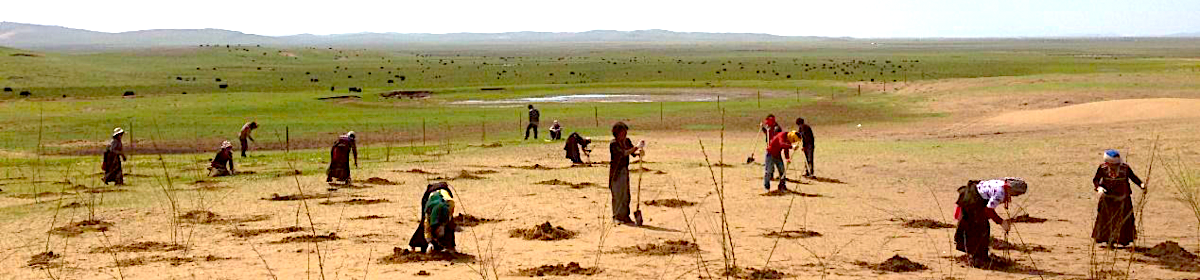
China’s great green wall: How 66 billion trees turned a ‘dead’ desert into a carbon sink

Story by TOI World Desk

https://www.msn.com/en-in/news/world/china-s-great-green-wall-how-66-billion-trees-turned-a-dead-desert-into-a-carbon-sink/ar-AA1Xfp4y

Across northwestern China, a desert long described as empty is showing measurable ecological change. New research examining the Taklamakan Desert finds rising vegetation cover and seasonal carbon uptake linked to decades of state-backed planting efforts. The findings suggest parts of this hyperarid region are beginning to function as a modest carbon sink. Scientists analysed satellite records alongside ground observations and detected stronger summer photosynthesis and declining net carbon emissions in restored zones. The work connects these trends to the country’s vast shelterbelt programme, often called the Great Green Wall. While uncertainties remain about scale and durability, the data indicates that even extreme drylands can respond to sustained ecological engineering, with possible implications for carbon management and desert control.

Design a site like this with WordPress.com
Get started