Showing posts with label The R Word. Show all posts

Friday, March 21, 2014

A Fair Shot

Other than my monthly wrap ups and the blog hop, I've been taking a needed blogging hiatus.  Rest assured I will be back to this and my other online efforts at some point. But for now, I'm taking some needed me and family time.

Today however, is World Down Syndrome Day.  I could not let this pass by without notice.

Last year, I wrote about some of the issues that I had with awareness campaigns, those for Down syndrome in particular.  I talked about awareness vs acceptance; marginalization by the medical community; inspirational porn and pedestal ableism; derogatory slang such as the R word; and flat out homicide.  I still stand by each and every one of these; they are real issues faced by people with Down syndrome every day, along with their families, allies and loved ones.

Plenty of socks/wacky socks/odd socks may seem like a fun, silly thing to do, to create awareness, but what does it do really?


Image
For the record, I hate socks, especially these horrible things.  *shudder*

Not a lot...   Outside of keeping your feet warm in what has been a god-awful winter.

Despite the presence of a lot of blue and yellow, including on Toronto's CN Tower and my current fingernail polish, not much will change about the lives with people living with Down syndrome today.  There will be pride, yes... there should always be that.  However, there will still be discrimination at the doctors office, by law enforcement, by teachers, counselors and therapists.  Much of it will be hidden under the guise of "meaning well" or paternalism, doing "what's best" for the person instead of considering individual needs, but it will still be there.  It may be based on old eugenics theories too, a sense of doing what's best for a skewed perception of "the greater good".  There is internalized ableism too within the community, and a lot of elitism even in the disability world towards those with intellectual disabilities.  There will still be a public perception of "lesser" and "sick" as our very language outlines how we really feel. 

As a society, we give a break to parents that murder/attempt to murder their children if they have a disability.  We wreathe these acts in compassion, that somehow the death of a child, of any person at the hands of another is okay if they have needs outside what is considered an able norm.  Instead of increasing community supports and education, we choose instead to buy into the tragedy rhetoric.   This year started out with another death of a person with Down syndrome, this time a 17 month old boy named Lucas Ruiz, who was poisoned not once, but twice by his parents in what they are calling a "mercy killing".  Both parents believed that their child who was born with an extra chromosome, a heart issue and required a feeding tube was "better off dead".   There are still many people who believe that he and people like my son should never have come into being at all, that Down syndrome is a burden to society.

After all the socks and banners and ribbons and awareness, and memoirs and conversations and "teaching moments", why are we still having these discussions?  Why are these things still happening?

What people with Down syndrome need is meaningful inclusion.  Is acceptance.  Equality.  PRIDE. A sense of community and of belonging.  Not socks.  Not pats on the head.  Not superpowers or heavenly qualities.  People with Down syndrome want a fair shot at having a happy life.

You know, the same stuff the rest of us want.  The same things I want for all three of my children, not just the "able" ones.

The same things we all keep writing about, over and over again.

Maybe this year we'll get lucky and someone will take the hint.

Happy World Down Syndrome Day.

Tuesday, March 4, 2014

In the News - February 2014

A collection of news articles, blogs, stories and information about Down syndrome, disability and special needs, from Down Wit Dat's Facebook page.  These are from February 2014.


Legend:
AUDIOindicates an audio clip
APPEAL indicates an online petition or plea
BLOG indicates a blog post
CASE indicates a lawsuit or proceedings
EVENT indicates a scheduled event
IMAGE indicates a graphic, image or comic
LAWS indicates a new piece of legislation
LINKS indicates links or resource materials
PHOTOS indicates photos
POLL indicates an online survey
POST indicates an advocacy statement made through social media
PRESS indicates a press release
QUOTE indicates a meaningful quote
STUDY indicates a study or discovery
THREAD indicates an online discussion thread
VIDEO indicates a video or movie clip
VLOG **NEW** indicates a video blog post


BLOG
Autistic people have the same rights as everyone else
LINKS
LINKS
Autistic Self Advocacy Network
IMAGE
"Introducing PACLA Magazine..."
Challenging Guardianship and Pressing for Supported Decision-Making for Individuals with Disabilities
APPEAL
POST
"Tonight at 10 -Paul needs a new heart, but they wont put him on the organ recipient list -all because he has #autism..."
VLOG

APPEAL
URGENT Action Alert: Contact the White House and Department of Labor

What Does the Research Say About Inclusive Education?
POST
BLOG
Stop… and Rail Against Stigma!
BLOG
Emma Discusses Biting
BLOG
BLOG
BLOG
the aRe word: the lecture
BLOG
The Old Man and The See
BLOG
It's Never "Just A..."
BLOG
It's not about political correctness, it's about not being an asshole
BLOG
Chalk Word Lines of Separation

BLOG
BLOG

What Musicians Can Tell Us About Dyslexia and the Brain
POST
"Experience teaches. And then, after a while, experience numbs," writes Will Saletan..."
IMAGE
"Non-Compliance is not a disorder. It is self-advocacy."

Peel board takes #fixtheformula message to school councils, community

Adult pulls sweater, teeth from 7-year-old student's mouth
BLOG
Calling People the R word
BLOG
Nobody Puts my Baby in a Corner
BLOG
The Ableist Mentality of “No Elevator to Success”
BLOG
I don't respect your (or my) intelligence
BLOGDeconstructing "Stupid"
BLOG
Autism, Empathy, and The R Word
BLOG
“Crazy”
BLOG
Let's Get Something Straight
BLOG
BLOG
This isn't a joking matter.
BLOG
BLOG
Violence in Language: Circling Back to Linguistic Ableism
POST
"The CDSS team supports #PinkShirtDay. Take a stand against bullying!"
POST
"Words mean things. They're pointers. That's the whole reason that we have..."
IMAGE
Privilege
POST
Inclusion: It can be done, and will benefit everyone.
BLOG
Inspiration Porn: Where Gawking, Guilt, and Gratitude Meet
IMAGE
BLOG
Dear Friendly Stranger

BLOG
Making Invisible Disability Visible: Stimming
BLOG

Backish

How Feminism Changed Us as Autism Parents

Sensory Sensitivities:  Understanding Triggers

IMAGE
"These autistic children are our authentic children and we owe them unconditional love."

Person With Down Syndrome ‘Delighted’ To Be Patted On The Head For 245th Time Today
BLOGWho Should Speak for the Disability Community?
BLOG

Inclusion, Communication and Civil Rights
POST"I’m a person with Down’s syndrome. I think if people with disabilities join together..."
BLOG
The Act of Telling

February also saw another edition of the T-21 Blog Hop...

Image

Thanks to all who participated.

The T-21 Blog Hop will take place every month on the 21st, for three days and will continue to feature advocacy posts from across the disability community.


...And that's the news.  Keep the stories and information coming!

Tuesday, November 19, 2013

It's Never "Just A..."

It never ceases to amaze me how many feel that this is actually open for discussion.

I, and countless other advocates for the Intellectually Disabled (including self-advocates) hear "it's just a..." in regards to each new thing that crops up, each new use of the word "retarded".  It's just a word.  It's just a lipstick.  It's just a shirt.  It's just a cat.

"Political correctness", "my rights", "free speech", historical etymology... it's almost fascinating to watch the entitled defense of this word, except the posturing makes me sick each and every time.

Here is the thing:  it doesn't matter who you are or who you know.
It doesn't matter what context you felt you were using it in.
It doesn't matter what poorly fabricated rationale you or your PR team comes up with to explain the use of this word.

Truth be told, you wouldn't defend yourself so hard if you didn't already know what you are doing is wrong.

Ultimately though, it's not about you, or your rights at all. 

It's not even about the Ann Coulters or the Jennifer Anistons or the Kat Von Ds or some comedian or shock jock DJ or any other sheltered celebrity or athlete that thinks they know better than the rest of us. It's not how you feel about this word, whether you are currently engaged in a scholarly debate or describing your life's latest little inconvenience. 

It's about others.

It's about the hundreds of thousands of people with Intellectual Disabilities and Developmental Delays, whether acquired congenitally or otherwise.  It's about people with Down syndrome, Autistics and people that are brain injured.  It's for those with aphasia and disabilities that affect communication. It's about their families and those that love them.

It's about people that are different than you. 

This word, this "R word", whether used as "Mentally Retarded", "retard(e)", "tard", "celebutard", "fucktard" or any other mash up (portmanteau) word ending in "-tard", has been used to denigrate. 

People.

It has been used by those in authority, by those in society to condemn people to a life of poverty.  To segregate.  To ridicule.  To sterilize involuntarily and subject to horrific experiments.  To abuse sexually, physically and emotionally.  To deny health care that many of us take for granted.  To isolate and institutionalize, to deny the most basic of rights...  including "free speech".  To bury in nameless graves by the thousands.  To be determined "life not worthy of life", loaded onto buses and killed, the bodies burned after being subjected to experiments.  To have the stolen organs and tissue to still be laboratory curiosities decades later.

This word, the one that you insist on using, yet claim means nothing to you?

It means EVERYTHING to us.

I mean "us" on this too...  Advocates of all stripes stand together on this.  This word means enough to us to unite and motivate us all to action, to write, to call, to petition, to picket.

This word?  You can call it our Jim Crow.  It is our Holocaust, both in reality and in metaphor.  This resistance is our Stonewall riots,  if that comparison makes it easier for you to understand.  Whether you do finally or not however, understand this:

It is not about you. 

It is about people like my son and their right to live in society;  to have an education; to live their life like any other.

This word embodies the removal of some of the most basic physiological and safety needs.  When you use this word or any of its permutations, when you exercise and flex your privilege, you participate actively in the removal of the rights of another.  You perpetuate the scorn, the hurt, the marginalization.

Those with disabilities are flavours of humanity; this world needs to accept this once and for all.  What keeps people with disabilities from leading their lives is not their "conditions".  It is society and the able bodied people in it.  It goes beyond a ramp, beyond an accessible door or parking, past service animals and assistive devices, deep into the rhetoric of our own language

Those who continue to use and defend this word are party to the atrocities committed in its name.

So it's never just a cat or a lipstick or a word or a matter of being polite.  It's not about being "too sensitive" or "politically correct" or "thinking that way" or intent or even "toughening up".  It's not about your rights to free speech.  It's about people.  People who live in a society that is ever ready to abuse and discard it's own citizens.

This has to stop.

Please.

Monday, July 8, 2013

Picking Rocks

"Ableism is so pervasive that it is difficult to identify until one begins to interrogate the governing assumptions of well-intentioned society. Within the space allowed by these rhetorical premises, ableism appears natural, necessary, and ultimately moral discrimination required for the normal functioning of civilization."
[A]bleism is that most insidious form of rhetoric that has become reified and so widely accepted as common sense that it denies its own rhetoricity—it "goes without saying." To fully address it we must name its presence, for cultural assumptions accepted uncritically adopt the mantle of "simple truth" and become extremely difficult to rebut. As the neologism "ableism" itself testifies, we need new words to reveal the places it resides and new language to describe how it feeds. Without doing so, ableist ways of thinking and interpreting will operate as the context for making sense of any acts challenging discrimination, which undermines their impact, reduces their symbolic potential, and can even transform them into superficial measures that give the appearance of change yet elide a recalcitrant ableist system..."
[Excerpts from  James. L. Cherney's "The Rhetoric of Ableism."]
 
I'm a mother and a nurse, not a scholar.  I'm not going to make any pretensions about that.   I'm also a half-assed gardener and occasionally, I take a pretty picture of something I've grown or of someone to whom I've given birth.  As a "writer" I am one voice in the wilderness of the blogosphere.  I came into this role woefully unprepared and in the process have discovered many things about Down syndrome, our world, our Western society and indeed, myself.  I started this place as a "Mommy blogger" and am slowly growing into a disability advocate.  I started out thinking that I could try to change a few minds and that would help create a world that was more receptive to people like Wyatt.  I wanted to help build a garden where old stereotypes did not linger in people's minds. A world where the phrase "my son has Down syndrome" would not automatically generate uncomfortable looks, apologies or awkward exclamations of sentimental rubbish.

Lately, I've been preoccupied with the subject of ableism and how it impacts my son.  Western culture is rife with it.  It is buried, deep within the rhetoric, deep within the language that we use to share our opinions to one another.  When it comes to the subject of advancement of people with intellectual disabilities such as Down syndrome, the tools that we advocates have chosen to use may appear to advance our goals of inclusion and acceptance. Sadly, those tools, in many cases, do the exact opposite.  How we view disability, how we see each other, how we as parent and friend advocates feel about the the world-at-large all impact our efforts. I've also realized that I shouldn't be planting anything for my son, but rather preparing the soil for him to sow a garden of his own.


It was those two quotes above that finally clarified what I had suspected for some time.  We are overgrown with ableist rhetoric, whether we mean to be or not, no matter how "good" our intentions. On the surface, the very words that we choose shape how others perceive us and how we see the world. The grand daddy of them all, the R word, is a perfect example of this.  However, the dialogue goes deeper than that.  Like rhizomes, negative concepts that shape our entire perception of disability are spread throughout our history, dating back to Aristotle.  As Cherney states, ideas such as "normal is natural", "disability is evil" and the "body is able" are rampant throughout the Western world.  Other rhetoric, including those that incorporate socioeconomic or religious ideals (such as "disability is uneducated", "disability is baseborn", "disability is ethnic") seem to sprout up everywhere.

These are all part of our great post-colonial tradition of "less than".  Our everyday language shows that we see others with disdain.  That able and functioning at optimum physical perfection is what we are all supposed to be and anything else is a failure;  lesser;  unworthy.  Even amongst "disabilities" there is a difference.  We in the Western world commonly refer to those that employ physical assistive devices such as wheelchairs and support animals as "differently abled".  Those that have cognitive impairments however are "developmentally disabled".

There's a fossil in there somewhere...As I've mentioned, I come from a medical background.  For years, I embraced a more mechanical definition of disability, which in its most basic form states "this part isn't working as it should, therefore the patient is disabled". The person is seen as broken, malfunctioning, stunted.  This quickly leads to pity disguised as empathy.  Then to romanticism, as an artistic touch is now given to what is "broken".  A more realistic viewpoint is the social model; this way, disability is described by a series of barriers, exclusions and negative attitudes (that includes language).  An individual may have a physical, cognitive or psychological difference from their neighbours, but it is the lack of societal provision that makes it an actual disability.  Humanity is diverse and flourishing;  it is only when a person runs into a situation where their needs are not met, can they be defined as actually having a disability.  Most can easily relate this model to well known things, such as ramps or closed-captioning. However, when it comes to DS and challenges of communication and interpretation, as a culture we cannot seem to move beyond the medical model.  No one seems to want to say that it is society that has disabled these individuals, not their neurological makeup.  Even within the whole of the disability community itself, those with Down syndrome and related developmental disorders are considered less than.

From the medical tradition you also get the -isms:  Infantilism, where those with DS are seen as adult babies,  "Baby Huey", or 'forever children'.  It is probably the most insidious, as it strips all dignity and sense of self and worth from the individual.  They are forever dependent, in the most basic sense.  There is also Anthropomorphism, where those with Down syndrome are referred to in supernatural or angelic terms or possessing traits that are more like "powers".   Quite possibly the most sneaky of them all (and one that I am guilty of as well) is Paternalism, where all decisions, beyond a point where they should be made by the person themselves, are removed and placed in the hands of those who are deemed--by the same abilist society--as being more qualified, be they parent, school, doctor or organization.   This model often decides "what is best" and assumes as Cherney states, that "it goes without saying", based on old, outdated practices and ideas.  For example, we are told that those with DS do not follow "typical" patterns of growth or development and that these ideals should not be applied.  Yet, we still continue to apply them with the attitude of "how else will we know whether the child is behind?",  instead of just allowing the child to develop at their own pace in a loving, supportive, caring environment.  IQ tests are culturally biased and archaic, yet we still continue to use them to determine 'level of cognition' and therefore predetermine a person's 'functionality' and thereby, worth.  Our organizations, both religious and philanthropic, readily fall into this trap too, as they betray their roots as the charities that they were originally founded as, to help "the poor unfortunates".   Regardless of the origin, regardless of some degree of "good work" having been performed, regardless of intent, the result is the same:  an abilist act grown of an abilist system.  Each and every time it is employed, it undermines those with Down syndrome.  It hampers efforts to become more visible, for those with DS to move out of the world of poverty and neglect.


Rocks Not surprisingly most of the Down syndrome advocacy movement is borne of this ableist system, myself included.  We allow the rhetoric to continue by ignoring demeaning language such as the R-word,  by describing our loved ones in childish terms, by giving them "angelic" or "superhuman" qualities, by romanticizing the medical definition of disability and by continuing to make all decisions for them.  We, the people that are supposed to be helping, are only perpetuating stereotypes.  Pictures of good looking kids with catchy sayings may sound like a good idea (and I won't deny that there was a certain purpose served by this initially), but they are not.  My son's extra chromosome is not kitsch, it is not property, it is not made of love.  He is not an angel and he himself is not perfection incarnate.  I did not design him either, nor do I believe a supreme being handcrafted him for our family... I only had the pleasure of providing half of his genetic material.

I've run into a lot of nationalism too.  Recently I read a Letterman-style "Top 10" list of reasons why one particular country was the best in which to raise a child with complex needs.  The article will no doubt be shared far and wide within the advocacy communities and it saddens me, as the article itself is so rife with inconsistencies, poorly researched half-truths and flat out falsehoods that it actually turned my stomach to read it.  Blogging communities seem to be often divided among these national lines as well.  There also seems to be some kind of hierarchy in the advocacy world;  the more disabled your child/loved one/you are, coupled with the amount of "time served" you have in this community, the more of an "expert" you are. Assuming there is such a thing in the first place. Politics within the movement itself are rapidly threatening its very life;  I don't know whether to laugh or cry when I see those calling for inclusion acting very negatively and exclusive in their practise. 

Finding your niche...But what about the world outside?  Much of what gets published about Down syndrome or special needs in the mainstream these days might as well be misery peddling. Subjects that go well beyond simple anticipatory grieving seem to be de rigueur and are now perpetuating the negative stereotypes that we are fighting so hard against. Initially, I'm sure this trend was meant to be a way for parents to find fellowship in what can be some very long and seemingly isolating days.  But, how much negativity can one person read surrounding a certain condition before they start applying those traits to that condition?  In our sensationalist world, unless a piece about disability keeps things at status quo (ie: 'less than'), it is not publishable.  Full of anger towards your child's diagnosis?  Blame your child's diagnosis for your own personal issues?  STOP THE PRESSES!  Depression, disgust,  having to "force" one's self to play with one's own child... these are are all things that go well beyond the realm of a grief reaction or situational crisis and in the end only feed our detractors and probably belongs in a therapist's office.  In the end, which is worse?  Our own community disparaging those that they claim to represent, or those outside that hate our kids? 

Then there is the stereotypical "Down syndrome superstar", who by having a prom date or scoring a goal or participating in a major life event, allows all to feel misty, paternal feelings.  Add a little more anthropomorphism, in the guise of "angels" and "my child has made me a better person" and you have the  domain of inspiraporn, which is just more ableist rhetoric.  The reality is that not every child will be a superstar and the effects of the extra chromosome will vary from child to child, as well as the resources and supports made available to them.  I'm personally guilty of this one, not realizing that the reason I felt the way I did when Wyatt was diagnosed with his AVSD (and probable chromosomal disorder) in utero, was the ableist society in which I lived.  If my culture had not continued to push the idea of the "hardship" or the "broken child", would I have been as sad as I was initially with his diagnosis?  Would I have grasped blindly for for the first sign of positivity,  the first glimmer of "hope" in the form of staged photo-ops and over the top inspirational motifs?  Let me put it another way:  if one truly accepts people with intellectual disabilities and developmental delays as equals, these stories would not be news.  However, many cling to them desperately, willing to overlook the weeds of ableism and instead renaming it a wildflower of "awareness".


Image
"Bucket of Rocks" shared with
permission from Chiotsrun.com
What this civil rights movement needs is more visibility.  Not from parents or people like me, but from the self-advocates themselves.  That is why I share almost everything from VATTA blog on our Facebook page.  It is the people with Down syndrome who need to create the language that describes them, it will be the self-advocates that create the new rhetoric to promote neurodiversity.  It is happening.  Slowly, seeds are germinating.

As one of my children has Down syndrome, I've had to evaluate my perceptions of disability over and over.  How will this affect Wyatt?  How can we, as his parents, best guide him to adulthood and allow him the freedom to advocate on his own behalf, whatever form that may take?  To reach "his full potential" on his own terms, not our abilist ones? At what point do I stop "parenting" and become "paternalistic"?  For now, I guess, my job is to continue to expose the rhetoric and ableism while nurturing the creation of a new construct, a new set of definitions that not only include neurodiversity but were created within that community.  Despite how disheartening all this can be sometimes, despite how physically and emotionally exhausting it is, I will continue to prepare the soil of this revolution.  My family will continue to explore the world of Intellectual Disability and Developmental Delay the only way we can, through the eyes of others, including our son.  I must persist with preparing this earth for my kids as they grow.  I know, one day, my son will communicate "It's ok, Mom... I've got this" and I will happily put down my bucket and drink a Mojito in the shade.  Until that time however, there is much work to be done.  All are welcome to offer a little sweat equity;  there is a lot of weeds to clear, soil to turn and rocks to pick...

Image
"Picking Rocks.." shared with permission from Chiotsrun.com
---------------------------
Cherney, James L. "The Rhetoric of Ableism." Disability Studies Quarterly 31.3 (2011):  The Rhetoric of Ableism | Cherney | Disability Studies Quarterly. The Society for Disability Studies. Web. 03 July 2013.

Thursday, April 4, 2013

Dream

"The whirlwinds of revolt will continue to shake the foundations of our nation 
until the bright day of justice emerges."
-- Rev. Dr. Martin Luther King, Jr.

Today is April 4th.

Forty five years ago today, a man named Martin Luther King Jr. was shot to death for speaking out about injustice, about poverty, about the denial of basic human rights and dignity.  His words, his actions shone a light into the darkest corners of prejudice and hatred.  

Eighty-two days ago, a man named Robert 'Ethan' Saylor died face down on a floor in a Maryland movie theater.  He died of positional asphyxiation after being handcuffed by three off-duty deputies who were moonlighting as security guards at the mall next to the theater.

His death too, has been ruled a homicide.

Ethan was not a civil rights leader.  He was a man who will always be defined by his Down syndrome.  His death is exactly what Dr. King was talking about.

It seems to be an easy thing, dismissing this man's death.  He had a developmental delay.  He looked differently, spoke differently.  Interpreted the world around him differently perhaps.  Took a little longer to respond to things than you or I probably.  The different.  The other.

Ethan died because he had Down syndrome.  Not that his chromosome killed him, or that his health issues, probably treated less aggressively due to his having Down syndrome, caught up with him quietly in his sleep.  He died because he did not live up to the stereotype of a happy, smiling, hugging man with DS.   He died, handcuffed by three sets of linked cuffs, in a 'hogtie' position, on the filthy floor of a theater.
"...a promise that all men...would be guaranteed the unalienable rights of life, liberty, and the pursuit of happiness"
There is a lot of anger in the various DS "communities" out there.  As parents, we often try and shield our kids and ourselves from the ugliness that is out there.  We involve ourselves in our chosen groups and turn our focus inward.  We get complacent, insular... and often forget how terrible those who were different had it in the past. We forget how hateful society really can be.

With Ethan's death, our innocence has been lost. 

It is painfully clear that this can happen anywhere at any time.  This isn't just a random incident isolated to the state of Maryland.  This story comes to us from San Diego.  This story comes to us from Guatemala. This story comes from the UK, where a family was asked to leave the theater as their child with DS was "laughing too loud" at a comedic film.  This story comes from New Jersey, where a teenaged couple, instead of being taken to the correct seats, were separated and made to sit elsewhere. 

There is a lot of anger floating about.  Although ruled a homicide, those that are responsible for Ethan's death walk free.  In fact, at first they went back to their regular day jobs as if nothing had happened.  After a few weeks, they were placed on "Administrative leave".  There is a demand for justice, for this life lost.
"I have a dream that one day this nation will rise up and live out the true meaning of its creed: "We hold these truths to be self-evident: that all men are created equal."
We have lost our blinders when it comes to how severe the hatred is out there.  Each new story tries to excuse the actions/inaction of everyone in that theater by portraying Ethan as a monster.  Instead of "young man dies", he had "anger issues".  Instead of "positional asphyxiation", he had "heart problems".  There aren't people carrying placards outside every government building and movie theater denouncing the existence of those with Down syndrome, true.  However, every online source covering this case has a litany of comments from ignorant, vitrol spewing people.  I'd re-invoked my rule of "don't read the comments" some time ago, but many parents now are viewing the extent of society's contempt for our children with reoccuring themes such as "where was his handler?", "anger issues", "retard strength" and yes, even "broke the law/deserved punishment" and "he deserved to die".   We tend to shield ourselves against such negativity; it is now there, in black and white, in our faces. There is no escaping it now;  we can't chalk this up to childish pranks or attention seeking ''shock jock' disc jockeys.  These are our neighbours.  They hate our kids.

Many people are voicing feelings of abandonment by the organizations representing their children.  People have realized in the last while that the charities that they have been donating to all these years do not advocate as they claim to do.  The giants are slumbering.  Although one has roused and briefly mumbled, those with the loudest voices of all are silent.  Passive.  Allowing their inaction to speak for them instead.
"I have a dream that my four little children will one day live in a nation where they will not be judged by the color of their skin but by the content of their character..."
We would like to think that all our children, not just the neurotypical ones, can walk freely with their heads held high and achieve whatever it is that they wish to achieve, to live to their potential.  That the shape of one's eye, the 'tone' of one's muscle, will mean nothing more than the beautiful variance that is humanity.  We parents feel keenly the looks, the stereotypes, the assumptions. Those living with Down syndrome are stung by the inequality and lack of representation.
"I am not unmindful that some of you have come here out of great trials and tribulations..."
I was talking to a friend one night who looked at me at one point and said "It is never "off" for you is it?  There is no time when you are free from all of this [prejudice]?"

No.  There isn't.

There is a certain bone-weariness that comes with that. It in turn, makes you want to isolate yourself further.  To stop talking.  To hide once again and pretend that this is all not happening.
"But there is something that I must say to my people who stand on the warm threshold which leads into the palace of justice. In the process of gaining our rightful place we must not be guilty of wrongful deeds. Let us not seek to satisfy our thirst for freedom by drinking from the cup of bitterness and hatred.

We must forever conduct our struggle on the high plane of dignity and discipline..."
I've heard this one too: "The problem with this is that there are too many passionate parents."  This is right, but not for the reasons that the author intended.  Parents are all too human as well.  Full of the same foibles as any random sampling of the population would be.  If anything should put to rest "only special parents are given special children" chestnut, it is a good look at this membership into the "Trisomy 21 Parenting club".  You will find the same personality disorders, the same secondary gains, the same attention seeking behaviour.  Because of this, some of the louder voices are too easily perceived as shouting randomly, by not only those minds we wish to enlighten, but by our own people.  Instead of  coming together, we are driven further apart.  Some do quite successfully talk the talk and walk the walk... but still, will never be able to fully accept their own flesh and blood as their own and it saddens me even further.
"We have also come ... to remind America of the fierce urgency of now. This is no time to engage in the luxury of cooling off or to take the tranquilizing drug of gradualism. Now is the time to make real the promises of democracy. Now is the time to rise from the dark and desolate valley of segregation to the sunlit path of racial justice..."
This is a time of struggle.  This is a time of seeking social justice.  This is not a time to 'let nature take it's course' or win hearts with cute pictures.  This is a time of action.  We don't have the luxury of doing it any other way at the moment.  Ethan's death has crystallized exactly what is wrong with society and its treatment of those with Intellectual Disabilities/Developmental delays.  If we let this go, if we lie down and go quietly into the night as those that make policy would have us do, we are globally condoning the prejudice and brutality in the articles I linked earlier.  If we stop raising our voices and getting "uppity", if we allow things to continue on in more gradual way, we will be shown our "place" again and expected to stay there.

My son does not have a "place", other than at his parents and siblings side.

We need to take action.  Regardless of what country, what city you live in, these events or ones similar are occurring there as well.  Those with Down syndrome, those with Intellectual Disabilities and Developmental Delays are being disregarded out of hand.  It is time to stop being the other

We need to write.  We need to speak out.  We need to act.  We need to represent those that have no representation.  We need to get our message heard and our sound amplified by those with bigger voices.  We need those living with DS to have a larger say.  We need more self advocates.  We need visibility.

I too have a dream, you see. 

Raise your voice.

Let freedom ring.

----------------------
King, Martin Luther, Jr. "I Have a Dream." Lincoln Memorial, Washington D.C. 28 Aug. 1963. Speech.

Monday, March 18, 2013

Make World Down Syndrome Day a Day of Action

Thursday is World Down Syndrome Day.  It is a day of celebration and of recognition.  It is also a day of global awareness.

Honestly, I've about had it with awareness.  I'm done, finished.  Most people are aware of Down syndrome by now.  They may not know exactly what is involved and may be very prejudicial as they base their opinions on outdated and incorrect information.  But, they know it exists.  Instead of having yet another day of awareness, I'd like to make World Down Syndrome Day one of remembrance and action.

Several things have weighed on me in the last little while.  The first is a doll, made by a mother of a 13 year old girl with Down syndrome.  They are called "Dolls for Downs" [spelled incorrectly].  The idea here is that "every child wants a doll that looks like themselves." 

I don't agree and furthermore, I am uncomfortable with these dolls in principle.

Firstly, I dislike anything that has the potential to perpetuate the stereotype that all people with Down syndrome look the same.  They don't.  My son looks like the rest of my kids;  an amalgam of mine and my husband's family.  He does not look like these dolls any more than any other child with DS that I know personally.  I find the description of "pudgy features" in the video to be extremely offensive.

Additionally, like the bald barbie debate for pediatric cancer patients, I'm going to take the stance that my son does not need this doll.  He does not need another feel good, "isn't that cute!", soft focus awareness campaign (which is what this doll will surely turn into).  He needs a medical profession who gives a damn.  He needs a society that is tolerant and accepting of neurodiversity. He needs an education system that will not decide his future based on bureaucracy and preconceived notions.  He does not need a doll whose proceeds line a private pocket, like most "awareness" paraphernalia does.

While I'm on the subject, people with Down syndrome are often under-treated and marginalized by the medical community.  Don't believe me?  The Special Olympics has the largest database of people with Intellectual Disability/Developmental Delay that there is and as it turns out, most of the athletes are lacking medical treatment of some description.  According to  the Special Olympics, 70% of athletes are overweight, 35% require vision care/new glasses, 30% have severe hearing impairment and 24% have untreated dental decay, just to name a few things.

I also cannot tell you how many stories I have heard of physicians and other medical staff dismissing a mother's concerns or simply shrugging something off as "it's to be expected".  There is the assumption too, that a person with DS is somehow a lesser human being and therefore not worthy of care (that would be, presumably, better spent on a "normal" person).  We need to stop denying surgeries and life enriching treatments to people with developmental delays.  We need to stop expecting the worst and completely disregarding people when we hear "Intellectual Disability" or "Developmental Delay".  We need to stop walking in with preconceptions and make accommodations on a person to person basis. It's not that hard, really.  However, I might as well be speaking ancient Greek to most people to whom I bring this up, as outdated, paternalistic practices run deep within medicine, our education systems and in the general public. 

Instead of chalking untreated symptoms/conditions up to "the suffering of Down syndrome", we need to call this what it really is:  neglect

I'm also done with "inspira-porn".  We see this stuff every day, especially in the vein of promoting awareness. Cute kid pics, fun sayings.  People with DS in the news, whether attending a prom with a (gasp!) "normal" person or doing things that everyone else aspires to do/does without thinking is not news.  I've recently had to take a hard look at what I am sharing on my Down Wit Dat Facebook page.  Who cares, if a star has a friend with Down syndrome?  Why is "your prom date with DS" news worthy?  We have to stop being satisfied with the "Down syndrome folk in the paper!" mentality and look at why we think this is significant.  Why are we perpetuating this?  Instead of being continuously starved for positive portrayal of people with Down syndrome, we need to change how things are done in the first place.  We need to create a world where this is all very commonplace and and no more worthy of airtime than anything else.  We need to stop sharing things that make us feel good initially, but have little impact on the world outside of the DS community itself.  Why is it only "feel good" stories of proms and basketball games and Academy Award nominees and dolls and similar things make the paper, but actual issues do not?  Stop with the inspira-porn, stop with the fluff.  It's a negative coping mechanism at best and selling our kids down the river at worst.

Alongside run the good intentions;  he or she may in fact "mean well", but they are not doing anyone any favors.  I know you "don't mean it that way" when you drop an R-bomb, but that does not mean I have to accept or even entertain the content of your speech when you are being a bigot.  There is an old saying that applies here:  "the road to hell is paved with good intentions".  Good intentions don't further any cause and in fact only serve to hinder ours.

I am still struggling with the death of Robert "Ethan" Saylor (captured excellently by atypicalson's post).  In the event that you are unfamiliar with the case--as it has not received the same level of airplay as say, a fun picture, prom story or a doll--Robert went to a screening of Zero Dark Thirty and enjoyed the film so much that he wanted to stay and watch it again.  Robert was (past tense) a man with Down syndrome who refused to get out of his seat after the movie ended.  His worker had reportedly gone to get the car.  When the theater staff were unsuccessful in convincing him to leave, they called in three off duty police officers who were moonlighting as plainclothes security at the mall next door.  By all accounts, Robert was a loving man who looked up to police officers.  Instead, what he got were three, authoritative looking men demanding that he leave.  The worker returned and tried to get to Robert's side to hopfully de-escalate the situation and was denied entry.  When he refused to leave and began to swear at them,  they threw Robert to the ground, face down, and handcuffed him.

Where he died.

Ethan died due to positional asphyxiation.  By all accounts, he coded on the floor right there and all three sets of linked cuffs were removed after the ambulance was called.  CPR was initiated, but he was later pronounced dead in the local hospital.  He died, this son, over a 12 dollar movie ticket.

I am tired of hearing "there is more training needed" in response to this story.  I know a lot of police officers.  They all know about positional asphyxiation, as does any psych nurse, any of the security guards that I have the honour of working with and any person who is trained to use any method of restraint.  I think officers everywhere should be outraged by this as well, as it puts them all in a bad light and perpetuates the stereotype of The Thug in Uniform.  I am sick of hearing "tragic accident" in reference to this story.

Let's call it what it really is:  homicide.

Ethan Saylor was killed by ignorance, by impatience and quite possibly by arrogance.  He was killed because they only saw 'Down syndrome' and they did not want to waste any more time on him.  He was not in a state of "excited delirium", he was not delusional.  Instead of taking a little extra time, the off-duty officers took the easy way out and took Ethan down.  I wonder how long it took them to notice he was in trouble.  I wonder how long it was before that knee came off the back of his neck.

The official party line of course is that "police officers don't get training to deal with Down syndrome".  That is, if you pardon the pun, a complete cop-out.  Officers get a lot of training, especially when it comes to de-escalation.  However, these three decided to go the other way in this instance and being very knowledgeable of exactly how much force they can use and get away with, they employed that method instead. 

Ethan died.  Over twelve lousy bucks.

It is of little comfort, but these three may not get away with it.  After days of deliberation, Ethan's death has been ruled a homicide.  After being allowed to return to regular duties for a few weeks, all three officers are now on administrative leave.  Even though they were employed privately as mall security guards at the time, they were still able to invoke their police privilege of not having to provide statements. 

I'm not hearing a lot of outrage when I come across discussion of this story and this upsets me even more.  I hear sadness and theory, not the white-hot anger it deserves.  I see my son, in a few years time, being stubborn like his mother and dying because of it.

We need outrage.

We need to change the system, to show that brutalizing and victimizing people with Down syndrome and other Intellectual Disabilities/Developmental delays is not acceptable.  People with DS are statistically at higher risk to be victims of assault and abuse.  It is completely inexcusable when this occurs at the hand of one (or two, or in this case three) who have sworn to Serve and Protect.

So this Thursday, on World Down Syndrome Day, instead of promoting awareness, I and others like me will instead be taking action.  We are asking no longer;  we are demanding.  Fairness.  Equality.  Inclusion. 

Now.

Take action.  Speak out against the violence perpetrated against those with ID/DD's including Down syndrome.  Speak out against outdated, paternalistic practices by both Medicine and Education.  Denounce stereotypes, the promotion of hatred and yes, even (and especially) the R-word. Remember Robert "Ethan" Saylor and all victims of violence, of discrimination and neglect.

We need action.  That's the type of awareness I want to promote this World Down Syndrome Day.  It seems a lot more important than wacky socks.

 
Thanks to all who voted for Down Wit Dat - The Group for Favorite Special-Needs Online Community!
 
Want to say something nice?  Tell About.com why you like Down Wit Dat! 
 

This Blog Symposium brought to you by:

 photo DSUbannersmall2_zpsfa60ecbb.jpg

Add your WDSD post now! 

Wednesday, March 6, 2013

End the Word

One year ago, I wrote a post that I wished I didn't have to write.  One year ago (exactly one year into being a parent of a child with Down syndrome) I wrote this post, explaining my position on "The R-Word" ("Retard" or "Retarded").

Since that time I have heard from many of you, both good and bad.  I have been thanked for my explanation and told "I had never considered that before".  I've also been told that this is "nitpicking" and "inconsequential" and "not important" and I am "wasting my time".

I will say now, that anything I do to try and make this world a better place for my kids, is never a waste of time. 

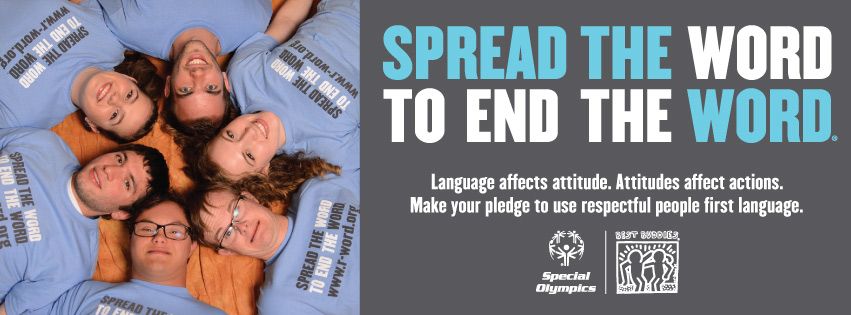
A full year later, here we are again.  Today is R-Word.Org's Spread the Word to End the Word Day of Action.  It's still a day that I wish I didn't have to happen.  This is yet another post that I wish I didn't have to write.

I'm not alone either.  Many bloggers have spoken out on the use of the R word, some of which will be linked to the blog hop below.  I've said it all before... I've talked about it's dehumanizing effects, I have mentioned how belittling this term is.  Yesterday, this post appeared in the Huffington Post.  Remember Amelia?  The R word almost killed her.

It is no longer a term suitable for medicine as both the DSM and the World Health Organization have seen fit to drop it from their next updates.  It is being written out of legislation.  The only place it really thrives these days is in every day parlance. I realize people fear change.  I realize that people feel like they are under attack each and every time I or anyone else, politely points out their use of this offensive word.

Good.

You should feel under attack as that is exactly what you are doing to thousands of Intellectually Disabled and Developmentally Delayed individuals.  This word, this word that you use to describe the silly little foibles in your day, has been used for hundreds of years to hurt, maim, demean and ultimately kill.

I've also heard from a few parents of children with special needs that they do not see their child as this word, that they do not let it define them.  I sincerely wish these parents well.  I also hope that their child's future potential employer and the registrar at their child's future college share this view.   Unfortunately the world-at-large does define our children by this word.  To some, they are useless eaters.  To others they are still easy targets for ridicule and abuse.  Then, the R word and by extension, those that are defined by it, are demeaned even further when used to describe life's trivial little problems.

I think John C. McGinley, put it best.  There is no tax.  There is no cost to disparaging a group of people that have done nothing to you.


Stretch your vocabulary.  Define yourself as a compassionate and caring individual, not an ignorant, abilist, archaic bigot.   Practice inclusion. Use person first language and offer respect to your fellow human beings.  The R word is not useful, nor accurate, nor funny.  Take the pledge to End the Word.

I hope one day I won't have to make these posts, that we will all live in a world with acceptance of neurodiversity.  More and more minds are opened every day, that is true.   More and more the language is changing; in our laws, in our texts, in our lives.  Like every other civil rights movement that has gone before, we are in this for the long haul.

With that in mind, I guess I'll see you next year...

 photo 625451_10151249421101157_509799039_n_zps5591372b.jpg 
 

This Blog Symposium brought to you by:

 photo DSUbannersmall2_zpsfa60ecbb.jpg
Add your R-Word post now! 

Friday, November 30, 2012

Why I'm Not a fan of "Tard" the "Grumpy Cat"

Every so often I find that I have to write a post like this.  It used to make me very angry when I ran into this sort of thing;  now, I just feel sad for people that clearly do not get it and have little intention of doing so.

Normally, I file this type of occurrence under "it will die in a few days and go away" but sadly, I am afraid this particular one won't for a while yet.  I'm talking about the current "Grumpy Cat" meme.  It's a cute cat.  I love cats.  In fact, I love all animals.  However, this particular animal's owners need a swat in the nose.

This "Grumpy Cat" as it is known, is a female cat and in the videos that the owners have posted on YouTube, it is a fluffy little sweet tempered doll of a creature.  However, it is unlike other cats, a fact that is made apparent quite quickly.  Her eyes are wider spaced and shaped a bit oddly, her nose is flatter and more button like than either of her parents, her jaw appears to be stronger and have a bit of an "underbite".  The ears are smaller and rounder too.  Sound familiar?  It should, as I have described all of these as markers of Down syndrome (and a few other genetic disorders).  "Grumpy Cat" obviously has some kind of chromosomal disorder, which is what gives her her distinct look and looser gait.  Like both feline and human versions, all these traits do occur randomly in the general population.  However, all together it is pretty indicative that a little something extra went somewhere.

Now my aim here is not to disparage the little thing.  Chromosomal disorders are quite common in the feline world (as they are in the human world).  Tortoiseshell cats, for example (of which, "Grumpy Cat's mother is one).  I did not know that male Torties could exist but they do as well;  they are all Trisomies.  We used to have a long haired female Tortoiseshell cat with thumbs that had a sweet disposition as well.  We chose to name our darling cat Fenchurch.

"Grumpy Cat's" owners chose to call her "Tard".

Once this factoid became a little more well known, it was retracted and changed.  The official story now, a few months later is that although they call her "Tard", her actual name is "Tardar" as in "Tardar Sauce".  The spelling error was explained as she was named by a small child,  at least on the talk shows.

Right.

I'm not sure which is more insulting.  The fact that they named this cat "Tard" in the first place, or the fact that they tried to kick a bit of litter over it after the fact.
 
This wouldn't be such an issue if this was some anonymous lady's cat down the street.  But, she's not.  This kitty now has it's own Facebook page, Twitter, Tumblr and is actively being marketed with a line of merchandise, not to mention being turned into countless meme images by fans every day.  Most just refer to it as "Grumpy Cat" but the YouTube videos and Tumblr account still tell the tale of this little cat and her offensive name.

Even if she was, say,  the cat of an older lady down the street does that make it right?  What if I got a Bull Terrier and named her "Dykstra"?  What if I named a Siamese cat "Chinkerly"?  Do the obvious short forms of those names strike you as something that should be condoned, shared, marketed and taught to my children?  Even if I blame it on the kids?  Do you think my neighbours, my sweet Trinidadian neighbours, for one second would tolerate me calling a black lab after the mascot of "The Dam Busters" Royal Air Forces No. 617 Squadron?  Imagine me, standing on my back porch, calling this dog and my children in for supper.  Would some hasty explanation involving Lancaster bombers, the Möhne Reservoir and WWII ease their hurt feelings?  I doubt it highly as in this very hypothetical case I would have chosen to name my dog, regardless of intent, a very offensive word.  So offensive, that charges might even be laid.

The owners of this cat knew full well what they were doing.  The word, whether a short form of it's "full" name or not, is a slur that has been used to degrade, humiliate and even exterminate people for being different.  Ironically this is exactly what we are celebrating this feline for.

There has been a lot of backlash in many forums when people bring this point up.  The usual arguments, including freedom of speech, citing what the cat's "full name" is, you're too sensitive, calling a plea for tolerance 'political correctness'...  all show how ignorant and willfully blind people continue to be with the intellectually challenged.  My favourite one of course, will always be that "[R-word] people don't know that it's wrong, they won't know what you are saying" which totally negates any sort of cognitive or emotional reaction from a developmentally delayed person, which in turn dehumanizes them even further.  That particular "argument" is ignorance and Abilism incarnate.

As I've said before, I love animals.  I treat them with the utmost respect.  I do the same with humans too, even if, based on their actions I don't think they really deserve it.  Amazingly, fans of this special little kitty get their fur up quite quickly when you suggest that the cat's name is offensive.  Well, as a Mom of a kid with Down syndrome, I'm here to tell you it is.  I'm also not alone in my opinion.  I wish her owners and many of her fans would extend to humanity the same respect that they lavish on this cat.  Back-pedaling and calling her "Tardar Sauce" or "Tardy McFluffypants" or "TARDIS"  or anything of the sort to cover you calling a cat with an obvious chromosomal disorder "Tard" is just ill conceived, stupid, ridiculous, slow and quite feeble minded.

You know, all the things that people use the R-word to mean.
Related Posts Plugin for WordPress, Blogger...