Haiku by Kashiana Singh, Goran Gatalica, and David Josephsohn

my epitaph
again and again
the weeds


Kashiana Singh (USA)

Commentary by Nicholas Klacsanzky:

Writing one’s epitaph has various connotations. It could mean the poet is near death or was near death at some point. Another reason is that the poet is already reflecting on her life and writing an epitaph, even though she is not close to passing away. Epitaphs are usually short and compact, and comprising a whole life in one statement is difficult.

The second line acts as a pivot, which could add content for either the first or third line. It is also a contrast of the finality of the first line. “again and again” could be pointing towards reincarnation or revising an epitaph over and over. There is another reading that suggests that the weeds keep coming up over the epitaph not matter how many times you get rid of them. Both ways of looking at the poem are interesting and make readers ponder. Overall, the poem makes me introspect about our insignificance and how nature cannot be truly disrupted, despite our push to control our environment. In addition, I think of how difficult it is to encapsulate a life in one sentence, as each of us is a multitude.

When I read “weeds,” I feel the weeds might be us. Also, the poet might be hinting that the weeds might be the true epitaph of the poet, and perhaps of us all. A weed also flowers and is often misunderstood. We label them as “weeds” when they are simply following their essential nature.

Peering at the more formal elements, the language mirrors the minimalism of an epitaph. Yet, the final image expands outward, suggesting seasons, neglect, and time passing after the poet is gone. It is difficult to pin down a kigo or seasonal reference here, as different types of weeds are more prominent at certain times of the year. In traditional Japanese haiku, common examples are ukikusa (duckweed) for summer, mugura (cleavers/creepers) for spring, dandelion for early spring, and tsuwabuki (rock butterbur) in winter. In this haiku, though, I don’t feel the poet is putting emphasis on the season. Rather, the poet is focusing on the link between permanence and impermanence.

In terms of sound, it seems the lightness of the e and a letters contrasts well with the heaviness of the g letters. This brings transience and mortality into focus again.

It’s quite a simple haiku at first glance, but the more you look at it, the more layers you discover.

starry night—
the generations of women
who did needlework

Goran Gatalica (Croatia) 
Awarded First Place in the 3rd John Bird Dreaming Award for Haiku, Australia, 2025

Commentary by Jacob D. Salzer:

This is a beautiful haiku that honors generations of women, giving them the respect and reverence they deserve. The relationships that women made with each other and with others resonate powerfully with the invisible constellations that connect the stars. I believe these relationships continue, spiritually, and also form new relationships when women continue the craft. When someone engages in an age-old tradition, I feel they are inherently connecting with their ancestors.

On that note, this haiku also makes me think of Indigenous culture. I’ve read that Indigenous Peoples believe each person’s spirit travels across the Milky Way at the end of their human life to meet their ancestors and the Great Mystery. Indigenous Peoples understand that everything is connected, which leads to reciprocity and community, as our lives are interwoven in a myriad of ways. This view shows that our lives are woven with our ancestors as well, which comes through this haiku.

In a broad sense, needlework is a crafting technique that often involves yarn, thread, and fabric to create clothing and other works of art. There are actually at least 14 different kinds of needlework: (1) embroidery, (2) appliqué, (3) knitting, (4) crocheting, (5) quilting, (6) sewing, (7) bead weaving, (8) cross-stitch, (9) ribbon embroidery, (10), crewel embroidery, (11) needlepoint, (12) needle lace, (13) tapestry, and (14) patchwork. These needlework approaches can result in delicate and textured works of art, quilts, clothing, home décor, scarves, intricate lace, blankets, toys, bags, and curtains. For more information on needlework, I recommend this article: 14 Types of Needlework. This article includes this quote: “These 14 needlework crafts, each with its distinctive techniques and histories, offer not just a means to create but also a way to connect with traditions, communities, and our creative selves.”

In summary, this is a powerful haiku that honors our ancestors, the women who did needlework, and the women who continue needlework today. It also shows the power of relationships. This haiku is spiritually charged with love and reverence, and tangibly shows how the threads of our lives are interwoven with each other and other forms of life in both obvious and mysterious ways.

busker’s song

coins rattle

in a minor key


David Josephsohn (USA)
Winner, the Haiku International Association 2023 Contest

Commentary by Hifsa Ashraf:

The opening line, “busker’s song,” recalls for me a performance I once heard along the River Thames in London. The phrase does not specify the melody, but the kind of songs buskers often choose i.e. sentimental, powerful, or quietly melancholic pieces that stir emotions. The apostrophe in the opening line suggests that it’s something very personal and emotional.  

The second line, “coins rattle,” introduces a sharp, sudden sound. The quick succession of coins in a bowl makes it a parallel rhythmic music that echoes a bit loud and also gets the attention of the audience. To me, it gives me a sense of sadness as personal feelings are being transformed into something materialistic. The rattling coins suggest that the song has touched many listeners, yet there is a subtle irony here: while the audience may feel deeply moved, their response is reduced to the simple gesture of tossing a coin. The sound becomes both appreciation and limitation in terms of a public token for private feelings that perhaps cannot be openly expressed.

The concluding line, “in a minor key,” gives an emotional touch to the poem. A minor key implies sadness, depth, and introspection. It’s a minor key with the strongest impact. The melancholy of the melody leaves some reflection where listeners can feel their profound emotions. Whether deliberate or instinctive, the busker’s choice of tone draws out a collective response that makes the minor key more significant.

The absence of punctuation encourages the readers to experience the moment freely. The repetition of the r sound (busker’s, rattle, minor) adds a subtle rhythm to the ears by integrating all the elements together: music, metal, and deep feelings.

Image

Haiku by Anthony Lusardi, Cezar Ciobîcă, and Jacek Margolak

weather forecast
neighbors discussing             
which tree might fall where

Anthony Lusardi (USA)
previously in Hedgerow, issue #151, 2025

Commentary by Jacob D. Salzer

I appreciate how down-to-earth this haiku is. This haiku features a moment where Nature and civilization collide. A fallen tree can, indeed, cause a lot of damage to houses and cars. Fallen trees can result in expensive home repairs and have, unfortunately, taken some people’s lives. On the other hand, it is true that the very construction of our neighborhoods and houses has caused a lot of environmental harm. I appreciate how this haiku encourages us to deeply contemplate how we truly want to live and encourages us to think deeply about our relationship with the Earth.

This haiku also makes me think of ways that we can build houses and buildings that protect us from storms and natural disasters. I think of earthquake-resistant buildings found in Japan, where earthquakes are common. Most houses, apartments, and duplexes are at least partially made from trees. Even where I live, I recently called the public utility company to request them to trim a tree back due to its obstructing a power line to the house.

The first line clearly alludes to a storm approaching, likely a windstorm. I have always been fascinated by the phenomenon of wind: how something invisible can be so powerful.

Aside from the philosophical conversation around Nature, storms, and architecture, I appreciate that there is community and conversation in this haiku. It demonstrates how an oncoming storm can bring people together, regardless of our many differences.

In summary, this is a down-to-earth and relatable haiku that focuses on storms, Nature, civilization, community, and the architecture of houses and neighborhoods. Perhaps most of all, I appreciate how this haiku encourages deep and meaningful conversation.

train from Ukraine
her nesting dolls
full of scars


Cezar Ciobîcă (Romania)
previously in Mayfly #78, 2025

Commentary by Nicholas Klacsanzky:

As someone who has lived in Ukraine for six years and is interested in Ukrainian culture, this haiku stood out to me. I also thought the mention of nesting dolls or “matryoshkas” was a stark cultural and political allusion. The poet doesn’t explain what he thinks about the nesting doll or its significance but allows the reader come to their own conclusion.

Though nesting dolls, or “matryoshkas,” are commonly associated with Russia and prominently featured in this haiku in a political sense, these dolls have been around in China since the Song Dynasty, which dates back to around 1000 AD. However, the Russian variant became popular in recent history (late 1800s) and has been a symbol of being Russian ever since. While in Ukraine, I saw murals of these dolls being shot at or brutalized in other ways. Attacking matryoshka dolls in Ukraine became a metaphor for resistance since the occupation of Crimea in 2014.

In association with this haiku, the image of the matryoshka doll is complex. As a reader, I want to sympathize with the toy and artwork, while at the same time feel a level of disgust at the russification of Ukrainian culture, with the Ukrainian girl or woman having a nesting doll by way of cultural occupation, oppression, and assimilation. It seems the nesting doll has gone through war too, despite being Russian itself on Ukrainian land. All of this can be summed up in the word “trauma.”

The first line could suggest that the person mentioned in the haiku is leaving Ukraine because of the current war. She has brought the nesting dolls with her, possibly as a keepsake, representing her family’s generations and the continuity of life. These values are more key in times of distress, and the person in the haiku is maybe holding onto the nesting dolls as a sign of hope. But, the third line throws in a twist, allowing the reader to ponder the context of “scars.”

Structurally, the poem mirrors the nesting motif. Each line gets smaller and smaller, yet expanding in meaning. With the absence of verbs (“nesting” acts as a noun, a gerund), the scene feels suspended. That tension between movement and stasis deepens the poignancy. The mix of hard (n and r) and soft (l and 0) sounds adds to the dual nature of the imagery.

Overall, the haiku succeeds through understatement. It doesn’t mention references to war, violence, or grief. Instead, it trusts the reader to recognize how a small, culturally resonant object can hold the weight of a nation’s wounds and oppression. A single object can carry a great mix of emotions and histories, and this haiku illustrates this with grace.

scraping fish
a few scales fall back
into the river


Jacek Margolak (Poland)

Commentary by Hifsa Ashraf:

I was deeply moved by this haiku because of its vivid imagery and profound meaning. The opening line, “scraping fish,” is a bit scary. It’s almost dreadful to imagine such a situation.  The word “scraping” is harsh and brutal as it evokes the physical act of removing scales and fins, and with it, the cruelty embedded deep down. It is not a pleasant image, and perhaps that discomfort is unavoidable, keeping the sensitivity of the image.  

Scraping a fish is part of preparing food, a very ordinary act of survival within the food chain. Yet psychologically, it may reflect the cold and ruthless side of human behavior. The fish’s scales and fins, which once served as protection against harsh water currents, are stripped away. This shows how life can fall into complete disarray when there is no one around to protect us physically and emotionally.

The second line, “a few scales fall back,” introduces a subtle movement within an otherwise quiet setting. The falling scales create a gentle motion, almost delicate in contrast to the violence of scraping. Their return to the water suggests going back to the origin. Yet this return is insignificant as the poet deliberately mentions ‘a few scales’. It makes little difference in the larger ecosystem, emphasizing how easily things disappear once annihilated. At the same time, the drifting scales blending into the river may suggest that nothing is completely erased; some traces remain behind as an example for the rest.  

The final line, “into the river,” completes the image with resonance and depth. Besides all harshness and cruelty, something returns to where it once belonged. Whether it’s a residue or restoration, the act shows the cyclical nature of existence. Life feeds on life. There are no moral safeguards within this natural order, only transience. The haiku quietly reflects this interplay between survival, loss, and return, leaving the readers to feel it deeply.

The lack of punctuation deepens the silence the poem carries, naturally slowing the reader and opening space for contemplation on life’s transience.

Image

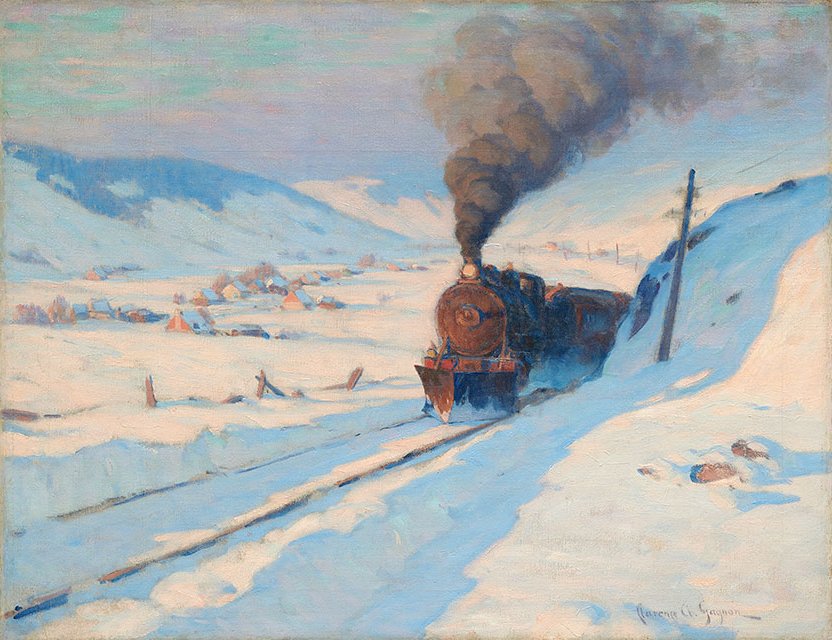
Le train en hiver by Clarence Gagnon, c. 1913-14, oil on canvas

Haiku by Sam Renda, Vaishnavi Pusapati, and John Tang

luminescent sea
all the little things
we think we’ll remember

Sam Renda (South Africa)
Published first in Autumn Moon Haiku Journal, Issue 5:2, Spring/Summer 2022

Commentary by Jacob D. Salzer

This is a powerful haiku that allows readers to contemplate the mysterious phenomenon of individual and collective memory. In addition, this haiku sparks several meaningful conversations.

The first line of this haiku is a powerful image, and also sets the mood and tone of the poem. The sea is vast, while human memory is limited. To that end, this haiku could be foreshadowing different forms of memory loss, including Alzheimer’s disease and/or dementia. With this in mind, this haiku seems to be encouraging us to take preventative measures to reduce the risk of Alzheimer’s and dementia as we age. For more information on doing our best to prevent Alzheimer’s disease and dementia, I recommend reading Reducing Risk for Dementia, and also discovering the neurological and cognitive benefits of drinking green tea regularly at Brain-Protective Effects of Green Tea and Beneficial Effects of Green Tea Catechins on Neurodegenerative Diseases. In short, a healthy diet, physical exercise, meditation, and avoiding tobacco and alcohol can all help prevent memory loss down the road.
Interestingly, neuroscientists have discovered that what we call memories are inherently incomplete fragments that are filled in subconsciously by our imagination. For more information on this fascinating subject, I recommend these two articles: Memory and Imagination: Exploring the Interplay Between Past and Future and How Your Brain Makes Up Stories to Fill in the Blanks.

Simultaneously, it seems this haiku is asking readers to contemplate what parts of our lives we want to document for our family and future generations. To put it more simply: what do we want to leave behind? Interestingly, on that note, this haiku could speak directly to the art of reading and writing haiku. In other words, as haiku poets, when we write haiku, we are leaving behind moments, traces of an experience, and documenting our lives in the ever-flowing “now” that seems to contain the entire past and the future within it. This leads to an interesting conversation on how personal haiku can be, and yet, how universal they can be as well. Do we want our haiku to allude to us as silent observers of life? Or, do we want to share parts of our seemingly private lives with others, including strangers? There seems to be a spectrum, and in our human lives, there seems to be room for personal as well as universal moments. In short, there appears to be room for our personal imagination, memories, and direct observations in our haiku writing that reflects the psycho-spiritual complexity of being human.

The notion of collective memory has been explored, perhaps most famously, by Carl Jung: “[The] collective unconscious: [a] term introduced by psychiatrist Carl Jung to represent a form of the unconscious (that part of the mind containing memories and impulses of which the individual is not aware) common to mankind as a whole and originating in the inherited structure of the brain. It is distinct from the personal unconscious, which arises from the experience of the individual. According to Jung, the collective unconscious contains archetypes, or universal primordial images and ideas” (collective unconscious).

This haiku also sparks a conversation about the history of this Earth and lost civilizations. For a fascinating dive into lost civilizations, I recommend these two articles: 11 Civilizations That Disappeared Under Mysterious Circumstances and 20 Lost Civilizations That Might Still Be Hidden Today.

Other spiritual teachers have sometimes used the term “Universal Mind” to describe Divinity. Interestingly, in terms of consciousness itself, it seems memory is infinite. With this in mind, returning to the haiku, poetically, the luminescent sea could relate to consciousness itself and the vast storage space that contains our memories. These memories could also include the memories of other species as well. This leads to an enriching conversation on the notion of past lives, reincarnation, and past lives that some children have remembered with evidence that strongly supports this, as they remember precise details. For more information on this subject, I recommend Children Who Report Memories of Past Lives.

Finally, with the invention of the internet and AI (artificial intelligence), I think we should be asking ourselves how we wish to be remembered in the digital world, think about how our memories are stored in digital ways, and find ways to protect and preserve what we choose to document and share. This can be a controversial and harmful terrain to enter, as there are many lawsuits involving artists and writers where AI companies have stolen or manipulated their original work and have violated copyright laws. For more information, here are two sources: Generative Artificial Intelligence and Copyright Law and AI giants are stealing our creative work. The limited memory space on a computer (and in the cloud) is also interesting when relating to the human brain’s capacity to store memories. Of course, with all this being said, The Matrix movie also comes to mind.

In summary, this is a highly contemplative haiku that encourages us to think deeply about memory, collective memory, our imagination, our identity, and what we each want to leave behind (and what we are collectively leaving behind).

autumn dusk —
    the empty swing
still warm


Vaishnavi Pusapati (India)
Published first in Autumn Moon Haiku Journal, 2025

Commentary by Hifsa Ashraf:

The opening line, “autumn dusk,” pauses me for a moment, allowing the scene to settle. Autumn dusk is often associated with sadness, dullness, and gloom; yet, this perception depends on the setting: a park, a school ground, a family courtyard, a garden, or a village home. Dusk is a threshold, a fragile pause where traces of the day still linger before transforming into night. In autumn, it reveals its truest colours, evoking nostalgia, melancholy, solitude, and quiet reflection. The em dash deepens this pause, suggesting the person is drawn into this moment by vivid memories or sudden flashbacks.

The second line introduces a sense of loneliness through the image of the empty swing. It becomes an object of remembered joy, perhaps of childhood, perhaps of a cherished phase of life that comes back time and again. The swing once held laughter, motion, oscillation, and presence; now its emptiness mirrors the inward sense of loss and longing. The space before the second line depicts the depth of emptiness and loneliness one is feeling at the moment.

The concluding line, “still warm,” gently shifts the emotional temperature of the haiku. Against the cold, muted tones of autumn dusk, warmth suggests recent human presence, someone who has just departed but has left behind fresh, tender memories. The word “still” implies continuity: memory has not faded with time. Warmth here becomes emotional rather than physical, affirming that no matter how distant the past, deeply held memories remain vivid and alive.

I especially admire the interweaving of cold and warmth, absence and presence, without making the poem explicit. Even the recurring m sounds subtly contribute to a sense of mystery, intimacy, and inward reflection—echoing the quiet depth of lived experience.

feather dance
in the twilight 
childhood wonder


John Tang (China)

Commentary by Nicholas Klacsanzky:

The first line, “feather dance,” caught my attention right away. It made me think of Native American and Oaxacan dances to honor gods and ancestors. Since the poet is from China, I conducted a little research on the Chinese Feather Dance, which is a tribute to ancestral temples or the Gods of the Four Directions. The dance was used in imperial or official sacrificial ceremonies, particularly during the Zhou dynasty’s court music and dances, known as Yayue. In China, feathers in ritual dances often represent the ability to soar, connecting the Earth with the divine or sky gods.

However, I think many readers will read “feather dance” as a single feather falling and twirling down to the ground. Given that we mostly see feathers as already fallen, witnessing one drift down from the sky is an awe-inspiring moment.

With the introduction of “in the twilight,” the haiku becomes more mysterious and mystical. Twilight is often when clarity softens, and imagination can breathe. It’s a fine setting for a feather to feel more enchanted rather than incidental.

The final line, “childhood wonder,” names the emotional resonance, but it doesn’t feel heavy-handed because it arrives after the image has already done its work. I also take it as a comparison between the feather’s dance in twilight with childhood wonder as a concept. The awe we feel in our childhood dies down when we become adults, but we can try to revive it. This could be seen as a dance or a beautiful oscillation.

With no punctuation in the haiku, the second line could be seen as a pivot. The poem can be read in two ways: feather dance/in the twilight, childhood wonder, or feather dance in the twilight/childhood wonder. So, twilight can relate either to the feather dance or childhood wonder, or both.

Within the fitting brevity of the haiku, there is also a strong sense of sound, with lilting l and i, as well as pounding d, which creates a juxtaposition between beauty and stark awe.

A lovely cultural haiku that resonates far beyond borders.

Image


Painting by Dawn Hudson