
Filed under: live reviews | Tags: demdike stare, emptyset, ghedalia tazartes, jarr moss, keith fullerton whitman, kfw, mark fell, pan, tm404

Exhibitions, workshops, screenings, afternoon talks and up to five or six concerts every evening/night taking place in six different venues during seven days: a group of unemployed music fans or carefree students couldn’t make it all, and I’m not even talking about the other partner festival, Transmediale, occuring at the same time. “Gloriously overloaded” as they say, CTM is one big sprawling superfunded festival dedicated to non-mainstream and less supported music. This year focusing on the theme of The Golden Age the curators want us to, quote unquote, reflect on the (over-)abundance of music in the modern world, and its consequences for individuals, aesthetics, politics, and economy. Not able to take in this year’s overload of music, here’s what I managed to attend.
> TM404 > Emptyset > Jarr Moss > Mark Fell > Keith Fullerton Whitman > Demdike Stare > Ghedalia Tazartès
Read the rest of the review at tokafi

Filed under: album reviews | Tags: actress, Andrew Pekler, andy stott, bellows, biblo, biosphere, boring machines, earth, ezekiel honig, fennesz, heroin in tahiti, how much wood would a woodchuck chuck, jana winderen, mannheim rocket, mirroring, oren ambarchi, raime, sun araw, the caretaker, the congos, vatican shadow, zoyd

Istanbul-based artist Biblo kept me excited all the year round. Since her more experimental self released albums (like Out/Land) dating back to a couple of years ago, she’s been regularly using her whispering/singing voice, now she’s got a thing for subtle beats and gorgeous yet mysterious dubby effects (have a listen to ‘Slave to Love’, her latest album). In Istanbul she often plays as a reggae DJ; she put a few gems in a very nice Jamaican-inspired mix for RBMA.

Ezekiel Honig has been another great (and late) discovery. ‘Folding In On Itself’ (Type Recordings, 2011) is the ultimate warm bath of field recordings and womby sounds; so well made that when you hear it at night you wish it never stops. Actually you might fall asleep in the middle of it but let me warn you, the dreams you’ll make are worth it.

In 2011 I listened a lot to Jan Jelinek. In 2012 I focused on another member of Groupshow: Andrew Pekler. ‘Sentimental Favourites’, released on Dekorder, is a weird album that won’t make you freak out. Fresh and mellow, it’s not showing off, it’s just very good but it’s hard to explain. ‘Entanglements In The Orthopedic Sensorium’ is another very good record of his; when I’m sick, I usually play the ‘Bacterial Dance’, it cheers me up.

I endured massive listening of Vatican Shadow in 2012. From the launch of Fernow’s new imprint ‘Bed of Nails’ with ‘September Cell’ to ‘Jordanian Descent’ and ‘Atta’s Apartment Slated For Demolition’, VS is always rewarding despite the fact that 1) you don’t even have the time to wait for the next release and 2) it’s always pretty much the same music. It must be that whole atmospheric identity, how it captures the moment.

It seems like everyone loved Actress‘ last album ‘R.I.P.’. Indeed this is a masterpiece and yet it does not want to hold that title. From the Burial-like atmosphere in ‘Caves of Paradise’ to the carefree absent-minded reverie of ‘Jardin’ there’s nothing unworthy of your ears but nothing will probably blow your mind either. Over repeated listening this batch of egoless tunes becomes one of the year’s key albums.

While ignoring what Earth did before (except what I heard on some Jarmusch movies), I decided to get ‘Demons of Light, Angels of Darkness II’ after having attended an intimate and impressive performance of the band. To me, Dylan Carlson has clearly seen the other side of the mirror: it’s a desert where all illusions fall flat. What remains in the music is the silence from which all things were born and that peculiar tenderness Carlson wraps his stretched melodies with. A reporter from beyond our planet’s horizon.

This is probably not the first thing you would make a friend listen to. I found Italian duo Bellows‘ last album ‘Reelin’ quite boring the first couple of times I heard it. Later I got hooked by the undersea feeling on some tracks, providing my imagination with an alternate and more minimal soundtrack for Zissou’s submarine rides. Then of course, the groove on this untitled track gets me every time. Reelin’ is actually quite amazing when your mind is cleared. Also, I listened to Giuseppe Ielasi’s 2009 album ‘Aix’ quite a lot, and for good reasons.


After the Milan-based duo come this Rome-based trio with a great name Heroin in Tahiti. Fuzzy guitars and psychedelic reverb in a spaghetti western, a dark and epic cocktail to remember; try this track for instance. I got to see another trio, Turin-based this time, play live in Berlin. It’s called, er, how much wood would a woodchuck chuck if a woodchuck could chuck wood? The name is a joke but the music isn’t funny. The singer declaims in a deep haunting voice, there’s a quiet yet obsessive guitar and sometimes female back vocals, drones and weird windy noises. Pretty dark and minimal, occasionally frightening. Both records released on the Italian label Boring Machines.


The body’s back in 2012. Andy Stott (‘Luxury Problems’, Modern Love) and Raime‘s (‘Quarter Turns Over A Living Line’, Blackest Black Ever) went for similar cover artworks, both showing a body in movement, muscles in action. Stott, talented as few are, mixed a female voice into his bass-driven techno, thus aiming at something different (yet not quite), more couch dancefloor than ever. Your favourite tracks might be vocal-less though: Sleepless and Expecting are amazing. A slower and instrumental version of Andy Stott’s stuff would bring you close to Raime’s world. Superbly produced beats (when there are some) drag you deep down in those decayed industrial landscapes the music conjures. Body awareness is the first quiet step towards any practice and you don’t need any beat for that. Then if your body wants to learn something new, repeating is the next step.
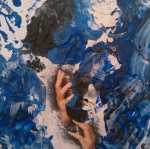
Jeff Gburek‘s The Watermark is something different. And yet it sounds obvious. What’s striking is how personal and timeless the music is; no school no chapel whatsoever. The Watermark is like an endless expansive ballad: basically a guitar talks to the universe, composed of a million things. You can feel the space, the immensity, the depth, the million things in between. Strangeness is sometimes around the corner, along with electronic and sitar sounds, whistles, etc. but it’s all part of the plan, or the game. I’m so happy I got one of those gorgeous limited hand painted CDs. Yeah, he paints and draws beautiful stuff too—and doesn’t even brag about it.

Sun Araw teaming up with legendary reggae band The Congos the time of an album (‘Icon Give Thank’), this sounds awesome doesn’t it? Well, it does. Spaced out guitars, dub rhythms, primal chants, synth chords and cosmic bleeps, it could have been a mess but in fact it’s an uplifting collection of pleases and thank-yous to Mother Nature.

Touch: 30 Years and Counting is a fantastic collection of sounds from artists who made the now 30 year old British label the way it is today. It’s not an album per se but you should enjoy it as if it were one. Amazing sounds (from field recordings to drones) are here beautifully mixed and packed together. Featuring works by Fennesz, Eleh, Rosy Parlane, Philip Jeck, Mika Vainio, Oren Ambarchi, BJ Nilsen and others, it’s as much a collection item for Touch’s die hard fans as a perfect introduction to sound art or whatever you want to call this kind of music.

Fennesz‘s 2011 album ‘Seven Stars’ (Touch, 2011) left me cold first. In 2012 I kind of rediscovered it. Repeated listening recommended.
Oren Ambarchi‘s album ‘Audience of One’ contains two gems and two other tracks which, to me, sound like bad old Air tunes from the 90s. One gem is limpid, it’s a song called ‘Salt’, one the most beautiful I have ever heard. The other one, ‘Knots’, is opaque and black as hell; take a deep breath.

I finally listened to Jana Winderen‘s albums (even seen her live in Madeira). Not much to say… impressive sounds. Please, Jana, keep going where no man has gone before. Let’s put an end to the Touch chapter.

Biosphere‘s take on an opera by Monteverdi, ‘L’incoronazion di Poppea’, uses only one kind of filter, so it seems, but it’s calm and beautiful. This commissionned work stays in the family but no, it’s not released by Touch.
Mirroring is Tiny Vipers and Grouper making music together; ‘Foreign Body’ is their first album. Gorgeous and dreamy.

‘Extra Patience (After Sebald)’ by The Caretaker is another album in touch with classical stuff (in fact the source material is Schubert’s Winterreise). Expect moonlight and sad retrospecting, vinyl crackles and age artifacts.

Mannheim Rocket makes techno in a fashion quite close to Andy Stott. He often recycles material from composers like Bartok and Schumann and combines it skillfully with bass-heavy loops. The album called ‘Eora’ (free download) is quite an achievement and you might want to check the live recording of his set in Berlin (I managed to miss it).
Filed under: live reviews | Tags: biosphere, jana winderen, madeira, madeiradig, mark fell, oren ambarchi, palmer eldritch, pete swanson, sculpture, sngr electroacoustic ensemble, thomas ankersmit

Two years after my first stormy visit I came back to Madeira. This time the festival’s line-up and the weather was fantastic. Can’t complain.
Situated 700km off the coast of Morocco, Madeira is a paradisical island (at least it feels like it coming from Berlin in December) which hosts one of the best reasonably-sized festivals I attended. Believe me, the climate of the island alone is not responsible for such a judgemental statement. Nine performances in four days took place in the Casa Das Mudas, a stylish venue on top of a cliff in Calheta. Most of them were outstanding.
Read the rest of the review on tokafi.com

Filed under: live reviews | Tags: Burkhard Beins, christian wolff, derek shirley, didier lasserre, ensemble hodos, experimental, john cage, philip corner

The variable-geometry Ensemble Hodos (gathering here a double bass, a cello, a guitar, a clarinet and a sax) is devoted to music written in a way that gives performers some control over the output; some freedom, if you prefer. Having been freed from tonal systems, the notes take on an existence of their own. Logically their act tonight is dedicated to John Cage and two younger, abnormal composers who have always been close to Cage’s creative groups: Christian Wolff and Philip Corner.
Read the rest of this review on tokafi.com.

Didier Lasserre
Filed under: album reviews, almost nothing, live reviews | Tags: 2011, aethenor, andy stott, biosphere, demdike stare, emptyset, ghedalia tazartes, grouper, Groupshow, john chantler, kreng, miasmah, miles, modern love, moritz von oswald, nisennenmondai, rashad becker, shackleton, single note project, sohrab, sun araw, vatican shadow, vladislav delay, vladislav delay quartet
∴ ∴ ∴ ∴ ∴ ∴
RECORDS.
To me, Modern Love was the label of 2011, the main support for my daydreaming. Demdike Stare’s ‘Tryptych’ (containing ‘Forest of Evil‘, ‘Liberation Through Hearing‘ and ‘Voices of Dust‘) and ‘Elemental‘, Miles’ ‘Facets‘ (also his ‘Midden‘ as Suum Cuique), Andy Stott’s ‘Passed Me By‘ and ‘We Stay Together‘, G.H.’s ‘Ground EP‘… all these have haunted my ears. As far as Demdike is concerned, even Andy Votel’s cover design is responsible for that feeling of achievement — a feeling you got in live events too. Last month, an outstanding party took place in Berghain. The Manchester-based duo was playing along with some mesmerizing footage of horror films on two huges screens and Andy Stott was throwing his swirling beats in some dark erotic way. The whole thing enraptured everyone.
The other label I couldn’t help coming back to through 2011 is Miasmah. I have been seduced by the somber and crystalline beauty of Kreng’s ‘Grimoire‘ (see my last post from… six months ago) and his previous albums, notably ‘L’Autopsie Phénoménale de Dieu‘. It strangely kept me warm during the colder month of the year. Simon Scott’s ‘Bunny‘ was also an inspiring album. And Kaboom Karavan’s ‘Barra Barra‘ made my day several times.
The good thing with this shortlist of mine is it has all been uploaded on the labels’ soundcloud page and therefore can be heard for free in a decent quality. Needless to say that you can buy the cd or vinyl versions.
∴ Demdike Stare – Tryptych, Elemental ∴
∴ Andy Stott – Passed Me By, We Stay Together ∴
∴ Kreng – Grimoire ∴


I wouldn’t be able to write down a top 30 or 50 list because I have not listened over and over again to that many, but a few other recordings stood out by themselves though.
∴ Æthenor – En Form for Blå ∴
∴ Biosphere – N-Plants ∴
∴ John Chantler – The Luminous Ground ∴
∴ Grouper – A I A ∴
∴ Miles – Facets ∴
∴ Pinch & Shackleton ∴
∴ Shackleton – Fireworks ∴
∴ Sun Araw – Ancient Romans ∴
∴ Vatican Shadow – Pakistan Military Academy, Kneel Before Religious Icons ∴
∴ Vladislav Delay – Vantaa ∴
∴ Vladislav Delay Quartet ∴


∴ ∴ ∴ ∴ ∴ ∴ ∴ ∴
LIVE EVENTS.
I also had the chance to attend some stunning live acts. I already said how good the party with Andy Stott and Demdike Stare was, but I have not mentioned Emptyset sharing the bill: in fact dancing on pure bass, dust sound and silence was quite a weird experience — that I highly recommend.
An evening with Aidan Baker, Jefre Cantu-Ledesma and Barn Owl at the Levee club contained gorgeous moments of music. In between songs I could sip my beer and have a chat with Adam Thomas (aka Preslav Literary School, who played some mighty tape loops at Madame Claude during the summer and released a gorgeous, drony album called Veer).
Ghedalia Tazartès playing and howling on the Haxan film at NK made a lasting impression and his last minute contribution to an improvised gig with Chris Corsano and Dennis Tyfus afterwards was such a happy ending.
Nisennenmondai at Festsaal Kreuzberg was an uplifting concert; whose mind does cute drummer Sayaka Himeno not blow?; their new disco-krautrock track ruled.
I was happily surprised by a short performance of Cyclo (Alva Noto and Ryoji Ikeda) in the Gestalten bookshop; not soulless at all; and some impressive visuals.
Possibly anachronistic band Atari Teenage Riot harmed my ears in Astra; logically they displayed energy and communicative rage.
Iranian ambient prodigy Sohrab was the last one to play in a series of mini-gigs that night of September in West Germany and he saved the night; good news for him might mean good news for me.
In the same venue, once again I enjoyed another Groupshow concert. Jelinek, Pekler, Leichtmann are adorable aliens. More than ever it felt like an improvised cooking lesson by some ménage à trois.
Last but not least, in a gallery named Vittorio Manalese I entered another space-time continuum thanks to the very still music emitted by Moritz von Oswald playing a grand piano and treated by Rashad Becker’s analog equipment. Single note project, they called it. Then followed a Pantha du Prince show with cloaks and bells: it all seemed Grand Guignol in comparison.
I’d cry if I had to write down all the gigs I missed this year. Silence is better.
Filed under: album reviews | Tags: ambient, autopsie phénoménale, classical, dark, grimoire, kreng, lynch, miasmah, quay

Kreng aka Pepijn Caudron creates music mostly out of samples and found sounds. Magic ingredients for a witch’s brew: you need vervain gathered from unsunned spots, midnight tears of a virgin, mandrake watered with cow’s milk… you need rare stuff. That’s Caudron’s job to find some. Be it free or ambient jazz, Z movie sounds, opera songs, throat singing, orchestral grandeur, casual noise or contemporary chamber music, he knows how to pick up the right thing. Already in his (fantastic and fantastically-titled) previous album ‘L’Autopsie Phénoménale de Dieu’, you were struck by unthinkable yet congruous combos: ‘Meisje in Auto’ combines 4 bars from a slowed down prelude by Chopin, lazy jazz drumming and a sobbing woman, ‘Tinseltown’ puts together exotic percussions, looped bits from a Sibelius sonatine, reed instruments and who knows what else. Such combinations might look common to passionate listeners of weird music but the science employed by Caudron to lay them out is most uncommon. Pure mastery.
‘Grimoire’, Kreng’s last output for Miasmah, could be the tale of near-death experiences or opium dreams. A voice in the first track, Karcist, puts you in situation: “Let go of the earth, you don’t belong here! Go towards the light!” before a couple of drones and a creepy breath fills the space. Later, ‘Wrak’ is how a modern symphony could (should) sound like, its climax is reached when the initial elegiac melody on strings gets overwhelmed by bursts and blasts from hell, free jazz dissonances and chaos, a carousel gone mad. Right after that comes this superb Purcell-like consort music, all elegant posture and baroque melancholia. Slowly until the end, the melody and the sound become more and more stretched out, mufffled, slooow, like swallowed by a weak black hole, defeated by growing distortions. This is the great, death-wishing ‘Ballet Van De Bloedhoeren’.
Caudron shows all the way his love for good old instrumental music from the past centuries but unlike much of today’s ‘modern classical’ music, this doesn’t sound like a collection of clean-cut corny harmonies meant for urban people tired of urban life. It’s much more intriguing. Everything takes shape within the frame of some unspeakable narrative (I wish I had seen an Abbatoir Fermé production). Kreng’s soundtrack-ish music would definitely suit Lynch’s and Quay Brothers’ overrefined atmospheres. Strongly anchored to typically Romantic Era themes, it brings in mind oniric images from Redon or Füssli, dark and unknown words from Huysmans or Poe. It reveals the luminous edges of darkness, recalls the great decadent works, inspires awe.
***
L’Autopsie Phénoménale de Dieu (2009):
Grimoire (2011):
Filed under: album reviews, interviews | Tags: adam thomas, echolalia, preslav literary school, tape loops, tapes


If you look for Preslav Literary School in Wikipedia, you will learn that it was a 10th-century literary school and a language laboratory. Today Preslav Literary School is the moniker used by English Berlin-based sound artist Adam Thomas. When I first had the occasion to listen to Echolalia, a complex 2010 record of a tape loop orchestra led by Thomas, I had no idea about who or what Preslav Literary School was, but it immediately felt like a strangely compelling work, impecably put together, full of neatly chosen sounds—decayed, altered, and organized in gloriously blending layers. To me Echolalia stands out from the ambient crowd for two reasons: first, the vast, almost encyclopedic range of sounds gives the exciting sensation that the whole world is contained within it; second, a resolutely unfocused quality makes the music always move forward, not just revolve around a couple of drones. Adam Thomas’ craftsmanship fooled me: he is not a middle-aged artist with decades of experience, he’s young, active and friendly. We met in a bar in Neukölln and discussed about tape techniques, literature influence and artists’ schedule.
Read the interview on tokafi.com and above all listen to Echolalia:
Filed under: live reviews | Tags: faitiche, Jan Jelinek, john chantler, lawrence english, masayoshi fujita, room40
Live at Festsaal Kreuzberg, Feb 2, 2011 – Club Transmediale Festival
Did you miss the series of mini gigs by Room40 and Faitiche crews? You shouldn’t have! (No one is perfect though, I missed the last one featuring Tujiko Noriko Trio.)
Read the review over at tokafi.com

Filed under: album reviews, almost nothing | Tags: 2010, actress, animal collective, chris abrahams, daf, fennesz, jeff gburek, konono, music, play scar, rafal iwansky, scientist, shackleton, shangaan electro, sohrab, sun araw, tubby


Sorry, can’t do top lists or rankings anymore, but I have been listening to a lot of music in 2010, old and new stuff, many different genres and I can tell what’s still on my mind at the end of the year.
First I discovered a blog about African music that made me realize the immensity of my ignorance on the topic. Searching for music, I found amazing things, from old Franco songs to the Congotronics series (the recent reworkings on it are worth listening); Nick Richardson’s report on Congo music and Konono n°1 in the April issue of the Wire was stimulating. Honest Jon’s release of Shangaan electro music (plus watching the dance that goes with it) blew my mind. Orchestre Poly-Rhythmo de Cotonou’s open air concert was delightful.
Later I got to hear Chris Abrahams’ new album Plays Scar. To my opinion, even if jazzy in spirit, it represented the best and the most refined of 2010’s otherworldly music. It also made me think many ambient/drone albums (in 2010 quite a few have been released) were alike or at least often created the same atmosphere — consequently theses atmospheres didn’t feel that otherworldly anymore. A live gig by Jeff Gburek and Rafal Iwansky provoked strong sensations and their album Slope/The Experience Of Losing Control was not a less impressive experience. Live experiences in this sonic world have been rich; among others: the Touch night with Sohrab (check his debut album ‘A Hidden Place’) and Fennesz, the Echtzeitmusiktage and MadeiraDig with Ben Frost and co.
In July, I discovered the new Sun Araw album, On Patrol and decided it would be my summer’s soundtrack. A couple of months later, I went to see Sun Araw live (Hype Williams and their powerful incense did the first part), finding myself among a surprisingly young crowd.
If I must drop techno names, then Pantha du Prince’s Black Noise, Efdemin’s Chicago and Four Tet’s There Is Love In You were essential albums frequently played at home when friends dropped by.
In 2010 I enjoyed many King Tubby classic albums. An inspiring interview of Scientist put me on the track of the technology-enthusiast dub producer. You may want to hear his recent and somehow surprising take on dubstep tracks. Speaking of music with plenty of bass, I couldn’t resist some Shackleton (thanks, the Wire) and right now I’m into Actress’s Splazsh (thanks again), a brilliant album opening many new worlds.
I also strangely felt on a special wavelength that made me massively listen to everything by Animal Collective and German pioneers DAF (‘Alles ist gut’ is so amazing), especially while going to work. The first band brought enough innocent joy and uplifting melodies to fill the day emotionally, the second brought substantial amount of scorn and made me furiously eager to dance the Berlusconi.
Filed under: live reviews | Tags: beautiful schizophonic, ben frost, caro mikaleff, grischa lichtenberger, hugo olim, janek schaefer, madeiradig, peter broderick, peter rehberg, pita, simon whetham, sound art, stephan mathieu


Live at Madeira Island, Decembre 3rd-6th 2010.
MADEIRADIG 2010 was the seventh edition of a festival which back in 2004 gathered an audience of 30 people in a brand new art center, the Casa das Mudas. Now the festival seems to have reached some perfect state. The audience and the musicians stay in two design hotels that support the project. They are not a small avant-garde elite anymore, it’s a group mixing the experimental enthusiasts with curious open-minded people, everyone obviously excited to meet up in a warm, green and everblooming island in winter.
Read the full review on tokafi.com
 Happily, the future...
