A Conversation with Claude: How soon will Local AI be commonplace?

Image
The following is a conversation between me and Anthropic’s Claude AI. The reason I was wondering this is because there’s a trend within technology to move toward more personalized use. If you think about the room-size computers of the 50s, the closet sized in the 70s, desktop in the 80s, laptops at the turn of the century and today most people carry their computer in their pocket (smart phones). It’s foreseeable that Localize AI (run on your own device without needing to access the web) is not that far away.

Danny:
Given the recent (20+ years) rate of advancement in computers, what will be the common ram size for computers in 10 years. For reference, what’s the current common ram size today?

CLAUDE: RAM Progression: Historical & Projected

Current common RAM (2025):

  • Budget laptops/desktops: 8GB
  • Mainstream consumer: 16GB
  • High-end consumer: 32–64GB

Read more

Advice to Libertarians (Part 2): The Fence and the Field

Image

Image

Part 2 of 2 (Read Part 1 here.)

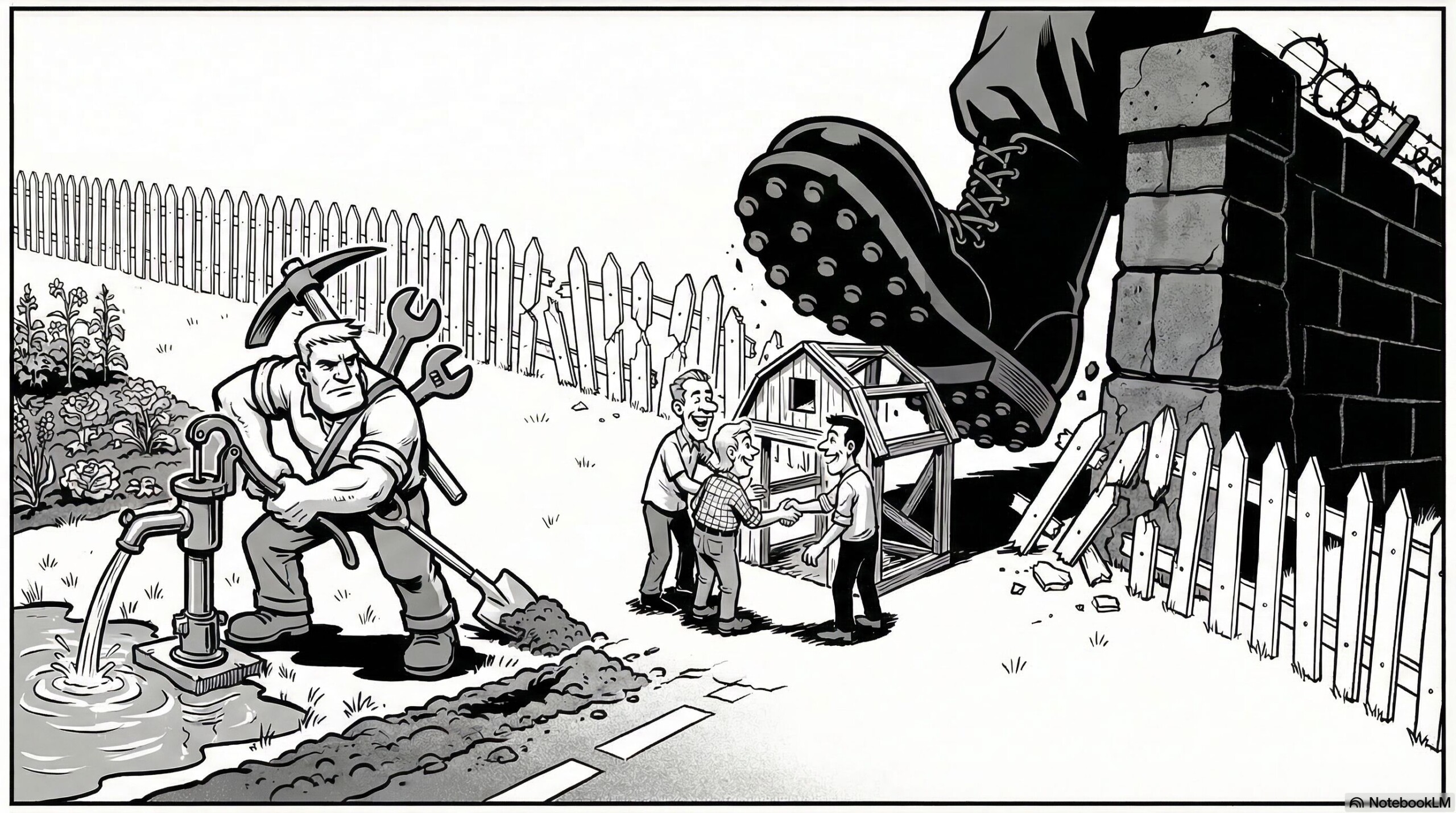
Across America there are all kinds of fences. Tough sturdy fences designed to limit the movement of massive, beasts who could trample a lesser fence without even thinking Then there are those smaller, decorative fences, designed to look ice, but also to mark territory. The white picket fence has been a symbol of the American dream for a long time. It’s not a very sturdy fence, and most people could knock it over by just leaning on it, but it served as a suggested barrier, to be respected by those who chose to be civilized and respectful.

The image of the white picket fence has stayed with me because it captures something most political philosophies get wrong about the relationship between freedom and structure. The Collectivist looks at the field and sees animals that need to be penned and design their fences accordingly. The Anarchist looks at the fence and sees an offense against human nature. The Libertarian — the serious one, not the bumper-sticker variety — looks at both and understands that the private property only works because the fence is respected, and only holds because people mostly choose not to test it.

Read more

Advice to Libertarians (Part 1): The Free-Range Steer

Image

Image
There’s a concept in cattle ranching called “low-stress handling.” The idea is simple: you design the chutes and pens so the animals move where you want them to go without realizing they’re being directed. No prodding needed. No resistance. Just architecture that exploits the animal’s natural tendency to follow the path of least resistance.

The cow thinks it’s walking freely. The rancher knows better.

Read more

Advice to Moderate Democrats (part 2): The Bitter Cup

Image

Image

Part 2 of 2 

I just made myself a cup of coffee, French press, picked one up at an estate sale for a dollar. The instructions I found online were specific: let the grounds steep in the hot water for exactly four minutes. Any longer and too much bitterness seeps out, and you’ve ruined what should have been a good cup.

The power of Collectivism works the same way.

Read more

Advice to Moderate Democrats (Part 1): The Wrong Threat

Image
Part 1 of 2 

George Orwell was a Socialist.

Not secretly or reluctantly or in a “well, technically” kind of way. He was a committed, vocal, lifelong democratic socialist who wrote that every serious line he’d produced since 1936 was “against totalitarianism and for democratic socialism.” He joined a Marxist militia in the Spanish Civil War and fought on the front lines for the “Republican”* cause.

And then he spent the rest of his life writing the two most devastating indictments of Collectivism in the English language.

Read more

Straddling the Middle of the Wedge: The Peace and Prosperity Zone

Image

Image

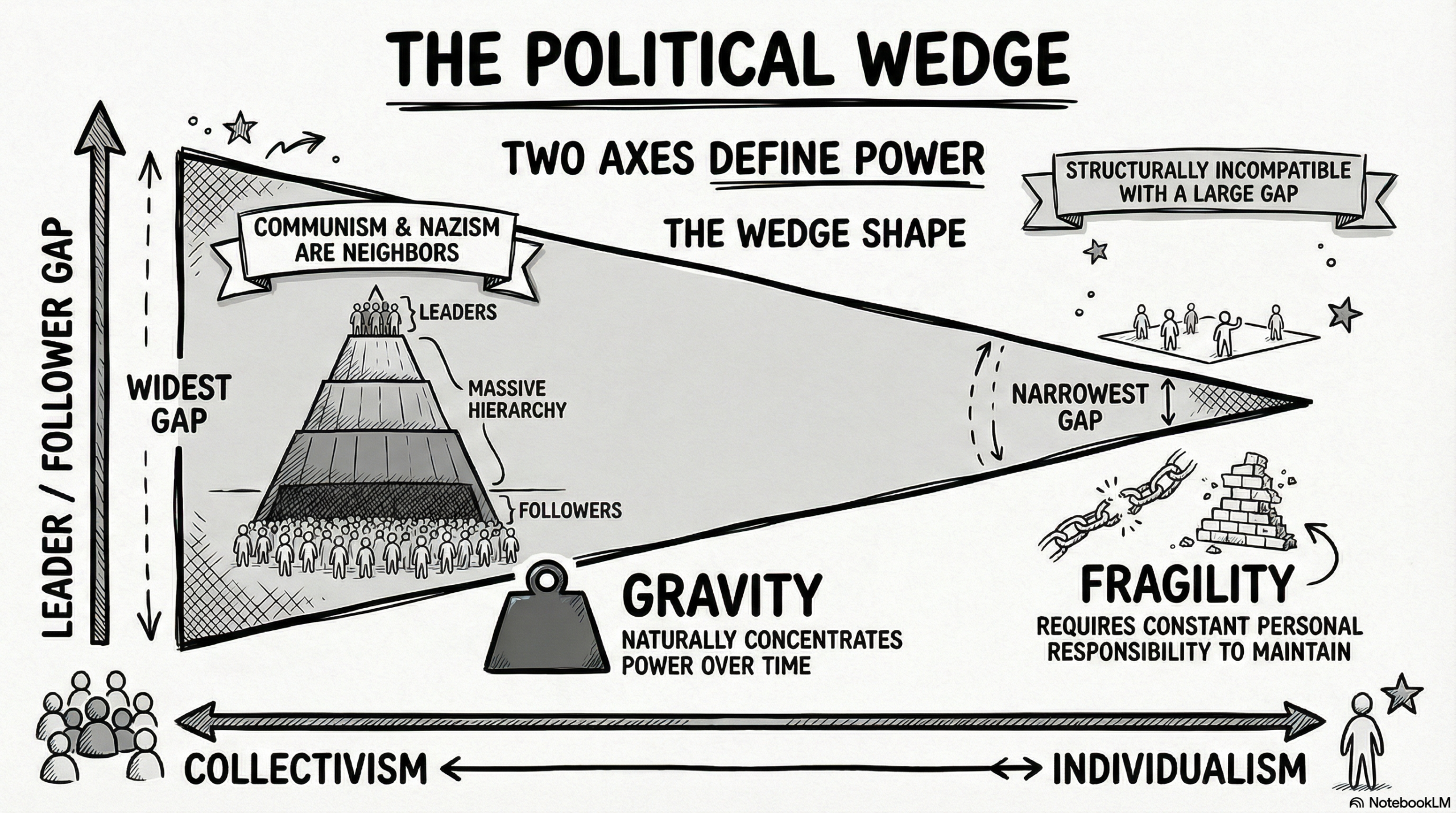
Over the past few weeks I’ve laid out a political framework, the Wedge, that replaces the broken Left-Right spectrum with something that actually describes how power works. Collectivism vs. Individualism on the horizontal axis, the Leader/Follower gap on the vertical, and a wedge shape that widens toward Collectivism because centralized control structurally requires hierarchy.

I also walked through every position on that wedge and named their weaknesses, including the weaknesses of my own tribe.

Now I want to zoom in on the middle.

Read more

Thinking Is the Enemy of Compliance

Image

Image

Here’s a line worth sitting with: Thinking is the enemy of Compliance*.

Not rebellion or protest or even armed resistance——thinking. The simple act of processing information for yourself instead of accepting someone else’s pre-packaged conclusion. That’s what every system of control, left, right, religious, secular or corporate, governmental, finds most threatening. Not because independent thinkers are dangerous. Because they’re unpredictable, and unpredictable people are very hard to manage.

Read more

Walking the Wedge: Where Everyone Actually Stands

Image

Image
Part 2 of 2 

Yesterday I laid out the Political Wedge,  a two-dimensional spectrum with Collectivism and Individualism on the horizontal axis and the Leader/Follower gap on the vertical. The shape is a wedge because Collectivism structurally requires hierarchy while Individualism structurally resists it. If you missed it, read Part 1.

This week: where does everyone actually fall?

Ground rule before we start. Every position gets its strength acknowledged and its structural weakness exposed. The credibility of any framework depends on the person using it being willing to apply it honestly to their own tribe. So that’s what I’m going to do.

Read more

The Political Wedge: Why the Spectrum You Learned Is a Lie

Image

Image
[Click to view detailed infographic]
Part 1 of 2 

Trump recently promised he wouldn’t get the U.S. into a war. It’s the kind of line every politician delivers, and most people nod along without thinking about it too hard. But this one stuck with me, not because of what he said, but because of what it exposed.

Republicans and Democrats don’t just disagree about war policy. They disagree about what the word “war” means.

Look at the pattern. Republican military engagements have historically come with specific goals, timelines, and exit strategies. H.W. Bush’s Gulf War had a clear objective, liberate Kuwait, a broad coalition and a withdrawal. Reagan’s Grenada was in and out. Democratic military engagements, by contrast, have a habit of becoming open-ended nation-building projects: LBJ’s Vietnam, Obama’s Libya.

Clean story. Except it falls apart the moment you say the name George W. Bush.

Read more

The Handle Problem: Why Labels Are Weapons

Image

ImageIn yesterday’s article about Iran, a word kept showing up: handle. The War Powers Resolution is a handle. Tribal loyalty is a handle. But I used the term without properly explaining it, and it deserves its own treatment because understanding what a Handle is, and how it differs from a Principle, might be the single most important thing you can learn about politics.

Read more