JOST A MON

The idle ramblings of a Jack of some trades, Master of none

Jun 2, 2011

Nutmeg

This is nutmeg.
Image
Nutmeg (from BBC)

Not very prepossessing, is it? And yet men killed and warred and competed all over the world for it.

Medieval mendicants and medics insisted that nutmeg was a cure for all ills. They claimed it could protect against the 'blody flux' and the 'sweating syckness' in the time of the plague. They recommended it against the cough ('mulled wine with nutmeg'), and trapped gas, and ills of the 'mouthe of the stomacke and the spleen'.

Andrew Borde wrote in the Dyetary of Helth (a treatise that made him more popular than his previous one on beards): 'Nutmeges be good for them which have cold in their head and doth comforte the syght and the brain.' He said that nutmeg dampened the libido, but by his own admission, 'it is hard to get out of the flesh what is bred in the bone' and he, a celibate former monk, died in disgrace.

Others claimed nutmeg was a powerful aphrodisiac. Charles Sackville said that even a tidbit of nutmeg before bedtime resulted in troubled slumber:
Dreaming last night on Mrs Farley,
My prick was up this morning early,
And I was fain without my gown
To rise in th'cold to get him down
Hard shift, alas, but yet a sure,
Although it be no pleasing cure.
And then, said Samuel Pepys, Sackville was gaoled 'after running up and down all night almost naked through the street.'

In Chaucer's time, nutmeg was a rarity available only to the rich. In the Canterbury Tales, Sir Thopas craved it.
Ther spryngen herbes, grete and smale,
The lycorys and cetewale,
       And many a clowe-gylofre,
And notemuge to putte in ale,
Wheither it be moyste or stale,
       Or for to leye in cofre.
Even Shakespeare wrote about it in The Winter's Tale:
I must have saffron to colour the warden
pies; mace; dates?--none, that's out of my note;
nutmegs, seven; a race or two of ginger, but that I
may beg; four pound of prunes, and as many of
raisins o' the sun.
A Dutch traveller named Jan Huyghen van Linschoten weighed in with his five volume Itinerario, an encyclopedia of the East Indies: 'nutmegs fortify the brain and sharpen the memory. They warm the stomach and expel winds. They give clean breath, force the urine, stop diarrhoea, and cure upset stomachs.'

And this is what led to all that mayhem and blood, and the rise of colonialism and the fall of empires.

Check out: Giles Milton, Nathaniel's Nutmeg: How One Man's Courage Changed the Course of History.

In the first few days following the announcement of this edition of the Giant's Shoulders carnival, I received a few articles that appeared to strike off completely from the subject matter of the previous edition. To wit, I hoped that I might be able to do for geophysics what The Primate Diaries had done so ably for Charles Darwin. Over the ensuing days, though, I realised that there would not be such a concentration in one topic as before, and that this carnival would end up being as motley as its readers like to see. And so we have not only geophysics, but also (as we expect) evolutionary theory, palaeontology, quantum physics, astronomy, epidemiology, and a remarkable treasure-trove of resources for the science of food.

John Ray (National Portrait Gallery) Before Darwin could come up with On The Origin of Species, someone had to rigorously define what a 'species' is. Indeed, before Linnaeus, someone had to come up with a coherent system of biological classification. The man to do both these things was John Ray. The Renaissance Mathematicus discusses Ray's contributions in A Boy From Essex Who Made Good, pointing out that the first definition of 'species' in a strictly biological context was made by Ray, who published a magisterial study of the flora of Cambridgeshire with his student Francis Willughby. Whilst in many an account of the scientific explosion in the 17th and 18th centuries the hat is tipped towards astronomy and physics, The Renaissance Mathematicus insists that this is unfair towards the other sciences, which also advanced greatly during the period. And, he adds, in a fair world in which the history of scientific development were not defined as the history of physics [.] Ray would be acknowledged as standing on a level with Galileo or Newton, and not be regarded as some obscure biologist. [via gg]

ImageBefore he got busy usurping credit for the idea of vaccination, Edward Jenner was a keen ornithologist who took it upon himself to answer a question that had puzzled natural historians since antiquity. The Common Cuckoo had been known to be a nest parasite, that is, it would lay an egg in the nests of birds of other species; when the egg hatched, the chick would be raised by the unwitting hosts. It would be the sole survivor in that nest - all other fledglings and eggs would vanish. Who was responsible for their disappearance? That was the puzzle, and Edward Jenner was responsible for its resolution in a seminal paper published in 1788, as revealed by John in his A Historic Paper on Cuckoo Behavior posted at A DC Birding Blog. John adds that this paper was written long before Origin of Species, and the lack of a concept of natural selection is evident in several passages ... Instead, Jenner refers several times to nature's design, a concept that he does not have much elaboration.

Brian Switek has been notably prolific this past month, and so we have three paleontological contributions from him [all via gg]. First, in The Species that Domesticated Itself, he discusses Louis Leakey's attempt to identify the earliest hominid ancestor and the various blind alleys and tight spots he put himself in when he made hurried claims that this fossil or the other was exactly that ancestor. When in 1959 his wife Mary reconstructed a skull that appeared at once familiar (like an australopithecine) and alien, Leakey insisted that this was a new ancestral species that he dubbed Zinjanthropus. But dating techniques cast doubt on this conclusion. Brian adds: It seems that in Louis' view he and his team discovered our ancestors while everyone else was puttering about with evolutionary dead-ends. Once he had in mind that something was an ancestor, such as Zinj, he forcefully made the case that it was so, even if he had to abandon the very notion he had just popularized.

When a field of study is pursued in completely different ways by two camps of scientists, it shouldn't surprise us that major differences of opinion should arise between them, not only with respect to methodology but also in the conclusions and in the resulting establishment of a foundational theory. In the second of his posts featuring in this carnival, Riding the Bicycle posted at Laelaps, Brian Switek draws our attention to one such schism: geneticists in their laboratories were observing a slow-and-steady pace of evolutionary change, while palaeontologists were demonstrating that evolutionary change occurred in bursts followed by periods of stasis. Brian describes an attempt in 1980 to reconcile these two strands of science that has now come to be known as a palaeobiological synthesis, but laments that in many popular portrayals of evolution the contributions of palaeontology still take a backseat to genetics: thanks for the fossils, but don't worry so much about the theory next time. Authors seem grateful that there are fossils with transitional features to demonstrate the fact of evolution, yet evolution is still often presented as being a uniformitarian march from simple to complex.

ImageThe third piece from Brian is The Witness of the Deluge, in which he reveals how the discovery in 1725 of a supposedly humanoid skeleton was taken as definitive proof for the Biblical flood, and hence as validation by devout Christians of their faith. To the Swiss naturalist Jacob Johann Scheuchzer, the skeleton appeared to have, as Brian writes, a distinctively human appearance. The remains primarily consisted of a backbone and a semicircular skull with two eyes in it, and the fact that the remains of an antediluvian human had been discovered was so astounding that Scheuchzer described it the following year and again in his 1731 work Physica Sacra. He called it Homo diluvii testis, commonly translated as "Man, a witness of the Deluge." But, of course, it was no such thing. We'd like to say that the story proves yet again that it pays to keep one's dogmas out of one's science. But in the 18th century, naturalists were generally in agreement that terrestrial geology had been shaped by Noah's Flood. So why pillory poor Scheuchzer?

ImageWe take this opportunity to segue from palaeontology to geophysics, and what better way to do so than to learn how the California Thrasher led a biologist Joseph Grinnell to his understanding of climate change. In a three-part post at Ecographica, Johnny says that the first post introduces the idea of the 'ecological niche' and then discusses [Grinnell's] papers introducing the concept. The second post (linked at bottom of the first) details his life's work and then transitions to the third and final post in which Grinnell's research is used in modern studies.

What effect do the eccentricities of the Earth's orbit around the Sun have on its climate? I use 'eccentricity' not only in its mathematical meaning, although the elliptical orbit, as is well known, does contribute to seasonal climatic change. But this elliptical orbit rotates such that its axes shift over time; simultaneously, the Earth itself precesses; and, finally, the tilt of its axis away from the perpendicular changes in a long cycle. Together, these effects cause periodic ice-ages over 100,000 years, and these are called Milanković Cycles. The Russian science site Elementy explains the Cycles, and I took the liberty of translating the article into English at Sundry Translations and Other Tangentialia.

Next up, TonyB has a guest-post at Watts Up With That? a discussion of Little Ice Age Thermometers - History and Reliability. He reports on studies that examine the reliability of historic datasets [between 1660 and 1850] as a means for climate researchers to gaze into our past to see if there are any lessons for the present.

Moving onto Fundamental Physics now; we first present Eric Cavalcanti, in Quantum Communications, who tells us all that we need to know about the Einstein-Podolsky-Rosen paradox, non-locality and Bell's Theorem, all pillars of the foundations of quantum mechanics, in his article Can Quantum Mechanical Description of Physical Reality Be Considered Complete? He concludes The answer is still debatable, if what the question is asking is whether or not hidden variables underlying quantum phenomena really exist. But in search of an answer, EPR, Bohm and Bell have unearthed the astounding fact that our classically intuitive descriptions of a reality in which things exist independently of each other, interacting only locally to create the multiplicity of phenomena we experience, is demonstrably untenable.

Speaking of ghostly interactions and ephemerae, Jeremy's Edumacation 101 delves into the wondrous world of the neutrino in What Are Neutrinos And How Are They Detected? He points out that since the particles are electrically neutral and are not affected by strong force, the neutrinos pass through the Earth relatively unaffected. It can be said that during the daytime, solar neutrinos shine down on humanity, but during the night, these neutrinos shine up from underneath! More than fifty trillion solar neutrinos pass through the human body every second. So why are we all not totally fried? Read and find out.

While this is not really a blog-post, I'm inclined to be broadminded this festive season, and so I include a contribution from Surbhi Bhatia that explains the workings of Quantum Computers. She offers A 'Quantum' Leap posted at The Viewspaper.

Next, we have Jennifer Ouellette's Chamber of Secrets posted at Cocktail Party Physics. She points out some lovely art inspired by cloud chambers, delves into the history of these original subatomic particle detectors, and talks of the multifaceted talent of Donald Glaser. This Nobelist not only developed the bubble chamber, but, bored by the increasing automation involved in particle physics, went on to achieve great things in molecular biology and oncology; he later founded one of the earliest biotech companies,correctly foreseeing the explosion in applying the fruits of molecular biology research to industry, particularly medicine and agriculture. And when even that lost its novelty, Glaser moved into neurobiology, specifically studying the human visual system and its perception of motion and depth. Glaser also used photo-analyzing equipment he'd originally developed for his bubble chamber to identify species of bacteria via computer scanning, so he brought a bit of automation to his new field as well.

Let There Be Light! exclaims Brian Koberlein, and presents Fiat Lux posted at Upon Reflection. While the story of Isaac Newton splitting light into its constituent colours is famous, surely not everyone is au courant with all the details. For instance, Newton wasn't the first to split light with a prism. And why did the prism produce the rainbow? Brian points out that in Newton's time it was already well known that light passing through a prism would produce a spectrum of colors. It was generally thought that the color must somehow be contained within the prism glass, and when light passed through a prism it would be tinted various colors. Newton was able to clearly show this was not the case.

ImageFrom Physics to Astronomy is not a massive leap, and so we can move right on to Becky Jungbauer's Truth Universally Acknowledged, which features a nice three-part write-up on Galileo, The Medici, and the Age of Astronomy. She begins Galileo Galilei wasn't just an Italian physicist, mathematician, astronomer, philosopher and heresy suspect (not to mention father of modern observational astronomy, modern physics, science, and modern science, that last one he was named by both Hawking and Einstein). He was also a friend of the Medici, the political Italian dynasty whose patronage of scientists and artists led to the Renaissance, and goes on to discuss some of the instruments that Galileo designed and developed, and sets his scientific achievements in the context of European culture in the 16th and 17th centuries.

What does a scientist do when he finds out that one of his best ideas has been independently obtained (and promoted) by another, far more famous, scientist? Dejection and frustration might prompt him to abandon his work. Or he could do as Ewan Cameron did when he found out that Linus Pauling also had the idea that Vitamin C could be help ameliorate the ravages of cancer. In spcoll's Pauling Blog we read the story of this fine researcher, who in later years recalled: Just as the idea evolved, I learned that Professor Linus Pauling had stated that vitamin C might be helpful for cancer patients. My first reaction was one of dismay, even defeat, but such a feeling did not last very long. I wrote immediately to Dr. Pauling and we have been close collaborators ever since.

Continuing to speak of disease: PalMD presents Captain of the Men of Death posted at White Coat Underground. This is a brief roundup of the history of the pneumococcus bacterium, which was known to live harmlessly in the nose and throat and only sometimes causes disease. Pneumoccocal disease was and is still a leading cause of disease and death, killing perhaps a million children per year. It causes ear and sinus infections, but also meningitis, and is the most common cause of pneumonia. In the past it was referred to as "the captain of the men of death" for its ability to claim so many.

Next up, folks, we have Greg Laden offering a comparative study on the dissonance in our minds when we encounter not-so-perfect copies of ourselves in Perfect Strangers at SEED Magazine.

And lastly, if you've ever wondered why it's better to whisk eggs in copper bowls and why milk is the best drink to kill spice, Gracie Turner is your portal to all the answers you seek in food chemistry. She presents 100 Great Videos to Learn About Food Science posted at Online Courses.org.

ImageTo conclude, I must point out that - for a limited time only! - the Royal Society (as you have all heard, I'm sure) has made freely available sixty classic papers from its Philosophical Transactions. This is part of the celebrations to commemorate its 350 years at the pinnacle of scientific endeavour. Check out the Trailblazing site, and note that at least one of the blogs in this carnival has been directly inspired by a 'classic' paper. A hat tip to the first person to identify the blog.

Please submit your blog article to the next edition of the giant's shoulders using the carnival submission form. Past posts and future hosts can be found on the blog carnival index page.

Thanks for all the contributions, folks. Happy Christmas, one and all, and a very Merry New Year!

In 1722, Daniel Defoe published his A Journal of the Plague Year (Dover Thrift)Image, a document of the Great Plague that had ravaged London fifty-seven years earlier. Astute readers would immediately have noted that Defoe would have only been five years old when the Plague struck. Defoe was offering his readership a copiously researched yet fictionalised account of that terrible time. With his journalistic background, he was perfectly suited for this task.

Alice Ford-Smith led a guided walk in the shadow of Defoe's great novel. Starting at Tower Hill and ending two-and-a-half hours later at Bunhill Fields, this was a well-organised affair under the auspices of the Guildhall Library. Alice interspersed a slightly energetic walk about the City of London with breaks where she discussed Defoe's life and times, the Plague years themselves, and recounted stories of the common people affected by the last pestilence in the City. Defoe, she said, narrated his tale through the voice of a single businessman H.F., who watched events unfold and tried to document them to the best of his ability.

Tower Hill to Muscovy Street (past Trinity House) to Seething Lane Garden where one finds a bust of Samuel Pepys, who himself had survived the Plague of 1665.

Defoe's narrator, H.F., discussed the symptoms of the infection, noting that it affected different people differently.
And here I must observe also that the plague, as I suppose all distempers do, operated in a different manner on differing constitutions; some were immediately overwhelmed with it, and it came to violent fevers, vomitings, insufferable headaches, pains in the back, and so up to ravings and ragings with those pains; others with swellings and tumours in the neck or groin, or armpits, which till they could be broke put them into insufferable agonies and torment; while others, as I have observed, were silently infected, the fever preying upon their spirits insensibly, and they seeing little of it till they fell into swooning, and faintings, and death without pain. 1
He was not to know, of course, (for the uncovering of the causes and types of the plague would take another couple of hundred years), but there were indeed three types of the pestilence: bubonic, pneumonic, and almost completely fatal septicaemic, and he described all three.

Seething Lane Garden to St. Olave's Church
ImageThis was Pepys' "Our own church", and centre of a parish that suffered terribly during the plague. Victims were initially buried with the usual ceremony, but the church grounds quickly ran out of space, and by then there were few people willing to stick around to minister to the dying. To their lasting shame, Church of England priests escaped the city at the first sign of the disease, abandoning their flocks to spiritual blackness. Defoe himself was of Dissenter stock, people who did not accept the Church of England, and who had been expelled in 1662. Seeing how the priesthood gave up their duties when the plague arrived, the Church recalled Dissenter preachers to provide succour to the masses, only to expel them once again when, after the plague died down, the cowardly mainstream priests returned. One can discern remnants of the bitterness that remained with Defoe and his fellow Dissenters at this base treachery.

Defoe as a Dissenter, then, would not have worshipped at St. Olave's. But it is in this parish that the first recorded death - of a Mary Ramsey - occurs. Today visitors stand on the covered graves of the victims, a fact that becomes obvious when they observe the steps that lead down to the front door of the church.

Left onto Crutched Friars to Hart Street to St Mark Lane to Star Alley to the Tower of All-Hallows Staining

The Church of All-Hallows Staining was one of the very few to survive the Great Fire of London, but only a few years later it collapsed, its foundations having been undermined by the pressure of all the dead bodies buried in the yard around it. Here in 1664 and 1665, as on other churches in the City, a helpful and hopeful administration put up bills of advice to the panicking Londoners.

What was the advice given to the citizens? At first, it was to evacuate the City. Two hundred thousand Londoners legged it to nearby villages such as Dulwich and Greenwich, and farther afield to Norwich. Of course, they carried the plague with them as well. Those who could not leave the city faced official measures to control the outbreak. Theatre was banned, no congregations were allowed, streets were cleaned of animal dung and fruit and vegetable remains on a daily basis. Pubs were allowed to stay open, but only till nine o'clock at night. These measures were no different from those enforced during previous outbreaks; they had been ineffective then and continued to be useless now, a sad reflection on the lack of progress in understanding the causes of this epidemic in the intervening decades.

H.F. reported that a man locked himself up in Charterhouse for seven months and survived; he himself had considered doing the same, and had amassed enough provisions to be able to do so. But his curiosity overcame his caution, and he ranged abroad and studied and observed.
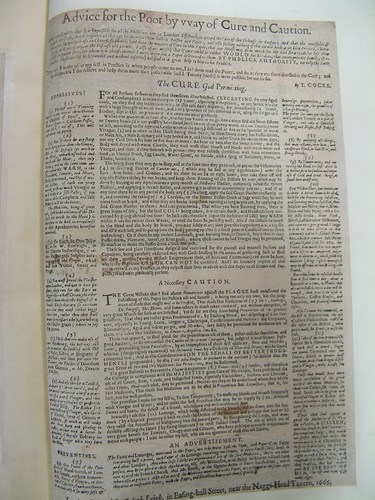
ImageCivil measures were 'enhanced' by pseudo-medical advice. "Certain Necessary Directions for the Preservation and Cure of the Plague", these advice sheets were called. People were urged to smoke. At Eton College, school-boys were punished severely if they didn't. People were urged to eschew cucumbers and melons and cherries. They were encouraged to consume garlic. H.F. talks about a husband who sucked on garlic and smoked all day, while the wife bathed herself in vinegar. It may not have been pleasant to be in their company, but they might very well have survived.

People were encouraged to contract syphilis! Rumours abounded that exposure to this sexually transmitted disease would ameliorate the effects of the plague. Some doctors scoffed at this thought, wondering why anyone would endanger their body and soul with such recklessness. But there may have been an element of fatalism in the face of so virulent a pestilence. If one is bound to die, perhaps one might as well do so after some hearty bonking?

Left onto Fenchurch Street to Lime Street through Leadenhall Market onto Cornhill past St. Michael's Church into St. Michael's Alley

People who lived separated from their neighbours by wide streets tended to have, on average, a lower mortality rate than those who lived in narrow bylanes (such as St. Michael's Alley). The former's mortality was approximately one person per household; in the crowded little streets, three people on average perished in a household. Quarantine was rigidly enforced - a large painted cross on a front door marked a house where a case of plague had been detected; the family of the sufferer were barricaded in, the front door locked and a guard posted in front. For forty days, they would be imprisoned. The feeling was that at the end of that period, they would either have survived the plague, or died from it, and were no longer a danger.
That if any House be Infected, the sick person or persons be forthwith removed to the said pest-house, sheds, or huts, for the preservation of the rest of the Family: And that such house (though none be dead therein) be shut up for fourty days, and have a Red Cross, and Lord have mercy upon us, in Capital Letters affixed on the door, and Warders appointed, as well to find them necessaries, as to keep them from conversing with the sound. That at the opening of each Infected house (after the expiration of the said Fourty Days) a White Cross be affixed on the said door, there to remain Twenty days more; during which time, or at least before any stranger be suffered to lodge therein, That the said house be well Fumed, Washed and Whited all over within with Lime; And that no Clothes, or Householdstuff be removed out of the said house into any other house, for at least Three months after, unless the persons so Infected have occasion to change their habitation. 2
Most households were unprepared for this incarceration; their lack of free movement meant that they were dependent on their neighbours for provisions and medical help, neither of which, in the panic, might be forthcoming. The stifling atmosphere no doubt engendered despair and desperation. People tried to get around their difficulties by attempting to bribe the guard, or sneaking out by way of the roof or backyards. One family, incensed by the guard's lack of cooperation, blew him up and absconded.

But people who escaped might have been infected, and would perish nonetheless. They would do so isolated, for nobody would come near them. They would collapse on the streets and die, and the infection would continue to spread. Meanwhile, it became more and more expensive to maintain the quarantines (would-be guards were more and more terrified of dying themselves and were reluctant to oblige); eventually, the policy of locking-up was rescinded.

Through Castle Court to Ball Court back to Cornhill to the Royal Exchange

Daniel Defoe was no stranger to the commercial heart of London, now occupied by the Royal Exchange. He was, for about forty years, a merchant of hosiery, and not too successful either. He was easily led into speculative ventures and spurious possibilities for profit, and tried to expand into horses and wine and even a diving machine that would supposedly make him wealthy. He was ruined and declared bankrupt in 1692, owing £17,000, a staggering sum. Despite being thrown into Newgate prison and paying off some of his debt, he was never entirely free from his creditors. A second bankruptcy in the early 1700s meant that they were to pursue him for the rest of his life.

To supplement his income, Defoe began to write, and he did so copiously. Nearly 350 manuscripts are known, from pamphlets to essays to books. In 1702, he wrote an anonymous satirical piece titled "Shortest Way With the Dissenters", in which he suggested that the best way to get rid of the Dissenters, who at the time were looked upon with suspicion and loathing by the general church-going populace, was not to pass laws against them, but to kill them all. Unfortunately for him, the note was taken seriously by hot-headed Anglican conservatives in office, and - when he was outed as the author 3 - even his co-religionists became upset with him. The satire was entirely missed. Defoe was arrested and convicted of seditious libel, fined heavily, and sentenced to three hours in three different stocks in the City.

Now this was a serious punishment - the convict's head and hands would be locked in place between wooden boards in public, and he would remain at the mercy of the passers-by. There had been cases of stoning resulting in the blinding or even death of prisoners. Defoe, faced with this terrible possibility, did not panic. He wrote a "Hymn to the Pillory", in which he claimed to be a champion of the downtrodden citizenry campaigning for their right to free speech.
"Actions receive their tincture from the times,
And as they change are virtues made of crimes."
This became so popular that, far from smashing his head in when he was put in the stock, the citizens of London crowded around him, casting flowers upon him, selling his pamphlet in large numbers, and protecting him from the violent elements.

Defoe, despite the brisk sale of his oeuvre, still didn't have enough money to pay the fine, so he was whisked off to Newgate prison once again. This time, however, Queen Anne came to his rescue. She paid his fine, and offered some monies to his family so that they might not want. So taken with him was the Queen that he was offered a post in the government offices. He even became a spy, which just goes to show that in Defoe's case at least, fact was more fabulous than any fiction.

Royal Exchange to Lothbury to Basinghall Street to the Guildhall
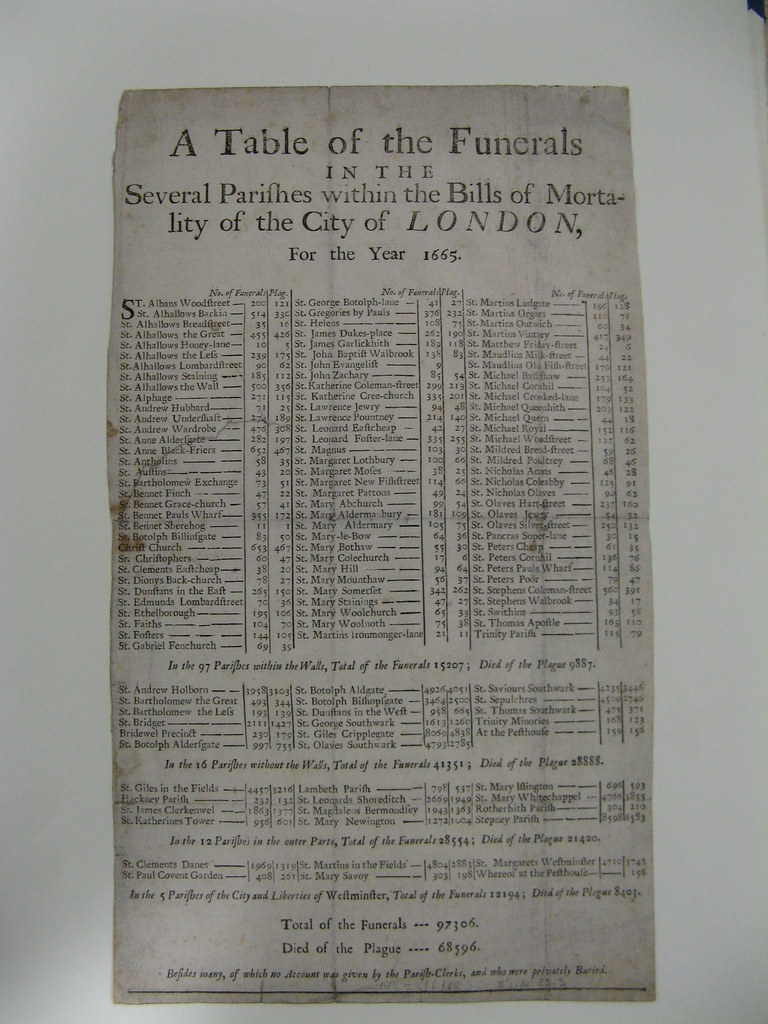
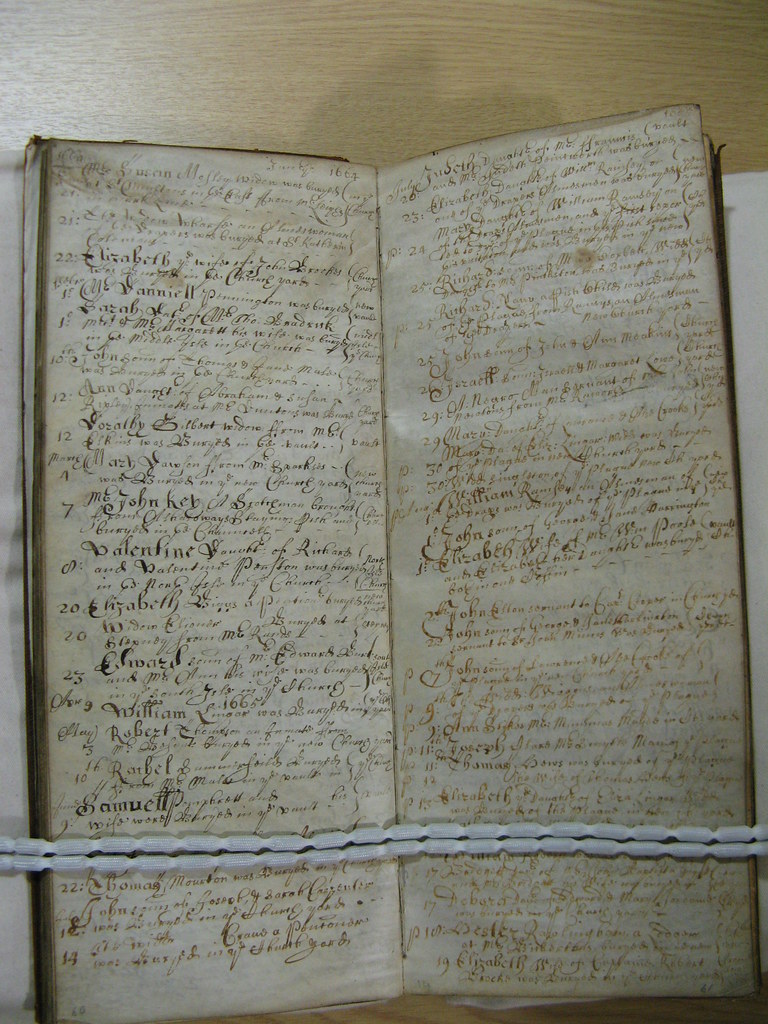
ImageIn the archives of the Guildhall, one can find the plague records meticulously maintained by the various parishes of the City. St Olave's parish provides an example of the staggering casualties during that terrible year. In August 1664, when the plague began to seethe first, two pages of the church death register were filled with the names of the dead. A year later, ninety-eight pages were filled with the names of the victims. There are about 30 names to a page; evidently, nearly three thousand people perished in just one parish in a single month.

Turn from Gresham Street right onto St Martin le Grand through Postman's Park and Watt's Memorial right onto King Edward Street to Little Britain through Smithfield Market right onto Charterhouse Street and onto Sutton's Hospital at Charterhouse Square

It was estimated that ten percent of London's population of half a million died in the first two months of the plague. By the time it died down, nearly a fifth of the population had been wiped out. People were dying so fast and the survivors so panicked that burials and spiritual support pretty much collapsed. The great plague pits that had been covered up after the previous visitation of the disease were reopened. One of them lies underneath the private garden in the middle of Charterhouse Square. Every night, plague carts plied the streets of the City carting the dead off to be tossed into the pits. During the day, the pits would be covered with lime. Upon hearing the carters' cry "Bring out your dead! Bring out your dead!", families would wrap their dead in cloth and put them on the alleys outside their homes; carcasses of people who died on the street were picked up by the carters. The near and dear of the victims were banned from coming anywhere near the plague pits: many, in their despair, wanted to throw themselves into them and end their misery, but suicide of course was a deadly sin.

There is a story of a merry piper who fell asleep, completely drunk, in a street one day, and was picked up by a plague cart. The tale doesn't end unhappily for him, however, as he revived before he was tossed into a pit and avoided the terror of being buried alive and suffocation.

Left onto Carthusian Street and past the Sutton Arms pub (dating from 1611) to Aldersgate Street through the Barbican past Defoe House and Speed House and Bunhill Row into Bunhill Cemetery

What prompted Defoe to write about the Great Plague nearly sixty years after the events he described? It might have been the news of an epidemic raging in France in 1720 that concentrated his mind, fully aware as he was of the extreme contagiousness of the dread disease. As it happened, the plague of 1665 was the last major outbreak of the pestilence in London. Defoe's book remains, however, a superbly detailed and rich account of those terrible times.

Bunhill Cemetery was one of the burial grounds in London for the Dissenters. Daniel Defoe was interred there, as was William Blake. He died a deeply unhappy impoverished man (facing, he wrote, insupportable sorrow) for he was hounded to the end by his creditors. He was buried under another name, possibly to put the creditors off track: they were known to dig up a debtor's body and ransom it for repayment from the grieving family. A collection from the children of London to honour their much-loved writer of Robinson Crusoe raised enough money for a grand obelisk to be erected in his name. Visitors to Bunhill cemetery can still see it today.

References

1. Daniel Defoe, A Journal of the Plague Year
2. Rules and Orders ... for prevention of the spreading of the Infection of the PLAGUE.
3. Ashley Marshall, The Generic Context of Defoe's The Shortest-Way With the Dissenters and the Problem of Irony, The Review of English Studies, August 4, 2009.

For the seventh time in as many weeks, I've fallen victim to a new variant of the cold virus. It's all the boy's fault, of course. His nursery is a hotbed of virulent mutants and pernicious disease, and my immune system can barely cope with the constant onslaught. So I sniffle and I snuffle and you better not shake hands with me.

I have a theory. Laugh all you want or propose me for the next Nobel Prize in Medicine. I swear it makes sense. I think these viruses actually modify human behaviour! Look at the facts dispassionately before you roll your eyes.

What does one do when faced with an epidemic? One flees the cities for the countryside, where one promptly spreads the infection among the unsuspecting peasants. Do you honestly think that a city dweller wants to go live in the boonies? He'd sooner kill himself. The reason he doesn't is that the virus won't allow it.

What does the AIDS victim do? Why, if he is particularly weak-willed, he has unprotected sex with as many partners as he can, so that the virus is disseminated far and wide. How about that, then?

Why has no cure ever been found for the common cold? The viruses have prevented it. Why would they permit their own destruction? Hoo-boy, bet you didn't think of that, did you?

Immigrants from tropical climes come to the dreary countries of the north and fall victim to various colds and flus. Does this rash of ill-health impel them to return to their more salubrious ancestral homes? No! Why not? Because the virus would not have much of a chance there, eh? The virus wants a growing pool of victims to live on, so the immigrant stays on in London. He faces cold after cold, convinces himself that his life is immeasurably better in this city of despair.

The mighty virus, meanwhile, continues to multiply, mutate, and laugh itself silly at yet another pusillanimous punter who continues to believe in free will.

Eh? Eh?

I came across the strangest paper recently. It is one scintillating example of interdisciplinary research. Why did heresies persist in mediaeval Europe despite the ruthless and brutal Inquisition? The Catholic Church went as far as genocide in its fervour to purge the land of false belief. Still, the virus of heresy proved difficult to contain.

The Inquisition quickly realised that a small number of influential people with a large circle of acquaintances were responsible for disseminating the heresies. When they targeted these few folk, the effectiveness of the purge was much more satisfactory.

A similar idea is used in the study of dynamics of epidemics these days. In general, most agents in an afflicted population are in contact only with a relatively small number of people, whereas there are a small number of people with large social networks, who turn out to be the most effective vectors. Networks such as these are called scale-free.

This property makes it much more difficult to control a plague, because the viruses persist longer in the population and are harder to eradicate than is predicted by standard epidemiological models.

As Ormerod and Roach point out in their paper, the early attempts to curb the 13the century Albigensian heresy were indiscriminate and widespread. The papal legate and monk, Arnaud Aimeric made the following remark at the storming of Béziers:
Knowing from the confessions of these Catholics that they were mixed up with heretics, [the crusaders] said to the abbot. ‘What shall we do, lord? We cannot tell the good from the bad. The abbot, ……is said to have said: “Kill them. For God knows who are his.” Thus innumerable persons were killed in that city.’
The parallels between the spread of disease and heresy were well-known at the time.
‘Just as one bunch of grapes can take on a sickly colour from the aspect of its neighbour, and in the fields the scab of one sheep or the mange of one pig destroys an entire herd,’ so, following the example of Toulouse, neighbouring towns and villages in which heresiarchs had put down their roots were caught up in the shoots put out by that city’s unbelief, and became infected with the dreadful plague.’
But by 1220, the futility of large-scale cleansing was recognised, and the recognition of the scale-free nature of the heresiarchs' network was beginning to be apparent. Indeed, the 1229 Council of Toulouse stated:
Heretics…who return to Catholic unity…not…voluntarily are to be imprisoned by the bishop of the place….to prevent their having the power of corrupting others.
Whereas in the 12th century, there was almost no targeting of powerful individuals, the arrival of specialist inquisitors from the 1230s led to extirpation of the Cathars. The Dominican Friar, Bernard Gui (parodied by Umberto Eco in The Name of the Rose) was interested in the interconnection between heretical sects, and suggested that suspected Cathars be asked:
Whether he had any familiar association with heretics; when; how; And who was responsible for it.
As well as how the network was physically organised;
Whether he received any heretical person or persons in his home; Who they were; who brought them there;….who visited them there and escorted them thence.
Although Bernard also asked what went on in houses as regards preaching or ceremonies, he was not at all interested in beliefs. Instead the guides and messengers were targeted.

Bernard recognised the wealthy heretics could pass off as merchants, and in the guise of trade, have secret meetings and important chapter gatherings. He and his fellow inquisitors then went on to propose methods to track down his quarry, isolate them, and then destroy them. First, they tried forced pilgrimages but quickly realised that this only enabled the heretic network to grow across a large geographical area. Next, they attempted large fines and punitive fiscal orders that were aimed at restricting the availability of money to support other heretics. This, though, was deemed too discreet with no public recognition of wrongdoing. Finally, they began to imprison the heresiarchs, which proved more effective because it targeted the wealthy (the only people who could afford their own maintenance in jail).

The most effective method of disruption of the heretic networks turned out to be the order given to supporters of heresy to wear a two yellow crosses (front and back of all visible clothing). As a penitent, if one were seen then to be consorting with a known heretic, the ensuing punishment for lapsing would have been particularly brutal. As a result, the supporters of the influential heresiarchs gave up on their networks. Even worse, nobody wanted to be seen even talking to the bearer of the crosses, for fear of being denounced as a heretic. This proved to be the death-knell for the Cathar faith.