Simona Mohamsson — en förolämpning mot väljarnas intelligens
18 Mar, 2026 at 15:43 | Posted in Politics & Society | 1 CommentAlla som sett en valvaka vissna vet hur politisk sorg ser ut. Att förlora gör ont.
Men det som sker i Liberalerna just nu är något annat. För vad människor de senaste dagarna har förlorat är inte en kamp eller en strid – utan sitt parti.
Deras partiledare har valt att föra dem bakom ljuset och omfamna mannen som under så många år varit partiets uttalade fiende. Simona Mohamsson lovar — trots att hennes parti fattat beslut om motsatsen — att göra Jimmie Åkesson till minister. I gengäld har Sverigedemokraterna gått med på att hafsa ner några minnesanteckningar om olika sakfrågor de har pratat om.
Men i stället för att säga som det är — att det är ett desperat försök att rädda sig kvar med stödröster — väljer Mohamsson en annan väg: Detta handlar om att sätta sakpolitiken i centrum, påstår hon käckt.
Det är en förolämpning mot väljarnas intelligens.
För avtalet är förstås ”inte vatten värt”, konstaterar Ebba Busch (KD). Förhandlingar inleds först efter en valvinst. Däremot är det praktiskt att kunna säga att vi är ett lag nu, fortsätter en nöjd Ulf Kristersson (M).
Habermas and the Frankfurt School
18 Mar, 2026 at 10:05 | Posted in Politics & Society | Leave a comment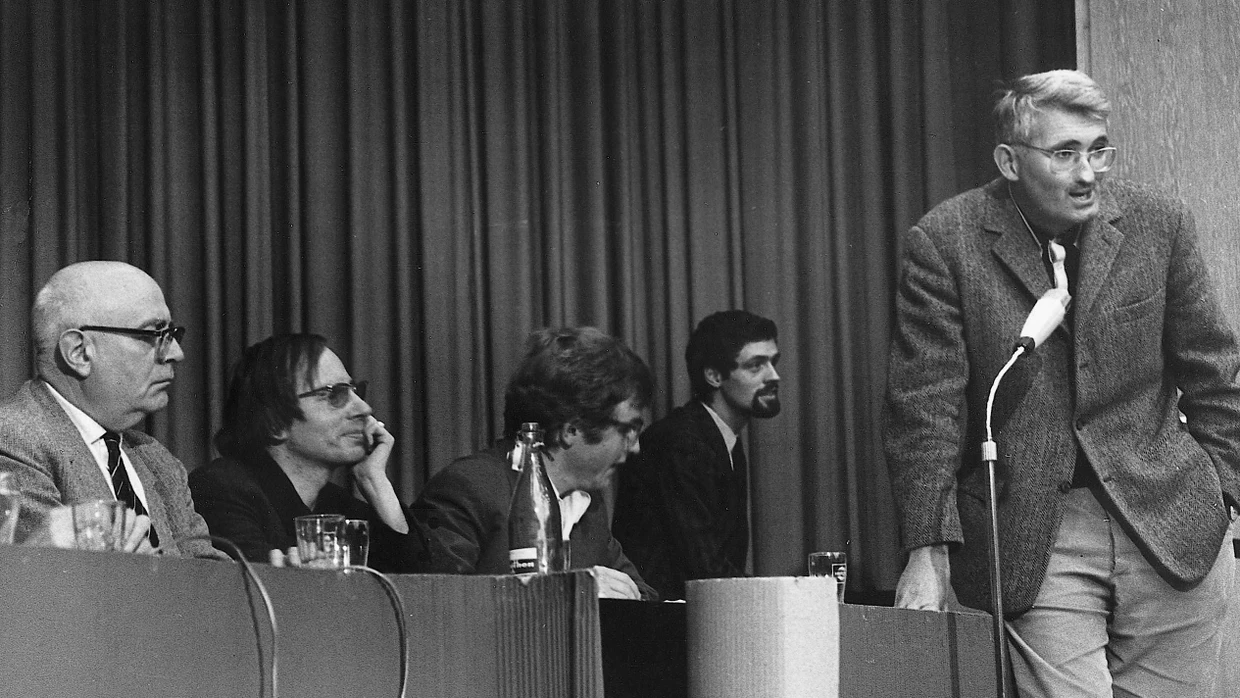 Jürgen Habermas is often seen as the most prominent representative of the second generation of the Frankfurt School, a successor to Max Horkheimer and Theodor W. Adorno. But the relationship is far more complicated. Habermas both inherited the Institute’s legacy and fundamentally reoriented it.
The primary point of contention lies in the project of Critical Theory itself. The first generation, particularly Adorno and Horkheimer in their Dialectic of Enlightenment, presented a bleak, nearly totalizing critique of reason. They argued that the Enlightenment’s promise of freedom had inverted into a new form of domination, culminating in instrumental reason—a rationality focused solely on efficiency and control, which they saw manifested in both fascism and the modern “culture industry.” This left little room for hope or emancipation.
Habermas crucially showed that Adorno and Horkheimer radicalised their critique to the point where reason seems entirely subsumed by instrumental reason, with no remnant of communicative or emancipatory reason capable of rescuing the Enlightenment. By negating all possible grounds for rational justification, they undercut the very epistemic foundations on which their own critique relies — thus entrapping themselves in a performative contradiction that culminates in an irresolvable aporia. Adorno’s and Horkheimer’s reduction of rationality to instrumental domination leaves no room for communicative, emancipatory reason. In doing so, Adorno and Horkheimer undermine the very basis of critique by denying Enlightenment any positive dimension.
Habermas fundamentally rejected Adorno’s and Horkheimer’s pessimism. Their critique was so total that it undermined its own rational foundations. If reason is merely a ‘totalizing’ tool of domination, on what basis can we critique it? To solve this, Habermas sought to “rescue” the project of modernity by reconstructing a different concept of reason, by shifting focus from the philosophy of consciousness to the philosophy of language and communication.
For Habermas, reason is not primarily instrumental but communicative. He developed the concept of the “ideal speech situation” and “discourse ethics,” arguing that norms can be justified through free and open dialogue.
The divide between Habermas and the Frankfurt School is also evident in their views on democracy. In contrast to Horkheimer and Adorno — who viewed liberal democracy as essentially a mechanism of capitalist control — Habermas argued that its legal and procedural frameworks are not (merely) illusory. He maintained that they contain a normative substance that enables the influence of communicative power to permeate the administrative state.
Habermas retained the Frankfurt School’s preoccupation with emancipation and the dysfunctions of modernity, yet he decisively broke with its social-theoretical reductionism and pessimistic conclusions regarding reason. His reconceptualisation of reason in communicative terms and his identification of democratic structures as sites of ’emancipatory potential’ fundamentally reconfigured Critical Theory.
Habermas transformed the project of Critical Theory from a purely ‘negative dialectic’ into a reconstructive enterprise. He showed that today, perhaps more than ever, it is vital to anchor critique — not in ahistorical reductionism and abstract negation — but in the normative claims of real social struggles.
Serenity
17 Mar, 2026 at 22:01 | Posted in Varia | Leave a comment.
A choir of angels performing Ola Gjeilo’s masterpiece in Lund Cathedral, where I have twice been awarded my doctorate, where my children had their school-leaving ceremonies, and where my son David was baptised.
Mikael Damberg borde lyssna på Ernst Wigforss!
17 Mar, 2026 at 11:42 | Posted in Economics, Politics & Society | 3 Comments Att den socialdemokratiska ledningen återigen faller in i det gamla mantrat om att “den som är satt i skuld är icke fri” är beklämmande.
Dagen den svenska liberalismen dog
15 Mar, 2026 at 09:07 | Posted in Politics & Society | 2 Comments
På en pressträff i fredags meddelade L-ledaren Simona Mohamsson att hon vill ge Sverigedemokraterna ministerposter. Det var en tragisk dag för liberalismen.
Men på ett personligt plan gör det också ont att se de personer jag fann liberalismen med, vara de som begraver den.
Jag minns hur jag som ny Lufare hörde äldre medlemmar stolt berätta om hur Barbro Westerholm tog bort sjukdomsstämpeln för homosexuella. Nu omfamnar man partiet som mer än några andra i svensk politik visat förakt för hbtq-rörelsen, som sagt att Pride legitimerar pedofili.
När synagogor skändades med nazistiska hakkors brukade vi ”lovebomba” byggnaden, genom att klippa ut små pappershjärtan och sätta upp dem på väggarna. Nu ska partiet som ”har sina rötter i nynazismen”, enligt vad Mohamsson själv sade för bara ett par år sedan, in i regering …
Till stora delar styrs den liberala partiorganisationen av just min tids Lufare. De har valts till politiska poster och jobbar som politiska tjänstemän.
Vi brukade säga att vi skulle förändra partiet inifrån, göra det till en äkta liberal, human och medmänsklig kraft.
Så tog de över partiet.
Och aldrig har Liberalerna gett upp sina ideal mer än nu. På fredagen såg jag min generations liberaler ta död på en hundraårig frihetskamp.
Jürgen Habermas (1929–2026)
14 Mar, 2026 at 20:54 | Posted in Politics & Society | 2 Comments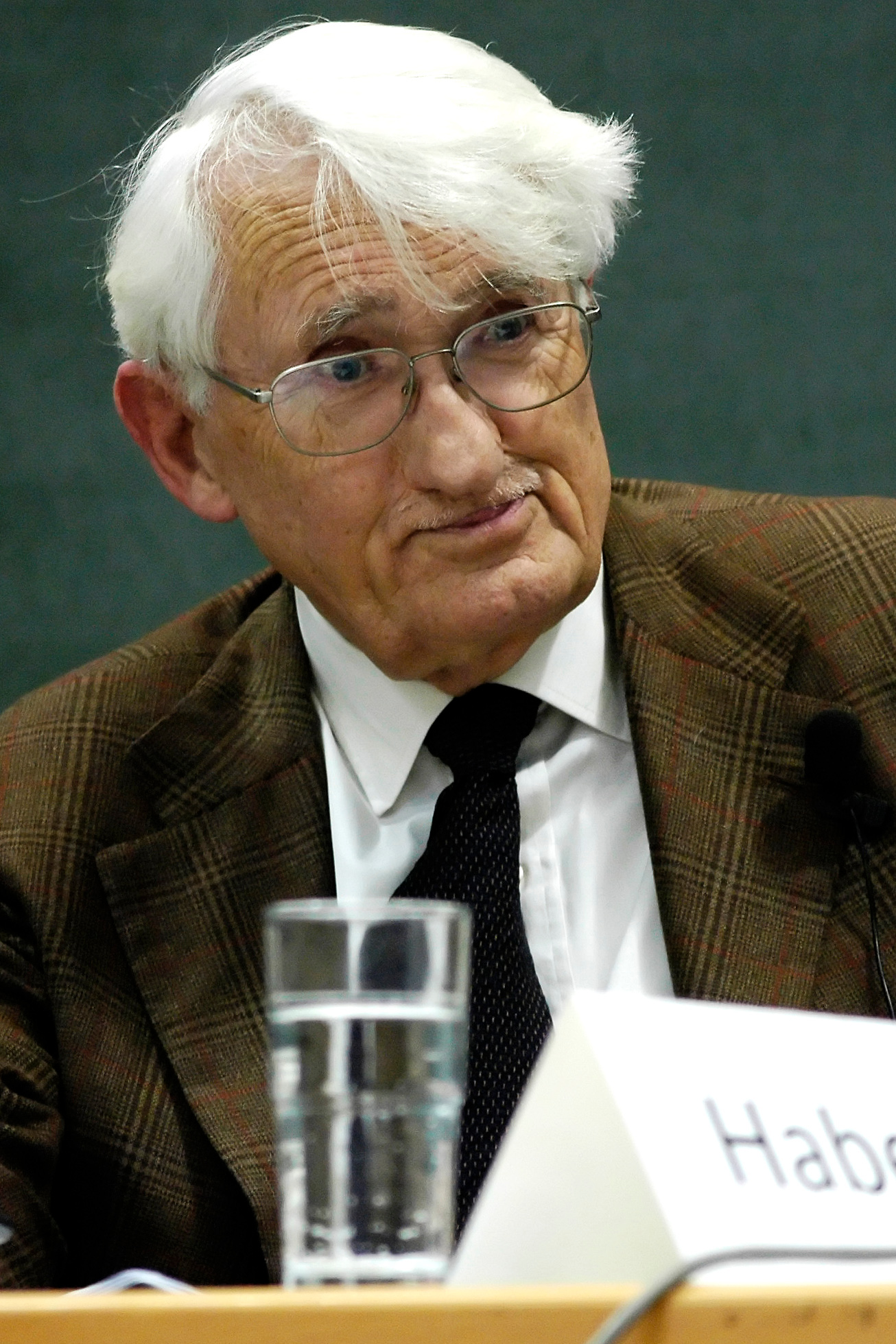 Jürgen Habermas, en av vår tids största filosofer, somnade idag in, 96 år gammal.
För oss som växte upp med Frankfurtskolan var Habermas mer än en akademiker. Han var en röst som sa att förnuftet inte behövde överges bara för att det hade missbrukats. Att samtalet mellan människor fortfarande kunde rädda demokratin. När det kändes mörkt fanns han där, som en påminnelse om att vi kan nå varandra om vi bara lyssnar och talar på allvar.
En del av efterkrigstidens samvete har lämnat oss.
Det känns som att ha förlorat en vän.
Vila i frid.
Why your dates are attractive jerks
14 Mar, 2026 at 19:18 | Posted in Statistics & Econometrics | 1 Comment
A helpful intuition for understanding ‘collider bias’ — the spurious correlation induced when one controls for a common effect rather than a common cause — can be found in modern dating behaviour.
In a population at large, it is reasonable to assume that attractiveness and personality are independent. Mean people are not necessarily attractive, nor are nice people. However, once we shift our focus from the general population to the specific subset of people who are currently dating, we are conditioning on a collider. The choice to date someone is caused by both attractiveness and personality.
Within the dating group, a false trade-off emerges. If an individual has a mean personality, the reason they might still be dating is probably their attractiveness. Conversely, if someone is unattractive, they must have a nice personality to be successful daters. Looking only at the dating pool, one would conclude that there is a negative correlation between the two traits, guessing that mean people are attractive and that unattractive people are nice.
This simple analogy should serve as a powerful warning for economists. In recent decades, the discipline has developed a tendency to address the problem of omitted variable bias by adding as many controls as possible to a regression. The logic seems sound — if leaving a variable out biases your estimate, putting it in should fix it. This mechanical approach, however, crucially depends on the type of variable being added. Controlling for a confounder — a variable that causes both the treatment and the outcome — removes bias. But controlling for a collider — a variable that is caused by both the treatment and the outcome — creates it.
When economists add variables that may themselves be outcomes of the processes they are studying, they risk opening up back-door paths and creating correlations that have no basis in reality.
Reducing complex research questions to manageable statistical hypotheses is a difficult art, and the assumption that one can simply treat real-world processes as if they were random statistical experiments is a phantasmagoric fantasy. If our goal is a relevant and realistic science, we must remember that more controls are not always better — sometimes, they are the very source of the illusion.
How (not) to make valid causal inferences
14 Mar, 2026 at 14:08 | Posted in Statistics & Econometrics | Leave a comment
Traditionally, analysts use data on stopped individuals to study bias by computing the difference in violence rates between stopped minority and white civilians, while controlling for observable differences between these two sets of encounters. We term this the “naïve estimator” … However, without further assumptions, this quantity will have no causal interpretation so long as the treatment affects the mediator (i.e., civilian race affects whether officers detain a civilian) … This is because treated encounters (with minority civilians) that result in a stop will not be comparable to those with stopped control (majority) civilians. As a simple example, suppose officers exhibited racial bias as follows: they detain white civilians if they observe them committing a serious crime (such as assault, potentially warranting the use of force) but detain nonwhite civilians regardless of observed behavior. When this is true, comparing stopped white and nonwhite civilians amounts to comparing fundamentally different groups. The analyst will observe force used against a greater proportion of stopped white civilians because of the differential physical threat they pose to officers. Under the traditional approach, the analyst would naïvely conclude that anti-white bias exists, yielding an erroneous portrait of racial discrimination in the use of force.
This study is a must-read for researchers seeking to identify causal relations from proprietary administrative datasets.
Looking only at data often gives the wrong causal impression — especially when, as is the case here, the data are biased from the outset and lead to sample selection effects due to post-treatment conditioning. Comparing white bank robbers to black civilians who have committed no crime does not provide the apples-to-apples comparison necessary for valid causal inference.
From a statistical perspective, the fundamental error in the traditional analyses is the all-too-frequent and deeply problematic assumption that one can simply treat convenience samples and real-world processes as if they were random statistical samples. They are not — and every statistical hypothesis tested is consequently of dubious value. Relying on unwarranted, phantasmagoric model assumptions is a risky manoeuvre if our goal is relevant and realistic science.
Reducing interesting research questions to ‘manageable’ statistical hypotheses is a difficult art. Data — whether ‘big’ or otherwise — never by themselves yield credible causal inferences.
Hans-Georg Backhaus (1929-2026)
12 Mar, 2026 at 22:20 | Posted in Economics | Leave a comment
Hans-Georg Backhaus è morto ieri, 8 marzo, all’età di 96 anni. Era mentalmente in forma e continuava a leggere e lavorare, ma qualche giorno fa è caduto ed è stato portato in ospedale, dove è morto serenamente tre giorni dopo.
Backhaus era nato a Remda, in Germania (poi Repubblica Democratica Tedesca), nel 1929. Negli anni ’50 è emigrato dalla Germania dell’Est a quella dell’Ovest, dove ha studiato filosofia, sociologia ed economia politica a Heidelberg e poi a Francoforte. Nel 1965 ha presentato i fondamenti della sua interpretazione della teoria del valore di Marx nel seminario avanzato [Oberseminar] di Adorno all’Università di Francoforte.
Nel 1969 scrisse il suo articolo più famoso e ampiamente tradotto Zur Dialektik der Wertform [Sulla dialettica della forma-valore] (Backhaus, 1969), che assieme a Zum Erkenntisbegriff der Kritik der Politischen Ökonomie [Il concetto di conoscenza nella critica dell’economia politica] di Alfred Schmidt (del 1968) può essere considerato il documento fondatore di quella che oggi è conosciuta come la Neue Marx-Lektüre [Nuova lettura di Marx]. Tra i suoi esponenti, vi sono Helmut Reichelt e Michael Heinrich.
Da quel momento in poi, in un processo duraturo di autocritica e autocorrezione, portato avanti nel corso di numerosi articoli (ora raccolti in parte nel volume Dialektik der Wertform: Untersuchungen zur Marxschen Ökonomiekritik (Backhaus, 1997b), sviluppò la sua interpretazione della critica di Marx all’economia politica.
Negli anni ’70 e nei primi ’80, quando ‘yours truly’ era lui stesso parte della scuola Kapitallogik, Hans-Georg Backhaus era una figura centrale che tutti leggevamo. Insieme al co-fondatore Helmut Reichelt, ha aperto la strada a un rigoroso riesame della teoria del valore di Marx. Tra gli associati chiave figuravano Hans-Jørgen Schanz dalla Danimarca e, in seguito, l’interprete Michael Heinrich. La scuola fu significativamente influenzata dai primi pensatori come Evgeny Pashukanis e Isaak Rubin, oltre che dalla teoria critica di Theodor Adorno.
Riposa in pace, amico mio.
Is smoking — really — good for babies?
12 Mar, 2026 at 19:50 | Posted in Statistics & Econometrics | Leave a comment Judea Pearl, in his The Book of Why, discusses the problems that arise if we thoughtlessly try to ‘control’ for too much in our quest to identify causal relationships.
One of his examples concerns the paradox that when we want to find out whether mothers’ smoking increases the risk of infant mortality, but only study newborns with a low birth weight, it can lead us to draw the incorrect conclusion that smoking is beneficial.
To understand the paradox, one must first appreciate the true causal structure. A mother’s smoking during pregnancy (MS) can cause her baby to have a low birth weight (LBW). Separately, a completely independent factor — genetic anomalies in the baby (GA) — can also cause low birth weight. Furthermore, these genetic anomalies (GA) are a direct cause of infant mortality (IM), just as low birth weight (LBW) itself can be. Crucially, smoking and genetic anomalies are independent—smokers are no more likely to have babies with genetic defects.
The trouble begins when a researcher decides to study the effect of smoking on mortality within a specific group: babies with low birth weight. By restricting the study to these babies, the researcher inadvertently conditions on the ‘collider’ LBW, which gives rise to a false correlation between the two independent causes of low birth weight: smoking and genetics.
If a baby has a low birth weight and the mother smoked, its low birth weight is easily attributed to the smoking. Consequently, these babies are less likely to have a severe genetic anomaly. However, if a baby has a low birth weight and the mother did not smoke, its low birth weight cannot be explained by smoking, implying a higher likelihood of an underlying genetic defect. Since genetic defects are a powerful cause of mortality, the non-smoking mothers’ babies with low birth weight will have a higher death rate than the smoking mothers’ babies.
This leads to the bizarre — and false — conclusion that smoking appears to be good for newborns. In reality, smoking is harmful. By mechanically controlling for birth weight (by choosing only to study low birth weight babies), the researcher creates a statistical illusion. This example powerfully underscores the importance of understanding the causal structure behind the data. It demonstrates that naive statistical adjustments, performed without a causal map, can transform a genuine harm into a perceived benefit.
The point yours truly made last week bears repeating: econometric models are frequently the result of researchers mistaking statistical control for causal identification. The problem? You can’t ‘control’ your way out of confounding — it requires a causal solution. Control for everything, and you’ll inevitably hit a collider, opening back-door paths and creating confounding that wasn’t there to begin with.
‘Overcontrolling’ (III)
11 Mar, 2026 at 11:39 | Posted in Statistics & Econometrics | Leave a comment.



-


Recent Comments
Jan Wiklund on Mikael Damberg borde lyssna på… Lars-Erik Eriksson on Simona Mohamsson — en fö… Jan Milch on Mikael Damberg borde lyssna på… Elefanten i S-rummet… on Mikael Damberg borde lyssna på… Jan Milch on Jürgen Habermas (1929–2026) Jan Milch on Jürgen Habermas (1929–2026) Jan Milch on Dagen den svenska liberalismen… Jan Wiklund on Why your dates are attractive… Jan Wiklund on Dagen den svenska liberalismen… Tje Frog on Mainstream economics — m… Lars Syll on Does eating caviar make you a… Jan Milch on Does eating caviar make you a… Jan Milch on RBC — four decades of in… Jan Milch on Katalys nya chefsekonom Jan Milch on Why Minsky still matters Reading List


Blog at WordPress.com.
Entries and Comments feeds.
 LARS P. SYLL
