Showing posts with label Katrina. Show all posts

Wednesday, August 27, 2025

It will always be Katrina times

Here is a photo I took five days ago.

  Entrance with Katrina mark


If you look closely at the left (viewer's left) of the door you probably can make out the still visible Katrina rescue markings. But just to help you out, here is a photo of the same door I took in 2006.


Entrance with rescue marks

Much like I did 10 years ago, I've been going around town this month revisiting scenes I photographed after Katrina to mark... progress isn't really the word, is it? The passage of time, then. These photos, in particular, illustrate what I mean by that. Does 1634 Third Street look like it's fared well over the course of 20 years?  Probably not from this view.  I could offer a more complex perspective on that but it's really a topic for a different post.  Anyway, I don't live there anymore. 

I did have a few thoughts on it, and a few other things, to share for this Katrina roundtable in the latest Southern Cultures, though. Fair warning, there will be more about the post-K 20 years in the next Ban Mayors chapter as well. After that, I'd like to say we can shut up about it for a while. But I don't think we can. 

Katrina was, is, and will always be the central event of my life. Everything since is a direct result. Everything I've tried to do or be is a direct reaction. The unfortunate thing I've learned is that nothing I do or could do would ever make a difference. But also I can't and won't choose to anything differently.


Friday, March 14, 2025

Nobody actually lives here

It's getting more difficult to hide the truth about this place.  

New Orleans and its suburbs have lost population at a faster rate than any other large metropolitan area in the country since 2020, according to new Census Bureau estimates released Thursday.

It's the second year in a row the New Orleans area has topped the list of fastest shrinking large metros.

The New Orleans area lost more than 39,000 people between 2020 and 2024, a decline off nearly 3.9%.

I suppose 2020 can be considered a turning point for many things. And it's fair to think of that as a transitional moment from a rapidly gentrifying Post-Katrina New Orleans, where the communities washed away by the flood were replaced by vacation rental amusements, to the Post-Covid ghost town where it just feels like the the wiring is being stripped out of everything. 

But, really, there is a consistent narrative flowing through both of these phases. As always, the root causes of the current hellscape trace back to what came before it. In our case, that's a long story about a city's ruling class and the deliberate choices it made in the wake of a disaster to change the city "demographically, geographically and politically," as one prominent member of the Rex Organization said at the time.  We've watched that process fairly closely over the years. The archives of this blog should show that farily well.  I have no idea if any of that mattered, though. 

In any case, the stated aim of the gentry, then, was to build a smaller, whiter, city with fewer poor people.  Congratulations to them on their success. 


Friday, May 13, 2022

They're still thinking about it

This site was never a great store of content anyway but if anyone is wondering why it's been especially sparse lately, it's because I just am using the phone to do short posts (sometimes) until the laptop is fixed. But most of the time if I have my phone in my hand and a link to share, I just end up tweeting it out. I know this is riveting. 

But I do like to use this blog to make notes when I can so can remember stuff later. It's much better for that purpose than Twitter, which can be kind of a black hole.   For example, I am right now using it to post this story from yesterday's T-P about the continuing victimization of people by the Road Home program some 16 years later. 

In 2008, the state of Louisiana offered Matthews $30,000 through the federally funded Road Home program to elevate her house to reduce the risk of future flooding. But her home was still unlivable, and she desperately needed the cash for repairs. To her relief, she said, a Road Home representative told her she could use the elevation grant to instead pay for repairs. So she did.

Now, more than a decade later, the state wanted the money back.

Only the latest reminder of the cruel stupidity of the regime people live under here. Poor people pay the costs of corruption. Every time.

Louisiana has sued about 3,500 people — about one in every nine people who received an elevation grant — for failing to use the grants to raise their homes after hurricanes Katrina and Rita struck in 2005.

The real problem, however, wasn’t that people ignored the rules, according to an investigation by The Advocate | The Times-Picayune, WWL-TV and ProPublica. It’s that the state Office of Community Development and a contractor it hired in 2006, ICF Emergency Management Services, mismanaged the program. For more than a decade since, the U.S. Department of Housing and Urban Development has insisted that the state recoup the money from people who are noncompliant.

 Y'all remember ICF, right? Only Katrina kids know.  Jarvis DeBerry wrote this seven years ago

Who's really to blame for homeowners getting more money than they ought to have received: ICF or the state of Louisiana itself? In some cases it may be ICF. In other cases it may the state. But none of that matters to homeowners caught between these two warring parties. If they've been mailed letters suggesting that they acted fraudulently when they didn't do anything wrong, then they should be provided documentation that clears everything up, a letter that gives them permission to never have to think about Road Home again.

Yeah, well, turns out that in 2022 they still gotta think about it.  

Also here's one more thing from that story to think about as we approach another hurricane season.  The costs of each disaster, and its associated mishandled response is only getting worse. 

Image


Welcome, again, to the shitty part of the year.

Tuesday, November 03, 2020

Normalcy in our time, normalcy in our town

Did we talk about the Democratic convention on here yet?  It's been such a weird year in so many ways. Too often I find myself falling behind the noise before I can write enough of it down.  That's not good. Keeping good notes on this website has been such a useful tool for me in just holding it together over the years, I am afraid if I let it go for too long I might dissociate completely from reality.  Maybe that wouldn't be such a bad thing.... 

Oh wait. Here it is. Just a quick summary because I was probably in a hurry. 

But one theme the Democrats pushed relentlessly was Joe Biden's capacity for "empathy."  In Zoom video after dimly lit Zoom video, speakers testified about the times Joe personally had reached out to someone to let them know how well he understood their trauma, how much he cared about and validated their pain.  Almost nothing was said about what he planned to do about any of it.  In fact, one may have come away from the convention with the impression that nothing can be done.  It's a strange thing to offer to voters but it does seem to be in line with the Democratic brand. 

They're basically saying, yeah we know, your life sucks right now. Look at Joe. He's out there feeling your pain. He understands. Meanwhile the policy program is full of little ways to make it easier for you to get used to and cope with the shittiness. We're not out to change the shitty conditions. We're here to valorize your experience of suffering through them.

The hallmarks of this ideology of free market fatalism are visible throughout the mainstream of the Democratic Party.  For example, the same tone was easily detectable in Mayor Cantrell's "State of the City" address delivered just around the time of the convention this year.

“We are all well-versed in the unwavering focus, the hope, and the strength it takes to rebuild from what can seem like disaster,” she said. “I’m here to deliver a message of hope and point the way forward to our future beyond this pandemic.”

The city is now five months past the initial outbreak, which trailed a range of side effects including rampant unemployment and evictions and a city budget now estimated to be more than $100 million in the red. Frequently harkening back to the 1853 yellow fever pandemic, which claimed 8,000 lives, and other, more recent tragedies, Cantrell framed the city and its people as among the most capable of rising to the challenge the current crisis presents.

“We are no strangers to trauma and disruption, you know better than me,” Cantrell said, noting next week will be the 15-year anniversary of the levee failures and flooding set off by Hurricane Katrina.

Again, the message is, our lives are marked by trauma but the mayor knows it and wants us to have "hope."  What, specifically, should we hope for? Well, it's murky.  She says we shouldn't have to worry about making rent.  But her policy response is embedded in trickle-down economics and charitable fundraising projects administered by private non-profits.  And, above all else, great pains are taken to ensure we do not saddle our landlords with worries of their own.

Acknowledging a tripling in the eviction rate, Cantrell touted various rental assistance programs — including a fundraising effort by the nonprofit set up for her transition into office — and said she is fighting for federal assistance.

“The time of a pandemic is not the time for our people to lay awake at night wondering how to make next month’s rent,” Cantrell said. “It is also not the time for landlords to face missing mortgage payments or losing investments they spent a lifetime to build.”

The Dem convention and Cantrell's speech took place a week prior to the 15th anniversary of Hurricane Katrina's arrival in New Orleans. That week, a New York Times feature called attention to the long term effects of that disaster and what everyone should know by now are the harmful consequences of the unjust and ineffectual "recovery" policies implemented in its wake.  Sorry to pull such a long quote here.

Pre-Katrina, there was already a considerable shortage of affordable housing in New Orleans. The situation has only become worse, as many of the affordable units the city had were never rebuilt after the storm and the urban core became whiter and wealthier.

New Orleans now has roughly 33,000 fewer affordable housing units than it needs, according to HousingNOLA, a local research and advocacy group. There are opportunities in every corner of the city to fix this, argued Andreanecia Morris, the executive director of HousingNOLA, when we met in her office in Mid-City on South Carrollton Avenue.

Most New Orleanians are renters. Pre-Katrina, the market rate for a one-bedroom apartment was around $578 monthly. It has roughly doubled since then, meaning a full-time worker must now earn about $18 per hour to afford a one-bedroom apartment.

Real wages, however, have stalled, and many of the places that employ New Orleanians remain closed. Tens of thousands of workers in the city’s beloved music, drinks, food and tourism businesses — who were the most likely to lose their livelihoods both after the storm and now during the pandemic — make a minimum wage of $7.25.

In some other cities, Ms. Morris explained, unaffordable rent “is the result of a housing stock shortage, but in New Orleans we have a vacancy rate of about 20 percent!” In total, there are about 37,700 vacant units. I could feel it biking and driving through the curvilinear streets that weave from the river to the lake, passing by elegant, unfilled properties on otherwise vibrant blocks, then by neatly rebuilt houses sitting lonely in areas frozen in 2007: three empty lots for every six homes you see.

Residents like Terence Blanchard, the Grammy Award-winning trumpeter, who resides in a thriving midcentury neighborhood along Bayou St. John, live this dichotomy. “People talk about the recovery,” he told me as we stood on his dock overlooking the water and City Park. “But if you go to my mom’s house in Pontchartrain Park, there was no real recovery.”

The federal housing vouchers mostly known by the shorthand “Section 8” — which subsidize rent payments above 30 percent of participants’ income — fully cover “fair market rate rent,” which in New Orleans is calculated as $1,034 to $1,496 for a one-bedroom apartment. That means even in increasingly upscale, higher-ground areas of town there is little stopping developers and landlords with vacant properties from lowering rents by a few hundred dollars and still being able to generate revenue.

For Ms. Morris, the continued holdout by many landlords that want “a certain kind of family,” or Airbnb customers, has grown to “psychotic” levels of classism and racism. “At a certain point,” she said, “the math has to let you at least manage your prejudices.”

Whenever the post-2005 destruction and gentrification of New Orleans is discussed, I am obliged to point out again that none of it was an accident.  Since, literally days after Katrina landed, we were already trying to warn that this was going to happen and it would happen as a result of deliberate policy choices made by people who wield political power in New Orleans. Then it happened. It happened every day. Sometimes in very big ways and other times as part of a general creep. But the whole time, we were saying out loud to anyone who would listen, this is happening, the money power, the real estate, tourism and business owners were gutting the city.

And it didn't matter. They did what they wanted. Because that's what always happens. They have the power. We have nothing. You can see it, you can say it, you can object all you want. But they do whatever they want and you don't matter.  Even now, in the middle of a pandemic, in the middle of a depression, there is no such thing as housing justice. Because they can afford to be "psychotic" in their stubbornness and no one with any political power will stop them.

Even at the lowest point of crisis, political leaders emphasize the concerns of landlords holding them equal to or greater than the housing stressed poor. Today, a week after a Category 2 hurricane ripped through and knocked out everyone's power we're still struggling with worries over whether or not the polling locations can operate.  Guess what was back up and running immediately, though.

The thing about New Orleans politics people most misunderstand is how fundamentally conservative it is. The governing ideology in all the major power centers is pro-police, pro-landlord, anti-labor. It's rare to find any observer, let alone someone from out of town, describe it this way, though. Which is why this New Yorker piece by Keeanga-Yamahtta Taylor is refreshing. Taylor is writing primarily about the superficial racial politics of the Biden-Harris campaign but within that argument we find this passage.

There is little consideration of how a municipal administrator’s class standing may complicate solidarities with those it is simply assumed they will represent. This is especially true for Black elected officials, many of whom come from working-class origins but whose class standing shifts when they move into political office. In May, 2018, LaToya Cantrell became the first Black woman to be elected as mayor of New Orleans. Cantrell, who first moved to New Orleans in 1990, in order to attend Xavier, a historically Black university, was deeply involved in community organizing in the aftermath of Hurricane Katrina, and served on the city council for six years before ascending to the position of mayor. Despite this background of community engagement, Cantrell has stood on the sidelines during a strike by a small group of Black sanitation workers, over demands for hazard pay and P.P.E. during the pandemic. Sanitation work is outsourced in New Orleans, allowing contracting companies to pay workers less than the city’s living-wage ordinance allows. In this case, when the sanitation workers decided to strike, one of the subcontractors procured a contract for prison laborers, who worked for even less than the striking workers. Even as these “essential workers” have called upon the mayor to help them secure P.P.E. and better pay, Cantrell has refused to intervene directly, saying that these issues are between the contractor and the workers. There is no inherent solidarity along the lines of race, and, when class conflict is introduced into the calculation, it is even more fraught.

This is a city where only a person who promises not to take from the rich and give to the poor and "all that kind of crap" can be mayor.  Policy can only be formulated through a distinctly neoliberal lens. Every problem can only be met with some sort of "business incentive" public-private partnership, or other such trickle down scheme to benefit the ruling classes.

Meanwhile, even within the (very small and insular) world of progressive activism you can't get agreement on basic principles like, for example, housing as a human right or that teachers deserve unions.  And, in any case, the decisions that matter get made at a 10,000 foot remove from any of that through deals between political careerists, tourism bosses, and real estate interests. The public side of the political process, such as it is, is just nonsensical theater.

Which brings us to today's elections.  If you've voted early, or if you've wandered into a polling location this afternoon, you may have noticed that there are a lot of things going on with your ballot besides just that dismal Presidential election.  What even is all that stuff?  Well, if you really want to know the details you should stop here and go read the excellent and extremely thorough Antigravity and DSA voter guides.  But if you want the short version, stay here and I will tell you. 

Basically three things are happening. A slate of reformist candidates mostly associated with the public defender's office is trying to win a bunch of judicial seats.  A few somewhat progressive minded challengers are trying to wrest one or two school board seats away from incumbent charter school privatizers with national corporate backing. And, all of this is happening in the context of various power brokering institutions trying to consolidate their positions as electoral and patronage gatekeepers ahead of next year's municipal elections. 

The linchpin in the insider tug of war is the DA's race where Mayor Cantrell's alliance with BOLD, which did very well in the legislative races last year, is backing Keva Landrum. You can read a little bit about the dynamics of the race in this Advocate story about the fundraising. Landrum has positioned herself as the more conservative "law and order" candidate compared to Jason Williams and Arthur Hunter who she has criticized as "backed by third party special interests." Each of their platforms is invested in reforming the criminal legal system more aggressively than she would like.

As I type this right now, the polls are open for another twenty minutes. But my strong suspicion is the establishment candidates will win most of these judicial and school board races and Landrum will run first in the DA race.  Overall the theme of the night is conservative establishment results at home to match the general "return to normalcy" nationwide as Joe Biden becomes the next President.

Maybe that is disappointing.  But disappointment has pretty much been baked into this since March. Here is what I told the kids yesterday on a parallel internet. We know that the Biden Presidency only represents the replacement of one kind of conservatism with another. We know that, regardless of the election result, we are no nearer to overcoming the massive obstacles to human happiness posed by poverty, racism, disease, empire, and climate catastrophe. And we know these are all deeply embedded consequences of systemic capitalist exploitation and that the work of rooting them out has not even begun. 

But, if only for the sake of your own mental well being and that of your neighbors, please do not deny yourself the chance to revel in the pure and absolute joy of seeing Donald Trump ejected from the White House. Fuck that guy. He's almost gone. It's okay to enjoy that.

Wednesday, August 29, 2018

People shouldn't post stuff on the internet

Having said that, I guess these twelve posts I put up around the time of the tenth Resilience-a-versary were fine for what they were and all. Today being the third anniversary of that seems a fair occasion to look at those again.

Wednesday, November 08, 2017

The New Orleans model

Post-Katrina New Orleans has so much to be proud of.  We were the laboratory of innovation where 21st Century disaster capitalism was born.* Our model is being replicated all over now.
The guerrilla campaign to open schools is running headlong into a separate effort from the top, to use the storm to accomplish the long-standing goal of privatizing Puerto Rico’s public schools, using New Orleans post-Katrina as a model. Last month, Puerto Rico’s Public-Private Partnerships Authority director spoke optimistically about leveraging federal money with companies interested in privatizing public infrastructure.   

Puerto Rico’s Education Secretary Julia Keleher has already called New Orleans’s school reform efforts a “point of reference” — tweeting last week that Puerto Ricans “should not underestimate the damage or the opportunity to create new, better schools.” She repeated these sentiments on Monday, saying that the aftermath of Maria provides a “real opportunity to press the reset button.”
Congratulations, Puerto Rico. You're officially the latest in a line of proud "blank slates" now. Good luck. 


*Domestically, anyway.  A lot of groundbreaking work was done in Iraq too.

Tuesday, August 29, 2017

Are you better off than you were 12 years ago?

I love this ridiculous city.


It's Katrinaversary 12 today. I guess I've mentioned it a little. But mostly, and rightly, our attention has been focused on Texas where they're reliving a version of our tragedy for us.  What Harvey is doing and how it's doing it, is different from what Katrina did. But there is a lot about the experience that is resonant including the slow motion unfolding of events.

Katrina blew through in one morning, but the disaster occurred over the several days that followed as levees failed, water rushed in, rose and sat there while people waited days for relief. The terrible President showed up and made a bad speech. It would be another month before most of us were allowed back.

Harvey arrived near Corpus on Friday.  The water is still rising in Houston right now. The terrible President is there giving bad speeches.  They're on a familiar track. We don't know how much it will cost or how long the "recovery" period will last there.

In New Orleans, we threw a big victory party after a nice round ten years. But that was really just for appearances.  In reality, there still isn't anything about life here that doesn't trace back to the flood in one way or another. Although we style ourselves "recovered" we're really still dealing with the disaster. I'd argue there have been more failures than successes along the way but people don't like to hear that kind of talk.

Still it's reassuring that we're sable to laugh at our own dismal state of affairs more often than not. The little banner at the pump station was the most inspiring image I came across on this anniversary. So, despite everything that's gone wrong and is currently going even more wrong, it is true that some version of this city convincingly similar to what we were before still exists.  Maybe that's the best they can hope for in Texas now.  But I hope they'll do better.

The beginning of the effort

The Vice President had a few things to say on Monday.
Vice President Mike Pence is stressing that the federal government will support Harvey recovery efforts going forward.

In an interview with Houston radio station KTRH Monday morning, Pence said the federal government will make the resources available to see Texas through rescue operations and recovery.

Pence noted that given the “magnitude of the flooding” that “it will be years coming back.”

The vice president stressed that President Donald Trump has been “continuously engaged” on Harvey, noting that it is still the “beginning of the effort.” He said details of Trump’s visit to Texas will be “forthcoming.”
We can't wait to see what that effort looks like once it really gets rolling.  The good news for Pence is, he's probably already got a template to work with.  He helped put it together after Katrina.
At the time Katrina hit New Orleans, Pence was chairman of the powerful and highly ideological Republican Study Committee (RSC), a caucus of conservative lawmakers. On 13 September 2005 – just 15 days after the levees were breached, and with parts of New Orleans still under water – the RSC convened a fateful meeting at the offices of the Heritage Foundation in Washington DC. Under Pence’s leadership, the group came up with a list of “Pro-Free-Market Ideas for Responding to Hurricane Katrina and High Gas Prices” – 32 pseudo-relief policies in all, each one straight out of the disaster capitalism playbook.
Pence's group recommended the suspension of labor laws and environmental standards, a school voucher scheme, as well as a number of tax breaks and "incentives" benefiting the wealthy contractors and developers who turned a city's misery into profit. You know, standard disaster response type stuff. Some of the worst elements of what we still insist on calling the "recovery" of New Orleans after the flood can be traced back to the opportunism expressed in Pence's response plan. The smaller, whiter, tenuous, unsafe, unhealthy, and somehow unaffordable city we've built in the past 12 years owes much to that "pro-market" neoliberal blueprint.

Today, on the anniversary of the day that set us in motion toward this fate, we look out our windows (we aren't allowed outside) to see conditions reminiscent of, though thankfully not identical to, those of this day in 2005. We look just one state over, though, and find drama and devastation on a scale much more comparable to that in our memory. We also find Mike Pence telling us this is the "beginning of the effort" for recovery there as well.  That is already beginning to look familiar.

Also:
As surely as flooding disasters like Hurrricane Harvey are followed by health concerns and homelessness, they’re followed by calls to legalize price-gouging.

And sure enough, the waters were still rising all across the Houston area when the first such calls were heard. They came from conservative economists Tim Worstall of Britain’s Adam Smith Institute, writing in Forbes, and Mark Perry of the American Enterprise Institute, whose piece appeared on the AEI website and at Newsweek. Both demonstrated the chief flaw of such analyses: They were based on irreproachable textbook economics, and showed no sensitivity whatsoever to how things work on the ground during a major catastrophe.
And this is just the beginning.  No doubt Vice President (for now?) Pence has plenty more in store for the next 12 years or so.

Memories


Monday, August 29, 2016

Lulled back to sleep

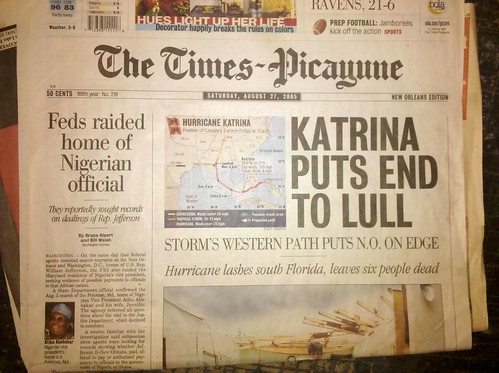
Katrina Puts End To Lull

We spent so many months remembering Katrina last year that today's subdued remembrances are not only appropriate but, frankly, welcome. The commentary is also subdued. The Advocate and T-P each ran "pay it forward" type editorials about the situation South Louisiana finds itself in in the wake of this year's flood. That seems most appropriate. That sentiment is repeated in a short post by Stephanie Grace here. Clancy Dubos offers advice to flood victims in his Gambit column this week.

Here is a more general Katrina remembrance by Bob Mann.

The papers also are running a low key series of progress reports. Here is one about public transit.
This one is about recovering urban plant life.

This one is a bit different. It's from a brief article by Gary Rivlin, the author and journalist who spoke at the tenth Rising Tide conference last year. 
Katrina was not an equal opportunity storm. A black homeowner in New Orleans was more than three times as likely to have been flooded as a white homeowner. That wasn’t due to bad luck; because of racially discriminatory housing practices, the high-ground was taken by the time banks started loaning money to African Americans who wanted to buy a home.

Nor has New Orleans experienced an equal opportunity recovery—in no small part because of the white civic leaders who openly advocated for a whiter, wealthier city. While water still covered most of New Orleans, Jimmy Reiss, a prominent local businessman and then-head of the Business Council, told the Wall Street Journal that the city would come back in “a completely different way: demographically, geographically, and politically,” or he and other white civic leaders would not return. That sentiment was paired with a policy approach then-Congressman Barney Frank described as “ethnic cleansing through inaction.”
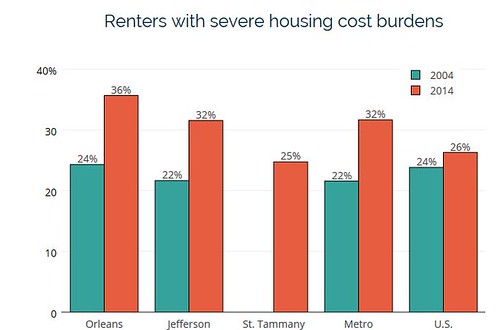
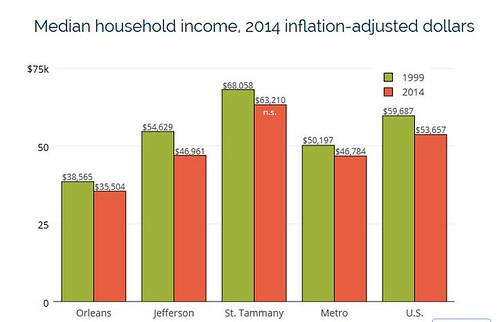
Here at the old Yellow Blog, we've been talking about that very story for over a decade now as we, as a local polity, have largely failed to make the inevitable "recovery" of New Orleans an equitable one. Rivilin's post references the Data Center's latest "Who Lives In New Orleans Now" report. There we find the heart of our failure in two graphs.

Here is the change in renters with severe housing cost burdens.

Renters with severe cost burden

And here is the change in median income.

Median Income 1999-2014

The median income for renters in Orleans Parish, by the way, is even lower. $24,773 according to this study.

If that's not depressing enough, consider also that now since we've reached the post-post-Katrina era of new New Orleans, the worst of our failures are calcifying into a more permanent new normal.  Last year, during August, I went around town revisiting places I'd taken photos of during the first couple of years before Katrina.  The result was this series of posts.  Looking back through those yesterday, I think it was this part that I most wanted to re-emphasize.
Here is something Troy Gilbert posted earlier this month that got my attention. It's a previously unpublished interview with Chef Greg Picolo about his post-Katrina experiences. There's a paragraph toward the end where Picolo talks about how the flood changed his outlook on civic life to a degree. 

Asked how he was changed by the entire experience, the Chef answers quickly, “That Greg doesn’t live here anymore. Before I led a very monastic lifestyle. I kind of broke out of the tunnel vision I had before. Today, I have more of a need to connect with people. I needed to lose some of my control. I’m easier going. I have zero patience for bullshit, and now I just don’t get bogged down with stuff.”
I'm certain I am not alone in saying this really hits home. It might be the common denominator of everyone's experience rebuilding New Orleans.  When we got back, we were shaken out of our silos. Each of us in some small way at least had to look around to see who our neighbors were. Who else was here? Who could help? How could we help them? Entire new networks were stitched together out of parts that just weren't possible to bring together before.

I wonder, though, if ten years later, we're starting to sink, bit by bit, back into our own tunnel visions of life in a new New Orleans. As we put the recovery "behind us" is receding from the tighter cross sectional communities we built during that process a good idea? Why might this be important?
I worry more now than ever that we're losing that sense of community.  The new normal New Orleans is defined more by "stay-in-your lane" stratification than grass roots organization. Traditional divisions reappear. Press and politics take a dimmer view of reader feedback and public input. Social media has evolved in such a way that it is more likely to fragment communities into walled off cliques than connect them across social and professional boundaries.

We've failed in so many ways to achieve social justice in New Orleans after the flood. Are we destined to lose our post-K social networks as well? Katrina may have ended the lull for a while. But it turns out the lull was resilient.