
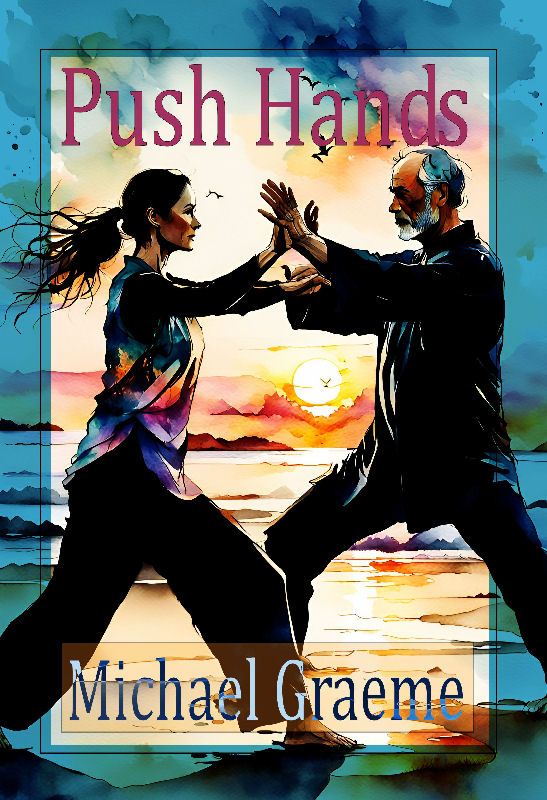
So, this time we’ve been working through my novel Push Hands, first published in 2008, sweeping up the typos, fiddling with commas and dashes, and basically enjoying the company of these characters again. We’ve made no major changes, other than a couple of the shorter chapters merged together, and some longer ones split. The latest version is out now. If you’ve not read Push Hands, indeed, if you’ve not read me at all, this is a good place to start. And it’s free.
The story is a literary romance of sorts, which is its main problem, I mean, were it ever to do the rounds of the publishers, which it never has, nor ever will. “Literary Romance” sits between two genres, two readerships without quite belonging to either – romance readers may expect a more conventional boy/girl thing and a cleaner happily-ever-after kind of ending, while literary fiction readers might shy away from the romance label altogether. But I think the story is warmer, funnier and lighter than most literary fiction, also more emotionally restrained, interior and honest, than most genre romance. It’s the kind of story I would like to read myself, therefore the best kind for a writer to write.
It began, indirectly, with a hike in the Yorkshire Dales, in a howling gale, midwinter, and one side of my face frozen. I had some ear problems after that, and it’s when I think the tinnitus started – a kind of scratchy whistling noise that never goes away. People get tinnitus to varying degrees. Mine is mild, but whatever the level, you tend to focus down on it and, if you let it, you can end up depressed. It can even ruin your life.
Western medicine shrugs at it, and fair enough – nothing they can do. Charlatans will try to sell you all manner of snake oil for it. Traditional Chinese Medicine (TCM) will have a go at it – herbs, acupuncture, ear-candling. I did the whole TCM thing, and it did help a bit, indirectly at least. But more than that it rendered the tinnitus both interesting and manageable. I noticed it came on more when I was tired or sickening for something. It still does. Most of the time though I don’t notice it.
The TCM led to taking up Tai Chi and Qigong, and to joining a little martial art’s school. What I learned there became the backbone of this story. Acupuncture and massage at the hands of Doc Lin (not her real name), remains one of the most profoundly stilling experiences of my life, and provides further material for some of the scenes in Push Hands.
Of the art of Push Hands itself, a unique form of martial art, my own experience of it is very basic, certainly not to the level Doc Lin teaches Phil and Penny in this story. But I’ve watched and admired the masters – a blend of skill, grace and power – and I’ve felt the balance of another person in the point of contact between our wrists, and read their minds in it, lowered their ego to the floor, and by turns had my own hands trapped in painful locks, as a result of my own lack of skill.

Even early in the new millennium, when this story was written, such things were, and to a degree still are, treated as “alternative” by some – even a bit weird. To engage deeply with them is to arouse consternation, even derision among strongly rational people. And to my surprise, even my little Buddha garden ornament proved disturbing to certain conservative religious types.
But the main lesson for me of those times is that we are each of us the universe coming to an awareness of itself through us, through our individuality. Therefore, it’s no use seeing ourselves through the eyes of anyone else, or living, or assuming an identity we imagine would better suit the expectations of others. We are the narrator, the first person protagonist of our own story, not a third person character in someone else’s.
So, we take up our unique perspective and live through it, even though it might be considered odd, indeed perhaps especially if it might be considered odd. Nor do we allow our own lives to become narrowed by what we think others might consider more conventional or appropriate. Otherwise, we are living in the Panopticon.
So, to the blurb: Phil and Penny were made for each other. The only problem is they’re both married to other people. When they meet at a Tai Chi class, they recognise at once the depth of one another’s loneliness. Fearful of the consequences, they go to elaborate lengths to avoid each other — but their paths keep crossing with a regularity that begins to feel less like coincidence, and more like fate.
Middle-aged, long-married, and surrounded by people with agendas of their own, Phil and Penny find their unlikely friendship forcing them to ask serious questions about their marriages, their families, and who they actually are beneath the roles they’ve been playing for years. The answers, when they come, are funnier, sadder and stranger than either of them expected.








 The Rivendale Review
