Conservator as Mediator: Paper Mends on Eighteenth-Century Connecticut Newspapers

Image
AAS Intern Mia Bloss at work in the conservation lab.

In summer of 2025, I was fortunate and delighted to assist as a graduate intern in the conservation lab at the American Antiquarian Society. My experiences at AAS piqued my interest in serving a research collection, and I am eager to apply the techniques I learned and refined with the insight and support of Chief Conservator Babette Gehnrich to future paper conservation treatments. After the internship concluded, I graduated with an MA in Fine Arts Conservation (Works on Paper) from Northumbria University, and have joined the Newberry Library in Chicago as the Samuel H. Kress Fellow in Paper Conservation. While I completed a range of treatments at AAS over the course of eight weeks, this blog post will focus on one large, multi-object project.

One of the exciting, complex projects I worked on during my time at AAS was the conservation of the first newspapers printed in New Haven, Connecticut, published from 1755 to 1767 [1]. Conserving issues of The Connecticut Gazette was fascinating for several reasons. As someone who lived on the Connecticut shoreline, not far from New Haven (where The Connecticut Gazette was printed), conserving gave me a new perspective on early American paper and printing in towns I was familiar with. The project also presented a challenge in conservation decision-making. The newspapers arrived at AAS over the course of centuries, largely from different institutions and private collectors. Therefore, they were in variable condition and had undergone a range of previous conservation interventions. I organized the treatments from low to high priority, considering the complexity and time required to fully perform the work and the vulnerability of each newspaper. While some steps were clear, like the need to rehouse the newspapers (placing each issue in conservation-grade folders), other decisions would require research and careful consideration.

Image
The set of Connecticut Gazette newspapers as they appeared when first brought to the conservation lab with other materials requested for use in the 2024 American Studies Seminar.

I took the time to view each issue  in transmitted light. Transmitted light reveals how the density of the paper changes, suggesting technical information about the history of the paper and revealing prior repairs or signs of structural deterioration. Watermarks, which papermakers created by weaving wire into metal papermaking molds, were visible in some of the sheets. Ranging from simple initials to intricate crests, watermarks attest to how papermills operated in the eighteenth century. On the one hand were the large English, Dutch, and French mills producing paper for export: fine sheets, with a light color, few inclusions, and an appealing delicacy and rattle. On the other hand, and my favorites, were the clearly local and colonial papers: those that had flecks of colored rag threads, tawny coloration, and heft that allowed the letterpress to sink the words into the fibres, lending them a particular dimensionality and relief.

Each newspaper was printed on different papers and in different formats. Beyond the content, the papers themselves tell a history of trade routes, agreements, and ingenuity in early Connecticut. By any means necessary, the newspaper would be printed, even if that paper came from a different mill each time. In fact, the printer placed an ad looking to acquire white rags and old sailcloth, likely to supply a local papermill with materials for rag paper pulp. This was a matter of practical necessity to have a ready supply of printing substrates and, as has been argued, a point of civic pride for early American communities [2].

Image
While surface cleaning the July 12, 1765 issue, I noticed this advertisement on the final page of one issue of The Connecticut Gazette: “Benjamin Mecom, Printer, at the Post-Office in New Haven, gives Ready Money for clean Linen Rags, old Sail-Cloth and Junk.”

I recorded the dimensions and created tracings of the watermarks. By comparing these with watermark guides, I hoped to identify where some of these papers were produced. Many were absent from the historical record. But a network of small papermakers clearly operated in the northeastern region of what would become the United States, supplementing a market otherwise dominated by European imports.

Image Image

Above is a watermark, seen in transmitted light, from the 5 May 1759 issue of The Connecticut Gazette (left). After digitally tracing this image in Photoshop, the initials “IH” are clearly discernible (right). This appears to match the watermark of Hans Jacob Hagey, a Swiss papermaker, who established a paper mill in Montgomery County, Pennsylvania, just a few years earlier in 1752 [3].

ImageAnother watermark of ‘Liberty & Prudence’ and its tracing from a manuscript (unrelated to The Connecticut Gazette), written in Worcester in February 1776 [4]. This watermark’s mill or papermaker has not been identified.

ImageA Pro Patria watermark, one of the watermarks typical of British papers. This watermark was found in a 1777 letter (unrelated to The Connecticut Gazette) sent from Nathaniel Greene, who was then writing from Long Island, New York [5].

Moving beyond the paper itself, I began to consider prior treatment interventions on the newspapers. Was the damage due to well-intentioned earlier repairs, or the natural aging process of materials? Would the already-present damage result in present or future harm? Pressure-sensitive tapes, or PSTs, were common, ranging from relatively benign glassine tape to a few mysterious, aged PSTs. I found one in an issue published on September 18, 1756, a previous mend for a paper that had split long ago along old folds into quarters. PSTs can degrade with age and cause significant damage to paper, so paper conservators prefer to remove them when possible.

There are a few routes to consider with each stage of the PST removal process. In this instance, a microspatula readily separated the plastic carrier from the adhesive layer. However, a thick accretion of adhesive remained on the surface of the fibers. It would not be possible to remove this adhesive safelythe use of some other method or material like heat or solvents which could damage the surface of the paper. Despite an attempt to use gentle heat to soften and remove the adhesive, this method proved unsuccessful.

Image
The adhesive residue on the newspaper was extremely glossy and waxy to the touch before it was reduced.

I then considered solvents. After using ethanol, I observed an interesting behavior: the adhesive bloomed, changing from clear to white, and lifted slightly out of the paper’s surface. I discovered that I required a two-part approach: first, blooming the adhesive with ethanol to increase its porosity; second, solubilizing and removing the adhesive with another solvent, toluene. This approach proved much more successful: it was not only the materials, but their order of use that mattered.

Image
Detail of the ‘bloomed’ adhesive, showing the porosity and white coloration that appeared after using ethanol.
Image
The gloss was reduced with the dual-solvent method.

The newspaper could then be washed and alkalized. This process removes discoloration from the object and reduces acidity while providing an alkaline reserve for the paper, prolonging its lifespan. I brushed gelatin, which papermakers historically used as a sizing agent to give paper slight water-resistance, a smoother writing and printing surface, and good rattle, onto both sides to resize the paper. I rejoined the quarters with reversible Japanese paper and wheat starch paste mends.Image

Image
Before treatment (top) and after treatment (bottom) images in visible light for the January 12, 1767, issue of The Connecticut Gazette.

The January 12, 1767, issue was missing part of the support (the paper that the text is printed upon) near the spine. This loss was obscured by PSTs, and the extent of the damage was not revealed until the glassine PSTs were removed with water during washing and alkalization. I made a sympathetic but strong mend using conservation-appropriate wheat starch paste and two layers of Japanese paper, feathered at the edge to ease attachment to the object as an infill. Fortunately, the loss was in the margin of the newspaper, and no text was missing. The newspaper could now be safely opened and read. I used a similar approach for many of the other issues.

Image
Detail of before treatment (left) and after treatment (right) images in visible light for the 12 January 1767 issue of The Connecticut Gazette. The pressure-sensitive tape was removed and the separated halves of the support were rejoined with Japanese paper and wheat starch paste.

These conservation treatments on eighteenth-century Connecticut Gazette newspapers challenged me to consider not only the materials and methods I would use, but their order and implementation. Ultimately, after rehousing, the newspapers are much more accessible to researchers. Now they can be handled without further risk to the objects and content.

During my internship at AAS, I refined my tangible treatment skills and abilities to use tools and materials. Beyond this, I also reflected upon my role as a conservator in a research collection. I needed to understand and appreciate the history of the object, both for its content and its materiality. The Connecticut Gazette project clearly communicates that no two objects are the same, and, consequently, why a ‘one size fits all’ attitude is unwise to adopt in conservation. Instead, the process requires careful observation, research, testing, and communication with others. One of my favorite aspects of my time at AAS was the unique opportunity to connect with research fellows. By speaking with them and learning about their far-reaching interests, I realized that to serve a research collection, my mends had to be sympathetic yet durable. Repairs must be strong but not interfere with how the object is to be used or read. A suitable conservation decision considers both the object’s past and future roles and finds an agreement between the two: the conservator is the mediator.

Video of Mia Bloss performing tape removal on the Connecticut Gazette.

References

  1. The Connecticut Gazette. James Parker and Benjamin Mecom, 1755-1768. American Antiquarian Society, Worcester, Massachusetts (NewsD CT New Conn).
  2. Mellen, Roger. 2015. “The Press, Paper Shortages, and Revolution in Early America.” Media History 21 (1): 23-41. doi:10.1080/13688804.2014.983058.
  3. Gravell, Thomas L. Gravell and George Miller. American Watermarks 1690-1835. Oak Knoll Press, 2002.
  4. Committees of Correspondence. “Worcester County, Mass. Committees of Correspondence. Convention. A.D. List of members present; list of votes taken.” Manuscript, 29 February 1776. American Antiquarian Society, Worcester, Massachusetts (Mss. Reserve).
  5. Greene, Nathaniel. “Discussing recent battles; relations between Hessian and British troops; Congressional powers given to General Washington; Quakers in Pennsylvania.” Manuscript letter, 20 January 1777. American Antiquarian Society, Worcester, Massachusetts (Nathaniel Greene Papers).

“Hold History” With AAS’ New Reading Room Initiative

Did you ever wish to visit the American Antiquarian Society but have no clue where to start? Have you ever felt intimidated by the marble columns and brick building, thinking that the library is just for professors or scholars? Did you ever go on a public tour on a Wednesday at 3:00 p.m. and want to continue the conversation with staff but do not know how to do so? Or does the timing of our public tours and public programs simply never work for your schedule? 

If you’ve asked these questions, a new AAS initiative called “Hold History” might be for you. Curators have selected a variety of materials from our collections and placed them behind the reference desk for anyone to view at any time. All you have to do is visit during our open hours and register as a reader with the expert guidance of our reception and reference staff.

Image
A trade card from the Graphic Arts collection available through the first iteration of Hold History. (Catalog Record)

Our curatorial and reference staff will let you handle the collection materials we’ve placed on hold and answer any questions you might have about the materials or doing research at AAS. You might read an eighteenth-century newspaper, hold a nineteenth-century children’s book, or examine an old piece of advertising. Curators will rotate collection items every few months, so there will always be something new to see.

Image
Cover of a pamphlet from the Children’s Literature collection available through the first iteration of Hold History. (Catalog Record)

In the past, AAS researchers had to have a defined research project to enter our reading room and speak to reference or curatorial staff. But with “Hold History,” you can visit for just 15 minutes — or all day — without a defined project. You can visit just to handle the pre-selected materials or get inspired for another visit to the library. Maybe you’ll want to launch a whole new project after holding history in your hands. After handling the collections we have selected, you may decide that you want to start researching your family history, create a historical novel, or even write your own work of local history…or something else! We welcome all who would like to visit the Society to “hold history” and start talking with us soon. Bring your family, your friends, or just yourself!

Show Me the Money! Online Gallery Features American Revolution Currency

These days it is rare to see someone pay with cash. Usually debit or credit cards are swiped or phones are tapped at checkouts and funds move invisibly between accounts. Apps like Venmo mean a group can easily move digital money around in real time to split a restaurant bill. Parking meters use apps, laundromats take pre-paid digital cards instead of quarters, and even jukeboxes have switched to apps like TouchTunes to allow customers to pay digitally. It is a very different world from just a generation ago when credit cards were new and cash was king. 

Around the time of the American Revolution there were similar shifts in payment methods. Each of the thirteen original colonies, and Vermont, created brand-new currency as they sought independence.  Prior to 1776, each colony issued local paper currency backed by banks in England, but very few colonists used it. The most trusted currency was coinage, with the Spanish dollar coin (also called a pistole or doblón) being the most accepted across the colonies.  AAS has a 1765 chart explaining conversion values that shows the variety of coinage circulating in the colonies and the complexities of assessing the value of each coin.

Image
Currency conversion table, engraving. Boston: Nathaniel Hurd, 1765. Gift of Charles Henry Taylor. (Catalog Record)

The American Antiquarian Society holds more than 2,200 pieces of paper colonial-era currency from 1690 to 1799, including rare paper coins printed in Massachusetts in 1722. American Currency During the Revolution,  a new online gallery on the Society’s website, features more than a dozen examples of paper money created between 1776-1781. As the thirteen original colonies moved towards declaring independence, they faced the urgent challenge of funding a war effort — paying soldiers, securing weapons and ammunition, and sustaining local economies. While united against the British king, each colony guarded its right to create and issue its own currency. Some hired silversmiths to engrave intricate copper plates while others relied on patriot printers to produce bills using letter press type and ornament.  

Image
Three paper coins, type set. Boston, 1722. (Catalog Record)
Image
Copperplate from the AAS collection of printing matrices for a North Carolina twenty-dollar note, issued April 2, 1776, engraved by silversmith Gabriel Lewyn. (Catalog Record)

These fragmented efforts at creating currency confused colonists, eroded public trust, and fueled widespread counterfeiting. In an attempt to stop counterfeiting (by both British agents and local criminals), colonial authorities had their printers employ different colored inks, arranged for bills to be signed by local authorities, and ordered special papers embedded with mica flakes and blue threads. Some colonial bills featured “nature prints”—designs created from a leaf pressed into plaster and cast in lead type metal. First developed in 1739 by Benjamin Franklin (1706-1790) and botanist Joseph Breintnall (d. 1746), the “nature print” process was especially useful for currency. Each leaf was unique, with intricate vein structures that thwarted counterfeiters. Several colonies, including Pennsylvania, Maryland, Delaware, and New Jersey, adopted this technique to safeguard their currency. 

Image
Verso of an eighteen-pence New Jersey note with “nature print,” issued March 25, 1776, typeset, Burlington: Isaac Collins.  (Catalog Record)
Image
Twenty-Spanish-dollar note, issued 1776, typeset, three colors, Savannah: printer unknown.  (Catalog Record)

The new website gallery offers an example of a paper bill from each of the original colonies and Vermont, as well as continental bills intended to help unite those colonies into one economy.  If you are interested in learning more about the history of early currency in America, the web resource also includes some helpful resources for further research.  These bills are important survivors of a time two hundred and fifty years ago that helped take thirteen separate economies and move them forward to becoming one nation.   

View the online gallery on the AAS website here: https://www.americanantiquarian.org/library/american-currency-during-revolution 

Adventures in Amateur Newspaper Cataloging: “Wicked” Magic at AAS

The recent purchase of the Western Investor, an 1890 newspaper from Aberdeen, South Dakota, brought an unusual level of excitement to the newspaper office at the American Antiquarian Society. Despite sporting a slightly whimsical masthead, the paper appeared to be a standard, somewhat dull financial newspaper interesting only for researchers of bank and stock market history. A peek inside, however, revealed that the Western Investor was published by L. Frank Baum, nine years before he wrote The Wonderful Wizard of Oz.

Image
Front page of the Western Investor. (Catalog Record)

A Google search and a few phone calls later, we learned the Western Investor published at least six issues from August 1890 to January 1891. The AAS copy is one of only two known surviving issues, and the only one held by an institution. As we dug further into Baum’s life, we learned that his first foray into publishing occurred almost twenty years before the publication of his famous novel, as a sixteen-year-old amateur journalist. As luck would have it, AAS holds a previously uncataloged newspaper, the Stamp Collector, which was written, edited, and published by a teenage Baum in Syracuse, New York in 1872. Two L. Frank Baum discoveries in a week! Maybe some of that “Wicked” magic has come to AAS.

Image
Front page of the Stamp Collector. (Catalog Record)

A Beginner’s Guide to Acquisitions

The American Antiquarian Society already preserves over four million books, newspapers, graphics and manuscripts, but new acquisitions are still being added to the collection every month.  How are newly acquired collection materials made accessible to researchers in the AAS reading room? This post examines the detailed process by which AAS staff acquire, receive, process, pay for, and catalog materials and ultimately place them on the shelves to be retrieved for readers

Image
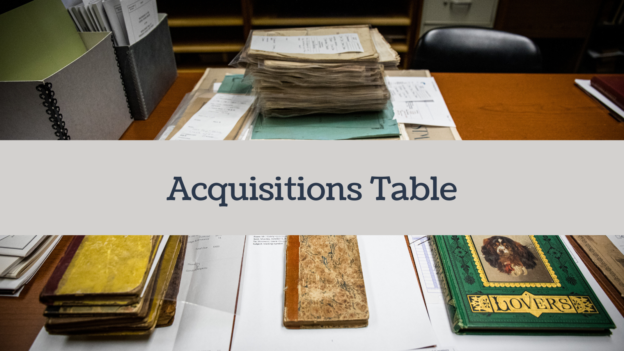
An image of the acquisitions table at the American Antiquarian Society.

When purchasing items for the collection, AAS curators select materials through a few different routes, such as online dealers, catalogs, shop visits, and book fairs. After curators identify items of interest, dealers send them to AAS, and then staff in the Acquisitions Department unpack and verify that all required paperwork is present for each order. Paperwork is important! Acquisitions staff create slips for each item to facilitate the approval process, during which curators confirm each item and check the shelves to avoid duplicate items.  

After the curator has approved an object for purchase, the Acquisitions Librarian assigns the appropriate fund from the available optionsThe Society’s annual budget includes many designated funds established by donors either by gift or bequest for the purchase of new collection materials. Some funds were created for specific types of materials, such as miniature books, titles about book history, or children’s books. These endowed funds support the Society and are designed to be used in perpetuity. (If you are interested in establishing a fund, please visit the AAS Support page.)

Once the fund is assigned each invoice moves to the finance department, who issues payment. After funding, the Acquisitions Librarian or the Processing Librarian creates a brief catalog record for books, graphic arts materials, and manuscripts. The Serials Cataloger catalogs newspapers and periodicals. Acquisitions staff create digital purchase orders and invoices in the library management system and maintain an accurate accounting ledger to be sure all funds are properly allocated and spent out

Image
A flow chart of the acquisitions process created by the author.

The Acquisitions Department handles gifts of material in a slightly different way, once the curators have approved the donation. While gifts still require documentation, they do not require funding or invoicing. The Processing Librarian creates brief catalog records directly after approval and passes all paperwork to the Head of Acquisitions to create gift acknowledgment letters. The Acquisitions Assistant accessions both purchased and donated items, inscribing specific marks to record provenance information, and routes all materials to the appropriate cataloger to be integrated into the collection. 

By communicating with other departments at every step of the process, the Acquisitions team ensures they account for every item and complete the administration of all paperwork, initial cataloging , payments to dealers, and thank yous to donors 

These steps change when curators or Acquisitions staff identify conservation concerns, such as mold or evidence of damage from pests. Acquisitions staff still create a brief catalog record, if possible, but they also include a conservation note with details on the item’s condition, before sending the item to the Conservation Department. Conservation staff return the item to Acquisitions after treatment, and the regular process continues.  

The staff at AAS takes the responsibility of managing historical materials very seriously, from the moment they enter the building to when a researcher accesses them. Following an efficient, thorough, and accountable acquisitions process ensures that provenance, or ownership history, is properly documented to comply with legal and ethical standards, and to maintain trust with donors, dealers, and researchersThis responsibility has been a core part of AAS since the Society’s early years, as shown in the 1813-1829 Donation Book (Catalog Record).

Image
A page from the 1813-1829 Donation Book. (Catalog Record)

Fully transcribed and digitized, this book contains details of the early donations to AAS, starting with Isaiah Thomas’s personal library and other materials from Elizabeth Bliss, Hannah Crocker, and more. The entries include information that remains important to record today, such as title (or description if no title is available), donor’s name, and date. 

Today, online library systems allow us to organize and record more information in a way that staff and patrons can use easily. However, paper records have not disappeared; we still use paper slips and other printouts, as mentioned earlier. This isn’t to say that modern systems are perfect, as they come with their own challenges, but AAS staff members work hard to ensure the process remains smooth and efficient for everyone involved.

New Online Gallery Showcases Cloth Printings at AAS

While most library collections are printed or written on paper, hundreds of historic objects at the American Antiquarian Society — including broadsides, children’s books, and ribbon badges — were printed onto cloth. Often produced as keepsakes, souvenirs, commemorative objects, or teaching tools, cloth printings in the AAS collection include texts and images printed onto silk, cotton, muslin, or linen.  

In 2024, AAS staff completed a conservation survey of 150 broadsides and newspapers printed on textiles. Curators and conservators reviewed these objects to assess housing needs and to plan for immediate and future conservation treatments.  You can read more about that work in a Past is Present post by Library and Archives Conservator Marissa Maynard. As part of the project, every object was photographed. Those high-resolution images were then archived in GIGI, the Society’s digital asset system, making these textile printings freely available to researchers.

A gallery of more than twenty cloth printings is now available on the AAS website. This “sampler” provides images and brief descriptions of the objects, as well as links to catalog records. Some of the highlights of the resource include an 1806 membership certificate on silk designed and engraved by a woman in Newburyport, Massachusetts; a commemorative menu printed on silk in Saint Louis, Missouri; and a large advertising banner made in New York that promotes the work of poet Walt Whitman.   

Image
(Image of textile printing promoting Walt Whitman’s books. Catalog Record)

There are multiple ways to print designs on textiles, including block printing by hand, stenciling, and machine printing. The cloth printings in the AAS collection were all machine printed. The cloth on which they are printed is closely related to the yard goods used for bed linens, clothing, and draperies then being produced at mills across the country. Calico printers were set up in the colonies as early as 1712, running small mills and dye houses near Boston and Philadelphia. After the invention of both the spinning jenny and cylindrical copper plates for printing onto cloth in 1770, the textile industry in Europe and in North America expanded rapidly. By 1836, 120 million yards of printed fabric were being produced in the United States annually.   

Unlike these mass-produced fabrics, most of the 150 cloth printings at AAS were created in small quantities in the newspaper shops and printing houses of urban areas from Boston to San Francisco.   Why did printers choose to make these objects on fabric when paper was the standard and easier to procure? Practicality was often a factor. A religious banner used by Millerites to predict the end of the world was likely printed on textiles to ensure easy transportation from one camp meeting to the next.

Image
(Image of “A Chronological chart of the visions of Daniel & John,” 1842. Catalog Record)

“Indestructible” books for children printed on cotton or linen were also practical.  Although they frayed when over-manipulated by young readers, they did not tear into pieces the way a paper book would have. Printing on fabric, especially silk, also could enhance the status of an object — silk was recognized as a luxury good in the eighteenth and nineteenth centuries. A framed membership certificate or memorial piece printed on it would glisten in lamp light, showing off the richness of the object (Insert Decatur memorial)

Image
(Image of “Sacred to the memory of the late Commodore Stephen Decatur,” 1820. Catalog Record)

The examples selected for the new gallery also illustrate how textile printing changed over time as synthetic dyes replaced natural dyes. Because most of the examples at AAS were made locally in job printers’ shops, standard printing inks were used.  These tended to fade or bleed more quickly than the dyes used in the textile industry.  Some printers used the term “Fast Colors” to indicate that their inks would hold up to wear and tear.

Image
(Image of “The House that Jack Built,” 1844. Catalog Record)

The first synthetic dye in the textile industry (magenta) was introduced in 1864, followed in 1880 by a synthetic blue,  which replaced indigo. Because they did not run or bleed and retained their brightness, synthetics quickly made their way into printing inks used by publishers of cloth books for children. One company in Ohio featured a baby chewing on a cloth book as a testament to durability of its products.

Image
(Image of “Mother Goose jingles,” 1900. Catalog Record)

Want to learn about how these cloth printings reveal the cultural and technological shifts of their time? Explore the gallery to find out more.  


Resources: 

The Dublin Seminar for New England Folklife: Textiles in Early New England: Design, Production, Consumption. Boston: Boston University Press, 1999. 

Herbert R. Collins, Threads of History, Americana Recorded on Cloth 1774 to the Present. Washington, D.C.: Smithsonian Institution Press, 1979. 

Florence H. Pettit, America’s Printed & Painted Fabrics. NY: Hasting House, 1970.  

In Her Own Words: The Life and Death of Rachel Wall, Massachusetts’ Female Pirate

Rachel Wall (née Schmidt) was born in Carlisle, Pennsylvania, on October 1, 1760. She was 29 years old on October 8, 1789, when she was executed by hanging on the Boston Common. According to some accounts, Wall may have been America’s first female pirate; it is certain that she was the last woman to be hanged by the Commonwealth of Massachusetts.  

The American Antiquarian Society holds a copy of Wall’s last words and dying confession, dictated by Wall herself and printed as a broadside by the jailers at the Boston Goal [sic] on October 7, 1789. Wall’s life of piracy has expanded into mythology over the centuries since her death, so this remarkable broadside stands out as a sworn narrative directly from Wall.  

Image
(Wall’s last words and confession. Catalog Record)

Wall recounts that she was born to “honest and reputable” parents, who gave her an education and raised her as a Presbyterian. Her father was a farmer, and she had three brothers and two sisters when she left home—without her parents’ consent or knowledge—to move to Philadelphia with her new husband, George Wall. The young couple later moved to New York City, then Boston, where George abandoned Rachel for some time. In Rachel’s words, she worked in servitude until George returned to her. “As soon as he came back,” George enticed Rachel to leave her servitude and “take to bad company,” a band of pirates whom she blames for her eventual ruin. George eventually abandoned Rachel in Boston again, leaving her alone with his whereabouts unknown. She notes in her statement that as a dying person, she forgives her husband. 

Image
(Wall forgives her husband. Catalog Record)

Wall confesses to four specific crimes in her final statement. In spring of 1787, she sneaked aboard a vessel at Long Wharf under cover of darkness and stole a black silk handkerchief containing about 30 pounds in gold and small change from under the sleeping ship captain’s head. Around 1788, she broke into a sloop at Doane’s Wharf and stole a silver watch, silver shoe buckles, and a parcel of small change while the crew slept. In 1785, Rachel conspired with George (imprisoned in Boston at the time) to bake a cake containing a saw and a file and send it to his cell to aid in his escape attempt from the jail.

Wall also admits to a crime for which a woman named Dorothy Horn had already been punished (with a public whipping on the gallows). It is notable that Wall does not admit to piracy among these crimes, nor the crime for which she has been sentenced to hang. 

Image
(Wall absolves Miss Dorothy Horn. Catalog Record)

Wall admits that she is guilty of “a great many” petty crimes, including theft, lying, and “almost every other sin a person could commit, except murder.” However, she denies her guilt in the robbery for which she would soon be executed.

Image
(Wall professes her innocence. Catalog Record)

Alleged to have stolen a bonnet off a “Miss Bendar,” Wall claims to know nothing of the crime. Her alibi? That she had been at work all the preceding day and had simply been walking by when she heard a commotion in the street and was arrested for the robbery.  

In her final words to her jailers, Wall forgives the witnesses who testified against her in the bonnet robbery trial. She commits her soul to the “hands of Almighty God” and her fate is sealed. Wall and the two men hanged alongside her were the last three people in the Commonwealth to be executed for highway robbery. The details of Rachel’s short life remain mysterious, but her intriguing legacy persists almost 250 years later. 

Image
(Wall’s last words. Catalog Record)

Letters from Freedom: New Digital Resource

Last year, the American Antiquarian Society received a grant from the Gladys Krieble Delmas Foundation to support the reorganization, rehousing, and digitization of 655 pages of letters, notebooks, and photographs created by formerly enslaved people. The new digital resource Letters from Freedom provides additional context to the materials and to the stories of the people therein.

At the heart of this project is the Chase Family Papers collection. The Chase family were Massachusetts Quakers who valued education and championed abolition. The collection contains letters from formerly enslaved students of Lucy and Sarah Chase, sisters who traveled from Worcester to Virginia and other parts of the South to teach in freedmen’s schools. At the end of the Civil War, formerly enslaved adults and children sought education at newly founded freedmen’s schools. These schools received support and funding from the Freedmen’s Bureau, missionary associations, and formerly enslaved people themselves.

Image
(Portrait of Lucy Chase. Catalog Record)
Image
(Portrait of Sarah Chase. Catalog Record)

The Chase Family Collection includes  letters written to Lucy and Sarah written by the sisters’ students throughout the South between 1864 and 1870. Letters written home to Worcester by Sarah and Lucy Chase provide descriptions of their schools and students.

The students’ letters tell stories of adversity and achievement. At least two of the students, Julia Anna Rutledge Kitt (b. 1849) and Elias Fenwick Jefferson (1844-1904), continued their studies at the Hampton Normal and Agricultural Institute (now Hampton University) in Virginia, and later became teachers themselves. Both were students of Lucy and Sarah Chase at the Morris Street School in Charleston, South Carolina, where the sisters taught during 1866-67.

Image
(Image of Elias Jefferson’s letter to Lucy and Sarah Chase. Catalog Record)

Julia Rutledge wrote to Sarah Chase on December 2, 1867, from Charleston, with news of her sister’s illness and the steps she was taking toward pursuing her secondary education.  Less than a year later, in a letter dated October 4, 1868, Julia wrote again to Sarah, this time as a student at the Hampton Normal and Agricultural Institute. Julia described her daily routine and noted the presence of other students from Charleston, including Elias Jefferson. Although Julia wrote to Sarah, “if you get this letter I will send my picture as I prommise [sic] it and would like you to have one,” the collection does not contain a subsequent letter or photograph. Perhaps one day Julia’s photograph will be recovered!

Image
(Image of Julia Rutledge’s letter to Sarah Chase. Catalog Record)

Julia graduated from Hampton in 1872 and taught at Princess Anne Court House in Virginia before returning to teach in her hometown of Charleston. She is listed in the 1895 Charleston city directory as living at 109 Smith Street with her husband, Wade Kitt, also a teacher.

Two websites had previously contained some of the content now featured on the new Delmas-sponsored webpage: “Through a Glass Darkly: Northern Visions of Race and Reform,”a website developed by Assumption University professor and AAS member Lucia Knoles almost 20 years ago; and “Manuscript Women’s Letters and Diaries,” a subscription-based project produced by commercial publisher Alexander Street Press in 1999. New digitization of the letters and diary and complete transcriptions have now made the content easily and freely downloadable to a wider audience.

To read the letters from Julia Rutledge, Elias Fenwick Jefferson, and others, please visit the Letters from Freedom resource at:

https://www.americanantiquarian.org/letters-from-freedom

The Infinities of Women’s Experiences: Cataloging Biographies at AAS, 1844-2024

As a cataloger at the American Antiquarian Society, one of my current projects involves updating bibliographic catalog records for American women of the nineteenth and twentieth centuries. AAS prioritizes cataloging for marginalized groups through the Inclusion, Diversity, Equity, and Access (IDEA) initiative, and I find it rewarding to contribute to a more inclusive and diverse catalog. Over the course of this project, I have enhanced access to more than 500 items by supplying accurate imprint information and adding access points such as subject keywords, summaries, series titles, and additional notes.

In working with these materials, I have had the privilege of acquainting myself with many remarkable women whose lives are preserved in the AAS collection. These materials include formal biographies, literary studies, collections of letters, diaries, journals, memorial works, eulogies, articles, wills, and various addresses. Together, they paint a picture of women of the period and reveal how their stories were framed in the early 20th-century United States.  Continue reading The Infinities of Women’s Experiences: Cataloging Biographies at AAS, 1844-2024

Adventures in Amateur Newspaper Cataloging: Roasts

Publishers of amateur newspapers devoted a significant amount of their limited space to critiquing other amateur papers — sometimes constructively, but often not. Two amateur publishers from Dassel, Minnesota, Allison C. Brokaw and Reno L. Hayford, grew tired of the critical nature of amateur journalism and wanted publishers to focus their efforts on literary pursuits.  

In April 1897, they published the first issue of Roasts (Catalog Record), an amateur newspaper that promised to print only “honest criticisms.” They wrote, “‘roasts’ are becoming so numerous as to appear in nearly every single representative of the cause. This should not be so and our idea is to publish monthly this paper, wherein any and all amateurs may rid themselves of those noxious sentiments that they would otherwise present through the medium of papers perporting [sic] to be of a high literary standard.”  

Image
(Image of the article from Roasts. Catalog Record)

Continue reading Adventures in Amateur Newspaper Cataloging: Roasts

Printing in the Hawaiian Language: New Digital Resource

Thanks to a generous grant from the Pine Tree Foundation of New York, newly digitized Hawaiian-language materials are now available through Printing in the Hawaiian Language, a digital resource on the American Antiquarian Society website.  The resource contains a digital library of 115 digitized Hawaiian materials, as well as background information on the Hawaiian collection at AAS, the history of printing on Hawai’i, and the stories of the people involved in the printing trade on the islands.  

Image
(Appearance of the three hills formed by the late eruption, on the coast at Nanawale bearing east by north one mile distant: July 9th, 1840. Catalog Record)

Much of the work completed for this grant was done “behind the scenes” under the direction of Curator of Books and Digitized Collections Elizabeth Watts Pope. Through conservation by Chief Conservator Babette Gehnrich and Library and Archives Conservator Marissa Maynard, the materials have been stabilized for future preservation; through cataloging and digitization, accessibility has been greatly improved. Continue reading Printing in the Hawaiian Language: New Digital Resource

Exploring Manumissions in the AAS Collections: A Summer Page’s Experience

Recently, I had the privilege of making a display that is now exhibited in the American Antiquarian Society reading room, as you enter through the main glass doors of Antiquarian Hall. My exhibit focuses on manumissions in 1800s America. Originally, I planned to highlight the freedom suit as a legal means of resistance to slavery. I had a hard time finding enough primary-source materials for display, and I mostly found secondary sources covering the topic in the AAS catalog. So, I decided to broaden my search to look at the different ways that enslaved people could free themselves. Enslaved people had three main ways of obtaining their freedom: escape, manumission, and freedom suits. Since I was having a hard time finding material related to the latter, I decided to look for manumissions and related documents instead. I found that in AAS’s “Slavery in the United States Collection,” AAS has a few manumissions that have quite intriguing stories.  

Image
(Amanda Holmes manumission from the Slavery in the United States Collection.)

One manumission involves a woman named Amanda Holmes, who was enslaved by William G. Elliot, Jr. in St. Louis, Missouri. The document states that she was manumitted for “good and sufficient reasons. This document, dated 7 July 1845, gave Holmes her freedom one year before Dred Scott first filed his freedom suit in 1846 in the state of Missouri. Scott’s case would not be decided until 1857, in the notorious Supreme Court decision in Dred Scott v. Sandford. Also of note about Holmes’s story is that five years after she gained freedom, she purchased her husband’s freedom for thirty dollars. The bill of sale for his purchase is dated 29 January 1850 for the sale of “one negro named William Holmes” and transfers ownership from Colonel Adam D. Stewart and wife Mary to Amanda Holmes, now a free woman of color. Continue reading Exploring Manumissions in the AAS Collections: A Summer Page’s Experience

New to AAS: William B. Sprague. The Tribute of a Mourning Husband, 1821.

Has bound with it: Alfred Ely, A Sermon, Occasioned by the Late Death of Mrs. Charlotte Sprague (Hartford, 1821) and Absalom Peters, Memoir of Mrs. Charlotte E. Sprague (New Haven, 1821).
Image
(Cover of A Tribute. Catalog Record)

Although the original leather and gilt binding has been worn down by much handling over the years, this bespoke volume provides a physical tribute to the memory of Mrs. C. E. Sprague. It joins many other tribute volumes in the AAS collections that often memorialize people who would otherwise be forgotten today, and demonstrate how printing and books have been used over the centuries as part of the mourning process. In this instance, the volume was presented by one mourner to another, Mrs. Sprague’s husband to their daughter. It is inscribed: “For my beloved child, Charlotte Adeline Sprague, as a memorial of her departed mother. WBS.” Inside are three printed tributes. The gift of Tanya S. Tellman, 2024.


~ Elizabeth Pope, Curator of Books and Digital Collections

New to AAS: Bi-Metallic Mining Company album. Granite, Montana, between 1887 and 1893. Photograph album with 101 photographic prints.

Now a ghost town, Granite, Montana, was once  a thriving mining town after the discovery of  silver in the 1870s. The Bi-Metallic Mining Company operated there from 1887 until 1893, when the Sherman Silver Purchase Act made the price of silver so low that the mines were abandoned.

Image
(Image from the Bi-Metallic Mining Company album. Catalog Record)

This album contains numerous photographs including cyanotypes, Kodak prints, and albumen prints suggesting that many of the photos were taken by those working for the mining company. Included are group portraits of miners, views of the equipment, buildings and downtown, women and children, and some modern snapshots from the 1990s showing the abandoned town.

~ Christine Morris, Associate Curator of Graphic Arts and Registrar