To check out my podcast on the Brazilian city’s controversial construction just click the blue box on the right.
Posted in Brazil News, Latin American news | Tagged brazil, favelas, Latino Lookout, Rio de Janeiro, shantytown | 2 Comments »
An audio slideshow telling a short history of the Cerro Rico mine in Bolivia, once South America’s richest mine, and now one of its poorest:
The photos were taken by me on my gap year trip to South America in 2004.
Posted in Bolivia News, Latin American news | Tagged bolivia, Cerro Rico, Latino Lookout, miners, Potosi, Tio Jorge | Leave a Comment »
Jungle Drums is the UK’s most well-known bilingual magazine on Brazilian culture, news and arts in Britain. Editorial assistant Milo Steelefox talks to Latino Lookout about what the magazine has to offer…
Posted in London-based Latino events and news | Tagged brazil, Brazilian culture, Jungle Drums, Jungledrums, Latino Lookout | 3 Comments »
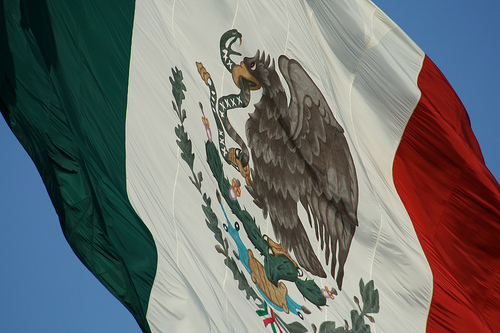
The Mexican flag ©Esparta Palma
Mexico has been ranked as the second deadliest place to work for journalists covering the news after Iraq, according to Newseum records. Many journalists killed were crime reporters, a dangerous profession in the midst of Mexico’s deadly and unstoppable drug wars.
The chairman of the Newseum interactive museum in Washington D.C., Alberto Ibarguen said in an Associated Press article: “These murders strike at the heart of democracy by silencing speech and by depriving a community of the information it needs to conduct its affairs.”
Posted in Latin American news, Mexico News | Tagged Alberto Ibarguen, drug wars, journalism, journalists, Mexico, Newseum | 3 Comments »
Posted in London-based Latino events and news | Tagged latino restaurants, london | Leave a Comment »

The uncontacted Indians of the Envira, who have never before had any contact with the outside world, photographed during an overflight in May 2008 ⓒGleison Miranda, FUNAI
Some of the world’s last uncontacted Indians have been fleeing from Peru to Brazil in order to escape illegal logging, says a report published earlier this week by Survival International.
The report highlights evidence found by employees of FUNAI, Brazil’s Indian Affairs Department since 2004. There have been numerous sightings of the Indians. Their arrows have been found and wooden boards were seen floating past the FUNAI post on the Envira River, coming downstream from Peru, where the Indians are known to live.
Jose Carlos Meirelles, head of the FUNAI team says in the report: “(There has been a) forced migration of autonomous groups in Peru, caused by mahogany exploration in the headwaters of the Jurua, Purus and Envira (rivers in Peru).
“The collection of arrows (belonging to the Indians) on my table is piling up. The situation will only be resolved when the Indians are left alone on the other side of the border.”
Tribal peoples are constantly under the threat of cattle ranchers, disease, missionaries and roads which cut tribal lands in half. Often tribal people are wiped out because they are thought to be standing in the way of ‘progress’. Many people believe that they are now laws in place to protect tribal peoples but they are still fighting for survival. One example is the Akuntsu tribe in Brazil.
Agents of FUNAI contacted them in 1995, and found that the cattle ranchers who had taken over the Indians’ land had massacred almost all the tribe, and bulldozed their houses to try to cover up the massacre. Only six Akuntsu survive.
It is sad to learn about previously uncontacted tribes who have survived for so long without modern technology being forced from their lands because of the greed which spurs illegal logging. Not only does it ruin the Amazon rainforest, helping to increase global warming, but it uproots tribal peoples, often leading to their death.
To see a photo click here.
Posted in Brazil News, Latin American news, Peru News | Tagged amazon, brazil, FUNAI, Illegal Logging, Indian, Peru, Tribe | Leave a Comment »

Casa da Sogra cafe in Camden ©Phoebe Ferris-Rotman
If you want to try some traditional Brazilian food, check out Casa da Sogra, a small cafe in the heart of Camden. I lived in Brazil for nearly a year on my year abroad at university and this sweet café temporarily transports me back, through a variety of Brazilian delicacies. The best item on the menu by far is açaí na tigela, halfway between a sorbet and a smoothie and served in a bowl. The dish is made from açaí, a natural energising berry from the açaí palm, found in the Amazon. In Brazil acai is part of the culture, which is understandable – it’s addictive. Make sure you ask for banana, honey and granola on top – it’s the way they serve it in Brazil.
If you have an interest in the Brazilian community in the UK, or simply want to know the best live Brazilian music acts going on in London, the café supplies many free Portuguese and English language magazines and newspapers detailing local events. The cafe is adorned with sunflower tablecloths and Brazilian flags and serves imported national beers and soft drinks as well as hot food and snacks.
Casa da Sogra, 4 Ferdinand Street, NW1
Posted in London-based Latino events and news | Tagged acai, acai na tigela, brazilian cafe, brazilian food, Casa da sogra, london | Leave a Comment »
Among the 300 political prisoners in Cuban jails today, 23 journalists are serving lengthy prison sentences for having founded an independent news agency, written for a dissident review, or spoken to a media in the Cuban diaspora. Many have been sentenced from 14 to 27 years and others are being held without trial.
In 2003 the government carried out a media crackdown called “black spring” which saw the arrest of 27 journalists, sentenced for alleged collaboration with the United States against “Cuba’s economy and national independence.”
The organisation Reporters Without Borders keeps detailed information on all the journalists being detained and calls for their release. One imprisoned journalist, Víctor Rolando Arroyo Carmona, who had been in jail previously for publishing an unauthorised article criticising tobacco growing methods, ran the biggest independent library in Cuba. He was called a “traitor to Cuba” at his trial and has been beaten in prison and denied communication with his family.
Raúl Castro‘s presidency, which began in 2006, has done little to alter press freedom, though four journalists imprisoned during “black spring” were released in February of last year. Cuba is the world’s second biggest jailer of journalists after China.
Posted in Cuba news, Latin American news | Tagged black spring, censor, cuba, discrimination, journalism, journalist, journalists, political prisoner, Raul Castro, Reporters Without Borders, Victor Rolando Arroyo Carmona | Leave a Comment »
- acai acai na tigela afro-bolivian AIDS Alberto Ibarguen amazon Amazon Watch anti-capitalist anti-gay architecture art black spring bolivia brazil brazilian cafe Brazilian culture brazilian food Buenos Aires carnaval Casa da sogra censor Cerro Rico Chevron civil union condoms Crude cuba discrimination drug wars Ecuador exhibition folha de sao paulo FUNAI gay gay tourism globo homophobia Human Rights Film festival Human Rights Watch ICA Illegal Logging Indian journalism journalist journalists Jungle Drums Jungledrums latin america Latino Lookout latino restaurants LGBT london Lula mcdonalds Mexico Michael Moore morales movimiento al socialismo Newseum Oscar Niemeyer Peru political prisoner Potosi racism Raul Castro Reporters Without Borders Rio de Janeiro samba santa cruz Texaco tourism Tribe Victor Rolando Arroyo Carmona world economic forum world social forum
Categories
Pages
 Latino cultural news
- Meet Son del Sur - CanvasRebel Magazine
- The King presides Associations of Ibero-American Universities meeting at Instituto Cervantes - thediplomatinspain.com
- R.I.P. Anthony Bourdain ~ Chef Who Brought ‘Parts Unknown’ to the World Dead at 61 - L.A. Taco
- Latin American business macro-roundtable winds up in Cuba - Periódico ¡ahora!
Latin American photos
Blog Stats
- 3,533 hits
March 2026 M T W T F S S 1 2 3 4 5 6 7 8 9 10 11 12 13 14 15 16 17 18 19 20 21 22 23 24 25 26 27 28 29 30 31 Archives
Meta


 Latino Lookout
