The fiction of hegemony is more threadbare than ever. The myth of the social contract is over. In place of coercion or consent, both of which depend upon granting transcendence to the state, posthegemony substitutes affect, habit, and an immanent multitude. Politics is biopolitics: in fact, it always has been, but today more clearly than before neither civil society nor the state are sites of struggle or objects of negotiation. At stake is life itself. One the one hand, increasingly corrupt forces of command and control modulate and intervene directly on the bodies of ordinary men and women. On the other hand, everyday insurgencies of constituent power reveal a multitude that betrays and corrodes constituted power from the inside, overflowing and escaping its bounds. The outcome of this confrontation is uncertain: constituent power may still fold back against itself; the line of flight that escapes may become suicidal; the multitude may turn bad and become monstrous; or perhaps, just perhaps, Exodus may lead to what Negri terms “the time of common freedom” (The Porcelain Workshop 161).
Read more.... (long .pdf file)
Showing posts with label venezuela. Show all posts
Showing posts with label venezuela. Show all posts
Thursday, August 14, 2008

Friday, December 14, 2007
exodus
Commentary on the recent Venezuelan referendum, particularly among foreign observers, has turned into a rather tiresome to and fro between self-satisfied opponents of Chávez, who like to think that the Bolivarian revolution has been stopped in its tracks, and equally self-satisfied supporters, who think they have refuted the claims of Chávez's dictatorial tendencies.
The referendum has also been interpreted as a weathervane for the region's Left Turns as a whole. With the Bolivian constitutional process also stymied, Lula quiescent, Bachelet unpopular, and the Kirchners apparently reinstating Peronist husband-and-wife politics as usual, have we reached the high water mark for Latin America's renascent left movements?
But in all this discussion, the central point has been lost: that the process of setting constitutions registers a balance of forces between constituent and constituted power.
In fact, the referendum's obvious winner was Chávez, as the President himself observed when he termed the wafer-thin margin a "Pyrrhic victory" for the opposition. The escuálidos would have been much happier had the poll gone the other way: they were apparently already handing out t-shirts that declared the result was a "fraud," and even now a week later they continue to propagate conspiracy theories, fuelled for instance by pillars of social democracy such as Jorge Castañeda, alleging that the military had to persuade a reluctant premier to accept the will of the people. Denied the outrage they had counted on, they have had to manufacture it for themselves. As always, the anti-chavistas are such a pitiful sight that, were I Venezuelan, they would almost inspire me to go out and sign up for a PSUV party card out of spite.
In fact, Chávez's dignified response to defeat enabled him to appear statesmanlike (not an adjective usually applied to a mercurial figure who won recent headlines for trying the King of Spain's patience) and, more importantly, sovereign, as Stephanie Blankenburg observes in one of the few decent articles to have appeared in the past few weeks.
For constitutions are all about defining and upholding sovereignty. Any alteration to the constitution is also potentially a threat to constituted power: in the passage between constitutions, the state is temporarily ungrounded. Everything is up for grabs, however briefly. There's no better example of that than the crisis currently affecting Bolivia, where even a hundred-year grievance over the site of the national capital has been thrown into the mix.
Meanwhile, the ongoing deadlock in Belgium, let alone the slow-motion catastrophe that is the process of European integration, both demonstrate that threats to constituted power abound as much in the North as in the South. We're living in an era of global reconstitution.
And so the defeat of Venezuela's proposed constitutional changes could be read as an affirmation of the country's current (hardly any less chavista) constitution and current head of state. Indeed, that's precisely how Chávez's defenders have portrayed the situation: as an endorsement of the institutional mechanisms cemented in place by the 1999 constitution, from the National Electoral Council (Consejo Nacional Electoral or CNE) to the clauses that regulate constitutional amendment itself.
In other words, at least at first sight, the rejection of the referendum is a victory for constituted power, and a defeat for constituent power.
 Chávez concedes, constitution in hand.
But the situation is rather more complicated. For the proposed constitutional reforms were very clearly generated within the state apparatus, rather than from outside and against it. Heinz Dietrich blames an entire "New Political Class" that he argues has sprung up and accreted to an increasingly sclerotic Bolivarian revolution. More revealing still are the complaints from Chávez supporters that the electoral defeat resulted from a failure to explain the proposals clearly and persuasively enough to the movement's base. Not only is this an unrepentant admission that the process was conceived as a top-down campaign to court consent. It also shows that what is at stake is a project for hegemony. And the mass abstention that led to electoral downfall is a sign that Chávez's hegemonic project is seriously frayed around the edges.
That the same result should be a victory for constituted power and at the same time a demonstration of the failure of hegemony should be no surprise. Constituted power has never depended upon hegemony.
What then of constituent power? Perhaps the fact that some three million people failed to vote shows a new development in Venezuela: an Exodus from the mechanisms designed to consolidate the Bolivarian state. Chávez's relationship with this subaltern excess has always been precarious and contingent, as he himself is fully aware. Hence the President is always in campaign mode, endlessly trying to reconstruct the political by insisting on the classical distinction between "friend" and "enemy." If the force of this interpellation is now fading, if people are happy not to vote or to vote "no" even when the choice in terms of the defense of national sovereignty, then chavistas have reason to worry.
But it's the anti-Chávez camp that has most to lose. For if the current president is no longer to keep the forces of constituent power in check, then who can?
Cross-posted to Left Turns? and Long Sunday.
The referendum has also been interpreted as a weathervane for the region's Left Turns as a whole. With the Bolivian constitutional process also stymied, Lula quiescent, Bachelet unpopular, and the Kirchners apparently reinstating Peronist husband-and-wife politics as usual, have we reached the high water mark for Latin America's renascent left movements?
But in all this discussion, the central point has been lost: that the process of setting constitutions registers a balance of forces between constituent and constituted power.
In fact, the referendum's obvious winner was Chávez, as the President himself observed when he termed the wafer-thin margin a "Pyrrhic victory" for the opposition. The escuálidos would have been much happier had the poll gone the other way: they were apparently already handing out t-shirts that declared the result was a "fraud," and even now a week later they continue to propagate conspiracy theories, fuelled for instance by pillars of social democracy such as Jorge Castañeda, alleging that the military had to persuade a reluctant premier to accept the will of the people. Denied the outrage they had counted on, they have had to manufacture it for themselves. As always, the anti-chavistas are such a pitiful sight that, were I Venezuelan, they would almost inspire me to go out and sign up for a PSUV party card out of spite.
In fact, Chávez's dignified response to defeat enabled him to appear statesmanlike (not an adjective usually applied to a mercurial figure who won recent headlines for trying the King of Spain's patience) and, more importantly, sovereign, as Stephanie Blankenburg observes in one of the few decent articles to have appeared in the past few weeks.
For constitutions are all about defining and upholding sovereignty. Any alteration to the constitution is also potentially a threat to constituted power: in the passage between constitutions, the state is temporarily ungrounded. Everything is up for grabs, however briefly. There's no better example of that than the crisis currently affecting Bolivia, where even a hundred-year grievance over the site of the national capital has been thrown into the mix.
Meanwhile, the ongoing deadlock in Belgium, let alone the slow-motion catastrophe that is the process of European integration, both demonstrate that threats to constituted power abound as much in the North as in the South. We're living in an era of global reconstitution.
And so the defeat of Venezuela's proposed constitutional changes could be read as an affirmation of the country's current (hardly any less chavista) constitution and current head of state. Indeed, that's precisely how Chávez's defenders have portrayed the situation: as an endorsement of the institutional mechanisms cemented in place by the 1999 constitution, from the National Electoral Council (Consejo Nacional Electoral or CNE) to the clauses that regulate constitutional amendment itself.
In other words, at least at first sight, the rejection of the referendum is a victory for constituted power, and a defeat for constituent power.
 Chávez concedes, constitution in hand.
But the situation is rather more complicated. For the proposed constitutional reforms were very clearly generated within the state apparatus, rather than from outside and against it. Heinz Dietrich blames an entire "New Political Class" that he argues has sprung up and accreted to an increasingly sclerotic Bolivarian revolution. More revealing still are the complaints from Chávez supporters that the electoral defeat resulted from a failure to explain the proposals clearly and persuasively enough to the movement's base. Not only is this an unrepentant admission that the process was conceived as a top-down campaign to court consent. It also shows that what is at stake is a project for hegemony. And the mass abstention that led to electoral downfall is a sign that Chávez's hegemonic project is seriously frayed around the edges.
That the same result should be a victory for constituted power and at the same time a demonstration of the failure of hegemony should be no surprise. Constituted power has never depended upon hegemony.
What then of constituent power? Perhaps the fact that some three million people failed to vote shows a new development in Venezuela: an Exodus from the mechanisms designed to consolidate the Bolivarian state. Chávez's relationship with this subaltern excess has always been precarious and contingent, as he himself is fully aware. Hence the President is always in campaign mode, endlessly trying to reconstruct the political by insisting on the classical distinction between "friend" and "enemy." If the force of this interpellation is now fading, if people are happy not to vote or to vote "no" even when the choice in terms of the defense of national sovereignty, then chavistas have reason to worry.
But it's the anti-Chávez camp that has most to lose. For if the current president is no longer to keep the forces of constituent power in check, then who can?
Cross-posted to Left Turns? and Long Sunday.
Monday, December 03, 2007
referendum
 I suspect that this will be the place for all your Venezuela referendum news: Radio Venezuela en vivo. They promise full coverage in multiple languages.
Otherwise, the best source for Venezuela analysis remains venezuelanalysis.com.
And I'm looking forward to reading Greg Wilpert's Change Venezuela by Taking Power, not least for its implied polemic with John Holloway's How to Change the World without Taking Power. Anyone serious about the issues raised by Zizek's "Resistance is Surrender" should probably read these two books. Sadly, too much of the hoo-ha around Zizek's article has been far from serious.
Thursday, March 02, 2006
Caracazo
The Oil Wars blog reminds us of the seventeenth anniversary of the Caracazo.
The Caracazo is the name of a massacre, carried out on the orders of then President of Venezuela Carlos Andrés Pérez, in which hundreds most likely thousands died. As "Oil Wars" comments, "This vicious massacre forever changed politics and in many ways can be said to have paved the way for Chavez's rise to the presidency."
We shouldn't forget, however, that it is also the name of an insurgency, a near-spontaneous protest against neoliberal "reform," a series of riots against the IMF. A multitudinous insurrection.
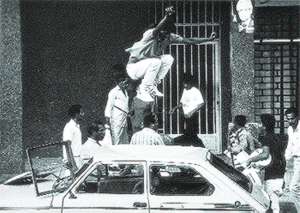
Here's a question: has Chávez's Bolivarianism more in common with the insurgency or the counter-insurgency? Is chavismo a continuation and expansion of that multitudinous energy? Or does Chávez rather re-establish a social contract otherwise broken in the Caracazo, thereby re-legitimating state power? Or both, of course.
For more on this, see also my friend Juan Antonio Hernández's article, "Against the Comedy of Civil Society: Posthegemony, Media and the 2002 Coup d'Etat in Venezuela." Journal of Latin American Cultural Studies 13.1 (March 2004): 137-145.
(Further links: various articles from Bitbiblioteca; "El Sacudón" by Rafael Rivas-Vasquez; "27 de febrero de 1989" from the Círculo Bolivariano 17 de marzo; "Venezuela después del Caracazo" (.pdf) by Margarita López-Maya; a personal account from priest Charles Hardy; and photos from the Agencia Bolivariana de Prensa.)
The Caracazo is the name of a massacre, carried out on the orders of then President of Venezuela Carlos Andrés Pérez, in which hundreds most likely thousands died. As "Oil Wars" comments, "This vicious massacre forever changed politics and in many ways can be said to have paved the way for Chavez's rise to the presidency."
We shouldn't forget, however, that it is also the name of an insurgency, a near-spontaneous protest against neoliberal "reform," a series of riots against the IMF. A multitudinous insurrection.

Here's a question: has Chávez's Bolivarianism more in common with the insurgency or the counter-insurgency? Is chavismo a continuation and expansion of that multitudinous energy? Or does Chávez rather re-establish a social contract otherwise broken in the Caracazo, thereby re-legitimating state power? Or both, of course.
For more on this, see also my friend Juan Antonio Hernández's article, "Against the Comedy of Civil Society: Posthegemony, Media and the 2002 Coup d'Etat in Venezuela." Journal of Latin American Cultural Studies 13.1 (March 2004): 137-145.
(Further links: various articles from Bitbiblioteca; "El Sacudón" by Rafael Rivas-Vasquez; "27 de febrero de 1989" from the Círculo Bolivariano 17 de marzo; "Venezuela después del Caracazo" (.pdf) by Margarita López-Maya; a personal account from priest Charles Hardy; and photos from the Agencia Bolivariana de Prensa.)
Wednesday, August 24, 2005
Chavez
Hugo Chávez is in the news again, now thanks to Pat Robertson's outrageous call for his assassination. The Venezuelan president is no stranger to the headlines, of course, nor does he shirk them. He takes on his (many and vociferous) opponents directly and publicly, whether by baiting the so-called "escuálidos" who are his domestic opposition, or by taking on the US government, most recently accusing DEA agents of international espionage.
I've never been a great fan of Chávez. His personalist style is deeply problematic. In typical populist manner, he deploys his charisma to conjure away the fact of state domination. I have been ambivalent about his regime despite recognizing that anti-chavista forces are far more unsavory. I remember asking a friend, who was at the time editor at the excellent Caracas-based Nueva Sociedad, whether the military might come to power if Chávez were overthrown. "Ah, but the military is already in power," was his response.
And it's true that Chávez is an ex-paratrooper, who came to attention first as head of an unsuccessful coup attempt in 1992. Also, if the 2002 effort to unseat him failed in part because of the multitudinous uprising that ensued, another reason was the loyalty shown by the military rank and file, most of whom still see him as one of them.
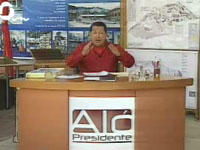 Ironically, in that he depends so much on television to construct and maintain his popular appeal, complete with his own talk show, Aló Presidente, and given his direct, over-dramatic, evangelical style, Chávez is in some ways the mirror image of his latest critic, the tele-evangelist Robertson. And Chávez's tele-populism undoubtedly depends upon and engenders the power of popular belief.
But is there anything more to chavismo than its faith in a leader?
I was (quite by accident) in Venezuela during the 2002 coup and counter-coup. It was an extraordinary week. And one thing was obvious: Chávez's supporters, who constitute, as has now been repeatedly demonstrated, the majority of the population, expected a lot of his government; but it had yet to deliver. The regime had not made much of a difference to Venezuela's poor. It was long on rhetoric, but short on results. It had proposed a number of creative and controversial foreign policy initiatives (from seeking to resuscitate and reorient OPEC to improving links with Cuba), but had been mostly on the defensive domestically.
That may now be changing. The fact that populism still figures the people as expectant (and so dependent) on a power alien to them remains its great limitation. But at least the people are no longer simply waiting. And the reforms that the government is effecting, in the wake of the counter-coup, suggest further change may be on its way. In the space of a few months, Venezuela has come to attention for its empowerment of workers on the shop floor, its education and health programs, and its ambitious land reform initiative.
One could draw a contrast with the government over which Brazil's Lula presides. Unlike Chávez, Lula has long been the darling of the international left. His Workers' Party grew out of struggles against military repression in the 1970s and 1980s, his personal biography is compelling, he has made all the right noises in terms of regional solidarity, and has hosted and encouraged the Porto Alegre gatherings of the World Social Forum. But, also unlike Chávez, his government has become mired in a corruption scandal that, if it doesn't reach to the very top, goes pretty close to it. Meanwhile, Lula's much vaunted social programs, particularly the "Zero Hunger" program, have so far proved insubstantial and ineffectual. And his economic policies have been a continuation of the neoliberal orthodoxy already in place, which have kept the markets happy but done little to reduce his country's appalling wealth and income inequalities.
The Council on Hemispheric Affairs has two useful articles detailing how the mess that Lula finds himself in contrasts with Chávez's status as Latin America's rising superstar.
I've always found it strange that Venezuela, despite its strategic importance and economic weight, has commanded so little attention outside its borders. (The number of prominent Latin Americanists with expertise on the country can be counted on the fingers of one mutilated hand, compared to the myriads studying, say, Argentina, Mexico, or Peru.) It's time for us to take a little more notice. A good place to start is www.venezuelanalysis.com. And Gregory Wilpert, as evidenced in articles such as this one, has for some time been among the more astute commentators on the so-called Bolivarian Revolution.
"We are the expression of the multitude", declare Venezuela's community media association. Well, maybe. Chávez continues to hog the headlines, but there may indeed be something rather interesting going on within the organizations that have been established under his regime's aegis, or in parallel with the regime itself.
I've never been a great fan of Chávez. His personalist style is deeply problematic. In typical populist manner, he deploys his charisma to conjure away the fact of state domination. I have been ambivalent about his regime despite recognizing that anti-chavista forces are far more unsavory. I remember asking a friend, who was at the time editor at the excellent Caracas-based Nueva Sociedad, whether the military might come to power if Chávez were overthrown. "Ah, but the military is already in power," was his response.
And it's true that Chávez is an ex-paratrooper, who came to attention first as head of an unsuccessful coup attempt in 1992. Also, if the 2002 effort to unseat him failed in part because of the multitudinous uprising that ensued, another reason was the loyalty shown by the military rank and file, most of whom still see him as one of them.
 Ironically, in that he depends so much on television to construct and maintain his popular appeal, complete with his own talk show, Aló Presidente, and given his direct, over-dramatic, evangelical style, Chávez is in some ways the mirror image of his latest critic, the tele-evangelist Robertson. And Chávez's tele-populism undoubtedly depends upon and engenders the power of popular belief.
 But is there anything more to chavismo than its faith in a leader?
I was (quite by accident) in Venezuela during the 2002 coup and counter-coup. It was an extraordinary week. And one thing was obvious: Chávez's supporters, who constitute, as has now been repeatedly demonstrated, the majority of the population, expected a lot of his government; but it had yet to deliver. The regime had not made much of a difference to Venezuela's poor. It was long on rhetoric, but short on results. It had proposed a number of creative and controversial foreign policy initiatives (from seeking to resuscitate and reorient OPEC to improving links with Cuba), but had been mostly on the defensive domestically.
That may now be changing. The fact that populism still figures the people as expectant (and so dependent) on a power alien to them remains its great limitation. But at least the people are no longer simply waiting. And the reforms that the government is effecting, in the wake of the counter-coup, suggest further change may be on its way. In the space of a few months, Venezuela has come to attention for its empowerment of workers on the shop floor, its education and health programs, and its ambitious land reform initiative.
One could draw a contrast with the government over which Brazil's Lula presides. Unlike Chávez, Lula has long been the darling of the international left. His Workers' Party grew out of struggles against military repression in the 1970s and 1980s, his personal biography is compelling, he has made all the right noises in terms of regional solidarity, and has hosted and encouraged the Porto Alegre gatherings of the World Social Forum. But, also unlike Chávez, his government has become mired in a corruption scandal that, if it doesn't reach to the very top, goes pretty close to it. Meanwhile, Lula's much vaunted social programs, particularly the "Zero Hunger" program, have so far proved insubstantial and ineffectual. And his economic policies have been a continuation of the neoliberal orthodoxy already in place, which have kept the markets happy but done little to reduce his country's appalling wealth and income inequalities.
The Council on Hemispheric Affairs has two useful articles detailing how the mess that Lula finds himself in contrasts with Chávez's status as Latin America's rising superstar.
I've always found it strange that Venezuela, despite its strategic importance and economic weight, has commanded so little attention outside its borders. (The number of prominent Latin Americanists with expertise on the country can be counted on the fingers of one mutilated hand, compared to the myriads studying, say, Argentina, Mexico, or Peru.) It's time for us to take a little more notice. A good place to start is www.venezuelanalysis.com. And Gregory Wilpert, as evidenced in articles such as this one, has for some time been among the more astute commentators on the so-called Bolivarian Revolution.
"We are the expression of the multitude", declare Venezuela's community media association. Well, maybe. Chávez continues to hog the headlines, but there may indeed be something rather interesting going on within the organizations that have been established under his regime's aegis, or in parallel with the regime itself.
Subscribe to:
Posts (Atom)
