Client Work – Creating assets for Shane’s FMP

It’s no secret that I’ve had help from a fellow student, Shane Pengelly, with programming my FMP. To return the favour we wrote up a contract between ourselves, the contract detailed that I would design any of the weapons and assets requested by Shane and in return he would continue to help me programme my FMP.

The asset that I was commissioned to create was a throwing axe that can be thrown by the player in his game. I started out by looking at other throwing weapons, such as: tomahawks, Steilhandgranate (M24 stick grenade), throwing knives, etc. After looking into the shapes of throwing weapons I asked Shane what style he wanted the piece in, he told me he wanted it to have to look stylised, having a Tolkien-like design, with realistic textures. So I drew up a few rough designs and asked Shane to pick his favourite.
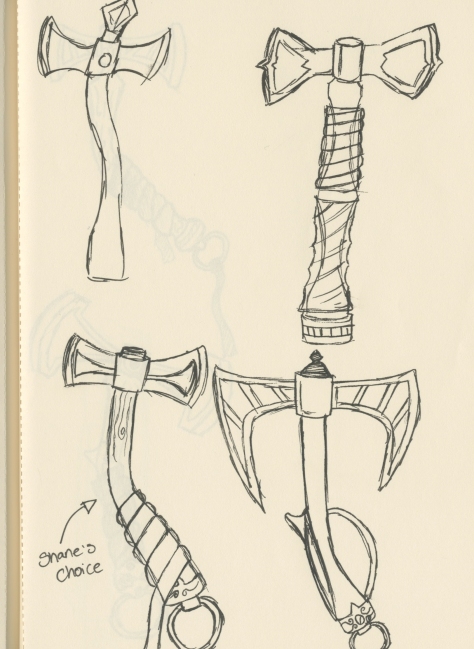
Scan 1 - 1

With Shane’s design chosen I drew up a couple of different variations.
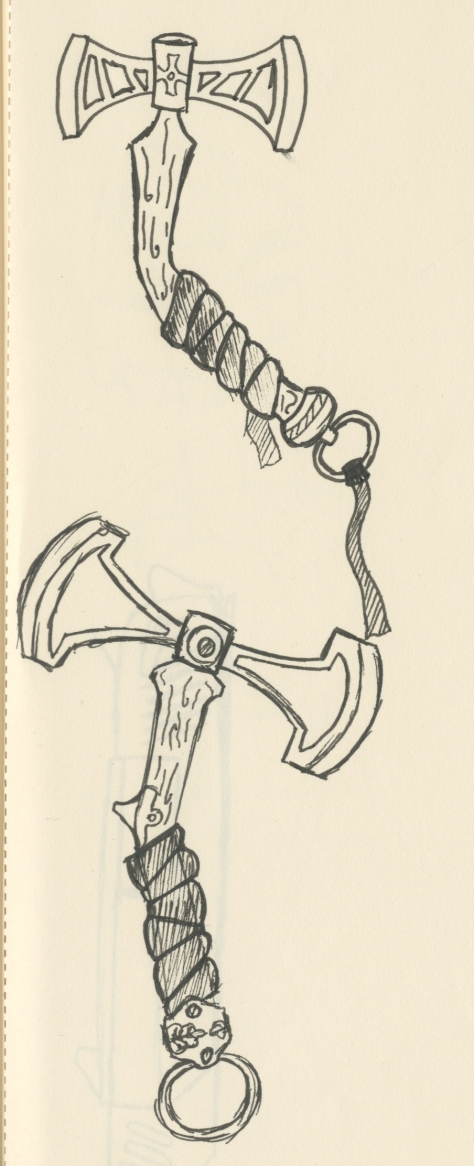
Scan 2 - 1

And then set to work with the model. For the modelling process I used 3DS Max to get the low poly model ready first, adding all of the necessary details. Once I was happy with the shape I took the model into ZBrush to get a high poly model to more accurately bake the textures in Substance Painter later, Shane told me he wanted the model to have hand drawn normal maps in the wood grain, so I decided to sculpt them in with ZBrush.

Once I was happy with the sculpted model I took the low poly model into Substance Painter 2 and used the sculpted model to bake the wood grain details, ambient occlusion, and curvature details onto the textures of the low poly model. With the texturing process I used custom alpha maps created in photoshop to add the engraving details found on the hilt and the head of the axe.

Below are the final renders.

The biggest difference from the chosen design is the lack of a bend in the handle, I chose to remove this because throwing weapons don’t tend to have warped shapes as it affects the flight through the air; I made sure to get the ok from Shane before making this choice.

Professional Practice – Personal Development

Below are my final designs for my business cards that have been printed and handed out to people at the degree show, and will also be handed out to potential employers at the next Brains Eden Game Jam event I will be attending.

The logo was something I designed at the end of my second year and I have used it in all of my promotional material, portfolio renders, and professional avatars. With the inspiration being my face I thought it made my logo easier to identify in the piles of applications employers receive.

My Portfolio: http://rets96.artstation.com/

My Artstation portfolio has been something I’ve worked on for just over a year now, whenever I get chance to create a piece of work that I can post there I always make sure it is represented in the best way possible. I also make sure that my renders feature a watermark (my logo) to avoid any plagiarism from other users. Once my work is up there I share it on all of my social media platforms.

FMP – Character Design

When designing my characters I took into account the overall theme of my game, being set in a ruined cathedral that has been transformed into a gladiatorial arena I wanted the character to reflect the war-torn environment he inhabits. On top of the apocalyptic style environment I also wanted to utilise a late-80’s early-90’s neon, retro, influence. I like to think I managed to achieve my vision in my designs, it took many iterations and design changes but I’m happy with my outcome.

1This was my first rough design for the character, I was going for a more medieval style to the armour.

2

This image was based more on a Deadpool-esque design for the character, there’s no real reason for this design other than I wanted to try something different to fully clad armour.

3

For this design I went with a more of a post-apocalyptic “Mad Max” influence. This carried over later to my final designs.

I decided I wanted more interesting silhouettes for my characters designs so I looked into retro 80’s fashion for colour and pattern ideas, and new-romantic/punk fashion for silhouette shapes.

I then started using the pareidolia technique to quickly get some character silhouettes.

Enemy Designs (Roughs)

The last set of silhouettes also feature some graffiti designs that I wanted my character to have sprayed onto his armour, this will be for representation that the character is a hired mercenary and has no allegiance to a cause or person, instead he takes the armour of people he takes out and defiles it as an act of rebellion.

Goon Design 1

The bright colours also show that the character is a mercenary. In medieval times mercenaries would wear brightly coloured clothing to distinguish themselves from military knights and I applied this to the design above; it also emphasises the 80’s neon aesthetic I’m going for with the rest of the game.

My next step after finishing the 2D design was to sculpt and High-Poly model the character to get him ready for the final game ready model.

The High-Poly model was done using a mixture of ZBrush, 3DS Max and Marvelous Designer. It’s at this point that I would like to talk about the characters boots, I initially didn’t put much thought into the footwear but whilst modelling I had the idea to base the boots on real-world counter parts; and for that I chose Dr Martens as the inspiration. Below are the reference images I used to model the boots, and a timelapse video of my modelling process.

My final modelling process for the character was to get him game ready, whilst doing this I made a conscious choice to limit my polygon count to 10,000. This was to keep the model optimised and ready for use in VR, and also because the online tool I used to rig and animate the model (mixamo.com) had a file size limit.

During the unwrapping stage I ran into a few issues. Below are two videos of me detailing the problem and how I fixed the issues.

My next process was to texture the model, for this I used Substance Painter 2 and many of the preset materials that come with the software. Utilising my knowledge of material masking and manipulation I created the texture sets for my character, sticking pretty closely to my original design (changing a few colours, patterns and materials in places where it was needed) I had my game ready character textured and ready to be rigged and animated.

For the rigging and animation I used my subscription to the Adobe Creative Cloud to utilise mixamo.com to do the majority of the rigging work for me.

Below are some videos of the animation tests that were conducted in engine.

It’s quite hard to make out in the videos but there were some rigging issues with the model, when I get more time I plan on adjusting the skeleton and model to fix the issues.

The next few videos are of myself and fellow student Shane Pengelly working to try and get the character working with the gameplay. This process is still ongoing as of this post, I will post an update when the character is fully implemented.

FMP – Mid Project Evaluation

Now that I’ve made it past the mid-point of my project, I feel that now is the time to evaluate what I’ve designed and created so far and discuss designs that I have abandoned, designs that I have changed and possible changes that may happen later in the project.

Originally my project was to be designed as a Star Wars fan game that would utilise the immersive capabilities of Virtual Reality (VR). I wanted to capture the feel of the Star Wars universe while putting my own twist on it, and creating a fun and immersive gaming experience within those design limitations. This idea was later adapted to be a Dark Souls-esque, romantic-age design (influenced by artists such as: Caspar David Friedrich, Eugene Viollet-le-Duc, J.M.W. Turner and Raphael Lacoste to name a few) with an 80’s new-romantic (with inspiration from public figures and bands such as: David Bowie, Duran Duran, Boy George and Spandau Ballet with the flamboyant and loud fashion choices of the time) and a neon twist, this was mainly because i didn’t want to deal with the potential copyright issues that could arise from developing a protected I.P (Intellectual Property) without a license. However, this new design would keep the gameplay similar to how it was originally, but changing how the weapon interactions would work with the gameplay.

At this point in my project I have the main gameplay elements working, now my focus is on the designs and making sure they all work with the overall theme of the game. So far I have realised that many of my design choices, mainly in my environment designs, aren’t working at the moment with the rest of the game’s themes. This is mainly due to my environment designs being quite underdeveloped, and not very well thought out in terms of gameplay accessibility. From now on I plan to re-design my environments with theme and usability in mind, utilising the inspirations mentioned previously. However, for a practical sense of the final outcome I may have to use a simplified design, but in the mean time I can let my imagination run wild and design more elaborate and interesting environments that can portray my original plans for the game.

My Time in the Renaissance… A Trip to Florence

So whilst walking around my university building, after starting my third year, I noticed posters dotted around advertising a trip to Florence, Italy, for a few days. Having had personal issues during the start of the academic year I thought it would be a good idea to go, and I was right. During the trip I experienced so much Florentine culture that I nearly became overwhelmed by it all, however it was also super useful for researching my FMP. The designs of the renaissance architecture were perfect for the visual representation of my game; from the architecture of the famous Florence Cathedral – The Duomo (designed by Filippo Brunelleschi, Arnolfo Di Cambrio, Giotto and Francesco Talenti), to the beautifully preserved paintings found in the Uffizi gallery (which featured the only known oil-painting by Michelangelo,which, by the way, was beautifully preserved), it will all have an influence on my designs for the environment of the game.

I’ve always wanted to visit Florence in particular ever since I played Assassin’s Creed II, back in 2009, as the city was one of the main focuses of the game. During my many playthroughs of the game I slowly started admire the renaissance-era architecture more and more, and having the chance to go and experience the culture myself was too good to pass up.

Client Work: Rabbit Heart – Update

My last post about the Rabbit Heart project detailed my work on the head of a destroyed rabbit mech, after that project had finished I decided to continue the project and design and model the rest of the mech. During the time between then and now I have managed to produce the majority of the model with designs for how it will animate in-game; I have also lightly touched on designing the weapons the mech will use (with my skill-set focusing in weapon design). I have no final designs yet for the weapons, but I have a few rough sketches that I will continue to develop into the final piece. The following images are some of my design processes.

Below is a timelapse video of me roughly designing the engine bay of the mech using TiltBrush for the HTC Vive. I have been using Virtual Reality quite a lot this year to help quickly visualise my ideas before producing them further.

The majority of the time spent on this project so far has been in the modelling period, I had to overcome a lot of obstacles and learn a lot of new techniques to produce the 3D model that I have so far.

Client Work: Burstalls Solicitors

My first client brief of year 3 was to finish an unresolved client brief given to the third years before me. The brief was to create an accurate 3D fly-through of the Burstalls Building in Old Town, Hull. My role was to remodel and re-texture the facade of the building. Due to the shortened production time we were allotted, 3 weeks, the final product failed to meet my personal goals for quality. During the time period I had to collect new reference images, estimated scale values & texture reference, as the original project files were unavailable to me. I also didn’t have access to the original client for feedback during production, which did become problematic in the long run as I was told by second parties what the brief actually was. The main focus of my efforts was to get the model looking as accurate as possible, which unfortunately didn’t leave me enough time to get the textures looking decent; and it’s very evident in the model. Here are some of the final renders of my part of the project:

Overall my satisfaction with this project was low, which greatly influenced my focus for my final year, shifting it away from environment/level design (which is what it was in the second year) to weapon and object design. This has definitely been one of my weaker projects of the third year so far.

Jason Rubin – A man after my own heart

With my current investment in VR it’s no surprise that I am very much interested in the professional development of the platform. Today I stumbled across an interview with the man who co-founded one of the greatest gaming studios to have ever graced the industry, Naughty Dog. The man in question was of course (as you have seen in the title) Jason Rubin. Jason is currently the head of content at Oculus, and is in charge of the experiences that are produced for the platform. In the interview I mentioned (with IGN), Jason talks about starting in the industry, starting Naughty Dog, leaving Naughty Dog, his role as a key speaker in the industry during a time that wasn’t pleasant for developers, his current role in Oculus and his predictions and hopes for VR as a platform and a development tool.

Rather than gushing over and over about this guy I will leave the video below and let you find out for yourself.

I will say this however that in a very controversial speech at the D.I.C.E summit in 2004, Jason highlighted key issues with workplace ethics in the industry, which is the main topic for my dissertation so that speech is very important to my research and bibliography. WIN!!

So what does this discovery mean for my project? Well one point is that it has inspired me to be more creative and experimental with how I use VR, knowing that industry veterans have taken major roles in the platform and are working to produce experiences that can define and cement VR as a major development in gaming. Another point is that with the constant improvement and development for the platform, any issues that I may run into with production will have a higher chance of being experienced by others who know how to fix it, hopefully making it easier for me to deal with the problems too.

FMP Update Thoughts

So, over the past week I have managed to make large strides in the development of my FMP. I have decided to go with multiple platforms in my environment, this has added a vertical aspect to my game which, in VR, is spine tingling. However, at this moment I’m not 100% sure how to effectively integrate it with my gameplay; for now I’m using it like a resting space for the player to regain their composure before throwing themselves back into the fray.

For now I need to focus on the more visual aspects of my game. The environment is going to have influences from the Romantic era (late 18th century), with hints of New Romanticism (formed around the 1980’s). The characters will also be in the New Romantic theme, focusing more on the punk aspects of the movement.

Design a site like this with WordPress.com
Get started