The financial scandal associated with UK university overseas travel policies

British universities have long had travel policies designed to control what staff travelling for research or on university business overseas are allowed to spend for travel, accommodation and maintenance.  In the past many of these were sensible and realistic, based on a good understanding of the real costs of conducting research-practice overseas.  The vast majority of academics acted responsibly, and few deliberately sought to exploit the system for personal gain.

However, in recent years these policies have become unnecessarily burdensome, driven in part by a claimed desire to show that universities are delivering on HMRC requirements.  In many instances these policies lead to

  • universities being charged substantially more for staff travel than is necessary,
  • research grants do not cover the full travel and maintenance costs associated with research,
  • staff usually have to pay considerable amounts out of their own pocket to undertake the research they are meant to be doing, and
  • there is a further breakdown of trust between university administrators and academic staff.

The net effect of this is little short of scandalous, especially when the time spent by staff in making bookings and accounting for this expenditure can also be overwhelming.

The enforced use of suppliers

Most universities now insist that staff use suppliers such as Key Travel or DGI Travel to book travel.  In part this is so that universities can claim that the rates charged are “reasonable”.  This also outsources administrative staff time in checking staff expenditure.  However, in my experience

  • I can always find flights and accommodation more cheaply if I book them myself.  Often, I can find rates between 25% and 33% better value, but have been explicitly told by senior management that I must use the more expensive central supplier
  • These suppliers mainly use digital systems so that they do not have to employ many staff to book transport and accommodation and respond to queries.  The quality of the individual service they offer when there are problems or crises (as with the cancellation of flights to and through the Arabian/Persian Gulf) is therefore very problematic, with long waiting times and an inefficient/inaccurate/rude service.
  • The design of these digital systems is also often very poor, meaning that it takes academic staff a considerable time actually to find and book their requirements.  Among the problems often encountered are:
    • Systems that only work on one or two common browsers (never my personal favourites!)
    • Frequent crashes leading to lost bookings
    • Difficulties in identifying optimal routes or accommodation choices
    • Results frequently showing there are no hotels available in a particular location
    • Frequently need to restart an application process to get it to work
    • Lack of clarity in documentation/receipts over whether the booking are refundable or not

In short, using such suppliers takes longer and costs more for staff involved in overseas research-practice.  This is deeply frustrating when I am always trying to get the best value so that my limited research grants can be eked out for as long as possible.

Strict following of government regulation

Many university administrators seem petrified of being flexibly and instead rigidly follow their own interpretations of government regulations, even when these permit some flexibility.  I have checked four university travel policies, and they all vary, with some being much more permissive than others.  The good ones show at least some understanding of the difficulties of undertaking research in complex contexts in other parts of the world, where cash (or even barter) are the common means of exchange and receipts unknown.

  • Most university administrators seek to follow the HMRC’s guidance on employment income (and updates),  but even then choose to ignore parts of it. This states clearly that “Employers are not obliged to use the published rates. It is always open to an employer to pay or reimburse their employees’ actual, vouched expenses, or to negotiate a bespoke scale rate amount under the terms of an approval notice which they believe more accurately reflects their employees’ spending patterns”.
  • Moreover, this government guidance is primarily intended for staff expenses in businesses and industry, which are in practice very different from those expenses involved in research-practice.  Universities need to negotiate a clearer and simpler scheme with government that better fits the requirement of academic enquiry.  Research funding is something very different from the possible taxable income that HMRC is focused on (see also HMRC EIM21765)

Interestingly, some funders of research actually have far more liberal and generous conditions associated with their grants than do the universities that administer them!

Inappropriate rates for travel and accommodation

One of the most problematic issues concerns that rates at which academic are allowed to claim expenses, especially for hotels and food.  Many follow the HMRC guidance on expense rates for employees travelling outside the UK, but this was published in 2020 and is hopelessly out of date.

  • Even if the rates are considered to have been appropriate in 2020 (which I do not), the subsequent inflation and currency exchange variations make such guidance completely inappropriate.  For example, the amount permitted for dinner in Accra, Ghana, is only Cedis 80.5 which is equivalent to £5!  Hotel rates are equally problematic especially when staying in conference hotels in major cities (in Pakistan, this list does not even include rates for the capital Islamabad).
  • Much more realistic and regularly updated figures are available from the UN figures for daily subsistence rates provided by the International Civil Service Commission, which can be at least a third more or sometimes almost double the UK provided rates.  Yet, some (perhaps many) UK institutions do not accept the use of these rates and insist on the HMRC figures.
  • Linking to the above, at least one supplier requires staff booking through its “services” to agree that they abide by the 2020 HMRC guidance!
  • Trying to abide by these rates means that most academics will be personally out of pocket when doing overseas research, which is most challenging for those early in their career who do not have the larger salaries of more senior academics.
  • It can also be noted that trying to keep costs as low as possible to fit within university requirements can give rise to serious risks, since cheaper hotels are often in more hazardous locations, and more “affordable” (i.e. very cheap) places to eat do not always have the highest quality of food hygiene.

Research staff time

Another very significant burden for academic staff is the amount of time they have to spend in booking and accounting for their research expenses, especially when frequent small payments for public transport, food or services in the field have to be accounted for.

  • The complexity and lack of user friendliness in booking through the required suppliers is both burdensome and frustrating.  Regardless of the increased financial cost this requires, I estimate that when I book flights or hotels myself I can do so in less than a third of the time it requires me to do so through the university’s official supplier.
  • Many universities use the Agresso system (part of Unit4), which might be good for university administrators but is a cumbersome nightmare for most academics.  As with much software, it seems to be designed more for the central “controllers” and administrators, rather than it does the end-user!  I know many people who take a whole day just accounting for their expenses for an intense week of field research-practice in parts of Africa or Asia.

In brief, this all means that staff not only have less time available for their research and teaching, but also become very frustrated and alienated from the administrative bureaucrats who are meant to be there to serve them (although I should point out that there are indeed some excellent people at junior levels in university administration who do their best to help their academic colleagues!). I confess that I rarely include any of the small receipts in claims I make simply because the time spent in processing them is not worth the effort.

Gifts, hospitality and air miles

The offering of small gifts and providing hospitality, especially when alcohol is involved, is undoubtedly controversial.  However, I am frequently ashamed when people across the world offer me generous hospitality, and I am not permitted to reciprocate if I strictly follow our university regulations.  Of course I do try to reciprocate, but it is out of my own pocket. 

  • I believe strongly that when our partners overseas contribute to the success of our research practice then it is absolutely right and proper to thank them in ways appropriate to their culture.  The UK has become internationally renowned for its stinginess (combined with arrogance), and this has done immense harm to our reputation.  Anything we can do as individuals to restore and build international friendship and co-operation has to be a good thing.
  • In many university regulations, individuals are not permitted to benefit from Air-miles or similar awards.  However, these enable recipients to have benefits ay no extra cost including additional baggage, priority check-ins, priority flight changes, and lounge access which are all incredibly helpful when conducting overseas research-practice.  Not only do they help staff travel in a less-stressed way and therefore perform their tasks better on arrival (such as when giving key note speeches), but they can also reduce the risks (such as theft and violence) associated with travel to and in certain countries.
  • Alcohol forms an important part of culture and life in many cultures, despite the efforts of the anti-alcohol lobby to prevent its consumption.   If a guest  wishes to drink, alcohol, surely this should be permitted, providing of course it is in moderation.  Moreover, much of my research is on wine and to undertake this successful it is essential to taste it, but university regulations prohibit any expenditure on alcohol.  Moreover in some parts of the world local beer is cheaper (and safer) than soft drinks, and yet one is prohibited from purchasing it.

In conclusion, I have tried to argue here that it is high time that university administrators in the UK cease being so sanctimonious, and come up with policies that show that they actually understand the complexities and challenges facing those undertaking rigorous academic research overseas.  This may well require us all to work collaboratively to change government policy, but unless we do so the costs of undertaking it (both financially and in terms of time spent in administration) will remain much higher than they need to be, and the quality of UK research will decline yet further.  Good new policies and practices could save considerable sums of money for universities. I used to be strongly against per diems, largely because of their abuse, but adopting such a system using the widely recognised international civil service model would greatly facilitate the administration of overseas research funding and would save the inordinate amount of time and effort that research-practitioners and administrators currently devote to this.  It will also help to build trust between them, which is so often lacking.  Most academics will still choose the best value for money options and often claim less than the permitted per diems quite simply because they want to make their grants go further!

1 Comment

Filed under Africa, Asia, research, Universities

Alt text: the problematic sub-text

In recent years I have tried, but often failed, to use “alt text” in my work when posting images online. I have failed dismally to go back and try to annotate all of the many images I have posted in the past, and I know I fail to be consistent in doing so in the present. Both of these failings are undoubtedly because of the time that this would take me, despite many platforms now encouraging its use, and my commitment to supporting people with disabilities (see my very old site at https://disabilityict4d.wordpress.com/).

For those who are unfamiliar with alt text it is the attribute in HTML that specifies alternative text for images, and is especially valuable for people with visual impairments, because it helps screen readers convey the meaning of images for them. The World Wide Web Consortium thus recommends that every image displayed through HTML should have alt text associated with it.

However, reflecting on this in the context of the increasing use of AI, has made me very aware of the ways in which alt text can be used by AI systems to describe images without the use of data labellers. At one level, this might be seen positively, because it can reduce the need for AI companies to use what is often termed “slave labour” to do the annotation (see Ganna Pogrebna, 2024). However, this would take away the very small income that such labour can generate, and is indeed valued in many parts of the world. Moreover, it is also a way that such images (or video) can be annotated for free for teh AI companies by the person doing the posting.

Image

Much more worryingly, though, is the potential for alt text to be used maliciously. If, with their permission, I post an image of a friend/colleague online, and label this using alt text, their name will be forever attached to that image, and be a vehicle through which AI and search engines can identify them and link to further related images of them. This could, for example, readily be used to track and surveil them when travelling. However, it would be equally possible for someone else to write something unpleasant or abusive about a person as alt text on an image, and that too would be recorded so that AI could then be used to build very erroneous profiles of them.

Image

I am inclined to think that the potential harms of this outweigh the benefits, although for innocent law-abiding people with visual impairments it would be an immense loss. Is this primarily a new way that the Digital Barons are deliberately exploiting us? Is that why platforms are incresingly encouraging us to include alt text when we post an image (as illustrated in the image above)?

2 Comments

Filed under AI, digital technologies, slavery

Artifical Intelligence and research – it’s not the tech that’s the problem, but rather why it is used!

Artifical Intelligence (AI) has undoubted positive potential to be used to enable completely new kinds of research, especially in areas that require the “analysis” of very large amounts of data. This is particularly so in fields as diverse as modelling environmental change, and medical diagnostics. However, I am shocked almost every day by the scale at which it is now used overtly to cheat (and seek to get an advantage over others) and to support downright laziness in academic research.

Image
Cartoon in exhibition along the shore of Lake Geneva, May 2024

Many univeristies have introduced AI policies for students (both undergraduates and postgraduates) that focus largely on identifying permitted and illegal aspects of the use of AI, focusing especially on penalising perceived abuse thereof. All too often these policies fail sufficiently to recognise how it can indeed be used positively and constructively. What such policies also fail to recognise is the scale at which deceit was already widely practised in universities prior to the advent of AI (see my posts in 2010 on Univeristy Students Cheating and on plagiarism and the production of knowledges, and in 2021 On PhDs). As with so many digital technologies, they serve to accentuate existing aspects of human behaviour. With the massification and grade inflation that has occurred in higher education over the last quarter of a century, it is scarcely surprising that some (perhaps most) people will use any means at their disposal to gain the highest level of certification with the least amount of effort.

What is deeply worrying is the speed at which the use of AI is transforming – and possible destroying – traditional values of academic integrity and labour. Two recent examples highlight the scale of the challenge:

  • Prize nominations. I have recently been on several boards reviewing nominations/applications for prizes. Increasing numbers of these appeared suspicious to me, and a quick check with a variety of AI detectors indicated high probabilities that they were indeed produced through the use of AI. Examining some of the entries for international awards ceremonies over the last couple of years, also suggests that several of the winning entries were produced through the use of AI, and that some of the evidence adduced therein was not based on physical reality. The reasons are obvious, with potential winners believing that they can gain an advantage through the use of such technologies.
  • Research proposals. In the last couple of years, an increasing number of proposals I receive from prospective postgraduate or post-doc applicants are clearly produced using AI. This is deeply concerning, not least because it provides no evidence that an applicant is indeed able to undertake independent research, and were such applicants to be accepted there would probably be very real problems during the research process. However what has provoked me to write this short post is that one such applicant seemed to express surprise that I should actually want to receive an application written only by a human!

Some members of review panels clearly do not mind if AI has been used to enhance a proposal, but I remain very concerned for four main reasons:

  • Above all, extensive reliance on AI to design research (and presumably therefore also to undertake and produce it) will take away the ability of human researchers to think for themselves and create new ideas. This is already happening, but any loss of this ability is deeply problematic, not least since it increasingly limits our individual and collective ability to be resilient and solve new challenges in the future. I fundamentally disagree with arguments that suggest this does not matter because it will enable our brains to concentrate on other, higher level, functionalities.
  • Second, though, AI is only as good as the data drawn upon by its algorithms. Such data, by definition, always comes from the past, and is biased. Hence, it cannot be truly innovative. All it does (at present) is reconfigure existing knowledge in new ways. To be sure, this can be interesting, but randomness (not least in our genetic makeup – although genetic drift is now seen as being less random that was previosuly thought) and serendipity are key elements of true innovation and creativity. These are what has enabled us to survive as a race, and if we lose them we will lose not only our souls but also our physical ability to function.
  • Third, all too oftenpeople using AI do so because they find thinking too difficult and/or they are lazy. They want a quick solution without the effort. Yet if we do not use our brains they will atrophy; if we do not draw on our memories, we will forget how to use them. Digital dementia is already a significant problem, but it will become very much more so in the future if we do not continue to exercise our minds. We must cherish real creative and innovative research by humans. This has always been tough; excellence does not come easy. However, it is rewarding. We must do all we can to encourage and reward real and high quality human research. If not, the mediocre and trivial will increasingly come to dominate our enquiry.
  • Fourth, it raises real problems for institutions and the management of research. Focusing on penalising cheating is a sign of failure. What we need to do is to encourage as many people as possible to think new thoughts for themselves. The mundane can indeed be left to those who enjoy trawling through the slop created by “AI pigs”. This will require much tighter processes for the selection of academic researchers (and this also surely applies to industry), along with absolute certainty and rigour over processes designed to penalise those who seek to dissemble. Put simply, all uses of AI should be declared (and on many occasions may be acceptable), and failure to do so should be accompanied by elimination.

Much more could be written (and indeed has already been writter by others) on these issues, but when people start assuming that universities and researchers welcome AI generated proposals or nominations then it is clear that the rot has already set in, and we need to quarterise it as soon as possible. We don’t have the antibiotics yet that can treat this infection!

1 Comment

Filed under AI, corruption, research, Universities

Latest six podcasts on Digital Inclusion in an Unequal World (Episodes 11-16)

The ICT4D Collective has recently launched a podcast channel on Apple Podcasts which contains audio versions of the vignettes in my upcoming book Digital Inclusion in an Unequal World: An Emancipatory Manifesto. The fourth tranche of episodes (11-16) is now available as follows:

Episode 16. Benita Rowe on “The Tech Will Save Her’ – False Promises in Digital Gender-Based Violence (GBV) Solutions”

Image

This is the sixteenth episode of our podcast based on the vignettes contributed by friends and colleagues to Tim Unwin’s new book Digital Technologies in an Unequal World: An Empancipatory Manfesto. In it, Benita Rowe illustrates how “Digital interventions aimed at preventing or responding to gender-based violence (GBV) have re-emerged in recent years in cyclical form, each positioned as a world-first innovation”. Yet, she argues that “Despite differences in format, these interventions often replicate a flawed set of design assumptions that consistently fail to
account for lived realities”.

The full vignette can be read here.

All audio files relating to the book are also available on our podcast with a new episode every week.

Episode 15. Nimmi Rangaswamy on “Social, Shared and Sustainable: Whatever Happened to the Community Internet?”

Image

This is the fifteenth episode of our podcast based on the vignettes contributed by friends and colleagues to Tim Unwin’s new book Digital Technologies in an Unequal World: An Empancipatory Manfesto. In it, Nimmi Rangaswamy concludes that “What was once imagined as a shared, empowering infrastructure has become a personalised, pay-per-use playground — curated for binge and scroll rather than community or collective good. The Internet in India today is more a screen in the palm than a shared window. It entertains more than it empowers, and connects more to content than to community”.

The full vignette can be read here.

All audio files relating to the book are also available on our podcast with a new episode every week.

Episode 14. Nnenna Nwakanma on “Working WITH, not FOR”

Image

This is the fourteenth episode of our podcast based on the vignettes contributed by friends and colleagues to Tim Unwin’s new book Digital Technologies in an Unequal World: An Empancipatory Manfesto. In it, Nnenna Nwakanma tells the story of her experiences having asked to visit a “school that the media has touted as the ‘model’” of good use of digital tech in education in a West African country. As she notes, “I needed to see things for myself, where the rubber hits the road. I also refused any ‘official’ or ‘media-related’ accompaniment”. The vignette reports on the schocks she encountered when she visited. As she concludes “When are we going to stop working FOR stakeholders and start working WITH them?”

The full vignette can be read here.

All audio files relating to the book are also available on our podcast with a new episode every week.

Épisode 13 en français. Yuliya Morenets sur « Au-delà du rôle symbolique: repenser l’inclusion des jeunes dans les forums mondiaux »

Image

Voici le treizième épisode de notre podcast, inspiré des témoignages d’amis et de collègues qui ont contribué au nouveau livre de Tim Unwin, «Digital Technologies in an Unequal World: An Empancipatory Manfesto». Yuliya Morenets y raconte sa rencontre dans le hall d’inscription d’un événement IGF, illustrant comment l’inclusion des jeunes privilégie souvent la familiarité à l’innovation. Elle conclut : « Si nous voulons une véritable participation, nous devons dépasser le symbolisme. Nous devons investir dans les jeunes, non seulement comme des acteurs, mais aussi comme des bâtisseurs : imparfaits, passionnés et toujours en apprentissage. L’important n’est pas de polir chaque voix, mais d’écouter celles qui n’ont pas encore été entendues ». 

Le texte intégral est disponible ici.

Audio en français

Tous les fichiers audio relatifs au livre sont également disponibles sur notre podcast, avec un nouvel épisode chaque semaine.

Episode 13 in English. Yuliya Morenets on “Beyond the Token Seat: Rethinking Youth Inclusion in Global Forums”

Image

This is the thirteenth episode of our podcast based on the vignettes contributed by friends and colleagues to Tim Unwin’s new book Digital Technologies in an Unequal World: An Empancipatory Manfesto. In it, Yuliya Morenets tells the story of an encounter in the registration lobby of an IGF event to show how youth inclusion often rewards familiarity over innovation. She concludes that “If we want real participation, we must move beyond tokenism. We need to invest in youth not just as performers, but as builders—messy, passionate, and still learning. The point is not to polish every voice but to hear the ones that haven’t been heard”.

The full vignette can be read here.

Audio in English

All audio files relating to the book are also available on our podcast with a new episode every week.

Episode 12. David Hollow on “Evidence-driven decision-making in the use of digital technologies in education”

Image

This is the twelfth episode of our podcast based on the vignettes contributed by friends and colleagues to Tim Unwin’s new book Digital Technologies in an Unequal World: An Empancipatory Manfesto. In it, David Hollow argues that building a cuture of evidence-driven decision making can help ensure that EdTech is used wisely to mitigate the global learning crisis. He argues that everyone can contribute to building such a culture of evidence-based decision-making in EdTech by asking the following question: will this use of technology lead to an impact on learning outcomes that is cost-effective and works at scale?

The full vignette can be read here.

All audio files relating to the book are also available on our podcast with a new episode every week.

Episode 11. Janet Longmore on “The Youth-led Imperative”

Image

This is the eleventh episode of our podcast based on the vignettes contributed by friends and colleagues to Tim Unwin’s new book Digital Technologies in an Unequal World: An Empancipatory Manfesto. In it, Janet Longmore provides a summary of the six main learnings from the work of Digital Opportunity Trust with young people drawing especially on their recent experiences in Rwanda and Uganda. Implementation of these learnings can provide a fundamental ‘mindset shift’ that reflects new skills and an entrepreneurial socially responsible spirit, resiliency and adaptability among young people that are critical for navigating employment and self-employment opportunities in a digital economy.

The full vignette can be read here.

All audio files relating to the book are also available on our podcast with a new episode every week.

Leave a comment

Filed under Books, digital technologies, emancipation, ICT4D, Inequality

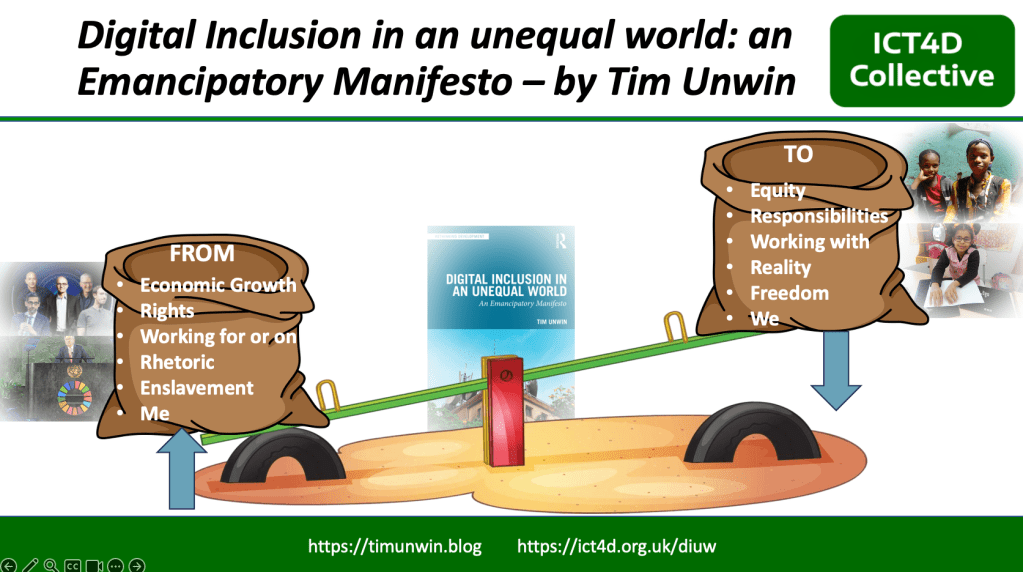
Digital Inclusion in an Unequal World: An Emancipatory Manifesto – a quick summary

For those wanting a quick summary of the arguments made in my upcoming book Digital Inclusion in an Unequal World: An Emancipatory Manifesto, the video and graphic below provide an outline of its concluding reflections (click on the slide to see the animated video).

Image

Full details of the book are also available through the following links:

Leave a comment

Filed under Books, capitalism, digital technologies, emancipation, Equity, ICT4D, Inequality, United Nations

Digital inclusion in an unequal world: visual interpretations

Image

I’m so grateful to the amazing award-winning Indian cartoonist Alok Nirantar (see @cartoonistalok) for sharing this challenging cartoon as a visual interpretation of the themes underlying my new book Digital Inclusion in an Unequal World (Routledge 2026). This image captures many aspects of the book, raising questions about who really benefits from digital tech (represented by the mobile phone): a rich young boy surfs the Internet, as an older and poorer man tries to hold on at the back to grasp some benefits; the direction of travel from the economically poor village to the smart city (shown below the mobile phone) also hints at the wider spatial implications of the processes of digitalisation.

An important dimension of the book is the inclusion of a diversity of voices and representations – not only images, but also 31 vignettes written by a rich diversity of people of different ages, ethnicities and experiences. Some of these are also available in audio, with new ones being made available on our podcast on a weekly basis. This visualisation is thus a great addition to the book, written by one of India’s best political cartoonists. It is indeed an honour that he crafted this cartoon for me. See Alok’s work on Facebook at https://www.facebook.com/CartoonistAlok.

Leave a comment

Filed under ICT4D, Books, Empowerment, digital technologies, emancipation

Latest four podcasts on Digital Inclusion in an Unequal World (Episodes 7-10)

The ICT4D Collective has recently launched a podcast channel on Apple Podcasts which contains audio versions of the vignettes in my upcoming book Digital Inclusion in an Unequal World: An Emancipatory Manifesto. The third tranche of episodes (7-10) is now available as follows:

Digital Inclusion in an Unequal World (Episode 10) – Nick Hughes OBE on “The Power of Micro-Transactions”

Image

This is the tenth episode of our podcast based on the vignettes contributed by friends and colleagues to Tim Unwin’s new book Digital Technologies in an Unequal World: An Empancipatory Manfesto. In it, Nick Hughes argues that “we must use technology to create new economic wealth by either helping someone make money or save money: market-creating innovation“. He then provides insights into how he thinks this can happen, suggesting that “The next phase of development will see digital payments linked to real-time economic output data. The use-cases are multiple, with the following being just a few: clean energy from distributed solar; earnings from tiny retail outlets unlocking working capital; and the lock-up of carbon into biochar rewarding buyers and sellers in the carbon markets”

The full vignette can be read here.

All audio files relating to the book are also available on our podcast with a new episode every week.

Digital Inclusion in an Unequal World (Episode 9) – Emily Hickson’s contribution to “Nigel Hickson: a digital life well lived for others”

Image

This is the ninth episode of our podcast based on the vignettes contributed by friends and colleagues to Tim Unwin’s new book Digital Technologies in an Unequal World: An Empancipatory Manfesto. Our dear friend and colleague, Nigel Hickson was to have written one of these vignettes based on his wealth of experience working on Internet Governance, especially for the British Government and ICANN, but his untimely death meant that he was unable to complete it. Instead, some of his friends have contributed very short pieces on what it was that made him so special, and a model to follow for anyone wishing to work at the policy level to ensure that the poorest and most marginalised can benefit from the use of digital tech. The full vignette can be read here.

All audio files relating to the book are also available on our podcast with a new episode every week.

Digital Inclusion in an Unequal World (Episode 8) – Judith Hellerstein’s contribution to “Nigel Hickson: a digital life well lived for others”

Image

This is the eighth episode of our podcast based on the vignettes contributed by friends and colleagues to Tim Unwin’s new book Digital Technologies in an Unequal World: An Empancipatory Manfesto. Our dear friend and colleague, Nigel Hickson was to have written one of these vignettes based on his wealth of experience working on Internet Governance, especially for the British Government and ICANN, but his untimely death meant that he was unable to complete it. Instead, some of his friends have contributed very short pieces on what it was that made him so special, and a model to follow for anyone wishing to work at the policy level to ensure that the poorest and most marginalised can benefit from the use of digital tech. The full vignette can be read here.

All audio files relating to the book are also available on our podcast with a new episode every week.

Digital Inclusion in an Unequal World (Episode 7) – G. ‘Hari’ Harindranath – How May Academics Help to Empower Marginalised Communities Through Digital Tech?

Image

This is the seventh episode of our podcast based on the vignettes contributed by friends and colleagues to Tim Unwin’s new book Digital Technologies in an Unequal World: An Empancipatory Manfesto. In it, Hari argues that “Empowering marginalised groups through our work with digital technologies, and striving to make the world a better place as a result may be lofty aspirations, but they are worth pursuing. That will require us all to get out of our comfort zones and find ways to prioritise outcomes, commit time and resources, and engage with communities on the ground, rather than in the ivory towers, to learn and gather evidence of impact and outcomes of using digital tech in the service of the world’s poorest and most marginalised”

The full vignette can be read in English here and all audio files relating to the book are also available on our podcast.

Leave a comment

Filed under Books, digital technologies, ICT4D, Inequality

Pre-launch at ITCILO for “Digital Inclusion in an Unequal World”

Image
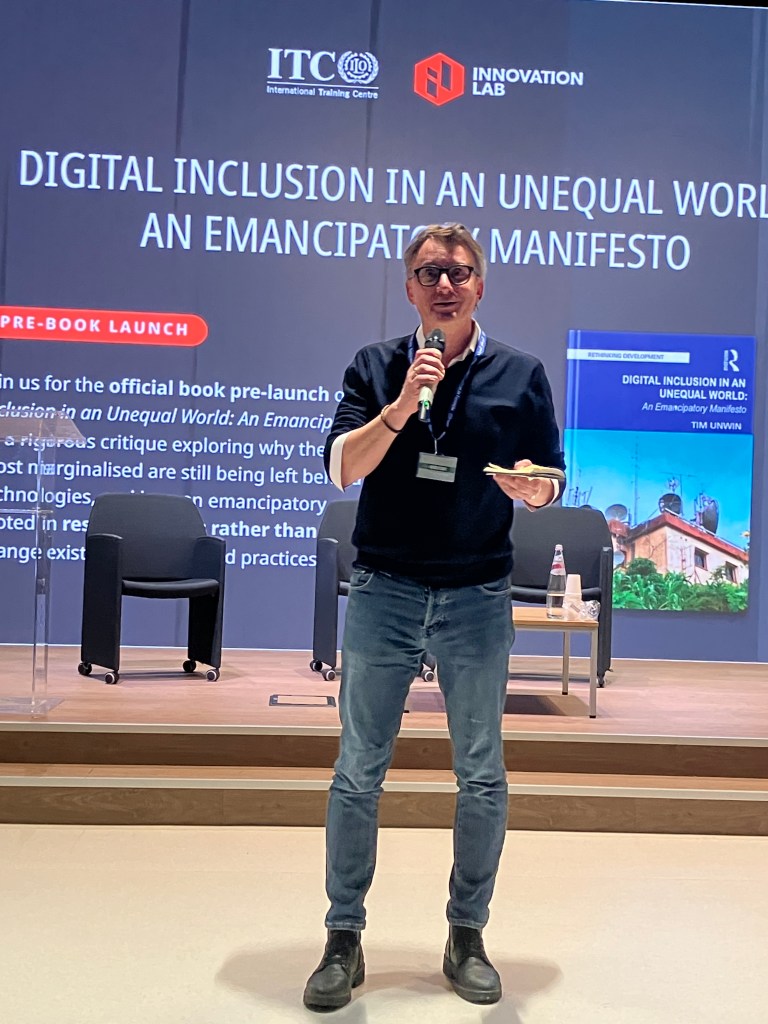
Tom Wambeke’s introduction to the evening

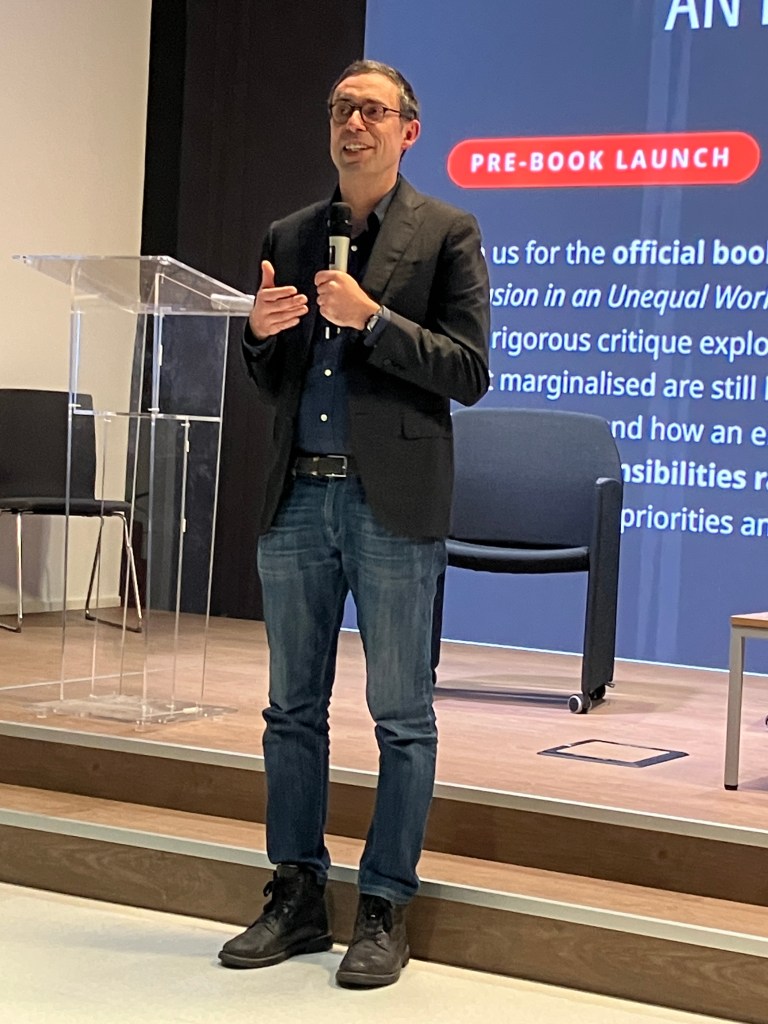
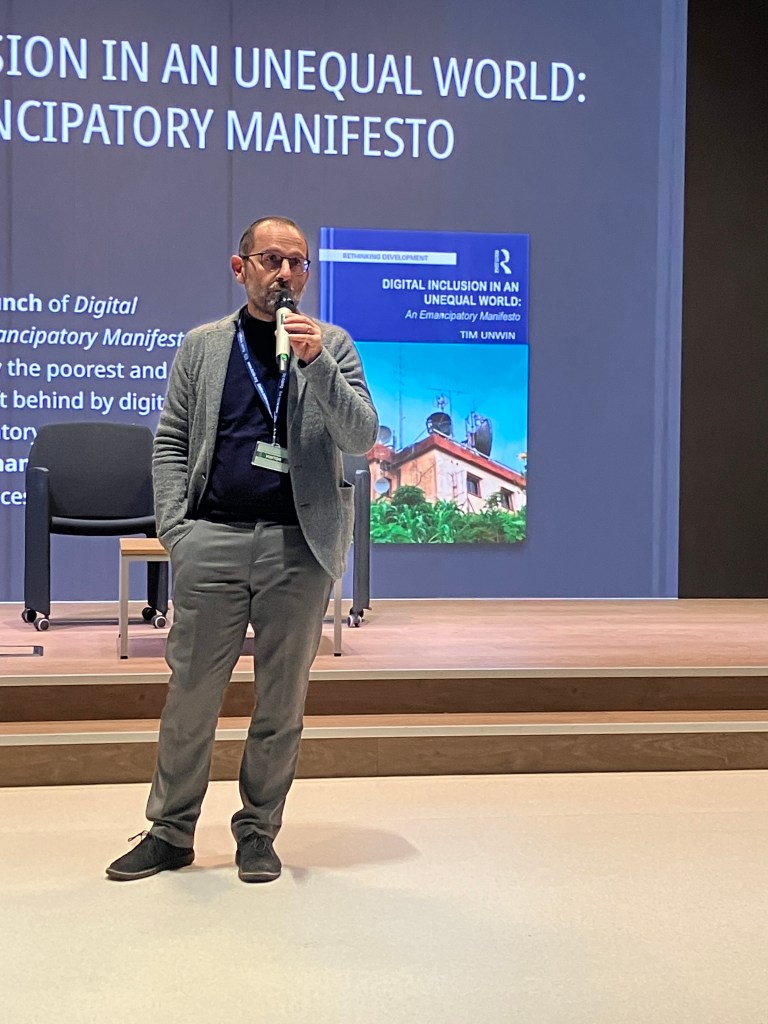
I am so very grateful to Tom Wambeke and the team at the Innovation Lab at the ITCILO (International Training Centre of the International Labour Organisation) who hosted a pre-launch event for my upcoming book, Digitial Inclusion in an Unequal World: an Emancipatory Manifesto on their magnificent campus in Turin on 1st December. It was a very special event – I have to admit to having been even more nervous than usual beforehand – and I was very humbled by the contributions of Tom himself, Ugo Vallauri, Ed Canela, Juan Carlos de Martin (Nexa Centre for Internet and Society, Polytechnic of Turin), and Fabio Nascimbeni (European Training Foundation), who were all most generous in their reflections. A copy of my presentation focusing on the UN and Innovation is available here.

Thanks too to the ITCILO, European Training Foundation, Nexa Center for Internet & Society and the Turin School of Development for supporting the event, with a delightful reception afterwards, during which I had the pleasure of speaking, albeit briefly with many in the audience.

It was also very special to have been inducted as the fifth person in the Innovation Lab’s Hall of Fame, for which I had to come up with a quotation that summarised my work. I’m most grateful to Tom and the team for this, and especially to the designer and graphic artist who put the plaque together!

Image

The ITCILO campus is a very special place, on the southern outskirts of Turin, and it has a magical calm about it. What a great place for representatives of governments, private sector companies and labour organisations to come together to discuss important issues about the future of work! I happened to be there at the same time as their 2025 Winter Forum on Demographic Transitions: Understanding the Impact of Demographic Transitions on the World of Work, and I am so grateful to Rute Mendes for inviting me to contribute a short keynote in her session on 4th December. I spoke on “Reflections on digital tech and the demographic transition“, and my short presentation is available here.

Thanks again to everyone at the ITCILO who made this such a special visit to Turin.

Leave a comment

Filed under Conferences, ICT4D, ILO, United Nations

Next three podcasts on Digital Inclusion in an Unequal World (episodes 4-6)

The ICT4D Collective has recently launched a podcast channel on Apple Podcasts which contains audio versions of the vignettes in my upcoming book Digital Inclusion in an Unequal World: An Emancipatory Manifesto. The second three episodes are now available as follows:

Digital Inclusion in an Unequal World (Episode 4) – Pari Esfandiari’s contribution to “Nigel Hickson: a digital life well lived for others”

Image

This is the fourth episode of our podcast based on the vignettes contributed by friends and colleagues to Tim Unwin’s new book Digital Technologies in an Unequal World: An Empancipatory Manfesto. Our dear friend and colleague, Nigel Hickson was to have written one of these vignettes based on his wealth of experience working on Internet Governance, especially for the British Government and ICANN, but his untimely death meant that he was unable to complete it. Instead, some of his friends have contributed very short pieces on what it was that made him so special, and a model to follow for anyone wishing to work at the policy level to ensure that the poorest and most marginalised can benefit from the use of digital tech. The full vignette can be read here.

Digital Inclusion in an Unequal World (Episode 5) – Domenico Fiormonte on “The Geopolitics of Digital Knowledge”.

Image

This is the fifth episode of our podcast based on the vignettes contributed by friends and colleagues to Tim Unwin’s new book Digital Technologies in an Unequal World: An Empancipatory Manfesto. In it, Domenico asks the important question “So who has the power today to ‘represent’ digitally the world’s languages, the core of human cultures?”. He answers: “It is a group of Western, predominantly English-speaking and U.S.-based corporations”. However, he concludes optimistically that “the real Web is becoming multilingual and multicultural, regardless of all its hegemonic and mainstream representations”

Audio in Italian

The full vignette can be read in English here.

Digital Inclusion in an Unequal World (Episode 6) – Mei Lin Fung on “Learning from Land Rights so Data Rights are Right from the Get Go”.

Image

This is the sixth episode of our podcast based on the vignettes contributed by friends and colleagues to Tim Unwin’s new book Digital Technologies in an Unequal World: An Empancipatory Manfesto. In it, Mei Lin Fung suggests that “The painful history of poorly defined land rights, which in the past led to displacement through lack of formal documentation, offers a crucial lesson for the digital age”. She concludes optimistically that “We still have time to shape the digital future so that it reflects the dignity of everyone it touches — and ensures meaningful participation for anyone, anywhere”

The full vignette can be read in English here, and it can also be watched on video here.

Leave a comment

Filed under Equity, ICT4D, inclusion, Inequality

Our podcast on Digital Inclusion in an Unequal World

The ICT4D Collective has recently launched a podcast channel on Apple Podcasts which contains audio versions of the vignettes in my upcoming book Digital Inclusion in an Unequal World: An Emancipatory Manifesto. The first three episodes are now available as follows:

Tendani Mulanga Chimboza on the exploitation of young women: digital tech at the heart of the immoral economy

Image

This is the first episode of our podcast based on the vignettes contributed by friends and colleagues to Tim Unwin’s new book Digital Technologies in an Unequal World: An Empancipatory Manfesto. In it, Tendani highlights how digital tech is being used to exploit young women in southern Africa. The vignette can also be read here.

Marine Al Dahdah on The Digital Privatisation of India’s Administration

Image

This is the second episode of our podcast based on the vignettes contributed by friends and colleagues to Tim Unwin’s new book Digital Technologies in an Unequal World: An Empancipatory Manfesto. In it, Marine focuses critically on aspects of the digital privatisation of India’s administrative systems. The vignette can also be read here.

Ken Banks on Memories of Innovation for the Most Marginalised

Image

This is the third episode of our podcast based on the vignettes contributed by friends and colleagues to Tim Unwin’s new book Digital Technologies in an Unequal World: An Empancipatory Manfesto. In it, Ken focuses perceptively on the reasons why so many digital initiative notionally intended to help the poor often fail to do so. As he says “I worked for 15 years trying to give a voice to, and support, the work of grassroots organisations through digital tech, butmy frustration in a wider development system that didn’t seem to want to do what they knew was best for those they were meant to serve eventually forced me to step away”. The full vignette can be read here.

Leave a comment

Filed under Equity, ICT4D, inclusion, Inequality