View from the Back
Ramblings of a retiree in France
French Fancies: Maison Verlet

Maison Verlet, founded in 1880, is the oldest artisanal roasting house in Paris still in operation. It roasts and sells single origin coffee beans, house blends and fine teas, with a salon for on-the-spot drinking upstairs.The historic address, a stone’s throw from the Palais Royal and the Louvre, embodies a French art of coffee and tea: demanding, refined, and deeply rooted in the capital’s history.

How it all began
Coffee was introduced in France in mid-17th century at the court of Louis XIV. Coffee, like tea and chocolate, were then called “Exotic hot liquors”. Coffee was served by the first “cafetiers” in a few rare places in Paris in the 1670s, in the street or from small stalls.
In 1880, the date of its creation, Verlet was one of the rare Parisian stalls to offer quality coffee, “home-roasted”, on the pavement in front of the shop. Every morning, a metal drum mounted at high temperature was turned by hand crank to uniformly “burn” the light green grains from the Americas, West Indies and Africa, until perfectly roasted. The colour of the roasted beans was called “Monk’s robe”, typical of French roasting, in which Verlet specialises. The smell of roasting coffee scented the neighbourhood. The exceptional quality of the products soon caused a stir, and coffee became a habit enjoyed by noblemen and intellectuals alike.

In 1921, the shop on rue Saint-Honoré was bequeathed to the young Auguste Woehrlé by his god-mother. A much-travelled, former merchant seaman, the young man imported coffee, tea and spices for his godmother’s shop, moved to Paris to take over her establishment.

Passionate about its products, he created special mixes of coffees, named “High Seas” and “Grand Pavois” in memory of his travels. He installed an elegant coffee lounge upstairs where customers came for lunch and to enjoy his coffees, as well as teas, infusions and pastries.

Closed during the Occupation, Verlet reopened post WWII and reconnected with its quest for quality products. The young Pierre worked alongside his father, then succeeded him in the early 1960’s. Verlet was the first company to have the audacity to roast and serve single origin coffee. This led to the creation of a pure Brazil, a pure Colombia, a pure Kenya, and other rare crus revealing all the richness of their terroirs. To this day, Verlet’s coffee roaster behind the Palais-Royal garden continues to transform each coffee bean into a drop of happiness.

Eric Duchossoy, who was born into a family of coffee roasters, took over the direction of the shop in 1995 and has broadened the company’s taste for rare local coffees and tea leaves from small plantations. He searches out exceptional producers and the tastiest crues (in Colombia, Panama and Guatemala) but also newer ones (in St. Helena, Thailand, Burma, Laos). Verlet knows every planter, every slope, every exposure, and selects the heart of the great crues and rare harvests to get the best aromas, favouring the plantations that defend a traceable and ethical approach to coffee and tea.
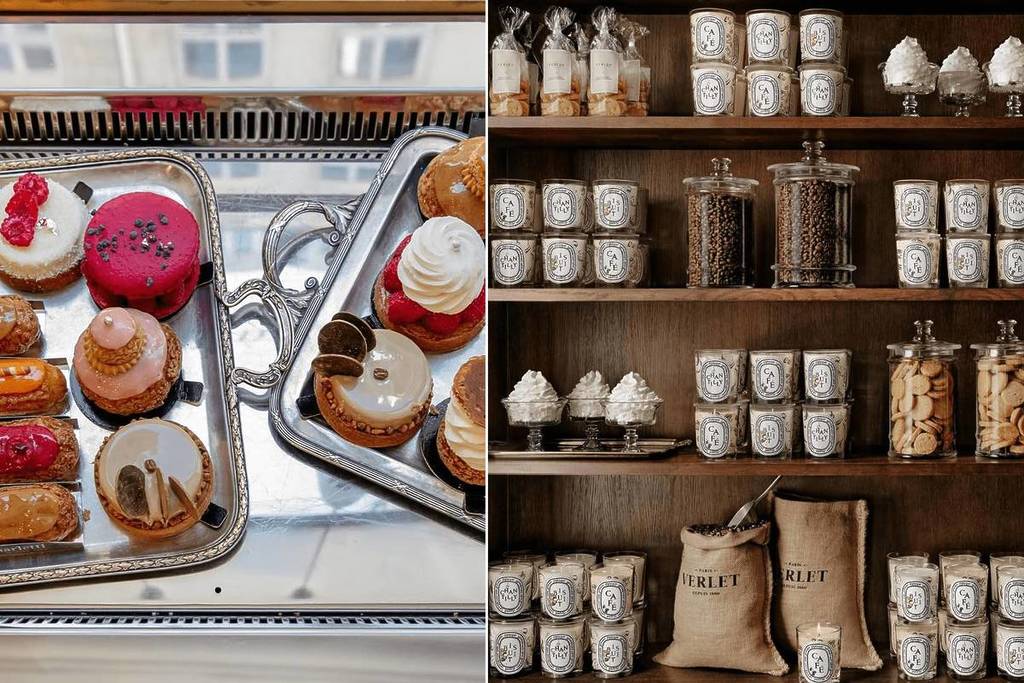
In addition to the thirty or so coffees and forty or so teas available for tasting on site or to take away, Verlet also offers a number of delicacies that would be a shame not to try! Waffles, French toast, croque-monsieur………..but also a fine assortment of French pastries: éclairs, saint-honoré, millefeuille, baba au rhum… Delights to be savoured all day long. As well as spices, the shop sells candied fruit from iSaint-Rémy-de-Provence, the capital of the confit fruit, from Maison Lilamant.
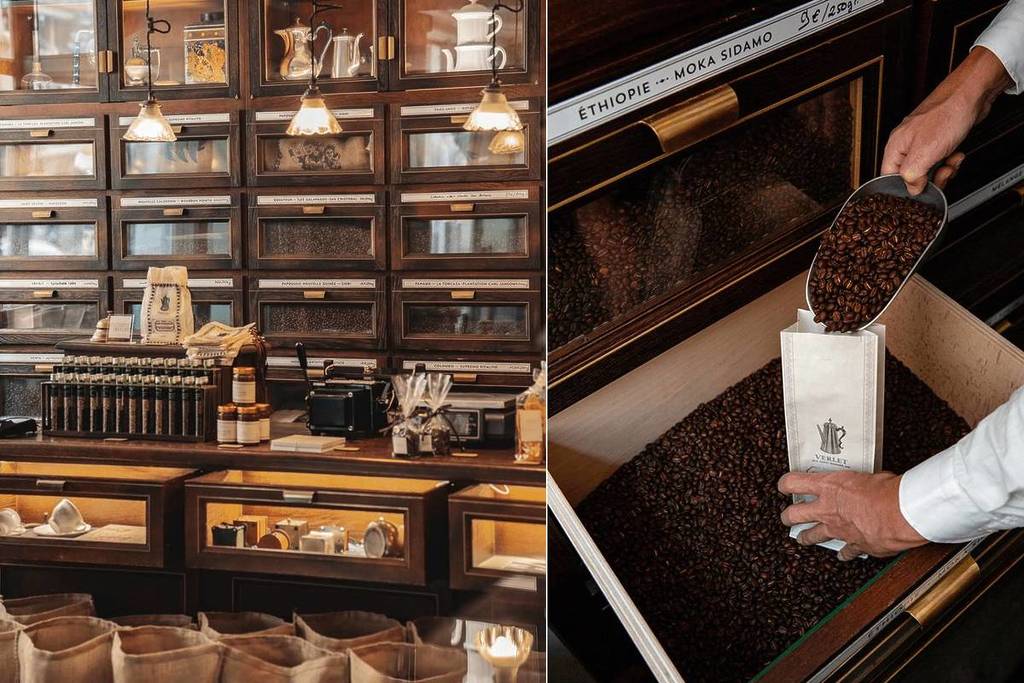
Heir to a French tradition of roasting and preparation, burner and researcher of exceptional local coffees and teas, the Maison invites amateurs to taste more than thirty pure coffees origin, and about forty of the best tea gardens in the world. Verlet remains the oldest Parisian coffee house still in operation to roast in an artisanal way and to make the taste of French coffee live.
All images courtesy of Maison Verlet
Friday’s Tall Tales #143
Whenever I photograph a door or gate I wonder about its provenance, who and what has happened across said door or gate, and what lies beyond.
I thought I might pick one from my sextet of Thursday’s Doors and tell you a bit more about it or……maybe even weave a story about it.

Yes, this is an ecclesiastical door and it’s one of many at the Basílica and Convent of Sant Francesc in Palma, Mallorca. Nestled in the heart of Palma, it’s an architectural masterpiece. This stunning Catholic church, famed for its intricate Gothic design and tranquil atmosphere, offers a peaceful retreat from the bustling city where visitors can admire the ornate altarpieces, beautiful chapels, and the serene cloister, making it an essential stop for those seeking both spiritual solace and artistic inspiration.

It’s only a short distance from the Iglesia de Santa Eulalia, and the three edifices comprise one of the most beautiful and best preserved architectural ensembles in the city. They form part of the monastery that was founded following the conquest of the island and affected by the ecclesiastical confiscations of Mendizábal in 1835.

The interior of the Gothic temple features the monumental Baroque altarpiece, and behind the high altar and under the choir is the sepulchre of Ramón Llull, Mallorcan philosopher and scholar who lived between 13th and 14th centuries.
The church has one central nave and eight side chapels. The apse also has adjoining chapels, the last of which were added between 1445 and 1670. The trapezoidal cloister located next to the church forms a beautiful ensemble that was built between 14th and 16th centuries. The fine columns and foiled arches are particularly striking. The north gallery is the oldest, the western gallery is attached to the church and the southern construction dates back to 15th century.
What’s even better is that it’s next door to one of my favourite hotels in Palma.
Flora and Fauna Friday #143
This post is my weekly homage to my parents who both took pleasure in having a beautiful garden. In particular, they loved sitting and watching the wild life enjoy their garden.

Thursday doors #324

Given my recent trip to Paris, you might expect that these would be Parisian Portes but no, I’m still featuring Spanish, Italian and French doors from my trips last year.


Thursday Doors is a weekly feature allowing door lovers to come together to admire and share their favourite door photos from around the world. Feel free to join in the fun by creating your own Thursday Doors post each week and then sharing your link in the comments’ on Dan’s site, anytime between Thursday morning and Saturday noon (North American Eastern Time).
Trip to Marché d’Aligre
I love visiting markets and they don’t get much better than Paris’ Marché d’Aligre.
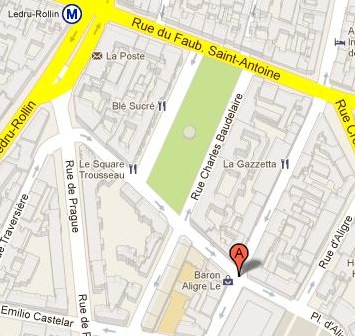
Running east from the Place de la Bastille is Rue du Faubourg Saint Antoine. A leisurely 10 minute stroll along this street, into 12th Arrondissement, brings you to Rue d’Aligre, home to perhaps the best food market in all of Paris. The Marché d’Aligre takes place every morning except Monday in Place d’Aligre and rue d’Aligre.
Even in winter the Aligre market is a riot of colours, smells and flavours. Tuesday to Sunday, the street is transformed into a food lover’s paradise in the outdoor market stalls, in the shops that line the street and in the covered market.
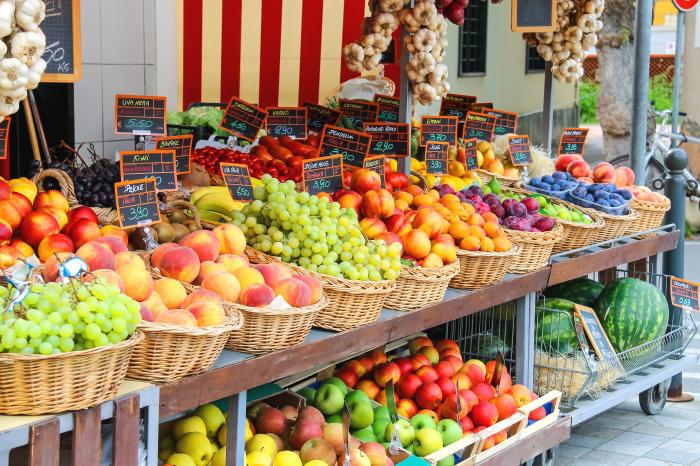
Aligre is, in a sense, three markets combined which make for one of the best food shopping experiences in Paris. First off, the street is lined with small specialist food shops, typical of most Parisian market streets. On market days, the street is filled with stalls displaying the best of French produce. You’ll find a huge variety and choice of fresh fruits and vegetables. It’s an amazing, bountiful choice for the food shopper and a wonderful place to stroll and feel part of the city’s culinary life.
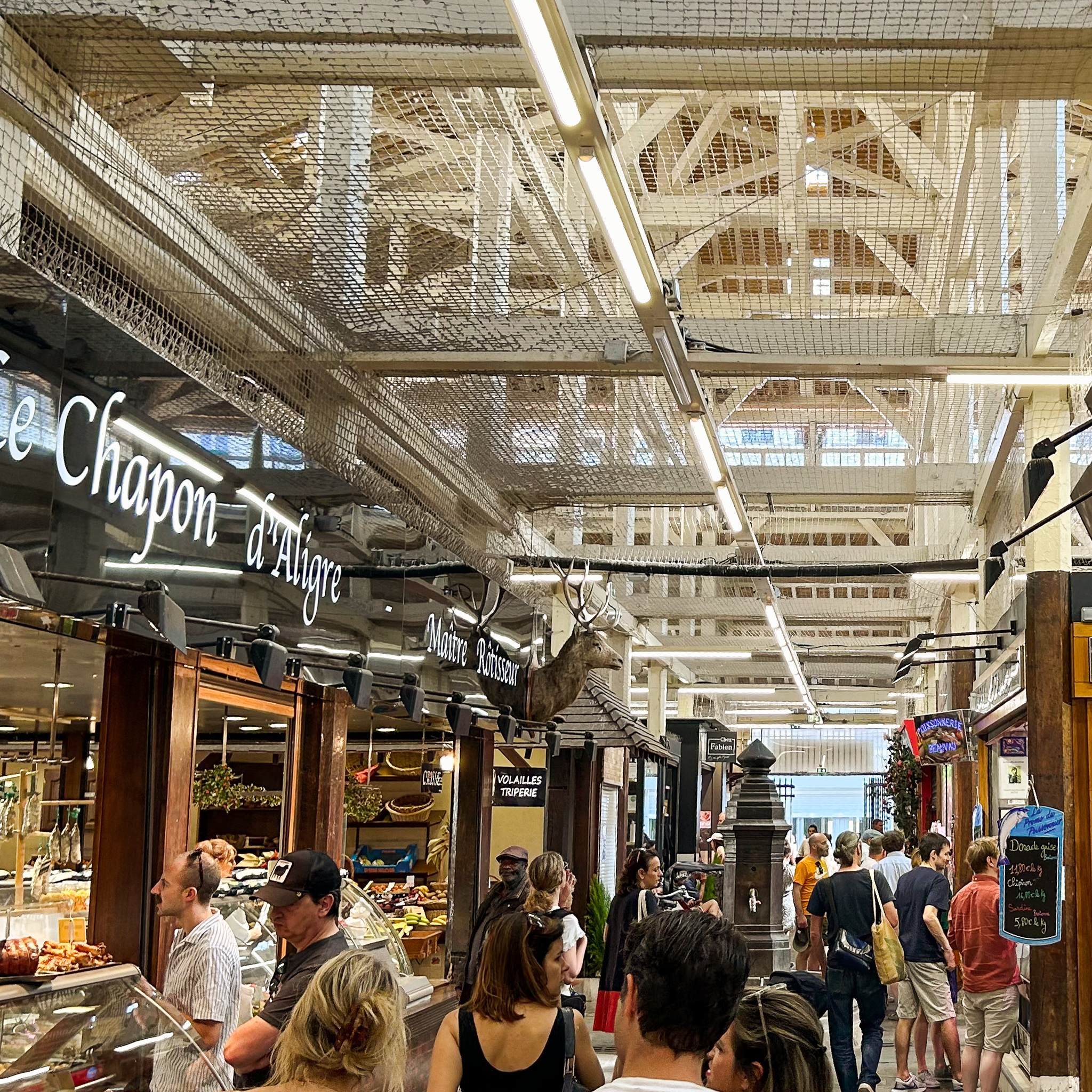
But that’s not all. At the end of the street is the Marché Couvert Beauvau dedicated to permanent food stalls with an array of butchers, fromageries, and other stalls selling wine, spices, coffee, flowers, and a selection of traditional, old-school French meats and fowl.
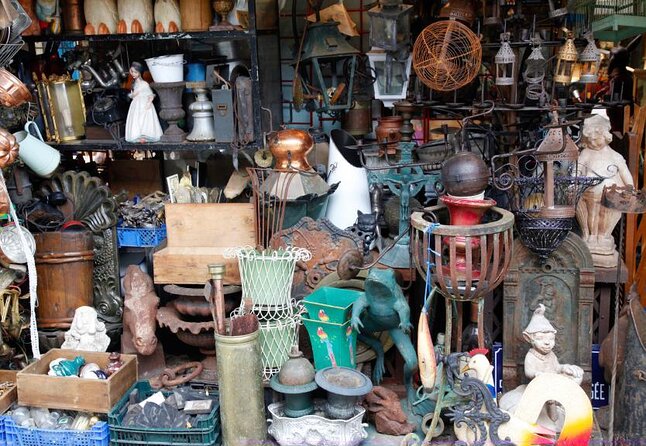
Then, on the Place d’Aligre, outside Marché Couvert Beauvau, there is usually a flea market filled with antiques, collectibles, clothing and used books.
How it all began
The market was named after Étienne François d’Aligre (1727–1798), the first president the Parliament of Paris when the market was built. While the covered part of the market, is named for Gabrielle-Charlotte de Beauvau, the last abbess of Saint-Antoine-des-Champs and daughter of Marc de Beauvau-Craon.
Before this neighbourhood was part of 12th Arrondissement of Paris (designated as such in the 1860s), it was a suburb called Faubourg Saint-Antoine — “faubourg” meaning suburb and “Saint-Antoine” after the abbey that was located here. At that time, the Aligre market was the primary source of food for the faubourg as well as place where craftsmen — carvers, gilders, polishers and cabinetmakers — sold their wares.
The era when the craftworkers populated the quartier is echoed today in many of the shops in the area. Constructed on the marshy former grounds of the Citeaux Abbey, opened in 1781, the Beauvau covered market initially supplied the residents of the then-working class Faubourg Saint-Antoine area with fresh food.
Very quickly, the market and its surrounding area was thronged with local farmers selling their products, as well as butchers, bakers and other artisans. At some points, it even rivalled Les Halles, the sprawling, chaotic market then known as le ventre de Paris (the stomach of Paris).
After the French Revolution, the Beauvau market was renamed the Marché Lenoir. It wasn’t until 1867 that the area and its open-air stands were given the name “Marché d’Aligre”, in homage to the eponymous chancellor and donor of a charitable hospital nearby, the Hospice des Enfants-Trouvés.

Later on, at the beginning of the 20th century when the nearby Gare de Lyon station opened, the area attracted North African immigrants (called maghrébins) who arrived from Marseille by train. Some of these new arrivals established market stalls at Aligre. In fact, most of the current vendors at the Aligre market are third- or fourth-generation vendors who have followed the family trade. It’s a true family business as the stalls and even the permits are passed down from father to son. The blend of Arabic and French voices are the spirit of the Aligre market.
The “Communard” spirit also continues to exist, however unassumingly, in the area– evidenced in the cafés associatifs (community cafés), theatres and children’s centres, some operating like co-ops and staging anything from musical performances to used clothing exchanges.
Trip to Le College des Bernadins
My beloved is fond of immersive musical events and I found one entitled “Le Mystère Mozart” at the Collège des Bernardins in Paris.
How it all began
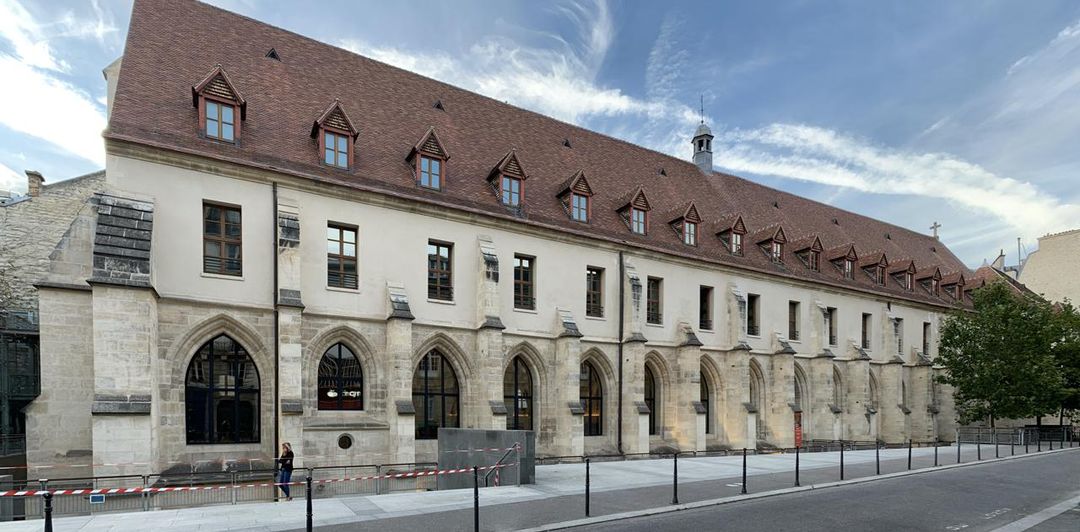
The Collège des Bernardins, or Collège Saint-Bernard, located at no 20, rue de Poissy in the 5th arrondissement, is a former Cistercian college of the University of Paris. Founded by Stephen of Lexington, abbot of Clairvaux, and built from 1248 with the encouragement of Pope Innocent IV, it served until the French Revolution as the residence for the Cistercian monks who were studying at the University of Paris.
After an overall renovation completed in September 2008, it is now a place for meetings, dialogues, training and culture. It offers a programme of public conferences and symposia, exhibitions, concerts, activities for young people and a theological and biblical studies centre. The Ecole Cathédrale offers coursework on Christian thought and every year enrolls over 3,000 students in its courses. Since 2009, it has housed the Académie catholique de France.

The college was listed as a French historical monument in February 1871. The Foundation des Bernardins, which operates the college, is placed under the control of the Notre-Dame cathedral foundation, both of which are supervised by the government of France.
Le Mystère Mozart
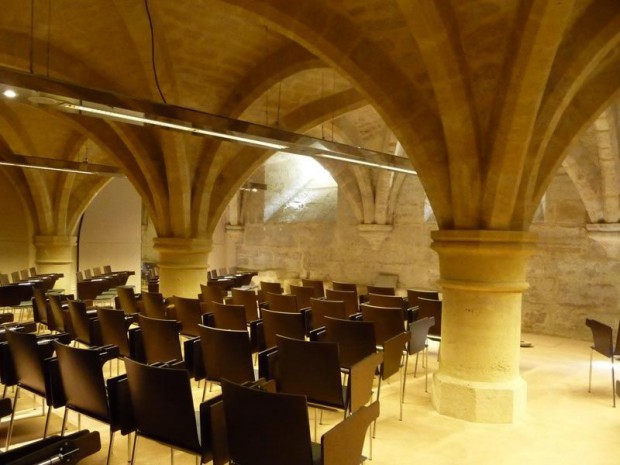
The show requires you to move around the building foolowing the scenes taking part in a number of different rooms. Audience participation is welcomed as part of a musical journey combining music, theatre, dance, period costumes, sound and luminous visual mapping.

Each area is an opportunity to bring Wolfgang Amadeus Mozart’s iconic masterpieces to life, such as the Magic Flute or Don Giovanni, through screenings, actors and dancers.
The Collège des Bernardins becomes a living painting of the life of the musical prodigy providing an opportunity to look into Mozart, the man, in search of meaning. Plus, the musical journey lets you look around Les Bernardins, a place of reflection, and especially a place of dialogue between faith, reason and art.
Every time I listen to Mozart, I can’t help but think that something of this profound harmony comes from the sky, and that Mozart has somehow been touched by the divine. – Benedict XVI
The Mozart Mystery is designed to seduce both classical music enthusiasts and those in search of an original cultural outing: with 90 minutes of music (17 works in total) and eight choreographed scenes in which to rediscover Mozart. My OH loved it – job done!
Musical Monday: Soundtracks #7

I’ve reported on a whole variety of songs: ones by artists I’ve seen live, covers, duets and those deemed iconic. I’m now turning my attention to what might be called “Soundtracks” those featured in films, television shows and advertisements.
Over the years Renault have produced some of the most memorable ad campaigns. From the sublime to the sexy, these ads have highlighted the French flair that is associated with the brand. Who can forget Thierry Henry’s Va Va Voom?
One of the most popular Renault ads in history is the ‘Celebrity Neighbourhood’ commercial. As a group of tourists explore a variety of Hollywood homes, the stars showcase their flashy sports cars on their drives. However, it turns out that these cars are just for show, because as soon as the tour cart disappears, the celebs reveal their everyday cars: Renault Clios. I love that it’s so tongue in cheek.
This was an original composition for the ad that feels perfect given its Hollywood setting. The track is a “happy” background piece characterised by a light, comedic tone that complements the ad’s setting—a high-end suburban neighbourhood where celebrities are casually performing mundane tasks. It brings the whole commercial to life and, somehow, makes it more comedic.
Unlike other Renault campaigns that feature famous pop songs (such as Daft Punk, Oasis or Earth, Wind & Fire), this specific commercial uses a production-style track rather than a mainstream radio hit.
As always, don’t forget to let me know your thoughts.
The Numbers Game 32, Monday 9 March, 2026
Today’s lucky number yielded 117 photos from which I’ve selected 6 at random.


The challenge is kindly hosted by Life Lessons – a blog by Judy Dykstra-Brown
To play along, go to your WP Media file and type that number (236) into the search bar. Then post a selection of the photos you find including that number and post a link to your blog in Judy’s Numbers Game blog of the day – easy!
French Fancies: Joseph Drouhin
If we’re talking old family companies we only need to turn to France’s rich Patrimoine of vintners. This one was founded in 1880 in Beaune.
Joseph Drouhin is a historic, family-owned winery in Burgundy, France, known for its high-quality Pinot Noir and Chardonnay wines. The family’s fourth generation now manages the estate, which is one of the largest in Burgundy and includes 80 hectares of vineyards across various appellations like Côte de Nuits, Côte de Beaune, and Chablis. They are also known for a long-standing partnership with the Marquis de Laguiche to manage vineyards in Le Montrachet.
In addition, there is a separate family winery in Oregon called Domaine Drouhin Oregon which focuses on producing elegant wines from Oregon’s terroir, with a winemaking philosophy influenced by their French heritage.
How it all began
Parts of the family’s wine cellars date back to 13th century though one portion of their cellar was built in 16th century for the king of France. Understandably, the family’s cellars have been classified as historical treasures. Today the estate is managed by fourth generation family members Robert, Philippe, Véronique, Françoise and Frédéric.
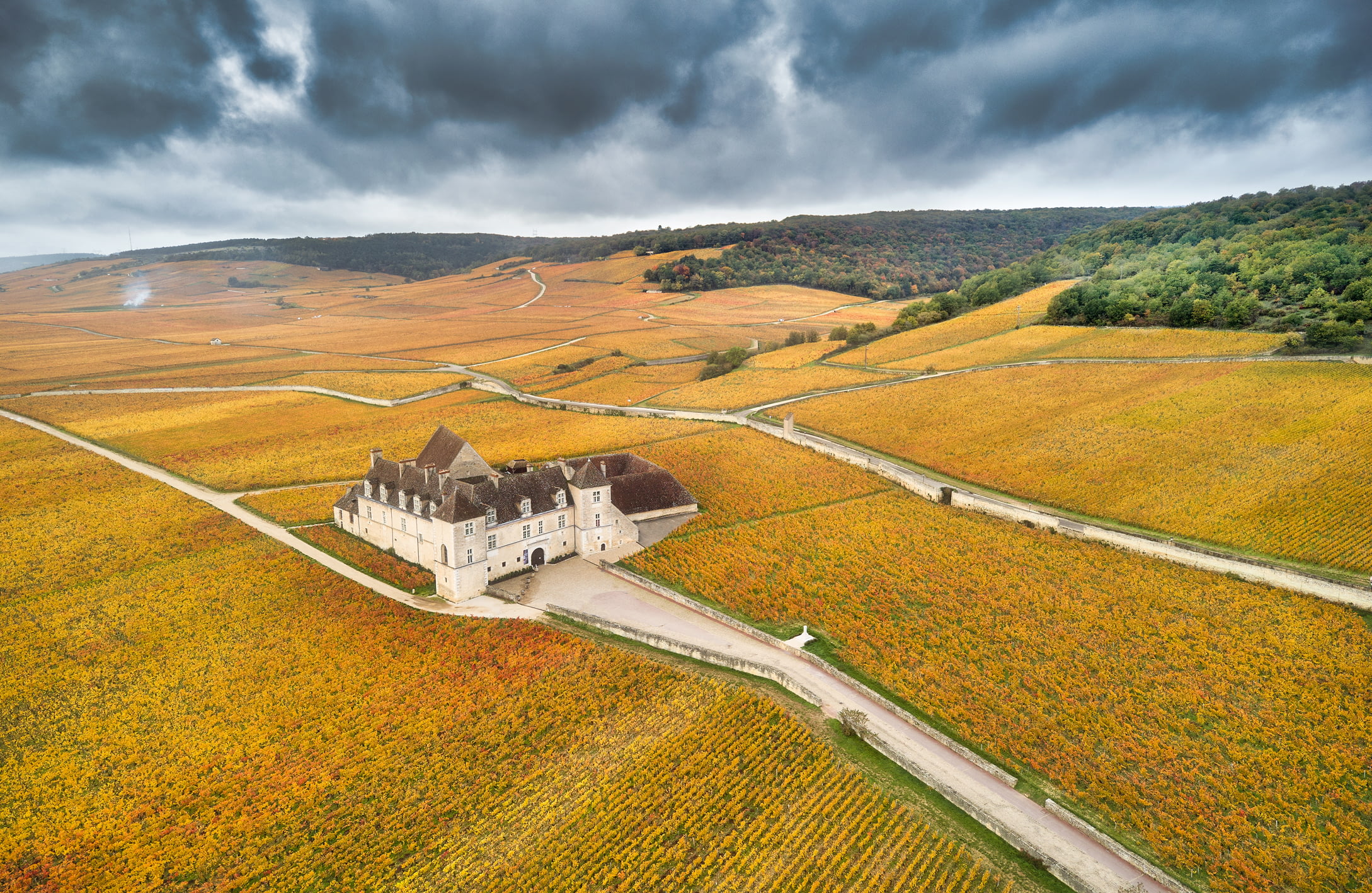
The winery in Beaune was founded in 1880 by Joseph Drouhin through the purchase of a wine trading house founded in 1756. Drouhin is still active in this segment today alongside wine production. The company has the exclusive right to market the wines of the Marquis de Laguiche (produced by Drouhin).
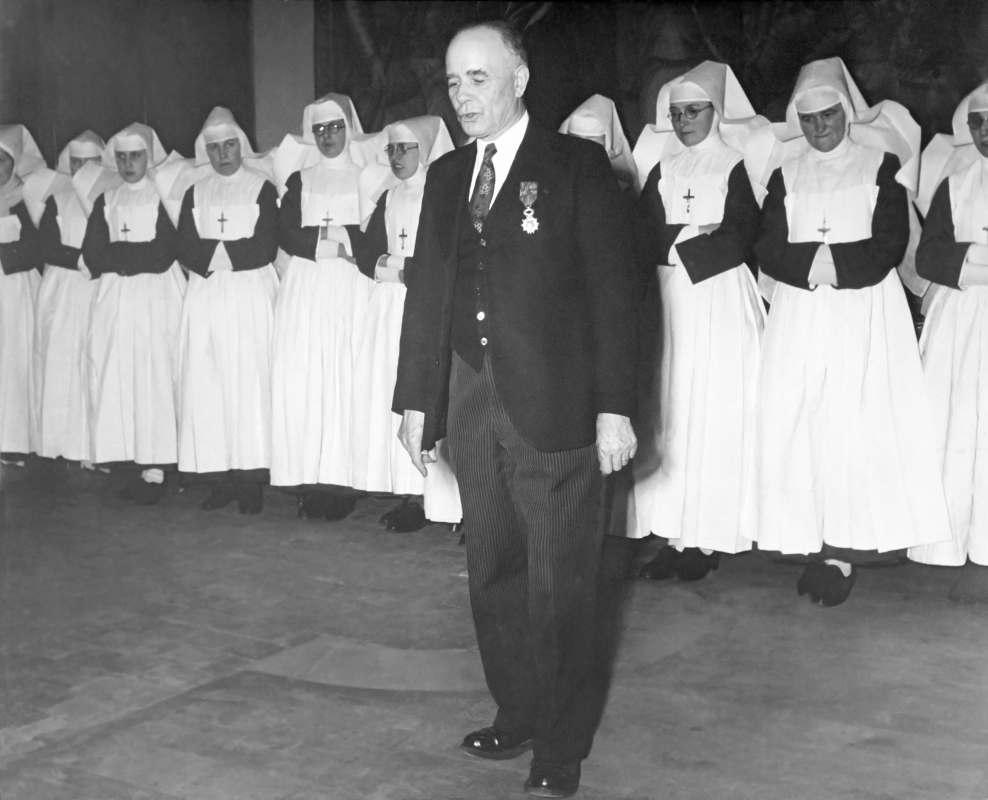
Joseph’s son, Maurice Drouhin, took over the company after the end of the First World War and steered it towards production of high-class products. In addition, he bought plots of land that were sold at very low prices due to the phylloxera disaster and replanted them. He joined the administrative commission of the Hospices de Beaune in 1925 and was its vice-president from 1941 to 1955.

The first purchase was a few hectares in the Premier Cru site Clos-des-Mouches (Beaune), from which a 1973 vintage took part in the famous Paris Wine Tasting in 1976. In the 1930s, a parcel in the famous walled (Clos) Grand Cru site Clos de Vougeot was acquired.
After the early death of his father Maurice, Robert Drouhin took over the business in 1957. He was one of the first in Burgundy to introduce the “culture raisonnée” (renunciation of pesticides and other chemicals) and set up an oenology laboratory. Today, the company is run by Joseph Drouhin’s four great-grandchildren, who were born between 1961 and 1968. Since 2003, Fréderic Drouhin has been responsible for day-to-day operations and Philippe Drouhin for winemaking. Maison Joseph Drouhin is a member of the renowned family winery association PFV (Primum Familiae Vini).
The extensive vineyard estate comprises a total of 100 hectares of vines in more than 160 appellations or Grand Cru and Premier Cru sites in the French region of Burgundy. These are spread from north to south in the Beaujolais, Chablis, Côte d’Or and Mâconnais areas.
The vineyards are cultivated according to the rules of biodynamic viticulture. Gentle thinning and careful foliage care promote optimal ripening of the grapes. Diseases are prevented with herbal preparations if necessary. The ideal harvest date is determined by regular sampling.

The top products include red wines and white wines made from Chardonnay and Pinot Noir from the following appellations, among others the Grand Cru and Premier Cru sites Bâtard-Montrachet(Montrachet), Bonnes-Mares(Chambolle-Musigny), Clos de Vougeot(Vougeot), Clos de Bèze(Gevrey-Chambertin), Clos-des-Mouches (Beaune), Corton-Charlemagne(Aloxe-Corton), Genevrières (Meursault), Givry, Grands Echézeaux(Flagey-Echézeaux), Les Clos(Chablis), Musigny(Chambolle-Musigny), Pommard, Pouilly-Fuissé, Puligny-Montrachet(Montrachet), Rully, Saint-Aubin, Saint-Romain, Saint-Véran(Mâconnais), Santenay and Vaudésier(Chablis). Around four million bottles are produced each year.
In 1988, the “Domaine Drouhin Oregon” (DDO) was built in the Willamette Valley in the US state of Oregon. The wines are mainly made from the Chardonnay and Pinot Noir varieties, as in Burgundy. The overseas operation is managed by Veronique Drouhin-Boss, the daughter of Robert Drouhin.

All images courtesy of Joseph Drouhin.
The Musette: White bean and anchovy dip

Anchovies always divide the crowd unless no one knows they’re there like in this white bean dip which is an excellent vessel for umami-laden anchovies. It combines the creaminess of white beans with salty capers, bright lemon and chilli flakes for a thick, rich spread atop thick slices of toasted bread topped with cooked vegetables, orange zest and a few more anchovies (optional) for good measure.
Ingredients (approx. 700ml/ 3 cups)
- 340g (2 cups) cooked cannellini beans
- 30g (1/3 cup) finely grated Parmigiano-Reggiano
- 6 cured anchovy fillets
- 3 tbsp cream cheese
- 3 tbsp capers
- 2 fat confit garlic cloves
- 1 tsp dried provencal herbs
- 2 tbsp extra-virgin olive oil
- 2 tbsp fresh lemon juice, plus more to taste
- 1 tsp finely grated lemon zest
- 1/2 tsp cayenne pepper
- fine sea salt and pepper to taste
Method
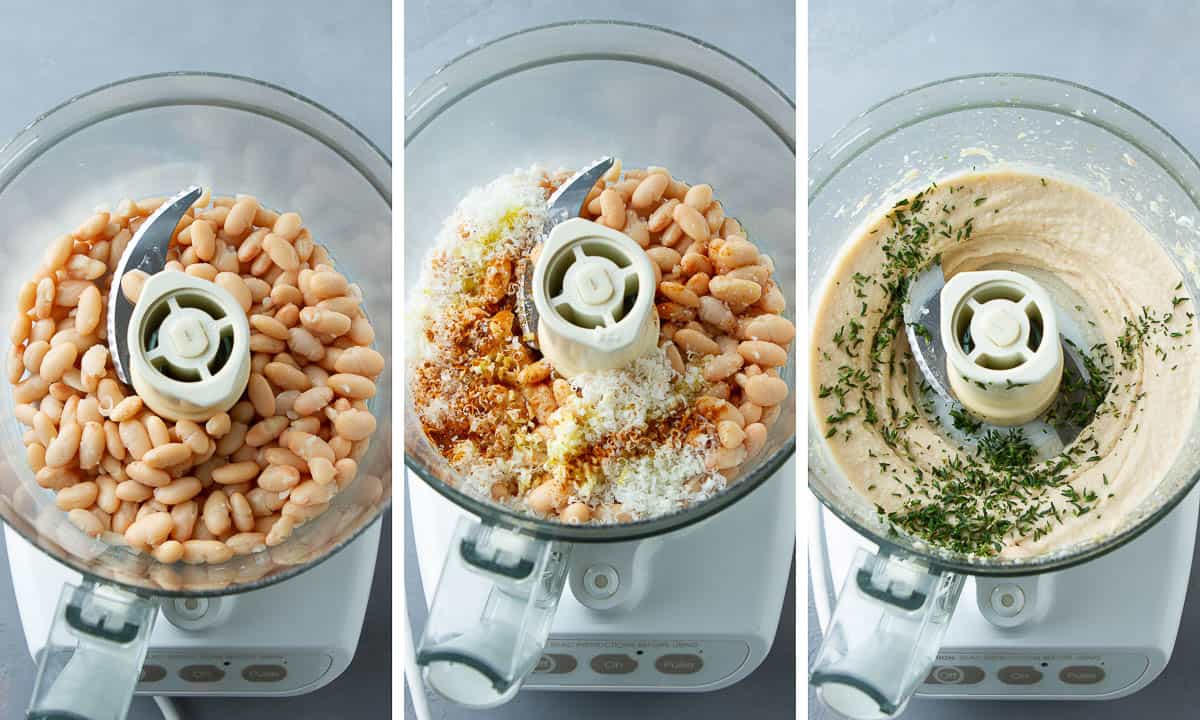
1. Add all the ingredients to a food processor, and blend on high until smooth. Season to taste with salt and more lemon juice, then serve the anchoïade immediately or transfer to an airtight container and store for up to 5 days in the fridge.
2. Use as a dip or spread, as shown below.
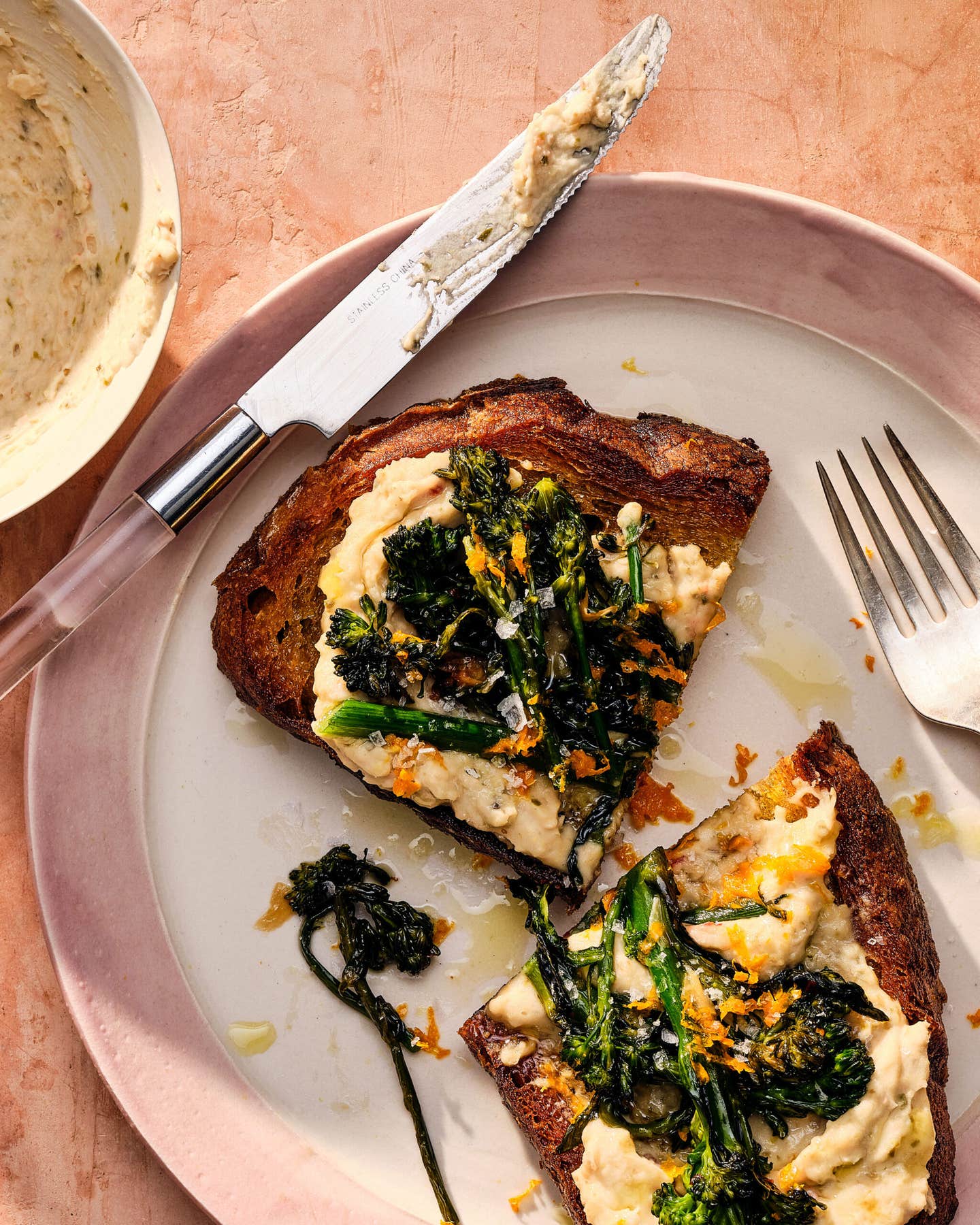
You can, of course, make this vegan by leaving out the anchovies and substituting with vegan cheeses plus 1 tbsp nutritional yeast flakes.
 View from the Back
