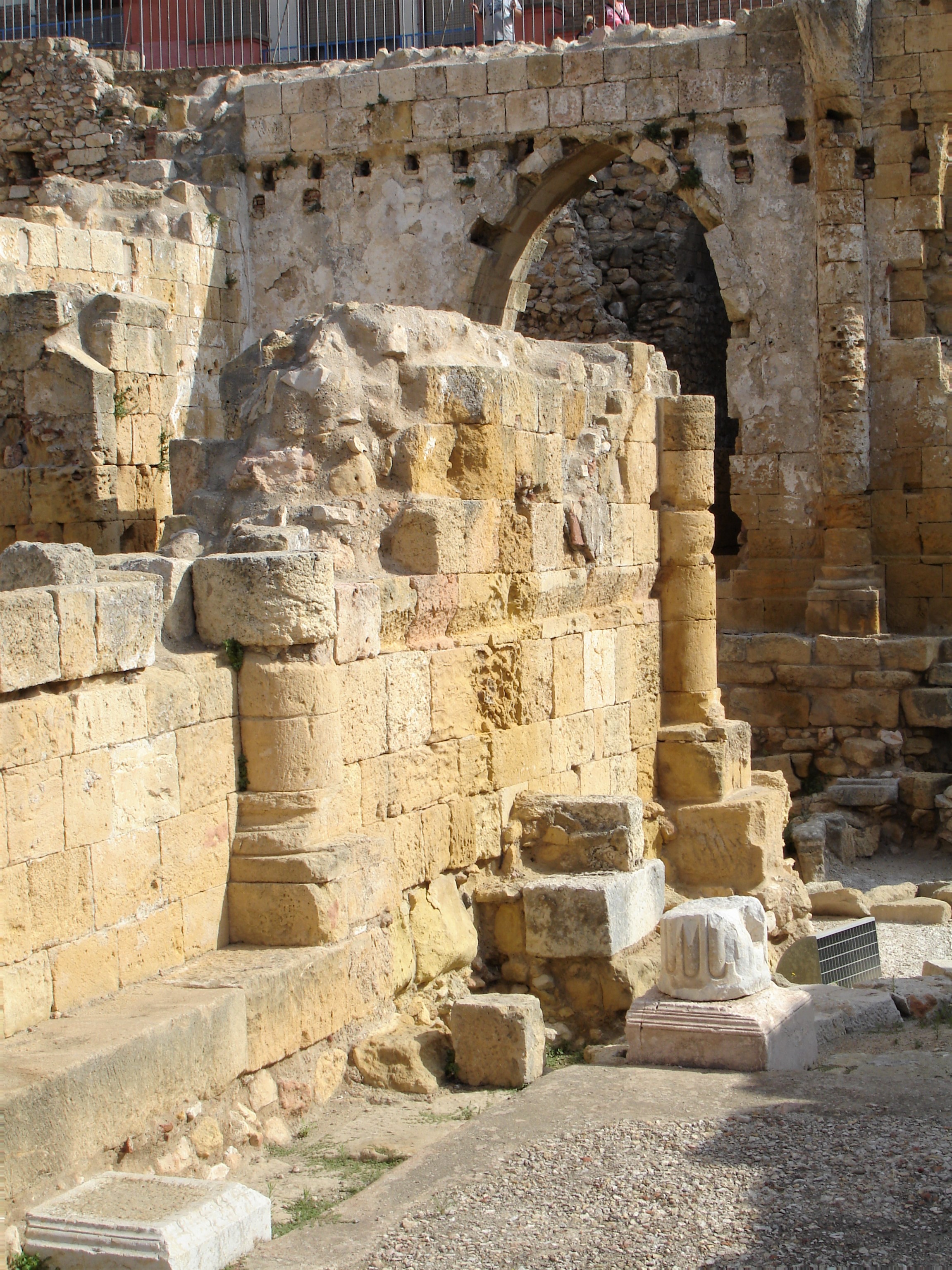
Tarragona’s Roman amphitheater is remarkable not only for its position overlooking the blue waters of the Balearic Sea but also for the fact that much of it was carved in situ out of the existing bedrock. The structure is 427 feet by 335 feet in size, and, at the time of its completion in the early second century CE, when the city was known as Tárraco, could accommodate an audience of some 12,000. In its early years, the amphitheater was the scene of the usual array of cruel Roman spectacles, and was renovated during the reign of Roman Emperor Heliogabalus (204-222).
Heliogabalus made quite a name for himself—briefly. According to historian Edward Gibbon, he “abandoned himself to the grossest pleasures and ungoverned fury” and was assassinated at the age of 18. So black was his reputation that he was then subjected to damnatio memoriae—the erasure of all references to his existence from the historical record. (The fact that such a practice actually had a recognized name tells us a lot about the time.) Nevertheless, archaeologists have discovered traces of his memory in the inscription celebrating the amphitheater’s renovation. It seems that they found key letters on scattered fragments of marble, allowing them to piece together what would have been a reference to the hated emperor.
Tarragona’s mayor asked modernista architect Josep Maria Jujol to undertake the amphitheater’s restoration in the mid-1920s, but nothing came of the project, and it would be the middle of the century before any serious work was done. Decades later, in 2000, the amphitheater was designated as one component of a UNESCO World Heritage Site—the Archaeological Ensemble of Tárraco.
When Maggie and I are in Tarragona, we stay in a small, family-run hotel a short bus ride up the coast from the amphitheater. After an afternoon of swimming on Savinosa Beach and a light dinner at a chiringuito (beach bar) called Pepe’s & Lugano Restaurant and Chill-out (that’s transcribed correctly, by the way), we can enjoy the view above from our hotel balcony.
As I expand and update my 2002 book When the Going Was Good, I’m posting revised entries from the first edition. Today’s deals with a classic account of island life off the west coast of Ireland.
☼ ☼ ☼
John Millington Synge: The Aran Islands (Dublin: Maunsel, 1907)
Although he played the violin from an early age and had studied music at the Royal Irish Academy of Music and in Germany, Synge abandoned music in 1894 for literature. He attended the Sorbonne in Paris, where poet William Butler Yeats met him in 1896. Yeats suggested that he seek inspiration in the Aran Islands rather than the French capital, but an operation for Hodgkins Disease (an affliction that would eventually kill him) intervened before Synge made his first visit in May 1898.
Synge, giclée print, c.1905
The three Aran Islands (Inishmore, Inisheer, and Inishmaan) lie across the entrance to Galway Bay off the West coast of Ireland. On his first visit, Synge stayed in the barren, isolated islands six weeks. He returned each summer for the following three or four years, spending most of his time in Inishmaan and living for the most part in rented rooms in simple cottages. The experience revealed a society that was in his estimation “perhaps the most primitive that is left in Europe.”
Synge, photograph of Inishmaan Islander, 1898
Although published in 1907, only two years before Synge’s death, The Aran Islands was written soon after the turn of the century. Synge himself called it his “first serious piece of work.” Very much the observer, Synge describes the islands’ desolate landscape and harsh weather, records their archaic and often brutal way of life, and transcribes the stories (often about the fairy folk) he heard. He witnessed evictions and funerals, but the patterns of life and death he discovered are universal, however specific their immediate circumstances. Much of Synge’s experience of the islands went into the plays Riders to the Sea (1903) and The Playboy of the Western World (1907), and it was their success (and, in the case of the latter, notoriety) that made the publication of his earlier work possible.The drawings by Jack B. Yeats (the poet’s brother) amplify Synge’s spare prose.
Jack B. Yeats, drawing from The Aran Islands
Editions to look for: The Oxford edition published as Four Plays and the Aran Islands includes an introduction and other secondary material by Robin Skelton. The Vintage edition published as The Aran Islands, and Other Writings includes an introduction and notes by Robert Tracy. The Marlboro edition includes an introduction by Edward J. O’Brien. The Penguin edition includes an introduction by Tim Robinson.Thanks to the Internet Archive, you can also read a copy here.
See also by Synge: In Wicklow, West Kerry and Connemara (1910). And for further information about Synge, I suggest: Deborah Fleming, A Man Who Does Not Exist: The Irish Peasant in the Work of W.B. Yeats and J.M. Synge (U Michigan P, 1995); Donna Gerstenberger, John Millington Synge (rev. ed. Twayne, 1990); Alexander G. Gonzalez, Assessing the Achievement of J.M. Synge (Greenwood P, 1996); David H. Greene, J.M. Synge, 1871–1909 (New York UP, 1989); David M. Kiely, John Millington Synge: A Biography (Gill & Macmillan, 1994); Edward A. Kopper, Jr., ed., A J.M. Synge Literary Companion (Greenwood P, 1988); and W.J. McCormack, Fool of the Family: A Life of J.M. Synge (New York U P, 2000).
If you’d like to subscribe to World Enough, enter your email address below:
I included a 1942 memoir by American writer Elliot Paul, The Last Time I Saw Paris, in my survey of travel narratives, When the Going Was Good. But I’ve only now gotten around to reading another book by him, The Life and Death of a Spanish Town (1937).
The town of Paul’s title is Santa Eulalia del Rio (or, in Catalan, Santa Eulària des Riu), and it lies on the northeastern coast of the small Spanish Mediterranean island of Ibiza (ee BEETH uh).
In a foreword dated August 1942, Paul explained that when the book was written and published, “it was apparent” that his friends “of Santa Eulalia del Rio and elsewhere in Spain were to be killed, starved and enslaved.” By then, his account had become a memorial.
Paul had moved to Ibiza in 1931, left for a time, and then returned with his new wife, Camille Haynes, in mid-July 1936. The book’s first section, “4000 B.C. to 1936 A.D.,” is a slow, loving portrait of the Santa Eulalia that he had originally found, and the wording of its title suggests that the peaceful life that Paul first observed there in the early 1930s had existed, largely unchanged, for millennia. Speaking of the town’s inhabitants, he writes that he “loved them and their animals and the shadows of the trees that fell upon their houses. They divided their last pesetas and red wine and beans and gay spirit with [him].” Then he “got away, and they did not. Their land is dying.” His account, he says, is “a debt” he owes them.
Endpapers of the 1937 & 1942 eds.
The book’s second section, “July 14 to September 15, 1936,” describes the town as he found it upon his return, along with his new wife, her son, and their dog. They had sailed from Barcelona aboard a “friendly and not too elaborate” ship, but it was only subsequently that he learned that it would be the ship’s last round trip to the Balearic Islands. Some of his journalist friends, he writes, “had suspected that there might be trouble in Spain,” but they had apparently (and erroneously) assumed that he knew as much about the situation as they did.
The “trouble” that Paul refers to is the outbreak of the Spanish Civil War, a violent and bitterly divisive conflict which ended in 1939 with the downfall of the Second Spanish Republic and the installation of Francisco Franco as dictator. Paul’s readers during the years following the publication of his book would of course have been well aware of the circumstances, having read about them on what was probably a daily basis in their newspapers. For readers in the twenty-first century, however, the exact nature of the conflict is unclear.
Rigoberto Soler, View of Santa Eulària, 1943
Paul’s account of events in those eight crucial weeks in 1936 is loosely organized, even chaotic in many passages. It’s here that the list of the “Men and Women of Santa Eulalia” following his foreword comes in handy, but, nevertheless, Paul’s account of the comings and goings of the town’s inhabitants is difficult to follow. They were all living day to day, even hour to hour, uncertain of what rumors to believe and which neighbors they could trust. I noticed in particular that although he mentions three artists, he pays no attention to their works. They were apparently of less importance than those he shared red wine and beans with. One, however, postimpressionist Rigoberto Soler (1896-1968), who moved to Santa Eulalia in 1925, is worth mentioning. His View of Santa Eulària captures the calm beauty of the town, although it dates from 1943, shortly after the chaotic events that Paul describes.
In a foreword (to a later edition) dated August 1942, Paul wrote that “[w]e all know that the war we now are preparing to fight began in Spain in July, 1936, if not sooner, and that the oppressed Republican Spaniards were on our side and against our enemies.” The war that he refers to was, of course, World War II—a far more devastating conflict than the one he already witnessed.
Rigoberto Soler
If you’d like to subscribe to World Enough, enter your email address below:
In my post for April 26, 2021, I described a visit that Maggie and I made to the site of the Pont du Gard in 2008. We were staying in Avignon, and had booked a short tour that would take us to the hilltop towns of Gordes and Les Baux as well as the famous Roman aqueduct bridge. I try to avoid tours, as they tend to pre-package your experiences for you, but unless you’re willing to rent a car or puzzle out the eccentricities of local bus schedules, they may be your only choice.
The Pont, which stands 155 feet high, was part of a long aqueduct that channeled water over the Gard River to Nemausus (today’s Nîmes) from the Eure springs near Uzès. It was constructed (without mortar!) by the Romans in the early decades of the current era, and, although the actual distance from the water’s source to Nîmes is only 12 miles, the aqueduct itself stretches along a course of some 31 miles in order to allow the water level to drop gradually (a total of only 41 feet) until it reaches its destination.
Hubert Robert (1733-1808), The Pont du Gard, 1787
Moving forward nearly two millennia, the 1891 edition of Baedeker’s Southern France has this to say: “The Pont du Gard, spanning the Gard or Gardon at a bend of the valley… , is one of the most imposing monuments of the Romans which remain to us.… The bridge is about 880 ft. long …, and is composed of three tiers of arches, each less wide than the one below.… The whole is admirably constructed of large stones, and no cement has been used except for the canal on the top.” And so on, in the guide’s informative but scrupulously dry prose.
Sketch by an unknown artist, to accompany A Little Tour in France, 1884
For a livelier look, I’ve turned to Henry James and his Litle Tour in France, which was originally published, just a few years before, in 1884. “I gave all my attention,” wrote James, “to that great structure. You are very near it before you see it; the ravine it spans suddenly opens and exhibits the picture.…The ravine is the valley of the Gardon, which the road from Nimes has followed some time without taking account of it, but which, exactly at the right distance from the aqueduct, deepens and expands, and puts on those characteristics which are best suited to give it effect. The gorge becomes romantic, still, and solitary, and, with its white rocks and wild shrubbery, hangs over the clear, colored river, in whose slow course there is here and there a deeper pool. Over the valley, from side to side, and ever so high in the air, stretch the three tiers of the tremendous bridge. They are unspeakably imposing, and nothing could well be more Roman. The hugeness, the solidity, the unexpectedness, the monumental rectitude of the whole thing leave you nothing to say—at the time—and make you stand gazing. You simply feel that it is noble and perfect, that it has the quality of greatness.”
James admits, however, that, “at the same time” he “discovered in [the Pont] a certain stupidity, a vague brutality. That element is rarely absent from great Roman work.”
Cass Gilbert (1859-1934), Pont du Gard, France
I sensed nothing of the stupidity that James mentions, and I don’t believe that Maggie did either. After all, the heaviest sandstone blocks in the Pont weigh 6 tons, and, given such enormous weights, I’m willing to allow quite a bit of “vague brutality.” In any case, our time at the Pont was short and another destination (or was it two?) awaited us. Our driver had been amiable enough, and there was another lazy June evening back in Avignon to look forward to. We were, after all, in Provence, “the land,” as James put it, “where the silver-gray earth is impregnated with the light of the sky.”
Who could ask for more?
☼ ☼ ☼
If you’d like to subscribe to World Enough, enter your email address below:
The name Chaïm Soutine probably doesn’t ring any bells with you, but perhaps I can change that.
Born Chaim-Itzke Solomonovich Sutin in 1893 in what today is the Eastern European nation of Belarus, Soutine studied art in Lithuania before moving to Paris. The French capital was then the center of the artistic world, and it was there that the young man began an immersion in a world of culture that he had only dreamed of. In the process, he made himself into an artist, one whose sinuous, thickly painted, sensuously contorted style is unmistakable once you’re seen it.
Soutine, House in Céret, 1920
Among the fellow artists Soutine befriended in Paris were Amadeo Modigliani, who painted Soutine’s portrait, and who had his own painted in turn. Soutine also gained the patronage of art dealer Léopold Zborowski.
When he was financially able to, Soutine decamped to southwestern France, settling from 1919 to 1922 in the commune (town) of Céret. Lying about 25 miles from the Mediterranean coast, Céret (as the site About-France.com puts it) is the “jewel of French Catalonia,” and had previously attracted such artists as Pablo Picasso and Georges Braque.
Soutine, Capuchin Monastery inCéret, 1920
Although he painted striking portraits and equally striking carcasses (!) of cattle, Soutine also chose Céret itself as a subject, and it’s the resulting works that I can identify with most easily. Studying them, I have a sense that the artist understood the nature of the very roots and bark and foliage of the town’s trees and the hard, lichen-covered stones of its houses. He understood that his subjects, even the supposedly inanimate ones, had souls.
Several books have been devoted to Soutine’s sojourn in the Catalan town, including the 519-page exhibition catalog Soutine: Céret 1919-1922, by Esti Dunow with Josephine Matamoros (Céret: Musee d’Art Moderne de Céret, 2000). I try not to buy any more books these days, but I’m tempted …
Artists such as Pablo Picasso and Georges Braque had visited Céret for a time in 1911, but their paintings of the town aren’t quite as memorable as Soutine’s. But I think their work and the town itself might deserve a closer look down the line.
☼ ☼ ☼
If you’d like to subscribe to World Enough, enter your email address below:
It’s one of many, many travel firms that have fallen by the wayside, in this case in 1926, when it was acquired by Matson Navigation Company of Honolulu.
However, the Oceanic Steamship Company had enjoyed a good run.
Founded in 1881 on Maui in the Kingdom of Hawaii by ambitious entrepreneur John D. Spreckels and several other members of the Spreckels family, the company operated as a subsidiary of a holding company, Wm. G. Irwin and Co. The Spreckels raised sugarcane, from which they extracted raw sugar and, using the ships of their own Oceanic Steamship Company, shipped most of it to San Francisco for refining and eventual distribution throughout the western United States. (In case you’re wondering, the Spreckels owned the city’s sugar refineries as well.) The company was apparently the first to schedule runs between the islands and San Francisco on a regular semimonthly basis.
Having replaced its original fleet of sailing ships with newer, faster steamships, Oceanic soon branched out into carrying freight, passengers, and mail, this last having long been a monopoly of a rival firm, Oceanic Pacific Mail.
In August 1898, the United States annexed the Kingdom, and, in 1906, the new territory’s second governor, G.R. Carter, had this to say in his Report of the Governor of the Territory of Hawaii to the Secretary of the Interior: “The Oceanic Steamship Company operates four steamers on the Honolulu run, i.e., the Sierra, 6,200 tons; Sonoma, 6,200 tons; Ventura, 6,200 tons, and Alameda, 3,200 tons. The first three steamers maintain a twenty-one day service between San Francisco and Sydney [Australia], stopping regularly at Honolulu, Pago Pago [Samoa], and Auckland [New Zealand]. These boats have accommodation for 200 first-class and 100 second-class passengers. The steamship Alameda of this line plies between San Francisco and Honolulu only. The round trip, including stays in port, consumes twenty-one days, dates of sailing being intermediate with those of the thru steamers.”
Oceanic eventually owned 17 ships, and was hailed at the time of its sale to Matson Navigation in 1926 by the New York Times as “one of the pioneers in transpacific trade.” The pioneer continued to sail under the name Oceanic for the rest of the century.
If you’d like to subscribe to World Enough, enter your email address below:
Elihu Vedder, The Questioner of the Sphinx, c. 1875
Grove Koger
If you look up the meaning of “sphinx,” you’ll learn that (according to Britannica) it’s a “mythological creature with a lion’s body and a human head,” and that it’s “an important image in Egyptian and Greek art and legend.” Britannica adds that the Muses had taught the legendary “winged sphinx of Boeotian Thebes” a riddle, and that the creature, in turn, demanded to know of everyone it encountered, on pain of death, What creature begins four-footed, becomes two-footed, and ends up three-footed?
After who knows how many deaths, Oedipus provided the answer, and the sphinx killed herself.
Writing (with margarita Guerrero) in his 1967 Book of Imaginary Beings, the great Jorge Luis Borges noted that Greek historian Herodotus referred to the Egyptian sphinx as androsphinx (“man sphinx”), thus distinguishing it from the Greek sphinx, which is female. He adds that the Greek sphinx is in the form of a lion, with wings and a woman’s breasts. (For a time, I considered calling today’s post “Sexing the Sphinx.”)
Valère Bernard, Sphinx, 1896
Most sphinxes in Western art do seem to be feminine, although various features come and go if you look for visual representations, as I have recently. Nevertheless, they add up to a disquietingly bizarre creature that looks right. The parts really do seem to fit together.
The world’s most famous sphinx is undoubtedly the Great Sphinx of Giza in Egypt, which was created about four-and-a-half millennia ago by altering an enormous limestone outcropping. Egyptologists believe that it represents either the pharaoh Khufu (r. 26th century BCE), who built the Great Pyramid of Giza, or one of his sons, Djedefre or Khafre. It’s been the subject of numerous paintings, almost all of which pay tribute to its size and power. Elihu Vedder’s painting at the top of today’s post manages both of those aspects, while suggesting its mystery as well.
Gustave Moreau, Oedipus and the Sphinx, 1864
There are very few appearances of the sphinx in literature. As far as Sophocles’ play Oedipus Rex goes, the creature’s encounter with Oedipus has already occurred before the play begins. More interesting to me, in any case, is an 1895 story by M(atthew) P(hipps) Shiel, “Huguenin’s Wife.” In this work, the narrator has traveled to the Greek island of Delos to meet his old friend Huguenin, who appears to have gone mad. The man had been married to a woman named Andromeda, a woman who had spoken of the “eternal mutations prepared for the spirit of man” and of the “limitations of animal forms in the actual world.” She had insisted, instead, “that the spirit of an extraordinary and original man, disembodied, should and must re-embody itself in a correspondingly extraordinary and original form.” And, she insists, “‘such forms do really exist on the earth, but the God, willing to save the race from frenzy, hides them from the eyes of common men.’”
Having struck his wife at the bizarre remark, Huguenin has inadvertently killed her, and yet something has taken her place, and Huguenin is certain that his own life is “intimately bound up with the life of the being he [has] stayed to maintain.” Then, finally, we see that being. “For if I say,” says our narrator, “that it was a cheetah—of very large size … its fat and boneless body swathed in a thick panoply of dark grey feathers, vermilion-tipped—with a similitude of miniature wings on its back—with a wide, vast, downward-sweeping tail like the tail of a bird of paradise,—how by such words can I image forth all the retching nausea, all the bottomless hate and fear, with which I looked?”
Georg von Rosen, The Sphinx, 1907
Has Huguenin’s wife become a sphinx? Or has she become something more like a griffin, that mythological creature with the body and tail of a lion and the head and wings of an eagle? Something between the two? It’s hard to say, but I think it fits well enough in our discussion. Shiel’s prose is as frenzied as Huguenin himself is, and it’s not to everyone’s taste, but it matches the many visual representations of sphinxes, several of which I’ve included in today’s post.
In Jean Cocteau’s 1934 play La Machine Infernale (The Infernal Machine), the Sphinx actually tells Oedipus the answer to the riddle before formally asking it. When Oedipus replies with the correct answer, she can then be allowed to die. In other words, she has chosen to commit suicide, an act that she has longed for. Cocteau’s vision of the sphinx is as rational as Shiel’s is irrational, and the two neatly bookend the range of what might be said about the creature.
One of Palma’s sphinxes
Maggie and I have actually admired four statues of sphinxes in Palma de Majorca, although these are far more restrained than the painted representations I’ve run across. I believe that all of the latter qualify as symbolist works. Unlike realism, symbolism dealt with dreams and obsessions, and, based on the evidence that I’ve found, the movement was an ideal vehicle for representations of sphinxes.
And, by the way, the answer to the sphinx’s famous riddle is man, who crawls on four limbs as an infant, walks on two legs as a mature individual, and must use a cane or stick in his or her old age.
֍֍֍
If you’d like to subscribe to World Enough, enter your email address below:
Sealand in 2005. Reproduced courtesy of the Bureau of Internal Affairs, Principality of Sealand, and Wikimedia Commons
Grove Koger
The chances are that you’ve never heard of Sealand. But I’ve been reading about the place recently, and here’s what I’ve learned.
Sealand is properly known as the Principality of Sealand, and exists on (or should I say “in”?) a seafort off the mouth of Britain’s Thames River. Seaforts are military installations that were designed by Guy Maunsell (1884-1961) and erected by Britain in the estuaries of the Thames and Mersey rivers during World War II to guard against German air raids and the deployment of mines.
Paddy Roy Bates, 1977
The installations were abandoned after the war, but one, Roughs Tower, was later occupied by adventurer Paddy Roy Bates and operated as a pirate radio station. Like the other forts, Roughs Tower was outside Britain’s territorial limits at the time, and although British authorities made several efforts to seize it from Bates and his family, the efforts were eventually abandoned as being unproductive.
The saga of Sealand is recounted at some length in Dylan Taylor-Lehman’s 2020 book Sealand: The True Story of the World’s Most Stubborn Micronation and Its Eccentric Royal Family (Diversion Books).
Taylor-Lehman refers to Sealand as a “micronation,” and explains that the term is distinct from “microstate,” which is “a tiny country recognized worldwide with membership in international organizations.” As examples of the latter, he cites Andorra, Lichtenstein, and Niue. A micronation, he says, “is generally defined as as an invented country within the territory of an established nation whose boundaries typically go unrecognized on the world stage.” They’ve been declared “for reasons serious and tongue-in-cheek,” but, as he points out, “Sealand was founded on territory that was in genuinely international waters and has endured since 1967. All the while, the Sealanders have fought to keep these claims alive in ways unmatched by most other micronations.”And, on top of everything else, we can think of Sealand as a very small island, or at least as something like an island.
I’ve visited some pretty small islands, here and there (as well as Lichtenstein), and I can testify that their appeal is real, at least to some. I’m reminded in this regard of D.H. Lawrence, who wrote a cruel short story, “The Man Who Loved Islands,” about just such a person. The story’s protagonist—Cathcart—was modeled on a real individual, fellow writer Compton Mackenzie, who was attracted to islands. Mackenzie had spent a few years with his wife on the Italian island of Capri during the second decade of the twentieth century, and went on to buy and live on, successively, two small islands in the English Channel, Herm and Jethou. Subsequently, he made his home on the Scottish island of Barra. So intense was his interest in such things that he became known as a “collector” of islands—which strikes me as a pretty good thing.In Lawrence’s story, however, Cathcart’s moves to increasingly small islands are indicative of growing mental illness.
But to get back to Sealand … Its online site explains that it “was founded as a sovereign Principality on a military fortress,” and that its national motto is “E Mare Libertas”—“From the Sea, Freedom.” It has its own flag, passports, currency, stamps, and even its own Facebook page. What more could you ask? Perhaps a noble title? Well, that can be arranged. A knighthood, for instance, goes for $149.99, for which you’ll receive a digital, printable deed of title. There are classic and premium grades of knighthood as well, the latter of which comes with a title deed personally signed by Paddy Roy Bates’ son and current sovereign, Prince Michael of Sealand.
If you’d like to learn more about the entity from which you might be procuring your knighthood, you can watch a 60 Minutes episode about the principality here.
If you’d like to subscribe to World Enough, enter your email address below:
“All those notes,” American composer Aaron Copland once remarked of Sergei Rachmaninov’s major compositions, “and to what end?”
Copland’s cutting remark is a lesson in the vagaries of reputation. In the third decade of the 21st century, I’d wager that the American’s once-bright star has dimmed among classical music listeners, while Rachmaninov’s has grown brighter.
And yet, there are a lot of notes in Rachmaninov’s music, cascades of them, along with sweeping, sonorous melodies. It’s music to be experienced emotionally, music that looks back wistfully to another era. Rachmaninov himself wrote that he felt “like a ghost wandering in a world grown alien.” He had, he said, “made intense efforts to feel the musical manner of today,” but it would not come to him. “I cannot cast out the old way of writing, and I cannot acquire the new.”
The composer, who had been plagued in his younger years with nearly debilitating self-doubts, was, once more, being hard on himself. He was familiar with jazz and enjoyed listening to Paul Whiteman (celebrated as the “King of Jazz”) and his Palais Royal Orchestra. And he admired George Gershwin’s famous Rhapsody in Blue, which Whiteman debuted in 1924. And, unlikely as it seems, he liked motorboats and fast cars.I’ve always imagined Rachmaninov as being somewhat dour, but apparently I’ve been wrong.
Born in 1873 in western Russia, Rachmaninov had initially made efforts to accommodate himself to his country’s 1917 revolution, but soon fled with his family. And although portions of his fourth and final piano concerto were apparently written in 1917, the first published version appeared, nearly a decade after the revolution, in 1926.
According to Patrick Piggott’s “BBC Music Guides” study Rachmaninov Orchestral Music (U Washington P, 1974), the work’s first performance took place in Philadelphia. However, the composer’s (and, apparently, the public’s) dissatisfaction with it led to his revising it and republishing it two years later. Yet another revision followed in 1941. This final version is tighter than the preceding versions, and is the one most often played. And, I’d argue, it’s the equal of the more popular second and third concertos. You can watch Anna Fedorova performing it here with the Nordwestdeutsche Philharmonie conducted by Marzena Diakun. However, if you’re curious, you can listen to the first version on YouTube here, and the second here.
What’s old may grow new again, and “all those notes” now sing louder than Copland’s do.
If you’d like to subscribe to World Enough, enter your email address below:
Giuseppe “Pino” Orioli was an Italian bookseller. Born in northeastern Italy in 1884, he set up a bookshop in Florence after World War I. And there, his admittedly modest importance in the wider world might have ended if not for three factors: his close friendship with writer Norman Douglas; his publication (apparently at Douglas’s suggestion) of the first, unexpurgated edition of D.H. Lawrence’s final novel, Lady Chatterley’s Lover, in 1928; and his subsequent publication and distribution of a series of a dozen signed, limited-edition books by Douglas, Lawrence, and other prominent authors of the time.
According to Mark Holloway’s Norman Douglas: A Biography (London: Secker & Warburg, 1976), Douglas had “a horror of being alone in the evenings, and wanted a close and permanent adult friend in Florence with whom he could be completely at ease without being passionately involved.” Orioli seems to have fit that bill perfectly, leading friends of the two to dub them “Pinorman”—a portmanteau that Richard Aldington adopted for the title of his 1954 book (London: Heinemann) of “personal recollections” of the pair and publisher Charles Prentice. In time, the relationship also led to the publication of the “Lungarno Series,” named for the street running alongside the Arno River—Lungarno delle Grazie—where Orioli had opened his shop.
Norman Douglas, photograph by Carl Van Vechten
The first volume in the series was a translation by Lawrence of Antonio Francesco Grazzini’s ribald sixteenth-century Story of Doctor Manente, Being the Tenth and Last Story from the Suppers of A.F. Grazzini Called Il Lasca. It appeared in 1929. The second, The Last of the Medici, by Harold Acton, concerned Gian Gastone de’ Medici, the final Grand Duke of Tuscany. It included an introduction by Douglas, and was published in 1930.
Douglas’s immense collection Capri: Materials for a Description of the Island appeared as volume 3 of the series. According to Holloway, Douglas called the publication “an heroic undertaking,” and, again according to Holloway, “it was thought to be the largest volume in English ever published in Italy.” Like the other books, it carries a limitation statement, reading, in this case, “Of this edition 525 copies have been printed, of which 500 only are for sale.” My copy, of which I’m inordinately proud (even though I’ve never visited Capri), is no. 115, and has been signed by Douglas. It runs to 365 deckled pages, is more than 26 centimeters tall, weighs a hefty 3 and a half pounds, and is attractively bound in blue paper and cloth with a blue leather title label.
Subsequent volumes contained more works by Lawrence (nos. 4, 6, and 10) and Douglas (no. 5), along with Richard Aldington’s novella Stepping Heavenward: A Record, which was no. 7. A memoir of Lawrence (who had died in 1930) by his younger sister, Ada Lawrence, and C. Stuart Gelder, Young Lorenzo, was number 8. W. Somerset Maugham’s story The Book Bag, set in what was then British Malaya, was number 9 in the series, and appeared in 1932.
Number 11 in the series was Norman Douglas, by Richard MacGillivray [Dawkins], one-time Director of the British School at Athens. It appeared in 1933, and, like the other volumes was printed by the Florence firm of Tipografia Giuntina. (My copy is no. 89.) The final volume was Orioli’s own Adventures of a Bookseller, sections of which may have been rewritten by Douglas.
Apparently there was to have been a thirteenth volume in the series, Venus in the Kitchen, or, Love’s Cookery Book. Based on an obscure but genuine 1926 collection by one Dr. Omero Rompini, La Cucina Dell’amore [the cuisine of love], it was to include new material contributed by enthusiastic friends and extensively rewritten by Douglas. As Orioli explained, “At this moment there is in my possession a curious typescript awaiting publication in the Lungarno Series. The title is Venus in the Kitchen or Love’s Cookery Book, by Pilaff Bey, and there is a colored frontispiece specially designed by DH Lawrence.” Alas, the book never appeared in the series, but was printed later. Lawrence’s frontispiece, by the way, is remarkably bad—so bad, in fact, that it may have been part of the joke. In any case, I’m sure it was taken that way.
֍֍֍
If you’d like to subscribe to World Enough, enter your email address below:
Photograph of the monument in 2023 by RayAdvait, reproduced courtesy of Wikimedia Commons
Grove Koger
Barcelona’s Columbus Monument, or, as the Spanish know it, the Monumento a Colón or Mirador de Colón, stands proudly at the lower end of the city’s most famous avenue(s), Las Ramblas.
Maggie and I have walked by it many a time, but it’s only recently that I’ve gotten curious about it.
According to Robert Hughes’ 1992 history Barcelona (Knopf), the monument was the “first symbol” of what Hughes calls the “‘new” city, one born (or, rather, reborn) out of the Universal Exposition of 1888. The event was the port’s first World’s Fair, and the monument itself was commissioned by the mayor of Barcelona, Rius i Talet (1833-1890), and designed by Gaietà Buïgas i Monravà (1851-1919).
Gaietà Buïgas i Monravà
John Marcus Dickey’s 1892 book Christopher Columbus and His Monument Columbia (Rand, McNally) includes a detailed account of the work’s construction. As Dickey explains, it “was cast in the workshops of A. Wohlgemuth, … and was made in eight pieces.” The base alone weighed 31.5 tons and the capital itself weighed 29.5 tons, while the statue of Columbus weighed an astonishing 41 tons. The total cost ran to one million pesetas, a third of which was collected by public subscription, while the remainder was contributed by the city itself.
Those are the cold facts, but, as Hughes remarks, the “mood of the time has been captured better by fiction than by history,” and recommends Eduardo Mendoza’s “saturnine and brilliant novel” The City of Marvels (1986) for its take on the city during this period.
The monument under construction in 1888
But why Columbus, who was, after all, born in the Italian port of Genoa? At one time, Barcelonans apparently chose to believe that he was a native of their own city. After all, he had sailed on his first historic voyage to the New World for Spain, although it was actually from Palos de la Frontera, in the country’s southernmost region, that he set out.
And, after all again, he had later sailed into the Spanish port of Barcelona to report his discovery personally to King Ferdinand and Queen Isabella. Never mind that, upon his return from the New World, he had first anchored in the Azores (a Portuguese possession), and then in the Portuguese capital of Lisbon, before reaching Palos de la Frontera again, and then, finally,Barcelona.
The pedestal of the monument in 1930
And yet, there the monument is, rising to a height of 197 feet or so above the port’s waterfront. (If you wish, an elevator will take you up to the top, but I’ve always been much happier with my feet firmly on the ground, so we’ve passed up the opportunity.) The figure of the explorer points out to sea toward … the coast of North Africa. But then it wouldn’t make sense for a sailor to point out across the Iberian Peninsula, would it?
If you’d like to subscribe to World Enough, enter your email address below:




 World Enough
