



Buy new:
-19%
$16.15$16.15
FREE delivery Saturday, April 4
Advertisement
Ships from: YourOnlineBookstore Sold by: YourOnlineBookstore
Save with Used - Very Good
$4.79$4.79
$4.99 delivery Monday, April 6
Advertisement
Ships from: Half Price Books Inc Sold by: Half Price Books Inc
Sorry, there was a problem.
There was an error retrieving your Wish Lists. Please try again.Sorry, there was a problem.
List unavailable.
Download the free Kindle app and start reading Kindle books instantly on your smartphone, tablet, or computer - no Kindle device required.
Read instantly on your browser with Kindle for Web.
Using your mobile phone camera - scan the code below and download the Kindle app.
Follow the author
OK
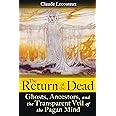
The Return of the Dead: Ghosts, Ancestors, and the Transparent Veil of the Pagan Mind Paperback – Illustrated, July 24, 2009
Purchase options and add-ons
• Demonstrates how Medieval Christianity transformed the more corporeal ghost encountered in pagan cultures with the disembodied form known today
• Explains how the returning dead were once viewed as either troublemakers or guarantors of the social order
The impermeable border the modern world sees existing between the world of the living and the afterlife was not visible to our ancestors. The dead could--and did--cross back and forth at will. The pagan mind had no fear of death, but some of the dead were definitely to be dreaded: those who failed to go peacefully into the afterlife but remained on this side in order to right a wrong that had befallen them personally or to ensure that the law promoted by the ancestors was being respected. But these dead individuals were a far cry from the amorphous ectoplasm that is featured in modern ghost stories. These earlier visitors from beyond the grave--known as revenants--slept, ate, and fought like men, even when, like Klaufi of the Svarfdaela Saga, they carried their heads in their arms.
Revenants were part of the ancestor worship prevalent in the pagan world and still practiced in indigenous cultures such as the Fang and Kota of equatorial Africa, among others. The Church, eager to supplant this familial faith with its own, engineered the transformation of the corporeal revenant into the disembodied ghost of modern times, which could then be easily discounted as a figment of the imagination or the work of the devil. The sanctified grounds of the church cemetery replaced the burial mounds on the family farm, where the ancestors remained as an integral part of the living community. This exile to the formal graveyard, ironically enough, has contributed to the great loss of the sacred that characterizes the modern world.
- Print length288 pages
- LanguageEnglish
- PublisherInner Traditions
- Publication dateJuly 24, 2009
- Dimensions6 x 0.7 x 9 inches
- ISBN-101594773181
- ISBN-13978-1594773181
Frequently bought together

Similar items that may deliver to you quickly
Travels to the Otherworld and Other Fantastic Realms: Medieval Journeys into the BeyondHardcoverFREE Shipping on orders over $35 shipped by AmazonGet it as soon as Tuesday, Mar 31Only 6 left in stock - order soon.
At the Borders of the Wondrous and Magical: Nature Spirits, Shapeshifters, and the Undead in the Never-Ending Middle AgesHardcoverFREE Shipping on orders over $35 shipped by AmazonGet it as soon as Tuesday, Mar 31Only 7 left in stock (more on the way).
The Pagan Book of the Dead: Ancestral Visions of the Afterlife and Other WorldsPaperbackFREE Shipping on orders over $35 shipped by AmazonGet it as soon as Tuesday, Mar 31Only 7 left in stock (more on the way).
Demons and Spirits of the Land: Ancestral Lore and PracticesPaperbackFREE Shipping on orders over $35 shipped by AmazonGet it as soon as Tuesday, Mar 31Only 7 left in stock (more on the way).
The Book of Grimoires: The Secret Grammar of MagicPaperbackFREE Shipping on orders over $35 shipped by AmazonGet it as soon as Tuesday, Mar 31Only 11 left in stock (more on the way).
Phantom Armies of the Night: The Wild Hunt and the Ghostly Processions of the UndeadPaperbackFREE Shipping on orders over $35 shipped by AmazonGet it as soon as Tuesday, Mar 31Only 6 left in stock (more on the way).
Customers also bought or read
- The Tradition of Household Spirits: Ancestral Lore and Practices
Paperback$17.27$17.27Delivery Tue, Mar 31 - The Pagan Book of the Dead: Ancestral Visions of the Afterlife and Other Worlds
Paperback$24.99$24.99Delivery Tue, Mar 31 - Demons and Spirits of the Land: Ancestral Lore and Practices
Paperback$17.35$17.35Delivery Tue, Mar 31 - Phantom Armies of the Night: The Wild Hunt and the Ghostly Processions of the Undead
Paperback$12.76$12.76Delivery Tue, Mar 31 - Cunning-Folk and Familiar Spirits: Shamanistic Visionary Traditions in Early Modern British Witchcraft and Magic
Paperback$49.95$49.95FREE delivery Tue, Mar 31 - Folk Witchcraft: A Guide to Lore, Land, & the Familiar Spirit (The Folk Witch Library)
Paperback$16.10$16.10Delivery Tue, Mar 31 - Consorting with Spirits: Your Guide to Working with Invisible Allies
Paperback$17.62$17.62Delivery Tue, Mar 31 - Song of the Dark Man: Father of Witches, Lord of the Crossroads (Sacred Planet)
Paperback$16.78$16.78Delivery Tue, Mar 31 - Witches, Werewolves, and Fairies: Shapeshifters and Astral Doubles in the Middle Ages
Paperback$16.95$16.95Delivery Tue, Mar 31 - Death and the Afterlife: A Chronological Journey, from Cremation to Quantum Resurrection (Union Square & Co. Chronologies)
Hardcover$17.97$17.97Delivery Tue, Mar 31 - Runelore: The Magic, History, and Hidden Codes of the Runes
Paperback$17.62$17.62Delivery Tue, Mar 31 - Circle for Hekate - Volume I: History & Mythology (Circle for Hekate Project)
Paperback$22.44$22.44Delivery Tue, Mar 31 - The Hidden History of Elves and Dwarfs: Avatars of Invisible Realms
Hardcover$24.00$24.00Delivery Tue, Mar 31 - Tell My Horse: Voodoo and Life in Haiti and Jamaica (Harper Perennial Modern Classics)
Paperback$8.32$8.32Delivery Tue, Mar 31 - The Dictionary of Demons: Expanded & Revised: Names of the Damned
Paperback$24.93$24.93Delivery Tue, Mar 31 - The Old Magic of Christmas: Yuletide Traditions for the Darkest Days of the Year
Paperback$13.49$13.49Delivery Tue, Mar 31 - Restless Dead: Encounters between the Living and the Dead in Ancient Greece
Paperback$34.95$34.95Delivery Tue, Mar 31 - Keeping Her Keys: An Introduction to Hekate's Modern Witchcraft - Second Edition
Paperback$20.41$20.41Delivery Tue, Mar 31 - The Book of Abramelin: A New Translation - Revised and Expanded
Hardcover$30.47$30.47Delivery Tue, Mar 31 - The Pagan Book of Living and Dying: Practical Rituals, Prayers, Blessings, and Meditations on Crossing Over
Paperback$11.66$11.66Delivery Tue, Mar 31 - The Occult Book: A Chronological Journey from Alchemy to Wicca (Union Square & Co. Chronologies)
Hardcover$17.44$17.44Delivery Tue, Mar 31 - At the Borders of the Wondrous and Magical: Nature Spirits, Shapeshifters, and the Undead in the Never-Ending Middle Ages
Hardcover$28.67$28.67Delivery Tue, Mar 31
Editorial Reviews
Review
"[Lecouteux's] conclusions . . . are stimulating and thought provoking. . . . I had no difficulty following his reasoning nor in accepting his conclusions. The book is well written, easily understood by even the average layman, and an invaluable addition to understanding the mindset of our European Pagan ancestors." ― Michael Gleason, reviewer, Aug 2009
" . . . [Lecouteux's] expertise lends to a powerful survey." ― The Midwest Book Review, Oct 2009
" . . . a scholarly survey of pre-Christian beliefs, focusing in particular on legends of revenants in Germanic and Scandinavian folklore. . . . highly recommended to those interested in thanatology." ― Psyche, SpiralNature.com, Oct 2009
"It is clear that many of the original pagan beliefs survive to the present day, as do the Christian beliefs. They tend to overlay each other not only in northern Europe, but also in every culture to which northern Europeans migrated. Many parts of this book will resonate for the reader of European descent. For readers from other backgrounds, it will be fascinating insight into why we have such beliefs in this area. I recommend this work to medieval scholars and students, those who wish to trace belief systems and present-day pagans who want real information on their beliefs." ― Jennifer Hopkins, New Dawn Magazine, No. 119, Mar/Apr 2010
"The Return of the Dead will change your perceptions and show you an ancient body of tradition and belief than can still be found today within some of our modern practices. Even better, this work will show the reader how to approach death from a polytheistic Pagan perspective and reading The Return of the Dead just may change your funeral plans." ― Sarah, Pagan Bookworm, Nov 09
“. . . a must read for any who like dark tales and great research.” ― EarthRites.org, May 2011
From the Back Cover
The impermeable border the modern world sees existing between that of the living and the dead was not visible to our ancestors. The dead could--and did--cross back and forth at will. The pagan mind had no fear of death, but some of the dead were definitely to be dreaded: those who failed to go peacefully into the afterlife and remained on this side in order to right a wrong that had befallen them personally or to ensure that the moral code promoted by their ancestors was being respected. These dead individuals were a far cry from the amorphous ectoplasm that is featured in modern ghost stories. These earlier visitors from beyond the grave--known as revenants--slept, ate, and fought just like the living, even when, like Klaufi of the Svarfdaela Saga, they carried their heads in their arms.
Revenants were part of the ancestor worship prevalent in the pagan world and still practiced in indigenous cultures such as the Fang and Kota of equatorial Africa, among others. The church, eager to supplant this familial faith with its own, engineered the transformation of the corporeal revenant into the disembodied ghost of modern times, which could then be easily discounted as a figment of the imagination or the work of the devil. The sanctified grounds of the church cemetery replaced the burial mounds on the family farm, where the ancestors remained as an integral part of the living community. This exile to the formal graveyard, ironically enough, has contributed to the great loss of the sacred that characterizes the modern world.
CLAUDE LECOUTEUX is a former professor of medieval literature and civilization at the Sorbonne. He is the author of numerous books on medieval and pagan afterlife beliefs, including Witches, Werewolves, and Fairies. He lives in Paris.
About the Author
Excerpt. © Reprinted by permission. All rights reserved.
The False Revenants
After analyzing the texts, it is possible for us to make a distinction between false and true revenants. The issue of true revenants--dead people who return of their own volition for their own reasons--will be examined in chapter 5. The false revenants that are the subject of this chapter, however, are the dead that make an immediate appearance after their decease, as if they continued to live for a span of time, or the dead who seem to have been called back to life under certain circumstances. Here, we will examine these two groups of false revenants: first, the dead who were carried to the grave against their will, then the departed who came back to life in self-defense, because their sepulchre has been violated, or because they have been forced to return through necromancy.
The Recalcitrant Dead
Losing life certainly cannot be pleasant, but being buried in exile, removed from the community of the living, was, it seems, intolerable. This was the true death--exile in a timeless retirement. It is easy to deduce the considerations related to this death from the references that pepper the narrations here and there. Someone named Hrapp asks his wife to make sure that he is buried standing up beneath the kitchen door so that he can watch over the household. Karl Thorsteinsson has himself buried at the edge of a river so that he can watch the coming and going of the ships. Ingolf requests that his body not be placed in the family mound but by the side of the road so that the girls of Lake Valley would remember him. It is therefore not surprising to see such deaths followed by strange phenomena.
Sigrid died during the night; a coffin was made in which to place her body, but things occurred that caused someone to be sent to fetch back her spouse.
Then Thorstein Ericksson sent word to his namesake (Master Thorstein) to come to him, saying there was no peace at home because the farmer’s wife was trying to rise up and get into the bed with him. When Thorstein entered, she had reached the sideboards of the bed. He took hold of her and drove an ax into her breast. Thorstein Eriksson died near sundown.
The text presents two important pieces of data: the dead can be intimidated, and they can return to seek out or designate those who are soon to die. We have another account of this incident, and it is interesting to compare the two narratives. Note that Sigrid is named Grimhild here:
[ . . . ] It was not long until the sickness came to Thorstein’s house, and his wife, Grimhild, was the first to fall ill. She was a very large woman, with the strength of a man, yet she bowed to the illness. Soon after that, Thorstein Eriksson was stricken, and both of them lay ill until Grimhild, wife of Thorstein the Black, died.
After she had died, Thorstein the Black left the room to seek a plank on which to put her body. Gudrid, the servant, then spoke, “Don’t be away long, dear Thorstein,” she said. He promised to do as she asked.
Thorstein Eriksson then spoke, “Strange are the actions of the mistress of the house now; she’s struggling to raise herself up on her elbow, stretching her feet out from the bedboards and feeling for her shoes.” At this, Thorstein the Black returned, and Grimhild collapsed that same instant, with a cracking sound coming from every timber in the room. Thorstein then made a coffin for Grimhild’s body and took it away and secured it. He was a large, strong man, and needed to call upon all his strength before he managed to remove his wife from the farm.
This final touch recurs frequently in the sagas: Sometimes even a pair of oxen can barely manage to pull the cart in which the deceased have been placed. Sometimes the body makes itself so heavy that it has to be buried wherever it seems to want to remain. In the following instance, Arnkel is bringing Thorolf Twist-Foot to his final resting place: “After a yoke of oxen had been hitched to sled, Arnkel laid Thorolf on it, and they began driving it through Thorsardale. It was hard work hauling Thorolf to his burial place.” This resistance does not presage anything good, and the narrator adds: “When they got him there, they built a solid cairn (rammliga) over him,” which clearly shows that everyone feared his return.
The recalcitrant dead are not people that are easy to move and the coffin offers no resistance to their pressure.
One night, Audun went in search of Thorgils. Gyda, his mother, had died in a bizarre fashion, causing the flight of the entire household. It should be said that she had witchlike powers. Audun wished to bury her and was looking for help. Thorgils and he went to the farm, built a coffin, and placed Gyda’s body inside. “Let’s carry the bier,” said Audun. “Put it in the ground and place over it the heaviest objects we can find.” Because two precautions are always better than one, they encircled the bier with iron bands before starting off.
They had barely gotten any distance from the farm when the coffin groaned, the iron bands burst into shards, and Gyda emerged. Audun and Thorgils grabbed her, and to hold her, they were forced to use all their strength, and they were both hearty men. Incapable of carrying her any further, they burned her body.
Product details
- Publisher : Inner Traditions
- Publication date : July 24, 2009
- Edition : Illustrated
- Language : English
- Print length : 288 pages
- ISBN-10 : 1594773181
- ISBN-13 : 978-1594773181
- Item Weight : 1.02 pounds
- Dimensions : 6 x 0.7 x 9 inches
- Best Sellers Rank: #1,099,975 in Books (See Top 100 in Books)
- #915 in Paganism
- #1,593 in Supernaturalism (Books)
- #2,223 in Folklore & Mythology Studies
- Customer Reviews:
About the author

Discover more of the author’s books, see similar authors, read book recommendations and more.
Products related to this item
Customer reviews
Customer Reviews, including Product Star Ratings help customers to learn more about the product and decide whether it is the right product for them.
To calculate the overall star rating and percentage breakdown by star, we don’t use a simple average. Instead, our system considers things like how recent a review is and if the reviewer bought the item on Amazon. It also analyzed reviews to verify trustworthiness.
Learn more how customers reviews work on AmazonTop reviews from the United States
There was a problem filtering reviews. Please reload the page.
- Reviewed in the United States on January 12, 2014Format: PaperbackVerified PurchaseI love this book- the author is a former Sarbonne Medieval Studies professor, and he goes into great deal about the now-forgotten undead problems going on during the Middle Ages. Who knew? We certainly wouldn't if not for this book because you need to understand Latin, Old Norse, Old English, etc and have access to old manuscripts to find this stuff. There is a lot of history and folklore, but the fascinating thing is how far and wide these beliefs have spread. Some of the customs are still in practice although most of us have forgotten why we do them, but you'll find out why in this book. You'll find out exactly how to answer if a monk or priest asks if you want to hold the keys to the cathedral.
This book covers the origins of funerary customs, sacrifices made during new building construction (still going on today, fortunately not human), and lots of tips on keeping the house spirits happy and how to keep the undead off of you if accosted outdoors & out of your house. There is so much of that advice that it makes you wonder what the heck WAS going on back then. Come to think of it, the world could still be full of old-school revenants and you'd never know it if you didn't know them personally. How creepy is that? At any rate, you'll have plenty of material to scare the living daylights out of everyone around the campfire.

- Reviewed in the United States on January 11, 2026Format: PaperbackVerified PurchaseAn exceptional book by a well educated author
- Reviewed in the United States on April 18, 2010Format: PaperbackVerified PurchaseHave you ever wondered why a person condemned to execution wears a blindfold?
Or to what purpose could a debtor exhume and mutilate the body of someone who had failed to pay up before dying?
Or perhaps, why bodies were frequently bound before burial?
The answers will surprise you!
Gruesome topics for reading or discussion to be sure, but Claude Lecouteux's book will have you thinking a lot about the origins behind the rituals and beliefs regarding the deceased that underpins much of Western spirituality and superstition in the last millennia.
What really makes this book accessible in the manner in which it is written. Lecrouteux passes little judgement upon his sources by eschewing opinionated editorialising and specious theorising, instead presenting solid historical sources that explain the relationship between revenants (ghosts) and Europeans from Roman times to the Middle Ages (with some reference to the 20th Century). Whilst much of the book is devoted to Nordic/Scandinavian sources, Lecouteux spends time examining the beliefs and superstitions of many other Western European people. It is not a detailed study, and neither does it claim to be, but rather a easy reading survey of some fascinating beliefs which may, perhaps, frustrate serious historians for its brevity. Nonetheless, for the general reader it has much to offer and for those studying the topic, the book serves as a fine entry point.
Note, this is not a book for those who want to "communicate with the other side" or "contact the deceased" but a survey of the traditions of the past, which like a revenant itself, continue to haunt our present.
- Reviewed in the United States on May 6, 2025Format: PaperbackVerified PurchaseBook came in excellent condition
- Reviewed in the United States on September 24, 2009Format: PaperbackVerified PurchaseThis book is excellent! Lack of formal academic books devoted solely to the dead in Paganism has rendered this work a one-of-a-kind. Sure, there are hundreds of books out there on spirits, the dead, and "crossing over", but all of them are presented from the position of washed-up neo-Spiritualism, usually mixed up with heretical Christianity.
"Ghost hunters", Sylvia Browne fans, and new agers will either be immediately turned off by this book or enlightened; I see no middle ground. Likewise, many neo-Pagans will share the same sentiment, as they discard traditional Pagan beliefs of the afterlife and dead for the quackery of Victorian Spiritualism.
Dr. Lecouteux's ground-breaking work in this field has produced a volume that cannot be excluded from serious Pagan "recommended reading" lists; and one that is sorely needed to purge the nonsense from the Pagan movement once in for all. The dead must be returned to their original, true forms in the minds of polytheists, no matter how frightening and ego-shattering that may be.
- Reviewed in the United States on August 1, 2020Format: PaperbackVerified PurchaseThis was a great price on a used book in good condition. I like to buy used like this so I can support local businesses right now and this was a dang good deal. I'm completely thrilled with my purchase and the ability to save a little bit of money in the process. 10/10. Highly recommend.
- Reviewed in the United States on October 4, 2019Format: PaperbackVerified PurchaseA relatively obscure author, but all his books so far have been flawless masterpieces.
Top reviews from other countries
crazy cat ladyReviewed in the United Kingdom on July 13, 20165.0 out of 5 stars Really enjoyed this book
Format: PaperbackVerified PurchaseReally enjoyed this book,some of the words are a bit hard to pronounce. But the history of how in certain countries in the Norse days like Scandinavia ect. How they treated their dead when they die to burial rites ect. And then the dead come back to terrorise the living. From gods like odin to folktales and fables. Very interesting.