-
-
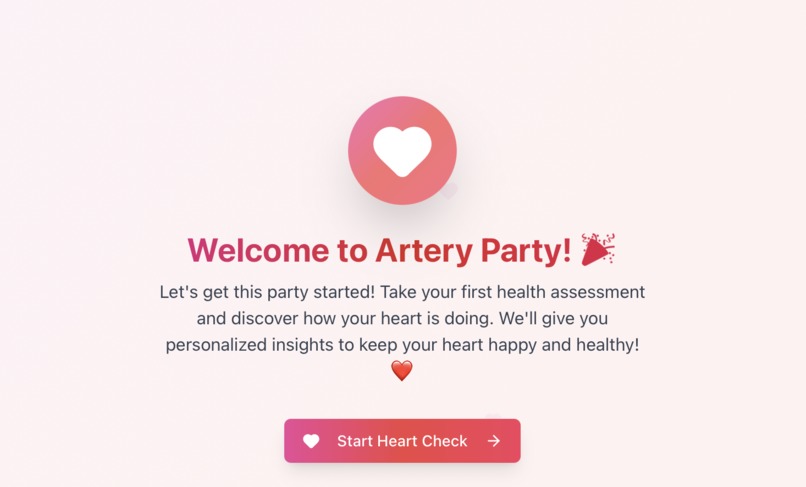
Thumbnail
-
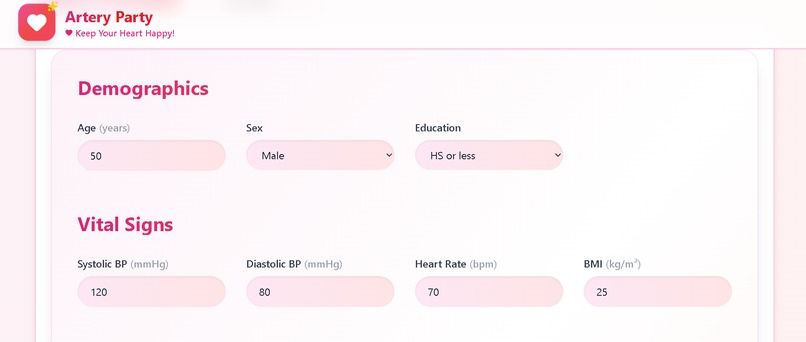
Patient Form
-
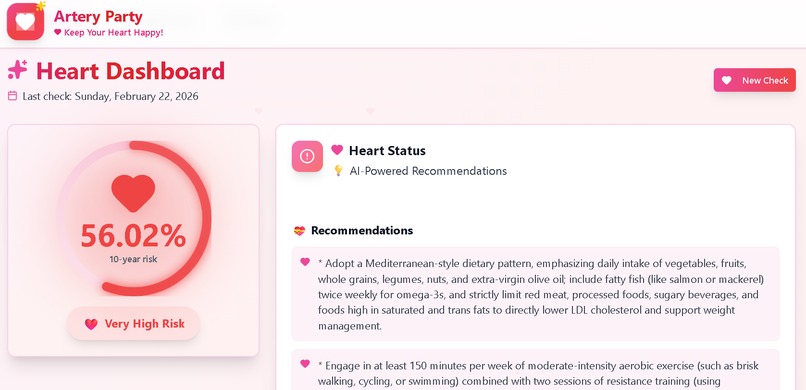
Predictions/Recommendations
-
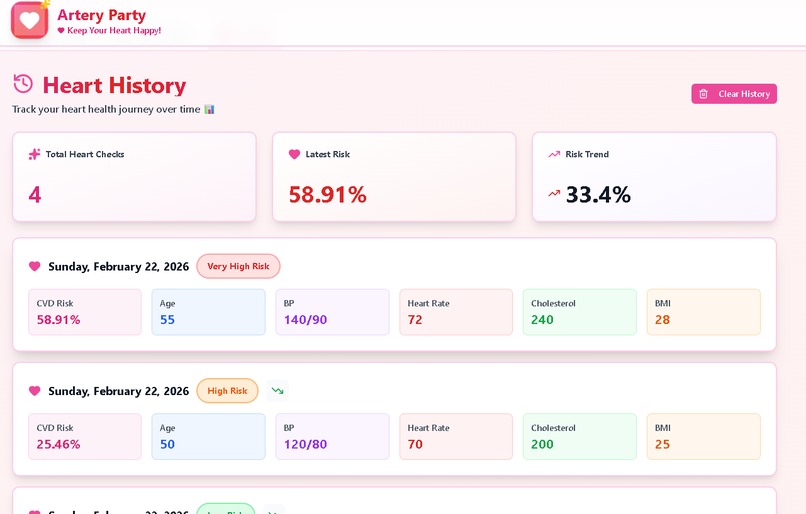
Heart History
-
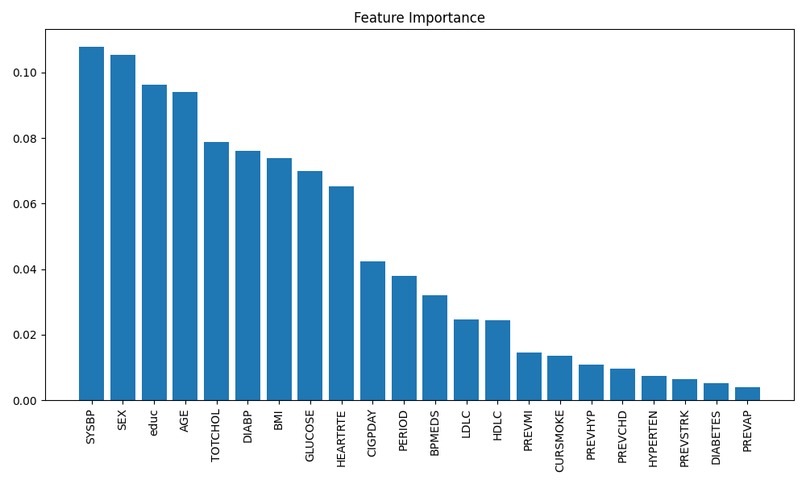
Feature Importance


Inspiration
Started in 1948, the Framingham Heart Study revolutionized modern medicine by pioneering the concept of cardiovascular "risk factors" through the first-ever large-scale prospective look at a living community. By tracking thousands of participants via biennial exams and detailed blood work, the study mapped how biological markers and health behaviors translate into long-term disease. This specific dataset provides a 24-year longitudinal window into the lives of 4,434 individuals, focusing on the progression toward major events like heart attacks, strokes, and mortality.
_ On a side note, last year one of our teammates' uncle passed away from CVD (Cardio Vascular Disease) —his death was our main inspiration to create this project. _
What it does
Artery Party predicts the likelyhood of having CVD in the next ten years via an AI model and conveys it in a user-friendly manner, to people of all demographics.
How we built it
Artery Party is a full stack React frontend; Python backend application. The backend runs a RandomForest ML model with a Flask API server, and a real-time voice assistant pipeline for a seamless, conversational patient experience. The backend is separated into three parts:
Train: The model is trained with RandomForest on the Framingham Heart Study database which is later cached in a joblib file.
Flask Webserver: The cached joblib file is retrieved and read, then exposed to API endpoints for frontend integration — including a dedicated /api/explain route that triggers the voice assistant to speak results aloud to the patient.
Voice Pipeline: A multithreaded speech-to-speech system runs alongside the Flask server, chaining Groq Whisper (STT) → Groq LLaMA 3.3 (LLM) → ElevenLabs (TTS) to let patients ask follow-up questions, extra clarification, or advice regarding their results in natural conversation.
ExpressJs server to connect the LLM to the ML model's predictions so the user can get insightful recommendations on what to change with his/her habits.
The Frontend was made with React.tsx and TailwindCSS for a seemless UI/UX design.
Challenges we ran into
- Integrating a real-time speech-to-speech pipeline with a multithreaded Flask backend without blocking the web server or dropping audio
- Training the RandomForest model to achieve 86% accuracy on the Framingham dataset without overfitting or hallucinated risk scores
- React + Tailwind configuration and CORS setup for seamless communication with the Python backend Managing cross-platform audio dependencies across macOS and Windows for the voice pipeline
What we learned
We learnt how to create and use stt models via eleven labs and Groq. While also practicing our development skills.
What's next for Artery Party
Global hardware implementation, more accurate predictions, Multivariate time model --train a model for each indivisual user.


Log in or sign up for Devpost to join the conversation.