Archive for water quality

Swimming in a cesspool? State looks at making counties phase out pumping sewage in ocean

Today, a state senate environmental committee is set to look at legislation that would phase out pumping sewage into the Atlantic Ocean.

Palm Beach, Broward and Miami-Dade counties are the only three counties that pump treated waste into the ocean, according to news from the Miami Herald, to the tune of 300 million gallons a day. The counties are supposedly balking at the idea of it, saying it will be costly and that there’s no proof the treated waste is harming coral reefs (although scientists have been studying that).

I don’t claim to know the answers about where the sewage should go, but there has to be a better place for it than the ocean. Even if you don’t do it for the coral reefs, or for the sea life, consider the economic impact. Florida’s main industry is tourism, no small part of that thanks to the beaches. If beaches have to turn people away because the bacteria levels are too high, that sends a bad message to tourists. It also tells residents we don’t care about cleaning up our own messes.

I, for one, don’t care to swim in a cesspool.

Leave a comment »

Adopt a lake

Lake County has started an Adopt-a-lake program, the Orlando Sentinel says. People can sign up to adopt a lake, taking water samples, cleaning up litter and the like. Volunteers are trained.

I think this is brilliant! More counties should invite citizens to adopt bodies of water.

Comments (1) »

Removing people for speaking up just arouses suspicions

Environmentalist circles are buzzing about the removal of an EPA scientist from the Everglades restoration effort after he reportedly spoke against U.S. Army Corps of Engineers plans to flush dirty water from Lake Okeechobee into Biscayne National Park, according to the St. Petersburg Times. Times writer Craig Pittman uncovered the details and also pointed out in the article that other scientists working on Everglades restoration have been removed from the project for offering alternative viewpoints or pointing out concerns.

State officials say they didn’t remove the scientist from the restoration project, according to the article.

It’s too bad when any group or organization is closed to differing viewpoints, and especially for something as important as Everglades restoration. Firing scientists and removing them from projects just for pointing out problems doesn’t solve anything — it just makes the public suspicious.

I suspect we’ll hear more about this in the future.

Leave a comment »

Kissimmee River restoration includes studying fish for pollution

Kissimmee RiverWe pay a lot of attention to the Everglades restoration and perhaps not enough attention to other important restoration projects in Florida, like the Indian River Lagoon and the Kissimmee River. This Orlando Sentinel article reminds us the Kissimmee River restoration is ongoing, and points out that studying the river’s inhabitants is a good way to assess pollution in the river. The restoration project will cost more than a half-billion dollars and take until at least 2012, the article says.
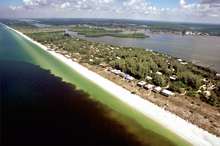
Image from Florida Department of Environmental Protection

Leave a comment »

New idea on cause of red tide

ImageThe cause of red tide is under debate again (is it caused or aggravated by pollution runoff, or does it occur naturally?), and this time the culprit is from far away — the Mississippi River, of all things, according to the Orlando Sentinel. Seems nitrogen (runoff) from the mighty river gets blown right across the Gulf of Mexico to southwestern Florida, a NOAA report suggests. The article points out that the Mississippi carried 800,000 metric tons of nitrogen into the gulf last year. (No wonder there’s a “dead zone” at the river’s mouth.)

This is an interesting idea, but it doesn’t explain the red tides on Florida’s eastern shore.

Image from NOAA

Comments (1) »

More water storage is needed to protect estuaries

Storing polluted water that flows out of Lake Okeechobee is one way to improve the quality of the water that flows into coastal estuaries, and that is part of the Comprehensive Everglades Restoration Plan. But even more water storage than what the plan has prepared for is actually needed, according to an environmental conference, Naples Daily News reports.

In the article, the Everglades Foundation said it would like to see the sheet water flow south from the lake as it originally did, but that time and funding are running out so it might not happen.

Leave a comment »

Everglades is still polluted, EPA report says

It’s ironic that while the state of Florida has named this Pollution Prevention Week, the EPA came out with a report today that says the Everglades are still polluted with too much phosphorus and mercury, according to the Miami Herald (and other news sources). The EPA study says it sees some progress, but that farms, development and Lake Okeechobee are still sending too much phosphorus into the ‘Glades. And mercury levels in fish still aren’t where they should be.

Guess it’s a good thing the state recently put a limit on fertilizer components.

Leave a comment »

Lake O back pumping on again

 After saying no to back pumping polluted water from farms into Lake Okeechobee a month ago, the South Florida Water Management District recently said it would go ahead and allow the water back into the lake to raise the low level of water in the lake, the Sun-Sentinel reports. Lake O is four feet below its normal level.

What I don’t understand is the water cycle here. The article says the reason water managers changed their minds is that farmers near the lake asked for lake water for irrigation. So if the water is coming from the farms, then going into the lake, and then going back to the farms for irrigation …? Do you see where this is going? Or maybe I’m missing something.

Comments (1) »

Muck raking (and sonar, and core sampling)

Old Tampa Bay/Safety Harbor in the Clearwater area is full of muck, and that muck has a chemical fingerprint, a St. Petersburg Times article says. The Southwest Florida Water Management District will be doing an environmental study of the goo starting next month to determine if the source of the relatively recent muck is from nature or man-made causes, like using too much fertilizer. The results of the extensive testing won’t be ready until next year.

Leave a comment »

Manatee protection missteps, red tide and water quality

I didn’t want to do this, o half of a reader out there. But I have a sick baby who’s not sleeping. And I want to post some interesting environment links but don’t have a lot of time. It was either this, or don’t post at all….

The Florida Fish and Wildlife Conservation Commission is thinking about cutting 90 law enforcement positions — including those that patrol manatee speed zones — the same time it’s planning to take manatees off the state’s endangered list. FWC staffers as well as the U.S. Fish and Wildlife Service and other organizations think it’s a bad idea. (BTW, it’s not just about manatee protection. If you get lost out on your boat, it’s bad news for you too.)

Not only that, but budget cuts could affect funding for manatee rehabilitation when the sea cows are found injured.

Weeki Wachee Springs is considered the deepest in the United States at 403 feet. Florida’s springs rock!

Researchers at MIT have been able to recreate red tide in the lab, which could lead to an answer for what causes red tide.

The Florida Department of Environmental Protection has ruled that lawn fertilizer sold to the public needs to have less nitrogen and phosphorus in the mix in order to improve water quality.

There’s much more I could say on these topics — I hope, another time.

Comments (3) »

Design a site like this with WordPress.com
Get started