
Likin’ the Lichen

Lichens are made up of two types of life forms: a symbiotic organism (fungus) plus a photosynthetic partner (green alga or cyanobacterium). The fungus part gets its nutrients from the air and rain, the photosynthetic one makes its own food with the sun’s help. Lichens have been used in making dyes and perfumes, as well as traditional medicines.
In the presence of environmental toxins, lichens perish, but when the air is clean, they thrive. So, their prevalence in the area was very good news. I took deep breaths and snapped my photos.
Knight Bird

Awash in Light’s poetry
the pelican transforms
into wood and butter,
a feathered knight.
But when fickle Light
rescinds Her majesty,
you are treading water
and fish-hungry again.

Mandala Musings

Stare at something long enough and you might start to see things that are not technically there. This phenomenon can be explained in several ways. One, is that our eyes are not perfect. Another, is that man lies (to others and to himself).
Here’s a third theory: what you see is inside of you.
The mandala has been used by various traditions as a conduit to enlightenment. Focus upon it, and let the magic begin. The basic form of most mandalas is a square with a circle inside of it.
The one pictured here is composed of five photographs. Can you identify the different layers? If you look at it long enough and have sufficient spiritual training, does your meditation of this mandala help you reach new, deeper levels of enlightenment?
“I don’t know, it looks like an ugly picture to me,” says the nonbeliever.
“You’re in it too,” I reply, which sends him into a tailspin.
The Exalted Pelican

Winner of Honorable Mention Award at the Fourth Annual Show of Shows Exhibition, Von Liebig Art Center, September 2011
Hell Bent

This piece was accepted at the 49th Founders Juried Awards Exhibition in the Von Liebig Art Center, judged by Diane Camber, director emeritus of The Bass Museum of Art with a long-standing involvement at Miami Art Basel.

Juice Break
One day, she will be the president or a neurosurgeon. Until then, a juice break.

Light Riff
At the carnival, I made believe my camera was a painter’s brush…or the conductor’s baton.
For the Zen Assassin

The Opportunist
If you see this fellow, hang on to your catch! 
Mother Nature’s “little black dress”
. . . and she’s not coming home alone tonight. 

This giraffe is human.


There has been a long-standing debate as to whether or not we should attribute human characteristics to animals. It’s called anthropomorphism. Many scientists, such as Pavlov, saw it as a lack of objectivity. Others, like Dian Fossey and Jane Goodall, attributed all sorts of emotions to their subjects. Of course, they were studying gorillas and chimpanzees, the closest living relatives to humans. Frans de Waal wrote, “To endow animals with human emotions has long been a scientific taboo. But if we do not, we risk missing something fundamental, about both animals and us.”
From an artistic viewpoint, I find it very helpful to attribute human emotions to my animal portraits. I’m in good company. Aesop did it in his fables. As did Lewis Carroll, Rudyard Kipling, C.S. Lewis, George Orwell, J.R.R. Tolkien, and the Walt Disney Company.
As for the giraffe, which human emotion do you see in this portrait?


I know exactly how Andy Warhol felt.

While eating a mediocre hamburger at a diner, this ubiquitous container of ketchup caught my attention. It seemed so dignified, there beside the bowl of creamers and grape jelly. Like a car accident (or a nude Brad Pitt on fire) I could not look away. Luckily, I had my camera. This, my friends, is art!


South Beach Neon
Give me a drink. Surround me in neon. Abracadabra, I’m beautiful. 
Blurry Ain’t Blah
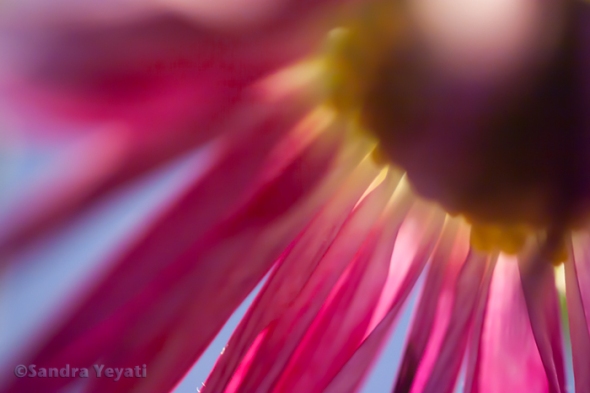
Maybe it has something to do with my love for Monet, but I like blurry photos. Blue Night
 Cajun Kiss
 Orange Slush


 Enso Monkey
