Welcome to the International Cartographic Association
Welcome to the website of the International Cartographic AssociationGet to know the new ICA Executive Committee for the term 2023-2027Get to know the ICA Commissions for the term 2023-2027
Welcome to the website of the International Cartographic Association
Get to know the new ICA Executive Committee for the term 2023-2027
Get to know the ICA Commissions for the term 2023-2027

Announcing the Atlas of Sustainability, a free and open source publication of the International Cartographic Association

We are pleased to announce the official release of the Atlas of Sustainability, a publication of the International Cartographic Association. The Atlas is a direct follow-up to successful ICA collaborations with the United Nations on the 2030 Agenda on Sustainable Development and related Sustainable Developments Goals (SDGs). Collaborations include the 2020 ICA free and open source textbook Mapping for a Sustainable World jointly published by the ICA and United Nations to support the design and use of “SDG maps” as well as follow-up ICA-sponsored mapping workshops in Harare, Zimbabwe, and Nanjing+Suzhuo, China.

Cover of the Atlas of Sustainability

The Atlas of Sustainability cover.

The Atlas of Sustainability is the practical application of the Mapping for a Sustainable World textbook, extending the SDG mapping based solely on the United Nations SDG Indicators Database in the textbook. The Atlas is a compendium of 17 map spreads, each covering a different United Nations Sustainable Development Goal from a local or regional perspective. Each spread is accompanied with an artistic statement about the design thinking behind the map, providing a compelling story about the key challenges driving the maps’ purpose and the cartographers’ creative pathways to identifying spatial arguments for intervening with actionable solutions.

Map connected to SDG 5: Gender Inequality in Mobile Phones by Ximing Wang, Yvonne Darko

Map spread connected to SDG 5: Gender Inequality in Mobile Phones by Ximing Wang, Yvonne Darko

Map connected to SDG 10: Where is Life Better? Well-being Indicators in Europe by Kristina Dujakovic & Miguel A Martinez Solano

Map spread connected to SDG 10: Where is Life Better? Well-being Indicators in Europe by Kristina Dujakovic & Miguel A Martinez Solano

Map connected to SDG 12: A Closer Look at Plastic Waste in South East Asia by Paula Martín Castillo & Camille Rahier

Map spread connected to SDG 12: A Closer Look at Plastic Waste in South East Asia by Paula Martín Castillo & Camille Rahier

Map connected to SDG 17: Data Delivered? Reporting SDG Tier 1 Indicators in 2020 by Anna Auermüllerová, Gabriela Godišková, & Dajana Snopková

Map spread connected to SDG 17: Data Delivered? Reporting SDG Tier 1 Indicators in 2020 by Anna Auermüllerová, Gabriela Godišková, & Dajana Snopková

Notably, the Atlas of Sustainability was made in just one week! The Atlas was the result of the 2025 Design Challenge, an intense mapping workshop running consecutively in the University of Wisconsin Cartography Lab since 2015 that brings together student cartographers, domain experts, and local stakeholders around a curated mapping theme. Held 12-16 May 2025 at the Technische Universität Wien, the 2025 event took the Design Challenge to an international stage and included organizing partnerships with the ICA Commissions on Sustainable Development and User Experience, the United Nations, the Erasmus Mundus MSc Cartography Programme, Masaryk University, the University of Salzburg, TU Wien, and the UW Cart Lab.

A total of 38 student cartographers from 26 different countries participated in the 2025 Design Challenge. The 2025 Design Challenge process was inspired by the Guerrilla Cartography “Atlas” model, with students forming groups of 2-3 students based on personal and professional interests in specific SDGs to divide efforts in creating the collective Atlas. The 12 joining organizers leaned into the diverse backgrounds and experiences of the international student group, encouraging them to tell a compelling visual story about their team’s common ground around the SDG and the alternatives possible from their different, worldwide perspectives. The Design Challenge schedule and resources, along with the Atlas itself, are archived at https://github.com/uwcartlab/Vienna-DC-2025 under a CC BY license for reuse and extension.

A selection of the participating student cartographers with the printed Atlas of Sustainability.

A selection of the participating student cartographers with the printed Atlas of Sustainability.

The 2025 Design Challenge in Action! (left to right) Merve Keskin, Zdeněk Stachoň, and Alicia Cowart leading a group formation activity based on mutual interests around the SDGs.

The 2025 Design Challenge in Action! (left to right) Merve Keskin, Zdeněk Stachoň, and Alicia Cowart leading a group formation activity based on mutual interests around the SDGs. (Photo: Robert Roth)

Accordingly, the Atlas of Sustainability is a case study in actionable cartography, demonstrating that Cartography is not only methodologically and technically capable of visualizing global goals, but also agile and impactful within tight timeframes. As Eric Losang and Vit Voženílek, Co-Chairs of the ICA Commission on Atlases, write in their review of the Atlas:

“The Atlas of Sustainability invites us to see atlas-making not only as a means of compiling knowledge but as a catalyst for learning, action, and social connection. It is a timely reminder that maps matter—and that when made collectively, with care and conviction, they matter even more… Let us embrace atlas-making not only as a means of representing the world, but as a way to shape it together.

ICA President Georg Gartner distributed printed copies of the Atlas of Sustainability at the 2025 United Nations Global Geospatial Information Management meeting in New York City this past August, where it received exceptional interest as a lead of example of academic and government collaboration to address the planet’s most pressing sustainability challenges. The Atlas editors plan on presenting the Design Challenge process and key take-home insights of the Atlas product at the The First Cartography and Sustainable Development Workshop in Aruba to be held in Aruba  26-28 January 2026 (abstract submissions are still open!) as well as at EuroCarto 2026. The ultimate goal of the project is to develop and evaluate a model curriculum for running SDG-related mapping workshops in a variety of international contexts from local to global, with the ICA partnering on future workshop events to maximize the power, potential, and relevance of maps for raising awareness and action about the SDGs.

ICA President Georg Gartner presenting the Atlas of Sustainability at the United Nations Global Geospatial Information Management meeting in New York City.

ICA President Georg Gartner presenting the Atlas of Sustainability at the United Nations Global Geospatial Information Management meeting in New York City.


Signed,
Editors, Atlas of Sustainability

Robert E. Roth
Georg Gartner
Gareth Baldrica-Franklin
Alicia Cowart
Lily Houtman
Ayako Kagawa
Merve Keskin
Menno-Jan Kraak
NT Nawshin
Felix Ortag
Britta Ricker
Sasha Schlumpf
Zdeněk Stachoň

ICA Workshop on Mapping for an Inclusive and Sustainable World

The ICA Commissions on Geovisualization and the Commission on User Experience, the ICA Working Group on Inclusive Cartography, and Nanjing Normal University and Suzhou University of Science and Technology held a workshop on June 7-16 in Jiangsu Province, China, on the topic of Mapping for an Inclusive and Sustainable World.

The workshop was jointly organized by Drs. Mingguang Wu (Nanjing Normal University & Vice Chair of the UX Commission), Taisheng Chen (Suzhou University of Science and Technology), Amy Griffin (RMIT University, Vice President of the ICA), Anthony Robinson (Penn State University, Vice Chair of the Geovisualization Commission), and Robert Roth (University of Wisconsin-Madison, Chair of the UX Commission).

Group shot of workshop organizers with students at Nanjing Normal University

Group shot of workshop organizers with students at Nanjing Normal University

The focus of the workshop was educational and supported student research presentation and writing skill development, building on the tradition of the ICA undertaking international exchanges to support student capacity building in cartographic scholarship. Accordingly, the multi-site workshop in both Nanjing and Suzhou enabled student participation across universities in the region, with approximately 70 undergraduate and graduate students attending across both campuses.

The workshop opened in Suzhou with research presentations from Drs. Taisheng Chen, Zhicheng Zhan, and Lu Cheng as well as a keynote from Dr. Anthony Robinson titled New Cartographic Frontiers in GeoAI. The workshop then proceeded in Nanjing with research presentations from six students with full papers accepted into the program: Wenqing Shao, Erwei Xu, Haiyue Lu, Lujia Li, Qiuxiang Pu, Ziming Cheng, and Qianqian Li. Student papers intersected the conference theme of inclusion and sustainability in interesting, tangible ways, with topics including AI-facilitated accessible design, visual neuroscience, affect and emotion, visual aesthetics, eye health, and green cartography.

Dr. Anthony Robinson delivering the workshop keynote at Suzhou Institute of Science and Technology.

Dr. Anthony Robinson delivering the workshop keynote at Suzhou Institute of Science and Technology.

Ample discussion time was planned between each presentation, both for faculty and student presenters. The open discussion was designed for ICA organizers to provide feedback as well as for non-presenting students to ask questions about the underlying research motivation and design. The pedagogical model allowed for both knowledge sharing from presenters as well as a flexible, two-way dialog about cartographic research different from a traditional lecture-based course. Each workshop day also included research and writing breakout sessions led by ICA organizers to help the attending students brainstorm prospective thesis topics as well as refine existing research framings and questions. Significant progress was also made on multiple collaborative research articles.

Student presentation by Wenqing Shao at Nanjing Normal University.

Student presentation by Wenqing Shao at Nanjing Normal University.

The workshop demonstrated the exceptional quality of student training and cartographic research at Nanjing Normal University and Suzhou University of Science and Technology, as well as the strong potential for international collaboration on student-facing initiatives through the International Cartographic Association. The workshop organizers encourage participation in 2026 ICA events in Asia, including AsiaCarto in 2026 and the Location Based Service conference (to be held at Nanjing Normal University). The concluding session of the workshop generated ideas for potential follow-up ICA workshops on inclusion and sustainability to be held at these future events, so please stay tuned!

ICA organizers gathering with students during a breakout session.

ICA organizers gathering with students during a breakout session.

On behalf of the participating ICA Commissions and Working Groups, thank you to the participating students and organizers, particularly local organizers Drs. Taisheng Chen and Mingguang Wu for hosting a memorable visit.

Prof. Ferdinand Jan “Ferjan” Ormeling Jr. (1942–2025)

ImageIt is with deep sadness that the international cartographic community announces the passing of Prof. Ferjan Ormeling Jr., a pioneering figure in thematic and atlas cartography and a backbone of the development of the International Cartographic Association.

He was born on 20 November 1942 in Utrecht; when he was 6 he moved to Indonesia, a country he always remained interested in. He grew up in the traditions of mapping and geography, following in the footsteps of his father, esteemed cartographer Ferdinand Jan Ormeling Sr.

Ferjan’s academic journey began at the University of Groningen, where he studied geography and worked on the Bosatlas—of which his father was the editor—from a young age. He went on to earn his doctorate in 1983 at Utrecht University under Professors Cornelis Koeman and Dick Blok, focusing on minority language toponyms on topographical maps—a topic he continued to champion throughout his career. Appointed Professor of Cartography at Utrecht University in 1985, Ormeling held that position until his retirement in 2009. His teaching encompassed atlas design, environmental mapping, cartographic theory, historical mapping, editing, and map production. He became a prominent voice in questions of visual communication, often criticizing the use—and absence—of maps in government policy documents, emphasizing their role in informed decision-making.

Prof. Ferjan Ormeling played a pivotal role in the International Cartographic Association (ICA), where his leadership helped shape the global direction of the field. As Secretary-General and Treasurer of the ICA from 1999 to 2007, he worked tirelessly to advance international collaboration in cartographic education, standards, and research. Before his role in the executive committee he was the chair of the Education and Training Commission between 1987-1999.

During his tenure, he strengthened the ICA’s institutional framework and financial stability; advocated for multilingualism and cultural inclusivity in mapping, especially in support of minority place names and indigenous languages; promoted geographic name standardization in cooperation with the United Nations Group of Experts on Geographical Names (UNGEGN) and supported global outreach and the inclusion of developing nations in ICA initiatives, helping to make cartographic knowledge more accessible.

His efforts contributed to the ICA’s growing influence in policymaking, map literacy, and academic excellence. In recognition of his lifetime achievements, the ICA awarded him its highest honor—the Carl Mannerfelt Gold Medal—in 2009.

Even after his formal role ended, Ormeling remained closely involved with the ICA’s mission, mentoring young cartographers and supporting thematic and educational mapping across continents. His ICA legacy endures in the organization’s structure, vision, and the many cartographers whose careers he helped launch.

His contributions were widely recognized through numerous honors:
Image

A champion of cartographic education, Ormeling co-authored with Menno-Jan Kraak the well-regarded textbook Cartography: Visualization of Spatial Data, now in its fourth edition, which remains a foundational reference for generations of mapmakers. Both during and after his career, he curated an impressive collection of atlases and historical maps. In 2003, his collection—enhanced by books and wall maps—was generously donated to Utrecht University, enriching its map room alongside his father’s legacy.

Prof. Ormeling’s dedication to the discipline inspired countless students and professionals worldwide. His commitment to mapping minority cultures, environmental themes, and the visual integrity of cartography has left a lasting mark.

He will be remembered not only for his scholarly work and leadership but as a mentor and advocate for clear, truthful, and inclusive cartography. He is mourned by his family, colleagues, and a global community of fellow cartographers.

Ferjan Ormeling’s legacy remains alive in his publications, his contributions to cartographic institutions, and the maps that continue to educate and empower. The global cartographic community extends heartfelt condolences to his family and all who were fortunate to have been inspired by his work.

On a personal note, I had the chance to visit him personally at his home near Utrecht in February 2025. Although suffering from illness his passion for cartography and ICA led immediately to inspiring discussions and exchange. Ferjan demonstrated also during this visit what fine character he was and what an excellent scholar.

Image

We will miss him.

Georg Gartner & Menno-Jan Kraak

Throwback to a successful, interdisciplinary RIMMA2025 conference

The RIMMA conference was held for the first time in Switzerland, at the University of Bern, from 27.-31. January 2025. The conference was co-organized by Andreas Zischg (University of Berne, Oeschger Center for Climate Change Research and MobiLab), Christophe Lienert (LAINAT, Federal Government of Switzerland and Co-Chair of the ICA Commission Cartography in Early Warning and Crisis Management), Horst Kremers (RIMMA Community of Experts), and David Bresch (ETH Zurich, Weather and Climate Risks).

Image

The conference focussed on the integrated management of natural hazards and risks, where information and warnings play a crucial role. One focus was on the effectiveness of warnings that are supposed to enhance preparedness and complement forecasts and emergency planning. Real-time data and warnings must be accessible, understandable, and tailored to different user groups. Impact-based warnings require collaboration between meteorological services, warning services, and warning recipients. Another focus was on visualization and communication, which are key to effective forecasting and warning systems. Maps play a pivotal role in this communication. They are digital, interactive, real-time, and easy-to-grasp. They integrate spatiotemporal big data and multimedia and are an important element of digital twins.

The conference addressed open questions about user-centered information management, visualization of uncertainties, and the economic and humanitarian impacts of natural hazards, alongside topics such as system interoperability, process standardization, and early warning distribution channels.

RIMMA2025 brought together a diverse range of disciplines and experts, including meteorological and warning services, disaster and risk managers, emergency responders, and specialists in cartography, visualization, and communication.

The conference attracted about 230 participant from 30 countries who had research, government and private industry backgrounds. The conference invited for various contribution formats, such as workshops, sessions, round-tables, side-events, exercises, panels, oral speeches and posters. Contributions ranged on the one hand from global to local topics, and on the other hand from conceptual frameworks to (hands-on, technological) applications. Vivid discussions were led in a constructive way. Climate change, urbanization, increased interconnectedness, humanitarian, risk and insurance aspects gave the backdrop to discussions on new, more user- and impact-oriented solutions using established methods and novel, advanced technologies like AI and ML.

The ICA, as well as the Swiss Society of Cartography, were actively present at the conference. Two keynotes were held by ICA-representatives (one by ICA President Georg Gartner on “The relevance of cartography in the context of natural hazards and risks” and one by ICA-Commission Co-Chair Shen Jie on “Cartography for Emergency and Disaster Management: Hotspots and Development Trends”). Other keynotes were held by representatives of the Swiss Government, the World Meteorological Organization, and the UN Office for the Coordination of Humanitarian Affairs.

Image

Prof. Shen Jie delivering her keynote lecture

Four ICA-commissions (Commissions Early Warning and Crisis Management, GeoAI, Geovisualization, and Cognitive Issues in Geographic Information Visualization) organized and held workshops, interactive panels and sessions. Representatives of these commissions also delivered oral speeches.

Image

Applied Workshop GeoAI: Disaster Management with Deep Learning

Image

Workshop for tabletop exercise on extreme droughts, together with insurance sector

The keynotes were held in the panel in the morning and late afternoon. Parallel sessions were organized throughout the conference days. On the first day, an ice-breaker event with a rich aperitif was organizied, the second day saw a booked-out conference dinner in the “Alte Tramdepot” in Bern’s historic city.

Image

Organizers of the RIMMA2025 conference

Image

Impressions from the conference dinner at the Alte Tramdepot

RIMMA2025-participants took advantage of a very interdisciplinary event that linked various domains (forecasting, preparedness, warning and response with visualization and communication) that usually still work rather sectorally and not entirely together. This thematic combination and linkage received very positive and encouraging feedback. Bridging various domains and enabling discussions on common (future) grounds was one of the main goals of RIMMA2025 and could be accomplished.

On the last conference day two excursions were offered. One took place at the headquarters of swisstopo (i.a., geodata lab, cartographic production, environmental observation). The other excursion brought interested participants to the “Top of Europe”, a.k.a. the Jungfrau Joch. There, at around 3500 m a.s.l., the University of Bern maintains a high altitude research station (i.e., atmosphere, climate, cosmic radiation).

Image

Some participants at the excursion to the Jungfrau Joch, 31.1.2025

Proceedings of the conference are in the works. A collection of abstracts is published in the Abstracts of the ICA, Volume 9, 2025. Other selected contributions will be published in a dedicated special issue for RIMMA2025 in the International Journal of Cartography.

On behalf of all conference chairs and the LOC, I would like to express my sincerey gratitude to all colleagues, friends, and sponsors. Special thanks goes out to ICA-colleagues and their invaluable contributions for making RIMMA2025 a success. A thank you also goes to the conference program committee (with many ICA-members) for reviewing submissions, and the executive committee of the ICA who – like the Swiss Society of Cartography – kindly granted sponsorship for RIMMA2025.

Additional weblinks

Christophe Lienert
Co-Chair of the ICA Commission Cartography in Early Warning and Crisis Management
President’s Blog: Year-End Greetings from ICA

Dear ICA Colleagues,

As we approach the close of 2024, I would like to extend my warmest greetings to all members, colleagues, and friends of the cartographic community. This year has been a remarkable journey filled with exciting achievements, collaborative efforts, and inspiring innovations in the world of maps and cartography. Let’s take a moment to reflect on the highlights of the year and celebrate our shared accomplishments.

A Year of Collaboration and Growth

The ICA continued to foster international collaboration through various conferences, workshops, and activities. Here are some of the key moments that defined 2024 from my perspective:

  1. Build on the momentum of former conferences highly successful regional cartographic conferences took place this year, including the EuroCarto Conference in Vienna (Austria), the Asia Carto Conference in HongKong (China) and the CaGIS+UCGIS Conference in Columbus (USA). They brought together professionals, researchers, and enthusiasts from around the globe. The conferences showcased cutting-edge research, innovative cartographic solutions, and inspiring presentations. From the dynamic discussions to hands-on workshops, the ICA-led conferences proved to be a hub of knowledge and creativity. And it is worth to mention, that ICA endorsed further successful cartographic conferences in Latin America, Africa and Europe.
  2. The record-number of ICA Commissions and Working Groups offer important focus points in a rapidly evolving field and deliver initiatives, publications and meetings, they remain really the power house for advancements in research, education and technologies. New proposals for working groups have been approved by the Executive Committee and joined the ICA family. A warm welcome to the Working Groups on Next Generation Cartographers (Co-Chairs Katarzyna Slomska-Przech, Chelsea Nestel), Cartographic Body of Knowledge (Chair Terje Mitbo), Inclusive Cartography (Co-Chairs Vincent an Altena, Jakub Wabinski), Standardisation in Cartography (Chair Barend Köbben) and Participatory Mapping (Jiri Panek).
  3. Celebrating the Cartographic Community: The heart of the ICA is its vibrant community of cartographers, geographers, and mapping enthusiasts. This year, we were thrilled to welcome new members and strengthen ties with existing ones. The exchange of ideas, resources, and expertise has enriched our collective knowledge and deepened our commitment to advancing the art and science of cartography. The family of ICA was (or is an ongoing process) joined by the following new national members: Kyrgyzstan, Cameroon and the following new affiliate members: National Agency of Public Registry Georgia, Georgian Cartographic Association, ARSC China, Qingdao Surveying and Mapping Institute China, ASECNA Senegal.
    A warm welcome to all our new members! And it seems, as if the eventual highest number of members ICA ever hosted will likely increase further in 2025, demonstrating the relevance and contemporary nature of cartography and ICA.
  4. ICA is taking a special focus on supporting our talents, young scholars and map enthusiasts. I am most pleased to announce another record, a total of 55 scholarship awards have been given 2024 for young scholars to attend an ICA event (such as a regional cartographic conference or a commission meeting). Given the fact, that the spirit, enthusiasm, contributions and motivation of those young awardees has enriched the ICA events significantly already, we feel highly confirmed to continue with this endeavour.
  5. ICA is a Non-Governmental Organisation run fully by volunteers. It is those Commission Chairs, Working Group Chairs, Executive Committee members and persons which devote time, effort, energy for the sake of it, which makes ICA such a unique organization which I am so proud of being privileged to be able to be a part of. The spirit is becoming specifically visible, when we have a chance to meet, like e.g at the ICA retreat in Vienna early 2024.
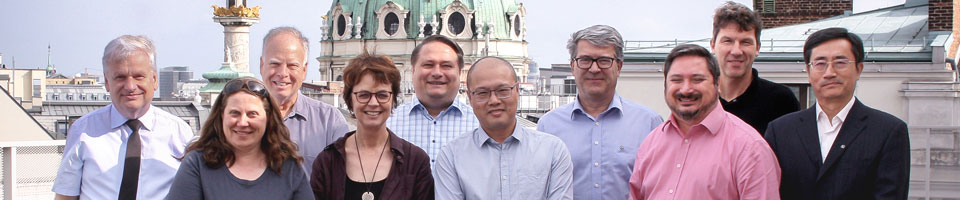
The ICA “people” in front of the Karlskirche during the ICA retreat, Vienna 2024

The ICA “people” in front of Karlskirche during the ICA retreat, Vienna 2024

Looking ahead to 2025

As we bid farewell to 2024, we look forward to the opportunities that lie ahead. Plans are already underway for new publications, including in the International Journal of Cartography, for initiatives to further support innovation in cartography, eventually by collaborating with strong partners such as the Geo Unions, the UN, the ISC and other organisations. We have plans for a further professionalisation of our organisation, as the role ICA can play needs a stable fundament. We want to further build on strong fundaments of our discipline. And, the next ICC, set to take place in Vancouver in August 2025, promises to be another milestone event, and we can’t wait to see you there!

Wishing you joy and inspiration

In this season of celebration and reflection, the ICA extends its heartfelt thanks to each of you for your dedication, creativity, and passion. Whether you’re designing maps, conducting research, or simply sharing your love for cartography, you are contributing to the main role maps play in our world. #MapsMatters #WeloveMaps.

Let me close in wishing all of you, that your end-of-year festivities be filled with joy, and may the new year bring inspiration and success to all your mapping endeavors.

From all of us at the International Cartographic Association, Happy Holidays and best wishes for a prosperous 2025!

– Georg Gartner
President of the International Cartographic Association

Invitation to the Barbara Petchenik Competition 2025

Dear friends and colleagues,

It’s a great pleasure and honor to announce the Official Call for the Barbara Petchenik Children’s Map Competition 2025.

Image

This year we have a new theme of the competition: Maps in everyday life (as selected by our colleagues from 11 countries).

All documents related to the organization of the next competition can be found here:

This year the most significant change for the member states and/or affiliate members planning to participate in the competition is that we have a new international coordinator starting from 2025: Our colleague Monika Kopecká from the Institute of Geography at the Slovak Academy of Sciences in Bratislava. We would like to reiterate our deepest thanks to Monika for accepting this key task in the running of the competition. Peter van der Krogt (The Netherlands), who has been the international coordinator since 2000, retired in 2022, but nevertheless continued to coordinate the competition in 2023. By means of this letter we would like to thank him again on behalf of the ICA for his very valuable contribution together with his brother René to the success of the competition in the last 24 years.

As became usual in the last years, national coordinators will be invited to participate in an e-mail-based voting process to select the winner works, which is planned for June 2025. By this reason it is very important to send names and e-mails of national coordinators by e-mail for the Chair and Vice-Chair of ICA Commission on Cartography and Children, otherwise we cannot ensure our direct contact for the invitation.

For more detailed information about the competition, please visit the Petchenik section on the ICA website, the website of the Commission on Cartography and Children or their Facebook page.

Feel you free to forward the call to other colleagues and anyone else potentially interested in participating in the competition. If you have any question, please do not hesitate to contact us.

Best regards

Silvia Marinova
Chair, ICA Commission on Cartography and Children

Jose Jesus Reyes Nunez
Vice-Chair, ICA Commission on Cartography and Children

Invitation to the 19th International Conference on Location Based Services (LBS 2025)

Finnish Geospatial Research Institute (National Land Survey of Finland) and Aalto University are pleased to invite you to the 19th International Conference on Location Based Services (LBS2025), which will take place in Otaniemi, Espoo, Finland on 7-9 May 2025. The conference is a joint effort of the ICA Commission on Location Based Services, the Commission on Digital Transformation of National Mapping Agencies, and the Commission on Cognitive Issues in Geographic Information Visualization.

Image

Built on the success of previous conferences in this series, LBS 2025 is addressed to scholars and researchers, digital industry / market operators, and students of different backgrounds (scientific, engineering and humanistic) whose work is either focused on or relevant to location-based services (LBS). The conference will offer a common ground to colleagues from various disciplines and practices where they can meet, interact and exchange knowledge, experience, plans and ideas on how LBS can and could be improved and on how it will influence both science and society.

Call for Papers

The Call for Papers is currently open. We call for full papers, work in progress, and showcases.

Important Dates

  • Deadline for full papers: 1.11.2024
  • Deadline for work in progress/abstracts: 1.2.2025
  • Deadline for showcases: 15.2.2024
  • Registration:
    • Early bird: 31.3.2025
    • Regular: 1.4.2025
  • LBS 2025 Conference, Otaniemi, Espoo: 7.–9.5.2025

Topics

We invite contributions in the following areas (but not limited to):

Geospatial Artificial intelligence (GeoAI) and LBS

  • Geography/GIScience-guided AI
  • Explainable GeoAI
  • GeoAI-enabled LBS

Context modelling and context-awareness

  • Smart environments and ambient spatial intelligence
  • Indoor spatial data modelling and mapping
  • Place modelling and understanding
  • Context modelling, personalisation, and context-aware adaptation

Mobile user interface and interaction

  • Visualisation techniques for LBS
  • Mobile human-computer interaction
  • Augmented reality and mixed reality

User studies and evaluation

  • Evaluation methodologies for LBS
  • User experiences of LBS
  • Mobile spatial cognition
  • Landmarks in LBS
  • Human wayfinding and navigation

Analysis, acquisition, management of location big data

  • Crowdsourcing and internet of things
  • Spatial data science and big data analytics
  • Computational mobility and activity analytics
  • Descriptive, diagnostic, predictive, and prescriptive analytics
  • Ubiquitous Positioning

Outdoor and indoor positioning

  • Multi-sensor system and sensor fusion
  • Social and behavioural implications of LBS

Location privacy

  • Legal, ethical, and business aspects of LBS
  • Biases in location data analytics and GeoAI
  • Innovative LBS and applications

LBS and security

  • Disruptive technologies and LBS
  • Intelligent navigation systems
  • Smart cities and sustainable mobility
  • Autonomous and connected vehicles
  • Public health
  • Location based social networks and games
  • Digital humanities

Image

More information regarding LBS 2025 can be found at lbsconference.org.

President’s Blog: A gathering of the ICA people – the ICA Retreat in Vienna

Many persons are involved in our organization. They have different roles, different background and different ideas. In order to learn to know each other better, to synchronize our understanding of “our” ICA and to allow for taking on board all those rich ideas, perspectives and thoughts all Executive Committee Members, Commission Chairs and Co-Chairs, Working Group Chairs and further ICA officers met at the Technische Universität Wien in Vienna, Austria from 22.3.2024 to 24.3.2024 for an intense working meeting.

The agenda included several information presentations on issues of mutual concern, several group-works and workshops and simply time to meet, discuss and be part of ICA.

In the unique venue of the “Kuppelsaal” of the Technical University of Vienna we found enough space and inspiration to gather and work together.

At the ICA retreat at TU Wien Kuppelsaal, Vienna, Austria 2024

At the ICA retreat at TU Wien Kuppelsaal, Vienna, Austria 2024

The meeting started with an introduction from President Georg Gartner on the nature, aims and scope and mission of the International Cartographic Association. It is really the global voice for Cartography and GIScience and the motto “We love maps” is a common nominator for all of us.

Image

In order to learn to know each other better we performed a group work, where we paired in two to be able to introduce always the other person accordingly.

We then collected ideas about the questions:

  • What would you like to give to the ICA community?
  • What would you like to get from ICA?

which resulted in a long and rich list of relevant items.

Dusan Petrovic, Pyry Kettunen and Francis Harvey working hard and having fun at the retreat at TU Wien Kuppelsaal, Vienna, Austria 2024

Dusan Petrovic, Pyry Kettunen and Francis Harvey working hard and having fun at the retreat at TU Wien Kuppelsaal, Vienna, Austria 2024

Having set the tone for the meeting with this we then dived into several existing structures, instruments and elements of ICA, such as the ICA Webservices (presented by Webmaster Manuela Schmidt), the International Journal of Cartography (presented online from the Editors Anne Ruas and William Cartwright), the ICA Publication Regime (presented online from Publication Committee Chair Menno-Jan Kraak), the ICA Executive Committee (presented by President Georg Gartner and Secretary-General Thomas Schulz), the ICA Commissions and their Administration (presented by Secretary-General Thomas Schulz), the ICA Conferences (presented by Vice-President Serena Coetzee), the ICA memberships, MoUs and relations to other organisations (presented by Past-President Tim Trainor), the ICA Research Agenda (presented by Vice-President Haosheng Huang), the ICA Body of Knowledge (presented by Working Group Chair Terje Mitbo).

Inbetween further group interventions took place, refering to the idea of synchronizing our understanding of the core concept of our organization (What is a map?), identifying and presenting commission and working group plans and synergies (led by Vice-President Dusan Petrovic), a SWOT (Strengths-Weaknesses-Opportunities-Threads) – Analysis of ICA (led by Vice-President Alex Kent), a open mic session on ideas and visions (led by Vice-Presidents Amy Griffin, Jiping Liu and Dariusz Dukaczewski).

The ICA “people” in front of the Karlskirche during the ICA retreat, Vienna 2024

The ICA “people” in front of the Karlskirche during the ICA retreat, Vienna 2024

Socializing opportunities despite the amical, fruitful and constructive working atmosphere have been taken on a joined short “CartoWalk” around Karlsplatz and joined meals.

Participants of the ICA retreat in front of the Technische Universität Wien, Vienna 2024

Participants of the ICA retreat in front of the Technische Universität Wien, Vienna 2024

The event proofs my feeling right again, that ICA is really more like a family – it is such a privilege to be able to cooperate with so many bright, motivated, enthusiastic, fantastic scholars and persons!

List of Participants

Executive Committee

  • President: Georg Gartner
  • Past President: Timothy Trainor
  • Secretary-General and Treasurer: Thomas Schulz
  • Vice President: Serena Coetzee
  • Vice President: Dariusz Dukaczewski
  • Vice President: Amy Griffin
  • Vice President: Dusan Petrovic
  • Vice President: Haosheng Huang
  • Vice President: Alexander Kent
  • Vice President: Jiping Liu

Commission Chairs and Co-Chairs

  • Art and Cartography: Taien Ng-Chan
  • Atlases: Vitek Vozenilek, Eric Losang
  • Cartographic Heritage into the Digital: Matyas Gede
  • Cartography and Children: Silvia Marinova
  • Cartography and Sustainable Development: Britta Ricker
  • Cartography in Early Warning and Crisis Mgmt: Christophe Lienert, Jie Shen
  • Cognitive Issues: Tumasch Reichenbacher, Pyry Kettunen, Petr Kubicek
  • Digital Transformation of Mapping Agencies: Bin Jiang
  • Education and Training: Tao Wang
  • Ethics in Cartography: Aileen Buckley
  • GeoAI: Samantha Arundel
  • Geospatial Analysis and Modelling: Xintao Liu
  • Geospatial Semantics and Ontology: Francis Harvey
  • Geovisualization: Florian Ledermann, Arzu Cöltekin
  • High-Definition Maps: Qingyun Du
  • Integrated Geospatial Information: Anja Hopfstock, Kathryn Arnold
  • Location Based Services: Jukka Krisp
  • Map Design: Ian Muehlenhaus
  • Map Projections: Krisztian Kerkovits
  • Maps and the Internet: Otakar Cerba
  • Marine Cartography: Ron Furness, Lysandros Tsoulos
  • Mountain Cartography: Patrick Kennelly
  • Multi-scale Cartography: Guillaume Touya, Izabela Karsznia
  • Topographic Mapping: David Forrest, Lukas Halik
  • Toponomy: Matjaz Gersic
  • Ubiquitious Mapping: Toru Ishikawa, Angela Schwering, Armand Kapaj
  • User Experiences: Robert Roth

Working Group Chairs and Co-Chairs

  • Next Generation Cartographers: Katarzyna Slomska-Przech, Chelsea Nestel
  • Inclusive Cartography: Jakub Wabinski, Vincent van Altena
  • Body of Knowledge: Terje Mitbo

President’s Blog: A landmark conference in Eastern Europe

ImageThe already 9th International Conference on Cartography and GIS has taken place in Bulgaria this time in Nessebar from 16-21 June 2024. The ICCGIS is a biannual conference that started in 2006 and had attracted attendees from more than 60 countries and has published more than 700 scientific papers in its proceedings.

The event has been organized by the Bulgarian Cartographic Association and the University of Architecture, Civil Engineering and Geodesy of Sofia, namely by Silvia Marinova and Temenoujka Bandrova. ICA is endorsing this conference, as it gives Cartography an international platform and allows to collect knowledge and share experiences about the latest achievements of Cartography and GIS.

Despite more than 100 presentations and  31 poster presentations four ICA Commission held their meetings at Nessebar, the Commission on Cartography and Children chaired by Silvia Marinova, the Commission on Cartography in Early Warning and Crisis Management with co-chairs Shen Jie and Christophe Lienert the Commission on Maps and the Internet chaired by Otakar Čerba and the Commission on Map Projections, chaired by Krisztian Kerkovits.

The organisers managed to have the presidents of ISDE (Alessandro Annoni), ISPRS (Lena Halounova) and ICA (Georg Gartner) being present, identifying the mutual interests of those societies and associations to contribute to global challenges by the means of cartography, GIScience and the wider geospatial industries.

Group picture

Participants of the 9th International Conference on Cartography and GIS, 18.6.2024, Nessebar (Bulgaria)

ISPRS President Lena Haounova and ICA President Georg Gartner

ISPRS President Lena Haounova and ICA President Georg Gartner at the 9th International Conference on Cartography and GIS, 18.6.2024, Nessebar (Bulgaria)

Otakar Cerba, Chair of the ICA Commission on Maps and the Internet, reporting on the commisson work

Otakar Cerba, Chair of the ICA Commission on Maps and the Internet, reporting on the commisson work and plans at the 9th International Conference on Cartography and GIS, 18.6.2024, Nessebar (Bulgaria)

Tag:
rawboned-refined