Firoz Shah Tughlaq: The Sultan Who Focused on Administration and Public Welfare

Firoz Shah Tughlaq was one of the prominent rulers of the Tughlaq dynasty of the Delhi Sultanate. He was born in 1309 CE and was the cousin of Muhammad bin Tughlaq. After the death of Muhammad bin Tughlaq in 1351 CE, Firoz Shah ascended the throne and ruled until 1388 CE.

Image

His accession came at a time when the Delhi Sultanate was facing political instability and economic challenges due to the ambitious but often unsuccessful policies of his predecessor. Unlike Muhammad bin Tughlaq, Firoz Shah adopted a more cautious and pragmatic approach to governance. His rule is often remembered for its emphasis on administrative stability, infrastructure development, and welfare measures.

Administrative Reforms

Firoz Shah Tughlaq introduced several administrative reforms aimed at stabilizing the empire. He reduced harsh taxation policies that had caused distress among farmers and the general population during the previous reign. He also reorganized the revenue system to make tax collection more systematic and less burdensome.

One notable policy of his administration was the revival and proper implementation of Islamic laws in governance. He established several departments to oversee various aspects of administration, including public works, charity, and justice. These departments helped maintain better control over the functioning of the empire and improved bureaucratic efficiency.

However, Firoz Shah also strengthened the power of nobles and hereditary positions in administration. While this brought short-term stability, it later contributed to weakening central authority in the Delhi Sultanate.

Public Works and Infrastructure

Firoz Shah Tughlaq is particularly remembered for his extensive public works. He undertook numerous projects that contributed to the economic and social development of the region. The construction of canals for irrigation was among his most significant achievements. These canals helped improve agriculture by providing a reliable supply of water to farmlands.

He also built several cities, mosques, schools, hospitals, and rest houses. One of the cities founded by him was Firozabad, which became an important urban center during his reign. Another notable construction was the Firoz Shah Kotla, a fortified palace complex that served as his administrative headquarters.

Firoz Shah was also known for preserving ancient monuments. He famously transported and installed two pillars of Ashoka the Great in Delhi, reflecting his interest in architecture and historical preservation.

Social and Religious Policies

Firoz Shah Tughlaq was a devout Muslim and strongly supported Islamic institutions. He established madrasas (Islamic schools) and encouraged religious learning. He also provided financial support to scholars and religious leaders.

However, his religious policies were more orthodox compared to some earlier rulers of the Delhi Sultanate. Certain taxes, such as the jizya tax on non-Muslims, were strictly enforced during his reign. These measures reflected the religious orientation of his administration.

Legacy

The reign of Firoz Shah Tughlaq is often viewed as a period of relative peace and administrative consolidation within the Delhi Sultanate. His focus on welfare measures, public works, and infrastructure development left a lasting impact on the region.

Despite these achievements, the policies that strengthened the power of nobles and hereditary offices weakened the central authority of the state after his death. Nevertheless, Firoz Shah Tughlaq remains an important figure in medieval Indian history for his contributions to governance, architecture, and public welfare.

Mughal Emperor Humayun

Mughal Emperor Humayun, the second ruler of the Mughal dynasty, remains a significant yet often overshadowed figure in Indian history. Born on March 6, 1508, in Kabul, he was the eldest son of Babur, the founder of the Mughal Empire. Humayun’s reign was marked by both setbacks and recoveries, shaping the foundations upon which his son, Akbar the Great, would later build one of the most powerful empires in South Asia.

Image

Humayun ascended the throne in 1530, following the death of Babur. At the age of 22, he inherited an empire that was still in its formative stages, facing multiple internal challenges. Unlike his father, who had established authority through military strength, Humayun lacked decisiveness and consistent political strategies. His early reign was marred by continuous struggles against Afghan nobles, Rajput rulers, and the rise of formidable adversaries like Sher Shah Suri.

One of the defining challenges of Humayun’s rule was his rivalry with Sher Shah Suri, a brilliant military leader and administrator. After a series of defeats, most notably at the Battle of Kannauj in 1540, Humayun lost control of his empire. Forced into exile, he sought refuge in Persia, where he received support from the Safavid ruler, Shah Tahmasp I. This period of exile was crucial, as it exposed Humayun to Persian art, culture, and administration, elements that later influenced the Mughal court.

Despite the setbacks, Humayun demonstrated resilience. After nearly 15 years in exile, he successfully regained control over Delhi and Agra in 1555, defeating the successors of Sher Shah Suri’s short-lived Sur Empire. This restoration of Mughal power, however, proved short-lived. In January 1556, just six months after reclaiming his throne, Humayun tragically died after a fall from the stairs of his library in Delhi.

Although his reign was marked by instability, Humayun’s legacy cannot be overlooked. His exposure to Persian culture during exile left a lasting impression on Mughal art and architecture. The fusion of Persian aesthetics with Indian traditions became a hallmark of Mughal identity, seen in manuscripts, miniature paintings, and architectural designs. Moreover, Humayun’s restoration of the Mughal dynasty ensured continuity, allowing his son, Akbar, to later consolidate and expand the empire into one of the most remarkable dynasties in world history.

A notable symbol of his memory is Humayun’s Tomb in Delhi, commissioned by his widow, Empress Bega Begum, in 1570. This UNESCO World Heritage site is considered the first garden-tomb in the Indian subcontinent and served as an architectural inspiration for later Mughal masterpieces, including the Taj Mahal.

In retrospect, Humayun’s reign reflected the struggles of a young empire finding its footing. While he lacked the military acumen of his father or the administrative genius of his son, his resilience and eventual restoration of the Mughal throne played a vital role in ensuring the dynasty’s survival. Humayun’s story stands as a testament to the challenges of empire-building and the enduring legacy of cultural exchange that defined the Mughal era.

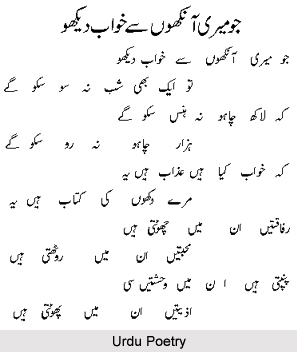
Urdu Poetry

Urdu Poetry

Urdu poetry has a richness in tradition and has many different forms that were basically started from Arabic and borrowing mush from Persian Language. Urdu poetry witnessed its growth and development during the early eras of 13th century, when some bards of the north India initiated in varied experimentation with the style. However the ingrained classic forms of Urdu poetry that contemporary generation are accustomed with did not really take on a final shape until the 17th century, when Urdu became the official language of the court in the Indian subcontinent.

Today a significant part of Indian culture, just like other languages, the history of Urdu poetry also shares origin and its influences with other linguistic traditions within the Urdu-Hindi-Hindustani mix. Urdu poetry gained immense popularity in the 18th century when Urdu replaced Persian as a major language of the region. In the 18th there was a scarcity of newspapers. Urdu poetry’s history is an amazing journey that is replete with intrigue for the curious onlookers. However, the amazing intensity with which it continues to thrive amidst the hurly burly of the cotemporary age bears the testimony of its presence.

Literary personalities, as far back as Amir Khusro (1253-1325) and Kabir (1440-1518) later inspired Urdu poets, and served as linguistic and intellectual sources. Ghalib, Anis, Meer, Dard, Dabeer, Iqbal, Zauq, Firaq, Josh, Jigar, Faiz and Syed Shmad Shah (Ahmad Faraz) are among the greatest poets of Urdu literature. The tradition is mainly concentrated in the subcontinent. In the year 1947, following the Partition of India, it found main scholars and poets residing mainly in present day Pakistan. Mushairas (or poetic expositions) are today held worldwide in metropolitan areas.

Like Elizabethan English which is complete with social and regional realities, Urdu holds a remarkable wealth of the conventions of many cultures and languages. This element got a great boost in the 18th century when there weren’t many newspapers or media of information available to the public. Urdu poetry became a more intimate form of communication regarding the social and political tribulations of the time. The commonest form of communication, in tradition with the Arabic culture, was to read poetry in gatherings, called musha’era, where poets would gather to read poems crafted in accordance with a metrical pattern, which was often prescribed beforehand. Not only did the poetry have to meet the choice of word, and the loftiness of thought but also strict metrical patterns. There were competitions like those held in ancient Greek, Roman and pre-Islamic Arabic cultures. However, the intensity and warmth of the musha’eras that developed in Delhi were indeed unique and helped popularize Urdu as the language of poetry in the Mughal Empire. A culture built around taking lessons in writing Urdu poetry became the in-thing for the royalty, and the masters of poetry were given reverence worthy of kings.

For more, visit the link below:

https://www.indianetzone.com/62/urdu_poetry.htm

Fairs in Eastern India

Fairs in Eastern India

Fairs in Eastern India are the true representation of the spectacular cultural heritage. In the mesmerising natural beauty of eastern India, the great fun and frolic that the fairs generate attracts tourists from different parts of the world to visit them. Myths, legends or events from the past are associated with the origin of each fair. Various activities in the fairs exhibit the rich heritage of the country.

Sonepur Cattle Fair
Being an integral part of the culture of Bihar, this fair remains one of the most prominent fairs since ages. There is a legend behind the organization of this fair. It is believed that there were two brothers, one honest and another shrewd, who were devotees of Lord Vishnu. Once they cast spells on each other and consequently one became a crocodile and one an elephant. When the honest elephant went at the confluence of the sacred rivers Ganga and Gandak on a kartik Purnima day, he was attacked by the shrewd crocodile. There, Lord Vishnu saved the good from the evil. Cattle trade is the main focus of this fair and all types of cattle including birds, bovines, poultry etc are marketed in this fair. The fair attracts tourists from all over the country through their traditional musical dramas, circus, fortune telling parrots and exhibition of beautiful fancy products.

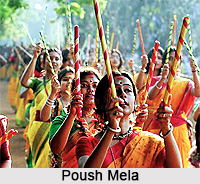
Poush Mela
Poush Mela is an important and well known fair of West Bengal which organized every year in Shantiniketan of Birbhum District. Live performances of Bengali folk music, especially Baul music is the most alluring feature of this three day fair. The basis of Poush mela is the acceptance of Brahmo creed by Debendranath Tagore from Ram Chandra Vidyabagish. On 21st December 1891, a Brahma Mandir was established in Shantiniketan and the fair was organized for the first time to celebrate this establishment. Tribal dances, sports and many other events are organized during this fair that showcases the true cultural heritage of India. The fair creates a glamorous and fun filled ambience attracting a number of tourists.

Fairs in Eastern India

Ambubachi Mela
Ambubachi mela, an annual fair, is organized in the Guwahati district of Assam during the month of Assamese month Ahaar, which falls during the monsoon. The fair is organized in the Kamakhya Temple to celebrate the yearly menstruation course of Goddess Kamakhya. Myth says that Devi Kamkhya, the presiding Goddess of this temple, goes through annual menstruation during this time. It is also believed that the nurturing power of the Goddess reaches to the devotees attending this fair. The fair serves as an important pilgrimage for the people of the entire country. Even the tourists from abroad come to visit this fair to receive the blessings of the Goddess.

Jonbeel Mela
Jonbeel Mela is another grand fair organized in the Marigaon district of Assam. The word Jonbeel comes from the union of two Assamese words jon and beel which refers to moon and wetland respectively. The fair is called so because of a large water body that resembles crescent moon. Jonbeel fair is an ancient fair, the origin of which can be traced to 15th century AD. Ahom Kings were the first to organize this with the purpose of discussing political scenarios. Fair is accompanied by a huge bazaar. The beginning of the fair is marked by fishing by the community people in the wetland of Jonbeel. The fair focuses on spreading brotherhood and harmony among the people of different tribes and communities of this state.

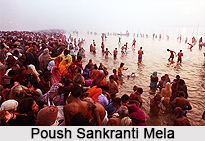
Poush Sankranti Mela
In Tripura, Sankranti Mela is organized every year at Tirthamukh on 14th January. Devotees from different regions belonging to different cultures and tribes visit this fair. The main attraction of this fair is the holy dip in the sacred Gomati River.

For more, visit the link below:

https://www.indianetzone.com/67/fairs_eastern_india.htm