1: Opinions
“Are you saying,” you ask, “that some opinions are better than others?”
I am. Controversial, isn’t it?
The best opinions, theories, viewpoints or conjectures are those which most closely mirror reality. Why? Because they empower us. Because they assist us in navigating a path through the real world.
“What about beliefs? Are they the same?”
Well, opinions are tricky… but beliefs are worse. People kill for their beliefs. Killing for opinions? Less so.
People become enraged when beliefs are challenged. Opinions are usually less ardently held…
The thought-mode of belief has a history of violence. By contrast, opinions have a history of changing with the wind.
“But I feel strongly about my beliefs!” you exclaim. “What’s wrong with that?”
Do you really want me to answer?
Everything’s wrong with that.
2: The middle ground
Don’t be alarmed. It’s not your beliefs I’m questioning. It’s belief in general. Belief as a way of thinking.
Here’s why:
- Believe it or not, beliefs polarise
Belief, in principle, allows for no alternative. My beliefs are 100% right. (If I didn’t think that, I’d consider them opinions, not beliefs.)
Belief has no middle ground. That’s the nature of belief. If I don’t have conviction, if I’m not confident or certain, it’s not belief.
“Ha!” you respond. “But what if I believe in the middle ground?”
Haha. Very funny.
But the principle still applies.
If you believe in the middle ground then you also believe that anyone who isn’t a ‘middle-ground believer’ is 100% wrong. Not in all their beliefs; but definitely in their failure to believe in the middle ground.

- A disconnect from the facts
Here’s another problem for belief: it hates being contradicted by the facts.
It’s no surprise that believers detest abandoning their beliefs. To do so diminishes something they once held dear. To do so makes their prior beliefs – the ones you are asking them to abandon – no more significant or profound than opinions.
Abandon belief when evidence contradicts it and your very identity as a believer is threatened…
Which gives us a problem in our fact-filled world. Belief as a mode of thought is fact-averse.
- Beliefs disempower
The certainty and conviction implicit in belief diminishes adaptability. How cognitively flexible can you be when you’re boxed in by belief? A new pandemic? Global warming? Recession? If your beliefs are disconnected from the evidence how capable will you be in the face of such issues?
We’ve seen how ideological leaders, locked into nativist conservativism or neoliberalism, fail in the face of coronavirus. For the same reasons, these leaders will fail in the next crisis, too.

- Belief damages cognition
The inflexibility of belief puts limits on cognition. Your conclusions have already been reached – so how can you think laterally, imaginatively or in new ways?
More than that, once you’ve adopted the thought-mode of belief, your susceptibility to propaganda and spin are increased. Belief doesn’t need evidence, so it easily becomes a stamping ground for the power-hungry and manipulative.
Divine rulers? Strong leaders? Strange conspiracies?
What is there that believers won’t believe?
- Extremism
The tribalism of belief, the believer/non-believer divide, makes it a perfect host for extremism. Are you with us or are you the enemy? And, if you’re the enemy, then what persecutions, destructiveness, cruelty, terror or aggression are we not entitled to pursue?
- Multiplicity
I’ll court a little more controversy: belief has a problem with monogamy.
It’s promiscuous.
The belief mode of thought will climb into bed with any conceivable concept or invention.
Why not? All that’s required is a leap of faith.
This gives us a very modern problem: an explosion in belief.
We see it on social media, on television, throughout everyday life. Beliefs proliferate like cancer across the social realm. But not one cancer. A multitude of cancers, all competing to grow the fastest, to become the most widespread, to dominate our attitudes and minds.
- Anger
And so we become angry. We’re immersed in a world where our rigid convictions are constantly colliding with the rigid convictions of others. “These are MY beliefs – so f*** you!”
Anger has become a defining characteristic of the internet. Social media has become a crucible of hate.
Log on anytime, anywhere. You’ll see.

3: A better way
So belief – the belief way of thinking – is problematic. Particularly now, in the face of the crises of the 21st Century.
What of it?
Well, I’ve a punchline for you: All of this is unnecessary.
The belief mode of thought is no longer needed.
It’s archaic, anachronistic, redundant.
We’ve got something better.
It’s called understanding.
4: Language
The language of understanding is flexible, adaptable, rooted in the evidence. It looks like this:
“If my understanding is correct then…”
“My current understanding is …”
“To the best of my knowledge…”
“From what I can see…”
“The evidence suggests…”
“As far as I understand…”
The language of understanding is collaborative. We share a common purpose: to more fully understand.
“Help me understand…”
“Is this right?”
“Show me…”
5: Humans among humans
Understanding means to grasp a thing with your mind, to comprehend it, to see it as deeply and clearly as possible. Understanding implies an objective reality which is there to be investigated and researched – and which can always be better understood.
To opt for understanding instead of belief is no second best. Understanding is the powerhouse of the modern world. Our universe is enormous, intricate and yet elegantly structured. We can attempt to understand its enormity, intricacy and structure using our senses of perception, the tools we’ve invented, the power of our minds. We’ve seen the success of this approach a thousand times over, in medicine, technology, science, IT.
Investigate, theorise, test… then utilise.

And there are other advantages to understanding.
It encourages compassion.
We are seeking to understand not just the fabric of reality but also the minds, feelings and needs of the other lives who share this reality with us. We are in this together, humans amongst humans, animals amongst animals.
An ever improving understanding is better for us all.
Understanding is inclusive. Where we differ, it’s the process of understanding that can bring us together. Understanding is non-threatening, non-tribal. If there is something to be understood, then anyone can understand it, given effort and time. It took genius to discover that the Earth was (approximately) a sphere – but it doesn’t take a genius to understand that now.
Understanding is all about reality, about evidence. Understanding empowers us in the face of an increasingly dangerous world. New challenges or threats? Let’s understand them… then we can act on our understanding.
6: The way out
It’s time to abandon belief as a way of thinking, to let understanding take its place.
The thought-mode of belief constrains us like a ball and chain.
The thought-mode of understanding can set us free.
www.ethicalintelligence.org “The ethics of common sense”
Twitter & Facebook: @EthicalRenewal
© Luke Andreski 2020. All rights reserved.
Time to read this:
Short Conversations: During the Plague
“A book which cuts to the heart of populism, climate denial, our profit-driven culture and the integrity of our politicians…”
https://www.amazon.co.uk/Short-Conversations-About-Everything-Matters/dp/B089M5BGGF
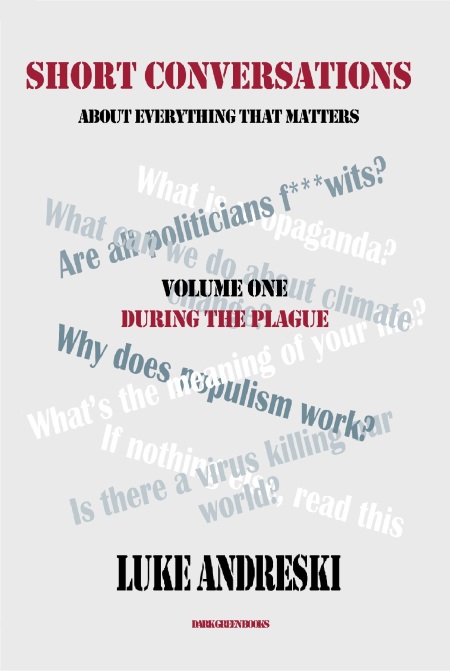
Want to penetrate the tsunami of propaganda and spin?
Try this:
Ethical Intelligence by Luke Andreski
www.amazon.co.uk/Ethical-Intelligence-Luke-Andreski/dp/179580579X
Need a fundamental basis for activism?
Try this:
Intelligent Ethics by Luke Andreski
www.amazon.co.uk/Intelligent-Ethics-Luke-Andreski/dp/1794618732


 Posted by Luke Andreski - Freedom Fairness Kindness
  Luke Andreski
