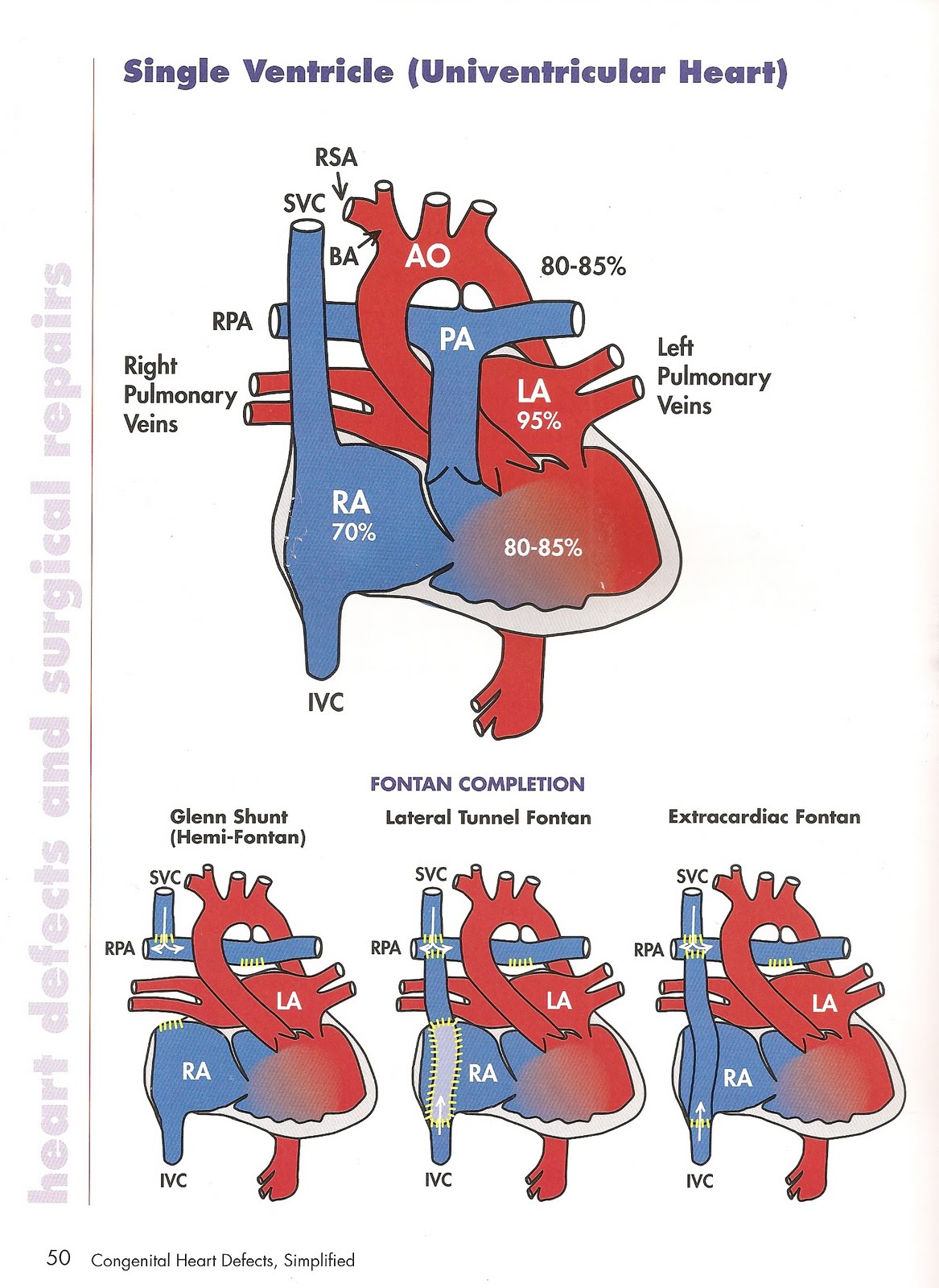
this is not riley's exact procedre, but very similar. She has a very rare heart, and her operation (like most pediatric heart pateints) are custom. i found a picture for double outlet, right ventricle but not
Riley's double inlet, left ventricle.http://heartdefectsforeveryone.blogspot.com/
There are currently about a million adults in the USA alone who have had pediatric heart surgery.
Stage One Blalock-Taussig (BT) shunt: usually performed within the first few days after birth, and establishes a systemic-to-pulmonary artery shunt between the brachiocephalic artery or the right subclavian artery, to the right pulmonary artery via (usually) a tubed homograft or synthetic graft.
Glenn Procedure or Hemi-Fontan: usually performed at 4-6 months after birth as a bridge to Fontan completion. The BT shunt and pulmonary artery band is usually removed. The superior vena cava is then attached to right pulmonary artery, creating a systemic venous-to-pulmonary connection.
Fontan Completion: Usually performed at 2-3 years of age; the inferior vena cava is connected to the right pulmonary artery via a tunnel like patch within the right atrium (Lateral Tunnel Fontan), or by creating a conduit for IVC flow outside the right atrium (Extracardiac Fontan). This essentially separates the pulmonic and systemic flow patterns and allows the body to adapt gradually to the varying flows, and prevents over-circulation and under-circulation to the lungs.
i also found this, same website under pulmonary artresia (included in Riley's diagnosis)
A" Rastelli procedure may be done, which is a procedure that replaces the pulmonary trunk with an aortic or pulmonary homograft. These types of conduits are now the preferred approach, as opposed to a patch repair which results in severe pulmonic regurgitation. This regurgitation will eventually lead to right ventricular dilitation as a result of volume overload and eventual failure, typically within 20 years or so.
Outcomes The majority of patients with this kind of defect require multiple surgical interventions. Pulmonary atresia is associated with a greater mortality rate, as opposed to syndromes with pulmonary stenosis (tetralogy of fallot).
Whether there are staged procedures, or primary surgical interventions does not significantly improve survivability.
After 20 years, survival rates are approximately 60%."