Archive
Sands National Academy: Financing Terrorism, Money Laundering, Academic Fraud, Human Trafficking – Khilda, Jordan
Sands National Academy (SNA) in Khilda, Jordan, is an English-based international school, that claims to offer Jordanian students a pathway toward prestigious university studies abroad. SNA claims to cooperate with Cambridge Assessment International Education (CAIE) for its British curriculum, which is attached to Cambridge University in the United Kingdom. CAIE claims on its website, to “work with governments” worldwide, to “create educational change and prepare schools and students for the modern world.” https://www.eskadenia.com/SubDefault.aspx?PageId=95&NewsId=2630
However, the operators and founder of its recognized school, SNA, since 2005, have been regularly documented, indirectly and directly, for human trafficking, financing terrorism, nepotism and cronyism, money laundering, employment rights violations, and academic fraud.


Sexual predators weasel their way into Iraqi Kurdistan’s education system
Recent UK media reports, including one on the BBC, have drawn attention to the past activities of a sexual predator who was operating from Duhok in the Kurdistan region of Iraq. The sex offender, Nicholas Clayton, was formerly employed as a principal at the Duhok British International School, between 2015 and 2017.
According to the National Crime Agency Clayton was using Facebook Messenger to contact up to 131 potential victims, children in different countries around the world, including Iraq, soliciting images, and even making arrangements for a 13-year-old boy from Cambodia to travel to Malaysia to meet him.

المتطرفون المسيحيون الأمريكيون في كردستان American Evangelicals in Kurdistan
ا هذا المنشور هو ترجمة لمقال سابق.

كتبه مايكل رينولدز. رينولدز مراسل أخبار رويترز.. يعمل أيضًا في منظمة في أمريكا توثق العنصريين والإرهابيين الدينيين في أمريكا.

https://www.typeinvestigations.org/investigation/2010/07/12/american-evangelicals-kurdistan/

Evangelicals have established schools, radio stations and churches in northern Iraq — all with the blessings of the Kurdistan government and assistance from U.S. taxpayers.
وفقًا لمايكل رينولدز ، المتطرفون المسيحيون والعنصريون من أمريكا ، بدولارات الضرائب الأمريكية والمدارس المبنية ومحطات الراديو والمزيد في شمال العراق / كردستان بأموال أمريكية

بعض المتطرفين المسيحيين والعنصريين الذين أسسوا مدارس مسيحية في كردستان / شمال العراق هم جورج غرانت ودوغلاس ويلسون ودوغلاس لايتون وستيفن مانسفيلد وهاري شوت. تسمى المدارس المدرسة الكلاسيكية للميديين في أربيل ودهوك والسليمانية.
July 12, 2010
12 يوليو 2010
مايكل رينولدز
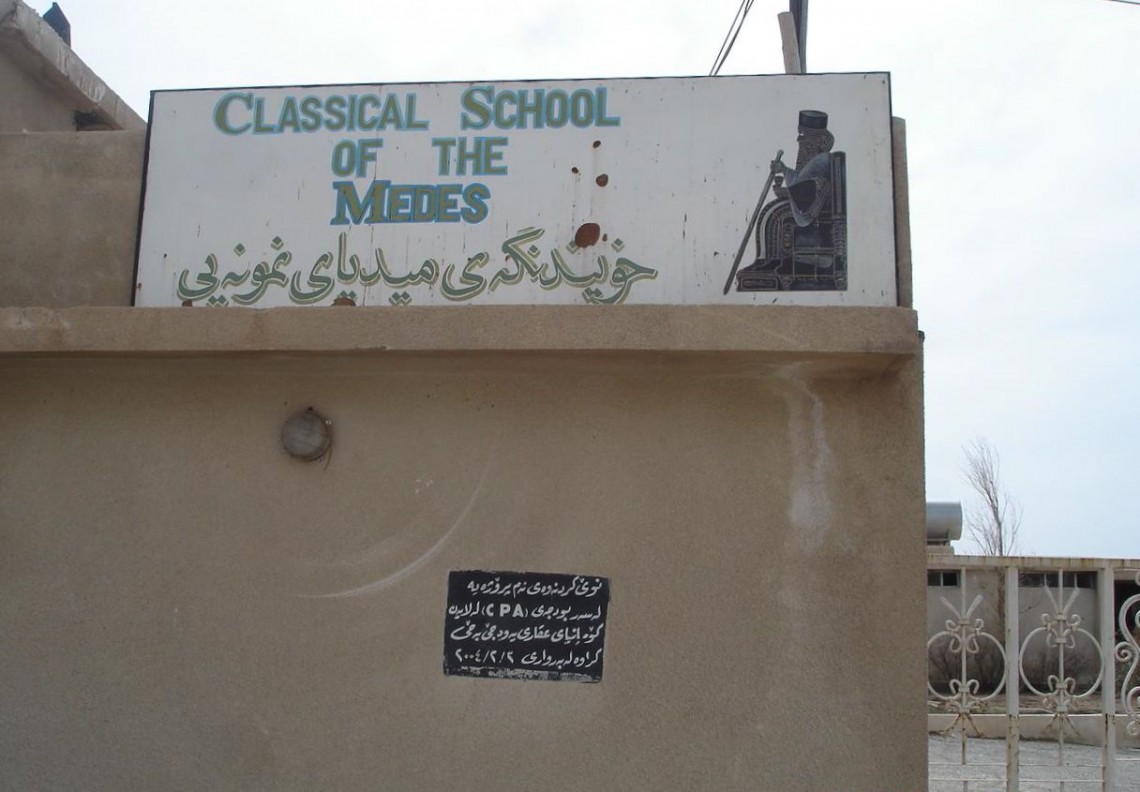
The Classical School of the Medes in Sulaymaniyah, Iraq | Credit: REBAZ MAHMOUD
المدرسة الكلاسيكية للميديين في الصورة
On a barren hillside outside Sulaymaniyah in southeast Iraqi Kurdistan sits a small compound of buildings clustered behind battered gray and ochre walls. Atop one wall is a large white sign glittering with gold and azure lettering that reads in English and Arabic: Classical School of the Medes. It is one of three new private schools in the region that teach a “Christian worldview,” the handiwork of American evangelicals from Tennessee.
على تلة جرداء خارج السليمانية في جنوب شرق كردستان العراق يقام مجمع صغير من المباني الطويلة ومن وراء الجدران الرمادية وفوق جدار عال تقف لوحة كبيرة بيضاء تلمع باللون الذهبي والأزرق السماوي مكتوب عليها بالحروف وباللغة الإنجليزية والعربية: المدرسة الكلاسيكية - الميديين.

وهي واحدة من ثلاث مدارس خاصة جديدة في المنطقة التي تعلم النظرة العالمية "للمسيحية" ومن عمل الإنجيليين الأمريكيين من ولاية تينيسي. أنشأت هذه المدارس مع محطات الإذاعة والكنائس الانجيلية في شمال العراق وكلها بمباركة من حكومة كردستان وبمساعدة من دافعي الضرائب في الولايات المتحدة.

ففي عام 2012 ، قتل طالب مدرسًا أمريكيًا يُدعى إرميا سمول. ثم قتل الطالب نفسه.

وقالت وكالة الأنباء الأمريكية إن الطالب كان يعاني من مشاكل شخصية.

ومع ذلك ، ذكر والد الطالب أن إرميا سمول حول ابنه من الإسلام إلى المسيحية.

ورغم أن المسيحيين في العراق أناس طيبون ، فإن المعلمين المسيحيين الأجانب في هذه المدارس "أسوأ من إرهابيي القاعدة".

https://ekurd.net/mismas/articles/misc2012/3/state6004.htm

Since the US occupation took hold, American evangelicals have established not only schools, but printing presses, radio stations, women’s centers, bookstores, medical and dental clinics, and churches in northern Iraq, all with the blessings and assistance of the Kurdistan government. Many of these efforts were funded in part by US taxpayer dollars, channeled through Department of Defense construction contracts and State Department grants.
منذ الاحتلال الامريكي تولى الإنجيليين الاميركان ليس بناء المدارس فقط ولكن المطابع ومحطات الإذاعة، والمراكز النسائية، والمكتبات، والعيادات الطبية وخدمات طب الأسنان، والكنائس في شمال العراق، ومع كل الدعم والمساعدة من حكومة كردستان وتم تمويل العديد من هذه الجهود كجزء من أموال دافعي الضرائب الأميركية، من خلال توجيه وزارة الدفاع لعقود البناء ومنح وزارة الخارجية.
In September 2003, just four months after US forces took down Saddam Hussein’s regime, 350 evangelical pastors and church leaders assembled in Kirkuk, where they were warmly welcomed by Massoud Barzani, president of the Kurdistan Regional Government.
في أيلول 2003، بعد أربعة أشهر فقط من غزو القوات الأمريكية وإزالة النظام، تم تجميع 350 من قساوسة وزعماء الكنيسة الإنجيلية في كركوك، حيث استقبلوا بحفاوة من قبل مسعود بارزاني، رئيس حكومة إقليم كردستان.
At that gathering, George Grant, a leader of Servant Group International, the evangelical organization in Nashville that set up the chain of Christian schools, declared that “Jesus Christ is Lord over all things; He is Lord over every Mullah, every Ayatollah, every Imam, and every Mahdi pretender; He is Lord over the whole of the earth, even Iraq!”
وفي ذلك الاجتماع، أعلن جورج غرانت، وهو زعيم مجموعة الخادم الدولية، والمنظمة ألانجيلية في ناشفيل عن إعداد سلسلة من المدارس المسيحية، على أن "يسوع المسيح هو الرب على كل شيء، فهو الرب على كل ملا، كل آية الله، وعلى كل إمام، وعلى كل الزعماء المهديين، فهو الرب على كامل الأرض وحتى على العراق!


CENTCOM documents show that between 2005 and 2007, DOD’s Joint Contracting Command Iraq/Afghanistan paid the Kurdish company Daban Group at least $465,639 for the construction of Grant’s School of the Medes. Two years earlier, tens of thousands of dollars from a State Department-funded program called Healthcare Partnerships in Northern Iraq also made their way into a variety of Servant Group evangelical and humanitarian projects.
تظهر وثائق وزارة الدفاع أن القيادة المركزية الأمريكية بين عامي 2005 و 2007، دفعت من قيادة التعاقد العراقي المشترك الى مجموعة الدبان وهي شركة كردية لبناء مدرسة غرانت للميديين بما مجموعة  465،639 $.

وقبل عامين، كانت هناك العشرات الآلاف من الدولارات من البرنامج التي تمولها وزارة الخارجية لشراكات الرعاية الصحية في شمال العراق أيضا في طريقها إلى مجموعة متنوعة من المشاريع والإنسانية لمجموعة الخادم الإنجيلية.

In return for the Regional Government’s support for this evangelical presence in Kurdistan, Doug Layton, another Tennessean and a Servant Group founder, served as a crucial liaison for the KRG in Washington during the Bush years. There, he ran Kurdish public relations efforts and recruited evangelical businessmen to invest in the region.
وفي مقابل دعم الحكومة الإقليمية لهذا الوجود الانجيلي في كردستان، قال دوغ لايتون، وهو من ولاية تينيسي وأحد مؤسسي مجموعة الخادم، وخدم كضابط اتصال مهم مع حكومة إقليم كردستان في واشنطن أثناء سنوات حكم بوش. ومن هناك، كان يدير العلاقات العامة للأكراد وجهود تجنيد رجال الأعمال الإنجيليين للاستثمار في المنطقة.


“Since the run up to the Iraq War, [Massoud] Barzani and the KRG played to the Bush administration and its right-wing evangelical Christian base,” said Mike Amitay, a Middle East senior policy analyst at the Open Society Policy Center. “That’s where they saw the power and the money. Barzani was going to let them set up schools and churches and get what he needed.” But, Amitay adds, “given the rise of the Islamic parties in Kurdistan and Assyrian Christian resentment of American evangelical exceptionalism and proselytizing, they’re playing with fire.”
"منذ الفترة التي سبقت حرب العراق، قام [مسعود البارزاني] وحكومة إقليم كردستان مع إدارة بوش والجناح اليميني لبناء القاعدة المسيحية الإنجيلية"، ويؤكد مركز سياسة المجتمع في واشنطون "بان كردستان العراق هو المكان الذي شهد صعود نفوذ السلطة والمال. فالبارزاني ذهب إلى السماح لهم بإنشاء المدارس والكنائس والحصول على ما يحتاجونه". ولكن، "نظرا لصعود الأحزاب الإسلامية في كردستان والاستياء المسيحي الآثوري من تمييز التبشير الإنجيلي الأمريكي جعل هؤلاء كمن يلعبون بالنار".

Tennessee Waltz
In the years since Saddam Hussein’s 1988 assault on the Kurds that culminated in the chemical weapon attack on the village of Halabja, some 14,000 refugees from Kurdistan made their way to Nashville, now home to the largest Kurdish population in the United States. In 1992, a cadre of Nashville evangelicals from Servant Group International, including large numbers of Kurdish believers, trooped out of their base at Belmont Church, a megachurch occupying several blocks on Music Square, and made their way to the mountains of Kurdistan in northern Iraq, where they set up shop. They were packing Kurdish-language bibles, bags of cash, medical equipment and a long-range game plan to establish their “Father’s Kingdom” between the Turkish border and Iran. Since arriving in northern Iraq some twenty years ago, Servant Group has widened its global presence, establishing offices, ministries and schools in Turkey, Central Asia, Indonesia, Germany, and Norway.
منذ هجمات صدام حسفي السنوات التي تلت عام 1988 قام اكثر من 14000 لاجئ كردي بالرحيل من كردستان إلى ناشفيل، والتي تعد اليوم أكبر جالية الآن نسبة إلى عدد السكان الكرد في الولايات المتحدة.

في عام 1992، قام كادر من الانجيليين في ناشفيل من مجموعة الخادم الدولية، بما في ذلك عدد كبير من "المؤمنين الأكراد"، وتقاطروا من قاعدتهم في كنيسة بلمونت، وكنيسة ميغا بمجموعات عدة للتحضير لإعادة الاحتلال في طريقهم إلى جبال كردستان في شمال العراق، حيث فتحوا مقرا صغيرا هناك كموطئ قدم لهم. وكانت التعبئة لذلك التوجه عبارة عن طباعة عدد كبير من الأناجيل باللغة الكردية، وأكياس من النقود، والمعدات الطبية، ووضع خطة طويلة المدى لوضع كل "مملكة الأب" بين الحدود التركية والإيرانية.

ومنذ وصولهم الى شمال العراق قبل نحو عشرين عاما، اتسع وجود مجموعة الخادم العالمية، وقامت بإنشاء المكاتب والوزارات والمدارس في تركيا وآسيا الوسطى، وإندونيسيا، وألمانيا، والنرويج.


After seven years of American dominance in the region, they have burrowed deep inside the Kurdistan Regional Government, the ruling coalition of Barzani’s Kurdish Democratic Party (KDP) and Jalal Talabani’s Patriotic Union of Kurdistan (PUK). With help from Layton at the Kurdistan Development Corporation and aided by connections with Republican lobbyists and Congressmen in Washington, they have brokered international business concessions and oil drilling contracts and funneled USAID and DOD money into their missions, setting up their chain of Christian schools. In turn, the KRG has backed Servant Group’s ministries and schools with grants of land, buildings and other favors.
واليوم وبعد سبع سنوات من الهيمنة الأميركية في المنطقة، تسللت هذه المجموعة بشكل عميق داخل حكومة إقليم كردستان، فالائتلاف الحاكم الكردي المؤلف من مسعود البارزاني (الحزب الديمقراطي الكردستاني) وجلال الطالباني (الاتحاد الوطني الكردستاني). وبمساعدة من لايتون في مؤسسة تنمية كردستان يقومون بالمساعدة لتحقيق الاتصالات مع جماعات الضغط وأعضاء الكونجرس من الجمهوريين في واشنطن، وقد توسطت الامتيازات التجارية الدولية وعقود التنقيب عن النفط وحولت الأموال لمهامهم من وزارة الدفاع والوكالة الأمريكية للتنمية، لإنشاء سلسلة من المدارس المسيحية. في المقابل، دعمت وزارات حكومة إقليم كردستان مجموعة فريق الخادم بان تم منح الأراضي والمباني وغيرها للمدارس بشكل مباشر وبعيدة عن المجاملات.
Servant Group and its partners are distinguished by their military model of evangelism (what they call “spiritual warfare”); their covert action tactics such as “tent making” or “Kingdom Business” (they enter a country to establish seemingly secular businesses as a cover for evangelism); their intelligence gathering, which they call “spiritual mapping” (where teams of evangelicals conduct full-spectrum “field research’” that includes demographic, historical and geographic data from the neighborhood level to entire countries); an ingrained animosity to Islam; and their dominionist “Kingdom Now” worldview (a fusion of neo-Calvinist authoritarianism and “New Apostolic” Pentecostalism, a millenarian sect of the Assemblies of God whose best known adherent is Sarah Palin).
وتتميز مجموعة الخادم وشركائها بنموذجهم العسكري للتبشير (او ما يسمونه "بالحرب الروحية") ؛ من حيث تكتيكات العمل السري مثل صناعة غطاء لعملهم أو ما يعرف "بالمملكة التجارية".

فقد دخلوا البلاد لإنشاء مؤسسات علمانية على ما يبدو على أنها غطاء للتبشير؛ وتم تجمعهم من قبل المخابرات، والتي يسمونها "برسم الخرائط الروحية" (حيث يكون سلوك الفرق من الانجيليين الكامل هو في البحث الميداني" والتي تتضمن جمع البيانات الديموغرافية والتاريخية والجغرافية على مستوى بلدان بأكملها)؛ وهذا الأمر ليس بجديد لهذه الطائفة فهو منهج كانت قد درجت

كذلك يجمعها العداء المتأصل للإسلام، وهدفها تحقيق السيادة "للمملكة الانجيلية" لقيادة العالم الآن (في انصهار كالفيني سلطوي جديد و "بالرسولية الجديدة للطائفة الخمسينية لجمعيات الله"  واشهر المعروفين المنتمين لهذه الجمعية  هي سارة بالين مرشحة الرئاسة الأمريكية الأخيرة لمنصب نائب الرئيس.
Servant Group missionaries shrewdly established themselves as valued assets to the KRG ruling families and the Bush/Cheney Iraq War effort. The group had close ties to the Bush administration: Stephen Mansfield, the author of The Faith of George W. Bush, a 2004 bestseller that portrayed Bush as “God’s man” in the White House, served for five years, until 2002, as the pastor of the Belmont Church in Nashville that serves as Servant Group’s home base. Prior to taking the pulpit, Mansfield traveled to northern Iraq with Servant Group to bring bibles and the Jesus film, a widely used evangelical proselytizing tool, to the Kurds. Together, Mansfield and Grant serve as advisers to a consortium of “openly Christian business executives” called American Destiny, who invest in development projects in Kurdistan.
هؤلاء المسيحيون من كنيسة بلمونت في ناشفيل بولاية تينيسي مرتبطون بجورج بوش وديك تشيني من خلال ستيفن مانسفيلد الذي يصف جورج بوش بأنه نبي. حكومة كردستان تحبهم لأن لديهم الكثير من المال.كذلك أنشأ المبشرون التابعين لمجموعة فريق الخادم بذكاء لأنفسهم أصول قيمة مع الأسر الحاكمة، كحكومة إقليم كردستان ومع بوش وتشيني وأمراء الحرب على العراق. فكانت هذه الجماعة على علاقات وثيقة مع ادارة جورج بوش: كستيفن مانسفيلد، مؤلف كتاب إيمان جورج دبليو بوش، وهو من أكثر الكتب مبيعا عام 2004 والذي يصور فيه بوش بأنه "رجل الله" في البيت الأبيض، وكان قد عمل لمدة خمس سنوات، حتى عام 2002، كراعي لكنيسة بلمونت في ناشفيل قبل أن يخدم كمؤسس لمجموعة فريق الخادم.هؤلاء المسيحيون من كنيسة بلمونت في ناشفيل بولاية تينيسي مرتبطون بجورج بوش وديك تشيني من خلال ستيفن مانسفيلد الذي يصف جورج بوش بأنه نبي. حكومة كردستان تحبهم لأن لديهم الكثير من المال.

وقد سافر مانسفيلد الى شمال العراق مع مجموعة فريق الخادم لجلب الأناجيل وتوزيع فيلم عن يسوع، وهي وسائل عادة ما يتم استخدامها على نطاق واسع كأداة للتبشير الإنجيلي بين الأكراد.

وقام مانسفيلد بمنح فرص عمل لمستشارين لمجموعة من "المديرين التنفيذيين يعملون علنا للأعمال المسيحية" ودعا أمريكا لتكون هي القدر، التي تستثمر في مشروعات التنمية في كردستان.

كتب ريتشارد مانسفيلد كتابا بعنوان "معجزة الأكراد".
يوسف ماتي ، مدير المدرسة الكلاسيكية لميدي كان في الكتاب. كما ظهر في الكتاب
 أفين هورامي ، المدير السابق للمدرسة الأمريكية الدولية في كردستان في أربيل.

تم إغلاق مدرسة أفين هورامي بسبب الاعتماد المزيف وشكاوى الطلاب من بيع الدرجات
أفين هورامي هي أيضًا صديقة مقربة لهاري شوت.

https://www.knnc.net/en/Details.aspx?jimare=685

In a 2002 interview in the Association of Classical and Christian Schools bulletin, Classical Schools teacher and trainer Mary Yacoubian said that she joined the Servant Group mission because “they weren’t content with just setting up a church in every city. Their goal was to truly ‘disciple’ the nation — establish Christ’s Kingdom in every area of society: government, arts, medicine, education, law, etc.” After calling Islam “a religion based on fear,” Yacoubian gushed, “We also get to witness believers being baptized in a little plastic pool in our garden! Just think about it. Men and women who have been steeped in Islam are turning to Christ!”
في مقابلة أجريت معها عام 2002 في رابطة المسيحية الكلاسيكية في نشرة المدارس تقول ماري يعقوبيان المدرسة في المدارس الكلاسيكية إنها انضمت إلى بعثة مجموعة الخادم لأنها "لم تكتف فقط لإعداد بناء كنيسة في كل مدينة. لكن هدفها هو التلميذ والأمة وإنشاء مملكة المسيح في كل مجال من مجالات المجتمع: الحكومة، والفنون، والطب، والتعليم، والقانون، الخ".

فبعد إظهار الإسلام "كدين يقوم على الخوف" ، تندفع يعقوبيان للحصول على "الشاهد المؤمن" حيث الرجال والنساء الذين لهم جذور في الإسلام بدؤوا يتحولون الى المسيحية
Yacoubian’s statements reflect the dangerous heart of the evangelical exceptionalist conviction — their “Kingdom of God” excludes all possibilities but their particular American brand of Christian society, governance and capitalism.
بيانات يعقوبيان تعكس تقلب خطير للاقتناع باستثناء الاضغاء إلى الإنجيلية وعن "ملكوت الله" وهو يستبعد كل الاحتمالات الأخرى غير العلامة التجارية الأمريكية المعينة من المجتمع المسيحي، والحكم والرأسمالية.
Doing Well by Doing Good
Douglas Layton is central to these successes. In his January 2002 publication, The Forerunner, longtime Christian Reconstructionist Andrew Sandlin, a close colleague of George Grant, praised Layton for his ambitious incursions into Kurdistan. “If we are going to support missionaries, let’s support missionaries who are going around the world to recapture cultures, not simply win a few souls here and there,” wrote Sandlin. “[C]onsider Doug Layton in Kurdistan, northern Iraq, who is re-building a Christian culture: new Christian schools, new Christian businesses, and more. He is not content to build churches; he wants an entire Christian culture.”
دوغلاس لايتون هو مركز هذه النجاحات. في تقريره المنشور في كانون الثاني 2002، يؤكد على إشادة أندرو ساندلين بالتنظيم المسيحي الجديد منذ فترة طويلة وهو زميل مقرب من جورج غرانت، ودعا لايتون لشن غارات مشروعة الطموح في كردستان.

حيث يقول "وإذا أردنا دعم المبشرين، دعونا ندعم المبشرين الذين هم في جميع أنحاء العالم لاستعادة الثقافات، وليس لمجرد الفوز بالنفوس القليلة هنا وهناك"، وكتب ساندلين الى دوغ لايتون في كردستان، شمال العراق، "الى الإعداد لبناء ثقافة مسيحية: فالمدارس المسيحية الجديدة، والأعمال التجارية المسيحية الجديدة، وأكثر من ذلك، وان لا يكتفي ببناء الكنائس وانما يريد ثقافة مسيحية بأكملها ".
Layton coauthored a book, Our Father’s Kingdom: The Church and the Nation, in 2000, in which he explicitly lays out his mission: “If communists and Muslims can take nations — so can our God!”
لايتون المشارك بتأليف كتاب، "أبانا في المملكة: الكنيسة والوطن"، في عام 2000، والذي ينص صراحة على مهمته : "إذا كان الشيوعيون والمسلمون يمكن لهم أن يقيموا الدول فان ذلك يعني حتى يمكن لنا الله من إقامة مملكته!"
في هذا الكتاب يعلن المؤلف فيه الأهداف العامة والحقيقية لحركة الحرب الروحية، وهو الجيش الذي يصف نفسه بأنه من الانجيليين في معركة ضد "الشياطين الإقليميين" لإقامة "مملكة المسيح".
That book’s co-author, George Otis, Jr., is a true general in the Spiritual Warfare movement, a self-described army of evangelicals in a battle against “territorial demons” to establish “the Kingdom of Christ.” He heads a global evangelical intelligence agency, The Sentinel Group, that deploys “field cells” with laptops to gather demographic data in countries the movement has targeted for conversion — currently, Uganda, as well as several countries in Central America and the Middle East, including Iraq. The data is forwarded to Sentinel’s computer banks as part of its “spiritual mapping” project.
Layton لديه صديق اسمه George Otis يمتلك Sentinel Group. مجموعة Sentinel هي خدمة الاستخبارات الإنجيلية العالمية ، وهي منظمة تنشر "خلايا ميدانية" مع أجهزة كمبيوتر محمولة لجمع البيانات الديموغرافية في البلدان المستهدفة حاليًا ، مثل أوغندا ، وكذلك في العديد من البلدان في أمريكا الوسطى والشرق الأوسط ، بما في ذلك العراق.

يتم إرسال البيانات إلى America and Servant International في تينيسي كجزء من مشروع ضخم كبنك بيانات لرسم خرائط للمشروع "الروحاني".

Layton has pushed evangelism in the Middle East to its legal limits. According to German court documents, Layton was arrested in 1993 in the northern Iraqi town of Dohuk for publicly preaching that Kurdistan would have their “promised country, if the Kurds followed Jesus” and that “Islam would not bring them anything but war and misfortune.” His speech sparked angry street protests, and after his arrest, Layton was ordered out of the country. He apparently sought to make amends by personally lobbying in support of the KDP in Washington where he made speeches at the Council for National Policy and testified at Congressional hearings, championing US support for an independent Kurdistan, investment in the region and Barzani’s KDP, in particular. By 1996 he was back in Kurdistan.
دفع لايتون الكرازة في الشرق الأوسط إلى حدودها القانونية. وفقًا لوثائق المحكمة الألمانية ، تم القبض على لايتون في عام 1993 في مدينة دهوك شمال العراق بسبب التبشير العلني وإعلان أن كردستان سيكون لها "دولة كما وعدت ، إذا اتبع الأكراد عيسى" وأن "الإسلام لن يجلب لهم سوى الحرب ، الدمار والخراب ". أثار خطابه احتجاجات غاضبة في الشوارع ، وبعد اعتقاله ، أُمر لايتون بالخروج من البلاد.

بعورغم ذلك سعى على ما يبدو لتدارك تلك الأحداث بتنظيمه حملة لكسب التأييد لدعم الحزب الديمقراطي الكردستاني في واشنطن حيث ألقى خطبا في مجلس السياسة الوطنية وأدلى بشهادات في جلسات الاستماع في الكونغرس، لدعم نصرة الولايات المتحدة لإقامة دولة كردية مستقلة، والاستثمار في المنطقة، وللحزب الديمقراطي الكردستاني ولا سيما للبرزاني.

بحلول عام 1996 عاد لايتون الى كردستان
Up until late 2009, Layton served as the Erbil director of the Kurdistan Development Corporation, a KRG-sponsored venture launched in 2004 “to promote, facilitate and establish business and investment opportunities in the Kurdistan Region in Iraq.” Before taking his job at the KDC, Layton held a post at the KRG Ministry of Health, where he wrote speeches for the minister and ran field operations for the USAID-backed Healthcare Partnerships in Northern Iraq.
عمل حتى أواخر عام 2009، مديرا لهيئة التنمية الكردية في أربيل، وهو المشروع الذي ترعاه حكومة إقليم كردستان وبدأ في عام 2004  بهدف "تعزيز وتيسير وإقامة الأعمال التجارية وفرص الاستثمار في إقليم كردستان في العراق".

قبل توليه منصبه في هيئة التنمية الكردية، شغل لايتون وظيفة في وزارة الصحة في حكومة إقليم كردستان، حيث كان مساعدا لوزير الصحة للعمليات الميدانية وسعى لشراكات الرعاية الصحية التي تدعمها الوكالة الأمريكية للتنمية في شمال العراق.
In 2008 the KRG folded the KDC into a new entity, Kurdistan Investment. It is unclear what role — if any — Layton plays in this revamped bureau. (He is not listed on its board of directors.) Layton currently directs a project called The Other Iraq Tours, which arranges junkets for American businessmen and politicians into Kurdistan. His partners in the company are fellow Servant Group leader Bill Garaway and Jason Atkinson, a conservative Republican state senator from Oregon and occasional Tea Party speaker. The Other Iraq also has strong ties to the military in the United States and Kurdistan. The company is a subsidiary of Point 62 Consulting, headed by retired US Army Col. Harry Schute, who was chief of staff for the Coalition Provisional Authority in northern Iraq from 2003 to 2004 and now serves as a senior security adviser to the KRG.
يمتلك دوغلاس لايتون أيضًا شركة توستفي عام 2008 أدمجت حكومة إقليم كردستان هيئة التنمية الكردية في كيان جديد، وهو "كردستان للاستثمار". ومن غير الواضح ما هو الدور الذي يلعبه لايتون في هذا المكتب بعد تجديده. وفي مجلس إدارتها.
يدير لايتون حاليًا مشروعًا لجولات أخرى في العراق ، حيث ينظم رحلات ترفيهية لرجال الأعمال والسياسيين الأمريكيين في كردستان. شركاؤه في الشركة هم بيل غاراواي ، رئيس مجموعة Servant Group ، وجيسون أتكينسون ، عضو مجلس الشيوخ الجمهوري المحافظ من ولاية أوريغون.

فالعراق وكردستان كدولة أخرى لها ايضا علاقات قوية مع جيش الولايات المتحدة. فشركة بوينت 62 هي شركة فرعية للاستشارات برئاسة العقيد المتقاعد هاري شوت في الجيش الأميركي ، الذي كان رئيس هيئة الأركان لسلطة التحالف المؤقتة في شمال العراق 2003-2004،


According to its website, Point 62 “provide(s) security and political advice to several elements of the KRG, principally the Prime Minister’s office and the Ministry of State for the Interior” and “security services to the oil and gas industry.”
ويشغل الآن منصب مستشار أمني بارز للحكومة في إقليم كردستان.
وبوينت62 تقدم الأمن والمشورة السياسية لعدة عناصر في حكومة إقليم كردستان، وبصورة رئيسية لمكتب رئيس الوزراء ووزارة الدولة للشؤون الداخلية" و"خدمات لصناعة النفط والغاز".
https://www.aihitdata.com/company/007DC754/point-62-consulting/overview
Col. Schute, who appears to wear many hats, is also executive vice chairman of VSC Security, a joint venture with the KRG, headed by Keith E. Schuette, a well-connected Republican Party player and up until this year, a lobbyist with Haley Barbour’s BGR Group; Schuette now serves as a senior advisor to the KRG.
العقيد شوت ، الذي يبدو أنه ارتدى العديد من القبعات ، هو أيضًا نائب الرئيس التنفيذي لشركة VSC Security ، وهي مشروع مشترك مع حكومة إقليم كردستان برئاسة كيث شويت ، المرتبط بالحزب الجمهوري ، مع جماعات الضغط مثل Haley Berber من جمهورية العراق. مجموعة BGR.
شويت الآن كبير مستشاري حكومة إقليم كردستان.
In 2005, Bill Garaway joined Layton at the KDC to launch a promotional campaign, Kurdistan: The Other Iraq, a series of video, print, and Internet ads and emails featuring smiling Kurds waving American flags and thanking the United States for its invasion of Iraq. They also touted the ripe investment opportunities that awaited multinational corporations in northern Iraq. To script and produce the campaign, Garaway and Layton brought in Sal Russo, who heads Russo Marsh & Rogers, a Republican PR firm based in Sacramento. The contract would bring the firm “millions of dollars over the next few years” from the KRG, according to Russo. A year earlier, the firm had produced a pro-war media campaign echoing Bush administration claims that Saddam Hussein possessed weapons of mass destruction and had “extensive ties” to Al Qaeda. The ads memorably attacked Democrats who opposed Bush’s war as “willing to undermine support for the war on terrorism to selfishly advance their shameless political ambitions.”
تعاون بيل جارواي ودوغلاس لايتون من منظمة سيرفانت إنتفي عام 2005 ، انضم بيل غاراواي إلى لايتون لإنشاء هيئة التنمية الكردية لإطلاق حملة ترويجية في كردستان للدعوة إلى أن كردستان بلد آخر ، من خلال سلسلة من مقاطع الفيديو والمطبوعات والإعلانات عبر الإنترنت ورسائل البريد الإلكتروني التي يظهر فيها الأكراد مبتسمين ويلوحون بالأعلام الأمريكية و شكر الولايات المتحدة على غزوها للعراق.
هذه الشركة هي أيضا مرشحة لفرص الاستثمار ، التي جاء دورها كشركة متعددة الجنسيات في شمال العراق. من أجل السيناريو لإنتاج هذه الحملة ، استأجرت Garaway و Layton Sal Russo ، الذي يترأس شركة Russo Marsh & Rogers ، وهي شركة علاقات عامة جمهورية مقرها سكرامنتو. وبموجب العقد ، ستحصل الشركة على "ملايين الدولارات خلال السنوات القليلة المقبلة" التي تقدمها حكومة إقليم كردستان ، بحسب روسو.
للمساعدة في الحملة الدعائية لكردستان لخلق كوردستان غير مستقرة.

قبل ذلك بعام ، أنتجت نفس الشركة حملة إعلامية مؤيدة للحرب كررت مزاعم إدارة بوش بأن صدام حسين يمتلك أسلحة دمار شامل و "علاقات واسعة" بالقاعدة. وتصف الإعلانات هجوم الديمقراطيين الذين عارضوا حرب بوش بأنه "استعداد لتقويض دعم الحرب على الإرهاب والتقدم بأنانية لطموحاتهم السياسية الوقحة".
Garaway also produced another, very different, propaganda video, A Journey To Iraq, financed by Servant Group and tailored specifically for American evangelicals. This one featured “faithful Christians answering God’s call to help spread Christianity to the Arab and Kurdish people.”
كما أنتج غاراواي مقطع فيديو دعائيًا آخر ، مختلف تمامًا ، "رحلة إلى العراق" ، بتمويل من مجموعة سيرفانت ومصمم خصيصًا للإنجيليين الأمريكيين. في هذا الشريط يظهر أحد "المسيحيين المؤمنين يستجيب لدعوة الله للمساعدة في نشر المسيحية بين الشعبين العربي والأكراد".
The Money Trail
In June 2002, as the Bush administration began prepping for the US invasion of Iraq, Congress green-lighted $3.1 million for a State Department-funded program called Healthcare Partnerships in Northern Iraq, ostensibly an effort to improve healthcare in the Kurdish region, but primarily viewed by Middle East policy experts in the United States and local NGO observers as a way to bring the KDP and PUK together under a unified governing body. And who was hired as field operations director for this team-building USAID project? Douglas Layton.
في حزيران 2002، بدأت ادارة بوش الاستعداد للغزو الأميركي للعراق، وأعطى الكونغرس الضوء الأخضر مبلغ 3.1 مليون دولار لتمويل البرنامج التي تمولها وزارة الخارجية ومنها الشراكات للرعاية الصحية في شمال العراق، بزعم المحاولة لتحسين الرعاية الصحية في المنطقة الكردية، ولكن في المقام الأول كان خبراء السياسة في الشرق الأوسط في الولايات المتحدة، والمراقبون في المنظمات غير الحكومية المحلية ينظرون على أنها كانت وسيلة لتحقيق الوحدة بين الحزب الديمقراطي الكردستاني والاتحاد الوطني الكردستاني معا تحت هيئة حكم موحدة. والذي تم التعاقد معه لمنصب مدير العمليات الميدانية لهذه الوكالة وبناء فريق المشروع هو دوغلاس لايتون.
Two-thirds of the Partnership money was swallowed up by Meridian International, a politically connected NGO whose board, at the time, included the wife of then-Senate Majority Leader Bill Frist, and its subcontractors, according to an analysis by one of the program’s participants. That left about $1 million for Layton to personally direct into Kurdish health programs. According to published reports by Servant Group and sources in northern Iraq who were involved with the program, Layton funneled much of it into Servant Group operations such as its mobile dental service, health clinics, and into the pockets of KRG officials with whom he was currying favor. Layton also used funds to rent an office in the KRG Ministry of Health for $1,000 a month-another kickback to KRG officialdom-where he wrote speeches for Health Minister Dr. Jamal Abdul Hamid Abbas. According to two NGO sources who were then in Kurdistan, Layton also handed out cash and equipment from Healthcare Partners to Abbas’ cronies.
بسبب الفساد المروع ، قامت شركة تسمى "ميريديان إنترناشيونال" يملكها السناتور "بيل فريست" بسرقة الكثير من الأموال الممنوحة لدوغلاس لايتون لمنظمة سيرفانت
إنترناشونال. خسر لايتون 2 مليون دولار من تلك الثلاثة ملايين دولار حسب السجلات.
حصلت زوجة رئيس الأغلبية في مجلس الشيوخ بيل فريست على ثلثي سجلات المنح المالية للحكومة الأمريكية.

استخدم لايتون حوالي مليون دولار فقط من أموال الحكومة الأمريكية لبرامج الصحة الكردية.

ووفقا لتقارير نشرتها مجموعة الخادم ومصادر في شمال العراق الذين شاركوا في البرنامج، حول لايتون الكثير منها إلى عمليات مجموعة الخادم مثل الخادم المتنقلة لطب الأسنان والعيادات الصحية، وإلى جيوب مسؤولي حكومة إقليم كردستان. واستخدم لايتون أيضا الأموال لاستئجار مكتب في وزارة الصحة في حكومة إقليم كردستان بمبلغ 1000 $ شهريا وكرشوة لحكومة إقليم كردستان الرسمي، حيث كان مساعدا للدكتور جمال عباس عبد الحميد وزير الصحة. ووفقا لمصادر المنظمات غير الحكومية فان اثنين من الذين كانوا آنذاك في كردستان، كان لايتون يسلمهم أيضا الرشاوى النقدية والمعدات الطبية لشركاء مقربين لعباس.

Beyond the self-dealing and influence peddling, Layton seems to have run a poor operation. Under his guidance, for example, the Partnership set up Internet connections at local clinics and medical schools, then required the organizations to pay $1,000 a month to continue the service — money, of course, they did not have.
كان لايتون أبعد عن التعامل الذاتي واستغلال النفوذ، ويبدو أنه كانت له فكرة عملية تشغيل الفقراء. تحت قيادته، فعلى سبيل المثال، قام بإعداد الشراكة في مجال الاتصالات والإنترنت وفي العيادات الطبية والمدارس المحلية، وبعد ذلك يتعين على المنظمات أن تدفع 1000 $ شهريا لمواصلة دعم مجموعة الخادم لهم وبطبيعة الحال، لم يكن لديهم هذا المبلغ الواجب دفعه وبالتالي تبدأ عمليات الابتزاز.
A field director for an international NGO involved in health programs in Kurdistan from 2002 to 2004 was not much impressed with Layton or with the Partnership. “HCP was full of shit,” said the field director, who, due to his ongoing work in the politically volatile region, asked not to be named. “Our NGO conducted a series of nursing trainings in all three major hospitals, and we heard of no activity in this area by the HCP.
بين 2002-2004 اشترك لايتون ومجموعته مع منظمة غير حكومية مجهولة. صرحت هذه المنظمة غير الحكومية المجهولة أن لايتون أن فريقه لم يفعل شيئًا بأموال الولايات المتحدة لكردستان لمساعدة صناعة الصحة. لقد كذبوا واستولوا على المال.
”You look at the HCP final report and one thing that jumps out is the fuzzy math. They say they gave twenty-six grants averaging about $13,000. That comes out to about $338,000, not nearly the $1 million they say went into the grants programs. As far as reports on grant activities go, this is one of the shoddiest pieces of garbage I have ever seen.“
وفقًا لهذه المنظمة غير الحكومية المجهولة التي عملت مع Servant Group و Layton. ادعى لايتون أنه قدم 26 منحة من حكومة الولايات المتحدة إلى كردستان لبرامج صحية تكلف في المتوسط حوالي 13000 دولار. هذا يساوي حوالي 338000 دولار. تشير تقارير لايتون إلى أنه أنفق ما يقرب من مليون دولار على صناعة الصحة في كردستان. أين باقي المال؟
Mike Amitay is a well-regarded expert on Kurdistan who worked with a number of NGO relief programs in the region during the 1990s. He now serves as senior policy analyst on the Middle East at The Open Society Institute in Washington, D.C. In an email interview, Amitay wrote, ”I find it troubling that, given Douglas Layton’s background and his activities on behalf of extreme Christian evangelists, he would be selected to administer significant US government aid programs in Iraqi Kurdistan.“
”I am disconcerted that despite the ineffectiveness of programs previously implemented under Layton’s direction, and knowing of his evangelical activism, Kurdish authorities continued to facilitate his prominent role in the Kurdistan Development Corporation,“ he continued. ”Despite the threat to Kurdish society posed by Layton’s less-than-hidden agenda.“
مايك أميتاي هو خبير مشهور في كردستان عمل مع عدد من المنظمات غير الحكومية في برامج الإغاثة في المنطقة خلال التسعينيات. الآن ، وهو محلل سياسي كبير في الشرق الأوسط في معهد المجتمع المفتوح بواشنطن ، كتب: "أجد أنه من المقلق ، نظرًا لخلفية دوجلاس لايتون وأنشطته نيابة عن المتطرفين المسيحيين ، أن يتم اختياره لإدارة مساعدة كبيرة للحكومة الأمريكية برامج في كردستان العراق ".

ويقول "أنا مستاء إذ أنه على الرغم من عدم فعالية البرامج المنفذة سابقا تحت توجيه لايتون، ومعرفة نشاطه الإنجيلية، واصلت السلطات الكردية تسهيل دوره البارز في مؤسسة تنمية كردستان"، "على الرغم من التهديد الذي يتعرض له المجتمع الكردي من جدول الأعمال الخاص بلايتون المخفي".
The School of the Medes
The principal of the Sulaymaniyah Classical School is Kawa Omer Qadir, a friendly forty-something man with a graying buzz cut and a massive Arabic-language Bible resting in front of him, who welcomed this reporter into his pink office. He says the Classical School of the Medes runs three schools in the region: his in Sulaymaniyah, plus schools in Erbil and Dohuk, each serving grades kindergarten through ten. All classes are in English, he explains, and the programs are funded by the government, through the Ministry of the Education, and by ”churches outside Kurdistan.“ His 800 students come from upper- and middle-class families, many of them the children of KRG officials. Most are Muslim, making them ripe targets for Servant Group missionaries. ”You can count the Christians on the fingers of one hand,“ he says.
مدير المدرسة الكلاسيكية في السليمانية كاوة عبد القادر عمر، وهو رجل في الأربعين وهو ودي مع شيب منتشر في رأسه، والكتاب المقدس باللغة العربية موضوع أمامه، يقول من مكتبه الوردي. ان المدرسة الكلاسيكية " الميديين" تدير ثلاث مدارس في المنطقة : المدارس في السليمانية، وفي أربيل ودهوك، وتخدم كل منها من مرحلة رياض الأطفال حتى الصف 10. وكل المراحل يكون التدريس فيها باللغة الإنجليزية، وهو ما يفسر، تمويل هذه البرامج من قبل الحكومة، ومن خلال وزارة التربية والتعليم، و"الكنائس خارج كردستان".

في هذه المدارس 800 طالب يأتون من عائلات عليا وبعضهم من الطبقة الوسطى ، وكثير منهم من أبناء المسؤولين في كردستان. معظمهم من المسلمين ، مما يجعلهم أهدافًا جاهزة لمجموعة من المتطرفين والمبشرين المسيحيين. يقول: "يمكنك عد المسيحيين من أصابع يد واحدة".
The schools are part of Classical Development Services International, whose governing board is based in Nashville. The school’s pastor, Yousif Matty, sits on that board, along with George Grant and Bill Garaway.
المدارس جزء من خدمات Classic International Development ، ومقرها ناشفيل. راعي الكنيسة والمدرسة ، يوسف ماتي ، يجلس على ظهر السفينة ، جنبًا إلى جنب مع جورج غرانت وبيل غاراواي.


The school enjoys central heating and air conditioning and its own generator, a luxury that spares teachers and students the routine power outages that plague the city and most of the region. The classrooms are painted pink, like Qadir’s office. In one, eighteen eighth graders were getting a math lecture from a Kurdish teacher from Sulaymaniyah University.
لمدرسة تتمتع بالتدفئة المركزية والتكييف والمولدات الخاصة، وهو نوع من الترف الذي قطع عن المعلمين والطلاب بانقطاع التيار الكهربائي الروتيني الذي يعاني منه معظم المدينة والمنطقة. والفصول الدراسية مطلية باللون الوردي، مثل مكتب عبد القادر وفي محاضرة للرياضيات لطلاب الصف الثامن يتكون الصف الواحد من 18 طالبا والمعلمين من جامعة السليمانية الكردية.
”Most teachers are from Kurdistan,“ Qadir says. ”But the staff from Classical Development Service Schools International provides us with international teachers who train our teachers and organize the curriculum and program.“ One young American teacher encountered at the school, who refused to share her name, says she is a member of Classical Development Schools International but doesn’t receive a salary. She was here ”trying to help,“ she says, because she believes that ”the US has a responsibility toward this country.“
يقول عبد القادر: "معظم المعلمين من كردستان ، لكن هناك موظفين من منظمة التنمية الدولية الكلاسيكية ومن مدارس مجموعة سيرفانت في أمريكا. هؤلاء المعلمون الدوليون يدربون مدرسينا وينظمون المناهج والبرامج".

حد المعلمات تقول إنها عضو في المدارس الكلاسيكية للتنمية الدولية لكنها لا تحصل على راتب. إنها هنا "في محاولة للمساعدة"، كما تقول، لأنها تعتقد أن "الولايات المتحدة تتحمل مسؤولية القدر تجاه هذا البلد".
”The government helps us through many ways,“ Qadir says. ”They gave us this building. They provide security. But we pay their salaries.“ That money comes out of donations from American evangelicals through the Belmont Church and other missionary organizations. Between 2002 and 2006, Servant Group pumped $2 million into its Kurdish evangelical operations with the help of Partners International, an evangelical outfit based in Spokane, Washington. Global Hope, another particularly aggressive evangelical organization from Tennessee, is building a $2 million high-tech facility, complete with an Internet cafe called Freedom Center Iraq. The project is headed by Heather Mercer, best known for getting herself arrested by the Taliban in August 2001 when she and another missionary were caught handing out bibles and showing the Jesus film.
ويقول عبد القادر “ان الحكومة تساعدنا من خلال العديد من الطرق فقد قدموا لنا هذا المبنى، ووفروا الأمن، لكننا من يدفع الرواتب” فأن المال يأتي من تبرعات من الانجيليين الأمريكيين من خلال الكنيسة والمنظمات التبشيرية في بلمونت.
بين عامي 2002 و 2006 ، ضخت The Servant Group مليوني دولار في عملياتها الإنجيلية الكردية بمساعدة الشركاء الدوليين ، وهي مجموعة إنجيلية مقرها في سبوكان ، واشنطن. وترأس منظمة "إنترناشونال بارتنرز" هيذر ميرسر ، التي اعتقلتها حركة طالبان في أغسطس 2001 عندما حاولت تحويل طالبان إلى مسيحيين.

هيذر ميرسر
Qadir doesn’t go into specifics about his school’s curriculum and teaching philosophy, but George Grant is far less reticent. A Christian Reconstructionist for decades, Grant guides the Classical Schools from his office half a world away at King’s Meadow Study Center, twenty miles south of Nashville. On Franklin Classical School’s website, Grant lays out exactly what he means by classical Christian education. ”Our foundational worldview is the unchangeable Word of God-the Bible…. We strive to practice biblical living and teaching everywhere, not only in our curriculum, but also in our administration and our staff…. The students consequently live in a Christian culture dominated by the authority of the Word of God.“
لا يستطيع قادر أن يشرح منهج المدرسة وفلسفتها التربوية ، لكن جورج غرانت يؤكد أن المنهج مسيحي. سيتعلم الطلاب العيش في ثقافة مسيحية يهيمن عليها سلطان كلمة الله.
Michael Gunter, a political science professor at Tennessee Tech University, has authored twelve books on Kurdistan; his latest, The Kurds Ascending, deals with the region in the post-Saddam era. Gunter called these American evangelical efforts in Kurdistan ”alarming.“
”The Kurds are Muslims, they don’t identify as Christian,“ Gunter says. ”While they are tolerant of Christians, even the nominal Muslims don’t care for evangelism, especially this aggressive brand. I find it strange that the KRG is allowing this.“
But Bill Garaway has a different take on the Kurds’ religious views. In a podcast interview last July, he brushed aside any evangelical problems inside Kurdistan by saying, ”Most Kurds don’t even like Muslims.“
وقد ألف مايكل غونتر، وهو أستاذ العلوم السياسية في جامعة تينيسي للتكنولوجيا، اثني عشر كتابا عن كردستان؛ كان الأخير، بعنوان: صعود الأكراد، وهو يتعامل مع المنطقة في عصر ما بعد صدام. وقد سمى غونتر هذه الجهود الأميركية الإنجيلية في كردستان "بالمثيرة للقلق"

"الأكراد مسلمون ، وهم لا يعرفون هؤلاء المسيحيين المتطرفين الذين يمتلكون ويديرون هذه المدرسة" ، يقول جونتر. "هؤلاء المسيحيون المتطرفون هم أقل تسامحا مع الديانات الأخرى ويمكن أن يكونوا عدوانيين. أجد أنه من الغريب أن تسمح حكومة إقليم كردستان لهؤلاء المبشرين بالعمل في كردستان".

لكن بيل غاراواي من Servant Group لديه وجهات نظر مختلفة حول الدين والأكراد. وفي مقابلة ، قلل من شأن أي مشاكل إنجيلية داخل كردستان ، قائلاً: "معظم الأكراد لا يحبون الإسلام".

مايكل غونتر
Racist Ties
Grant is the author of The Blood of the Moon, a book first published in 1991 and reprinted in 2001. In his book, Grant calls for conquering the Islamic world by military might in order to bring about Muslim conversion, an obvious prerequisite for achieving his uncompromising theocratic worldview. In his 1987 Dominionist polemic, The Changing of the Guard, Grant wrote: ”Christian politics has as its primary intent the conquest of the land — of men, families, institutions, bureaucracies, courts, and governments for the Kingdom of Christ. It is to reinstitute the authority of God’s Word as supreme over all judgments, over all legislation, over all declarations, constitutions, and confederations.“
نشر جورج غرانت كتابا بعنوان "دم القمر" في عام 1991. وفي هذا الكتاب يدعو غرانت إلى غزو العالم الإسلامي بالقوة العسكرية من أجل تحويل المسلمين إلى المسيحية ، وهو شرط واضح لتحقيق ذلك. من النظرة الدينية لبلاده التي لا هوادة فيها ".

في عام 1987 ، نشر جرانت مقالًا بعنوان "تغيير الحرس" ، حيث قال ، إن الهدف الرئيسي للمسيحية هو احتلال الأرض والرجال والعائلات والمؤسسات والبيروقراطيات والمحاكم والحكومات في ظل مملكة يسوع. المسيح ، وليسترد سلطان كلمة الله السامية على جميع الأحكام وعلى كل التشريعات وعلى جميع الإعلانات والدساتير والأمم ".
In an April 2004 lecture at fellow Dominionist R.C. Sproul’s Highlands Study Center in Virginia, Grant said, ”We’re to make disciples who will obey everything that He commanded, not just in the hazy zone of piety, but in the totality of life…. It is the spiritual, emotional, and cultural mandate to win all things in the name of Jesus.“
وفي محاضرة في نيسان 2004 في روتردام قال غرانت في مركز دراسات في ولاية فرجينيا، " سوف نجعل التلاميذ يطيعون كل ما هو أمر، ليس فقط في المنطقة الضبابية من التقوى، ولكن في مجمل الحياة.... وهذه هي الولاية الثقافية والروحية والعاطفية، هي للفوز بكل شيء باسم يسوع ".
Mark Potok, director of the Intelligence Project at the Southern Poverty Law Center, which tracks racist and far-right social movements, is well acquainted with Grant and his schools, which, he argues, ”are deeply influenced by white supremacist ideas.“ He points, in particular, to Grant’s close association with Douglas Wilson, who founded both the Association of Classical and Christian Schools (of which Grant is a longstanding member) and New Saint Andrews College in Moscow, Idaho, which provides teachers to the Classical Schools in Kurdistan.
مارك بوتوك ، مدير مركز قانون الفقر الجنوبي ، الذي يتتبع المتطرفين الدينيين والإرهابيين والحركات العنصرية ، على دراية جيدة بغرانت ومدارسه.

ويشير ، على وجه الخصوص ، إلى ارتباط جرانت الوثيق بدوغلاس ويلسون ، الذي أسس الرابطة الكلاسيكية للمدارس المسيحية (التي كان عضوًا فيها منذ فترة طويلة) وكلية سانت أندروز الجديدة في موسكو-أيداهو ، والتي ترسل مدرسين مسيحيين أمريكيين متطرفين إلى مدرسة ميديس الكلاسيكية في كردستان.
Wilson also coauthored a disturbing book, Southern Slavery: As It Was, a neo-Confederate fantasy disguised as history. The book argues that Southern slavery was sanctioned by the Bible and that slaves enjoyed a wonderful life due to the patriarchal benevolence of their evangelical masters. ”Slavery produced in the South a genuine affection between the races that we believe we can say has never existed in any nation before the [Civil] War or since,“ it reads. ”There has never been a multi-racial society which has existed with such mutual intimacy and harmony in the history of the world.“ According to Potok, Grant and Wilson are in the leadership of a movement within Christian Reconstructionism called ”Celtic Sunrise“ that is deeply influenced by white supremacist ideas.
كتب دوجلاس ويلسون وصديقه ستيف ويلكينز كتابًا بعنوان "العبودية الجنوبية: كما كانت". في هذا الكتاب ، يقول ويلسون وويلكنز ، إن العبودية الجنوبية في أمريكا كانت مدعومة من قبل يسوع والكتاب المقدس ، وأن العبيد كانوا يتمتعون بحياة رائعة بسبب أسيادهم الإنجيليين.

ويلكنز عضو مجلس إدارة منظمة "رابطة الجنوب" في أمريكا والتي توصف بالإرهابيين المسيحيين العنصريين.

دوغلاس ويلسون هو أيضًا قس في كنيسة المسيح التي ظهرت في الأخبار الأمريكية مرات عديدة.

لقد بشر بالبغض. يعلم أتباعه أنه لا يمكن للمرأة أن ترفض أي طلب من الأزواج. وأن تستسلم المرأة للرجل.

وفقًا لبوتوك ، فإن جرانت وويلسون هما قادة التفوق الأبيض.

https://www.vice.com/en/article/m7ezwx/inside-the-church-that-preaches-wives-need-to-be-led-with-a-firm-hand

https://www.splcenter.org/fighting-hate/extremist-files/group/league-south


Few Answers
Though I spent months in pursuit of interviews for this story, the evangelical leadership in northern Iraq remained resolutely, uniformly unresponsive. Yousif Matty, the Servant Group pastor in Erbil, begged off repeatedly, first citing health reasons and then saying he would talk, but not for publication. Pastors at two new evangelical churches in the region, the Kurdzman Church and the Free Evangelical Church, were more blunt: ”We don’t talk to the media.“
وعلى الرغم من كل ما ذكر ، ظلت القيادة الإنجيلية في شمال العراق ثابتة ولم تستجب بشكل موحد لجميع طلبات صاحب البلاغ لإثبات الهوية الشخصية. على سبيل المثال ، يوسف ماتي ، راعي مجموعة Servant Group في أربيل ، بعد سؤاله مرارًا وتكرارًا ، كان يعتذر لأسباب صحية ، أو يقول إنه سيتحدث بعد ذلك ، ولكن ليس للنشر. أما رعاة الكنائس الإنجيلية في المنطقة ، مثل كنيسة كوردزمان والكنيسة الإنجيلية الحرة ، فقد كانوا أكثر صراحة عندما قالوا: "نحن لا نتحدث إليكم".

Layton also declined to be interviewed in person for this article and requested that all questions be emailed to him. Seventeen questions covering his role as an evangelical, his performance in the USAID program, how he landed his job at the KDC, and his relationships with several specific individuals were sent; Layton refused to answer any of them.
رفض دوغلاس لايتون أورفض لايتون أيضا إجراء مقابلات لهذا المقال، خشية معرفة قيمة أدائه لبرنامج المساعدات الأمريكية، وفي الهيئة الكردية للاستثمار، وعلاقاته مع أفراد معينين في كردستان.
”Your questions are so full of falsehoods and misrepresentations that I do not think it would be productive to comment further,“ he wrote in an email. ”My activities in Kurdistan have been to help the Kurds to develop a thriving economy and a democratic society.“
رد دوغلاس لايتون فقط بأنه يحاول فقط خلق ديمقراطية في كردستان / العراق
هذا الموقف من قبل رجالات العمل الانجيلي في كردستان العراق يؤكد حقيقة ان جدول الأعمال لايتون وزملائه الانجيليين في المنطقة يقومون بما يعرف عندهم بلعبة. وفقط الأكراد يأخذون هذا الأمر بصورة جدية.
When asked about his longstanding relationships with Servant Group leaders George Grant, Stephen Mansfield, Bill Garaway, Yousif Matty and the coauthor of his book, George Otis, Jr., Layton’s strange response was, ”I have never heard of most of the incidents or people you describe and only know slightly most of the other people you mention, and there is simply no truth I have involvement in the issues you raise.“
Because such a blanket denial flies in the face of the facts, it casts a cloud on Layton’s true agenda and that of his fellow evangelicals in the region. ”Everyone knows it’s a game. The Kurds just want to cash in,“ says Amitay. ”The KRG isn’t concerned about what evangelicals say over here. English reports in the US aren’t going to be read over there.“ He then points out that the KRG ”will draw the line“ if the evangelicals pursue aggressive conversion efforts. ”A priority for the KRG is a decent relationship with Tehran,“ he says. ”And there is a rising pro-Islamic movement responding to the economic disparities between wealthy Kurds and the majority of working poor. There is resentment out there that the Islamists can tap into.“
حكومة إقليم كردستان ليست قلقة لأنهم يعتقدون أن التقارير في أمريكا لن تقرأ في كردستان أو العراق.

ومع ذلك ، قد تكون هناك نية من قبل حكومة إقليم كردستان لـ "رسم الخط" بينها وبين الإنجيليين في حال استمرار المساعي العدوانية للإنجيليين ، أو إذا كان موقف الحكومة الأمريكية هناك ضعيفًا وهناك نقص في التمويل. للمشاريع الخاصة هناك.

فهناك اليوم أولوية لحكومة إقليم كردستان وهي العلاقة "اللائقة مع طهران"، إذ ان هناك حركة ارتفاع إسلامية موالية للاستجابة لأوجه التفاوت الاقتصادي بين الأكراد القليل منهم أغنياء وغالبيتهم من الفقراء العاملين، وهناك استياء كبير
All they’d have to do is read Layton’s comments in a 2003 interview with the evangelical magazine World, a champion of the Christian push into Kurdistan, in which Layton confirmed Amitay’s worries with an inflammatory observation regarding the political dynamics in a post-Saddam Iraq. ”Americans made a mistake because of their misunderstanding of Islam,“ Layton wrote. ”Shia and Sunni will never like us. They will always hate us and our view of government. They don’t recognize inalienable rights.“
ورد دوغلاس لايتون على تعليقات مايك أميتاي بأن الأمريكيين لا يفهمون المسلمين والإسلام. وقال: "الشيعة والسنة لن يحبونا أبدًا. سوف يكرهوننا دائمًا ويكرهون نظرتنا إلى الحكومة. إنهم لا يعترفون بالحقوق غير القابلة للتصرف"
عند قراءة تعليقات لايتون في مقابلة أجريت عام 2003 مع مجلة Evangelical World ، ادعى لايتون أنه البطل الذي يدافع عن المسيحيين في كردستان.

قال لايتون: "لقد أخطأ الأمريكيون لأنهم أساءوا فهم الإسلام" ، قال لايتون. "الشيعة والسنة ليسوا مثلنا ، والكراهية ستوجه إلينا دائمًا حسب وجهة نظرنا في الحكومة. الإسلام لا يعترف بالحقوق".
The presence of someone like Layton inside the Kurdistan government, brokering foreign investment in the region and setting up Christian schools with the goal of proselytizing to Muslims strikes Michael Gunter, the Kurdistan expert at Tennessee Tech, as a dangerous proposition given the current volatile political climate in Iraq. ”The stability of Kurdistan is very fragile right now,“ he said, citing the fractious state of affairs in northern Iraq between Kurds, Assyrian Christians, Yazidis, Turkomen and Sunni Muslims that has produced a wave of bombings and assassinations over the past several months. The national elections in March have left Iraq fragmented along political, tribal and religious lines-and have left unanswered the pressing question of who will control the oil-rich regions of Tamim, which includes Kirkuk, and parts of the Nineveh plain.
إنه لمن دواعي القلق البالغ أن وجود شخص مثل لايتون داخل حكومة كردستان بشأن قضايا الاستثمار الأجنبي والسمسرة في الإقليم وإنشاء مدارس مسيحية بهدف تبشير المسلمين سيضع الجميع في موقف خطير بالنظر إلى الوضع الحالي. مناخ سياسي مضطرب في العراق.

حتى الآن ، تركت الانتخابات الوطنية الأخيرة في العراق منقسمًا على أسس سياسية وقبلية ودينية ، وتركت بلا إجابة السؤال الملح حول من سيسيطر على المناطق الغنية بالنفط.
US military commanders have said that tensions between Kurds and Arabs are the greatest threat to Iraq’s security as American troop withdrawal accelerates. A cadre of US Kingdom Now evangelicals in the mix — especially with ties at the upper levels of the KRG — can only provide more fuel to an increasingly flammable situation.
صرح القادة العسكريون في الولايات المتحدة أن هؤلاء المتطرفين المسيحيين قد يصبحون قال قادة عسكريون أمريكيون إن التوترات بين الأكراد والعرب هي أكبر تهديد للأمن في العراق في ظل تسارع وتيرة انسحاب القوات الأمريكية. يوجد اليوم على أرض كردستان العراق ألف كادر من المتطرفين المسيحيين الإنجيليين من الولايات المتحدة. وهم الآن مرتبطون بالمستويات الأعلى في حكومة إقليم كردستان ويمكن لهذه العلاقات أن توفر المزيد من الوقود لدولة قابلة للاشتعال بشكل متزايد.
Rebaz Mahmoud contributed reporting from Kurdistan. This article was reported in collaboration with The Investigative Fund at The Nation Institute, now known as Type Investigations.
ABOUT THE REPORTER
MICHAEL REYNOLDS
مايكل رينولدز
Michael Reynolds writes on terrorism, violence, crime, politics, money, and religion for numerous publications.
Protected: Globe English School: A Dodgy Black Company in Japan
The Canadian International School Kurdistan Erbil and Anne Frank: Anti-Semitism and International Schools
Kurdistan24 News once claimed religious pluralism “is a cornerstone for a new Kurdistan state.” https://www.kurdistan24.net/en/analysis/31d42429-c2d9-4135-85de-34ce5234fa43 I want to believe this, despite no synagogues or community of Jews in Kurdistan. Despite witnessing swastika chains sold at the Citadel’s Bazar and Nazi Swastikas drawn next to mosques. And despite my personal experience with the Diary of Anne Frank at the Canadian International School (CIS) of Erbil in Kurdistan. https://www.facebook.com/CanadianISErbil/


The Canadian International School Kurdistan Erbil and Anne Frank: Anti-Semitism and International Schools
(Picture of the Canadian international School of Erbil, Iraq)

Kurdistan24 News once claimed religious pluralism “is a cornerstone for a new Kurdistan state.” https://www.kurdistan24.net/en/analysis/31d42429-c2d9-4135-85de-34ce5234fa43
I want to believe this, despite no synagogues or community of Jews in Kurdistan. Despite witnessing swastika chains sold at the Citadel’s Bazar and Nazi Swastikas drawn next to mosques. And despite my personal experience with the Diary of Anne Frank at the Canadian International School (CIS) of Erbil in Kurdistan. https://www.facebook.com/CanadianISErbil/
(Nazi Swastika near mosque) 
(Nazi Swastika near mosque)

I’ve decided to expound upon my experience at the Canadian International School because it penetrates the fragile veneer of fake and superficial image so prevalent in Middle Eastern schools, it mentions Western businesses that provide legitimacy for anti-Semitism and Shia-Sunni Muslim animosity at schools, and it highlights how the innocent youth are unknowingly positioned upon the educational pillars of anti-Semitism here in the Middle East.
Background
I worked at the Canadian International School of Erbil in Kurdistan (Northern Iraq), for approximately 6 months. As usual, in my over ten years experience of teaching in the Middle East, the students are wonderful.
And as always, not the administration.
Regularly, I find school administrators in the Middle East incompetent, unqualified, exploitive, religious bigots, abusive, and corrupt. Disgusting may be a euphemism.
To respect accuracy and honesty, the CIS is not too corrupt.
I Think They Hate Jews Here
On August 1, 2018, the principal, sent me an English literature syllabus for September. The Diary of Anne Frank was listed on it.


My first augury came as the following September session commenced, I witnessed a Social Studies instructor saluting like Adolf Hitler, while shouting Seig Heil, as a couple of cult students chimed in with “Children of the Corn” fashion. I sternly voiced my disapproval. This educator retorted with a laugh and smiling exasperation, “Don’t worry. It’s okay here.” He ceased this behavior for a while.
Nonetheless, as the session progressed further, I oddly discovered that the 8th grade Houghton Mifflin Harcourt Collections English Literature books had the Diary of Anne Frank ripped out of the teachers’ and students’ textbooks. My queries to the administration were met by prevarication.
An Australian colleague, Vanessa Powell, brought to my attention that it wasn’t solely Anne Frank censored, it was above a hundred pages on the Holocaust. This disclosure shocked me like reading history’s pages on the nefarious 1933 book burnings in Nazi Germany. I also quickly recollected the well-deserved criminal prosecution for the same act which occurred in Japan in 2014. https://www.nytimes.com/2014/02/22/world/asia/diary-of-anne-frank-vandalized-at-japanese-libraries.html
Therefore, I sent a complaint to Cambridge Assessment International Education which boasts the Canadian International School (CIS) as one if its Cambridge Schools, which consequently gives access to CIS students to “the world’s best universities,” in Western nations.
Cambridge also claims, “we develop Cambridge learners who are confident, responsible, reflective, innovative and engaged – equipped for success in the modern world.” https://www.cambridgeinternational.org/why-choose-us/find-a-cambridge-school/?Country=Iraq
Cambridge International Assessment advised that I handle this situation within the administration.
So, I did.

I’m On The Wrong Team
There is an annual competition in Cumbria, England called The World’s Biggest Liar. The following narrative was too pathetically gossamer to contemplate candidacy in the preceding event.
The principal of the CIS, blamed the Ministry of Education for the books. The Ministry of Education denied this.
Other international schools and universities in Kurdistan responded to my phone inquiries that they would “never” do this. The International School of Chouefat stated they would only do this, if the Ministry of Education demanded.
I caught wind though that the exception was Ronaki School, a Fethulleh Gulen Movement school which is located near the Canadian International School https://www.jpost.com/Opinion/Fethullah-G%C3%BClen-and-the-Jews-A-different-angle-459953. Ronaki, oddly, was administering their students the same Jewish censored Houghton Mifflin Harcourt Collections textbooks as the CIS.
Ronaki claimed it was the fault of a Lebanese book distributor, yet would not divulge the name. After confronting the CIS with the Ministry’s and schools’ replies, the principal blamed a Jordanian book distributor, but also wouldn’t reveal who that distributor was.
Whatever the truth, veering past the prevarication, I realized religious pluralism was not an ethic among my new team at the CIS.
Let’s Find Out If Hate Is Taught
I’ve witnessed Israel ripped out of students’ textbooks before at the Modern American School of Amman, Jordan, but not the Holocaust or the Diary of Anne Frank. This was too much, a red line. This childish act of censorship was akin to removing the human face from all Jews in my opinion.
No modern nation with a decent education system punishes constituents of any religion by censoring that entire religion’s authors in school textbooks. Even in the United States where Middle East critics condemn the U.S government as pro-Israeli, I first learned about Islam and Palestine from American school textbooks.
And while in the Middle East for ten years, I have persistently used the Diary of Anne Frank, without problems, as a means of teaching religious tolerance and pluralism. I was inspired by Erin Gruwell in the film Freedom Writers.
Therefore, I decided, without textbooks, to teach the Diary of Anne Frank by YouTube videos and lecturing. I also assigned poster boards on Anne Frank for student projects, taping them on classroom walls. It was a bold, perhaps provocative to a few, yet an admirable success! I taught my students humanity and religious pluralism, through the Diary of Anne Frank.
The students understood that no one should be targeted or discriminated against because of politics or religion. These students’ lives have already been detrimentally affected by the former and latter in Kurdistan, so of course, they could relate.
The results were conclusive. Religious pluralism and tolerance and love can be taught.
Indian spiritual guru, Rajneesh, stated a child’s innocence is his or her wisdom. And American author Neale Donald Walsh believes one can change the world with such wisdom.
I learned from my experience at the CIS that we adults are the ones who make monsters of these precious children. As you will see soon, Western accrediting and qualification agencies, also do.
(Pictures of my students with Anne Fran posterboards)


Then, The Administration Responded.
If it is true that God sends children to show he is not discouraged of humans, according to Indian poet Rabindranath Tagore, then schools like the CIS are in existence solely to prove its antithesis.
On November 11, I not only was admonished with a verbal order to cease teaching Anne Frank, but was ordered to immediately tear down students’ poster boards. Later that night, I received the same demand by e-mail from the principal.

Coincidentally, after the e-mail by the principal, I began witnessing the emetic tautology of the Social Studies teacher again, commencing Nazi salutes while screaming Hitler’s name and Seig Heil, in proud tittup, on a daily basis, in front of innocent children as young as KG.
Shortly afterwards, the Indian head teacher, school principal, and Social Studies instructor; in Gestapo manner, interrupted my class one day and demanded I stop teaching the Universal Declaration of Human Rights.
A formal e-mail complaint to the Head Teacher, about the Social Studies teacher’s toxic behavior was unanswered. The principal replied to my complaint privately in the hallway between classes, “it was only a joke.”
I am proud of my restraint, that I was able to conceal under my breath, “so was the Jim Crow caricature in the American South.”


In A Circus, Don’t Ask Clowns To Be Serious
I felt inured to speak rationally with my cohorts. While Charles Dickens reigned supreme in Victorian England, Bozo the Clown from Chicago’s 1960s, “The Bozo Show,” would be its perfect equivalent to describe the “educators” at the CIS.
While employed at the CIS, I witnessed the Academic Director, also father of the principal, scream at a poor elderly Arabic language teacher in front of students, bringing her to tears, and later eventually firing her.
I also heard students gossip that the Academic Director capriciously padlocked the canteen shop because of Iranian potato chips. Bone broth, beet root, and Chia seeds were more preferable than the normal cafeteria victuals at the CIS, so I was sadly fond of the canteen.
While in the teacher’s break room once, the thin walls of the adjoining classroom disclosed a teacher loudly inculcating into students that Shia Muslims aren’t Muslims. And Iran was a danger to Sunni Muslims.
I accidentally wrote “Shia” into my lesson plans unintentionally in consequence.
And finally, my colleague Vanessa Powell, profited from the gracious tutelage of professionalism at the CIS by the Head teacher. She couldn’t drink tea, eat her lunch in the teacher’s room, change student’s classroom seating, wave hello to strangers during field trips, and print worksheets.
I also proctored the principal’s sagacious authored exam for a two hour period, that only had three multiple choice questions.
And I also in vain complained that a few students were allowed to be out of attendance for over an entire month, yet passed somehow.
The preceding was enough to convince me this “international” school, is a tragic missing episode from an Alfred Hitchcock Series.
Liz Ryan Was Absolutely Right!
Contributor to Forbes Magazine, Liz Ryan, listed ten indications your employer is itching to terminate you. All ten occurred to me at the CIS after I requested the principal to reconsider his demand that I tear down students’ Anne Frank poster boards. It was the respectful, yet strong way in education to be an August Landmesser who refused to salute like Hitler in Nazi Germany.
Ultimately, I was fired for chewing gum and writing questions in a joking manner on exams which was considered unacceptable by the principal. The first minor complaint, I was guilty. The last was a lie. The head teacher had described my exams in e-mails prior my termination as “great” and “perfecto.” And unexpectedly, the staff had lost their sense of humor, unless it involved Adolf Hitler.


After my termination, I furthered my complaint to the Director of the British Council in Iraq, Victoria Lindsay. The British Council is partnered with the CIS, as you can see their logos on the CIS students’ shirts. https://www.linkedin.com/in/victorialindsay/?originalSubdomain=uk
Days later, though she hasn’t visited the CIS for years, she posed in selfies, gleefully smiling with the cadging staff at the CIS.
I couldn’t comprehend the natural ease and comfort she displayed beside such company. But that’s the power of picturesque artificial imagery for those easily fooled.
After the staged photo-shoot, the British Council Director replied by e-mail that I would need to complain to the Ministry of Education in Kurdistan. I didn’t believe her sincerity. I don’t trust the Ministry.
Politics and Religion Does Not Justify Censorship of Anne Frank
Anne Frank didn’t survive religious hatred in her time, but her story has survived attempted censorship and challenges throughout history in Norway, Sweden, Austria, the United States, the Middle East, etc. Today, the Diary of Anne Frank has sold over 30 million copies worldwide, is listed as one of the twentieth century’s best sellers, is kept in UNESCO’s Library of the World, and material from the text is found on SAT and IGCE exams.
Also, today, those who love and profit from hatred and intolerance, or who are stuck in its cycle after being victimized, employ religion and politics like a Peter the Hermit during the Crusades, to challenge the simple humanity of Anne Frank and her thoughtful diary.
Some, like Hezbollah in 2009 in Lebanon, justify banning her diary declaring it is a Zionist propaganda tool for Israel. I respond, shall we ban the Quran and Bible because of the Islamic State and Klu Klux Klan? And should they expect anyone to sympathize with their own victimization, when they can’t for other victims, like Anne Frank?
I strongly feel the youth in the Middle East deserve better education, the lesson of religious pluralism that the rest of the normal world instills in children they love sincerely. The message from Anne Frank’s Diary is not to repeat the cycle of hatred others victimize you with. The other message is humans are taught hatred, not born with it. It’s a message we desperately need today in Iraq, Kurdistan, and the Middle East.
Western Accrediting Agencies Cooperating With Anti-Semitism and Anti-Shia Schools
Ronaki school which was using the same Jewish censored textbooks as the CIS have replaced them, after I complained to Maurice Dimmock of ASIC who accredits Ronaki. I respect Ronaki and ASIC for doing the right thing, which is rare today.
The Canadian International School (CIS) still hasn’t from what I have heard though. I may be wrong.
Recently, I sent e-mails to the University of Ottawa and York Universities to confirm the degrees of the Director and principal of CIS. Both universities indicated no records of either attending.
In addition to anti-Semitism and anti-Shia sentiment I witnessed, nepotism,and employee abuse; its physical structure is dirty and unsafe. It has no music or art or dance classes.
It is a mystery why the UK Cambridge Assessment International Education boasts that the Canadian International School is a Cambridge school (https://www.cambridgeinternational.org/why-choose-us/find-a-cambridge-school/?Country=Iraq), the New York American International Accreditation Association of Schools and Colleges places it under provisional accreditation status ( https://www.aiaasc.com/iraq) and the British Council has partnered with it.
I can only assume money is more important to them than religious pluralism or preserving the reputation of the UK and the United States.
Conclusion
In the Middle East, we have religious tolerance, not religious pluralism. Kurdistan24 should comprehend the difference. As Chris Beneke pointed out in “Beyond Toleration: the Religious Origins of American Pluralism,” in the 1730s religious tolerance in the American colonies meant alleviating the harsher punishments and discrimination and indignities against religious minorities. It wasn’t religious pluralism because that means equality.
I’m hoping that Kurdistan will become religiously pluralistic. I’m certain the Kurds comprehend how it feels to be targeted for one’s religion or race. Thus, I’m hoping the Kurds will help Anne Frank survive the CIS.
I hope they wish better for their own children too.
(Anne Frank Picture Below)

I Was a Professor at the Horribly Corrupt American University of Iraq… Until the Neocons Fired Me
Republished from AlterNet: https://www.alternet.org/story/148443/i_was_a_professor_at_the_horribly_corrupt_american_university_of_iraq…_until_the_neocons_fired_me
The hero of this story is the $100 bill — or rather, the wad of $100 bills. My first meeting with those lovely $100 bills came at the end of my interview for a job teaching English at the American University of Iraq Sulaimaniya (AUIS). At the end of the interview, the Chancellor, Joshua Mitchell asked me what my travel expenses had been and pulled out a wad of $100 bills. He peeled off 11 of them — the cost of my ticket — and slapped them down on the table, snarling, “There, that’s how I do business!”
It certainly wasn’t the way most American academics do business. Most Americans are horrified by the sight of large amounts of cash, and American academics, an even more squeamish lot than most, would never have slapped that much money down on a table without asking for a receipt or any other formality. I was impressed; there’s something appealing about raw gangsterism popping up when you expected overcautious pedantry — especially when that raw gangsterism is giving you cash.
Any scruples I might have had about joining the occupation vanished with the last of our cash. My wife Katherine and I had been truly poor in the preceding three years — homeless, begging at food banks, the whole deal. I evenpublished some helpful hints in AlterNet for those experiencing real poverty for the first time.
We went to Iraq to make money, not because we believed the neocon talk about training Iraq’s future leaders in the great ideals of the West.
And once we got to know our colleagues at AUIS, we found that nearly all the faculty was there for the same reason. Oh, they knew the talking points — democracy, Great Books, transforming an authoritarian culture — but they were in Iraq to make money. Well, to make money and to drink. In fact, when the talk got boozy, as it almost always did at faculty gatherings, the nonsense about bringing democracy disappeared and people started talking openly about SUVs and houses in the country.
AUIS bloomed in the Northern Iraqi desert, a very artificial growth sustained hydroponically with US tax dollars. One night, at a very boozy faculty party, some veteran AUIS teachers told us the secret story of how the place was created .They claimed that AUIS was born when John Agresto, a right-wing academic and vassal of the Cheney clan, drove over the Turkish border with $500,000 cash taped to his body. There was something grotesque about this legend, because Agresto is a notably fat man, and once you’d heard the legend of his cash-strapped trip across the border, you couldn’t help imagining him bulging with cash on top of his other bulges, like a wombat infested with botfly larvae.
Bizarre as that story sounds, it’s probably true. Stranger things, involving much bigger stashes of tax money, have happened throughout the US occupation of Iraq — and Agresto certainly had the political connections to score that kind of cash. In the early stages of the US occupation after the 2003 invasion of Iraq, Agresto was in charge of “reforming” the Iraqi education system on good Republican principles. To his credit, he wrote a reasonably honest book about the experience called Mugged by Reality. Unfortunately, the mugging didn’t take; Agresto has gone back to his right-wing roots, avoiding that disrespectful thug, Reality, as much as possible.
Agresto has a very typical right-wing biography, steeped in resentment and nourishing long, slow, vengeful designs on the academic profession which had humiliated him. He was a Reagan appointee to the National Endowment for the Humanities in the mid-1980s, joining his patron, Bill Bennett, in the project to de-fund the Left. But when he was nominated as Deputy head, a job that required congressional confirmation, Agresto was bitterly humiliated. He was criticized as a “mediocre political appointment” by the American Studies Association, with a dozen academic organizations joining up to issue a statement deploring his “decidedly partisan reputation.” There were also raised evebrows at the fact that a witness who testified for Agresto at his confirmation hearings had recently been given a large grant at Agresto’s behest. After these bruising revelations,his nomination was dropped.
Humiliation was the theme of all Agresto’s memories of venturing into the wider world, beyond the tiny enclave of neocon academics. Even his ideological allies seemed to hurt him; he once described Lynne Cheney, his boss at the NEH, as “gruff and manly,” then repeated with real hatred in his voice, “Gruff…she was gruff.”
All that bitterness, and all those wads of taxpayer cash, ended up in the creation of AUIS. It was planned, as we new faculty were told, as a three-campus system, with branches in Baghdad and Southern Iraq. But Reality mugged that plan savagely; any attempt to stroll the groves of academe in any part of Iraq other than the Kurdish far north would have been interrupted with a lesson in practical physics from an IED.
Agresto took that money to Sulaimaniya, in the Kurdish zone of Northern Iraq, and set up AUIS, with himself in charge. He apparently chose Kurdistan for the simple reason that Baghdad, the natural place to put an American university in Iraq, was already too dangerous for Americans.
So AUIS was sited in Sulaimaniya, a quiet Kurdish town near the Iranian border with a long reputation of separatism towards the rest of Iraq, especially Arab Iraq. Saddam recognized Sulaimaniya’s tradition of fierce independence, once saying that “the head of the serpent lies in Sulaimaniya,”
“Suli,” as we expats called it, is a quiet, dusty town. When you fly into the Suli airport, the city seems almost invisible, because the favorite building material is concrete, and the beige and tan blocky houses blend perfectly with the dry brown hills. It’s hot in the summer and cold and damp in the winter and there’s very little to do. One of my colleagues described living there as “sensory deprivation.”
I arrived, with a dozen other new hires, in September 2009. We flew in on the same plane and were taken to our hotels on the same bus. Most of us were pretty flinchy at first, wincing at every loud noise.But we soon learned there was nothing to fear from terrorists or even street hawkers. The Pesh Merga, the Kurdish militia who run security, are extremely effective, and the Kurds themselves are a polite, phlegmatic people.We soon realized the only danger in Suli was crossing the street. Everybody who’s anybody in Suli has an SUV — Kia Sportages for the middle class, Toyota Landcruisers for the rich — and very few locals know how to drive. But there is no violence against foreigners, as far as I know. We learned to go back to sleep after hearing bursts of AK fire, the established manner of celebrating a wedding or an election or just the fact that it’s Friday night. The only time I really flinched, once we were settled in, was when a bolt of lightning detonated directly above our hotel in the middle of the night. And even then, though I assumed it was a bomb, I wasn’t worried for our safety; my first thought was, “Agh, they’ll send us home and I won’t get any more of that money.”
In fact, I want to say clearly here how much I like and admire the people of Suli, my students in particular. They were a wonderful change from the timid, bland kids I’ve encountered in my recent North American teaching experiences. Most of the students at AUIS could name relatives tortured or killed by Saddam, or in the vicious Kurdish civil war of the 1990s, and nearly all of them were studying in an alien language they’d had little chance to learn properly. Yet they were smart, funny and without self-pity.
It was my fellow Americans who were the problem. And I was not alone in that opinion. I once asked a colleague at AUIS if she had any trouble getting respect from male Kurdish students. She looked at me like I was crazy and said, “Absolutely not. Are you kidding? The problem around here isn’t the students, it’s the assholes in the Main Building.”
The Main Building dominated the campus. In fact, the campus was divided in two like an ante-bellum plantation: there was the Main Building and the cabins. The cabins were cheap, prefabricated white metal shacks, shimmering in the bright sunlight, laid out like an army camp inside a square of blast walls. All the actual teaching, and all the teachers’ offices, were in the cabins. The Main Building, a big stone Soviet-style edifice, was reserved for the administrators’ vast offices.
That was the real campus. It wasn’t the one we’d seen online. That was the first shock of our arrival: finding out that the huge, luxurious campus on the AUIS website — the one you could fly around on a “virtual tour” that swooped along tiled walkways connecting grand buildings labeled “Presidential Building” and “Student Housing” — didn’t exist.
Oh, there’s a construction site, sitting on a dry hillside just out of town. And for years, AUIS shamelessly showed “virtual video” of that site as it’s supposed to look, if and when it’s ever finished, as if it already were the campus. It may never be finished; already the university hired and finally fired a local construction firm which missed every deadline it was set. A Turkish company has the contract now, adding to the Turks’ domination of all business in Iraqi Kurdistan.
When anyone at AUIS dared to suggest that it wasn’t very honest to keep up the “virtual tour” fiction, Mitchell and Agresto had a stock response: “We’re a startup operation!” It reminded me of a stand-up comic’s line: “I try to remain new on the job as long as possible.
One reason we accepted shocks like the nonexistent campus so docilely was that, when our minders met us at the Suli airport, they gave us a nice little packet containing a cellphone and $5000 cash “to help [us] settle in.”
Next day, they took us to the real campus and assigned us to one of the white cabins. We soon discovered that these cabins were damn near fictions themselves. They were so shoddily built that the door handles came off nearly every one of them at some point in my year at AUIS. Mine decided to fall off at the worst possible moment, after a morning of grading essays with the help of way too much coffee, just when my aging bladder decided it had had enough. I walked quickly to the door and — clunk. The door handle had become a souvenir, a key chain.
The shoddiness of the cabins came in handy at that point, because all I had to do was bang on the wall we shared with professors in the other half of the cabin, and one of my colleagues obligingly came over and opened the door from the outside. He knew what that banging on the wall meant; the same thing had happened to him a week earlier. It all made for a kind of cheerful roughing-it camaraderie, but it also underlined the strange sense of falseness, that you were living and teaching in a stage set.
All the claims AUIS made had the same stagey, silly feel, a boastful absurdity typical of the US in Iraq. The claims made for our mission were ridiculous; we were supposed to be transforming Iraq’s culture, teaching its future leaders a new and democratic way of thinking. But the university had only 200-odd students, and was straining to accommodate that number. It was hard to see how a group this size would transform a country of more than 26 million people.
And when I taught my first classes, I learned that those few students were woefully unprepared for university courses in English. We’d been told — another lie, of course — that the university’s ESL program produced fluent speakers and writers of English. That was a joke. Had I graded my students at the same level as in an American university — another one of our official fictions — at least two-thirds of them would have failed. A better man would no doubt have done the principled thing; I wanted those $100 bills and simply handed out a lot of generous C’s and B-‘s.
Total fabrication; that’s what it all seems like now. We were supposed to be bridging the great ethnic divides of Iraq, but in that first semester, I taught a Composition course that consisted of what I thought of as a “Wall of Kurds” and a “Wall of Arabs.” The class was almost entirely male, and had the feel of a gang fight in hibernation. On one side of the room was the Wall of Kurds, a half dozen tough-looking, rural Kurdish students who spoke very little English; and on the other, a half-dozen much more urbane but much wimpier Arab students from Baghdad who wore a permanent flinch. The Arabs spoke and wrote much better English, the beneficiaries of Saddam’s preferential treatment of Baghdad, and the Kurds resented every sentence their erstwhile tormentors got right.
Both groups regarded me as an ephemeral inconvenience — a real surprise for me, because Agresto had assured me in the job interview that we were the biggest thing in these kids’ lives, the transformative yeast in the Iraqi loaf. At AUIS, he had told me (and every other new teacher), we’d see the total dedication to learning that we had longed for, and missed, in American students.
It never appeared. What I saw was several hundred lively, intelligent adolescents who were tremendously excited about living away from home, talking to members of the opposite sex, and trying on new identities. Classic adolescent stuff. There were times, in good weather, when the panorama of fevered social cliques occupying their few square meters of turf on the steps of the Main Building made the place look like a teen movie or a live-action Archie comic — all those family-ridden kids, burdened with having to be somebody’s son or daughter, brother or cousin, all their lives, suddenly allowed to be characters out of Heathers or Clueless.
There was an even bigger problem with fulfilling our messianic mission: the faculty. We were not an impressive bunch. There were good teachers at AUIS — I won’t name them, because praise from me might get them fired–but they survived by lying low; being bright and a good teacher made you suspect in a place where center stage was firmly occupied by a clique of loud, provincial rightwing nuts. In this sense, AUIS was an excellent microcosm of the American polity that had produced it: the best lacked all conviction, while the worst (with apologies to Yeats) raked in the cash and talked nonsense.
Successful Profs: Red-State Brown-Nosers with No Qualifikashuns
There was a clear, simple formula for success at AUIS: be a Southern white male Republican with a talent for flattery, an undistinguished academic record, and very little experience in university-level teaching.
Some of the faculty were so dismally unqualified and shameless that even our students, mostly reverent toward foreign authority-figures, saw through them.
The man Agresto hired to teach American History makes a perfect Exhibit A in any list of what’s wrong with AUIS. The first sign that he was not exactly committed to intellectual integrity was his choice of textbook for the course: an abominable book called America: The Last Best Hope, by William Bennett. Yes, THE William Bennett, Reagan’s Secretary of Education, the buffoon who sermonized on virtue until his gambling losses added up so high that they drowned out his pomposities, the man who once scolded a child in public for wearing a Bart Simpson t-shirt.
Bennett’s title sums up the thesis of his textbook clearly: America is literally, simply, the last and best hope for the human species. Tough luck, China — or Burma, or Ecuador, or any other nation on the planet — because we R it, the alpha and omega. It’s a classic reactionary thesis: “I can’t imagine any nation ever being as great as America; therefore no nation ever will be.” Argument by lack of imagination — a favorite among opponents of evolution, biological or historical.
My students used to leave this book on their desks between classes, so I had a chance to flip through it. I expected it to be awful, but it was even worse than I could have guessed. Bennett gives sleazy imperial apologists a bad name. If you want to see this thing done well, try Hitchens or Paul Johnston, the British neo-imperialist historian from the Thatcher era. Bennett, who can’t write worth a damn and has never done original research in his life, is the worst of that very bad lot.
One student, the son of prominent Kurdish freedom-fighters and a genuine believer in things like intellectual freedom, saw through Bennett and had the courage to complain about the book. The teacher replied, “Well, this is a conservative university and it’s my job to give you the conservative perspective.” A simpler, more honest answer would have been: “Look, kid, I got this job by sucking up to John Agresto, who happens to be a close friend of William Bennett, so my hugely-inflated salary depends on feeding you this crap.” I still remember the disgusted shrug the student gave after telling me the story. He was learning about Western standards of intellectual integrity, all right — but not the way he was supposed to be.
Luckily for the students in American History, they spent most of their time watching war movies rather than reading Bennett’s Sunday School tales. Since I taught in the same cabin as our American History instructor, separated from his class by a flimsy metal wall, I got to listen to a whole semester’s worth of bad WW II films. Three long months of trying to teach my students to use the simple present, rather than the present progressive, in their essays, shouting to be heard over the corny dialogue coming through the wall: “I’m hit, Sarge! Uh…go on without me!” usually followed by explosions that rocked the thin metal wall, as Sarge and friends took their revenge for the Gipper.
His one criterion was “bad language.” He wouldn’t show any movie with swearing in it (thus eliminating every decent war movie ever made). That scruple served him in place of any squeamishness about giving his teaching to the likes of William Bennett and John Wayne.
And for this, he was paid about $15,000 per month. The only reason I know he made that much is that he was a terrible braggart. We’d just been paid our first month’s salary, in cash, and as he walked with me among the cabins, he crowed, “Here I am walkin’ along with $15,000 cash in my pocket!”
He didn’t rate that sort of money because of his qualifications. As in, he didn’t got none. Not even a Ph.D. (though he claimed later to have picked one up from an online degree mill). He had no recent teaching experience, and no academic publications. Even by the lax standards of AUIS, the disparity between his rank and his qualifications became the object of speculation.
It was only through his habit of boasting that we found out the truth. As the winter break approached, he started strutting around telling everyone how he was going home to lobby Sen. Saxby Chambliss of Georgia, his home state, to send AUIS a big grant. He liked to boast while grooming himself in the stinking men’s room of the Cabins, which always stank like a chicken coop in hot weather. Standing at the urinal, he boasted to anyone trying to empty their bladders in his vicinity that his wife was one of the richest women in the state and a close friend of the Senator. He’d have no trouble getting an audience with Chambliss.
So that $15,000/mo. salary was only nominally for teaching; the man was actually a lobbyist with connections to the sleaziest and most lucrative crannies of the Southern rightwing elite. When I heard him boasting about his connections to Chambliss, I looked up the good senator and got another involuntary lesson in the utter falseness of the ideals holding up AUIS and its constituency. Saxby Chambliss was elected to the Senate in 2002 thanks to campaign ads showing the incumbent, Max Cleland, next to photos of Osama bin Laden. Even John McCain called the ads “reprehensible.” But that’s not the worst of it: Max Cleland, whose patriotism Chambliss impugned, lost three limbs to a grenade while fighting in Viet Nam. Saxby Chambliss never served, supposedly because he had a bad knee from playing high school football. The knee, of course, miraculously recovered once ol’ Saxby was past draft age.
But there was no time to get angry at the history professor, because by the time the news that he was an unqualified lobbyist came out, we were already trying to deal with a psychotic sexual episode, another classic of rightwing pathology.
This boil-over was especially shameful, because it involved an American male professor abusing and intimidating a woman, a violation of our sacred mission to teach the Kurds to value free, independent women.
The American who boiled over was a strange little fello– a hollow-eyed fanatic, one of those tenth-generation Calvinists who can’t help meddling in everyone else’s business. And what he hated most, naturally, was … free, independent women.
The woman he decided to obsess about was a foot taller than he was. He didn’t like that. And he didn’t like the fact that she was teaching in Iraq while her husband was back home in the US. Worse still, this woman was in the habit of having lunch with a man — a tall preppie who was not her husband. This proved unendurable to our mad midget. He started his campaign by glaring at her for weeks — you know that classic rightwing expression, a mixture of frustrated lust and cowardly rage? And then he decided God wanted him to take action. First he went to have a little pastoral intervention with the tall, dim Preppie guy this woman lunched with. He told the Preppie that, by having a falafel with a married woman, he was threatening the sanctity of marriage and leading the woman into sin.
The preppie had little to say in return. He himself was a classic subspecies of North American Phalangist eugenics: tall, athletic, but not exactly the sharpest oar on the rowing team. I once had to listen to him at a party, drunkenly boasting that he was going to open up a McDonald’s in Sulaimaniya, going on and on about how his father had raised $16 million recently and would have no trouble coming up with the $900,000 he’d need to start a Mickey D’s in Kurdistan.
After screaming at the male preppie, the little Calvinist hunted down the American woman, the real culprit, and harangued her about her sins. She didn’t take it very well, even dared to object to being sermonized. That was when the little fellow lost it completely. He ended up screaming at her, “You’re nothing but a whore, you fucking whore!”
The woman complained to Agresto, who called the little man into his office for a mild scolding. It was interesting that Agresto considered this explosion such a minor infraction. In a real American university the mad midget would have been fired, or placed on psychiatric leave, but after all, he had acted in the defense of traditional values, so his outburst was classed as a misdemeanor, a matter of excessive zeal. He’s still teaching at AUIS, very popular with the administration, loathed by students.
I soon learned that the rules were different at AUIS. My first slap in the face came in Jordan, hours after we newcomers had flown in to begin the academic year. At an outdoor buffet at the hotel there, AUIS’s Personnel Director, Lara Dizeyee, told us, “If you’re Jewish– keep it to yourself.” I waited for the sky to fall; you don’t talk that way. I thought it was illegal to say things like that. But no one said a thing. The people who ran AUIS anticipated and enjoyed this cowardice; they clearly enjoyed frightening the faculty. Every time something happened, Joshua Mitchell, our “acting chancellor,” would announce a meeting, and we’d file in — middle-aged men and women with fancy academic titles, all hunched over and shuffling like eighth-graders. Mitchell would take a seat front and center, never looking at us; then, after a gravitas-gathering pause, address us in a petulant whine.
After a few of these meetings, we realized that Mitchell’s speeches always had the same thesis: something had gone wrong again and, as always, it was the faculty’s fault.
The first crisis was the most dramatic: one of the ESL teachers was raped by two local men who’d offered her a ride. We only learned about this through the grapevine; no word came from the main building for several days, at which time Mitchell called a meeting to discuss “the incident” — he would only refer to it that way. The meeting was our introduction to the Mitchell crisis mode: a long, pompous oration designed to buffer the unwelcome news. When he finished, we knew no more about “the incident” than we had before — but we knew that whatever horrible thing had happened, it was our fault.
That vague blame wasn’t good enough for the Dean of Student Affairs, Denise Natali. She stood up and began shrieking at us that “the incident” was all our fault — specifically the fault of the American women on the faculty. In this case, it was…sleeveless blouses! That was what had caused the rape! Natali, always excitable, couldn’t seem to stop repeating her accusation: “I see women walking around here in sleeveless t-shirts! Tank tops! What do you expect?”
Everyone looked around furtively, checking out their neighbors’ attire. But there were no tank tops, sleeveless t-shirts, or other beachwear in evidence. In fact, our female students dressed much more provocatively than women faculty. The rule in Suli seemed to be that as long as the skin is covered, anything goes, including skintight black leotards.
Natali, not finding any wardrobe crimes, just repeated her accusation more loudly: we had brought it on ourselves!
I felt the same mental confusion as when the HR director told us to keep any Jewishness to ourselves. Had Natali actually said that it was the rape victim’s own fault, and that any other woman who dressed immodestly deserved to get the same treatment? I remember hesitating to believe what I was hearing. I grew up in Berkeley, where you assume the world would end if anyone said such things out loud. But she was saying them, repeating them in the same crazy shriek, and everybody was taking her very seriously, or pretending to.
We didn’t get a saner version of “The Incident” until our Kurdish security director came for a follow-up talk a few weeks later. He showed up in what he took to be the American manner: informal, relaxed, the complete opposite of Mitchell and Natali. And when asked to explain the rape, he said simply, “Look, Kurdish young men do not handle their drink very well. I would say, if you want to be safe, just don’t go where young Kurdish men are drinking.”
As usual, the Kurds had contradicted our neocon leaders’ view of them; and once again, the Kurds seemed to make much better Americans than the actual specimens we brought over to run the place.
The Big Death Threat
This became painfully clear when our shriek-prone Dean of Student Affairs Denise Natali got the death threat.
The trouble began with a typically heavy-handed, authoritarian policy directive from the Main Building: teachers were to take attendance every single day. If a student missed two classes, we were to inform Denise; any student missing four classes was out of the course. Period. No excuses accepted, not even major surgery.
By the time we got this order, we were used to the AUIS way of doing things. The new policy was a perfect fit for AUIS; it concentrated power in the hands of the bigwigs in the Main Building, kept the faculty off-balance, and scared the students.
By mid-semester, Natali had expelled several students for missing class. Our courses cost a lot of money by local standards, so anyone but the arrogant fools who ruled AUIS would have expected trouble. But like their masters in the Iraq occupation, the bosses at AUIS never imagined that they might be liable to normal human reactions. And when the reaction came, they proved as feeble and weepy when taking abuse as they were callous and boastful when dishing it out.
Someone didn’t like getting scolded and expelled; so, one weekend, someone taped a death threat to Natali’s office door.
As usual, it took several days for the Chancellor, Mitchell, to respond. And as you’d expect, the response, when it finally came, involved another grand meeting, a ponderous oration, and a bizarre memo.
That memo became notorious. It was so offensive and downright ridiculous that it proved too much, even for the cowed, venal faculty. Its thesis, of course, was that the death threat was all our fault. We teachers had forced Natali to play bad cop, and now she was paying for our cowardice. This was a lie, of course; the whole point of the harsh attendance policy was to reinforce the Main Building’s power over what went on in the cabins. But Mitchell had clearly written in heat; he and Natali were very close, and since it could not be the administration’s fault, he decided it must be the faculty’s, as you’ll see in this excerpt:
“The letter Denise received [containing the death threat] suggests that its author was a student who is disgruntled by a decision that Denise implemented. I say “implemented” rather than “made” because every teacher and administrator on the academic side of the house is bound by AUI-S policies-and expected to act within their proper purview to enforce those policies. It is no secret that too often during the course of the last year faculty members and administrators have played the “good cop,” which has forced Denise into a position of making the tough call that should have occurred elsewhere.
This cannot ever happen again. I need your promise that it will not…
Under no circumstances may you any longer pass a tough decision off to Denise, or to her successor, should Denise leave shortly.
I don’t know how I can make this any clearer, except to say that it is a condition of your ongoing employment that you do abide by this understanding…”
That was the real point: the concluding paragraph warning that dissent will lead to dismissal. It was classic neocon rhetoric, starting off with high-minded blather about togetherness (“in concert”) and ending up with a reminder that they could fire any of us, any time they felt like it. We knew that; Agresto and Mitchell had already fired most of the Business Department in the most vindictive possible manner. One of them had complained bitterly to me that when he wrote to Agresto asking whether he’d be wanted back or should pursue other opportunities, Agresto sent him a one-sentence email: “I’d look into those other opportunities.” Another Business prof was fired, rumor had it, because she was involved in a lawsuit against the Federal laboratory where Agresto’s wife worked. What could you do, sue them? In Iraq? They had all the power.
So we let Mitchell browbeat us in this ridiculous memo; there was nothing we could do.
It was the students who really responded to Mitchell effectively. And they did it by saying nothing at all. According to everything that Agresto and Mitchell told us, those students, indoctrinated in civic duty by the likes of Bill Bennett (who began his career in public service by informing on his Harvard roommates for smoking pot), our students should have fallen over themselves to turn in the anti-freedom thug who posted that threat.
Mitchell, naturally, sent the students a memo to encourage them to inform — an unintentionally comic mixture of bluster and threats with patronizing instruction in the norms of “civility”:
“Students,
This past Thursday, April 22, a faculty member received a written Death Threat [sic] taped to her AUI-S office door…
Any student who has knowledge about this Threat is expected to come to my office before 4 PM on Monday afternoon. If you do not come forward,and I later discover that you had any knowledge of this, you will be immediately and permanently expelled from AUI-S. If you do come to my office with the name or names of the person or persons responsible, you will be pardoned and allowed to stay at AUI-S…
Until further notice, every single student and guest coming on campus will be padded down, and whatever bags you carry will be fully inspected.
This is an American University. We grant you liberties that you do not have at other universities here in Iraq. In return, we expect much. Most notably, we expect decency and civility in all that you do. One or more of your classmates has now violated those terms. As a consequence, all of you will be affected for the rest of the school year and beyond. Do not forget that with liberty comes responsibility.
[The memo continues with a warning about what Dr. Agresto, then away from AUIS, will do when he gets back — a variant of the old “wait till your father gets home!” theme.]
Earnestly,
Joshua Mitchell
Acting Chancellor
The American University of Iraq – Sulaimani”
Mitchell expected this bombardment of gravitas to shock and awe our apprentice-Westerner students into rushing to his office, begging forgiveness and spelling out the culprit’s name in neon.
It didn’t happen. I’m betting that every student at AUIS knew who’d posted the death threat. But not one said a word. When they could be persuaded to discuss the matter at all, they shrugged contemptuously, clearly regarding this as a silly fuss, a lot of Gringo nonsense. And they were notably lacking in sympathy for Natali.
Mitchell and Agresto reacted to this great disappointment like Bush and Cheney to the insurrection: first they simply lied, saying that “we” were making great progress on the case.
After several weeks, when it was clear no one was going to come forward, Mitchell and Agresto simply dropped the subject. In the end, they settled for offering Natali very concrete reassurance: they constructed a huge blast wall just outside her office. The wall was a source of great amusement to our students; this was Iraq, and they were not impressed by walls — especially when one of the collective punishment/humiliations imposed on them for not informing was to have to go around to the back door.
Natali returned to her job after a few weeks. The job was her life; she had nowhere else to go; and the real risk was probably very small. If the death threat really had come from a student, it was unlikely to be carried out; our students were more serious than Americans of the same age, but Suli was not a very violent city; it was as if the Kurds had had enough of violence, and wanted a peaceful life for once. Natali faced a simple calculation: make a lot of money by facing a very minor threat, of go back to America — the most frightening place on earth for someone without money or a job.
I was facing the same decision, because it was now Spring 2010, and though everyone I knew had already been rehired by Agresto, I hadn’t heard a thing from him, and that was a bad sign. He liked to keep people on the hook.
I couldn’t understand what I’d done wrong. I was the most abjectly loyal, earnest employee Agresto and Mitchell could want. I wore a suit and tie every single day. I even wore the silly nametag that everyone else dropped after a few weeks. And I tried to be a cheerful American, even though I’m not very good at it, consoling myself with the fact that this bunch wasn’t very good at it either.
At last, I made an appointment with Agresto and told him directly I’d like a contract for two more years. His response floored me: “I don’t know anything about you,” he said coyly, adding, “You never have lunch with me.”
The reason I never had lunch with him was that I was sick as a dog, constantly nauseous, going through four or five awful spasms of vomiting every day. They started at 5:00 a.m. (the people who lived downstairs from us said they used my dawn vomiting session as an alarm clock) and continued through the teaching day. My students got used to my sudden departures followed by off-stage retching noises, but I was trying to hide them from the administration.
I had no idea what was wrong, and no way to find out. There was no doctor on campus, though we’d been promised there would be. There was nobody. Worse yet, there were no competent doctors in the entire city. When I asked a Kurdish friend for a good doctor, she said, “The Kurds don’t go to doctors. They wait until they are dying and then go to hospital.” And I’d seen the Suli hospital, which reminded me a lot of Matthew Brady’s photos of the Union Army’s medical facilities; I wasn’t going back there.
But I was literally more afraid of poverty than of death. So I swallowed the bile (again literally) and made a point of sitting at Agresto’s table in the cafeteria, smiling and being submissively sociable. Agresto liked my new attitude, and deigned to visit one of my classes. That sealed the deal, and I soon got the two-year contract I craved — and I got it the same way I’d gotten the job in the first place: by playing on John Agresto’s huge, wounded ego.
I’d prepared for that first interview by reading Agresto’s book, Mugged by Reality, on the plane. And it’s a pretty good book, I’ll admit. But the way he ate up my flattering account of it was a bit of a shock. And I felt the same shock, seeing how quickly he responded to a little lunchtime sucking-up. The man was more easily played than a kazoo.
With my new contract signed and sealed, I started to warm to Agresto and Mitchell. Maybe I’d been unfair to these guys, I thought. They must be more broadminded than I’d thought. They must have googled me before hiring me, and if you google me you soon find out that I’m a comic writer, and not of the harmless-joshing variety. Conservatives are wary of comedy in general, infatuated as they are with High Seriousness; and my comedy is rather harsh by any standards.
“It was damned nice of them to hire, and then re-hire me,” I thought, “They’re actually very tolerant people!”
Of course, I was wrong. They were as tolerant as Cotton Mather. They were exactly what they always seemed to be: pompous petty tyrants.
What I hadn’t realized was that they were also incredibly stupid and lazy, so stupid and so lazy that they hadn’t even Googled my name when hiring or re-hiring me. When I realized that, I couldn’t help thinking of an anecdote from the life of Michael Collins. While Collins was in hiding, running a guerrilla war against the British, his niece got hired as Private Secretary to a high official in the British administration. When Collins heard, he said, “How the Hell did these people ever get an Empire?”
But my case, if it has any bearing on the bigger picture, answers a different question: “How did these Americans manage to throw away an empire so quickly?” And the answers are simple: laziness. Stupidity. Turning potential allies into enemies. The usual.
Because, as it turned out, they’d never even bothered to Google me — or, for that matter, read the CV I sent them when applying for the job. They had no idea I’d written anything that might bother them; and when they found out, they reacted in exactly the way you’d expect.
My Departure
The last few weeks of the Spring 2010 semester were a wonderful time. Not only did I have a new contract but Katherine had found me a good doctor, a Moldovan practicing in Erbil, the biggest city in Iraqi Kurdistan. He was grim and cold in the Russian manner, but he knew what he was doing. After a day of tests (you haven’t lived until you’ve vomited Barium while on a turning X-Ray platform), he figured out that I was suffering from megaloblastic anemia. One injection of B-12 and I stopped vomiting. By the time the semester ended, I felt ready to walk to Istanbul.
Katherine and I flew back to the US, trying to adjust to seeing the same landscapes we’d trudged as poor folk with the very different perspective of “the man who is rich and right,” as Stevens puts it. It was disorienting, but in a very pleasant way. From time to time we’d just laugh with the joy of being solvent.
And then, in mid-July 2010, some spoilsport had to go and send John Agresto an article I’d written against the Iraq War back in 2005. It was clearly a shock to Agresto, and he reacted very quickly. One blissful sunny afternoon in Seattle, I got this message:
Dear John Dolan, We have a problem, which has just now come to our attention. Please see this: //exile.ru/articles/detail.php?ARTICLE_ID=7809&IBLOCK_ID=35. This link is attributed to you. Absent your correction, we presume it is you. The obscenity and racism included in this link, and others not unlike it, are vile. They are, moreover, anathema to everything this university represents. If this piece, and especially the image it contains, were ever made public in Iraq, your life, our lives, and the life of the university would be in danger.
Given this situation we have no choice but to: (1) ask that you resign; or (2) pay you for the remainder of your current contract and cancel your new contract.
As a courtesy to you and Katherine we will box up and ship your goods to an address in the US or Canada that you provide us.
John Agresto
Provost
I had to read the letter a few times to believe it. The article he linked to was published four years before I’d been hired. It had been sitting in plain view online since 2005. It was all listed on the CV I’d sent with my application. I’d even given a talk to the AUIS journalism students about working for the eXile, where this article had been published. If Agresto or any of the big shots had come to the talk, they would have seen me hand out examples of the satirical articles I wrote back then.
Then there was that warning, or threat, in Agresto’s letter, suggesting that I’d be killed if I returned to Sulaimaniya. The article, a bitter satire comparing the Bush diehards to “the Infected” from Danny Boyle’s zombie film 28 Weeks Later, was hardly likely to offend the Kurds; its targets were all white Americans. The only people who would want to kill me for that article were…well, John Agresto and his neocon comrades. So I took that part of the letter as a pretty direct threat that I’d be killed if I came back.
The rest was such gibberish that I couldn’t help wondering if Agresto had written it as a taunt, a “Nah-nah-nah” moment to savor, a chance to grind at least one of the detractors of his patron Cheney into the dust.
It was too ridiculous to be taken seriously. “Racism”? The only “racism” the article showed was in a paragraph in which I said disgustedly that African-Americans, as the only demographic to oppose the Iraq War, were the last sane group in the country, and that white Americans were “truly a nation of suckers.” According to the rules involving “racism” as I understand them, a white American like me is entitled to talk badly about white Americans without being called “racist.”
But the real shocker was hearing John Agresto talk about firing me for thought crimes. You see, John Agresto has only one claim to fame as an academic (not counting his role as bagman for The Agencies in Kurdistan). He became quasi-famous in rightwing circles during the 1990s as … take a guess. Seriously, what would be the most ironic predicate you could put on that sentence? That’s right: he became famous as a crusader against the tyranny of political correctness in American universities. If you enjoy truly awe-inspiring displays of hypocrisy, I invite you to read Agresto’s article, “To Reform the Politically Correct University, Reform the Liberal Arts.” In this brave treatise, Agresto argues that the key to returning freedom of thought to the university lies in bringing ideological diversity to the liberal arts — you know, English and so on.
Now he had taken refuge in the oldest, dirtiest trick in the PC censor’s book, accusing me of “racism” and “obscenity.” It was a little difficult to believe that Agresto really took concerns like racism very seriously, because he has a decades-old record of refusing to apply affirmative action guidelines in any job he takes. (He certainly managed to select a pure lily-white staff at AUIS.) In fact, Agresto’s article on reforming the Liberal Arts to eliminate PC is full of comments like this:
“[W]hen we in and out of the academy complain that our students are being indoctrinated rather than educated, our main examples all seem to come from areas like … English departments or, God help us, in the various sub-departmental “studies” — Women’s, Gay, Chicano, and so on.”
Maybe Agresto enjoyed using the jargon of those “God help us” fields he despises to accuse me of “racism” toward white Americans, or maybe he’s just too stupid to see the contradiction between his scorn for the leftist critique and his eager use of it to quash a heretic. As always when dealing with the American Right, it’s difficult to say where stupidity gives way to malice, if indeed the distinction can be made at all.
And there’s no way I can milk this disaster for much in the way of pity-points. I went for the quick buck with those sleazy academic bagmen; they found out I was a double-agent; they canned me. It’s no martyr’s tale. But it still leaves a bitter taste, if only because those sleaze-sters are still getting all those bundles of $100 bills, and I’m not.z
I’m not sure what it all means. But I know one thing: the next time some rightwinger starts mouthing off to me about “Liberal PC” or “leftwing censorship,” I’m going to spit in his face.
American International School of Kurdistan Erbil: Nothing Personal, Just Integrity and Wasta
via American International School of Kurdistan Erbil: Nothing Personal, Just Integrity and Wasta

Mr. Barzo Faysal Shakir of the Ministry of Education has asserted there are many schools in Kurdistan that are American. It’s not a personal issue with the principal or the American system. It’s an issue pertaining to years of numerous outrageous complaints against the “problematic” school and with its lack of accreditation and curriculum authenticity. “This year, there are 23 schools in the Kurdistan Region, of which 19 are international and backed by scientific institutions…We have been for years informing the school to submit scientific accreditation obtained from a known institution. The school has not yet submitted this to us,” he said. It is important to add that if AIS-K rectifies this, the average time for ascertaining or renewing accreditation for a school, is from one to two years.
American International School of Kurdistan Erbil: Nothing Personal, Just Integrity and Wasta
Republished from KNN: https://www.knnc.net/EN/Details.aspx?jimare=685
The American International School of Kurdistan (AIS-K) in Erbil, Northern Iraq sticks out to the bustling public that traverses Gulan and Bakhtiari streets. Recently, Rudaw published an article declaring the school closed by the Ministry of Education, though the publication unexplainably was retracted days later. (Original article- http://www.rudaw.net/english/lifestyle/28082018 and screenshot of cached version- https://ibb.co/cQAgX9) Rudaw journalists Chris Johannes and Ayoub Nouri would not provide a reason when contacted.
The article highlighted that the schools curriculum is unacceptable and its diplomas are no longer approved by the Ministry of Education. The principal, Aveen Hawrami, stated the issue is “personal.” However, its not. Whether the Ministry of Education hates the school or not is insignificant, the facts below will remain the same regardless.
An article on the AIS-K in the Kurdish Globe dated March 2012, cites inappropriate facilities, lack of student textbooks, no adherence to American educational standards, and over-charging students who erroneously believe the US Consulate Erbil is affiliated with it. https://www.thefreelibrary.com/School+struggles+to+meet+American+standards.-a0283490397
Six years after the Kurdish Globe publication, today the AIS-K still persists in maintaining dilapidated and dirty facilities. Students complain of no soccer field and that the library is a household closet. One AIS-K student reported, “The school has old screws sticking out of desks….classrooms are connected to abandoned bedrooms and bathrooms. You can tell the school was a motel.”
There are still no student textbooks for courses and the school has no ESL (English as a Second Language) diagnostics test prior admission, nor is there an ESL department. Students with weak English just fail without any help, one anonymous student reported. A teacher at UKH (University of Kurdistan Hawler) remarked in disbelief, “If American students at American high schools need textbooks, how can we expect students whose native language is not English, to do without textbooks?”
Fraudulent Claims
The principal persistently claims, tacitly in public and explicitly in private to students and parents, the US Consulate Erbil is ‘affiliated with the AIS-K. Rudaw even quoted Aveen Hawrami stating “the US Consulate Erbil is part of the negotiations” to prevent the closure of the school by the Ministry. This is a lie. The AIS-K is ‘not affiliated with the US Consulate Erbil, despite the principal’s claims or her many invitations to Consulate staff to visit the school. An e-mail from Thomas Sherear, Director of the State Departments Overseas Schools, on March 14, has finally resolved this mystery.
There are also other false claims by the school such as teaching American standards. On its website under the section “Curriculums,” the AIS-K claims, “AIS-Kurdistan follows a strict guideline by using the ‘latest American Curriculum that is supported and supervised directly by Birmingham Public School in Michigan.” Its another lie. An e-mail on March 29 by Anne at Birmingham Public School stressed, “We do not support or supervise them in any way.” Finally, the school is also not accredited by any organization, like Advanced-Ed accredits the British International School of Kurdistan, which explains another reason the Ministry and universities abroad have problems with it.
It is also important to highlight that the AIS-Ks website claims it “only employs qualified teachers from the USA.” Students state this is another lie. The majority of its teachers are not US passport holders. Lastly, Ms. Hawrami stated that “we (AIS-K) also have branches in the US, Canada, and some other countries in the Middle East.” This is yet again, another lie. (The AIS-K website here) http://ais-k.org/
Current Problems
In addition to fraudulent claims by the school and the Ministry of Educations concern over integrity, there are reports of serious issues which should concern the average parent. One of the largest transparent conundrums endemic at the AIS-K, is a lack of professionalism. The school last year in September publicly lambasted the Ministry of Education on its Facebook page,
“AIS has decided to take legal action…We challenge the ministry of education of KRG to prove all documentation against us when we have all documentation proving their own corruptions against AIS due to being belonged to the United States Government System…”
The school has erased this post, but many AIS-K students and Ministry employees recollect it. (Screenshot of Facebook post) https://ibb.co/f7Ggw7
Mr. Barzo Faysal Shakir of the Ministry of Education has asserted there are many schools in Kurdistan that are American. It’s not a personal issue with the principal or the American system. It’s an issue pertaining to years of numerous outrageous complaints against the “problematic” school and with its lack of accreditation and curriculum authenticity. “This year, there are 23 schools in the Kurdistan Region, of which 19 are international and backed by scientific institutions…We have been for years informing the school to submit scientific accreditation obtained from a known institution. The school has not yet submitted this to us,” he said. It is important to add that if AIS-K rectifies this, the average time for ascertaining or renewing accreditation for a school, is from one to two years.
Other problems with the school entail the school unfairly manipulating test points for students who attend Consulate lectures, like YouTube videos, and travel to the frontline of war zones with weapons. Other parents complain of waiting an excessive amount of time outside the AIS-Ks front gate. One mother was threatened with the expulsion of her two children unless she wrote an apology letter for screaming for entry at the locked gate, after her son feinted in the school’s bathroom. Students and teachers and parents have also reported incidents of humiliating abuse by the principal. One teacher reported being wrongfully terminated for submitting a complaint to the Ministry of Education that he was coerced to falsify grades. He stated the Asaysh were sent after him when he filed a civil suit against the school. Other common complaints are the principals gossamer favoritism toward students of wealthy and affluent parents, security being assaulted by students without punishment, guns being brought upon the school’s campus, uncontrolled bullying at the school, and certain students passing the semesters despite failing courses. An anonymous student of the Barzani tribe stated, “”Aveen needs money from me to pass…Aveen said if you did not show your parents your marks, I can change them.”
Despite the Ministry of Education demanding the closure of the school on June 26 to maintain the integrity of Kurdistan’s education system and Rule of Law, Ms. Hawrami persists in allocating guilt toward “personal issues” instead of addressing the real ones above. Parents, teachers and students claim the school remains open today because of wasta (wasta is a term meaning corrupt connections to political figures). In consequence, the school will continue to earn an income remaining open, while potential future AIS-K graduates will face a blemished and possibly irreparable future. Graduates of AIS-K currently face difficulties with acceptance at universities abroad and within Kurdistan. One student, Sherkho Kamal, stated, “Last year, my sister graduated from this school. But no university gave her a place to study.” Worse though, the youth are possibly being taught by the school that wasta is acceptable in Kurdistan.
American International School of Kurdistan Erbil


 A Collective Consciousness and TJP Production
