In a Country Shop

Long Melford, Suffolk, February 2020

Lady Jane dept store
Lady Jane Department Store, no less, in Long Melford

Going up to the first floor of a country shop – you know the type, with everything from cutlery to pigeon figurines, accessories for the AGA and the dog, crockery and soaps – and placed in a private house, so that from the outside you would barely know a shop was there – I found that they (in addition to a tucked away room dedicated to a sale on Sunday best China) had several rooms of country clothing. And as most other things, it was all made in England.

It just so happened on this day that I had bought from a vintage stall in the village a pair of breeks, the knee-length trousers worn by country gentlemen throughout the British isles. I should explain at this point that I for my part am made in Norway, where breeks were once what you wore for skiing, as can be seen in the old, battered photograph below of my maternal grandfather wearing his plus-four breeks. In Norway we call these “nikkers” – yes, pronounced just like “knickers” and as such, a potential cause of embarrassing misunderstandings.

grandpa breeks
Back from skiing: my maternal grandfather (on the right, in case you wondered) together with my “mormor” (mum’s mum in Norwegian). He is wearing his own nikkers.

To go with my breeks I needed a pair of socks that would start at the toe and work their way all the way up to the knee, and meet the breeks half way, so to speak, thus covering the entire leg from their respective directions. 

After ascending the creaking staircase, decorated with Hunter wellies on each step and pictures of horses and dogs on the walls, I arrived at this Aladdin’s cave of country attire. There were the woollen sixpences and wax covered hats, as well as padded gilets, in the first room. To the right was the aforementioned China-room (misnamed, as all the porcelain was hand-made in England), and then on the left, a bigger room, with Tattersall checked shirts, leather gloves and, lining the walls and criss-crossing the floor, rows of great big country jackets; some were the well-known waxed variety by Barbour, and others the tweed covered type with huge pockets to keep your shot-gun cartridges in (and possibly with room to spare for a bird or two, by the look of them). All, no doubt, made in England. 

Underneath one of the rows of these plus-sized garments, along the wall, were three cardboard boxes of what were labelled ‘Shooting socks’. It is very English, I think, to have items of clothing that are very specifically dedicated to certain activities. There are school shoes and weekend shirts, morning coats and dinner jackets, but I had never owned a pair of shooting socks before. They were exactly the sort of socks that would go with my breeks, reaching, as they appeared to do, all the way to the knees and possibly beyond. 

shooting socks
Shooting socks – noun, not verb

I crouched down and started rummaging through the boxes. My breeks were in in a traditional dark green tweed, and there were several socks that would have fitted the bill, but as I zoomed in on the price tags, I realised that the cheapest pair was £45, increasing to £95. I thought that rather steep for a pair of socks I shall only be wearing every once in a great while, even though they were all made in England. So I decided that as much as I would love to have bought them in this shop and given the charming business my support, I would have to give it a miss this time and rather look for more cost effective alternatives elsewhere.  

As I rose from my lowered position a young man passed behind me, noticing that I had been perusing the shooting socks. He paused by one of the racks of jackets, putting his hand on one of them and crossing one leg in front of the other. His feet were clad in muddy wellies (as behoves a country person), his legs in well-worn jeans (no self-respecting countryman has new jeans), he wore a weathered waxed jacket and had a sixpence on top. His face was a pleasant one with a rather distinctive nose, he was skinny and slightly taller than me: what in cheap novels a young nobleman might be described as looking like.

His opening salvo, pronounced in a voice that seemed too deep for someone his age, was, “So, do you shoot?”

Perhaps it is because I am a translator, and as such take a particular interest in learning the peculiarities of the English language, but I am glad to say that, unlike the inner city kids who were shocked to hear their teacher had been “shooting” at the weekend, I did understand that the young man was not referring to taking illicit drugs by needle.

There are in fact three distinct country activities related to what in other countries we would cover with whatever word we have for the term “hunt” (in Norwegian jakt, which is etymologically related to the English boating term yacht, from the Dutch term for a jaghtschip (literally a ship for chasing), in turn from the German term jagd: to hunt, chase).

In proper English, though, the hunt is when you ride out on horseback with hounds to chase the fox – a traditional country pursuit made partly illegal in an act of class warfare by the then Labour government in 2004. Going after large game, deer for example, with a rifle is called stalking, and the downing of fowl with the use of a shotgun is called to shoot.

fox-hunting_3372949b
This is a hunt, not a shoot

So when he asked me if I shoot, at least I knew the nature of the activity he was referring to.

“Er…well, not yet.”

“But you’re planning to.”

“Yeah, yes definitely…”

He tapped on the jacket he was leaning on.

“Guess what this costs.”

Ignoring the strangeness of this imperative, I looked at the garment. It was not entirely dissimilar to a Barbour jacket I owned, only this one was one of those covered in tweed. 

“Oh…two hundred? Three?”

“No, more”.

“Really?!”

“Yah, sixhundred and twentyfive. Look here.”

He plucked out the price tag, and there it was. 

“Goodness,” I said. “Tailor made, is it?”

“Huh…” he replied.

“So…do you shoot”, I thought it was better to counter attack before I had another question about my sporting habits. I was also genuinely curious.

“Yeah, I go shooting with my grandfather.”

Of course he did. I started feeling at a slight social disadvantage, so I thought I’d put him on the spot with a little check move. 

“And…do you have your own gun?” I was pretty certain this seventeen, eighteen, perhaps nineteen year old did not own his own gun. 

“No…”

Ha! Knew it.

“But I use one of my grandfather’s guns.”

Ah! Checkmate. Of course his grandfather had lots of guns. How silly of me.

“Oh, good, good. Yes, it’s great fun to shoot, isn’t it?” I asked moronically to avoid a return question regarding my gun ownership – or total lack of it.

“Yeah, but it’s rather expensive,” and nodding towards the desired jacket he added, “…especially the clothes.”

“Indeed…” 

woman in breeks
Where’s the bird? Expensively clad and well equipped.

Because of course one had to have the proper clothes, hadn’t one. One could not be seen pulling the trigger of an old Holland & Holland or Purdey clad inappropriately. That would never do.

I did find this preoccupation with the right and expensive shooting attire a little funny, but I also couldn’t help liking the young man. There was something about his face. It wasn’t arrogance or entitlement – as some may have seen in it – just a complete at-homeness in himself, coupled with the eternal insecurity of the young, the need to have the approval of their peers and surroundings by the wearing of the right clothes. For the urban youngster this might be the garishly branded products of Tommy Hilfiger or Reebok or some such rubbish made in China, and for the young landed gentry, as my interlocutor in the country shop, it is high quality shooting clothes, expensively made in England. And of the two I think I prefer the latter.

The conversation was rounded off at this point with the usual polite phrases, and then the tall youngster with the dirty wellies disappeared into the next room of the upstairs, and must have gone out a back door, as I didn’t see him come back out again. 

I have no idea whether he worked in the shop or had some connection to the owners of it – he seemed so very much at home there by his behaviour, but then again, perhaps he behaves like that everywhere in his natural habitat. I have no clue as to why he opened up a conversation with me on the topic of shooting, except for his perceptiveness of observation, and the assumption that as I was looking for shooting socks, I must, by logical deduction, also be looking to shoot, and therefore we had a shared interest.

I didn’t buy shooting socks that day, but I did purchase a couple of sandalwood soaps, handmade in England. And I hope when I return to the shop in the near future, I might again run into the tall, young shooting enthusiast who, I am certain, is also very much made in England.

slim breeks
Slim breeks: Self-portrait of the author as a much slimmer man (artistic licence)

Dickens’ A Christmas Carol or: Buying Christmas

Charles Dickens is often called the inventor of the modern Christmas, not least with his perennial story of the miser Scrooge turned generous benefactor. But what is the real message that emanates through the pores of this story like the rich smell of a newly steamed Christmas pudding? The answer may surprise you.

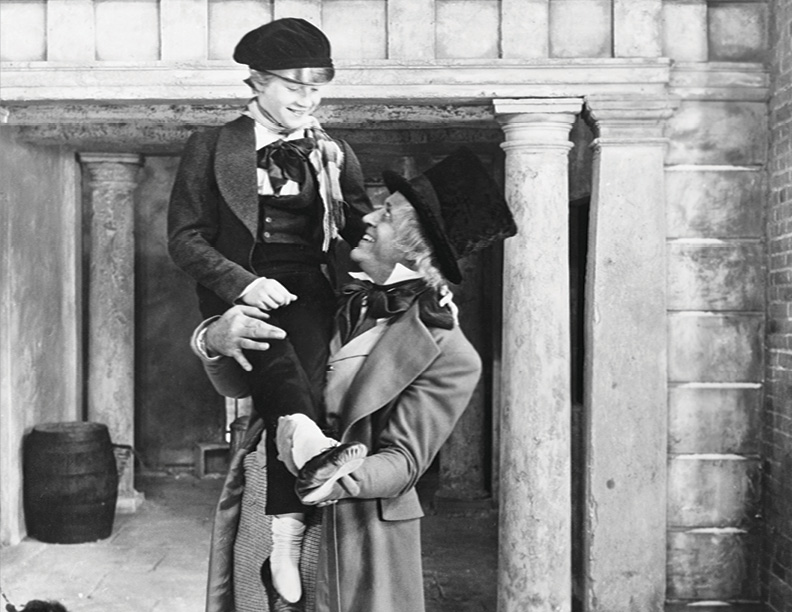
Sim as Scrooge
Alastair Sim as Scrooge – perhaps surprised at my new interpretation

In the first televised debate between Boris Johnson and Jeremy Corbyn, the now ousted Labour leader was asked what he would leave for his opposite number under the Christmas tree. His answer was very telling – mostly of Mr. Corbyn’s simplistic world-view – because he chose A Christmas Carol by Charles Dickens, saying, ”…and he can then understand how nasty Scrooge was.” As we are in the season of revisiting this 1843 story, with the BBC’s 2019  dramatisation of the story being one of the more recent productions, perhaps it is time to reconsider what A Christmas Carol really is all about, because I think Corbyn, and many with him, has failed to understand that the story of Scrooge’s redemption, far from being a rebuke of private wealth, is in fact a celebration of a consumerist Christmas; a hymn to capitalism and spending money, and the happiness you gain from consumption rather than hoarding.

The story of A Christmas Carol is well known. Scrooge the miser is visited by four ghosts on Christmas Eve, three of whom show him Christmas past, present and future, and as a result, Scrooge is reformed from greedy, grabby miser to generous benefactor. 

We tend to emphasize the transition from meanness to liberality in Scrooge’s attitude to other people. We make it fit into a familiar complaint about Christmas: ‘oh, it’s all about consuming stuff, it’s all about buying things, it’s too materialistic, too focussed on spending, we are forgetting the REAL meaning of Christmas’. But what is the real meaning? In a secular age, the religious content is largely part of the aesthetic backdrop. Baby Jesus over here, Coca-Cola’s Santa Claus over there. 

What A Christmas Carol suggests, directly and indirectly, is that the consumption of goods and the happiness that can be had from it, is the real meaning of Christmas. The author spends 40 lines deliciously describing produce on offer in shops, then one feeble line stating that people went “to church and chapel”. The story certainly criticises miserliness, but it also, in Dickens’ masterly way, criticises the hypocrisy with which our society, steeped as it is in a derivative Christian morality of poverty as a virtue, sees the acquisition of wealth as evil, but the spending of wealth, ironically, as a great good (especially the spending of other people’s wealth, as in Corbyn’s case). 

This is beautifully expressed during the vision of the first didactic spirit, when the young Scrooge’s fiancé decides to break off the engagement because of his dedication to making money, referring to “a golden idol” having taken the place of his former love of her. 

Young Scrooge replies:

“‘This is the even-handed dealing of the world!’ he said. ‘There is nothing on which it is so hard as poverty; and there is nothing it professes to condemn with such severity as the pursuit of wealth!’”

It has been said of Microsoft founder Bill Gates that he was never so much celebrated for creating his business and making all that money, as he was for giving some of the money away. This is a modern echo of the Scrooge-story: the Old Scrooge is a miser, yes, but he is also a creator. Not only has he amassed a fortune, he has built a business that employs at least one man directly and perhaps many others indirectly by investments and financing. Mr. Cratchit, who in his toast to “the Founder of the Feast”, referring to Scrooge, shows an understanding of this. But this is not what the novella primarily celebrates, as Mrs. Cratchit’s acid response makes perfectly clear. 

893602_victorian_christmas_maxi
A Victorian Christmas – extolling the joys of consumerism

Let’s look a little closer at exactly how A Christmas Carol makes consumerism the real meaning of Christmas:

The first scene of the story is set in Scrooge’s counting house, after an introduction that leaves the reader in no doubt as to what kind of man Scrooge was: “A squeezing, wrenching, grasping, scraping, clutching, covetous old sinner!”. 

In the counting house there are two fires: a small one in Mr. Scrooge’s office and an even smaller one in the cell occupied by his clerk. The clerk is not allowed to replenish the fire on pain of unemployment. In other words, the first concrete example of the deficit of Scrooge’s character is his failure to consume more fossil fuels, thus reducing his company’s carbon footprint – perhaps old Scrooge should be a patron saint for our modern day puritans in the Extinction Rebellion movement.

His nephew enters to make the following feeble argument for Christmas: “‘…though it has never put a scrap of gold or silver in my pocket, I believe it has done me good, and will do me good; and I say, God bless it’”. Scrooge naturally, as he should, rejects this argument with one of his many (in)famous “humbug!” ejaculations.

The next to make an argument for consuming more are two gentlemen, themselves portly embodiments of over-consumption. They implore Scrooge to part with the money he has made to buy meat and drink for the poor, because, as they put it, this is a time of year when, “‘Want is keenly felt, and Abundance rejoices.’” Old Scrooge, in another of his rather pointed remarks replies, “‘I don’t make merry myself at Christmas and I can’t afford to make idle people merry.’” In other words, consuming more could have made him merry – or happy – but he doesn’t go in for that. 

After this scene there is a whole paragraph describing how the festivities are being prepared across the city, with descriptions of glowing shop windows, of poulterers’ and grocers’ doing trade as a “glorious pageant”. The Lord Mayor orders his “fifty cooks and butlers to keep Christmas as a Lord Mayor’s household should” whilst the humble tailor and his wife stir their pudding in happy anticipation. In other words, the trade and consumption of produce is creating the warm glow of happiness across an otherwise cold city. 

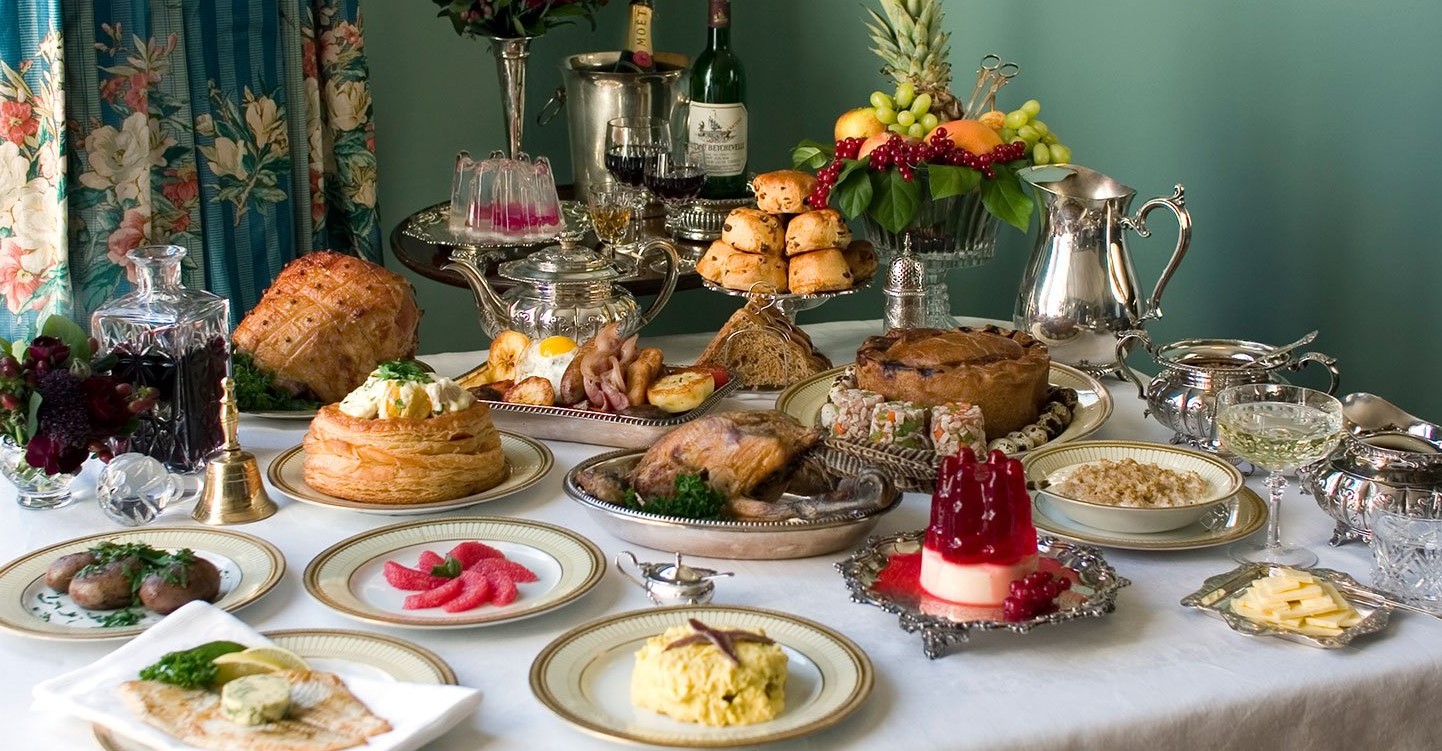
Victorian food
What Dickens might have had in mind if writing on an empty stomach

The contrast from the glowy happiness of consumer goods to the gloomy, dark house where Scrooge lives his ascetic, non-consumerist life, is stark and forms the backdrop for the visit of the first of the three didactic spirits – a strange light-emitting creature. And light is then cast upon Scrooge’s past, where his old employer, Mr. Fezziwig, as the first spirit puts it, “‘[…] has spent but a few pounds of your mortal money […]’,” to create a Christmas Eve feast of medieval proportions and abundant jollity. Then, in the next vision – one that most certainly is in breach of the General Data Protection Regulation – Scrooge is shown a scene of domestic bliss from the life of his former fiancé. Her husband, one who clearly must have worked at least as hard as Scrooge to maintain what appears to be a very large family in comfortable surroundings, enters “…laden with Christmas toys and presents.” More frivolous consumerism! 

Ghost of Christmas present

The advent of the second spirit proves even more overtly consumeristic: this is where Dickens goes to town describing consumer goods on offer; the poultry, the game, the fish, the fruit, the “broad-girthed Spanish onions, the “great, round, pot-bellied baskets of chestnuts, shaped like the waistcoats of jolly old gentlemen,” and so on and so forth for 40 consecutive, delicious lines. The depiction of eager customers “crashing their wicker baskets wildly” could have been from the Aldi Black Friday sales. The spirit shows him some humble Christmas gatherings, but the main scene of that vision is the house of aforementioned nephew Fred, where a solidly middle-class feast is held, with food and wine and furniture and a piano.

George Orwell, in his essay on Dickens from 1940, makes the point that Dickens seems to know very little about work. He says, “It is not merely a coincidence that Dickens never writes about agriculture and writes endlessly about food. He was a Cockney, and London is the centre of the earth in rather the same sense that the belly is the centre of the body. It is a city of consumers.” And goes on to say, “Everything is seen from the consumer-angle”. This is certainly true in the vision of the second spirit. 

But the story then moves to the more austere vision of the third spirit, that of Christmas Future. The two main points from that part are of course poor Tiny Tim’s death, genuinely moving in that way only Dickens can do it – as Oscar Wilde said of another Dicken’s story, ‘One must have a heart of stone to read the death of little Nell without laughing’.  The other main point is the happiness caused by Scrooge’s own death. This clinches Scrooge’s conversion, and he wakes up on Christmas morning feeling happy, merry and giddy. His first act as the born-again Scrooge is to lean out the window and engage the nearest boy to tell the poulterer in the next street he wants to buy the largest prize turkey. The next act is to donate to the charity he rejected the day before, whose purpose was to buy food and drink for the poor to celebrate Christmas. He then attends his nephew’s dinner (more consumption of food and drink). The next day, he raises his clark’s salary (increasing the money supply and therefore consumption) and instructs Cratchit to “‘Make up the fires, and buy another coal-scuttle before you dot another i, Bob Cratchit!’”. Need I say it? He is increasing his carbon footprint and destroying the lives of Swedish girls everywhere! How dare he? The story concludes with Tiny Tim surviving and Scrooge knowing “how to keep Christmas well”, and we all know what that means by now. He started spending money and it bought him happiness and friends, as even Jesus Christ said according to Luke, “…use worldly wealth to gain friends for yourselves.”

Scrooge new
The reformed Scrooge makes new friends – after he starts spending money

Apparently Dickens’ inspiration for Scrooge came when walking through a cemetery in Edinburgh, where he chanced upon a headstone inscribed with “Ebenezer Lennox Scroggie – a meal man”. Old Scroggie had amassed a fortune dealing in corn, and was actually a generous benefactor, but Dickens misread it as “a mean man” and commented in his notebook on how tragic he thought this epitaph was. It is ironic that a story so widely misread and misunderstood as A Christmas Carol, was itself begot by a misunderstanding. Fake news is nothing new, it seems.

Again I will quote Orwell, who I think got Dickens just right, writing here about Hard Times: 

…its tendency if anything is pro-capitalist, because its whole moral is that capitalists ought to be kind, not that workers ought to be rebellious. […] His whole ‘message’ is one that at first glance looks like an enormous platitude: If men would behave decently the world would be decent.

But what is “decent”? Scroggie, the Scotsman whose tombstone inspired Dickens, is said to have done more good through his business than through his philanthropy. If you merely give away all your money without investing them, no new businesses or jobs will be created. The message for this, and any, Christmas, that I would like to take away from my reading of A Christmas Carol, is therefore that money can indeed buy happiness, and that it is a natural human response to abhor suffering in our fellow men. Therefore, as you spend your money to have a modern version of the pre-Christian mid-winter Yule-feast, do so with a healthy conscience: you are buying happiness for yourself, for those who receive the presents and hospitality, for those who work in the shops, who owns the shops, who work in the factories and farms producing the goods, and in addition, giving to a charity of choice buys you a nice, warm glow of self-satisfied virtue, if you need it.

Whatever rebellious crusties say, spending money, as Scrooge discovered, makes you and everyone else happy. A very Merry Consumer Christmas to you.

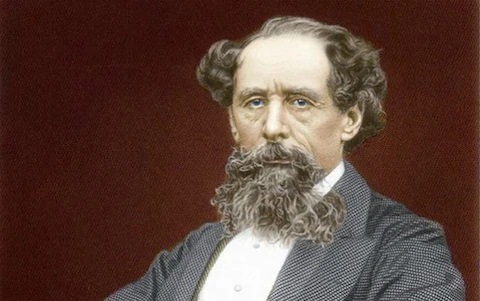
charles-dickens
Charles Dickens feeling merry

[This article was printed in the Colchester Gazette on Monday 23rd December 2019]

The Green Camper Van

By W. Hagerup

Camper van
‘It’s a pity we can’t live like this permanently,’ Tom had said.

‘We can if we really want to,’ Mary had replied.

And by this exchange the notion of a wish had planted the seed of an idea that grew to
a seedling of firm intent and eventually developed into the white barley grass of
action.

Tom had been promoted sooner than he had expected in his job in local government, and had used some of the unexpected extra earnings on a Volkswagen camper van
that he discovered he had always wanted to have. Then he had spent time and money
doing it up: it had been fitted with a gas cooking unit as well as seating and a table
that could be turned into a bed, whilst Mary had followed an online instruction video
and made curtains for the windows. The entire vehicle had been resprayed in a light
green colour and Tom, who had an artistic bent, had hand painted some flowers on the
front and sides, to complete the flower-power theme of the van.

It was coming up to the end of the two weeks in which they had traversed the
southern part of Britain, going from one camp site to the other, as well as occasionally
staying the night at some pretty spot that was not, strictly speaking, regulated for this
purpose. Those were perhaps the best nights. The night when the question that opened
this tale had been posed was indeed such a night. They had been driving along a
country lane, when a river came into view running alongside the lane. Then they
spotted a place next to a cluster of trees where they could stop, and take their chances.

And as they sat on their picnic chairs, sharing a bottle of Pinot Grigio and listening to
the river steadily getting on with it, Tom had made the remark. It was not quite
seriously meant, as he didn’t really for a moment think it was a realistic prospect. After all, they had only the previous year finally been able to buy a flat. It was
difficult to get on the housing ladder these days, and they had planned to pay it down
for five years and then try to up-scale, perhaps in time for any family increase. But
Mary was one of these people who, having no creativity herself, liked it in other
people. It was one of the reasons she fell in love with Tom. He painted, he wrote
poetry, he could play the guitar and sing tolerably well. All things that for her lay far
beyond the attainable. She had been good in maths, and all her school work had
always been just right and very neat. She had become an accountant, and wanted to
progress to auditor. Tom had ended up going into local government simply because a
position was advertised that he reckoned he could do, and with his Master degree in
Media and Art studies, he was formally qualified. The job suited him with its regular
hours and benefits-he had enough spare time to pursue some of his creative hobbies -and when a manager resigned to move to Italy, he was unexpectedly promoted. They were both appreciably happy with how it had worked out, and slightly nocent
about it too. From the uncertainty they both had felt in their twenties, their thirties had
been a time of really getting settled. Perhaps a little too settled. Tom didn’t paint any
more. He wrote no poetry, and he hadn’t tuned up his guitar for months.

‘Yeah, but…well yes, if we really want to, but I mean, we have jobs and a flat to pay
down on and…’, he took another sip of the pale wine. ‘Look, I can work anywhere. All I need is access to the accounts to work on, but it doesn’t really matter where I sit. We have several people working from home, and I am sure I could get a similar arrangement. If we let the flat it will pay for itself, and by living frugally one income is all we need as a nomadic couple.’
‘One income?’ Tom realised he would have to give up his job to go travelling in the
camper van. ‘Yes, but also, you could sell your paintings. You should do something more with your creative side. You are not getting to use it these days, are you?’ No, he had to admit he had not nurtured his creative side of late.

Mary said he could paint various scenery as they travelled along and sell them in the towns and cities they travelled through. The thought began to appeal more and more to Tom.

‘Shall we seriously look into the possibility of doing it?’ he looked at her with that
eager glint that she was so fond of.

‘Yes,’ she said, not wanting to extinguish it.

By spring of the following year Tom had resigned and Mary had managed to make
arrangements to be a remote worker. They had found a good tenant for the flat who
wanted to rent it on an annual basis. He was a freshly divorced man with a steady job. His ex-wife had taken over the house and he was too old for a mortgage, so would
be a long term renter. It was all beginning to come together and they were both very
excited. The final few nights before their new life started in earnest they spent at Tom’s
parents. The divorcee had moved into the flat, but they still had one or two things to
arrange before they could set off on the road. Tom’s father was very sceptical to the
whole idea.

‘You’re supposed to be lookin’ after her, not swanning around paintin’ whilst she’s
makin’ the money.’

The first property he had owned, the first property his family had ever owned, was the
council house he was able to buy when Thatcher gave tenants the right to buy.
‘It’s different times now, Clive. The woman can take care of the man if she wants to,’ said his wife. She felt a certain female pride that Mary would become the main breadwinner, and she also felt glad that her sensitive, creative son would be able to use his creative
talents. She had certain worries, but at least they hadn’t sold the flat, as she told her
husband. This, he also felt, was at least a good sign that they hadn’t completely lost
their marbles.

The evening before they were to set off they met up with friends and had a few drinks
to mark the occasion. Some of the friends had given her cards with congratulations on
your new home, but as Mary pointed out several times, they were not actually moving
anywhere else, they were just going to be on the road, but come back often.

Finally the first day arrived. ‘We’re not going that far,’ Mary said, reassuring herself as much as those listening. ‘Not travelling abroad or anything. Just within this country.’ Admonitions of safe driving were offered, and then the green flowery Volkswagen
camper van set off down the road.

The first few weeks were great fun. Mary had set up a Facebook page that she initially
wanted to call Our Gypsy Life, but then thought that might be an offensive term to
some. Then she wanted to call it Our Life as Travellers, but then thought that the
travellers’ community might think that was cultural appropriation, so in the end she
ended up calling it The Green Camper Van. On the page she uploaded pictures of
breakfast in the sunrise, of Tom painting in a landscape of outstanding natural beauty
and of herself doing her accounting work sitting at the table in the back of the camper
van. All her friends, and quite a few besides, followed the page. Even a journalist
from the local newspaper had seen it and did a big piece on them in the Saturday
edition, which made Tom’s father embarrassed and his mother proud. The online
following grew even more.

The first few months were fine. As summer turned to autumn they abandoned the plan
to tour the northern part of the country. Can do that next summer, they reasoned. Heading south, like migratory birds, they found that breakfast-and most other meals -had to be taken inside the camper van. It was more difficult for Tom to do any
painting, as there wasn’t really space inside the van, and using oils was out of the
question due to the smell. He was also slightly annoyed at having to rise early. Mary
had to get on and do her eight hours of accounting every day, which meant she needed
the table, and that in turn meant they had to break up the bed, so he could not sleep.

‘What was the point,’ he silently questioned, ‘of this freewheelin’ lifestyle, if I have
to rise at seven o’clock every day?’ On some days, if they had camped close to a town, Mary would go and sit in the public library and do her work there, to allow Tom to continue sleeping. He was, after all, the artist, and needed to be given some space to breath, she reasoned.

Her Facebook posts became fewer and farther between, although when, one day in four, the weather permitted them to eat their supper under the sky, this was shared. Of
course, a bad weather day could also be an occasion for an update: the two of them
snuggled under woolly blankets as torrential rain pours down outside, made for a very
pretty post, where the problem of heating the camper van was not mentioned.

The pictures she posted received lots of “likes” and were re-posted by numerous “friends”. There were comments underneath her posts. One said, ‘you are soo lucky, living the dream life I so wish I could do the same but bf not willing to try sad face’. Another was more philosophical, ‘You challenge the Western patriarchal structure of society, by Mary’s being the breadwinner, by rejecting having a fixed address, by not tying yourself to a local community. Without the tight nit structure of a traveller’s
community around you, you have cast adrift by severing the ties that bind, and in so
doing put two fingers up to the established order. Considering writing my sociology
thesis on you guys. Well done!’. Reading this last one made Mary slightly depressed. She hadn’t wanted to ‘cast adrift’ or ‘sever ties’ nor challenge anybody’s notion of society, patriarchal or otherwise. They had just wanted to perpetuate that feeling of relaxed freedom they had so enjoyed on their holiday. And isn’t that what life is all about? Feeling happy? Aren’t we supposed to constantly feel good about our life and about ourselves? Not literally always, of course. But most of the time. That is the goal, yes? No? Mary wasn’t sure any more.

She was looking at her friends’ Facebook posts. Pictures of ever smiling people. Sitting around tables at restaurants or at home. Glasses of wine, food, selfies where the persons obscured most of the objects of interest in the background, pets doing silly things, walks in the countryside; always feeling happy. She longed to be back in the flat. To go to the office in the morning, grabbing a coffee at the little kiosk by the train station, having a flick through the free newspaper. All those miserable faces that she had been so happy to escape in the first weeks of their turning nomadic. She missed them. Missed the shared miserability. Missed the relief of Fridays, as everybody seemed slightly more relaxed and some practised “dress down Friday”. She missed her co-workers in the office, even missed the office, with its nondescript “art” on the walls, sad green plants in corners and the photocopier that always played up.

They would be going to her parents for Christmas. She was considering what to
answer the inevitable questions on how things were going.

Tom had thoroughly enjoyed not having to go to work. Despite Facebook posts to the
contrary, Tom had hated his job. He hadn’t disliked his previous job too much, but
after the promotion he disliked going to the open plan office in the morning. He had
called in sick quite often without there being anything particularly the matter with him. Just couldn’t face another day of meetings, of memos, of long emails that were really
about covering one’s back, of trying to read the Guardian and having the right
opinions. He certainly didn’t want to go back to all that. Yet, this camper van life had
not quite been what he had expected either. Firstly, most mornings he had to get up
when Mary rose. Secondly, with the weather turning autumnal and then wintry, there
was little opportunity to do much painting out of doors, and inside was impossible too. He had to use acrylic paint if he was to get anything done at all, and that he felt was a
bit hobbyish. Not like proper artists, who used oil. He had never mastered water
colours, but he did consider trying to learn it properly. He tried to do some writing, poems on the road, the countryside, on being free and footloose. He had quite a few
started poems, but none quite finished. It was coming up to Christmas and they were
going to Mary’s parents. What would they think of him? He feared they might think
he was taking advantage. Mary did look a bit drawn and not quite as…polished, as
she had used to. She was always so smart and well presented. Now, her hair had not
seen the inside of a salon since before their adventure started, and her clothes were all
a bit crumpled, she didn’t really apply much make up, if any at all. She did put some
on for pictures for the Facebook page, but that was about it. That reminded him: he
had to get at least one painting finished to upload on the Facebook page. And a poem. He wondered if Mary was really happy about this life they had chosen. He knew he
wasn’t quite satisfied at the moment, but that it was better than local government. He
dreaded going back. Couldn’t do it.

It was very difficult to return to life in the camper van after Christmas at Mary’s
parents’ house. There they had enjoyed the huge log fire, seemingly burning at all
hours, a steady supply of food and drinks and warmth, warmth, warmth. Yet they both
put on a brave face when the week was over and said how they longed to get back on
the open road. ‘We’re quite the travellers now’, Mary had said, and posted on the
Facebook page how, despite having had a wonderful time with the family over
Christmas, they now longed to travel again.

They decided to buy an awning that could be attached to the camper van, and found a
camp site close to a market town in the south of England, where they could stay for
the rest of the cold season. Here they could connect to the camp site’s mains, there
were proper showers and even an inside swimming pool, for the use of the guests. The
days were quite pleasant again. Mary would rise first, go into the awning and put on
the heater, and after a little while she could start her work. Then, when Tom
eventually woke he would come and have his coffee, Mary would go and sit inside the
camper van itself, whilst Tom could paint in the awning. The awning made it almost
like a little house; a part fabric cottage. They went for walks in the area, the town was
charming, and it was almost as if they lived there permanently. Only less comfortable.

‘Do you wish to go back to how it was?’ Tom asked one evening, as they sat in the
awning and looked out on a dark, wet camp site.

‘Yes,’ Mary had replied before she had time to consider her response. ‘

Yes,’ Tom said. ‘It’s coming up to a year, we need to give notice to our tenant soon
if we want to move back in.’

‘Yes,’ Mary said again. She was thinking of what to put on the Facebook page. ‘Perhaps if we say that now the year of roving is coming to its close, we will be starting to make arrangements for our return to…normality…no, to…settled life again…no, to…again being persons of a fixed abode…yes, that sound good.’ She typed it out.

‘Yes, that is good. Let’s make it sound as if we all the time only planned for it to be a year. I mean, that is sort of what we did, isn’t it?’, Tom asked.

‘Yeah…sort of,’ Mary said, knowing that it wasn’t.

Their tenant was one of their followers on the Facebook page, having been fascinated
by the lifestyle choice they had made, and he was not happy to find out via that page
that the owners planned a return to their old home. Mary did make sure to send the formal notification within the correct time frame, but the damage was done, and the tenant left some rather sarcastic comments on the Facebook page. All their friends responded with messages of happiness to the news of their return to the settled fold, although they also expressed surprise that it hadn’t been a permanent change.

‘We sort of wanted to leave the option open,’ Mary explained, ‘but it was always
really meant to be for a year, actually.’

Believed or not, this was accepted, and thought sensible. Mary returned to her much missed office and Tom, just on the off chance, applied to be an arts teacher in a privately run school in the area. They called him in for an interview. In the course of it the topic of the green camper van came up, and it turned out the Head Master had been one of the followers of the page.

‘Oh! I so wished I could go roaming like that. The feeling of freedom must be
wonderful,’ he had said to Tom, and Tom had confirmed, but said that being a teacher
is like going on a journey, because two kids are not alike, so every day brings new
challenges, in much the same way as travelling brings you to new places.

He got the job.

The following year Mary was expecting a baby, and resented that yet again her career
will be delayed. They both had taken a silent dislike to the green camper van. Going
on a holiday in it was out of the question. They used the van for Glastonbury one
weekend, but apart from finding the music boring and the politically correct wannabe
hippiedom of the organisers tripe, it had given them all the wrong vibes. Shortly after,
Tom sold it. The year after, they were sitting in the nearby park, Tom was reading an article in the Telegraph’s Saturday paper edition, Mary was reading the Financial Times on her tablet, and little Jacob was gurgling contentedly in his pram. Tom put his paper down and said, ‘Mary, how would you like to go on holiday in a narrow boat?’

narrowboat-batteries-image1


Finder’s Keeper

MoneyThis short story came about from two things: 1. A challenge from a friend to write in the present tense, rather than the far more common, and for me comfortable, past tense. It is much more difficult than you think to write in present tense. Go on, try it!

2. A dream I had. No, seriously. I dreamt something similar to what happens at the beginning of the story. Only my dream was even weirder, which I guess is the way with dreams.

Hope you enjoy the read.

Finder_s Keeper