Charles Boni’s Paper Books

Perutz 1 (2).jpg

Grove Koger

An attractive paper edition of a Pulitzer Prize novel  marked the beginning of a short-lived venture in subscription publishing.

Charles Boni and his older brother Albert had been in the business in New York City since 1923, and in 1929 they released the first in their series of Paper Books, inexpensive reprints featuring striking covers designed by noted artist (and writer) Rockwell Kent. Their plan offered discerning subscribers a dozen books a year for the relatively modest fee of $5, with a new volume published and mailed on the 25th of each month.

The series’ editorial board included Padraic Colum, Louis Untermeyer and Kent himself, as well as several now-forgotten figures. A statement printed at the back of each volume explained the laudable intent of the series: “to place good books, well-designed and carefully made, within the reach of any reader.”

Wilder’s novel The Bridge of San Luis Rey, which had been published in its first edition by the brothers in 1927, was printed as an “example of the format” in May 1929. It was followed in September by a second volume, and then, month by month, further titles through November 1930.

Alas, the series failed after 16 selections, a victim of the Great Depression. But by then, the editors had chosen a number of estimable titles, including The Master of the Day of Judgment by Leo Perutz (illustrated above), The History of Mr. Polly by H.G. Wells, The Lost Girl by D.H. Lawrence, and Cheri by Colette—this last the French writer’s masterpiece. In retrospect, the most surprising entry in the series may have been The Cardinal’s Mistress by one Benito Mussolini, an ambitious figure destined to make his name in another, entirely unrelated field of endeavor.

Perutz 3 (1).jpg

A subsequent series from the publishers, Bonibooks, reprinted a number of the Paper Books, but was not offered by subscription.

□□□□

Pictured at the bottom are the volume’s endpapers, which I assume were created by Kent as well. 

Évora’s Megaliths

20170912_105801

Grove Koger

One of the highlights of our trip to Portugal in 2017 was a visit to Neolithic megaliths near the city of Évora in Portugal’s Alentejo region. Conducted by Mário Carvalho of Ebora Megalithica, the small tour took us to several sites, including the Almendres Cromlech, a remarkable, almost magical complex of nearly eight dozen granite stones arranged on a gently sloping hillside. Unlike the stones we had seen in Cornwall in 2016, these were heavily weathered and bore faint traces of carved drawings. The oldest have been dated to some 8,000 years ago, and the cromlech itself, which stands amidst holm and cork oaks beneath the Alentejo’s dazzling blue sky, is the largest in the Iberian Peninsula.

DSC00907

A single menhir about 14 feet high and standing nearly a mile away is apparently aligned with the cromlech, as a line drawn through it from the cromlech stretches toward the rising sun at the time of the winter solstice.

The megaliths were discovered by Jenrique Leonor Pina in 1966 and unearthed by Mario Varela Gomes in the 1980s and ‘90s.

DSC00898 (2)

The area in which the stones are found is accessible by car, assuming you know the way, but I heartily recommend booking a tour with Ebora Megalithica through the company’s site at http://www.eboramegalithica.com/index.html. And when you see Mário, say hello for Maggie and me!

□□□

I discussed Évora along with several attractive destinations in Portugal’s southernmost region, the Algarve, in “Blessed by the Sun,” which appeared in the November-December issues of the late lamented Laguna Beach Art Patron and Palm Springs Art Patron magazines.

□□□

If you’ve enjoyed today’s post, please share!

James Riley’s Sufferings

001 (9a)

Grove Koger

As I noted in my January 7 post, my book When the Going Was Good is now out of print. I hope to complete a second edition, but in the meantime I plan to post revised and updated sections here. Today’s entry deals with a harrowing and influential book published in 1817 by James Riley, who died at sea on March 13, 1840.

□□□

An Authentic Narrative of the Loss of the American Brig “Commerce,” Wrecked on theWestern Coast of Africa, in the Month of August, 1815. With an Account of the Sufferings of Her Surviving Officers and Crew, Who Were Enslaved by the Wandering Arabs on the Great African Desart, or Zahahrah; and Observations Historical, Geographical, &c., Made During  the Travels of the Author, While a Slave to the Arabs, and in the Empire of Morocco;  Preceded by a Brief Sketch of the Author’s Life; and Concluded by a Description of the Famous City of Tombuctoo, on the River Niger, and of Another Large City, Far South of It,  Called Wassanah; Narrated to the Author at Mogadore, by Sidi Hamet, the Arabian Merchant; With an Arabic and English Vocabulary (Hartford, Conn.: Published by the author, 1817)

Born in Connecticut a year after the American Revolution, James Riley went to sea at the age of fifteen. He quickly rose through the ranks, commanding his own ship by the time he was twenty and trading (albeit with indifferent success) as far away as Europe, the West Indies and the eastern coast of South America. In 1815 he secured command of the brig Commerce, first visiting New Orleans before sailing east for Gibraltar and southwestward along the coast of Africa.

002 (12)

Although Riley intended to take on a cargo of salt in the Cape Verde Islands, the Commerce ran aground in late August on the forbidding northwest coast of Africa near Cape Bojador, today in the Moroccan-occupied territory of Western Sahara. The survivors cast off in the ship’s boat, but on going ashore a few days later they were captured by Arabs who stripped them and carried them off into the desert. Subsequently a trader returning from Timbuktu purchased five of the survivors, including Riley, and ransomed them to the British consul in the port of Mogador in southern Morocco. In the three months since their shipwreck, the men had been marched a thousand miles and reduced to skeletons, “squalid and emaciated,” their hair and beards crawling with vermin.

6206750185_97459be418_o (2)

Riley was urged to publish his account of his ordeal, and when the result appeared in 1817, it became a best seller, going through numerous editions and revisions and making its author famous in the process. A plainly written recital of great adversity and sweet redemption, the Narrative also included much material of anthropological interest about a virtually unknown corner of the world. Like many American readers, Abraham Lincoln counted it a favorite, and it is thought to have molded the future President’s attitudes toward slavery.

□□□ 

The most readily available edition is an abridgement published by Clarkson N. Potter as Sufferings in Africa: Captain Riley’s Narrative (New York, 1965) and reprinted by Lyons Press (New York, 2000). Oddly enough, its introduction by G.H. Evans makes statements about Riley’s early life clearly contradicted in the text.

Relying upon his father’s journal and manuscripts, W. Wilshire Riley compiled an account of Riley’s subsequent life and career. Published in 1851, it was entitled Sequel to Riley’s Narrative: Being a Sketch of Interesting Incidents in the Life, Voyages and Travels of Capt. James Riley, from the Period of His Return to His Native Land, After His Shipwreck, Captivity and Sufferings Among the Arabs of the Desert, as Related in His Narrative, Until His Death.

Dean King’s Skeletons on the Zahara (Little, Brown, 2004) is based on Riley’s account as well as another published in 1817 by able seaman Archibald Robbins, A Journal, Comprising an Account of the Loss of the Brig “Commerce,” of Hartford (Con.) James Riley, Master, upon the Western Coast of Africa, August 28th, 1815; Also of the Slavery and Sufferings of the Author and the Rest of the Crew upon the Desert of Zahara, in the Years 1815, 1816, 1817; With Accounts of the Manners, Customs, and Habits of the Wandering Arabs; Also, a Brief Historical and Geographical View of the Continent of Africa.

003 (1)

If you’ve enjoyed today’s post, please share!

The Tears of Chios: Mastic and Mastika


20180304_153149

Grove Koger

I’ve been fascinated by mastika— or mastiha, as it’s sometimes transliterated into English—ever since my first wife and I visited the little settlement of Ierepetra in southern Crete in the 1970s. A small group of travelers had gathered in our hotel room for a party, and when we ran out of ouzo, I was delegated to buy more. Well, it was late and the light in the little grocery was dim and apparently I was a little dim myself, because when we passed around the new bottle, we had an unpleasant surprise. What we tasted wasn’t the liquoricey ouzo we anticipated but a strange concoction that, on close examination, turned out to be—mastika. 

The flavor was so unusual that I became obsessed with it, and over the years I gathered as much information as I could about it and the mastic that gives it its flavor. My essay “The Tears of Chios” is the fruit of that obsession. It appeared originally in Illuminations: An International Magazine of Contemporary Writing for Summer 2013, and was reprinted online by The Island Review on December 18, 2014.

Since I wrote the essay, I’ve revisited Greece several times and have revised my somewhat harsh opinion of mastika. On our most recent visit to Athens, Maggie and I sampled a liqueur being served in the lobby of our hotel. Intrigued by its unusual flavor, I was astonished to learn that it was—you guessed it—my old acquaintance, rendered much more palatable with the addition of what I suspect was honey.   

The Tears of Chios

Of all the disasters to have befallen Greece over the past few years, the fires that swept across southern Chios in 2012 were certainly not the worst. Yet they and the destruction they left in their wake are strikingly emblematic of the dangers that Greece faces in the opening years of the twenty-first century.

Chios is a mountainous island in the eastern Aegean that lies within sight of the Turkish mainland. It has passed through the hands of a succession of invaders—Persians, Romans, Byzantines, Venetians, Genoese, and Ottoman Turks—and was the scene of two terrible calamities in the nineteenth century. The Ottomans slaughtered tens of thousands of Chians during an uprising in 1822, an atrocity that rallied worldwide public opinion behind the eleven-year Greek struggle for independence and inspired Eugène Delacroix to paint his famous Scène des massacres de Scio. Chios would not become part of the modern nation of Greece until 1912, but in the meantime it suffered another devastating event—an earthquake in 1881 that may have claimed another ten thousand victims.

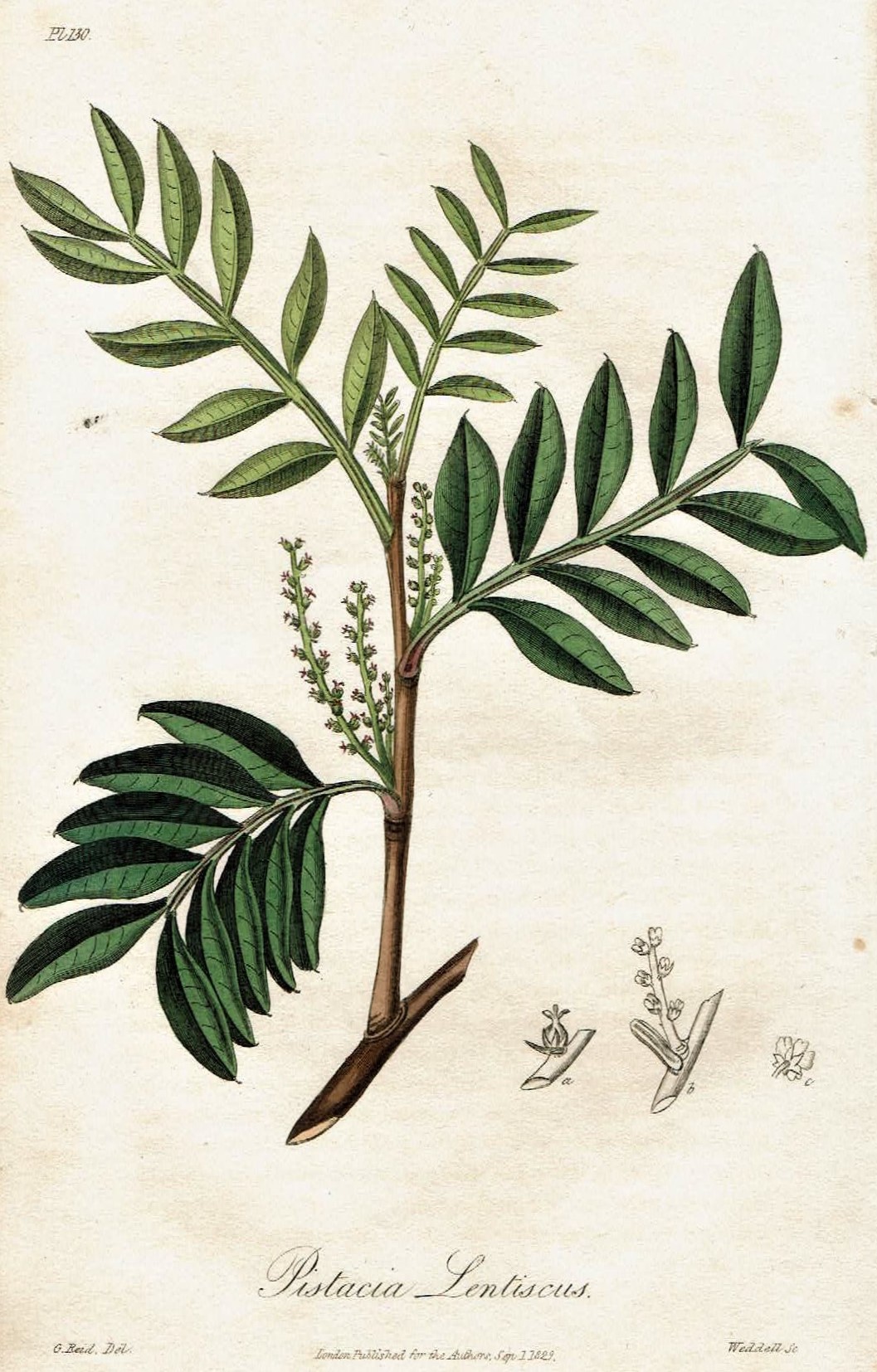
It was the Genoese, relatively benign rulers of the island from the mid-thirteenth through mid-sixteenth centuries, who organized and encouraged the widespread cultivation of Pistacia lentiscus. An evergreen that rarely grows higher than fifteen feet, the tree thrives throughout the Mediterranean region, but it is only in southern Chios and an adjacent stretch of the Turkish coast that it yields drops of the aromatic resin known as mastic.
001 (9)

□□□

Legend has it that Saint Isidore of Chios, a Roman naval officer, professed his Christianity to his commander while on the island and was subsequently beheaded when he refused to renounce his faith. At his death, the mastic trees growing in the southern part of the island are said to have begun weeping—hence the fact that you may still hear mastic drops referred to as “tears.” Today agronomists speculate that the area’s microclimate and its dry, limestone-rich soil are responsible for the aberration.

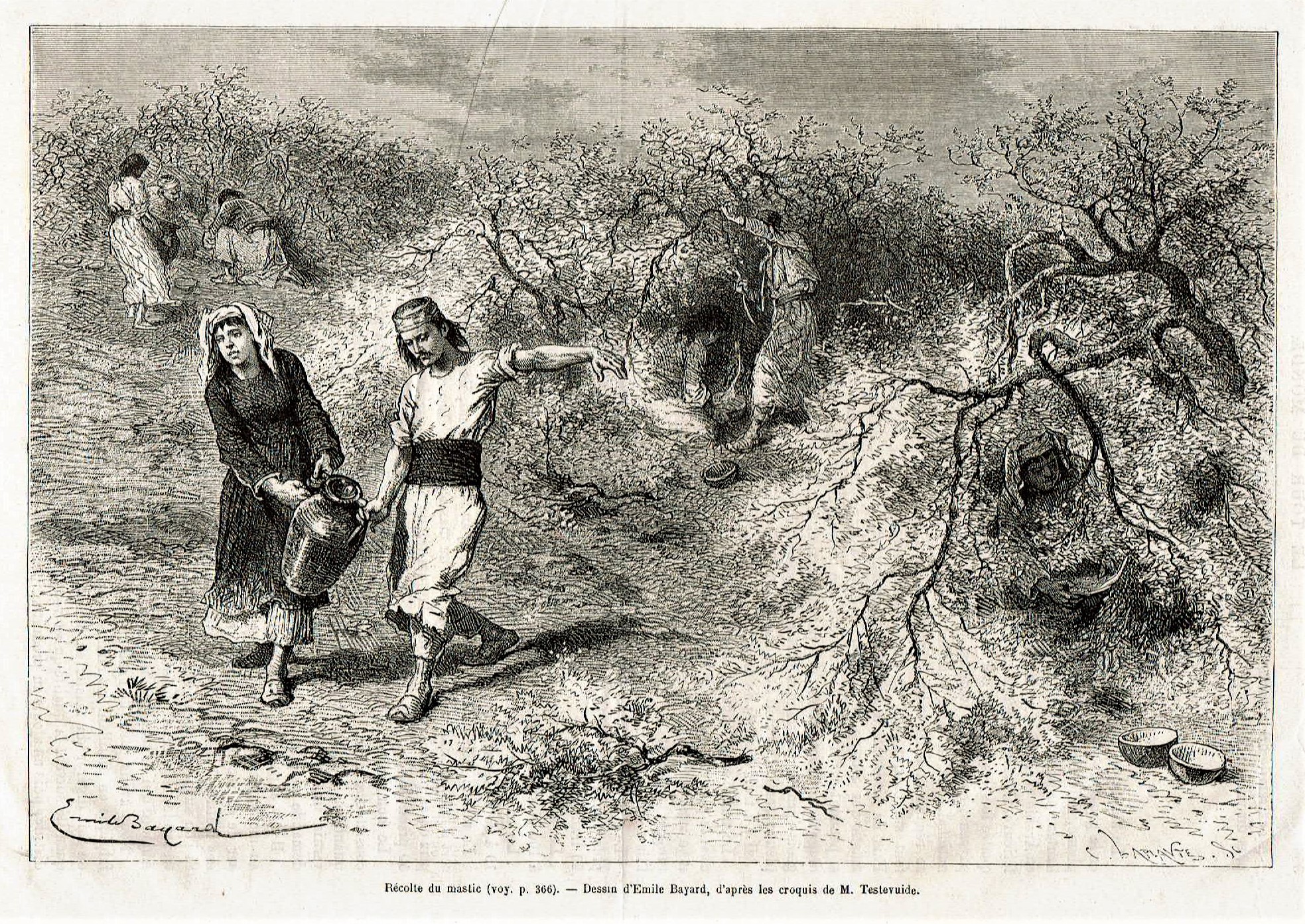
Mastic production is concentrated around some two dozen mastikahoria, or mastic villages, in southern Chios. Pruned and fertilized every winter, the plants begin producing mastic when they are about five years old. At that point villagers clear the ground beneath the trees and cover it with white clay. Then, over the course of the summer, they make multiple incisions in the branches. The resin seeping from these incisions falls to the ground and hardens over a period of fifteen to twenty days, after which the drops are collected in baskets, cleaned, and sorted.
002 (9)

Harvesting mastic is exhausting work involving methods that have scarcely changed over the centuries, but the substance is a precious commodity that has assured the island’s prosperity. Taking its name from the Greek word mastichein, “to gnash the teeth,” it appears to have been the original chewing gum, and in turn has given us our word “masticate.” Mastic is used throughout the Balkans and the Near East in various kinds of confectionary, including “spoon sweets.” These are thick, sugary pastes flavored with fruits or spices and typically served by the spoonful in glasses of ice water. Commonly known as “submarines,” such treats are the summertime favorites of Greek children. Mastic is also used to flavor a liqueur known as mastika, and recent studies suggest that mastic oil is an effective antibacterial and antifungal agent.

Mastic is routinely described as being “piney” or even “cedary,” and is something of an acquired taste in whatever form you sample it. In Reflections on a Marine Venus, his account of the two years he spent on the eastern Aegean island of Rhodes after World War II, Lawrence Durrell compared mastika to “horse-embrocation.” Yet the regional demand for mastic is great, with some 3,000 local families making a living and many more supplementing their incomes from its production. In recent years, shops specializing in mastic products have opened in larger Greek cities as well as Paris and New York City.

Ironically, the climate in which the mastic tree thrives also poses a grave threat. Although many parts of Greece experience torrential rains in fall and winter, summers are dry and are growing hotter. Wildfires burned their way across southern Chios in 1994, and according to early reports those that struck in August 2012 destroyed half of the island’s mastic trees within a few days. Due to widely broadcast scenes of rioting in Athens and Thessaloniki, tourism had already fallen to half its anticipated level on the island, and, coming as they did during Greece’s deepening economic crisis, the fires were an even greater catastrophe. However, some trees that initially appeared dead put out leaves and blossoms in 2013, and others were quickly replaced thanks to the Marfin Investment Group, which collaborated with Blue Star Ferries in purchasing 9,000 saplings from a local nursery and distributing them gratis to farmers.

For me, mastic represents a near-miracle of intense flavor drawn—perhaps “wrung” would be more accurate—from an uncompromising landscape under what are often harsh conditions. Greece itself has been involved in regional and worldwide conflicts throughout its modern history, and endured bitter civil wars during its fight for independence and after World War II. By 2013 fully a third of its citizens were living in poverty. Under the circumstances, the mere fact of the country’s continued existence seems miraculous. And so when the time comes for me to take down my bottle of mastika yet again, I’ll be tasting much more than just the resin of a strange tree from the other side of the world.

□□□

The hand-colored botanical illustration at the top of the page was engraved by H. Weddell from a drawing by G. Reid and appeared in John Stephenson and James Morss Churchill’s Medical Botany; or, Illustrations and Descriptions of the Medicinal Plants of the London, Edinburgh, and Dublin Pharmacopœias, published by Churchill in London in 1831. The engraving of the mastic harvest is by Emile Bayard after a drawing by Dr. Erhard Testevuide, and appeared in Testevuide’s article “L’Ile de Chio,” which was published in an 1878 issue of the French periodical Le Tour de monde.

□□□

If you’ve enjoyed today’s post, please share!