Later That Night …

Wells 4

Grove Koger

As I explained in my October 30 post, one of the first science fiction novels I read as a boy was H.G. Wells’ famous War of the Worlds. In addition to its classic status, it served as the basis for a famous, make that infamous, radio broadcast. The paragraphs below conclude my description of that night and discuss the event from the perspective of Idaho’s capital city. The article originally appeared in the September/October 2014 issue of Greenbelt Magazine as “A Night to Remember.”

□□□

“It’s Coming This Way”

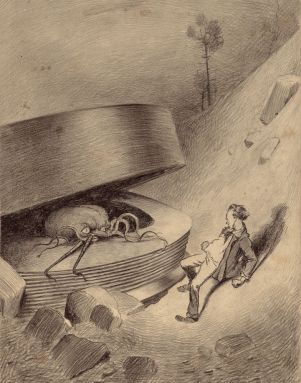
The end of the cylinder was seen to be rotating, and listeners heard the clank of a huge piece of falling metal. And then, on cue, Phillips described “something wriggling out of the shadow like a gray snake.” There was a “humped shape,” a “jet of flame” that set everything afire. “It’s coming this way now,” Phillips announced breathlessly, “about 20 yards to my right—”

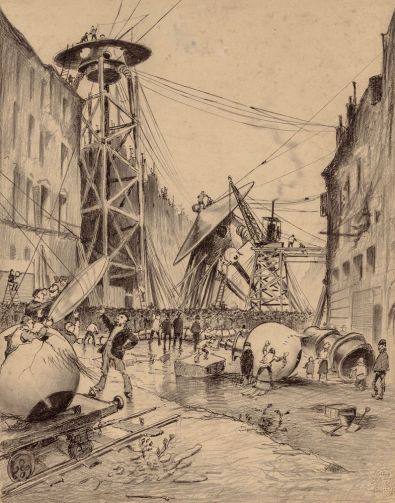
Phillips would not be heard from again, but an announcer brought on the commander of the New Jersey state militia to report that several counties in the area had been placed under martial law. There followed a series of self-assured comments from a Captain Lansing who described the scene as thousands of militiamen advanced on the cylinder. But then the captain’s voice turned anxious as he watched something rise out of the pit, something “rearing up on a sort of metal framework” and turning its heat ray upon the troops …

Meanwhile

Here in Boise, authorities were deluged with calls from worried residents. And no wonder. The program they were listening to was describing “one of the most startling defeats ever suffered by any army in modern times.” More of the mysterious cylinders had hit the earth! New York City was being evacuated as the Martians strode across the countryside in their monstrous tripods! Miraculously, Professor Pierson was back on the air, broadcasting from an empty house and wondering whether he might be the “last living man on earth.”

As the Idaho Statesman would report breathlessly the next day, “hundreds of radio listeners in Boise and vicinity verged on hysteria.” According to the paper, four of its reporters spent the hour of the broadcast trying to reassure frightened members of the public. One hysterical caller said that “hundreds of death machines” from Mars had “landed in New Jersey!” Another screamed, “They’ll be here in Boise by dawn!”

In Newark, New Jersey, hundreds of men and women were said to have run through the streets, their heads wrapped in towels and handkerchiefs to ward off the effects of the Martians’ poison gas. In Birmingham, Alabama, the pious gathered in groups to pray. Closer to home, in Concrete, Washington, the power went out during the broadcast. For a time, according to the Statesman, the town was “frantic.”

But Wait—

Unlike the Statesman, the Boise Capital News reported that radio’s “super-catastrophe” didn’t create a panic in Boise. “Those who were accustomed to listening intelligently and thoughtfully …  enjoyed the program, went off to bed and untroubled sleep.”
Wells 5

It’s difficult now to determine who was right, but studies suggest that things weren’t as bad as the Statesman claimed. In Getting It Wrong, W. Joseph Campbell argues that “most listeners … were neither frightened nor unnerved.” Instead, says Campbell, the broadcast gave American newspapers an “irresistible opportunity” to rebuke the new medium of radio, which was competing with the papers for advertisers. Much the same relationship exists today between older media and the Internet.

Just as we can’t be sure of the extent of the “panic” that October night, we can’t be sure of what expectations Wells may have had. Not surprisingly, however, his sputtering Mercury Theatre got a new lease on life when Campbell’s Soup agreed to sponsor 13 more episodes. Given the broadcast’s date—the night before Halloween, remember—it was a lucky number indeed.

□□□

The illustrations I’ve added to my article were drawn by Brazilian artist Henrique Alvim Corrêa for the 1906 edition of Wells’ novel.

A Night to Remember

Wells 1

Grove Koger

One of the first science fiction novels I read as a boy was H.G. Wells’ famous War of the Worlds. It’s never been surpassed as an account of interplanetary invasion, and I doubt that it ever will be. But among its other claims to fame, it served as the basis for a famous, perhaps infamous, radio broadcast. This article, which discusses that event from the perspective of Idaho’s capital city, originally appeared in the September/October 2014 issue of Greenbelt Magazine. Given its length, I’ll post its conclusion tomorrow.

□□□

October 30, 1938, was a cool, rainy Sunday in Boise. It was also the day before Halloween, a fact that might have raised suspicions about what took place that night. But as events unfolded with ever-increasing rapidity, it must have been difficult to think clearly.

“Merely a Coincidence”

Radio listeners who had tuned in a few minutes late to The Mercury Theatre on the Air may have been intrigued to hear a report that “several explosions of incandescent gas” had been observed on Mars. The broadcast then returned to a program of dance music, but was interrupted again by another announcement. Listeners should stand by for an interview with one Professor Pierson, a “noted astronomer” with the Princeton Observatory.

Shortly afterward commentator Carl Phillips began his interview with Pierson, who was apparently at that very moment staring through a huge telescope at the red planet. He assured Phillips that while the chances of finding intelligent beings on Mars were a “thousand to one,” he could not account for the explosions.

At that point someone handing a message to Pierson, who examined it and then helpfully passed it on. At 9:15 PM Eastern Standard Time, Phillips read aloud, a seismograph had registered a “shock of almost earthquake intensity” near Princeton. The professor speculated that the shock was probably due to a meteorite of “unusual size” and dismissed its arrival as “merely a coincidence.”

Things were starting to get interesting …

Mr. Welles and Mr. Wells

What many listeners failed to note was that the director of The Mercury Theatre, a 23-year-old American named Orson Welles, was staging a dramatization of The War of the Worlds by British writer H.G. Wells. As it turned out, the novel proved ideal for the director’s purposes, although he moved its setting from England to the east coast of the United States.

Even now, decades later, one sentence that Welles adapted from the novel’s opening stands out. “Across an immense ethereal gulf,” he intoned ominously, “minds that to our minds as ours are to the beasts in the jungle, intellects vast, cool and unsympathetic, regarded this earth with envious eyes and slowly and surely drew their plans against us.”

Of course if you had tuned in late, as many listeners had, you would have missed the explanation. (And you may not have noticed that “Professor Pierson” sounded a lot like Orson Welles.) Some 40 minutes into the program there was a brief announcement identifying the dramatization for what it was, but by then there was plenty of cause for alarm.

Wells 3

It seems that a “huge, flaming object” had landed near Grover’s Mill, New Jersey, where Phillips had driven with Pierson. Half-buried in a pit was a “huge cylinder” that the ever-helpful Pierson estimated to be about 30 yards in diameter. There was a crowd that the police couldn’t contain. There was a “curious humming sound” that seemed to come from inside the cylinder. Then there was a scraping sound.

TO BE CONTINUED

The marvelous illustrations I’ve added to my article were drawn by Brazilian artist Henrique Alvim Corrêa for the 1906 edition of Wells’ novel.


A Westerner in Tibet

Neel

Grove Koger

As I expand and update When the Going Was Good, I’m posting revised entries from the first edition. Today’s deals with a volume by Alexandra David-Neél, who was born Louise Eugénie Alexandrine Marie David on October 24, 1868. 

□□□

My Journey to Lhasa: The Personal Story of the Only White Woman Who Succeeded in Entering the Forbidden City (New York: Harper, 1927)

Fascinated as a girl by the adventure novels of Jules Verne, Alexandra David routinely ran away from home. She “craved, “she wrote, “to go beyond the garden gate … and to set out for the unknown.” An inheritance allowed her to visit India and Ceylon (now Sri Lanka), but when it was exhausted she turned to the theater, which allowed her to continue her travels, and finally journalism, which allowed her to travel even more. She married Philippe Neél de Saint-Sauveur in 1904, but quickly came to an amicable arrangement that allowed her to live apart while he paid for her travels and helped arrange publication of her writings.

In 1912 David-Neél interviewed the ruler of Tibet, the Dalai Lama, then temporarily in exile in Sikkim in northern India. Explaining her long-standing interest in Buddhism and her desire to visit the Dalai Lama’s homeland, officially closed to outsiders, she received the advice “Learn Tibetan.” This she did, and managed to slip into the country briefly in 1914 and again in 1915. Subsequently expelled from India, she worked her way east to China and, circling back, northeastern Tibet, where she studied in a monastery off and on for three years. It was from here that David-Neél set off for the Tibetan capital of Lhasa in 1921, although she was forced to follow a roundabout course that took her into Mongolia and through eastern China.

It was only in October 1923, in the passes where China, Burma, and Tibet meet, that David-Neél began her final push. And it is here that her account, My Journey to Lhasa, begins. The traveler was disguised as a poor arjopa, or pilgrim, and was accompanied by a Sikkimese monk pretending to be her son. The book treats their arduous trip through the harsh Tibetan winter as if it were one of Verne’s more thrilling novels, complete with narrow escapes and humorous asides. (At one point David-Neél’s companion warns an aged couple that the goat they are mistreating will be a man in the next life and that the three will “meet again.”) David-Neél finally reached the Forbidden City in February 1924, the first Western woman to do so, and remained there two months incognito. She returned to France a hero, and thanks to this and her many other books is revered as one of the principal interpreters of Buddhism to the Western world.       

□□□

My yellowing Penguin edition of My Journey to Lhasa, illustrated above, dates from October 1939 and includes an introduction by Dr. A. D’Arsonval, member of the Adadémie des Sciences, the Adadémie de Médecine, etc. If you’re looking for a good modern edition, the 1986 Virago (London) and Beacon Press (Boston) editions include an introduction by noted popular historian Peter Hopkirk, while the 1993 Beacon Press edition includes a foreword by Tenzin Gyatson, the Fourteenth Dalai Lama, and an introduction by Diana N. Rowan. David-Neél also wrote With Mystics and Magicians in Tibet (1932) and Tibetan Journey (1933).

□□□

The literature on David-Neél is extensive, and includes Tiziana and Gianni Baldizzone, Tibet: Journey to the Forbidden City: Retracing the Steps of Alexandra David-Neél (Stewart, Tabori & Chang, 1996); Barbara Foster and Michael Foster, The Secret Lives of Alexandra David-Neél: A Biography of the Explorer of Tibet and Its Forbidden Practices (Overlook, 1998; rev. ed. of Forbidden Journey: The Life of Alexandra David-Neél, 1987); Ruth Middleton, Alexandra David-Neél: Portrait of an Adventurer (Shambhala, 1989); Luree Miller, On Top of the World: Five Women Explorers in Tibet (The Mountaineers, 1984); and Kenneth Wimmel, The Alluring Target: In Search of the Secrets of Central Asia (Trackless Sands, 1996).

Barcelona’s Hotel Continental

450px-Hotel_Continental_(Barcelona_-_2014)

Grove Koger

Maggie and I stayed in the elegant Hotel Continental during our first trip to Barcelona in 1998, and we’ve tried to spend at least a night or two there every time we pass through the city. It’s located on Barcelona’s main thoroughfare, Las Ramblas, near the big Plaça de Catalunya, and on our most recent visits, including this year’s, we’ve asked for a room with a balcony overlooking the busy street and its spreading plane trees. It’s a grand view—but read on …

The Continental’s history goes back more than a century, and apparently it once occupied a building next door. Its ownership changed in 1931, but in 1936, in the opening months of the Spanish Civil War, those new owners were “invited” (as the hotel puts it) to leave the building so that the besieged local government could set up new headquarters in their place. George Orwell’s wife, Eileen, lived in the Continental while her husband fought for the duly elected Spanish Republic, and he mentions the establishment several times in his vivid account of his experiences, Homage to Catalonia.

Hotel Continental

In that book, Orwell described the “pressing shortage of food” gripping Barcelona, and the Continental, in 1937: “On that Thursday night the principal dish at dinner was one sardine each. The hotel had no bread for days and even the wine was running so low that we were drinking older and older wines at higher and higher prices.”

Today, in contrast, the hotel maintains a small around-the-clock buffet that includes both wine and beer.

Hotel Continental 2

In an article I published in 2011, I called cosmopolitan Barcelona the “capital of the world.” I don’t see any reason to change that admittedly over-the-top assessment, but I realize that there are some disadvantages to the situation. Since 1972, when I visited Barcelona for the first time, it’s become one of Europe’s most popular tourist destinations, and it can now be astonishingly busy. Maggie and I had just spent two weeks of blessed calm in Majorca before returning to the city, and we found the sudden onslaught of people and cars on the Ramblas overwhelming. And yet, there we were, in the Continental, and it was good to be back!

□□□

The photo at the top of the page is by Jordiferrer and is reproduced courtesy of Wikimedia Commons. The image in the middle appeared on a travel advertisement, probably of the 1930s, and is taken from the cover of a small notebook that now sits on Maggie’s shelf. The luggage label at the bottom probably dates from a little later, and is part of my collection of travel ephemera.

Kenneth Dodson’s Naval Epic

Dodson

Grove Koger

As I’ve mentioned previously, I’ve been working for several years on a readers’ guide to maritime literature—novels, stories, plays and poems about sailing, the sea, the seaboard, and island life. I plan to call it “Sea Fever,”a title borrowed from a wonderful short poem by John Masefield. One of the entries I’ve completed is devoted to the most famous novel by Kenneth Dodson, who was born October 11, 1907, and died in 1999.

□□□

Away All Boats (Boston: Little, Brown, 1954)

Born to American missionary parents in the Portuguese colony of Angola in Africa, Kenneth Dodson moved with his family to California when he was still a child. Influenced (as so many maritime writers would be) by the writings of Joseph Conrad, he stowed away on a ship as a teenager and, after finishing high school, sailed the Pacific as a deck boy, quartermaster and master. 

Dodson commanded the freighter Cape Flattery in the early years of World War II, but soon volunteered for active duty. He went on to serve aboard the attack transport USS Pierce through nine major assaults in the Pacific campaign—experiences that would become the basis for his first and most successful novel, Away All Boats. As Robert Shenk explains in his introduction to the Naval Institute Press edition, it was during Dodson’s postwar confinement in a hospital that he decided to follow through on his long-standing dream of putting those experiences into words. As chance would have it, Carl Sandburg was given access to letters that Dodson had written his wife during the war, and the famed poet mentored the fledgling writer. (Sandburg would even use Dodson as a model for the character Kenneth MacKenzie MacDougall in his 1948 novel Remembrance Rock, and Dodson in turn gave his quietly heroic protagonist the same last name.)

Away All Boats is a highly dramatic novel, but its drama derives from the simple facts of history. If Herman Wouk’s Caine Mutiny is the epic of destroyer-minesweepers, Away All Boats is the epic of amphibious assault craft. Dodson recounts the experiences of the crew of the USS Belinda as it deploys the newfangled craft—lowered into the water at the order “Away all boats”—through the course of the Pacific war, culminating in the 1945 assault on Okinawa. From a literary point of view the work is crowded, perhaps too crowded, with characters and incidents, but ultimately satisfying in its portrayal of the grueling, sea-level realities of the struggle.

□□□

The original Little, Brown edition of Dodson’s novel provides maps on its endpapers, while the 1996 Classics of Naval Literature edition from the Naval Institute Press contains a useful bibliography in addition to its introduction by  Shenk. Unfortunately, neither includes a dramatis personae. 

Dodson’s other books include Stranger to the Shore (1956), The China Pirates (1960), and Hector, the Stowaway Dog: A True Story (nonfiction juvenile, 1958). For further information about him, see Dodson and Penelope Niven, The Poet and the Sailor: The Story of My Friendship with Carl Sandburg (University of Illinois Press, 2007).

Away All Boats was filmed by Joseph Pevney under the same title in 1956. Jeff Chandler, George Nader, Julie Adams, and Lex Barker starred.

Peter Ackroyd & Doctor Dee

Ackroyd - Dee.jpg

Grove Koger

British novelist, biographer and historian Peter Ackroyd was born October 5, 1949. This review of one of his best works originally appeared in Necrofile: The Review of Horror Fiction issue 17 (Summer 1995). I also discussed what was then another new novel by Ackroyd, The Trial of Elizabeth Cree, which has since been filmed. I’ll revise that section of my review for publication another time.

□□□

The House of Doctor Dee. London: Penguin, 1994

In a field in which many writers’ imaginative reach exceeds their grasp, British author Peter Ackroyd is an accomplished and acknowledged stylist. Not surprisingly, he began as a poet (London Lickpenny, 1973) and one with an ear for the stops and tentative starts of other people’s voices. His interest in style extends to other people’s clothes (Dressing Up, Transvestisim and Drag: The History of an Obsession, 1979). Other artists intrigue him; he has written acclaimed biographies of T.S. Eliot and Charles Dickens, and made fictional use of Dickens, Oscar Wilde, eighteenth-century boy poet (and literary fraud) Thomas Chatterton, architect Nicholas Hawksmoor, artist William Hogarth, and composer William Byrd.

For such a writer, the past is always present. Ackroyd’s novels, most of which are supernatural, might well be described as studies of the present impaled on the past. His latest works explore familiar imaginative territory with truly breathtaking results.

The House of Doctor Dee deals with the famous sixteenth-century mathematician, philosopher, and alchemist. It strongly recalls Hawksmoor (Harper, 1986), Ackroyd’s breakthrough third novel in which an eighteenth-century ritual murderer and a twentieth-century detective stalk each other down the dark corridors of time and identity. Once again, historical and contemporary figures are matched, in this case John Dee and “professional researcher” Matthew Palmer. He latter has inherited the house in question from his father, who is gradually revealed to have been a “black magician” intent, like Dee, on creating an homunculus. When we learn in addition that Matthew was adopted, we begin reading (and rereading) very carefully indeed.

Ackroyd’s sixteen-century London is a masterful creation, a lurid metropolis beneath whose odorous mud Dee searches for ancient cities. Yet Dee is oblivious to what is before his very eyes; he takes on an apprentice who poisons his wife, steals his secrets, and set his priceless library afire. He is comforted finally by a vision of his dead wife, and by his sense of another, shadowy figure who is in turn occasionally aware of him.

I’m giving away little in describing the novel’s moving conclusion, one in which the various narrative strands finally intertwine. Matthew, a young man engaged rather typically in trying to find himself, finds Dee inside himself instead, and the author of the book we are reading joins them in celebration. “Come closer, come toward me so that we may become one,” he enjoins. “Then will London be redeemed, now and for every, and all those with whom we dwell—living or dead—will become the mystical city universal.”

Ackroyd has stepped from the darkness of Hawksmoor into the light of day.