The Pearl of the Adriatic

Image

Dubrovnik 1

Grove Koger

My initial experience of Dubrovnik came in 1972, when my first wife and I were heading down the Adriatic coast of what was then Yugoslavia on our way to the Greek island of Corfu. Approached from the sea during the afternoon, the city can be a stunning sight, its pale ochre walls and red tile roofs glowing in the sun. But to be perfectly honest, I’m pretty sure that our ferry put into the deepwater harbor at Gruž near the northern, less picturesque side of the city. In any case, we stayed several days with a family whose house lay outside the city proper, enjoying home-cooked Croatian food and giving our amicable hosts a bottle of cherry liqueur when we departed.

Dubrovnik 5

Since then I’ve been lucky enough to revisit the city with Maggie twice, staying for several blissful days in 2005 in an apartment in a renovated house dating from 1780, the Family House Fascination. Among other attractions, the building offered several arbors and terraces as well as the only real garden left within the city walls. We sat outside with our glasses of pivo (beer) every evening, and as the sky faded to violet, the city’s swallows gradually gave way to its equally large population of bats.

Ten years later, in 2015, we revisited the city to research an article on Croatian art for Art Patron Magazine. During that period, the Pearl of the Adriatic, as it’s long been known, had grown into a tourist mecca, choked during the day with tens of thousands of foreigners like ourselves. But recently the New York Times reported that the current pandemic and the resulting drop in tourism have turned the city into a “quiet, almost unrecognizable” place. We’ll be watching to see how it recovers.

Dubrovnik 3

Dubrovnik is said to have been founded in the seventh century by Greek refugees, but evidence suggests that there had been a settlement there long before. It passed through a period of Byzantine dominance, emerged as the Republic of Ragusa, fell under the control of Venice, then of Hungary, and so on—and on. Its complicated history defies easy summary, but suffice it to say that, over many centuries, it grew into a major seafaring state.

dubrovnik 6

Besides offering a myriad architectural wonders, Dubrovnik has several good (but rocky) beaches. A few minutes away lies the attractive islet of Lokrum, where Maggie and I enjoyed an alfresco lunch under the watchful eyes of hungry peacocks and swam off the island’s rocky shoreline.

Dubrovnik 7

The image at the top of today’s post shows Dubrovnik from the sea; the second, an arbor at the Family House Fascination. Below it you see the old port as we departed for Lokrum, followed by a shot of the islet’s rocky coast. At the bottom you see one of Lokrum’s more colorful residents.

The Lone Woman of San Nicolas

Image

Blue_dolphins

Grove Koger

Today’s post reprints an article I wrote for Winter 2017 issue of the late lamented Laguna Beach Art Patron Magazine. It was a pleasure to research, and as usual on such occasions, I learned a lot. 

□□□   

The story of the Lone Woman of San Nicolas Island is actually two stories. One is a factual account of a woman who was marooned on an island off the coast of what was then Alta California, while the other is a vivid fictional recreation of the woman’s lonely plight and her evolving appreciation for the natural world. The first is frustratingly brief and ambiguous, while the second has become a modern classic.

The scene of the Lone Woman’s adventures was fog-bound San Nicolas, the most remote of the Channel Islands. San Nicolas was once inhabited by a group of people we’ve dubbed the Nicoleño, Native Americans whose numbers were decimated when Russian and Aleut fur traders began hunting the sea otters living in the island’s waters. In 1835 Catholic missionaries arranged with a schooner captain to transport the remaining inhabitants of San Nicolas to the mainland.

Blue - Map

The story might have ended there, but for some reason the seamen left one young woman behind. Did she leap off the ship when she realized that her child was not aboard? That was the story that circulated decades later, apparently with no basis in fact. What we do know is that the wind rose and the ship’s captain had no choice but to cast off and abandon the woman.

It was only after 18 years—18 unimaginably lonely years—that Santa Barbara hunter George Nidever happened upon signs that someone was living on San Nicolas. He returned with several other hunters, one of whom encountered the woman skinning a seal. She “was of medium height,” Nidever wrote, and “rather thick.” He added that “she was continually smiling,” but that her teeth were “worn to the gums.” She obligingly helped the men hunt otters for several weeks, and left with them as the ship sailed back to the mainland.

No longer “lone,” the woman lived with Nidever and his wife, but no one, not even local Native Americans, could understand a word of what she said. Nevertheless she seems to have been delighted with what she saw—including children and horses—and danced to show her pleasure.

Blue - O'Dell

Fast forward a century and we find writer Scott O’Dell approaching the end of his stint as book editor for the Los Angeles Daily News. Born in LA on May 23, 1898, O’Dell had lived in San Pedro and on nearby Rattlesnake (Terminal) Island, worked as a cameraman in Hollywood, and hobnobbed with the likes of John Barrymore and F. Scott Fitzgerald. Then in his mid-fifties, he’d published a handful of books, but none of them had set the world on fire—a situation that was to change with the appearance of Island of the Blue Dolphins in 1960.

O’Dell had first heard of the Lone Woman in the 1920s. But it was only much later, in anger at the hunters who were slaughtering “everything that creeps or walks or flies” near his house in the mountains, that he began to rework the story in a subtly different form.

O’Dell transformed the Lone Woman into Karana, who jumps ship to remain with her abandoned brother, Ramo. However, Ramo is soon killed by wild dogs, leaving Karana completely alone. Yet she perseveres, making a simple but ultimately fulfilling life for herself. She survives on shellfish but spares larger animals, realizing that “the earth would be an unhappy place” without them. Instead she tames birds and two of the dogs as her companions. When she’s rescued at last and taken to the mainland, accompanied by her animals, she can’t help but remember “all the happy days.”
Blue - Photo

The fictional story ends there, but the factual one has a much less satisfying conclusion. After enduring years of solitude, the Lone Woman died only seven weeks after her rescue, apparently from the effects of the rich food suddenly available to her. Her real name had never been discovered, but she was baptized as Juana Maria by the fathers at Mission Santa Barbara and buried in an unmarked grave in the mission’s cemetery.

Island of the Blue Dolphins went on to win Scott O’Dell a host of awards, including the prestigious Newbery Medal for the year’s “most distinguished contribution to American literature for children.” Long since recognized as a children’s classic, it’s been translated into 28 languages, and its simple account of Karana’s stoic response to her situation has inspired millions of young readers.

In 2012, after years of searching the island, Navy archaeologist Steve Schwartz discovered what he believed was the cave that the Lone Woman had lived in. What clues to her ordeal might it reveal? However, the Navy, which administers San Nicolas, has ordered the work halted in light of protests by the Pechanga Band of Luiseño Indians, who claim a cultural affiliation with the Nicoleños. That claim has been challenged, but for the moment, at least, San Nicolas is keeping its secrets.

□□□ 

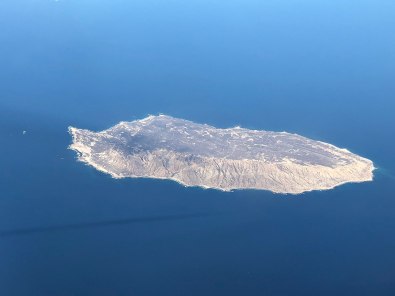
The image at the top of today’s post reproduces the cover of the first edition of Island of the Blue Dolphins. The map is reproduced from Wikipedia under the provisions of the Creative Commons Attribution-Share Alike 3.0 Unported license, while the photograph of the island is also reproduced from Wikipedia, but under the Creative Commons Attribution-Share Alike 2.0 Generic license. The portrait of O’Dell is reproduced from A-Z Quotes, which doesn’t provide any further information as to its source. 

Seeing Double(s)

Image


Sun Dogs - Nuremberg chronicles - 1

Grove Koger

As a boy growing up on a farm in rural Idaho, I spent a lot of time looking at the sky. Frequently it was because my attention wandered while I was weeding our garden or tending to the ditches that we watered our fields with. But often I was simply lying on the grass looking at the sky—a sadly underrated way of spending one’s time, by the way. I saw majestic cumulus clouds and fancied I was floating among them. I saw rainbows and I saw hawks and vultures soaring on thermals. There were fewer airplanes then, so the appearance of one was something of an event. Most were propeller planes, of course, and their soothingly distant throb doubled the pleasure of lying on the grass.

What I don’t remember seeing as a child were sun dogs. Surely they were as common then as now, but somehow they didn’t register on me. In any case, I see them frequently now, usually overhead. Sun dogs (or mock suns, as some people call them) are more technically known as parhelia. Their name meaning “beside the sun,” parhelia are bright or brightish spots in the sky at the same apparent altitude as the sun. In other words, they “dog,” or follow, the sun. They often appear as parts of a dimmer halo, and are the result of the scattering and refraction of sunlight in cirrus and cirrostratus clouds. Frequently they bear traces of color, as if they were fragments of rainbows.

Sun Dogs - 1

There’s generally nothing particularly mysterious about sun dogs, although there have been reports over the centuries of very peculiar instances that are difficult, even now, to account for. Nevertheless, they seem magical to me, and magic is hard to come by these days—like opportunities to lie in the grass and stare at the sky. They’re links to another age, hence the archaic images I’ve chosen.

These matters are on my mind at the moment because I’m shopping a chapbook I call Sun Dogs. In its basic form (which I modify frequently in order to meet publishers’ varying requirements), it’s made up of stories that involve doubling or that are inspired by mythological accounts or works created by others. One was suggested by press reports from 1942 that Ronald Reagan would be starring in a new movie called Casablanca (really!). Another involves a remote South American village in which everyone is named Borges. In another, a young man has an unsettling encounter with sirens. Yet another reviews a book recounting the real history of Ruritania. You get the idea … In fact, now that I’ve written these words, I think I need a story that’s literally about sun dogs. But what’ll I call it?

OLYMPUS DIGITAL CAMERA

The top and bottom images in today’s posts are reproduced from  Die Schedelsche Weltchronik (Schedel’s World History or Nuremberg Chronicle). The middle image is Two Mock Suns, an engraving by Frederick Rudolph (?) Hay after William Marshall (?) Craig, published by R.N. Rose, London, 1820.

Portugal’s Sweet Treats

Image

Pasteis de nata

Grove Koger

Among our happiest discoveries on our 2017 visit to Portugal were the wonderful little pastries known as pastéis de nata. We know now that they’re widely recognized as a Portuguese delicacy, but somehow we had learned nothing about them beforehand, despite having done quite a bit of research.

The name pastel de nata (that’s the singular) translates into English as “pastry of cream,” and while the little tarts aren’t much more complex than that—besides cream or milk, the custard filling includes sugar, a bit of cinnamon, and egg yolks of course—the phrase doesn’t do them justice. They’re a breakfast staple, but they’re just as good a treat later in the day, in the unlikely event that the local bakery happens to have any left.

The Portuguese seem to have derived their taste for rich pastries from the Moors, who brought recipes for sweet, egg-rich desserts with them when they invaded the Iberian Peninsula centuries ago. The pastéis themselves may have originated during the seventeenth and eighteenth centuries in convents and monasteries, institutions that raised chickens in order to supply the eggs used in clarifying wine. Or were they using the whites to starch their laundry? In either case, there was a constant surplus of yolks. Fortunately, the members of the orders found a good use for them.

york-house-lisbon

Those in the know hail the version known as pastéis de Belém as the Holy Grail of Portuguese sweets. They were created by the nuns of the Mosteiro dos Jerónimos in Lisbon’s Belém district in the early nineteenth century, and today are baked only in the shop that bears the pastries’ name. Their exact recipe is a closely guarded secret, and the few who know it have sworn never to write it down. The lucky diners who’ve tasted them, however, confirm that they’re superior to the de nata variety. Sadly enough, Maggie and I didn’t make it to Belém; Lisbon is a big, complex metropolis that would repay weeks of exploration. Next time …

We did, however, visit the small city of Évora (east-southeast of Lisbon), where we sampled a similar pastry known as queijadas de requeijão de Évora. They’re a little larger and made with sheep’s cheese, usually the variety known as requeijã. They were good, but not, I’m afraid to say, a match for Lisbon’s pastéis.

□□□

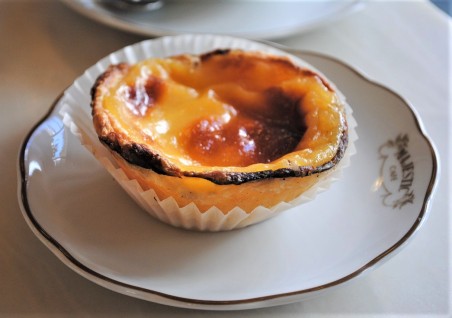
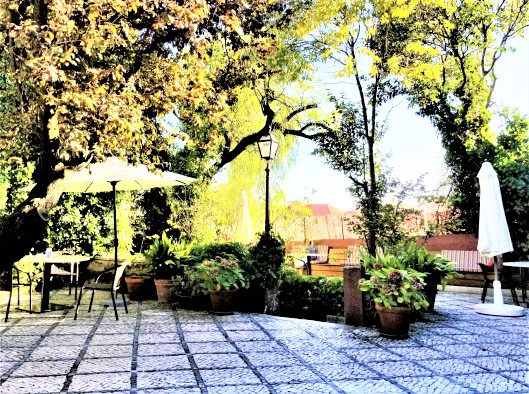
As you can see from the image at the top of today’s image (a photograph by Carolina P. reproduced courtesy of Needpix.com), pastéis are as visually appealing as they are tasty. The second image is a photograph of the courtyard of our hotel in Lisbon, the wonderful York House, a converted Carmelite convent dating from 1606. It was here that we had our fill of pastéis every morning.

I should also note that in Portuguese, a final s is pronounced sh. Therefore, pahs-tay-ish.