Compton Mackenzie’s Charlie Chaplin War

Image
Image

Grove Koger

Prolific British novelist Compton Mackenzie, who died on November 30, 1972, wrote two novels set in an unidentified “city in southeast Europe,” Extremes Meet (1928) and The Three Couriers (1929). The city is obviously Greek and is based on Athens, where Mackenzie directed counter-espionage operations for the Aegean Sea region during World War I.

According to David Stafford in The Silent Game: The Real World of Imaginary Spies (University of Georgia Press, 1988), Mackenzie “served unorthodoxly but with distinction,” although his cavalier methods and nonchalant attitude irritated his more conventional colleagues. After taking control of counter-intelligence, he transferred its office to the British School of Archaeology, and charged the school’s librarian with maintaining its rapidly burgeoning records of German agents and sympathizers. (The number of subjects eventually grew to an astonishing 23,000 “suspicious” individuals.) He gave his  three dozen or so agents the operational names of British poets, and he himself, required to choose a letter of the alphabet by which he’d be known officially, selected “Z.” He sometimes wrote his reports in blank verse.

Image

Mackenzie worked within a befuddling array of British intelligence agencies that were often at near-war with each other: MI1C, which dealt with intelligence and counter-intelligence outside the British Empire and which would later become MI6; MI5, which operated within the empire; MI2, military intelligence; and NID, the Naval Intelligence Division. His own operation was known, naturally, as the “Z Bureau.” Then there were the intelligence services of France, Italy, Russia, and Germany itself. As Mackenzie’s protagonist remarks in The Three Couriers, “This is a Charlie Chaplin war.”

To confound the situation, Greece remained neutral during the early years of the war, although its monarch, King Constantine, was the brother-in-law of the Kaiser and favored Germany. The Prime Minister, Eleftherios Venizelos, favored the allies, and had territorial ambitions as well, which the philhellenic Mackenzie enthusiastically supported. As a result, Mackenzie was able to take effective control for a time of the country’s Cyclades Islands, nudging their local rulers into alignment with the prime minister’s policies. On one particularly memorable occasion, he even commandeered a Greek royal yacht on Syra in order to make a triumphant tour of the entire group.

Of course this comic-opera situation had a dead-serious side, and both aspects are conveyed in Extremes Meet and its sequel. Their protagonist is Lieutenant Commander Roger Waterlow, who has botched his chances of promotion in the Royal Navy and is now involved in thwarting the designs of enemy agents and King Constantine himself—lampooned as “Tom Tiddler,” from the name of a then-popular children’s game. In Extremes Meet, it’s a question of delaying an enemy submarine long enough near the coast to allow the Royal Navy to sink it. In The Three Couriers, it’s a question of attempting to keep crucial military documents from being smuggled out of the country. Thwarting Waterlow’s efforts are debilitating heat, verminous insect life, the vagaries of sexual attraction, and the ineptitude of officialdom.

Image

Two factors have contributed to Mackenzie’s neglect in espionage fiction circles. The first is that the novels are hard to categorize. While they reflect the reality of his experience of the war, they’re a bit too absurd to pass as realistic fiction, but not quite absurd enough to qualify as farce. They aren’t exposes of spycraft, although they include more than a few elements of Mackenzie’s actual practice, including his naming his agents after poets. They aren’t bitter, although Mackenzie’s own experiences caused him more than a little frustration.

Another factor was the publication of W. Somerset Maugham’s collection of related stories Ashenden: or, The British Agent in 1927. Maugham’s book is generally hailed as the first work of realistic spy fiction, although I think that Maugham handles its episodic form somewhat unsatisfactorily. Nevertheless, he had a greater awareness of human frailty, which in turn contributed to his mastery of characterization, and in that aspect, Mackenzie can’t compare, at least in these two novels.

Mackenzie’s experience in Greece proved more than frustrating in the postwar years as he began publication of his memoirs, one of which, Greek Memories (Cassell, 1932) contained details of the British espionage operations in that country. Most damagingly, the book revealed the initial—“C”—used by the head of Britain’s Secret Information Services! The result was that Mackenzie was tried (in closed and truly farcical legal proceedings) under Britain’s Official Secrets Act and fined £100 plus another £100 in costs. But the former spymaster had already run up far more substantial legal bills, and was forced to sell the manuscripts of his books as well as a number of volumes from his personal library. In addition, his publisher was forced to withdraw all copies of the offending volume from publication. A censored version was released by Cassell in 1939, but the original text didn’t see the light of day until 2011, thanks to Biteback Publishing of London.

Mackenzie’s revenge was to publish a novel about espionage that was truly farcical, Water on the Brain (Cassell, 1933), but that’s another story for another day.

□□□

For more information about Mackenzie, see D.J. Dooley, Compton Mackenzie (Twayne, 1974); Andro Linklater, Compton Mackenzie: A Life (Chatto & Windus, 1987); and Leo Robertson, Compton Mackenzie: An Appraisal of His Literary Work (Richards Press, 1954). The writer’s career in espionage is discussed in Anthony Masters, Literary Agents: The Novelist as Spy (Blackwell, 1987).

□□□

The image at the top of today’s post is the jacket of the Chatto / Landmark Library edition of Extremes Meet, and the second image shows Mackenzie in uniform. The third image is an antique postcard of the harbor of Hermoupolis on the island of Syra (Syros), where Mackenzie commandeered the royal yacht.

Jack London’s Sea-Wolf

Image
Image

Grove Koger

Today’s entry from my “Sea Fever” series is about the most famous novel by American writer Jack London, who was born in San Francisco on January 12, 1876, and died on November 22, 1916.

□□□

The Sea-Wolf.New York: Macmillan, 1904

Born poor and illegitimate, Jack London nevertheless became one of the bestselling writers of his time. He packed a multitude of experiences into his forty years, and the meteoric trajectory of his rise to fame, quick deterioration, and early death seems quintessentially American.

As a youth, London raided oyster beds from his own sloop, the Razzle Dazzle, but soon switched sides and went over to the California Fish Patrol. Then he signed aboard the three-masted sealing schooner Sophia Sutherland when he was seventeen for a voyage to the North Pacific. The most immediate literary result was his “Story of a Typhoon off the Coast of Japan,” which took first prize in a contest sponsored by the San Francisco Morning Call. However, the finest fruit of those seven months was The Sea-Wolf.

Image

The creature of London’s title is Wolf Larsen, captain of the Ghost. Extraordinarily strong, prodigiously intelligent, brutally selfish, Larsen is a Nietzchean superman cursed with the bitter knowledge of his own mortality. When the Ghost picks up effete Humphrey Van Weyden after a collision in San Francisco Bay, Larsen refuses to return the youth to land, forcing him instead to sign on as a cabin boy on a sealing voyage to the Bering Sea. Under Larsen’s cruel tutelage, Van Weyden grows to manhood, while Larsen himself, apparently suffering from a brain tumor, succumbs to madness and physical paralysis.

Fast-paced, vividly realized, and informed by London’s firsthand knowledge of shipboard life, The Sea Wolf is one of the most readable of those books we call “classic.”  It’s a pity, then, that London chose to introduce a second, and highly unlikely, castaway into the company of the Ghost—young poet Maud Brewster. The character was inspired by Charmian London, whom London had met in 1900 and who became his second wife in 1905. Theirs was a full-blooded romance, but little of their ardor can be glimpsed in The Sea-Wolf. Much of the blame goes to the editor of the Century magazine, who had accepted the novel for serialization but was concerned that Van Weyden and Brewster observe the proprieties. The rest of the blame rests on London’s shoulders. Despite his socialist sympathies, he was eager for success, and promised the editor that he would include nothing “offensive.” The resulting romance is the stuff of the conventional popular fiction of the time, and is treated with noticeably less realism and intensity than the other elements of the novel.

Image

If you don’t have a copy of The Sea-Wolf, look for Matthew J. Bruccoli’s 1964 Houghton Mifflin edition. The version in the Library of America volume Novels & Stories (1982) contains notes by Donald Pizer and a text based on Bruccoli’s. There have been a number of biographies of Jack London, including Jay Williams’ Author under Sail: The Imagination of Jack London, 1893-1902 (University of Nebraska Press, 2014), and Author under Sail: The Imagination of Jack London, 1902-1907 (University of Nebraska Press, 2021). Williams has also edited The Oxford Handbook of Jack London (Oxford University Press, 2017.

□□□

The dramatic illustrations in today’s post are by W. J. Aylward and are from the first edition.

□□□

For a discussion of London’s Cruise of the “Snark,” see my post for January 12, 2020, at https://wordpress.com/post/worldenoughblog.wordpress.com/1870.

Paul Bowles’ Lyrical History

Image
Image

Grove Koger

Today’s post is devoted to a late work by Paul Bowles, who was born December 30, 1910, and died November 18, 1999. Most of the text is drawn from a review I published in the November/December 1987 issue of The Bloomsbury Review.

□□□

Paul Bowles: Points in Time (Ecco P., 1982)

Was it Gertrude Stein or Alice B. Toklas who first sent the young American Paul Bowles to Morocco? Bowles’ own accounts vary. In any case, he spent several months there in 1931. By 1934 he had visited North Africa several times, and in 1947 he returned to Morocco for good. Along the way the accomplished composer who had studied with Aaron Copland became an accomplished writer, and, before long, America’s most distinguished expatriate.

Not unexpectedly, Bowles’ adopted home figures prominently in his work. Four of his five novels are set in Morocco or neighboring Algeria, including his most famous, The Sheltering Sky (1949), as well as most of his many stories.

Image

In 1982, Bowles published a stunning new work that conveyed the inner experience of his adopted home better than any of his previous writings and brought together the composer and writer. But its publication was greeted with virtual silence; perhaps critics found the book too brief or elusive to get an easy grip on.

Points in Time consists of eleven sections, one of them all of sixty words long and a few the length (and shape) of short stories, arranged chronologically from the earliest times to the day before yesterday. The collection opens with a glimpse of Morocco’s Atlantic coastline as it must have looked to Hanno, the Carthaginian traveler who sailed through the Strait of Gibraltar and down the West African coast about 500 B.C.E. Many of the subsequent episodes explore the relationship between Moslems, Jews, and “Nazarenes,” or Christians.

Image

One of the best pieces, which is apparently based on a true incident, concerns one Andrew Layton, an English exporter living in the windy seaside town of Essaouira two centuries ago. Layton becomes involved in a fracas with some farmers and in anger strikes a woman in the face with his whip, dislodging two of her teeth. All parties are called before the Sultan in Marrakech, where Layton straightforwardly admits the crime and the farmers successfully press their demand for “precise retaliation.” What follows is pure Bowles:

Layton “had the presence of mind to ask that the teeth to be pulled be two molars which recently had been giving him trouble. The complainants agreed to the suggestion. Back teeth being larger and heavier than front teeth, they felt that they were getting the better of the bargain.

“The operation went ahead under the intent scrutiny of the villagers. They were waiting to hear the infidel’s cries of pain. Layton, however, preserved a stoical silence throughout the ordeal. The molars were washed then presented to the claimants, who went away entirely satisfied.”

Impressed with Layton’s composure, the Sultan befriends him, hoping that eventually Layton might become British Consul in Marrakech. But no, he will stay in Essaouira. “He had got used to the wind, he said.”

He had got used to the wind …

Disputes among people of various religions and nationalities, among the colonizers and the colonized, are usually settled less satisfactorily. “At night in the courtyards of the Rif, grandfathers fashion grenades. Each rock in the ravine shields a man. The Spaniard in the garrison starts from sleep, to find his throat already slashed.”

Ecco Press promoted Points in Time as a novel, a pretty elastic term that nevertheless is misleading in this case. Points in Time resembles nothing so much as a suite, a form favored by Bowles in his composing days. (There’s even a translation here of an anti-American song popular n Morocco in the 1950s.) Every word counts, and each is carefully chosen so that the effect is precisely musical, however varied the movements. In Points in Time, Paul Bowles the composer has returned to collaborate with Paul Bowles the writer to produce their most important work, a resolutely unromanticized suite morocaine drawn from that country’s extravagant history. It was worth the wait.

□□□

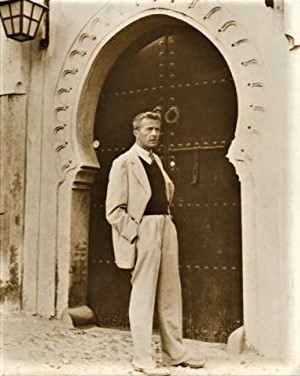
The jacket of Points in Time was designed by Cathy Saksa, and the photograph of Paul Bowles was taken in Tangier. The map of Morocco is by 16th-century cartographer Abraham Ortelius, and is reproduced in black and white on the endpapers of Points in Time; north and the southern coasts of Spain and Portugal are to the right.

Arnold Bax, Morar & Morag

Image
This image has an empty alt attribute; its file name is morar-3.jpg

Grove Koger

Hoping to free himself of distractions, the great British composer Arnold Bax made his first visit to the small village of Morar in western Scotland sometime in the winter of 1928-29, and it was there that he seems to have completed the orchestration of his ravishing Third Symphony. He wrote to his close friend Harriet Cohen in February 1929 that “this place is most enchanting when it is fine as it was this afternoon. I went down to the loch, and the silence and peace simply flooded me all through.… There was not a sound except the distant cry of a sea-gull, and now and then a whiff of peat smoke came long, and made [the] magic more wonderful.”

Image

Subsequently, says biographer Lewis Foreman, Bax “started making a regular annual pilgrimage to the west coast of Scotland in winter-time, taking the train on the wild west-coast line” and staying in an unheated room in what was then the Station Hotel and is now the Morar Hotel. He wrote part of a sinfonia concertante called Winter Legends there, dedicating the manuscript to Cohen. He was often accompanied by another close friend, Mary Gleaves, and ultimately orchestrated all of his subsequent symphonies there. “It was wonderful in the north in spite of a mantle of cloud all the time,” he wrote of one visit, adding that there had been “only two sunny days in three weeks.”

This image has an empty alt attribute; its file name is morar-1.jpg

Morar is situated between Loch Morar and the rugged Atlantic coastline, and its broad beaches are known as the White Sands of Morar. The loch itself is the fifth largest in Scotland, and, at 1,017 feet, the deepest. For what it’s worth, a number of witnesses have reported sighting a monster or “water horse” known as Morag in its waters.

Maggie and I spent several days in Morar in September 2006, and, since I’ve been fascinated by Bax’s music for decades, we made a point of staying in the Morar Hotel. A small sign in one of the upstairs hallways identifies the location of Bax’s customary room, although the space has been divided up since his time. A genial bar was tucked into one corner of the lobby, and although the windows of our room were frustratingly small (the structure was built in 1902), I’m glad to say that the room itself was heated. In any case, the hotel’s dining room offered a stunning view out over the Silver Sands and the Inner Hebrides islands of Eigg and Rùm, and one evening I split a steak with Maggie that was the best I’ve ever tasted.

This image has an empty alt attribute; its file name is morar-4-1.jpg

Another day we took a small boat trip to Eigg and Rùm and another island named Muck, enjoying yet more robust food and drink and gaining a wholehearted respect for the region’s bracing weather and its frigid seas.

□□□

Lewis Foreman’s remarks are taken from the third edition of his authoritative biography Bax: A Composer and His Times (Woodbridge, Suffolk: Boydell Press, 2007). And if you’d like to learn more about Morar’s water horse, read The Search for Morag, by Elizabeth Montgomery Campbell and David Solomon (New York: Walker, 1973). An epigraph on the book’s title page quotes an old Scottish lay as running “Morag, harbinger of Death, / Giant swimmer in deep-water Morar, / The loch that has no bottom … / There it is that Morag the monster lives.”  Maggie and I paid a visit to the western end of the loch one afternoon, but I’m sorry to say that Morag wasn’t disporting himself (or herself) within view.

□□□

You can listen to a recording of Harriet Cohen and the BBC Symphony Orchestra playing Winter Legends at https://www.youtube.com/watch?v=Teiv6ZvJkr4. And there’s a fine modern performance of Bax’s Third Symphony by the BBC Philharmonic under the baton of one of his greatest interpreters, Vernon Handley, at https://www.youtube.com/watch?v=YrEFRhA05T4.

□□□

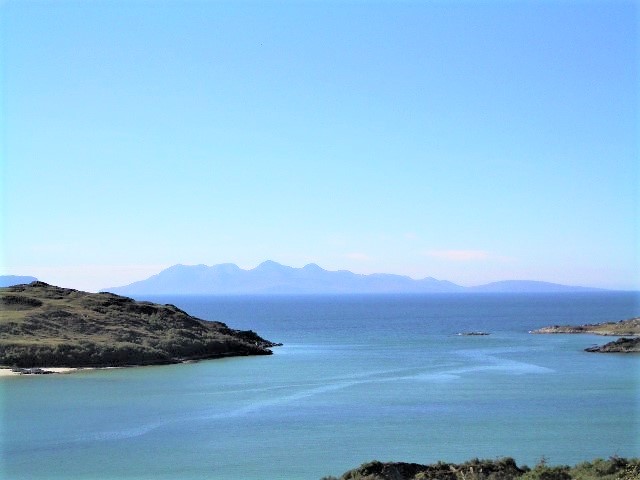
The top image on today’s post is Maggie’s photograph of the western end of Loch Morar. The Elliot & Fry portrait of Arnold Bax dates from 1926 and is reproduced courtesy of the National Portrait Gallery under a Creative Commons License (https://creativecommons.org/licenses/by-nc-nd/3.0/legalcode). The third and fourth images are Maggie’s photographs of the Morar Hotel and the view out to sea from Morar. I think that’s Rùm on the horizon.

The Smallest Political Entity

Image
Image

Grove Koger

My parents bought me a copy of John Gunther’s fat 1955 volume Inside Africa sometime in the late 1950s, and I read it with alacrity from cover to cover. I don’t remember many details, however, aside from several of the pithy epigraphs opening its 46 chapters and the mention of one specific place whose peculiarity lodged it securely in my mind.

That place was the tiny Fort of São João Baptista de Ajudá, or the Fort of St. John the Baptist of Ajuda. Gunther pointed out that it “must be the smallest political entity in the world. It lies in [the French colony of] Dahomey, on the Guinea Coast a few miles from the French post of Ouidah. The Portuguese have held it since 1680. The territory consists of nothing but the Fort, and the garrison comprises exactly one officer (who is also the Resident) and a handful of men.

Image

“My wife and I applied for visas to the Fort of St. John the Baptist, and were courteously given them by the Portuguese embassy in Washington. We were told that we were the first non-Portuguese in history ever to ask to go there.”

But did Gunther and his wife actually pay the fort a visit? Oddly enough, he doesn’t say. In any case, Dahomey annexed the mud-walled structure, which by then contained only a church and officers’ quarters, on August 1, 1961, and capured its two remaining inhabitants as they attempted to burn it down.

Image

In late 1976, travel writer and novelist Bruce Chatwin (1940-1989) visited Ouidah, in what had become the Marxist Republic of Benin, while researching a book. Early the following year, the writer found himself involved, unwittingly, in an attempted coup. Or was it a false flag operation intended to strengthen the hand of the country’s dictator? In any case, Chatwin was roughed up and jailed for a time before being freed and expelled.

The book that Chatwin was working on was The Viceroy of Ouidah (1980), a short novel whose protagonist was modeled on ruthless slave trader Francisco Félix de Sousa (1754-1849). Despite the facility of Chatwin’s writing, I can’t recommend the book, as it’s an unflinching chronicle of the appalling brutality and degradation that the anguished Kurtz called “the horror” in Joseph Conrad’s novella Heart of Darkness.

Image

I’m fascinated by enclaves, those bits of territory surrounded by other, separate states or nations, and by the idea of “the smallest political entity in the world.” But there’s no getting around the fact that Portugal was once in the forefront of the slave trade, or that São João Baptista de Ajudá, which de Sousa ran for many years, was a trading post for slaves. Slavery was abolished in Portugal’s African colonies in 1869, but the practice lived on for decades more under the guise of “contract labor.” As late as 1909. Britain’s three leading chocolate makers stopped buying cocoa beans from the equatorial Portuguese islands of São Tomé and Príncipe due to the presence of slavery.

Portuguese citizens overthrew their hated dictatorship in 1974 in a bloodless coup, and a few years later the new Portuguese government arranged with Benin to restore São João Baptista de Ajudá, with the help of Lisbon’s Calouste Gulbenkian Foundation. Today the fort houses an historical museum documenting, appropriately enough, the slave trade.

Image

The top image is a photograph in the public domain of the Fort of São João Baptista de Ajudá in 1917 from the Arquivo Histórico Ultramarino, Portugal, and is reproduced courtesy of Wikimedia Commons. The second and third images are the covers of the 1955 Harper edition of Inside Africa and the 1980 Cape edition of The Viceroy of Ouidah, while the fourth is a painting of Francisco Félix de Sousa by an unknown artist. The fifth image is a photograph taken by jbdodane of what was once the house of the fort’s Portuguese Resident and is now the Historical Museum of Ouidah; it’s reproduced courtesy of Wikimedia Commons and Flickr.