Victor Hugo, Guernsey & the Casquets Lighthouse

Image
Image

Grove Koger

Incensed by the anti-democratic policies of Emperor Napoleon III, famed French novelist Victor Hugo exiled himself for fifteen years on the island of Guernsey, one of the two British Crown dependencies in the English Channel known as the Channel Islands.

Hugo had initially taken refuge in Belgium before moving on to Jersey, the largest of the Channel Islands. But he soon found himself expelled for contributing to an anti-royalist (anti-British-royalist, that is) newspaper and moved on in October 1855 to Saint Peter Port on Guernsey, where he and his wife, Adèle Foucher, remained until 1870. While living there, Hugo purchased, remodeled, and redecorated the four-story Hauteville House, which stands on the port’s heights and which, from its handsome belvedere, offers commanding views of the port, the neighboring islands of Herm and Sark and, farther off, the island of Alderney and the French coast.

Image

It was while he was in self-imposed exile that Hugo published Les Misérables, Toilers of the Sea (which he set on Guernsey), and The Man Who Laughs. But aside from his celebrated literary works, Hugo was also a strikingly original amateur artist who produced more than 3,000 sketches. One of these caught my eye the other day on Facebook, an almost frighteningly dramatic pen and ink wash sketch of the Casquets (or Caskets) lighthouse signed “Victor Hugo / 1866.”

The rocky and notoriously dangerous Casquets lie a little more than 20 miles northeast of Guernsey. As Hugo wrote in his historical novel The Man Who Laughs, “to be wrecked on the Caskets is to be cut into ribbons.” Given Hugo’s long residence in the Channel Islands, I assumed that he might have caught sight of the Casquets on an excursion at one time or another, but I haven’t been able to trace a reference to such a visit. At the very least, he would have had access to written accounts, and the level of detail he deploys in describing the structure of his own day suggests his reliance on them:

Image

“The Caskets lighthouse … is a triple white tower, bearing three light-rooms. These three chambers revolve on clockwork wheels, with such precision that the man on watch who sees them from sea can invariably take ten steps during their irradiation, and twenty-five during their eclipse. Everything is based on the focal plan, and on the rotation of the octagon drum, formed of eight wide simple lenses in range, having above and below it two series of dioptric rings; an algebraic gear, secured from the effects of the beating of winds and waves by glass a millimetre thick…. The building which encloses and sustains this mechanism, and in which it is set, is also mathematically constructed. Everything about it is plain, exact, bare, precise, correct.”

However, Hugo’s sketch of the lighthouse reaches back to another age. The first Casquets lighthouse was built in 1724, and in The Man Who Laughs (which is set in late seventeenth- and early eighteenth-century England), Hugo described the primitive structure of that period as “a flaming pile of wood under an iron trellis, a brazier behind a railing, a head of hair flaming in the wind.”

And that’s exactly what we see in his sketch.  

Image

Hugo’s sketch of the original Casquets lighthouse is large, nearly 36 by 19 inches. The Guernsey stamp showing Hauteville House was issued in 1975, and the wood engraving of the Casquets Lighthouses as they looked in Hugo’s day dates from 1868. The map of the Channel Islands was created by Aotearoa and is reproduced courtesy of Wikipedia under the Creative Commons Attribution-Share Alike 3.0 Unported license.

□□□

If you’ve enjoyed today’s post, please share!

A Taste of Scotland

Image
Image

Grove Koger

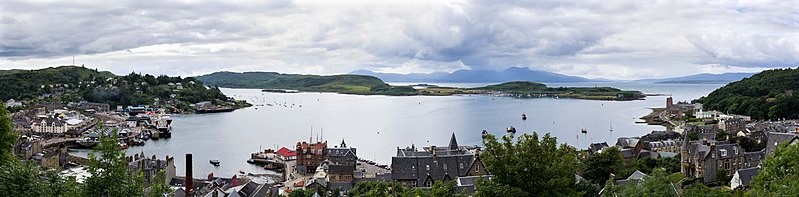
When Maggie and I reached the western Scottish port town of Oban (OH-bin) on the Firth of Lorn by train in 2006, we were on our way to Mull in the Inner Hebrides. As so frequently happens, however, the train and ferry schedules weren’t a good match, so we’d reserved a room for the night in a guesthouse. That left us plenty of time to visit one of the town’s main attractions—the Oban Distillery, which, as its owners like to point out, is only 208 steps from the waters of the Firth.

Image

The Oban Distillery is one of the oldest in Scotland, having been established in 1794 as the Oban Brewing Company by brothers Hugh and John Stevenson. The brothers’ first brew was Cowbell Ale, but they converted their brewery to a distillery within a short time and began producing scotch. The town of Oban, which borrowed its name from the distillery, wasn’t founded until 1811. 

Despite its age, Oban remains one of the smallest distilleries in Scotland, boasting only two small stills and, at the time of writing, seven employees. It draws its water from a nearby loch but buys its barley from the Burghead Maltings in the Strathspey region of northeastern Scotland.

Image

Scotch needs no introduction, and I have nothing original to say about it, aside from my impression that sampling Oban scotch in Oban itself conferred a kind of “identity” on it for me. For the first time in my life, there in that little grey granite port, the smoky, peaty beverage made sense. Since then, Maggie and I have been delighted to discover that several lounges in Boise offer Oban.  

The Gaelic word oban actually means “little bay,” so it’s appropriate that the distillery’s latest offering is Oban Little Bay, created by blending Oban scotches of different ages and then aging the blend further in a series of three small oak casks, including ex-sherry casks. Someone has given Maggie a bottle for her birthday, and I anticipate that we’ll be sampling it soon!

Image

The panorama of Oban and the Firth of Lorn (with the islands of Kerrera and Mull in the background) is by Colin, and is reproduced courtesy of Wikipedia, while the photograph of the Oban Distillery is by Ayack and is reproduced courtesy of Wikimedia Commons. The photograph of ferries in the Firth of Lorn is by Kasman and is reproduced courtesy of Needpix.com; we would have taken a ferry like one of these to Mull.

□□□

If you’ve enjoyed today’s post, please share!

The Mystery of Santa Cruz

Image
Image

Grove Koger

It’s Santa Cruz de la Mar Pequeña that I’m referring to, or Holy Cross of the Little Sea—a Spanish fort lying somewhere on the coast of Northwest Africa.

For Spain’s Africanistas, who supported a more aggressive colonial presence in Africa in the late nineteenth and early twentieth centuries, it was a reminder of their country’s early and illustrious activities on the continent.  

Image

And that takes us back to 1468 and Diego García de Herrera, a Castilian knight who controlled several of the Canary Islands, including Fuerteventura. Operating under a concession from King Enrique IV of Castile, Herrera organized an expedition to build and garrison a modest fortress and trading post—Santa Cruz de la Mar Pequeña—on the African coast that year. The fort took its name from a nearby lagoon known as the Mar Pequeña, or “Little Sea.” 

Herrera and his compatriots hoped to take advantage of the trans-Saharan trade, establish a fishing station, and, as they had decimated the Canaries’ indigenous population, procure slaves to work on the islands’ sugar cane plantations.

Image

When Herrera died in 1485, Santa Cruz was abandoned, only to be rebuilt by Alonso Fajardo in 1496 as a direct possession of the Castilian monarchy. It was attacked two years later by Portuguese troops (apparently in league with Herrera’s widow), and although it survived, its demise finally came in 1524 when it was sacked by forces of the Saadi dynasty of Morocco. By then, Spanish colonial interests had shifted to the New World, and the country’s attention returned to Northwest Africa only in the mid-1880s, when Spain began establishing modest trading posts and forts along the coast of what would become the colony of Rio de Oro.

This image has an empty alt attribute; its file name is santa-c-4.jpg

However, the exact location of Santa Cruz de la Mar Pequeña had long since been forgotten. Although there was little reason to think so, Spanish authorities decided that the site lay near the coastal Moroccan settlement of Sidi Ifni, northeast of Rio de Oro, and in light of this dubious identification, Spain eventually established the tiny colony of Ifni there.

More recently, researchers have finally identified the ruins of the fort, farther to the southwest and opposite Fuerteventura, near the extensive Naila Lagoon in what’s now Morocco’s Khenifiss National Park. Dr. Mariano Gambín García describes the discovery in his book La Torre de Santa Cruz de la Mar Pequeña (Le Canarien, 2015).

Image

The image of the top of today’s post (by D.C. Alvarez Dumont) appeared in “Intereses Españoles en Marruecos” in the weekly Madrid periodical La Ilustracion Española y Americana XXXII (1882), and makes what was then the accepted identification of Sidi Ifni as the site of the fort. Its caption reads (in translation) “Mouth of the Ifni River, where Santa Cruz de Mar Pequeña is located. Section of the coast. Customs of the Berbers. Outpost of the caravan of Timbuctu, parading before the ruins of the tower of Herrera (Burg-el-Rumi). Sidi Ifni shrine and graveyard.” The postage stamp from Spanish Sahara (as Rio de Oro eventually became known) was issued in 1961, and the map of the Canary Islands and the nearby African coast dates from 1823. The striking photograph of the lagoon in the Khenifiss National Park is by TarfayaMedia and is reproduced courtesy of Wikimedia Commons under the Creative Commons Attribution-Share Alike 2.0 Generic license.

□□□

If you’ve enjoyed today’s post, please share!
California’s Eucalyptus Culture(s)

Image
Image

Grove Koger

One of the high points of my writing career was my involvement with Art Patron Magazine, which began publication as Laguna Beach Art Patron Magazine but soon added a Palm Springs edition. Publisher and creative director Christine Evangelides Dodd hired me to copy-edit, proofread and fact-check, but before long I started writing for every issue and eventually graduated to assistant editorship. Today’s post is a shortened version of an article that appeared in the Summer 2017 issue of Palm Springs Art Patron Magazine.

□□□

Were eucalyptus trees a good idea? A bad idea? Over the past few decades, Californians have had sharply differing opinions about them, but they certainly seemed like a good idea at the time.

That time was California in the 1850s, when so many of the new state’s forested acres had been stripped of trees for fuel and construction. In other parts of California, the naturally spare landscape struck newcomers as barren and uninviting. As Jared Farmer notes in his fascinating Trees in Paradise, it was about then that W.C. Walker’s Golden Gate Nursery of San Francisco started selling the seeds of a new and unusual tree—the eucalyptus.

Image

Eucalypti are natives of Australia and thereabouts, but of course countless species now grow in California. One in particular, the Tasmanian blue gum (Eucalyptus globulus), is common in the lower elevations, and its blue-green color and menthol odor are familiar to most of the state’s residents. They’re also giants to be reckoned with. The largest one in California—and the nation—is growing in the Lost Coast community of Petrolia. It’s 141 feet high, 49 feet in circumference, and has a spread of 126 feet.

We can’t be certain, but when nurseryman Walker planted some of those seeds himself in 1853, he may have been the first person in the state to do so. In any case, he hoped to harvest much more than firewood and timber from the exotic trees. Their leaves would yield a medically valuable oil and their flowers a bumper crop of honey. Walker’s optimistic fellow Californians followed suit over the following decades, with encouragement from the federal government. The Timber Culture Act of 1873 specified that homesteaders put a minimum number of their acres in trees, and the fast-growing eucalypti were an obvious choice.

Image

Not coincidentally, California was filling with human newcomers as well, including the men and women who would become its most prominent artists. One of them, Italian-born San Franciscan Giuseppe Cadenasso, became famous for painting eucalypti. Initially the works drew ridicule, but after his death in 1918, the San Francisco Bulletin remembered him as “the first California artist to catch the mystic beauty of the eucalyptus tree with a facile grace and atmosphere entirely his own.”

Farther south, George Rogers bought 155 acres in the early 1880s in what’s now downtown Laguna Beach, planting much of the ground with eucalyptus seed and then subdividing it a few years later. While most of the trees had been cut down by the late 1920s, the newly formed Laguna Beach Garden Club saw to their replanting.

English-born Norman St. Clair had begun living in Pasadena around 1900, but he visited Laguna on a regular basis and set up a studio there in 1903, coming to be regarded as the little community’s “pioneer” artist. At least one of his watercolors, Eucalyptus—Laguna, depicts the trees that had by then become ubiquitous. Other artists followed and were naturally drawn to the giants, which soon became as common on canvas as they were on the ground. Joseph Kleitsch painted them shading Laguna’s old post office, Granville Redmond painted them towering over meadows glowing with wildflowers, and Edgar Payne painted them rising dramatically against a backdrop of distant foothills. Perhaps the most striking example is Guy Rose’s dramatic Laguna Eucalyptus. It wasn’t long before the plein air, Impressionist-influenced painters of Southern California became known as the “Eucalyptus School.”

Image

All things considered, eucalypti haven’t lived up to their promise. Wharf owners and railway men learned early on that their timber made poor pilings and ties. On the other hand, their fallen leaves and constantly peeling bark can be serious fire hazards, as community after community has learned. The trees crowd out native species, alter soil chemistry and nitrogen mineralization rates, interfere with migratory bird patterns—it’s a litany of unpleasant facts that you’re undoubtedly familiar with. And yet …

In the century and a half since W.C. Walker planted his first eucalyptus seeds, the trees have grown to be reassuringly familiar if problematic features of the California landscape. But thanks to a generous assist from the Eucalyptus School, they’ve become something else as well, something bigger—cultural icons. A number of them even appear on Laguna’s Heritage Tree List. And unpleasant facts are no match for icons.

Image

The painting reproduced at the top of today’s post is Eucalyptus—Laguna by Norman St. Clair. It’s followed by The Drug Store (c. 1925) by Joseph Kleitsch; Eucalyptus Landscape by Edgar Payne; and Laguna Eucalyptus (1917) by Guy Rose. All are in the public domain in the United States.

□□□

If you’ve enjoyed today’s post, please share!