Colin McPhee, Bali & the Gamelan

Image
Image

Grove Koger

Chances are you’ve never heard of Colin McPhee, but if that’s the case, you have an aural treat in store.

Born in Montréal, Canada, in 1900, McPhee studied at Baltimore’s Peabody Institute, where one of his professors was Edgard Varèse. The avant-garde composer would play an important role in McPhee’s development, but more important still was McPhee’s wife, Jane Belo, whose inherited wealth allowed the couple to travel.

Image

McPhee and Belo visited Indonesia (then the Dutch East Indies) in the 1930s and eventually settled in a village on the island of Bali. There they befriended a cosmopolitan group of dancers, composers, anthropologists (including Margaret Mead), and ethnologists drawn to the island’s rich culture. Belo herself concentrated on photographing and filming Balinese life, while her husband studied the island’s music, particularly the ensemble of largely percussive instruments known as the gamelan.

Image

McPhee’s “discovery” of gamelan music, which is common throughout much of Indonesia, was decisive. Before visiting Bali, he had been fortunate enough to hear a recording of a typical gamelan piece. As he later wrote of the experience, “the clear, metallic sounds of the music were like the stirring of a thousand bells, delicate, confused, with a sensuous charm, a mystery that was quite overpowering.… I couldn’t imagine what type of a culture could produce music like that. This was nothing that I had ever been taught to think could be music, and yet these were sounds that always seemed to have been in my own mind.” Now, on Bali, he attended a gamelan concert for the first time, and in time learned to play some of its instruments.

Thanks to YouTube, you can listen to authentic gamelan performances here and here. And for a sample of McPhee’s gamelan-influenced music, you can listen to his Tabuh-Tabuhan for 2 pianos & orchestra here. According to YouTube user Gwan Go, the recording is illustrated with the works of Belgian painter Adrien Jean Le Mayeur de Merprès, “who lived in Bali from 1931 to 1957 and who married a Balinese dancer. After his death she donated his paintings to the Indonesian government, which declared their house in Sanur a museum dedicated to the paintings.”

Now that you know the context, I urge you to sit back, relax, and immerse yourself in the flow of these sonorous, sensual works.

Image

The photograph of gamelan performers in Java was taken by Gunawan Kartapranata, and the map of Bali was created by Sadalmelik; both are reproduced courtesy of Wikimedia Commons. The portrait of McPhee is by Carl Van Vechten and is reproduced from the Carl Van Vechten Photographs collection of the Library of Congress, while the striking painting you see above is by Le Mayeur.

□□□

If you’ve enjoyed today’s post, please share!

Gerald Brenan’s Andalusian Idyll

Image

Grove Koger

As I expand When the Going Was Good, I’m posting revised entries from the first edition. Today’s deals with a classic account of life in a Spanish village by Gerald Brenan.

□□□

South from Granada: Seven Years in an Andalusian Village (London: Hamish Hamilton, 1957)

The son of a British army officer, Gerald Brenan was born on the island of Malta in 1894 and grew up in various postings of the Empire. He led a bohemian youth, traveling widely if not wisely and struggling with little initial success at writing. During the Great War he won the Military Cross and the French Croix de Guerre. Demobilized in 1919, he sought “new and more breathable atmospheres” than he had experienced in class-conscious, convention-ridden England.

Image

Brenan’s quest took him to Spain, which he knew second-hand from reading and rereading George Borrow’s Bible in Spain. He was particularly interested in the Andalusian region known as the Alpujarra, lying between the Sierra Nevada and the sea. In the remote village of Yegen he found a house that, after some negotiation, he could afford, and moved into it with several thousand books in January of 1920. He was to live there off and on until 1934.

Image

Yegen proved remarkably hospitable to Brenan (neighbors provided him with food and firewood when he had no money), and he was to repay its generosity with a lyrical if candid memoir. South from Granada is a bounteous harvest of history and folklore and gossip (much of the last amorous in nature), written decades after the events it describes and distilled to the richness of a fine liqueur. But Brenan also describes visits from such Bloomsbury friends as the grandly eccentric Lytton Strachey and devotes several chapters to the Andalusian cities of Granada and Almeria, including a tongue-in-cheek account of the latter’s brothels. Brenan had failed at poetry and fiction, but his works about Spain (particularly this volume) assured him a place in English literature and Spanish culture alike. When South from Granada was finally translated into Spanish in 1974, he was feted throughout the country.

Image

If you’re looking for a copy of South from Granada, the edition published by the Folio Society (London, 1988) includes an introduction by Philip Ziegler. And for further information about Brenan, read Jonathan Gathorne-Hardy’s fascinating Gerald Brenan: The Interior Castle (New York: Norton, 1992).

Image

The book cover at the top of today’s post is from the first edition, while the portrait of Brenan (1921) and the painting Mountain Ranges from Yegen, Andalusia (1924) are by Brenan’s good friend Dora Carrington. The map, which shows Alpujarras in red, is reproduced courtesy of Wikipedia.

□□□

If you’ve enjoyed today’s post, please share!

Glimpses of Corsica

Image
Image

Grove Koger

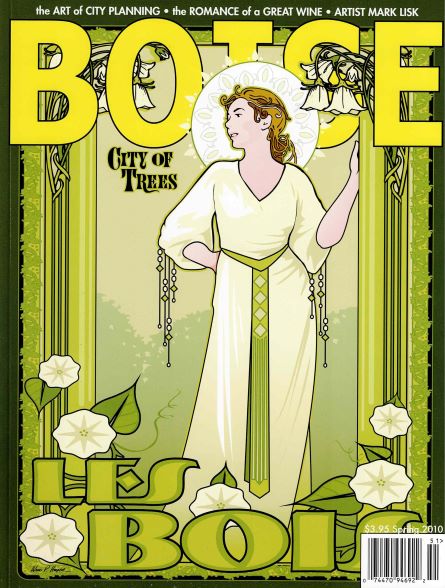
Today’s post originally appeared as part of a longer article in the Spring 2010 issue Boise magazine, edited by Christine Dodd.

□□□

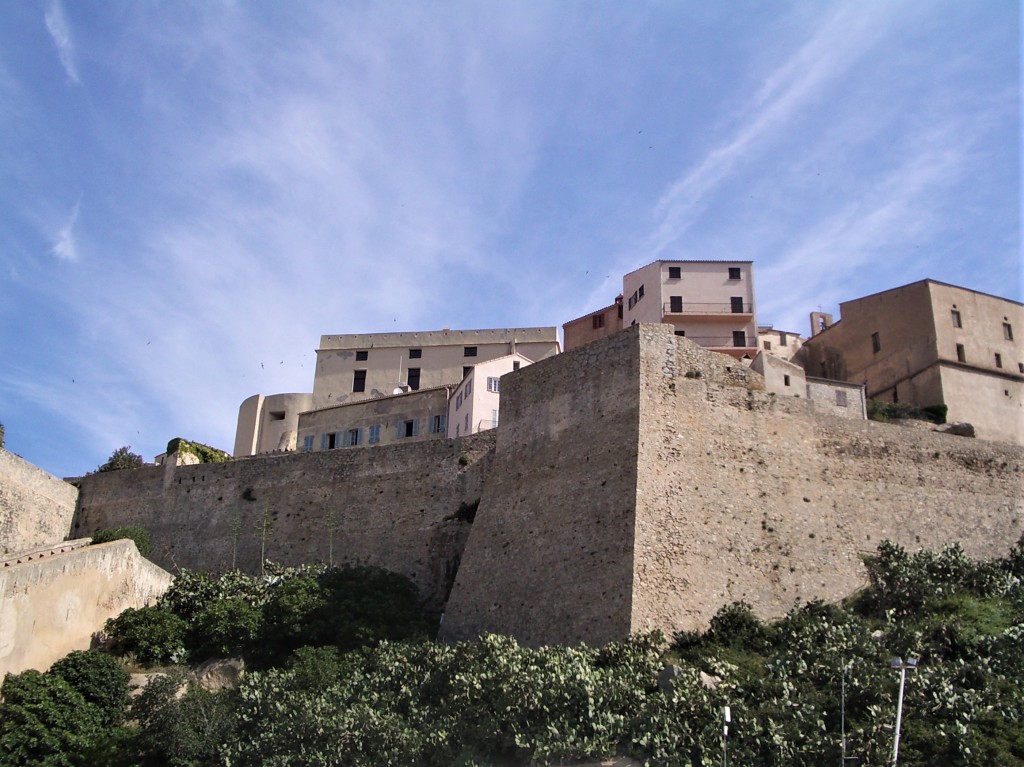
On our visit to the Mediterranean island of Corsica in 2008, Maggie and I stayed several days on the outskirts of the port of Calvi on the northwestern coast of the island. Those in the know claim that Corsica’s 200 or so beaches are the best in France, and that the Gulf of Calvi’s is the best of the lot. Broad and sandy, backed by dense stands of umbrella pine, it follows the voluptuous curve of the gulf’s shoreline for almost four miles, and, like the gulf itself, is dominated by the thirteenth century Genoese citadelle that overlooks the city.

Image

Our little hotel lay only ten minutes’ walk from the beach, and between the two stood a little open-air market, so when the afternoons grew too hot, we shopped for dinner before taking our siesta. Out front, tubs of olives and golden lupini beans glistened in the sun like jewels, while inside was a tantalizing array of individual focaccias and pizzas. Coolers at the back held white wines and bottles of Pietra, Corsica’s chestnut-based beer.

Image

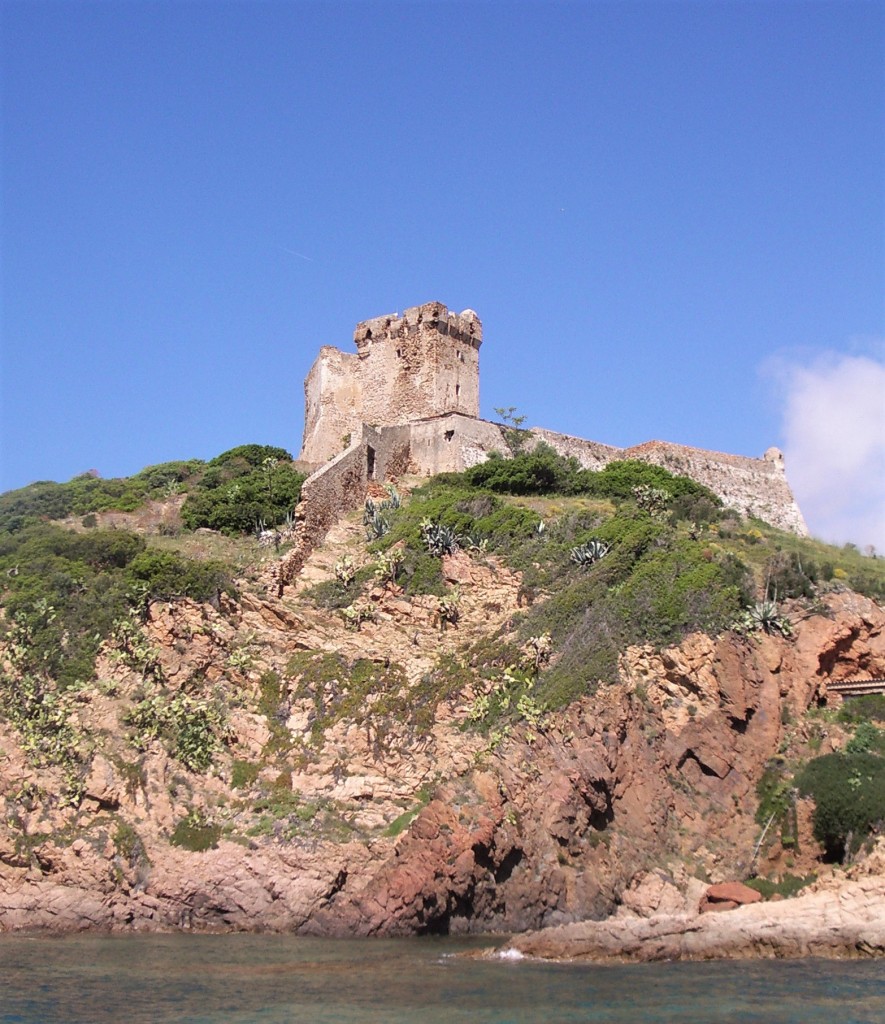
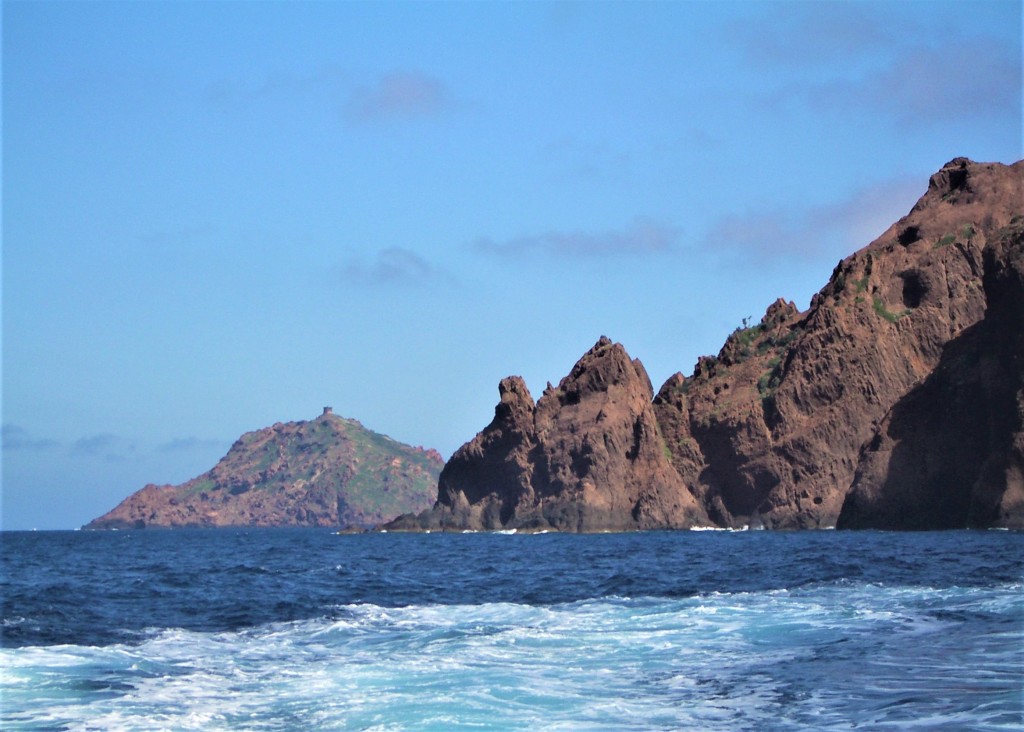
One of the high points of any trip to Corsica is a visit to Scandola, a nature reserve a few miles down the coast. Access to the reserve is limited, so the only practical means of seeing the area is by boat. Our excursion started early one morning in Calvi’s harbor and took us down a coastline that grew progressively wilder and more desolate. Here and there, Genoan watchtowers stared mutely out to sea—reminders that Corsica was part of the far-flung Genoese Empire for five long centuries. Eventually we found ourselves passing along dark grottoes and rusty red rhyolite pinnacles that towered dizzyingly, frighteningly overhead. Gulls shrieked resentfully at our intrusion. The trip had started so early, we realized, so that the little boat could take its time weaving in and out of the phantasmagoria.

Image

After a long, lazy lunch at the tiny fishing village of Girolata, we returned to the boat for a quick trip back to Calvi, where we make a stop at “our” market before settling in for the evening. The spectacular, inhuman beauty of Scandola loomed large in our minds, but we knew that another, reassuringly unspectacular pleasure awaited us. Our room lay at the back of the hotel, and while the immediate prospect from our balcony wasn’t especially noteworthya patch of lawn and a pine grove sheltering a campground—we had learned that a canal along the edge of the property was home to dozens and dozens of frogs. That evening, as the light faded and we ate our dinner, we were serenaded by a throaty, sonorous chorus warming up for the busy night of love that lay ahead.

Image

If you’ve enjoyed today’s post, please share!

Natives & Newcomers: California’s Palms

Image
Image

Grove Koger

Today’s post originally appeared in a slightly different form in the March/April 2018 issue of the late-lamented Laguna Beach Art Patron Magazine, edited by Christine Dodd.

□□□

Palm trees are such a ubiquitous feature of life and art in Southern California that the state’s residents take them for granted. But the fact is that only one species—the California fan palm—is native to the region. Known to the scientifically minded as Washingtonia filifera, they grow in scattered and sheltered oases where they have access to water. The area around Palm Springs can boast the greatest concentration of the trees in the nation.

California fan palms fascinated European-American travelers, who initially had a certain amount of difficulty in seeing them for what they were. “In the presence of these ancient desert monarchs,” wrote minister and journalist George Wharton James in his 1906 book Wonders of the Colorado Desert, “it is easy to forget the activity of American life, and all association with the occidental world, and imagine oneself in the heart of the Sahara.”

Image

In romanticizing the trees in such terms, James was overlooking a key aspect American life, of course—the life lived by the region’s Cahuilla Indians. Subsequently, in his 1914 book California, Romantic and Beautiful, he acknowledged that the Native Americans gathered “their big-pitted native dates from the palms of Palm Canyon.” The Cahuilla actually made use of almost every part of the trees—cooking and eating their pith (which they called maul pasun), gathering their fronds to thatch their roofs and weave into baskets, and filling their rattles with the trees’ dried seeds.

California fan palms became a favorite subject of artist Carl Eytel, who had traveled the region with James and who contributed more than 300 evocative drawings to the journalist’s account of the Colorado Desert. Having settled in Palm Springs in 1903, Eytel would be dubbed “the artist of the Palms,” and his painting depicting a half-dozen of the trees in an otherwise forbidding landscape, Desert near Palm Springs, hangs in the History Room of the California State Library.

Image

Another traveler-author, J. Smeaton Chase, described the trees in terms almost as romantically evocative as James’s. “Though the palm is certainly not the most beautiful,” he wrote in his California Desert Trails of 1919, “it is perhaps the most poetic of trees. In symmetry of tapering shaft, fountain-like burst of crown, and lay of glossy frond, it is the ideal of gracefulness in plant life.” Chase went on to embrace James’s geographical metaphor wholeheartedly in Our Araby: Palm Springs and the Garden of the Sun.

James had noted in his Wonders that “in the sand-hills north and west of Indio, Mr. Fred Johnson is contemplating the planting of a sunken garden of date-palms similar to those found in the oases of the African Sahara.” It was an important observation whose story had its origin a few years earlier.

Image

The Agricultural Act of 1898 had provided for employing “agricultural explorers” to travel the world in search of plants that “might be adapted to cultivation” back home. One of these explorers was Walter T. Swingle, who brought back shoots from a number of Middle Eastern date palms, including the prized Deglet Nour of Algeria. The tree’s honey-sweet fruits were already a favorite among the few Americans who could afford the high prices the imports commanded.

As it turned out, the trees thrived in the Coachella Valley, and by late 1916, an agricultural bulletin was noting that Johnson had “four 11-year-old palms that he raised from offshoots imported by the Government.” There were other growers as well, and just five years later, in 1921, Indio celebrated its first date festival. After nearly a century, the Coachella Valley remains the larger producer of dates in the United States.

Image

California’s native fan palms and Middle Eastern date palms aren’t the whole story, of course. Legend has it that Father Junίpero Serra brought Canary Island palms with him to the Spanish colony of California in the eighteenth century, and since then, newcomers have taken over. Depending on where you live, you might see any number of the hundreds of species that have been introduced here—queen palms, windmill palms, blue palms, L.A.’s signature Mexican fan palms … The list is endless. They’ve caught the attention of some of the state’s best artists, from Eytel to California Impressionist Guy Rose, from Modernists Agnes Pelton and Richard Diebenkorn to countless contemporary realists. What would life in Southern California be without them?

Image

The painting at the top of today’s post is Palms by Guy Rose. Further down you see Coachella Valley and Desert near Palm Springs, both by Carl Eytel, and a photograph of Deglet Nour dates by M. Dhifallah, reproduced courtesy of Wikimedia. The fifth image is a painting of dates by Agnes Pelton, photographed by Christy Porter from the collection of Robert and Kay Hillary.

□□□

If you’ve enjoyed today’s post, please share!