John O’Hara Visits New York

Image
Image

Grove Koger

January 31 is the birthday of one of my favorite writers, John O’Hara, who was born on this day in Pottsville, Pennsylvania, in 1905. To mark the occasion, I’m reprinting a section from a long review I wrote for the September 9, 2014, issue of the late lamented Philadelphia Review of Books, “The Way We Were: On Penguin’s John O’Hara Reissues.”

□□□

John O’Hara’s second novel, BUtterfield 8 (1935), intercuts episodes from the lives of half a dozen characters living in one of New York City’s Upper East Side neighborhoods. (The seemingly cryptic title refers to a new telephone exchange in the area.) It’s near the beginning of what we now call the Great Depression, and Prohibition is still in force. Several sections of telegraphed reportage strengthen our sense that events are random and chaotic, perhaps out of control: “On Monday afternoon an unidentified man jumped in front of the New Lots express in the Fourteenth Street subway station,” and “Mr. Hoover was on time for the usual meeting of his Cabinet,” and “Jerry, a drunk, did not wake up once during the entire afternoon, which he spent in a chair at a West 49th Street speakeasy,” and so on. Things are going to happen, we feel, and many of them are not going to be nice.

Image

The speakeasy where Jerry fell asleep was only one of what may have been an astonishing one hundred thousand to be found in New York City at the beginning of the 1930s, and a myriad of them show up in BUtterfield 8. In his introduction to the 2013 Penguin reprint of the novel, Lorin Stein refers to O’Hara’s belief that Prohibition helped turn his generation—“the losing, not the lost, generation,” in O’Hara’s formulation—into alcoholics. It also turned them into lawbreakers, and a mood of commonplace, everyday criminality seems to have infected everyone in the book.

Jim Malloy, who was O’Hara’s alter ego and who had a bit part in the author’s first novel, Appointment in Samarra, shows up again here, but the novel’s central character is Gloria Wandrous, an attractive and sexually adventurous young woman involved (intimately and otherwise) with several of the men in the book. Wandrous is both a victim and a victimizer, and is loosely based on Starr Faithfull, whom O’Hara had known slightly and who became a tabloid sensation after her body washed up on the shore of Long Island one day in 1931.

Image

Malloy, not so coincidentally, has just published his first piece in The New Yorker and is working on a novel. Here he’s described as looking as if “he were permanently drunk” and insists that although he’s “often taken for a Yale man,” he’ll always be an Irishman, a “Mick.” However, he has no real connection with Gloria, and his presence seems slightly gratuitous, even if his experiences mirror O’Hara’s own. Another character, Eddie Brunner, is genuinely in love with Gloria (who reciprocates his feelings), although O’Hara has a hard time breathing life into him. But Wandrous herself is a full-blooded creation, as vital as any character O’Hara ever created. The passages describing her abuse and her descent into promiscuity and alcoholism are among his very best, although they make for uncomfortable reading.

□□□

If you’d like to subscribe to World Enough, enter you email address below:

And if you’ve enjoyed today’s post, please share!

Urquhart Castle’s Trebuchet

Image
Image

Grove Koger

If you visit Loch Ness, as Maggie and I did in 2006, you may stay for several days in the attractive little village of Drumnadrochit. The village is convenient for one of those obligatory boat rides on the famous loch, a tour of the Loch Ness Centre & Exhibition, a visit to the dramatic ruins of Urquhart Castle, and—if you’re interested in the mechanics of medieval warfare—a close inspection of the castle’s trebuchet.

Image

As you may know, a trebuchet is a kind of large catapult capable of throwing large stones. Employed carefully and accurately, it was capable of destroying wood or even stone walls or other structures with enormous force from a considerable distance.

Image

While trebuchets are indeed medieval weapons, Urquhart Castle’s example was built by several dozen members of the Timber Framers Guild—a group “dedicated to promoting, supporting, honoring, and advancing the craft of timber framing”—in 1998. Utilizing what was apparently a design from a thirteenth-century manuscript, the group fashioned a Douglas fir log into the weapon’s 26-foot arm and used oak for the rest of the structure. The 8-ton counterweight (which you can see clearly at the bottom of the arm in our second photograph) was made of lead, while the stones the trebuchet was designed to throw weigh 250 pounds apiece. I understand that if actually utilized, the weapon could hurl stones some 200 yards at a speed of 127 miles per hour. Rolling wheels (in this case inscribed with Celtic patterns) would prevent the structure from lurching violently when in use.

Image

The name Drumnadrochit, by the way, is something of a mouthful for non-Scots. The village grew up adjacent to a bridge over the River Enrich, and its name is derived from the Scottish Gaelic phrase Druim na Drochaid, or the “Ridge of the Bridge.”

Image

If you’d like to subscribe to World Enough, enter you email address below:

And if you’ve enjoyed today’s post, please share!

Quenching Versailles’s Thirst

Image
Image

Grove Koger

Some time back I happened across a painting by one Pierre-Denis Martin titled Vue de la Machine de Marly. I had never heard of Monsieur Martin, or Marly, or the Machine de Marly, but I was intrigued, so I made a note of the painting and did some research.

Pierre-Denis Martin, it turns out, was a French painter of historical subjects and the like who lived from 1663 to 1742. The Machine de Marly, or Marly Machine, that he painted in 1723 (and that you see at the top of today’s post) was a massive water-lifting and pumping station built on the banks of the Seine some 7.5 miles from Paris. And Marly itself, or more precisely Marly-le-Roi, was the site of a reservoir that was part of this complicated water-supply complex.

Image

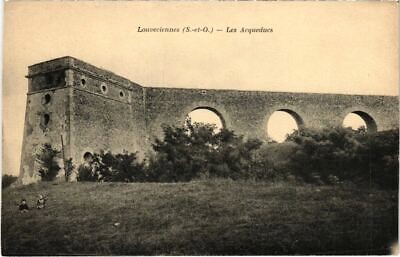
The machine featured 14 waterwheels, each of them more than 39 feet in diameter, designed to draw water up in buckets from the river. In turn, several series of suction and treading pumps forced the water farther up the bank to several series of catch basins, eventually depositing it in the Aqueduct of Louveciennes (seen above in a vintage postcard), for a total vertical rise of some 500 feet. The aqueduct then carried the water to the vast Palace of Versailles and the nearby Château of Marly. Oddly enough, there’s precious little groundwater beneath Versailles, hence the need to transport such an enormous amount to feed the palace’s many, many fountains and jeux d’eau, or water features.

The devilishly intricate Marly Machine was the work of hydraulics engineer Arnold de Ville, whose employees took seven years to complete the project. King Louis XIV was present at the machine’s inauguration in 1684. Although I mention above that the complex fed the fountains at Versailles, I don’t mean that it fed them adequately, for, as impressive as it was, the Machine de Marly simply couldn’t supply enough water. As if to make up for that inadequacy, it was extraordinarily noisy, as everyone living near it could attest.

□□□

If you’d like to subscribe to World Enough, enter your email address below.

And if you’ve enjoyed today’s post, please share!

Return to Antikythera

Image
Image

Grove Koger

In reviewing a list of last year’s most important stories in archaeology, I’ve learned that yet another important artifact was recovered from the famous Antikythera shipwreck a few months ago.

Antikythera is a small Greek island lying between western Crete and the Peloponnese Peninsula, and it’s not likely that anyone outside of Greece would have heard of it if it weren’t for a shipwreck off its coast dating from the First Century BCE. Known, naturally, as the Antikythera Shipwreck, it’s famous for the discovery in 1901 of pieces of what’s regarded as the world’s first astronomical calculator. This extraordinarily intricate mechanism could be used to calculate the motions of the planets and the moon, as well as the positions of the constellations of the Zodiac, and in terms of sophistication is regarded as being a thousand years ahead of its time.

Image

But the Antikythera Mechanism isn’t all that’s been found, although naturally it’s captured most of the attention. The most recent discovery, which took place in mid-2022, involves the large, corroded marble head of a figure believed to be that of Hercules. If that identification is correct, it probably belongs to a headless statue, Hercules of Antikythera, recovered more than a century ago from the shipwreck and now on display in Greece’s National Archaeological Museum in Athens. Until last year, the head had lain hidden under several massive boulders covering part of the wreck. (Interestingly enough, the position of those boulders seems to be a mystery.)

Over the past few decades, underwater archaeologists have been able to carry out their work at the site using increasingly sophisticated techniques. The current series of explorations, “Return to Antikythera,” is being conducted by the Swiss School of Archeology in Greece and runs until 2025, so stay tuned.

Image

The photograph of the marble head at the top of today’s post was taken by Orestis Manousos and is reproduced courtesy of the Hellenic Ministry of Culture and Sports and the Swiss School of Archaeology in Greece. The photograph of the Antikythera Mechanism is ours, and the photograph by Jimmyoneill of the harbor of Potamos on Antikythera in the evening is reproduced courtesy of English Wikipedia.

□□□

If you’d like to subscribe to World Enough, enter your email address below:

And if you’ve enjoyed today’s post, please share!

At Sea with the Compañia Trasmediterránea

Image
Image

Grove Koger

January 1 is the anniversary of the day in 1917 that a noted Spanish ferry company began operation. Formed from the merger of several older companies the previous year, Compañia Trasmediterránea held a monopoly for decades on routes between the Spanish mainland and the Balearic Islands (Majorca, Minorca, and Ibiza), the Canary Islands, and the Spanish cities of Ceuta and Melilla on the North African coast. For several decades, when land transportation was more of a challenge, the company also ran ferries between various cities on the coasts of mainland Spain. An itinerary for 1929 I bought years ago lists, for instance, routes between Barcelona and Cádiz, between Bilbao and Málaga, and so on.

At one time, the company also scheduled ferries to the colonies of Spanish Sahara and Spanish Guinea, as well as to the Italian port of Genoa and the English port of Portsmouth.

Image

My first wife and I took a Trasmediterránea ferry from Barcelona to Ibiza in the 1970s, and we had vague plans to book a trip aboard another one of its ships to Spanish Sahara by way of the Canary Islands. The territory was essentially off-limits to non-Spaniards without governmental permission, but when the time came to apply for the necessary papers, we had run out of energy. Shortly afterward, Morocco invaded the territory and has occupied most of it—in the face of international condemnation—ever since. I think we all understand that you can’t step in the same river twice, but there are too many rivers that we never step in even once.

In the early years of this century, Compañia Trasmediterránea was purchased by a consortium of other companies and now operates officially under the name Acciona Trasmediterránea. And somewhere along the line, it’s added a connection to Rome’s port of Civitavecchia.

Maggie and I have taken the company’s ferries to Majorca and Minorca several times over the past two decades. The ships are bigger and faster than they once were, but they’re no longer quite as elegant; they’re simply a means of transportation. But they continue to offer opportunities to savor those twin enigmas, departure and arrival, to their fullest.

Image

The images of the stock certificate, schedule, and company logo in today’s post are reproduced from my collection of travel memorabilia.

If you’d like to subscribe to World Enough, enter your email address below.

And if you’ve enjoyed today’s post, please share!