The Erl King & His Kin

Image
Image

Grove Koger

Halloween may be behind us, but as our nights grow longer and darker and colder, I can’t help thinking of the darker strains of folklore and literature.

One of the darkest of these strains involves the Erl King (or Erlking or Erlkönig), a malignant being who steals children. The basis of the story seems to be an old, old Danish ballad known as “Elveskud,” which, in one version or another, involves a man whose encounter with elves ends badly.

Most modern forms of the story derive from Johann Wolfgang von Goethe’s ballad “Erlkönig,” which the writer originally included in his light 1782 opera Die Fischerin. Here, a father goes out riding one dark night with his young son, only to encounter the Erl King, who steals away the child’s soul, leaving his body lifeless. (The image at the top of today’s post is the fatal ride as imagined in 1911 by Julius von Klever.) The ballad has been set to music numerous times, most famously in an 1815 piece by Franz Schubert. Thanks to YouTube, you can hear a performance (and read an accompanying English translation) with Philippe Sly and Maria Fuller here. Franz Liszt, in turn, arranged Schubert’s piece for piano solo in 1838, which you can hear in a bravura performance by Yuja Wang. (Liszt revised his arrangement in 1876, but I can’t tell you which one the pianist is playing.)

Image

And on and on the settings go, although the horror of Goethe’s dark ballad tends to get lost over time. And it’s that horror that we need to keep in mind, for, during the centuries in which the story arose, most couples were forced to rely on their children to care for them in old age and to carry on their bloodline. The loss of a child was a disaster on many levels.

Image

There are quite a few close approximations of the Erl King story in folklore, and they constitute what we might call the Stolen Child Motif. The most famous of these is probably the story of the Pied Piper of Hamelin, who took his revenge on the townspeople who refused to pay him for luring their rats away by luring their children away instead. (The 1881 interpretation you see above is by James Elder Christie.) Goethe wrote a version, “Der Rattenfänger,” in 1803, as did the Brothers Grimm (Jacob and Wilhelm) in their 1816 collection Deutsche Sagen.

A later version of the motif, dating from 1870, is “The Child That Went with the Fairies” by Irish writer Joseph Sheridan Le Fanu. Here, several children living “eastward of the old city of Limerick” encounter a colorful antique coach drawn by four horses, accompanied by disturbingly “diminutive” attendants, and carrying a beautiful lady and her Black female companion. The story is particularly memorable for a brief passage that absolutely defies reason. I won’t describe it, because it relies for much of its power upon shock, but you’ll find it near the end.

Image

The most recent literary iteration of the story I’m aware of, and by far the most sophisticated, is Michel Tournier’s 1970 novel Le Roi des Aulnes, which was translated by Barbara Bray and published as The Erl King. It was the first novel ever chosen unanimously for the Prix Goncourt, and put its author in contention for the Nobel Prize. In it, a misshapen, simple-minded French mechanic, pigeon-keeper, and apparent pedophile named Abel Tiffauges is taken prisoner by the Nazis during World War II. However, he finds the experience liberating, particularly when he is given the task of recruiting boys to become soldiers—a project in which he believes that he is fulfilling his true destiny. But Russian troops are advancing inexorably from the east and Germany is collapsing …

The Erl-King is a dark and uncomfortable book, and it brings home the horror of the old story like no other version. And that’s the way it should be.

□□□

If you’d like to subscribe to World Enough, enter your email address below:

And if you’ve enjoyed today’s post, please share!

Fikret Amirov, Elmira Nazirova, and Their Alluring Concerto

Image
Image

Grove Koger

Partnerships among composers of popular music are fairly common, but they seem to be much less so among classical composers. It’s not that unusual for one classical composer to write a set of variations on another composer’s theme (Rachmaninov’s Rhapsody on a Theme of Paganini, for instance), but for two to work together is rare.

The only instance that I can think of readily is the Concerto for Piano and Orchestra after Arabian Themes by Fikret Amirov (1922-1984) and Elmira Nazirova (1928-2014).

Image

If you don’t recognize the names, they were both from Azerbaijan, and Amirov in particular is regarded as one of his country’s leading composers. And for those of you not up on your geography, Azerbaijan is a Turkic nation on the western shore of the Caspian Sea, and was part of the USSR until 1991. (See the map below, reproduced courtesy of Wikipedia.) It has a rich musical heritage stretching back centuries, onto which cultural officials overlaid Western classical forms during the Soviet era. Toward the end of that era, Amirov himself emerged as a major force in Azerbaijani music, and his “symphonic mugams,” which blended Western and traditional elements, were widely performed within the country and abroad. You can listen to one of the best, Azerbaijan Mugam no. 2 (Kyurdi Ovshari), as performed by the Houston Symphony Orchestra under the baton of Leopold Stokowski, here.

Image

One of the reasons I think of the Amirov-Nazirova concerto is that it’s one of those rare mid-twentieth century works that classical music audiences can readily enjoy. In addition, it’s an outstanding argument for partnership in composition. As Anastasia Belina explains in her notes to Naxos CD 8.572666, Amirov wrote it “in collaboration” with Nazirova (whom she identifies only as a “prominent Azerbaijani pianist,” although she was a composer in her own right). Belina adds that the concerto “was inspired by Amirov’s trip to several Arab countries, where he was struck by how often he heard … melodies and rhythms that were very close to his native Azerbaijani music.” He recorded the melodies and subsequently combined them “within the framework of the traditional European [concerto] genre.”

Whatever the collaboration actually involved, the result is an alluring and passionate piece that’s been performed many times, as the number of videos on YouTube suggest. Aside from the Naxos version, my favorite dates from 2019 and features Khatia Buniatishvili on the piano and Rauf Abdullayev conducting the Orchestre Philhamonique de Monte-Carlo. Abdullayev himself, by the way, was born in Azerbaijan, and Buniatishvili was born in the neighboring nation of Georgia.

The Naxos CD also includes several other works, including a more percussive but equally exciting piano concerto by yet another Azerbaijani composer, Vasif Adigezalov. I’ll talk about it another day.

□□□

If you’d like to subscribe to World Enough, enter your email address below:

And if you’ve enjoyed today’s post, please share!

Looking in on Silver Creek

Image
Image

Grove Koger

Maggie and I pay a visit to the little central Idaho community of Ketchum twice a year, usually in the relatively quiet slack season. It’s a three-hour drive from Boise, and a pretty gradual climb of 3,000 feet or so—a trip that takes us through a series of Idaho’s landscapes, including mountains and meadows and high desert. There are also several attractive stops along the way, two of which are the Camas Prairie Centennial Marsh Wildlife Management Area andjust a few miles beyond our usual route—the Silver Creek Preserve. (I love the idea of a “centennial marsh,” but let’s save that for another day.)

Image

With the encouragement and guidance of the Nature Conservancy, the Preserve began its existence in 1976 with an area of 479 acres, but today it’s grown to 881 acres (or quite a bit more than a square mile). Just as important, the conservation easements that have since been put into place mean protection for another 12,000 acres or so.

Image

On a recent trip, Maggie and I paid a short visit to the willowy, watery world of Silver Creek. We heard (but seldom saw) a few of the 150 species of birds that have been spotted in the Preserve. Coyotes and bob cats frequent the area, and—according to the Conservancy—it boasts one of the highest densities of stream insects on the continent. Those insects feed the fish that in turn attract numerous anglers, who have access to the creek at 30 locations. There are several more access points for boaters. You can learn more from Silver Creek: Idaho’s Fly Fishing Paradise by Dave Clark and Dave Glasscock (Caxton: 1997), although the book’s a bit dated at this point.

It’s easy for me to overlook the marvels lying in my own backyard, and our visit to Silver Creek was just the kind of reminder that I needed.

□□□

If you’d like to subscribe to World Enough, enter your email address below:

And if you’ve enjoyed today’s post, please share!

Britain’s Greek Empire

Image
Image

Grove Koger

November 5 is the anniversary of the establishment of the United States of the Ionian Islands.

Despite what their name might lead you to think, these United States were actually a British protectorate, and operated for most of their existence—from 1815 to 1864—under the terms of a British-approved Constitution.

There are seven major Ionian Islands scattered down the western coast of Greece, from Corfu (or Kerkyra) in the north, opposite the Greek border with Albania, to Kythira, off the southern tip of mainland Greece. There are also a number of islets, including Antikythira, which lies about 24 miles southeast of Kythira itself.

Image

The Ionian Islands are generally referred to as a group, but given their geography and particularly the great distance between Kythira and the other islands, I think it’s more accurate to think of them as a string. Some sources, including the Ionian Environment Foundation, refer to the six northernmost islands—Corfu, Paxos, Lefkada, Ithaca, Kefalonia, and Zakynthos—as an archipelago. It’s a classification that makes sense, as they lie more or less closely to each other. 

The islands were controlled by the Republic of Venice from 1363 to 1797, by France for a few subsequent years, by a Russo-Turkish alliance (during which the islands were known as the Septinsular Republic) for a few more years, and by France again for a few more years still. During the early nineteenth century, the British navy defeated the French navy in a number of battles and went on to seize several of the islands, eventually capturing Corfu itself in 1814.

Image

Finally, on November 5, 1815, according to the terms of the Treaty between Great Britain and Russia, Respecting the Ionian Islands, a British protectorate—the United States of the Ionian Islands—was established. (If you’re paying attention to the broader picture, the treaty was one of several signed during the 1815 Peace of Paris.) A constitution providing for a locally elected Parliament that would advise a British Lord High Commissioner of the Ionian Islands went into effect a little less than two years later.

Britain instituted a number of welcome reforms, including freedom of the press and the use of modern Greek in all public and legal proceedings. An Ionian University was established, along with Greece’s first botanical garden. The British also introduced cricket, tsitsibira (lemon-flavored ginger beer), and postage stamps. Once mainland Greece established its independence from the Ottoman Empire in 1830, however, sentiment for union with Greece naturally grew. After considering the situation for three decades, during which time it resorted to imprisoning and exiling a number of dissidents, Britain gave up its protectorate and ceded the Ionian Islands to Greece on May 21, 1864.

Britain’s decision was largely a strategic one. While it valued Corfu’s wide harbor, that of the island of Malta, which was some two and a half miles long and had been the base of the British Mediterranean fleet since 1827, was even better. In addition, Greece’s newly enthroned king, Danish-born George I, was viewed as sympathetic to British interests.

Image

The image at the top of today’s post is a photograph of the harbor of Corfu, said to have been taken in 1860. The first map shows a section of the Ottoman Empire as it existed in 1801, with the Septinsular Republic in orange, while the seconda German map published by Georg Joachim Goschen in Leipzig in 1830shows what had become the United States of the Ionian Islands. The stamp is one of three issued by Britain in 1859. Rather than carrying face values, they were distinguished by color; this one was for 2 pence.

□□□

If you’d like to subscribe to World Enough, enter your email address below:

And if you’ve enjoyed today’s post, please share!

The Best Adventure Novel?

Image
Image

Grove Koger

What’s the best adventure novel ever written? Answers might include Robert Louis Stevenson’s Treasure Island (1883), H. Rider Haggard’s King Solomon’s Mines (1885) or She (1887), Anthony Hope’s Prisoner of Zenda (1894), Baroness Emma Orczy’s Scarlet Pimpernel (1905), John Buchan’s Greenmantle (1916), James Hilton’s Lost Horizon (1933), and C.S. Forester’s African Queen (1935). Among authors with greater critical standing, we could include Charles Dickens for A Tale of Two Cities (1859), as well as André Malraux for The Royal Way (1930). Among writers closer to our own time, Lionel Davidson’s underappreciated Rose of Tibet (1962) deserves to be in the running.

But the very best? I’d nominate Percival Christopher Wren’s novel Beau Geste, which was published by John Murray in 1924, almost exactly between the dates that Treasure Island and The Rose of Tibet appeared.

Image

Wren’s novel opens with a mystery. Major Henri de Beaujolais of the Spahis (French light cavalry regiments) has come upon a fort—Zinderneuf— deep in the Territoire Militaire of the Sahara Desert manned by dead soldiers of the Foreign Legion. Their bodies have been arranged on the fort’s ramparts, as if they were still defending it from attack. The major also finds the fort’s dead commander, a bayonet in his heart and a letter in his hand. It’s a mystery indeed!

The scene then shifts to the English country house of Brandon Abbas, where the three Geste brothers—Michael (known as “Beau”), John, and Digby—live with their aunt, Lady Patricia, along with two young women, Isobel and Claudia. One evening, Lady Patricia is persuaded to bring a beautiful jewel, a sapphire known as the “Blue Water,” out of hiding for all to admire. But then the lights suddenly fail and the group are plunged into darkness. When the lights come back on, the jewel has vanished!

Now that Wren has set up a second mystery, the Geste brothers vanish, one by one. Could anything be more suspicious? We follow the three as they join the French Foreign—apparently the obvious choice in those days for red-blooded young men in desperate straits—and serve beside each other in North Africa helping fight France’s colonial wars. Eventually they’re posted to Fort Zinderneuf, where some of the book’s mysteries are solved.

We know a few facts about Wren’s life, but there are tantalizing lacunae that will probably never be filled. Wren himself supplied some details, and his publishers supplied more, but some are too good to be true.

Image

Wren was born in London on November 1, 1875, and died on November 22, 1941. He attended what’s now known as St Catherine’s College, Oxford, a fact that sounds a bit posher than it really was, as the school had been established in 1868 for those who couldn’t otherwise afford the university. According to his comments in his entry in the 1942 edition of Twentieth Century Authors (Wilson), he subsequently spent five years travelling and working as a “sailor, navvy, tramp, schoolmaster, journalist, farm laborer, explorer, hunter, and costermonger in the slums.” Exactly what his accomplishments as an explorer might have involved he left unexplained.

Wren married Alice Shovelier in 1899, and she gave birth to a daughter, Estelle Loren, in 1901 and a son, Percival Rupert Christoher Wren, in 1904. Wren himself joined the Indian Educational Service (IES) and in 1904 was appointed headmaster of the Narayan Jagannath Vaidya Government Higher Secondary School in Karachi, a city then in India and now in Pakistan. It was a position he held until 1906. During this same time, he also served with the Educational Inspectorate for Sindh, the province that includes Karachi.

Like many children of English couples living in India at that time, Estelle was sent “home” to England at some point, and she died there in 1910. Alice Wren herself died four years later. Wren resigned from the IES in 1917 and sometime afterward, as he would claim for the rest of his life, he joined the French Foreign Legion. And it’s precisely here that serious doubts arise, as no one, including Wren himself, has ever provided a shred of evidence for his service in the Legion. His name never appeared on its rolls (although, admittedly, he claimed to have enlisted under a false name), no fellow legionnaire ever referred to him, and no photographic evidence has ever been produced.

As Jean-Vincent Blanchard concludes in At the Edge of the World: The Heroic Century of the French Foreign Legion (Bloomsbury, 2017), “In all likelihood, Wren never joined the Legion, and he drew on the memoirs of George Mannington and Frederic Martyn.” Mannington’s book A Soldier of the Legion: An Englishman’s Adventures under the French Flag in Algeria and Tonquin was published in London by John Murray in 1907, and Martyn’s memoir Life in the Legion, from a Soldier’s Point of View was published in London by G. Bell four years later. Although I haven’t read it, the latter account apparently describes an incident that could easily have inspired Wren’s account of the perplexing situation at Fort Zinderneuf. In any case, as Wren published his novel in 1924, he would have had ample time to obtain and read the two books.

Image

Where might we have found the fort? The question is a bit more complicated than you might think. In the novel’s first chapter, a character refers to the “little post of Zinderneuf” as lying “far, far north of Zinder.” And in the second chapter, another character remarks that the fort itself is in French Soudan. Well, the city of Zinder actually exists, and during the period in which the novel is apparently set, it lay in the eastern area of what was indeed the colony of French Soudan. Around the turn of the twentieth century, the French reorganized the area as the separate colony of Niger, and in 1960 it became an independent nation. So … my guess is that Fort Zinderneuf lay near the northern border of what’s now Niger. (You can see Niger and Zinder near the eastern edge of the map of the federation of French West Africa, above.)

In Visions of Yesterday (Routledge & K. Paul), which discusses the first three motion picture versions of the novel, Jeffrey Richards writes that Beau Geste “dramatizes those attributes of a good public schoolboy—loyalty, comradeship, self-sacrifice, duty and honor.” Wren would undoubtedly have agreed, but we should remember that in England, a “public school” is actually a costly private one—the kind that Wren was able to attend only under special circumstances. Would his memories of his social and economic situation at St Catherine’s have rankled?

The Geste brothers’ heroic self-sacrifices may strike more sober-minded readers as being out of proportion. Yet somehow they add to the book’s appeal, although they probably resonate most strongly with adolescent readers—and with the adolescents still lurking in the hearts of many of us. Which leads us to another question: Did an adolescent lurk in Wren’s heart as well?

Image

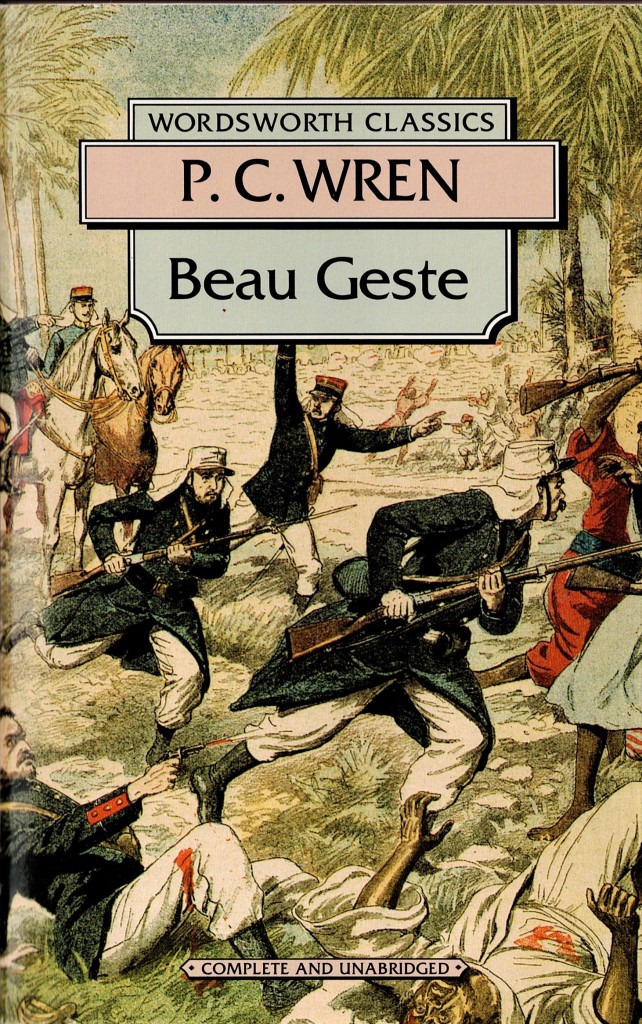
The image at the top of today’s post is the cover of my 1960 Permabook copy of Beau Geste. The cover of the 1994 Wordsworth Classic edition showing the Legion in action in Algeria is reproduced from the Sunday supplement to the June 14, 1903, issue of Le Petit Journal. The map of French West Africa is reproduced from the February 29, 1936, issue of L’Illustration, and the French West Africa stamp showing a landscape in Niger dates from 1947.

□□□

If you’d like to subscribe to World Enough, enter your email address below:

And if you’ve enjoyed today’s post, please share!