Celebrating Walpurgis Night

Image
Image

Grove Koger

The night of April 30-May 1 doesn’t just mark the end of one month and the beginning of another. It’s also Walpurgis Night (or Walpurgisnacht in German and Dutch)—a reference that may have meant something to your ancestors, if they were European, but probably not to you.

In short, it’s the night before the feast day of Saint Walpurga, an 8th century missionary. Walpurga was born in 710 in what’s now England and, after a suitable period of evangelizing, was appointed head of a monastery in Heidenheim an der Brenz (or simply Heidenheim) in what’s now southern Germany. She died on February 25, 777, and was canonized on May 1 a century or so later. I understand that early representations show her holding a stalk of grain—perhaps an example of the Christian church’s habit of adopting older, “pagan” concepts, traditions, festivals, and so on as its own.

Image

Now in Europe, May 1 has traditionally been thought to mark the beginning of summer, falling as it does more-or-less halfway between the spring equinox and the summer solstice. The Romans celebrated Floralia in honor of flower goddess Flora two days before, and marked the occasion by carrying bouquet of wheat ears (remember those representations of Saint Walpurga) to a shrine. What’s more, the month-long Mysteries of Dionysus and Aphrodite—which involved carrying torches about at night and indulging in general drunkenness and licentiousness—came to be celebrated every three years at about the same time of year. These celebrations also coincided with the Gaelic festival of Beltane, which involved setting bonfires and, depending on which ancient source you believe, burning an enormous “wicker man” inside of which animals and even people had been imprisoned. (The unnerving 1973 Robin Hardy movie The Wicker Man depicts just such an event on a Scottish island in modern times.)

Add a saint’s day to this heady mix, although the date may have been chosen in the ninth century by coincidence, and you have something of a head-on conflict between old and new, “evil” and “good.” And this is where Walpurgis Night comes in, for the intercession of Saint Walpurga was thought to be especially efficacious against evil, and this particular night was also believed to be a witch’s sabbath. In other words, Walpurgis Night allowed those who celebrated it to keep a foot comfortably in each camp.

Image

Halloween, of course, is treated extensively in folklore, literature, art, and music, and while Walpurgis Night has its own small body of folklore, it doesn’t seem to have generated any memorable music that I can identify. Literature is a somewhat different story, as Johann Wolfgang von Goethe set Scene XXI of his play Faust on Walpurgis Night atop Brocken, the German mountain where the Brocken Spectre is often seen. A survey of art, I’m glad to say, turns up several lively representations, and today’s images include works by, top to bottom, Mariano Barbasan Lagueruela, Albert Welti, and Augustus John (whose ink and watercolor sketch was apparently inspired by the scene from Faust).

□□□

If you’d like to subscribe to World Enough, enter your email address below:

And if you’ve enjoyed today’s post, please share!

The Worlds of Marco Polo

Image
Image

Grove Koger

Should you find yourself in Venice this year, you have a particular treat in store—one above and beyond the enormous pleasure of simply being in La Serenissima. It seems that Venice, with the collaboration of the Università Ca’ Foscari Venezia and the Italian Cultural Institute of Shanghai, has mounted an exhibition to mark the 700th anniversary of the death of its most famous citizen, who died there on January 8, 1324.

We don’t know the day of Marco Polo’s birth, although the year seems to have been 1254, and there’s even some uncertainty over the place of his birth, with Venice and the Croatian island of Korčula both claiming him as a native son. However, since Korčula was a Venetian possession at the time of Marco’s birth, the question isn’t a particularly pressing one.

Image

In any case, more than 300 artifacts relating to the explorer are on display in the Doge’s Palace, many of them loaned by the countries through which Marco is thought to have traveled. You can even see the explorer’s handwritten will. The Worlds of Marco Polo: The Journey of a 13th-Century Venetian Merchant runs through September 29, so you have plenty of time to make your plans.

I wrote about Marco in my 2002 book When the Going Was Good, and below is what I had to say.

□□□

The Description of the World (Divisament dou monde), 1299

For most of us, Marco Polo is the quintessential traveler, yet we know little about him. He was born into a noted Venetian mercantile family, two of whose members—Marco’s father Niccolo and uncle Maffeo—had already made the long journey east. When they set out on a second expedition to China in 1271, they took Niccolo’s son with them. The three returned in 1295 after an absence of twenty-four years.

Marco might never have recorded his impressions of Asia had he not been captured in a naval battle between Venice and Genoa and imprisoned in the latter city. It was here that he met one Rustichello de Pisa, an experienced writer who took down his account. The resulting book—originally entitled Divisament dou monde—appeared in 1299, the year Marco was freed, but is commonly known to us today as The Travels of Marco Polo.

Image

Marco’s actual journey through western and Central Asia to the Mongol capital of Shangtu (northwest of today’s Beijing) takes up only the first chapters of his book. Most of the remainder are devoted to celebrations of Mongol ruler Kublai Khan (into whose service Marco had entered) and to descriptions of the kingdoms and cities that the Mongols had so recently conquered. A list of modern countries that the explorer passed through would include Iraq, Iran, Afghanistan, China, Burma, Indonesia, Sri Lanka, India, and Turkey.

Marco’s seemingly endless lists, the fruit of his merchant’s eye, can be dry and uninvolving, and his virtual absence from his own book is frustrating to modern readers. Yet he introduced a world of wonders to his fellow Westerners, reportedly asserting on his deathbed that he had not revealed half of what he had actually seen. (If true, the assertion might account for the fact that he failed to mention the Great Wall of China, which would have been virtually impossible to overlook.) Marco’s message, albeit challenged from time to time, is that of every traveler before and since: I was there!

Due to the early period in which the Description was produced, a number of versions of it exist. Among English translations, those prepared by Sir Henry Yule contain extensive notes and numerous illustrations. The last of these (published in 1902 as The Book of Ser Marco Polo, the Venetian: Concerning the Kingdoms and Marvels of the East) was completed by Henri Cordier, who went on to publish yet another volume of notes in 1920. A three-volume reprint published by Dover in 1993 includes Yule’s complete 1902 text as well as Cordier’s 1920 supplement. The translation prepared by Manuel Komroff (numerous editions) corrects William Marsden’s 1818 translation against Yule’s, regularizes the numbering of its chapters to match Yule’s, and includes an introduction for the general reader. The Penguin edition (1958) is translated with an introduction by Ronald Latham.

Image

And for a highly imaginative take on the explorer, I recommend the 1972 novel Le città invisibili by Italo Calvino, translated into English as Invisible Cities. It’s made up of descriptions of 55 cities as described by Marco to Mongol emperor Kublai Khan, cities that are not only imaginary but fantastic. In turn, the novel inspired a 2013 opera by Christopher Cerrone that was staged in Union Station in Los Angeles while the station was in operation. The work was a finalist for the 2014 Pulitzer Prize for music.

Image

If you’d like to subscribe to World Enough, enter your email address below:

And if you’ve enjoyed today’s post, please share!

Some Visitors to Ponza

Image
Image

Grove Koger

I’m fascinated by connections and intersections. Few seem meaningful, and yet, having worked for three decades as a reference librarian, I’ve come to suspect that everything is connected, at some level, to everything else. Sometimes we have to go looking, but on other occasions, those intersections drop into our laps.

And on the basis of my fascination, I’d like to talk about three visitors—mythic wanderer Odysseus, British writer Norman Douglas (1868-1952), and British painter Edward Seago (1910-1974)—to the tiny Italian island of Ponza, which lies in the Tyrrhenian Sea off the western coast of Italy near Naples.

Since we know very little about Odysseus, or whether he even existed, anything we might say about him is purely speculative. However, there’s a possibility that Ponza is the island where he and his men encountered the sorceress Circe. There are grottos known as Grotta della Maga Circe (“Cave of the Sorceress Circe”) and Grotta di Ulisse O Del Sangue (“Cave of Ulysses of the Blood”) on the island’s west side, so … why not?

Considerably closer to our own day is Douglas (below), who was once widely known as the author of the 1917 novel South Wind, which describes the goings-on of a number of louche individuals on the imaginary Mediterranean island of Nepenthe. He was also a travel writer, one of the three or four best in the English language, and Nepenthe itself is based loosely on the Italian island of Capri, where Douglas lived for several years. But Nepenthe owes several of its aspects to other Italian islands Douglas was familiar with, including Ponza, Ischia, and Lipari. You can find all four on a map, although of course you’ll look in vain for Nepenthe.

Image

In his little book Summer Islands (1931), Douglas reprinted two articles from the English Review, the second and shorter of which deals with Ponza. As he explains in yet another little book, Late Harvest (1946), he “utilized the geographical features of this group, over-coloured for literary purposes, to describe the cliff-scenery of Nepenthe in South Wind … The minerals mentioned in South Wind are such as occur on Ponza—nearly all of them.”

By the way, Douglas isn’t making a slip when he refers to Ponza as a “group,” as it’s actually the largest of the Pontine Islands archipelago, which includes five other islets, four of them uninhabited. In ancient times, they were known as Πόντιαι, or Pontiae. Douglas calls this section of the book “Islands of Oblivion,” a reference to the fact that they were places of exile during the centuries of the Roman Empire, and explains in an “Author’s Note” that it’s based on a visit he made in July 1908. The little article deals at some length with the islands’ geology—Douglas was a keen amateur geologist—and at one point describes the beauty of Ponza’s highest point, Monte Guardia: “Viewed from the sea … and in the morning light, the whole mountain is suffused with roseate blushes of such intensity as to appear unreal—the fabric of a dream.”

Douglas notes in Late Harvest that “if one is never supremely happy for more than a moment, I was seldom nearer that condition than during those days, not moments, which were spent in July, 1908, on the island-group of Ponza.” However, it seems that Ponza wasn’t really prepared for travelers in 1908: “Life would assuredly be more endurable” on the island, he wrote, “if a hostelry could be found which, by any stretch of imagination, could be regarded as a place of public entertainment. Yet the town is well provisioned, and if future visitors will bring their own cooks and then take private apartments with a kitchen, they may survive indefinitely.”

Image

By the time Edward Seago visited Ponza in 1957-58, the island had made better preparations for travelers, and judging by his paintings, it must have been paradise on earth. Seago had actually visited Italy in the 1930s, and again in the 1940s as “personal war artist” to British Field Marshall Harold Alexander. But in Ponza, he seems to have encountered the full, bewitching beauty of the Mediterranean world for the first time. Perhaps it was Circe’s island after all!

□□□

Speaking of connections, I’ll mention that Douglas’s other summer island is Ischia, an antique map of which appears on the cover of his book. This is the island where British composer William Walton and his wife Susana lived for several decades. You can read my blog about them and about the gardens that Susana created and nourished here.

Image

If you’d like to subscribe to World Enough, enter your email address below:

And if you’ve enjoyed today’s post, please share!

Tavira’s Dragons & Their Relatives

Image
Image

Grove Koger

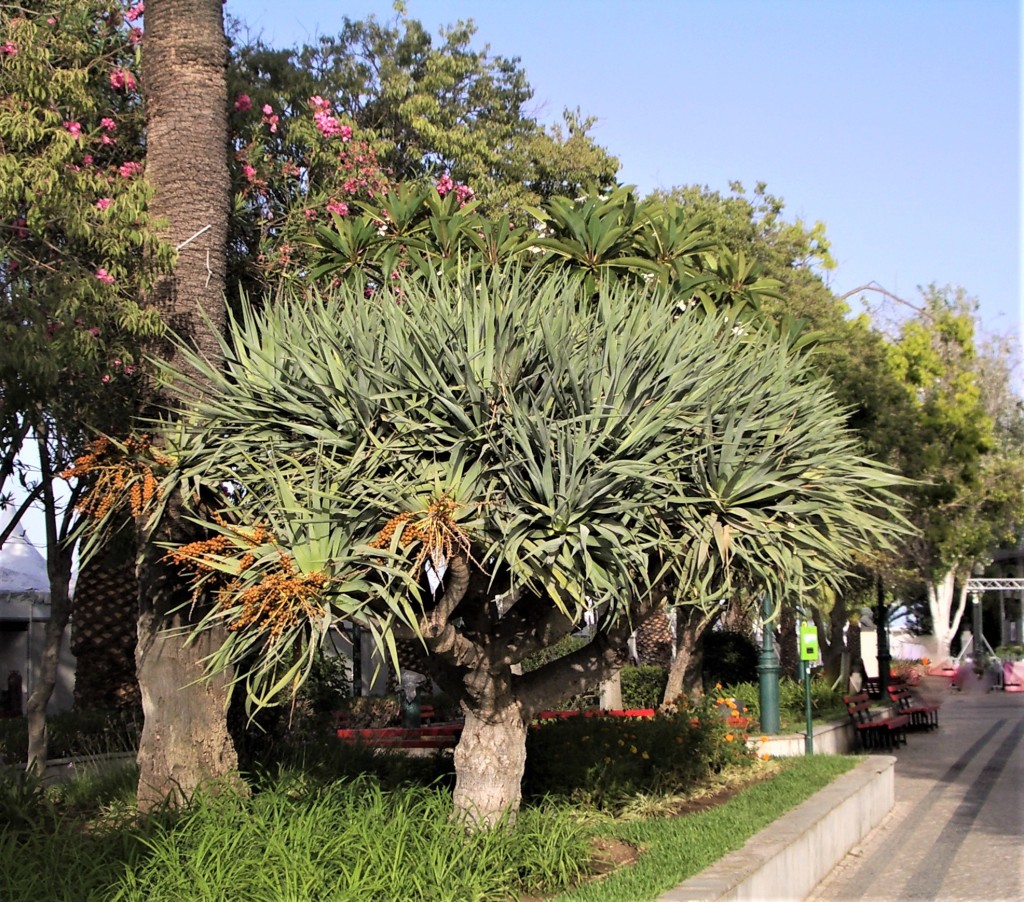
When we paid a second visit to the little southern Portuguese community of Tavira in 2023, the sights we planned to revisit included the town’s handsome dragon trees.

Growing in a little riverside park a few hundred feet from our hotel, the two trees probably go unnoticed by most of the town’s residents and visitors, but they’re a botanical delight for those who pause to look at them carefully or take time to learn more about them.

The dragon tree, or Dracaena draco, is native to southwest Morocco, the island nation of Cape Verde, the Spanish archipelago of the Canary Islands, and the Portuguese archipelago of Madeira. Scientists think that it was introduced to another Portuguese archipelago, the Azores, by Portuguese travelers from Cape Verde several centuries ago. Over time, the widely separated populations have developed into several subspecies.

Image

Dragon trees are evergreens with pithy trunks, and can reach as much as 60 feet or so in height and 20 feet in circumference. They also have an unusual and distinctive growth pattern. After ten or fifteen years, the tree blooms and grows multiple branches, each one of which then grows more branches after another long period, with the result that its crown spreads wider and wider, as if the tree were growing upside-down. As John Mercer writes in Canary Islands: Fuerteventura (David & Charles, 1973), the “dense vivid green upon the pale grey, with a patch of the darkest shadow on the ground below, make a fresh, cool sight even amongst the other trees.”

The trees’ small fruit have a red resin that was once used in pigments and traditional medicines. The indigenous inhabitants of the Canary Islands, the Guanches and the Canarios, carved shields from the trees’ bark, and I’m sure took advantage of the shade that Mercer refers to.  

Reading about dragon trees in Visit Native Flora of the Canary Islands, by Miguel Ángel Cabrera Pérez (Everest, 1999), I’ve learned that a separate species of the tree has been identified on Gran Canaria Island and designated Dracaena tamaranae. This “new” species, found on the southern (and geologically oldest) section of the island, apparently shares characteristics with such East African species as Dracaena ombet and Dracaena schizantha, as well as an Arabian species, Dracaena serrulate. Botanists speculate that specimens may have reached the island millions of years ago in the Miocene period.

Image

I don’t know when Tavira’s dragon trees were planted, but the oldest specimen on the Canary island of Tenerife is known as El Drago Milenario, and, at an estimated 1,000 to 5,000 years of age, it may be the oldest in the world. At 69 feet in height, with a circumference of about 66 feet, it may be the largest as well. That’s it you see above in a photograph by Mike Peel (www.mikepeel.net), reproduced courtesy of Wikimedia Commons. And should you find yourself on Tenerife, you can take a closer look by visiting the Parque del Drago, Icod de los Vinos, on the north shore of the island.

There was once another ancient specimen on the island, one examined by famed geographer and naturalist Alexander von Humboldt in 1799. Sadly enough, it was destroyed during a storm in 1867. According to John Mercer’s Canary Islanders (Rex Collings, 1980), the Guanches once “venerated” this particular tree, “seeing it as a protective spirit. Used by the Spaniards as a boundary post when dividing up the land amongst themselves in 1496 …, its well-authenticated measures were 75ft high, 78ft around the trunk.” Botanical artist Marianne North followed in Humboldt’s footsteps in 1875, discovering that the once-sacred tree had “tumbled into a mere dust-heap” with “nothing but a few bits of bark remaining.” However, she found “some very fine successors about the island,” one of which you see in her painting at the bottom of today’s post. And following in both sets of footsteps, A. Samler Brown added in the 1922 edition of Brown’s Madeira, Canary Islands, and Azores  (Simpkin) that “a cutting [was] still growing in one of the conservatories at Kew.”

The many people who stroll by Tavira’s dragon trees probably take them for granted, but the trees are members of a distinguished family, and worthy of our attention.

Image

If you’d like to subscribe to World Enough, enter your email address below:

And if you’ve enjoyed today’s post, please share!

A Week with Max Ernst

Image
Image

Grove Koger

April 2 is the birthday of Max Ernst, an artist I would rank as the most important member of the Surrealist movement, which arose in the aftermath of World War I.

Born in the Rhineland in 1891, Ernst never studied art formally, but developed his own methods and techniques. If you aren’t familiar with him, you’ll find more than enough information online, but today I want to talk about a specific work of his, Une semaine de bonté: ou, Les sept Éléments capitaux, or, in English, A Week of Kindness: or, The Seven Deadly Elements.

“Work” probably isn’t quite the right word, as it’s more of a project, although I’ve been surprised to learn that its creation occupied Ernst for only three weeks in 1933, while he visited friends in Italy. My surprise was prompted initially by the fact that Une semaine consists of quite a few images, 182 in all, but then I learned that these are divided among … five pamphlets.

Image

There are, of course, seven days in a week, even for Surrealists. The explanation is that the project didn’t meet the success that Ernst anticipated, so he included the final three days of the week, Thursday through Saturday, in the final pamphlet. (I find most of the images fascinating, but I’m sure they confounded most of those who first encountered them, so I’m not sure why the artist would have anticipated greater success than they achieved.) In any case, Ernst created the images by cutting up and combining images from several other sources, most of which have been identified by critics. These include a little-known illustrated novel by Jules Mary (1851-1922), Les damnées de Paris, and a volume of prints by Gustave Doré (1832-1883).

The pamphlets are thematic, with each assigned an “element,” an example of the element, and an illustrative quotation. Sunday’s element, for instance is “Mud,” and the example Ernst provides is “The Lion of Belfort”—a reference, more or less, to a large sandstone sculpture by Frédéric Auguste Bartholdi celebrating the 1870-71 Siege of Belfort during the Franco-Prussian War. The quotation is from the 1899 autobiographical work L’Amour absolu by Alfred Jarry (1873-1907), an “absurdist” writer often cited as a predecessor to the Surrealists: “The ermine is a very dirty animal. In itself it is a precious bedsheet, but as it has no change of linen, it does its laundry with its tongue.” The section abounds with images of lion-headed figures.

Image

Capturing a mood of disorientation and impending doom, the images are at once a document of their nightmarish, unravelling times and, at our remove of nearly a century, a reminder that the more things change, the more they remain the same. Here are lion-faced beasts, bird-winged and bat-winged figures, men and women in frenzied postures and poses, serpents, dragons, and so on, all scattered among what would otherwise be scenes of placid bourgeois life. In other words, they could be a commentary on life in the early twenty-first century.

Une semaine de bonté was printed in Paris in 1934 by Georges Duval and published by Editions Jeanne Bucher in an edition of 828 sets. Each of the five volumes is dated—beginning with April 15 and concluding with December 1—to indicate the day the printing of that particular volume was completed, and each was bound in a distinctly colored cover. They were exhibited together for the first time two years later in Madrid at the Museo de Arte Moderno.

□□□

If you’d like to subscribe to World Enough, enter your email address below:

And if you’ve enjoyed today’s post, please share!