Grove Koger
In light of renewed demands by Greek Prime Minister Kyriakos Mitsotakis that a number of ancient Greek marble sculptures in the British Museum be returned to Greece, it’s worth considering the arguments involved.
First of all, the very choice of what to call the sculptures is fraught with difficulty. Most British and American readers think of them as the Elgin (pronounced with a hard “g”) Marbles. But Greeks in particular speak of them as the Parthenon Sculptures. And it’s right there that the battle’s joined.
The works in question were once part of the Parthenon in Athens but were removed more-or-less under the direction of Thomas Bruce, 7th Lord Elgin. A Scot who served as envoy extraordinary, or ambassador, to the Sublime Porte—that is, the Ottoman Empire—in Constantinople (Istanbul) from 1798 to 1803, Elgin was a popular and hard-working diplomat. But he was also a philhellene who respected the artistic achievements of the ancient Greeks and had serious reservations over the treatment that their monuments were receiving at the hands of Greece’s Ottoman occupiers.
It was with these concerns in mind that he obtained permission from the Ottoman authorities to send a team of painters and draftsmen to make drawings of Athens’ ancient ruins. Apparently (and it’s here that things get murky) Elgin’s men had also been given permission to erect scaffolding around the Parthenon, Athens’ most important ruin, and to take molds of the monument’s sculptures. The permission came in the form of a firman, or decree (which survives only in a suspect Italian version), but in any case, Elgin’s team ended up cutting out actual sections of the monument’s frieze, metopes, and pediments—elements that embellished its upper portions. In all, the workmen stripped some 60 percent of the Parthenon’s surviving sculptures before crating them up and loading them onto barges and ships to be transported to England.
Elgin’s concerns over the damage that Athens’ antiquities might suffer in situ may have been well-founded, but his efforts hardly guaranteed their safety. In fact, one of the vessels loaded with the precious fragments sank near the island of Kythera (Cerigo), and it was two or three years later before the precious cargo was recovered.
Back in England, Elgin displayed the Parthenon sculptures, along with numerous other antiquities he had “collected” in Greece, in a temporary museum. But soon enough, a kind of cosmic fate took a hand. It seems that Elgin had expended his entire fortune in transporting the antiquities to England and was forced to try to sell his collection to the British Museum. However, his asking price proved too high and the legality of his actions was called into serious question. Poet (and fellow philhellene) Lord Byron wrote a biting attack in verse, “The Curse of Minerva,” on what he regarded as Elgin’s desecration of the ancient Greek monument.
Eventually, however, thanks to an act of Parliament, Elgin’s ownership of the sculptures was recognized and the museum purchased them for £35,000—about half of what Elgin had hoped to get.
There’s much more to the saga of the marbles, and you’ll find as much as you care to know online, but the basic elements of the story haven’t changed in some time. The Greeks justifiably regard the sculptures as theirs, and have made repeated demands for their return, but the British Museum, on pretty shaky ground, regards them as its own. Of course, if Nazi officials had given permission to cart away antiquities during their occupation of Greece during World War II, no one would dream of trying to justify the legality of the act.
However, there’s no longer any practical rationale for Britain’s refusal to return the marbles. The country’s arguments, shaky or not, are simply beside the point. It’s now possible to reproduce artifacts in exact detail, meaning that it would be relatively simple for the Museum to create replicas of the pieces before returning the originals. What’s more, the act would be greeted universally as a gesture of good will. The pieces would be displayed in Athens’ stunning new Acropolis Museum, where most of the sections that Elgin left behind can now be seen. And that, at long last, would be that.
As I was finishing today’s post, an article in Greece Is reported that the Museo Archeologico Antonino Salinas in Palermo, Italy, will return a fragment of the Parthenon frieze to Greece, where it will join other sections of the frieze in the Acropolis Museum. Perhaps the move will encourage Britain to reconsider its own position.
□□□
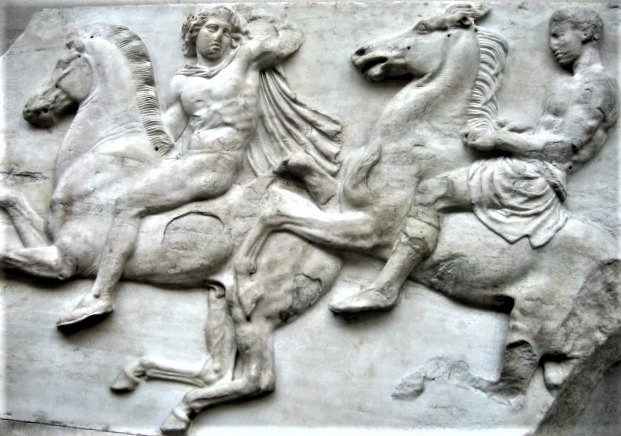
The image at the top of today’s post is a photograph by Urban of one of the Parthenon sculptures in the British Museum, a section of the western frieze; the second is a painting of Lord Elgin by Anton Graff; both are reproduced courtesy of Wikipedia. The third image is our photograph of the Parthenon and the fourth is our photograph of the Acropolis Museum taken from the Acropolis itself; both date from 2016.
□□□
If you’ve enjoyed today’s post, please share!




 World Enough
