Reproduced courtesy of Remi Jouan and Wikimedia Commons
Grove Koger
It’s known formally Villefranche-sur-Mer, but the suffix is seldom used.
In any case, Villefranche is a port on the Mediterranean coast of France, west of the French-Italian border and just east of Nice. Its bay is deep, and over the years it’s figured prominently in naval affairs, although now its greatest importance seems to be as a port of call for cruise ships.
My interest in Villefranche is cultural, and I once hoped to visit it as part of a modest writing assignment. However, the assignment took Maggie and me instead to the Basque Country, where we had what I’m sure was just as pleasant a time as we would have on the Riviera.
Reproduced courtesy of Prud’homie des pêcheurs de Villefranche-sur-Mer, Vallée du Var
I had planned to visit two buildings in Villefranche. The first, in terms of chronology if not importance, is the Chapelle Saint-Pierre, a modest chapel at 4 Quai Courbet built in the 16th century but decorated in 1957 with frescoes by that most protean of cultural figures, Jean Cocteau. Aside from his many writings (fictional, dramatic, and otherwise) and his highly influential films, Cocteau was a graphic artist of note. And although his drawings are more striking than his paintings (which are essentially drawings with some color added), the frescoes he created for the modest chapel are outstanding. Mixing abstract designs with sacred and profane imagery—punkish angels, fishermen and their wives, and Pierre (Peter) himself, who was the saint of fishermen, shipbuilders, and fishermen—it’s a monument to life itself.
The Chapelle Saint-Pierre was listed as a Historic Monument in December 1996 and received a 20th Century Heritage label in 2001.
Gate of the Villa Nellcôte, reproduced courtesy of Gudrun Schwartz (gudrunfromberlin) and Wikimedia Commons
The second building of cultural significance is the Villa Nellcôte (10 Avenue Louise Bordes), which dates only from the 1890s and was originally known as the Château Amicitia. It was here, in the villa’s basement, in the early 1970s, that the Rolling Stones recorded the songs that were released in 1972 as the double album Exiles on Main Street, generally rated as the best rock album ever recorded. More specifically, the villa was leased by Keith Richards in April 1971, although the guitarist was forced to vacate only a few months later over legal problems involving his use of marijuana.
Exile is an album inspired by Black American music, played by British musicians, and recorded in France. As eclectic as that sounds (and is), I don’t think there’s a better embodiment of the pain and the promise of those exciting times.
For more information about Cocteau and the Chapelle Saint-Pierre, I recommend An Impersonation of Angels by Frederick Brown (New York: Viking, 1968) and Cocteau by Francis Steegmuller (Boston: Atlantic Monthly, 1970), as well as (if you can put your hands on it) Cocteau’s attractive little book La Chapelle Saint Pierre, Villefranche sur Mer (Monaco: Éditions du Rocher, 1967). And for more information about the events at the Villa Nellcôte, musical and otherwise, read Robert Greenfield’s Exile on Main Street: A Season in Hell with the Rolling Stones (Da Capo, 2006). Or, better still, just listen to the album, which you’ll find on YouTube if you don’t already own it. You’ll be glad you did.
If you’d like to subscribe to World Enough, enter your email address below:
You may think of the telegraph as an “old” technology, but it evolved from several older technologies, including an ingenious optical version developed by French engineer Claude Chappe (cloh duh shahp) with the help of several of his brothers.
Chappe was born in 1763 in Brûlon, France, and educated at Rouen. He was interested in several branches of science, but, with the advent of the French Revolution in 1789, focused those interests on perfecting a system of transmitting messages over long distances.
Chappe’s eventual solution to the problem was to erect towers on high ground (or to commandeer church belfries) 6 to 10 miles apart across the countryside and to equip them with telescopes and moveable mechanical “arms,” the latter designed by clockmaker Abraham-Louis Breguet (1747-1823). These arms could be arranged in any one of 98 distinct combinations that the men at each station in a series would duplicate as quickly as possible for the next station.
The particular combination of signals was devised at the first station in a series with the use of a codebook, and then decoded at the final station using a duplicate of the same book. The first signal would be understood to refer to a particular page in the book, while the second indicated the line on that particular page. Elaborate plans were put in place to allow for situations in which poor weather made regular transmission of messages impossible.
Chappe had little success with his invention until his brother Ignatius, who had been elected to the Legislative Assembly, helped him secure official backing. As a test, 15 towers were built on heights between Paris and Lille in 1793—a distance of about 127 miles—and a message sent from one end to the other. It took only 9 minutes. In light of the success, a second line was established in 1798. When Napoleon seized power in 1799, he extended the network, including a branch to the English Channel in preparation for an invasion that never took place. Eventually France established 556 stations on networks covering a total distance of 2,983 miles.
Despite his telegraph’s success, Chappe killed himself in 1805, depressed by illness and accusations from rivals that he had stolen his ideas.
□□□
Frustratingly enough, my sources differ on a number of details involving Chappe and his invention. In today’s post, I’ve used what appear to be the most reliable dates and figures available.
As for today’s images, the striking one you see at the top is The Church of Saint-Pierre de Montmartre and the Ruins of the Abbey in 1820 by Jacques Auguste Régnier. The second image is a trading card devoted to Chappe and published by Chocolat Poulain, while the third is taken from Les merveilles de la science by Louis Figuier, 1868.
□□□
If you’d like to subscribe to World Enough, enter your email address below:
June 28 is the birthday of Eric Ambler, who was born in London in 1909. Usually categorized as a “spy novelist,” Ambler (whom you see in our second image) did write from time to time about people who spied, but it’s more accurate to think of him as writing novels of international intrigue. And it’s in that category that his masterpiece, A Coffin for Dimitrios (1939), fits most comfortably.
The title character, one Dimitrios Makropoulos (or is his last name Taladis? Talat?) was apparently born in 1899 in the Greek (now Turkish) city of Larissa on the western shores of Asia Minor. He began his adult life as a fig packer, but soon enough involved himself in a plot to assassinate “the Gazi”—better known as Mustafa Kemal Atatűrk, first President of the Republic of Turkey. Then, like so many Greeks living in Asia Minor, Dimitrios was displaced during the Second Greco-Turkish War (1921-1922) and soon became involved in the brutal assassination of Aleksandar Stamboliyski, prime minister of Bulgaria, in 1923. Subsequently he took up less spectacular endeavors—including procuring and smuggling drugs. But now, as the novel opens, his corpse has been found floating in Istanbul’s harbor.
British mystery writer Charles Latimer, who happens to be visiting Istanbul, is shown the corpse by Turkish police officer Colonel Haki, himself a devotee of that most cliched of forms, the country house mystery. Intrigued by what Haki has told him about Dimitrios, and more intrigued still by what Haki isn’t able to tell him about the criminal’s sordid life, Latimer sets out on an “experiment in detection.” He will fill in the gaps in that life story.
Latimer’s quest takes him from Istanbul to Athens, to the Bulgarian capital of Sofia, to Geneva, and finally to the back alleys of Paris—the Impasse des Huit Anges, to be exact—where the writer finally realizes that his “experiment” has been very foolish indeed. The French word impasse, by the way, means “dead end.”
At the conclusion of Coffin, we see the last of Latimer as his train speeds into a tunnel. And given the date of the novel’s publication—1939, remember—we know just what kind of dark tunnel the world itself was then entering. On September 1 of that year, for instance, Germany invaded Poland, and on November 30, the Soviet Union began its invasion of Finland. And on and on …
However, we’re to meet Latimer once more, thirty years later, in Ambler’s 1969 novel The Intercom Conspiracy. Ambler’s worldview has broadened as the times themselves have changed. And while Latimer himself has aged, his most dangerous characteristic—his curiosity—has remained the same. As I wrote in Salem Press’s Critical Survey of Mystery and Detective Fiction (2008), the novel’s “ingeniously unfolding plot concerns the aging heads of two European intelligence agencies who purchase an obscure newsletter in which they begin to publish classified information. Realizing that they are being blackmailed, the governments of the major powers buy out the publishers, who may now retire on their handsome profits. Less fortunate, alas, is Latimer, who this time has pursued the wrong mystery.”
By coincidence, Ambler won an Academy Award nomination for his screenplay for The Cruel Sea (1953), adapted from the novel by Nicholas Monsarrat, whom I wrote about in my June 13, 2023 post.
And by another coincidence, I had the opportunity to recommend Ambler’s books the other day, mentioning A Coffin for Dimitrios as well as The Light of Day (1962), which was filmed as Topkapi in 1964. The movie provided consummate actor (and fellow writer) Peter Ustinov an opportunity to steal the show right out from under the feet of leads Melina Mercouri and Maximilian Schell. But that’s another story for another day.
If you’d like to subscribe to World Enough, enter your email address below:
April 11 is the anniversary of the death of Jacques Prévert, who died in 1977. If you recognize his name, it may be because City Lights published a translation of his poetry collection Paroles in its “Pocket Poets” series in 1966. Or you may recognize him as the screenwriter for the films Quai des Brumes (Port of Shadows) and Les Enfants du Paradis (Children of Paradise). In both cases, the director was Marcel Carné, and in the latter, the pair created what’s regarded as one of France’s (and the world’s) greatest movies.
As Prévert explained in an interview printed in the Classic Film Scripts edition of Children, the paradise (paradis) of the title is a reference to the “cheapest seats in the theatre, the worst, the furthest away from the stage, for the ‘people.’”
The film chronicles the intersecting lives of five disparate characters in the Paris of the 1830s—the beautiful courtesan Garance (played by actress Arletty) and the four men pursuing her, including Baptiste Deburau, a mime (played by Jean-Louis Barrault) at the Théâtre des Funambules. Deburau’s infatuation with Garance is the heart of the film, but the courtesan’s other admirers—the mediocre actor Frédérick Lemaître, the arrogant aristocrat Édouard de Montray, and the elegant and equally arrogant criminal Pierre-François Lacenaire—form a kind of knot that Lacenaire, who has been insulted by de Montray, finally cuts in a dramatically Gordian manner.
Children of Paradise is divided into two sections—“The Street of Many Murders” and “The Man in White”—and in its unedited version runs to more than three hours. The Classic Film Scripts edition also includes scenes that never made it to the screen.
It’s nearly impossible to talk about Children of Paradise without mentioning the incredible story behind its filming. It was shot in 1943 and -44, during the German occupation, and its sets had to be moved between Nice and Paris because its designer (Alexandre Trauner) and composer (Joseph Kosma) were Jewish and were constantly in hiding. The main set was damaged during a storm, and a number of the movie’s German extras, hired out of legal necessity, had no idea that they were working alongside other extras who were Resistance fighters by night. Ironically enough (or perhaps not), Arletty was found guilty of treason after the war due to her romantic involvement with a Luftwaffe officer and was sentenced to a period of house arrest.
Children of Paradise is a film in the grand manner, but I can imagine an even grander one in which a master director creates a second film devoted to the creation of the first, perhaps told from Arletty’s point of view, and manages to fold the two stories, old and new, into an enormous collage—a glorious tribute to the counterpoint of art and life. I’m willing to give the idea away, and all I ask in return is an acknowledgement in the credits—and, at the premiere, a seat in paradis.
If you’d like to subscribe to World Enough, enter your email address below:
Some time back I happened across a painting by one Pierre-Denis Martin titled Vue de la Machine de Marly. I had never heard of Monsieur Martin, or Marly, or the Machine de Marly, but I was intrigued, so I made a note of the painting and did some research.
Pierre-Denis Martin, it turns out, was a French painter of historical subjects and the like who lived from 1663 to 1742. The Machine de Marly, or Marly Machine, that he painted in 1723 (and that you see at the top of today’s post) was a massive water-lifting and pumping station built on the banks of the Seine some 7.5 miles from Paris. And Marly itself, or more precisely Marly-le-Roi, was the site of a reservoir that was part of this complicated water-supply complex.
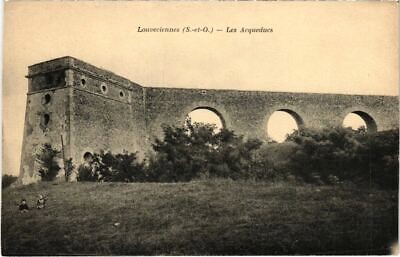
The machine featured 14 waterwheels, each of them more than 39 feet in diameter, designed to draw water up in buckets from the river. In turn, several series of suction and treading pumps forced the water farther up the bank to several series of catch basins, eventually depositing it in the Aqueduct of Louveciennes (seen above in a vintage postcard), for a total vertical rise of some 500 feet. The aqueduct then carried the water to the vast Palace of Versailles and the nearby Château of Marly. Oddly enough, there’s precious little groundwater beneath Versailles, hence the need to transport such an enormous amount to feed the palace’s many, many fountains and jeux d’eau, or water features.
The devilishly intricate Marly Machine was the work of hydraulics engineer Arnold de Ville, whose employees took seven years to complete the project. King Louis XIV was present at the machine’s inauguration in 1684. Although I mention above that the complex fed the fountains at Versailles, I don’t mean that it fed them adequately, for, as impressive as it was, the Machine de Marly simply couldn’t supply enough water. As if to make up for that inadequacy, it was extraordinarily noisy, as everyone living near it could attest.
□□□
If you’d like to subscribe to World Enough, enter your email address below.
Today’s post originally appeared as part of a longer article in the Spring 2010 issue Boise magazine, edited by Christine Dodd.
□□□
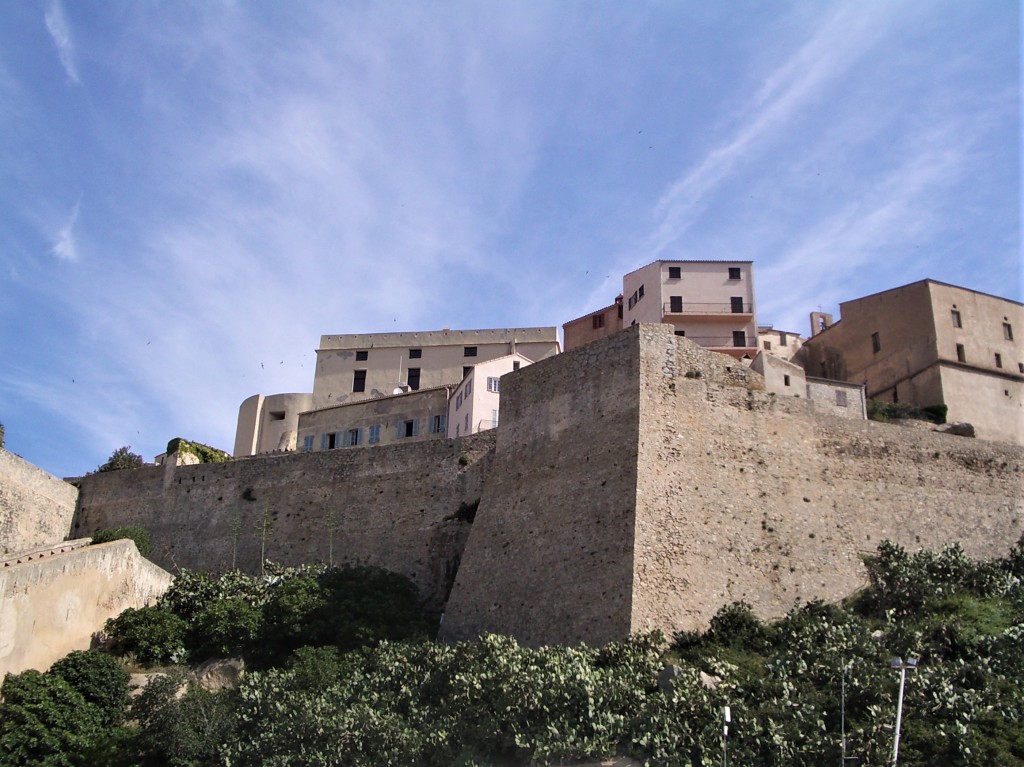
On our visit to the Mediterranean island of Corsica in 2008, Maggie and I stayed several days on the outskirts of the port of Calvi on the northwestern coast of the island. Those in the know claim that Corsica’s 200 or so beaches are the best in France, and that the Gulf of Calvi’s is the best of the lot. Broad and sandy, backed by dense stands of umbrella pine, it follows the voluptuous curve of the gulf’s shoreline for almost four miles, and, like the gulf itself, is dominated by the thirteenth century Genoese citadelle that overlooks the city.
Our little hotel lay only ten minutes’ walk from the beach, and between the two stood a little open-air market, so when the afternoons grew too hot, we shopped for dinner before taking our siesta. Out front, tubs of olives and golden lupini beans glistened in the sun like jewels, while inside was a tantalizing array of individual focaccias and pizzas. Coolers at the back held white wines and bottles of Pietra, Corsica’s chestnut-based beer.
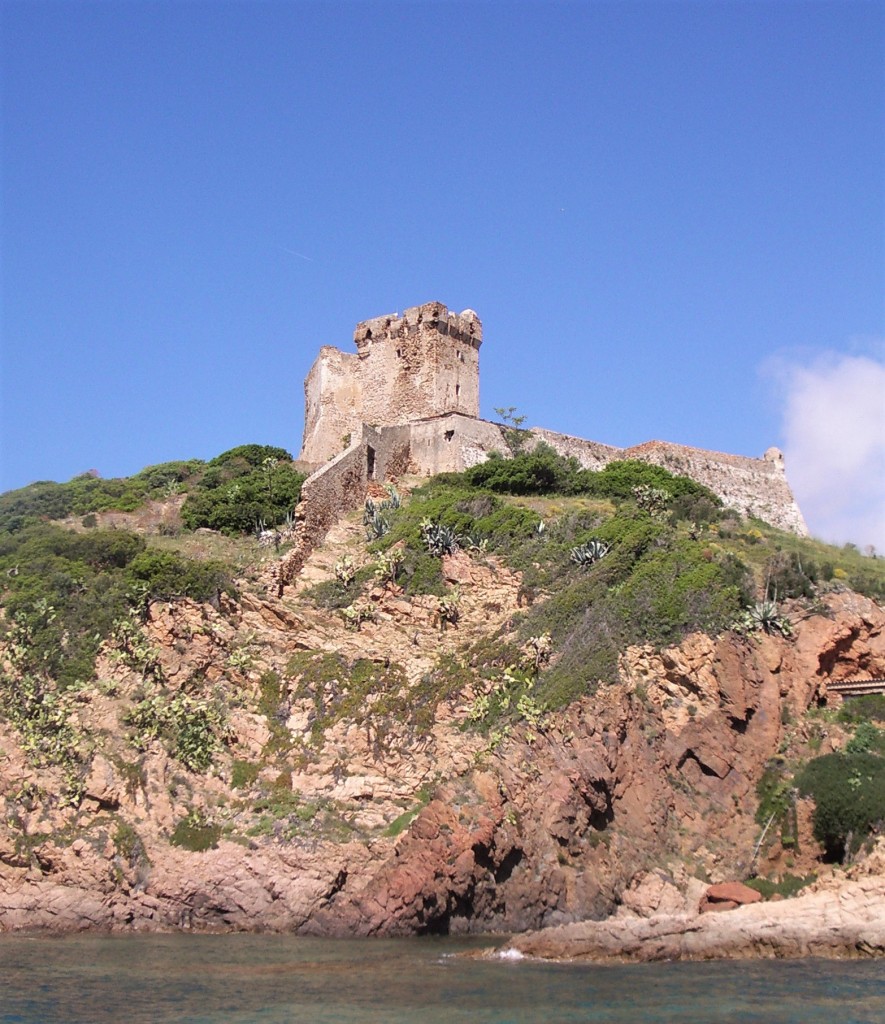
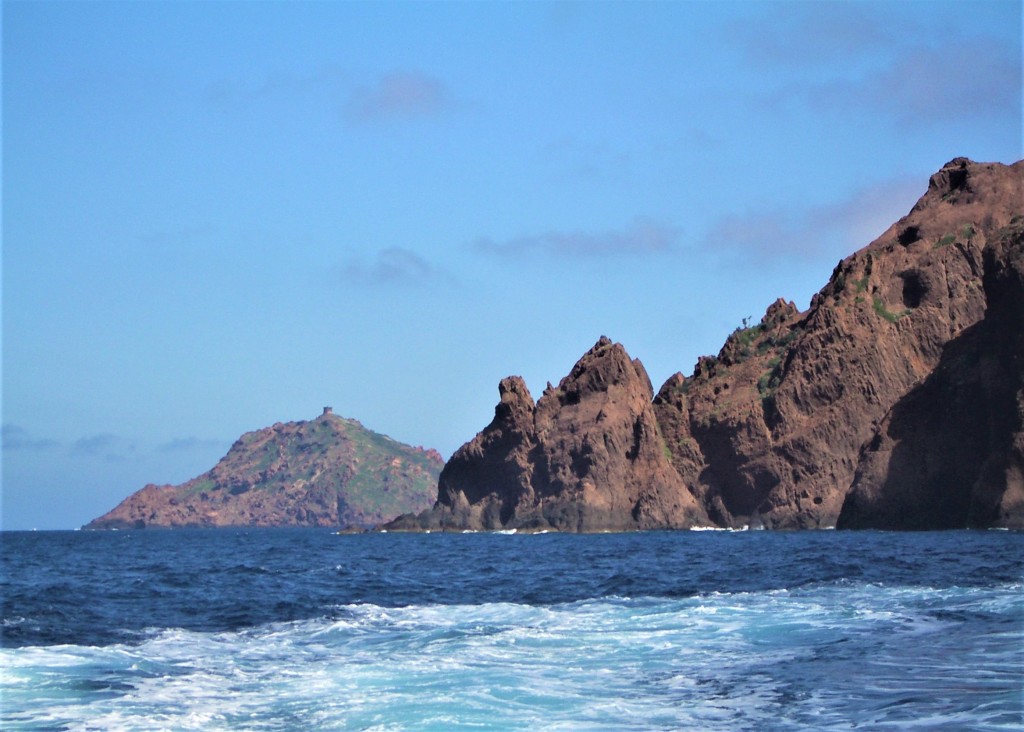
One of the high points of any trip to Corsica is a visit to Scandola, a nature reserve a few miles down the coast. Access to the reserve is limited, so the only practical means of seeing the area is by boat. Our excursion started early one morning in Calvi’s harbor and took us down a coastline that grew progressively wilder and more desolate. Here and there, Genoan watchtowers stared mutely out to sea—reminders that Corsica was part of the far-flung Genoese Empire for five long centuries. Eventually we found ourselves passing along dark grottoes and rusty red rhyolite pinnacles that towered dizzyingly, frighteningly overhead. Gulls shrieked resentfully at our intrusion. The trip had started so early, we realized, so that the little boat could take its time weaving in and out of the phantasmagoria.
After a long, lazy lunch at the tiny fishing village of Girolata, we returned to the boat for a quick trip back to Calvi, where we make a stop at “our” market before settling in for the evening. The spectacular, inhuman beauty of Scandola loomed large in our minds, but we knew that another, reassuringly unspectacular pleasure awaited us. Our room lay at the back of the hotel, and while the immediate prospect from our balcony wasn’t especially noteworthy—a patch of lawn and a pine grove sheltering a campground—we had learned that a canal along the edge of the property was home to dozens and dozens of frogs. That evening, as the light faded and we ate our dinner, we were serenaded by a throaty, sonorous chorus warming up for the busy night of love that lay ahead.
When Maggie and I visited France in 2008, we spent some time in Paris tracking down the haunts of two of the most famous writers of the twentieth century, Ezra Pound and Ernest Hemingway, both of whom had strong connections with Paris and Idaho. Those connections proved to be substantial enough for an article that was published, to my delight, as the cover story of the Spring 2009 issue of Boise Journal.
□□□
Ezra Pound and Ernest Hemingway … The lives of these two giants of modern literature form an intriguing trajectory. Pound was born in Hailey, Idaho, in 1885 and Hemingway died, by his own hand, just a few miles away in Ketchum in 1961. Their lives intersected in Paris, for decades—no, make that centuries—the capital of the artistic and literary worlds, and the city played a key role in their careers. Hemingway in particular embraced the spectacle that was Paris, calling it “the city I love best.”
Here’s their story, along with a quick glance at the Paris of today.
Ezra Pound’s family left the small community of Hailey within two years of his birth. He would not, or course, remember anything of Idaho, but the narrator of his poetic sequence “Hugh Selwyn Mauberley” would speak of having been born in a “half savage country.”
Pound first laid eyes on Paris in 1898, when he toured the Continent with his mother and great aunt. After several years of academic life as a student and teacher, he spent the summer of 1908 in Venice, where he published his first slim volume of verse—at his own expense. Later that year he moved on to London.
The young Pound was brilliant, generous, provocative, and (as he said of himself) “nomadic,” darting hither and thither while throwing off pronouncements and diatribes about the future of one or another of the arts. “In London,” as his friend T.S. Eliot later put it, Pound “always seemed on the point of crossing the Channel.” Cross the Channel he did, repeatedly, and with his wife, Dorothy, set up base in Paris in the early 1920s. He had already made important contacts in London, and in the French capital he would make many more, including a green young writer named Ernest Hemingway.
Hemingway had been born outside Chicago in 1899 and had worked as a reporter, an experience that would contribute to his famously lean style. He had also driven an ambulance in Italy for the Red Cross during World War I. Hemingway had passed through the French capital in 1918, but his real arrival dates from late 1921, when he was accompanied by his fiancée, (Elizabeth) HadleyRichardson.
Initially, Hemingway stayed in the Saint-Germain area near the Seine, a traditional haunt of artists and writers. Most of the establishments he frequented are still there, including the Brasserie Lipp (whose potatoes in oil he loved), the Café de Flore and Les Deux Magots. He would move several times, and eventually came to prefer La Closeries des Lilas in Montparnasse. Like so many members of the “Lost Generation,” he relished café life, finding an ambiance that nourished his soul as well as food and drink that nourished his body.
It was in early 1922 that the Hemingways took tea at the Pounds’ Montparnasse apartment. At first, the poet’s airs put Hemingway off, but Pound quickly became, said Hemingway, “the man [he] liked and trusted the most as a critic … the man who believed in the mot juste—the one and only correct word to use.” In turn, Hemingway taught Pound to box, and reported to a friend that the poet had “developed a terrific wallop.” At the moment, Pound was shepherding into print Hemingway’s landmark collection of vignettes in our time, to be published by Paris’s tiny Three Mountains Press. A typical piece begins with the stark sentence, “They shot the six cabinet ministers at half-past six in the morning against the wall of a hospital.” American prose would never be the same.
Nor would American poetry. The would-be boxer had long since rejected the conventional, world-weary tone of his first works. After a 1913 visit to Paris, Pound had been moved by an experience at La Concorde subway stop to write “In a Station of the Metro,” arguably the best short poem in the language: “The apparition of these faces in the crowd: / Petals on a wet, black bough.”
In 1920’s “Hugh Selwyn Mauberley,” Pound mourned in bitter, blazing lines the “myriad” who had died in the First World War “[f]or a botched civilization,” one that amounted to nothing more than “two gross of broken statues” and “a few thousand battered books.” But before long, he was darting off in a new and (some would say) ultimately dismaying direction. Three Mountains was preparing to published A Draft of XVI Cantos, the first installment of the difficult, labyrinthine project that would occupy him for the rest of his life.
Pound was ready to dart off literally, too, and relocated to the Italian Riviera in 1924. He was already showing signs of the anti-Semitism and mental instability that would disfigure his later years, and those who knew him thought that his loss of contact with the artistic ferment of Paris had a deleterious effect. Yet he kept track of his friends. In 1928 he received a garbled account of how Hemingway had received a serious cut after pulling down the skylight over his toilet while reaching for the chain to the water tank. “How the hellsuffering tomcats,” Pound demanded from Italy in his typical epistolary style, “could Hemingway git drunk enough to fall upwards thru the blithering skylight!!!!!!!”
Hemingway himself left Paris later in the decade, but returned again and again, most memorably in 1944, when he and a band of American soldiers “liberated” the bar of the Hotel Ritz. Yet for him, too, the best years—years when he was “very poor and very happy”—were over. Only in the posthumously published, bittersweet memoir of his Paris years, A Moveable Feast, would he recapture the bright vigor of his early works.
The streets of twenty-first century Paris are clogged with cars, but most of the landmarks familiar to the Lost Generation remain.
The Lipp is still there, although the potatoes that Hemingway was so fond of have been dropped from the menu. There were plenty of other choices when Maggie and I looked in, but the prices weren’t writer-friendly, and they weren’t much better across the street at the Flore and the Deux Magots. It was a warm, thirsty afternoon, and we were relieved to get back to the café that had become our “local” in another, far less fashionable arrondissement.
In A Moveable Feast, Hemingway described the Closeries des Lilas: “It was warm inside in the winter and in the spring and fall it was fine outside with the table under the shade of the trees.” It was the café in which he worked on his novel The Sun Also Rises, but it might well have been ours.
Here, seated around us, were Parisians that Pound and Hemingway would have recognized: a workman who was doing more drinking than working; pairs of friends and lovers; a quartet of distinguished men who sat for hours over coffee and water; an elderly woman escorted by a waiter to a table for an early dinner. When a storm moved through the neighborhood, drenching the pavement and shivering the glass doors, they all crowded inside and shook off the rain, talking excitedly and laughing at each other. The bartender got down to work.
Here they all were, ready to nourish yet another generation.
June 8 is the anniversary of the death of French engineer Eugène Freyssinet (1879-1962), celebrated in professional circles for his use of prestressed concrete but remembered in others for having proposed a wildly, wildly impractical project.
You’ll find ample information about Freyssinet’s career online, and it’s impressive. Among other accomplishments, he designed five bridges over the Marne River in the late 1940s, a runway at the Paris-Orly Airport, and, near the end of his life, the elegant Gladesville Bridge over the Parramatta River in New South Wales, Australia.
Freyssinet in the uniform of the École Polytechnique. Wikimedia Commons
Along with these successful projects, however, Freyssinet also submitted a truly fantastic design to the 1937 Exposition Internationale des Arts et Techniques dans la Vie Moderne, otherwise known as the Paris Exposition or Paris World Fair. It was for what he called the Phare du Monde, or “Lighthouse of the World”—a structure towering some 2,300 feet above the ground that was to have been the centerpiece of the exposition. (By comparison, the Eiffel Tower is a mere 1,083 feet tall.) The Phare would have been built out of concrete, naturally, and would have been ascended by way of a spiral ramp with 30 revolutions that would have taken daring drivers to a parking garage at the 1,640-foot level. That facility would have held some 400 (or was it 500?) cars, and above it would have been a restaurant (seating 2,000 diners!), a hotel, a beacon, and, at the very, very top, a “meteorological cabin.” If you didn’t care to drive, you could apparently take an elevator, or a series of them, to the restaurant—a prospect that leaves me feeling only slightly less uneasy.
Modern Mechanix July 1933
Speaking of the Eiffel Tower, it was that iconic structure that another engineer, André Basdevant, believed could be improved by allowing access by automobile. If you missed it, you can see my post about him and his ideas here.
In any case, did Freyssinet intend for his proposal to be taken seriously? Or could it have been his way of acknowledging the ever-increasing importance of the automobile in contemporary society? Needless to say, the Phare didn’t get off the ground, but, as you see, contemporary representations of it have survived. To my way of thinking, they speak for themselves.
I struggled for a bit with the title of today’s post, in part because I had frustratingly little information about my subject, and in part because I couldn’t decide what attitude to take toward that information.
André Basdevant was a French engineer who put forward at least two arresting proposals that, while visionary enough, were wildly impractical. A third proposal was equally visionary but far more practical, although his involvement in it, sadly enough, came to nothing,
If we take those concepts in order, we can begin in 1936 with Basdevant’s proposal to build a pair of helical access ramps spiraling up from the streets of Paris to the second floor of the Eiffel Tower.
Judging from the online image I’ve found, each ramp would have involved ten tight revolutions—meaning that a dizzying corkscrew ride would have carried you up 377 feet from street level. Once you’d accomplished that feat, you would be able to dine at your leisure in the tower’s restaurant. But this being Paris, you would of course be wining and dining—all before making what I’m pretty sure would have been an equally dizzying descent, an experience that I can imagine might well lead to another serious bout of wining.
I think can we can agree that this was a wildly bad idea.
Basdevant’s second concept, dating from 1938, was even grander in design. He proposed the construction of a rotating elevated landing strip in the middle of Paris directly above the Seine.
Yes, you’ve read that correctly.
The project would have placed the strip on two very large, circular platforms supported by a series of immense towers. (Or are they skyscrapers?) In case you’re wondering, the artist who prepared the second image you see in today’s post has seated the viewer in what may be a biplane, looking down at the airstrip through the plane’s crossed rigging wires.
Again, I’m sure we can all agree that this was a wildly bad idea.
Basdevant’s third concept was grander still. In 1938, he presented a proposal to the French Chamber (the CCI de France) to dig a tunnel beneath the English Channel. His design provided for a double-track railway on its lower level and four lanes for automobiles on its upper level. Of course, the idea of a tunnel beneath the channel wasn’t new, having been around for at least two centuries, but technical and political considerations had long delayed its implementation.
In any case, Basdevant’s proposal was impressive enough to win the sponsorship of the French Chamber, but the approach of World War II forestalled all such projects, although the Supreme Allied War Council briefly considered whether the tunnel might be dug quickly enough to aid the allied cause. After the war, Basdevant was able to present his proposal officially to an Anglo-French commission, but British authorities rejected it, citing technical issues involving geology and ventilation. In coordination with several other engineers, Basdevant submitted a revised proposal in 1958, but it was not to be (although by this point you might be rooting for the poor fellow). Under the terms of an alternative proposal, the tunnel was eventually dug by the Anglo-French construction consortium TransManche Link and opened for rail service, and rail service only, in 1994.
Perhaps you’re familiar with the French word outremer (oo-truh-mehr). Until recently, I think I’ve encountered it only once, in the 1974 novel, Monsieur; or, The Prince of Darkness by Lawrence Durrell, who did, in fact, spend most of his life outremer.
In its most literal definition, the word simply means “overseas,” but it has other definitions as well, although I didn’t know about them until I started investigating the word further.
In their Introduction to The French of Outremer: Communities and Communications in the Crusading Mediterranean (Fordham UP, 2018), Laura K. Morreale and Nicholas L. Paul write that the word “has been used for centuries to designate various ‘overseas’ territories, and to this day outre-mer is associated with a variety of legal, administrative, and cultural relationships between France and its former colonies throughout the world.”
More precisely, outre-mer can refer to what the French know as their Départements et régions d’outre-mer, their Collectivités d’outre-mer, and their Territoire de’outre-mer—those former colonies that are now parts of France but that lie beyond the European, or Metropolitan, part of the country. The categories have changed over the past few decades, as the political world has evolved, but as I’ve tried to sort through them all, I’ve wondered whether a kind of bureaucratic mania for political taxonomy might also be at work.
At the present time, the Départements include the island of Réunion and the archipelago of Mayotte, both of which are in the Indian Ocean; Guyane, or French Guiana, on the northeastern coast of South America; and the islands of Guadeloupe and Martinique in the Caribbean.
France’s Collectivités are Saint Pierre and Miquelon, an archipelago in the Gulf of S. Lawrence; the island of Saint Barthélemy and the northern part of the island of Saint Martin, both in the Caribbean; and French Polynesia and the Territory of Wallis and Futuna, in the South Pacific Ocean. In addition, French Polynesia (which is made up of more than one hundred islands and atolls) has been a particular kind of collectivity, a Pays d’outre-mer or overseas “country” within France, since 2004.
Then there’s France’s single Territoire de’outre-mer, the Terres australes et antarctiques françaises, or French Southern and Antarctic Territories, which is composed of five districts, none of which has a permanent population. This fragmented entity is made up of the Îles Éparses, or Scattered Islands, which lie in the tropics near Madagascar and are all nature preserves; Terre Adélie, a narrow wedge of land claimed by France on the continent of Antarctica; and three archipelagoes in the southern Indian Ocean: Crozet Islands, Kerguelen Islands, and Saint Paul and New Amsterdam Islands.
(In the interests of accuracy, I’ll mention that there are at least two other pieces of overseas France that don’t fall into any of the political categories I’ve discussed: the uninhabited atoll of Clipperton Island in the North Pacific and the much larger island of New Caledonia and its dependencies in Melanesia. According to The World Factbook, the latter is considered a sui generis collectivity of France—a “unique status falling between that of an independent country and a French overseas department.”)
As Morreale and Paul point out, “In the francophone West of the central and later Middle Ages, la terre d’outremer [also] designated a similarly complex patchwork of principalities forged in the eastern Mediterranean in the context of the First Crusade in the decade from 1098-1109 and lasting until the fall of the last bastions of Frankish dynastic power in Cyprus and mainland Greece in the late fifteenth century.” These territories, which are usually referred to as the Crusader States, were the Principality of Antioch, the County of Edessa, the Kingdom of Jerusalem, and the County of Tripoli. They’ve been the subject of a number of books and studies, and deserve their own post sometime down the line.
The image of the constituent lands of the French Republic at the top of today’s post is by Godefroy, while the map of Polynesia (with French Polynesia on the right) is by Hobe/Holger Behr. The two flags are those of New Caledonia, which is one of the few countries or territories in the world to have two national flags. The map of the Crusader States is by Amitchell125 and, like the other images, is reproduced courtesy of Wikimedia Commons.






 World Enough
