Riding Bilbao’s Funicular

Image
Image

Grove Koger

When I travel, one of the things I look forward to is being able to look out over my surroundings, to orient myself in relation to everything around me. And so one of the first things we did when we visited the city of Bilbao in the Basque Country in 2019 was to take a trip up its funicular.

Bilbao’s residents know it as simply “du funikularra,” but officially it’s the Artxandako Funikularra, or Artxanda Funicular in English, and it links the city, which has grown up along the Nerbioi River, to the summit of Artxanda Mountain. As I’ve mentioned before in World Enough, a funicular is a cable-operated railway that runs on steep slopes. It consists of a pair of carriages connected to the opposite ends of a single cable and involves, in this case, a single set of rails that splits into two for a short distance at the midpoint, allowing the two carriages to pass each other. Boarding stations are built at each end of the rails.

Image

Proposals for just such a connection date from 1901, when reaching the summit took an hour on foot, but finances were lacking, and so the project was postponed until 1915. That year, Swiss company L. Von Roll began construction, and the funicular was opened to the public on October 7, 1915. And so a once-arduous ascension could now be accomplished, while comfortably seated, in seven minutes.

Image

Over time, the Artxanda Funicular has suffered some setbacks. During the Spanish Civil War, the upper sections were bombed by Francisco Franco’s Nationalist forces, and service didn’t resume until July 18, 1838. Then a serious accident in June 1976 closed the funicular until 1983. Today, however, the new and improved funicular runs faster, and the ride (about 1.1 miles) takes just 3 minutes.

The summit of Artxanda is home to restaurants, a park, exhibits (including one of the funicular’s original gears, which you see above) and even a hotel. And the view over the city includes the amazing Guggenheim Bilbao Museum (below), designed by Canadian-American architect Frank Gehry.

Image

If you’d like to subscribe to World Enough, enter your email address below:

And if you’ve enjoyed today’s post, please share!

Ascending Vesuvius

Image
Image

Grove Koger

After writing my March 17 post about Vesuvius, I discovered that it was once possible to reach the summit of the famous volcano by funicular. Then my good friend Amy Vecchione mentioned that older members of her family, the Marottas and the Vecchiones, actually remembered using the funiculars. However, their ascents apparently aggravated their acrophobia, a condition I’m intimately familiar with.  

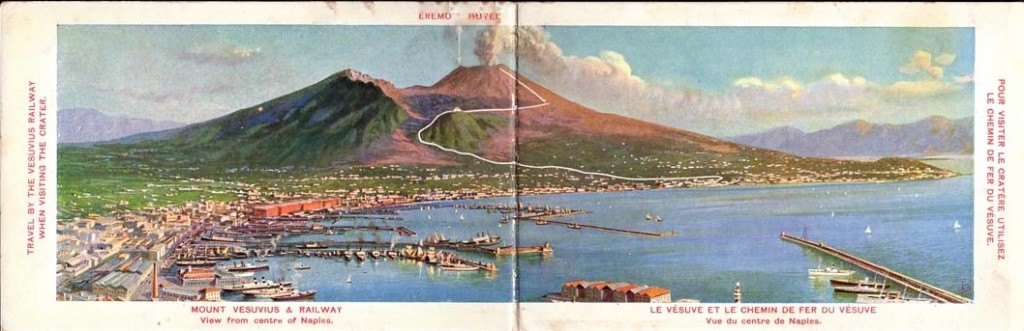
In the early 1870s, Italian painter Giuseppe de Nittis required “six hours on horseback” to accomplish the ascent, and had “to make the final climb to the crater on the shoulders” of his guides. But by then, Hungarian engineer Ernesto Emanuele Oblieght had already commissioned a trio of engineers to draft a plan for the construction of a funicular railway up the steepest slope of the volcano. However, the task took years to accomplish, and it was only on June 10, 1880, that the system was opened to the public. (That’s it you see in the photograph below by Giacomo Brogi.)

Image

Here I should explain that a funicular is a particular kind of cable-operated railway system designed to run on steep slopes. It consists of a pair of carriages connected to the opposite ends of a single cable and running on parallel tracks. This arrangement allows for one carriage to ascend as the other descends, significantly reducing the amount of force necessary to move them. In the case of some funiculars, there are two sets of tracks running beside each other, while in other, narrower designs, there is a single set that splits into two for a short distance at the midpoint, allowing the two carriages to pass each other. Boarding stations are built at each end of the rails. Maggie and I have ridden on several funiculars in Europe, and the experience is always a fascinating one.

Interestingly enough, my 1900 edition of Baedeker’s Southern Italy refers to the system on Vesuvius as a “Wire-Rope Railway,” and adds that the trip then took 12 minutes. “At the uppper station travellers are conducted by a tolearable footpath over ashes and slag to the summit of the crater, which presents an imposing picture.”

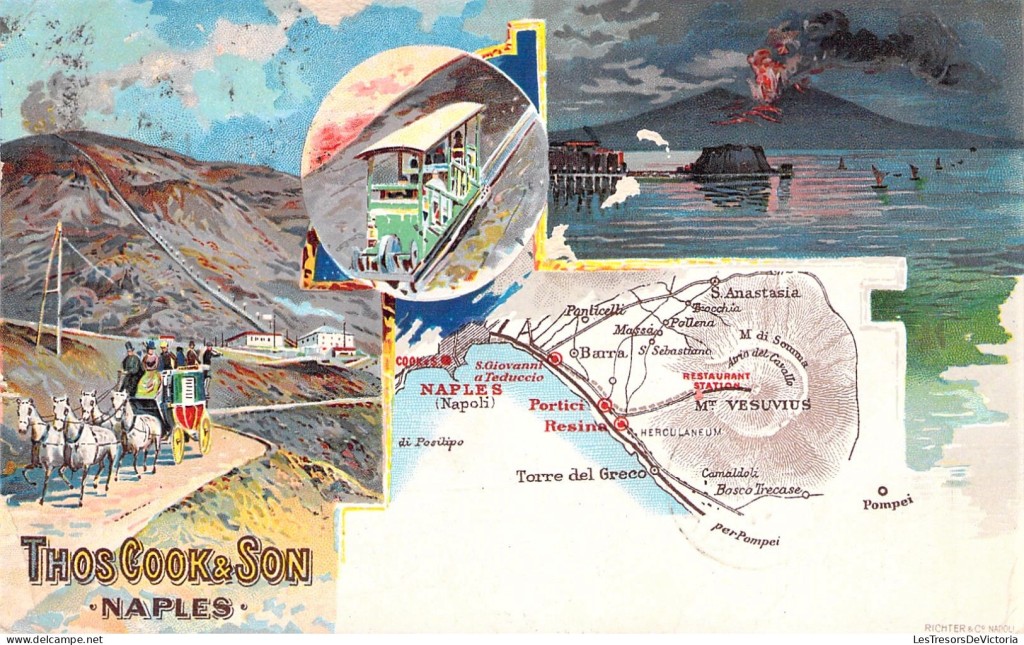
The funicular was sold in 1886 to the Société Anonyme du Chemin de Fer Funiculaire du Vèsuve, but, after a short time, the company went bankrupt and was purchased by the famous firm of Thomas Cook and Son (who were responsible for printing the lithograph at the top of today’s post). In time, the funicular was replaced (or perhaps supplemented) by a rack-and-pinion railway, in which a cog wheel beneath the carriage engaged a toothed rail between the tracks. However, volcanic eruptions in 1906, 1911, and 1929 damaged the system, and a severe 1944 eruption destroyed it completely.

Image

There’s quite a bit more to the saga, including the establishment of a hotel, visible as a tiny dot on the two-panel postcard above (reproduced courtesy of Stamp Community Family) halfway up the slope. But I’ll leave it to you to read as much as you care to by going to the generously illustrated sites PompeiiinPictures and Tramway Information. Or you can watch this YouTube video assembled by Ruairidh MacVeigh and based on the Thomas Cook Archive and Wikipedia.

Should you be contemplating a visit in the near future, you can now take a short train ride from Naples on the EAV (Ente Autonomo Volturno) Circumvesuviana to Ercolano, then follow it up on a shuttle bus. Nessun problemo. I also understand that, thanks to a system of well-maintained trails, hiking up the side of Vesuvius is easy now, and that you can even buy snacks and drinks along the way. But keep in mind that it is a volcano …

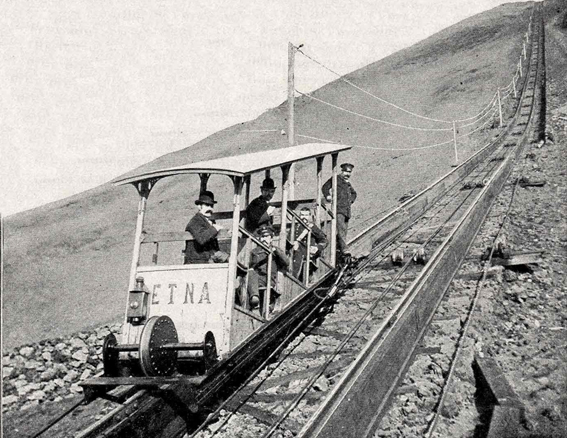
Two notes: The Vesuvius funicular is said to have inspired the 1880 song “Funiculì, Funiculà,” by Peppino Turco and Luigi Denza. And … the name “Etna” that you see on the carriage in the image below (reproduced courtesy of VolcanoCafé) may have been intended as a joke, as the volcano Etna is actually on the Italian island of Sicily, some 214 miles, or 345 kilometers, from Vesuvius.

Image

If you’d like to subscribe to World Enough, enter your email address below:

And if you’ve enjoyed today’s post, please share!
Donostia’s Magnificent Beach

Donostia 1

Grove Koger

Before visiting the Basque port of Donostia (or San Sebastián), I doubted the assertion that it possesses Europe’s most beautiful city beach. If you read much commercial travel writing, you run across such grandiose assertions all the time and tend to discount them reflexively. So I expected nothing more than a pleasant enough experience on our visit last year. But now, having walked the entire length (nearly a mile) of Playa de la Concha, or La Concha Beach, I have to agree.

Maggie and I had reached Donostia after an hour’s bus ride from Bilbao, our first stop in the Basque Country, and after checking in at our hotel at a reasonably early hour in the afternoon, decided to take advantage of the sunny weather by walking to Mount Igueldo. Fortunately, the obvious route lay along the elegant promenade that flanks the gentle arc of La Concha and the wider but less spectacular beach that adjoins it, Ondarreta.


Donostia 6

Besides commanding the western end of the Bay of La Concha, 600-foot Igueldo is the site of a funicular railway, and it was this ingenious system—as well as the views it would afford us—that was our destination. But our walk that bright afternoon, with a long series of elegant Belle Epoque structures (set back at a decent distance) on our left and the beach and the lazy waters of the bay on the other, was one of the most memorable we’ve ever been lucky enough to take. There could be no better place on earth at that moment, I felt.

Donostia 5

A funicular is an ingenious cable car system that runs two cars in opposite directions at the same time. In the case of the Igueldo funicular, the bright red cars run on the same track, passing each other on a short loop in the middle. It’s an arrangement ideally suited for steep hillsides such as Igueldo’s where there’s a potential for quite a bit of foot traffic. 

Donostia 2

We’ve enjoyed other funiculars at the monastery of Montserrat near Barcelona and in the Croatian capital of Zagreb, and they’re always a treat. But the real payoff generally comes at the top of the track, as our two panoramic photographs of La Concha Bay and Beach (top and bottom) illustrate. The second photo shows the funicular station at the base of Mount Igueldo, while the third shows the mountain itself, as seen from the little island of Santa Clara (visible in the bottom photo).